AI Observability for Large Language Model Systems: A Multi-Layer Analysis of Monitoring Approaches from Confidence Calibration to Infrastructure Tracing
Pith reviewed 2026-05-07 15:36 UTC · model grok-4.3
The pith
Connecting model confidence signals to infrastructure anomalies remains the central unsolved challenge in LLM observability.
A machine-rendered reading of the paper's core claim, the machinery that carries it, and where it could break.
Core claim
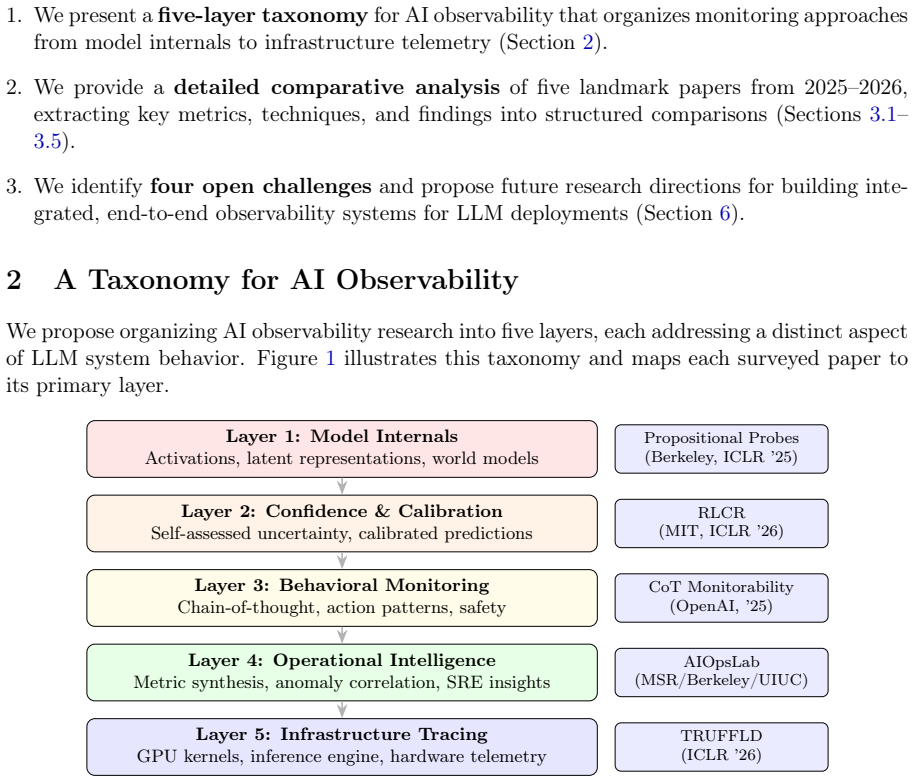
We organize these contributions into a five-layer observability taxonomy, synthesize their key findings into a unified comparison, and identify four critical gaps that remain unaddressed. Our analysis reveals that while individual monitoring layers have matured rapidly, the integration challenge—connecting model-level confidence signals with infrastructure-level anomalies into coherent operational intelligence—remains the defining open problem for the field.
What carries the argument
A five-layer observability taxonomy that spans model internals to GPU kernels and infrastructure telemetry.
If this is right
- Techniques at each layer can continue to advance independently in the near term.
- Operational observability platforms must translate combined telemetry into insights for site reliability teams.
- Four specific gaps must be closed before full-stack monitoring becomes practical.
- Contextualizing research directions against real-world infrastructure systems reveals where academic work falls short of deployment needs.
Where Pith is reading between the lines
- Future tooling may need new interfaces that map low-level kernel traces directly to high-level model uncertainty measures.
- Traditional software observability practices could supply patterns for bridging the model-infrastructure divide once adapted to probabilistic outputs.
- Empirical tests could measure whether integrated dashboards reduce mean time to recovery compared with current siloed monitors.
Load-bearing premise
The five selected 2025-2026 contributions collectively define the emerging landscape of AI observability without major omissions.
What would settle it
A documented production LLM system that successfully joins model confidence outputs with infrastructure anomaly data into a single actionable view, or a 2025-2026 paper on observability that covers a major approach absent from the five reviewed works.
Figures

read the original abstract
The deployment of large language models (LLMs) in production environments has created an urgent need for observability systems that span the full stack -- from model internals to GPU kernels. Yet existing monitoring approaches address isolated layers of this stack, and no comprehensive analysis has examined how these techniques relate, overlap, or complement each other. This paper presents a structured analysis of five recent research contributions (2025-2026) that collectively define the emerging landscape of AI observability: confidence calibration via reinforcement learning (MIT), internal state monitoring through propositional probes (UC Berkeley), chain-of-thought monitorability evaluation (OpenAI), autonomous cloud operations benchmarking (Microsoft Research, UC Berkeley, UIUC), and non-intrusive inference-level tracing (TRUFFLD). We organize these contributions into a five-layer observability taxonomy, synthesize their key findings into a unified comparison, and identify four critical gaps that remain unaddressed. We further contextualize these research directions against practical operational observability systems that translate infrastructure telemetry into actionable insights for site reliability teams. Our analysis reveals that while individual monitoring layers have matured rapidly, the integration challenge -- connecting model-level confidence signals with infrastructure-level anomalies into coherent operational intelligence -- remains the defining open problem for the field.
Editorial analysis
A structured set of objections, weighed in public.
Referee Report
Summary. The paper claims to offer the first structured analysis of five key 2025-2026 contributions on AI observability for LLMs. It proposes a five-layer taxonomy covering model internals to infrastructure, synthesizes findings from MIT's RL-based calibration, Berkeley's probes, OpenAI's CoT evaluation, MSR/UC Berkeley/UIUC's cloud ops, and TRUFFLD's tracing. Four gaps are identified, with the primary conclusion being that integrating model confidence signals with infrastructure anomalies into operational intelligence is the field's defining open problem.
Significance. Should the analysis prove balanced, this work would significantly aid the field by consolidating disparate research threads in LLM system monitoring. It emphasizes the need for holistic observability solutions, which is timely as LLMs move to production. The taxonomy and gap analysis provide a roadmap, though its impact hinges on the representativeness of the selected papers.
major comments (1)
- [Introduction / Paper Selection] No explicit inclusion criteria, search protocol, or coverage argument is provided for selecting the five contributions (MIT calibration, UC Berkeley probes, OpenAI CoT, MSR/UC Berkeley/UIUC cloud ops, TRUFFLD tracing). This selection is load-bearing for the central claim that these works collectively define the landscape and that the integration challenge remains the defining open problem; without it, omitted efforts on cross-layer fusion could narrow or partially close the asserted gap.
minor comments (2)
- [Abstract] The four critical gaps are referenced but not enumerated in the abstract; a brief listing would improve reader orientation.
- [Taxonomy section] The five-layer taxonomy would benefit from a summary table or diagram explicitly mapping layers to the five papers and their techniques.
Simulated Author's Rebuttal
We thank the referee for their constructive feedback on our manuscript. We address the major comment below and will revise the paper to incorporate an explicit discussion of selection criteria, thereby strengthening the foundation for our claims.
read point-by-point responses
-
Referee: [Introduction / Paper Selection] No explicit inclusion criteria, search protocol, or coverage argument is provided for selecting the five contributions (MIT calibration, UC Berkeley probes, OpenAI CoT, MSR/UC Berkeley/UIUC cloud ops, TRUFFLD tracing). This selection is load-bearing for the central claim that these works collectively define the landscape and that the integration challenge remains the defining open problem; without it, omitted efforts on cross-layer fusion could narrow or partially close the asserted gap.
Authors: We agree that the manuscript would benefit from greater transparency on how the five contributions were chosen. These papers were selected as they each exemplify a distinct layer within the proposed five-layer taxonomy and constitute the most prominent 2025-2026 works addressing model internals through infrastructure monitoring. In the revised version, we will add a new subsection in the Introduction titled 'Rationale for Contribution Selection' that (1) states the criteria (recent publication date, coverage of separate layers in the taxonomy, and representation of leading research groups), (2) describes the targeted literature review process used to identify them, and (3) acknowledges scope limitations by noting that while preliminary cross-layer fusion efforts exist, none of the surveyed works fully integrate model confidence signals with infrastructure anomalies. This addition will support rather than weaken our conclusion that the integration challenge remains the central open problem. revision: yes
Circularity Check
No significant circularity in literature synthesis
full rationale
This paper is a structured literature review and synthesis of five external 2025-2026 contributions (MIT, UC Berkeley, OpenAI, Microsoft Research/UC Berkeley/UIUC, TRUFFLD) with no equations, derivations, fitted parameters, or mathematical claims. The five-layer taxonomy and identified gaps are presented as an organizational framework derived from the cited works rather than self-defined or reduced by construction. No self-citations appear, and the central claim about the integration challenge as the defining open problem rests on the reviewed external papers without circular reduction to the present manuscript's inputs.
Axiom & Free-Parameter Ledger
axioms (1)
- domain assumption The five named research contributions (confidence calibration via RL, propositional probes, chain-of-thought monitorability, autonomous cloud benchmarking, non-intrusive tracing) collectively define the current landscape of AI observability.
invented entities (1)
-
Five-layer observability taxonomy
no independent evidence
Reference graph
Works this paper leans on
-
[1]
AIOpsLab : A holistic framework to evaluate AI agents for enabling autonomous clouds
Yinfang Chen, Huaibing Peng, Chetan Maddila, Chandra Bansal, Saravan Rajmohan, Qingwei Zhang, Dongmei Lin, et al. AIOpsLab : A holistic framework to evaluate AI agents for enabling autonomous clouds. In Proceedings of Machine Learning and Systems (MLSys), 2025
work page 2025
-
[2]
Mehul Damani, Isha Puri, Stewart Slocum, Idan Shenfeld, Leshem Choshen, Yoon Kim, and Jacob Andreas. Beyond binary rewards: Training LMs to reason about their uncertainty. arXiv preprint arXiv:2507.16806, 2025. Presented at ICLR 2026
work page internal anchor Pith review arXiv 2025
-
[3]
Monitoring latent world states in language models with propositional probes
Jiahai Feng, Stuart Russell, and Jacob Steinhardt. Monitoring latent world states in language models with propositional probes. In Proceedings of the International Conference on Learning Representations (ICLR), 2025. Spotlight paper
work page 2025
-
[4]
Guan, Miles Wang, Micah Carroll, Zehao Dou, Annie Y
Melody Y. Guan, Miles Wang, Micah Carroll, Zehao Dou, Annie Y. Wei, Marcus Williams, Benjamin Arnav, Joost Huizinga, Ian Kivlichan, Mia Glaese, Jakub Pachocki, and Bowen Baker. Monitoring monitorability. Technical report, OpenAI, 2025
work page 2025
-
[5]
LLM observability: A complete guide to monitoring production deployments
Inference.net . LLM observability: A complete guide to monitoring production deployments. https://inference.net/content/llm-observability-monitoring-production-deployments/, 2026
work page 2026
-
[6]
Twinkll Sisodia. From natural language to PromQL : A catalog-driven framework with dynamic temporal resolution for cloud-native observability. arXiv preprint arXiv:2604.13048, 2026
work page internal anchor Pith review Pith/arXiv arXiv 2026
-
[7]
Ruilin Xu, Junyi Li, Zongxuan Xie, and Pengfei Chen. TRUFFLD : Bridging non-intrusive tracing and fine-grained cross-layer representations for LLM inference diagnosis. Submitted to ICLR 2026, 2026
work page 2026
discussion (0)
Sign in with ORCID, Apple, or X to comment. Anyone can read and Pith papers without signing in.