Recognition: unknown
Finite Functional Programming
Pith reviewed 2026-05-07 13:37 UTC · model grok-4.3
The pith
Treating predicates as functions with finite support unifies functional and logic programming.
A machine-rendered reading of the paper's core claim, the machinery that carries it, and where it could break.
Core claim
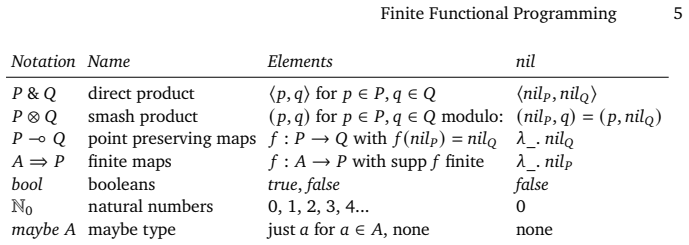
By equipping every function with its support—the finite set of inputs on which its output is nonzero—predicates become representable as input-output tables. Datalog is recovered exactly as the language of finitely supported boolean functions. Extending the codomain from booleans to arbitrary pointed sets uniformly accounts for aggregation and weighted logic programming. The resulting combination, called finite functional programming, interleaves finitely supported functions as data with ordinary higher-order functions as code, all checked by a type system that uses graded effects to enforce variable grounding and relevance types to model pointed sets.
What carries the argument
Finitely supported functions, where support is the finite set of inputs yielding nonzero output, allowing table representation, combined with higher-order code under a graded-effect type system.
If this is right
- Datalog programs become ordinary expressions built from boolean functions whose support is finite and statically checkable.
- Aggregation and weighted rules are obtained simply by changing the codomain to a pointed set while retaining the same table representation.
- Variable grounding and relevance are enforced uniformly by graded effects and relevance types rather than by separate logic-programming machinery.
- Functions can be freely mixed with higher-order code because finite support is a property of the data representation, not a separate language construct.
Where Pith is reading between the lines
- Compilers could translate logic queries directly into table-lookup operations, potentially improving performance for finite domains.
- The approach suggests that hybrid languages could avoid duplicating syntax for declarative and procedural styles.
- Similar finite-support restrictions might be applied to probabilistic or differentiable programming to keep representations tractable.
Load-bearing premise
Representing predicates as finitely supported functions (and generalizing their codomains to pointed sets) preserves the full semantics and expressiveness of logic programming without hidden limitations.
What would settle it
Existence of a standard logic-programming feature, such as stratified negation or certain forms of recursion, that cannot be expressed using any finitely supported function or enforced by the graded-effect and relevance-type system.
Figures


read the original abstract
We unify functional and logic programming by treating predicatesas functions equipped with their support: the set of inputs whose output is nonzero. Datalog, for instance, is a language of finitely supported boolean functions. Finite support allows representing functions as input-output tables. Generalizing from boolean functions to other pointed sets neatly handles aggregation and weighted logic programming. We refer to the combination of finitely supported functions, represented as data, with higher order functions, represented as code, as finite functional programming. We give a simple type system to check finite support, using graded effects to check variable grounding and relevance types to model pointed sets.
Editorial analysis
A structured set of objections, weighed in public.
Referee Report
Summary. The paper proposes unifying functional and logic programming by modeling predicates as functions equipped with finite support—the set of inputs yielding nonzero outputs. Datalog is presented as the special case of finitely supported boolean functions, which can be represented as input-output tables. The approach generalizes to other pointed sets to handle aggregation and weighted logic programming. The combination of finitely supported functions (as data) with higher-order functions (as code) is termed finite functional programming. A type system is sketched that uses graded effects to enforce variable grounding and relevance types to model pointed sets and the distinguished zero element.
Significance. If the type system can be shown to be sound and to recover the full expressiveness of logic programming without hidden restrictions, the work would provide a uniform functional foundation for hybrid paradigms. Representing predicates directly as tables via finite support, combined with graded effects and relevance, could simplify implementations of Datalog-style systems and weighted logics inside functional languages, while preserving higher-order programming.
major comments (2)
- [Abstract] Abstract: the unification and type system are asserted without any formal semantics, typing rules, derivations, or even small examples of how graded effects check grounding or how relevance types interact with higher-order functions; the central claim therefore cannot be verified from the provided text.
- [Abstract] Abstract: the weakest assumption—that finitely supported functions over pointed sets preserve the full semantics and expressiveness of logic programming without additional mechanisms—is stated but not demonstrated; no argument is given showing that the representation as input-output tables plus the proposed type system recovers standard Datalog operations or aggregation without loss.
minor comments (1)
- [Abstract] Abstract contains a typographical error: 'predicatesas' should be 'predicates as'.
Simulated Author's Rebuttal
We thank the referee for the constructive and detailed feedback. The comments highlight important gaps in the current presentation that we will address through revision. We respond to each major comment below.
read point-by-point responses
-
Referee: [Abstract] Abstract: the unification and type system are asserted without any formal semantics, typing rules, derivations, or even small examples of how graded effects check grounding or how relevance types interact with higher-order functions; the central claim therefore cannot be verified from the provided text.
Authors: We agree that the manuscript asserts the unification of functional and logic programming via finitely supported functions and sketches a type system using graded effects and relevance types, but does so without supplying formal semantics, complete typing rules, derivations, or concrete examples. This limits verifiability of the central claims from the text. In the revised manuscript we will add a formal semantics for finitely supported functions over pointed sets, explicit typing rules for the graded effects (to enforce grounding) and relevance types (to model the zero element), example type derivations, and small examples showing their interaction with higher-order functions. revision: yes
-
Referee: [Abstract] Abstract: the weakest assumption—that finitely supported functions over pointed sets preserve the full semantics and expressiveness of logic programming without additional mechanisms—is stated but not demonstrated; no argument is given showing that the representation as input-output tables plus the proposed type system recovers standard Datalog operations or aggregation without loss.
Authors: We accept this observation. The manuscript states that Datalog corresponds to finitely supported boolean functions representable as input-output tables and that generalization to other pointed sets handles aggregation and weighted logic programming, yet provides no explicit argument or demonstration that this representation plus the type system recovers the full expressiveness of standard Datalog operations and aggregation without loss or extra mechanisms. We will revise the paper to include a dedicated section containing an argument (with supporting examples) that the table representation together with the graded-effect and relevance-type discipline recovers standard Datalog operations such as joins and projections, as well as aggregation, without loss of expressiveness. revision: yes
Circularity Check
No significant circularity
full rationale
The paper's central move is a definitional unification: predicates are reinterpreted as functions equipped with their (finite) support, with Datalog as the boolean case and pointed-set generalization for aggregation. This is presented as a conceptual reframing rather than a derivation or prediction extracted from prior fitted results. The type system (graded effects for grounding, relevance types for pointed sets) is proposed to enforce the invariant, but no equations, parameters, or self-citations are shown to reduce the claimed unification back to its inputs by construction. The approach is self-contained as a modeling choice with no load-bearing self-referential steps.
Axiom & Free-Parameter Ledger
axioms (2)
- domain assumption Predicates can be treated as functions equipped with their support without loss of semantics.
- domain assumption Finitely supported functions can be represented as input-output tables.
invented entities (1)
-
Finite functional programming
no independent evidence
Reference graph
Works this paper leans on
-
[1]
Antoy,S.,Hanus,M.:Functionallogicprogramming.CommunicationsoftheACM53(4), 74–85 (Apr 2010)
2010
-
[2]
In: Companion of the 2025 International Conference on Management of Data
Aref, M., Guagliardo, P., Kastrinis, G., Libkin, L., Marsault, V., Martens, W., McGrath, M., Murlak, F., Nystrom, N., Peterfreund, L., Rogers, A., Sirangelo, C., Vrgoč, D., Zhao, D., Zreika, A.: Rel: A programming language for relational data. In: Companion of the 2025 International Conference on Management of Data. p. 283–296. SIGMOD/PODS ’25, Associatio...
-
[3]
In: Proceedings of the 21st ACM SIGPLAN International Conference on Functional Programming
Arntzenius, M., Krishnaswami, N.R.: Datafun: A functional Datalog. In: Proceedings of the 21st ACM SIGPLAN International Conference on Functional Programming. pp. 214–
-
[4]
https://doi.org/10.1145/2951913
ICFP 2016, ACM, New York, NY, USA (2016). https://doi.org/10.1145/2951913. 2951948
-
[5]
Augustsson, L., Breitner, J., Claessen, K., Jhala, R., Jones, S.P., Shivers, O., Jr., G.L.S., Sweeney, T.: The verse calculus: A core calculus for deterministic functional logic pro- gramming. Proc. ACM Program. Lang.7(ICFP), 417–447 (2023). https://doi.org/10. 1145/3607845
2023
-
[6]
In: Pacholski, L., Tiuryn, J
Benton, P.N.: A mixed linear and non-linear logic: Proofs, terms and models (extended abstract). In: Pacholski, L., Tiuryn, J. (eds.) Computer Science Logic, 8th International Workshop,CSL’94,Kazimierz,Poland,September25-30,1994,SelectedPapers.Lecture NotesinComputerScience,vol.933,pp.121–135.Springer(1994).https://doi.org/10. 1007/BFB0022251
1994
-
[7]
Benton, P.N., Wadler, P.: Linear logic, monads and the lambda calculus. In: Proceed- ings, 11th Annual IEEE Symposium on Logic in Computer Science, New Brunswick, New Jersey, USA, July 27-30, 1996. pp. 420–431. IEEE Computer Society (1996). https://doi.org/10.1109/LICS.1996.561458
-
[8]
Contrastin, M., Orchard, D.A., Rice, A.C.: Automatic reordering for dataflow safety of datalog. In: Sabel, D., Thiemann, P. (eds.) Proceedings of the 20th International Sym- posium on Principles and Practice of Declarative Programming, PPDP 2018, Frank- furt am Main, Germany, September 03-05, 2018. pp. 9:1–9:17. ACM (2018). https: //doi.org/10.1145/323695...
-
[9]
Escardó, M.H.: Infinite sets that admit fast exhaustive search. In: 22nd IEEE Symposium on Logic in Computer Science (LICS 2007), 10-12 July 2007, Wroclaw, Poland, Pro- ceedings. pp. 443–452. IEEE Computer Society (2007). https://doi.org/10.1109/LICS. 2007.25
-
[10]
Blog post (2007), https:// math.andrej.com/2007/09/28/seemingly-impossible-functional-programs/
Escardó, M.H.: Seemingly impossible functional programs. Blog post (2007), https:// math.andrej.com/2007/09/28/seemingly-impossible-functional-programs/
2007
-
[11]
Filardo, N.W.: Dyna 2: Towards a General Weighted Logic Language. Ph.D. thesis, Johns Hopkins University (10 2017), https://www.ietfng.org/nwf/publications-and-talks/ 2017-thesis.html Finite Functional Programming 17
2017
-
[12]
Francis-Landau, M.: Declarative Programming via Term Rewriting. Ph.D. thesis, Johns Hopkins University (1 2024), https://matthewfl.com/research#phd
2024
-
[13]
SIGPLAN Not.51(9), 476–489 (Sep 2016)
Gaboardi, M., Katsumata, S.y., Orchard, D., Breuvart, F., Uustalu, T.: Combining effects and coeffects via grading. SIGPLAN Not.51(9), 476–489 (Sep 2016). https://doi.org/ 10.1145/3022670.2951939
-
[14]
In: Proceedings of the 21st ACM SIGPLAN International Con- ference on Functional Programming
Gaboardi, M., Katsumata, S.y., Orchard, D., Breuvart, F., Uustalu, T.: Combining effects and coeffects via grading. In: Proceedings of the 21st ACM SIGPLAN International Con- ference on Functional Programming. p. 476–489. ICFP 2016, Association for Comput- ingMachinery,NewYork,NY,USA(2016).https://doi.org/10.1145/2951913.2951939, https://doi.org/10.1145/2...
-
[15]
Green,T.J.,Karvounarakis,G.,Tannen,V.:Provenancesemirings.In:Libkin,L.(ed.)Pro- ceedings of the Twenty-Sixth ACM SIGACT-SIGMOD-SIGART Symposium on Principles of Database Systems, June 11-13, 2007, Beijing, China. pp. 31–40. ACM (2007). https: //doi.org/10.1145/1265530.1265535, https://doi.org/10.1145/1265530.1265535
-
[16]
Henglein,F.,Kaarsgaard,R.,Mathiesen,M.K.:Theprogrammingofalgebra.In:Gibbons, J., New, M.S. (eds.) Proceedings Ninth Workshop on Mathematically Structured Func- tional Programming, MSFP@ETAPS 2022, Munich, Germany, 2nd April 2022. EPTCS, vol. 360, pp. 71–92 (2022). https://doi.org/10.4204/EPTCS.360.4
-
[17]
In: Proceed- ings of the 41st ACM SIGPLAN-SIGACT Symposium on Principles of Programming Lan- guages
Katsumata, S.y.: Parametric effect monads and semantics of effect systems. In: Proceed- ings of the 41st ACM SIGPLAN-SIGACT Symposium on Principles of Programming Lan- guages. p. 633–645. POPL ’14, Association for Computing Machinery, New York, NY, USA (2014). https://doi.org/10.1145/2535838.2535846
-
[18]
Khamis, M.A., Ngo, H.Q., Pichler, R., Suciu, D., Wang, Y.R.: Convergence of datalog over (pre-) semirings. J. ACM71(2), 8:1–8:55 (2024). https://doi.org/10.1145/3643027
-
[19]
Publications de l’Institut Mathematique96, 17–23 (2007)
Kosta, D., Petrić, Z.: Relevant categories and partial functions. Publications de l’Institut Mathematique96, 17–23 (2007). https://doi.org/10.2298/PIM0796017D
-
[20]
Kovach, S., Kolichala, P., Gu, T., Kjolstad, F.: Indexed streams: A formal intermediate representation for fused contraction programs. Proc. ACM Program. Lang.7(PLDI) (Jun 2023). https://doi.org/10.1145/3591268
-
[21]
Madsen, M., Lhoták, O.: Fixpoints for the masses: programming with first-class data- log constraints. Proc. ACM Program. Lang.4(OOPSLA) (Nov 2020). https://doi.org/10. 1145/3428193
2020
-
[22]
O’Hearn, P.W., Pym, D.J.: The logic of bunched implications. Bull. Symb. Log.5(2), 215– 244 (1999). https://doi.org/10.2307/421090
-
[23]
Pacak, A., Erdweg, S.: Functional programming with Datalog. In: Ali, K., Vitek, J. (eds.) 36th European Conference on Object-Oriented Programming, ECOOP 2022, Berlin, Ger- many, June 6-10, 2022. LIPIcs, vol. 222, pp. 7:1–7:28. Schloss Dagstuhl - Leibniz- Zentrum für Informatik (2022). https://doi.org/10.4230/LIPICS.ECOOP.2022.7
-
[24]
Stud Logica70(2), 271–296 (2002)
Petrić, Z.: Coherence in substructural categories. Stud Logica70(2), 271–296 (2002). https://doi.org/10.1023/A:1015186718090
-
[25]
In: Jeuring, J., Chakravarty, M.M.T
Petricek, T., Orchard, D.A., Mycroft, A.: Coeffects: a calculus of context-dependent computation. In: Jeuring, J., Chakravarty, M.M.T. (eds.) Proceedings of the 19th ACM SIGPLAN international conference on Functional programming, Gothenburg, Sweden, September 1-3, 2014. pp. 123–135. ACM (2014). https://doi.org/10.1145/2628136. 2628160
-
[26]
Raedt, L.D., Kimmig, A., Toivonen, H.: Problog: A probabilistic prolog and its application inlinkdiscovery.In:Veloso,M.M.(ed.)IJCAI2007,Proceedingsofthe20thInternational Joint Conference on Artificial Intelligence, Hyderabad, India, January 6-12, 2007. pp. 2462–2467 (2007), http://ijcai.org/Proceedings/07/Papers/396.pdf 18 Arntzenius and Willsey
2007
-
[27]
Lang.9(PLDI), 1220–1244 (2025)
Rioux,N.,Zdancewic,S.:Functionalmeaningforparallelstreaming.Proc.ACMProgram. Lang.9(PLDI), 1220–1244 (2025). https://doi.org/10.1145/3729299
-
[28]
Shaikhha, A., Huot, M., Smith, J., Olteanu, D.: Functional collection programming with semi-ring dictionaries. Proc. ACM Program. Lang.6(OOPSLA1), 1–33 (2022). https: //doi.org/10.1145/3527333
-
[29]
Journal of Mathematical Sci- ences151, 3032–3051 (6 2008)
Smirnov, A.L.: Graded monads and rings of polynomials. Journal of Mathematical Sci- ences151, 3032–3051 (6 2008). https://doi.org/10.1007/s10958-008-9013-7, trans- lated from Zapiski Nauchnykh Seminarov POMI, Vol. 349, 2007, pp. 174–210
-
[30]
Somogyi, Z., Henderson, F., Conway, T.C.: The execution algorithm of mercury, an effi- cient purely declarative logic programming language. J. Log. Program.29(1-3), 17–64 (1996). https://doi.org/10.1016/S0743-1066(96)00068-4
discussion (0)
Sign in with ORCID, Apple, or X to comment. Anyone can read and Pith papers without signing in.