Recognition: unknown
The β-Dependence of Particle Spectra in Relativistic Turbulent Reconnection
Pith reviewed 2026-05-07 13:24 UTC · model grok-4.3
The pith
Higher plasma beta produces steeper non-thermal particle spectra in relativistic turbulent reconnection, with the exponent scaling as beta to the power one-half.
A machine-rendered reading of the paper's core claim, the machinery that carries it, and where it could break.
Core claim
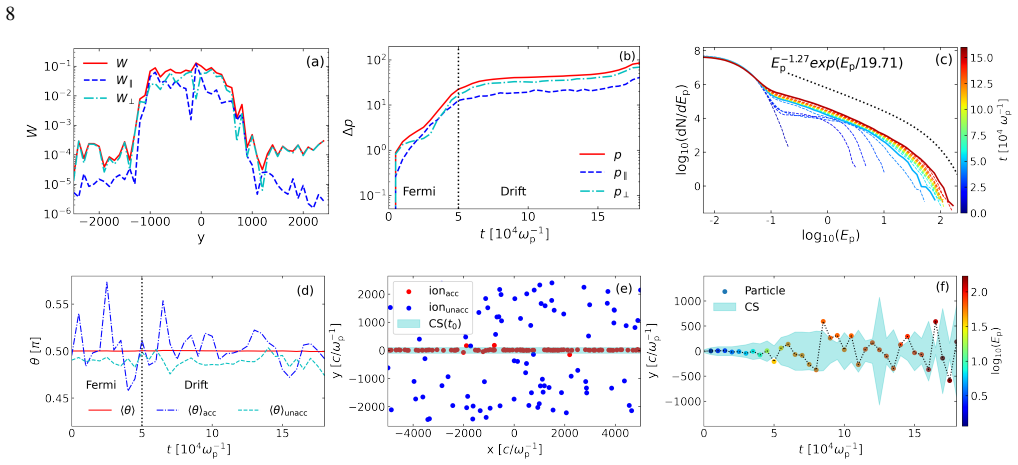
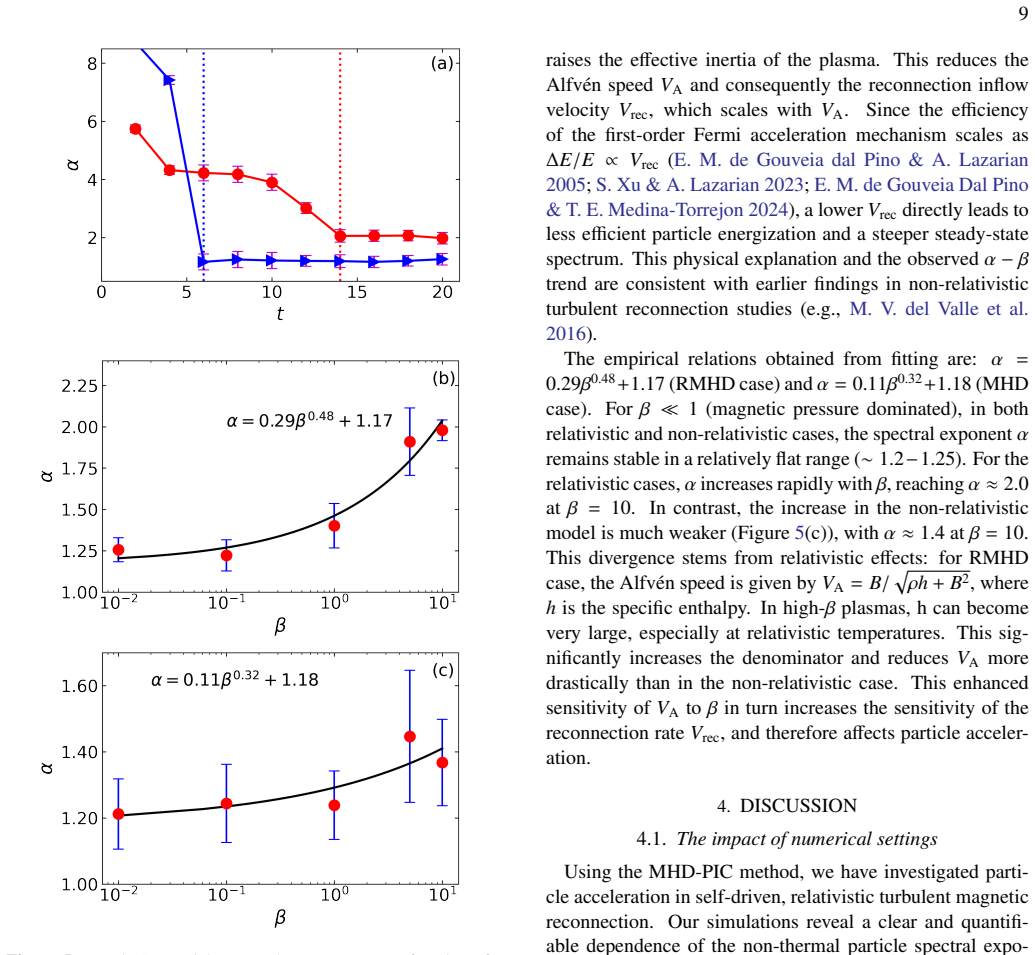
Simulations of relativistic self-driven turbulent magnetic reconnection show particle acceleration in two stages: an initial efficient first-order Fermi phase where momentum gains occur in parallel and perpendicular directions, followed by a slower drift-dominated phase. The power-law slope of the non-thermal spectrum is set during the Fermi phase. The spectrum steepens systematically with increasing plasma beta, yielding the empirical scaling alpha proportional to beta to the 0.5 in the relativistic regime versus beta to the 0.3 in the non-relativistic case. This difference stems from relativistic physics in which the increased inertial mass density acts as an energy sink, lowering the Alfv
What carries the argument
Inertial mass density acting as an energy sink that reduces Alfvén velocity and alters magnetic energy release and partition in high-beta plasmas.
If this is right
- The scaling supplies a unified physical framework for interpreting the diversity of non-thermal radiation spectra from black hole corona X-ray flares, gamma-ray bursts, and active galactic nucleus jets.
- The initial Fermi phase establishes the power-law slope across a range of beta values.
- Varying plasma beta can account for observed differences in particle spectra among astrophysical sources.
Where Pith is reading between the lines
- Spectral index measurements from specific astrophysical events could be used to infer local plasma beta values.
- The same inertial-mass mechanism might influence particle spectra in other relativistic reconnection or turbulence settings.
- Testing the scaling at extreme beta values beyond the simulated range would check whether the 0.5 exponent persists.
Load-bearing premise
The increase in inertial mass density with beta is the dominant cause of the observed spectral steepening and is captured without significant numerical artifacts in the MHD-PIC runs.
What would settle it
A higher-resolution or differently formulated MHD-PIC simulation that finds the spectral exponent independent of beta or no longer scaling as beta to the 0.5 would falsify the central claim.
Figures



read the original abstract
We perform numerical simulations of particle acceleration in relativistic, self-driven turbulent magnetic reconnection using the MHD-PIC method. We systematically investigate the dependence of the non-thermal particle spectral exponent on the plasma $\beta$. We find that particle acceleration proceeds in two stages: an initial, efficient first-order Fermi phase where momentum gains are comparable in parallel and perpendicular directions, followed by a slower drift-dominated phase. The power-law slope of the non-thermal spectrum is established during the Fermi phase, as found in previous studies. Our results demonstrate a systematic steepening of the accelerated particle energy spectrum with increasing $\beta$. We derive empirical scaling relations: the spectral exponent $\alpha \propto \beta^{0.5}$ in the relativistic regime, compared to $\alpha \propto \beta^{0.3}$ in the non-relativistic case. This marked difference is rooted in relativistic physics: the increased inertial mass density ($\rho h$) in high-$\beta$ plasmas acts as an energy sink, reducing the Alfv\'en velocity and thereby altering the dynamics of magnetic energy release and its partition efficiency. The derived scaling provides a unified physical framework for interpreting the diversity of non-thermal radiation spectra observed in astrophysical sources, including black hole corona X-ray flares, gamma-ray bursts, and active galactic nucleus jets.
Editorial analysis
A structured set of objections, weighed in public.
Referee Report
Summary. The manuscript presents MHD-PIC simulations of self-driven turbulent magnetic reconnection in relativistic plasmas. It reports that non-thermal particle acceleration occurs in two stages—an initial efficient first-order Fermi phase establishing the power-law slope, followed by a slower drift-dominated phase—and finds a systematic steepening of the spectral exponent α with increasing plasma β. Empirical scalings are extracted: α ∝ β^{0.5} in the relativistic regime versus α ∝ β^{0.3} in the non-relativistic case. The difference is attributed to the relativistic increase in inertial mass density ρh acting as an energy sink that lowers the Alfvén velocity and modifies magnetic energy release and partition.
Significance. If the reported β-dependence survives numerical scrutiny, the work supplies a concrete empirical framework for interpreting the range of non-thermal spectra observed in black-hole corona flares, GRBs, and AGN jets. The two-stage acceleration picture and the relativistic versus non-relativistic contrast in scaling are useful additions to the reconnection-acceleration literature. The systematic parameter scan across β is a clear strength of the simulation campaign.
major comments (2)
- [Numerical methods] Numerical methods / simulation setup: No resolution or particle-number convergence tests are shown at multiple β values. Because v_A ∝ 1/√(ρh) decreases with rising β, the eddy turnover time lengthens and the same physical cascade requires proportionally finer grids or longer integration times to reach an equivalent inertial range; without such tests the steeper spectra at high β could partly reflect increased numerical diffusion rather than the intended ρh effect.
- [Results and discussion] Results / scaling derivation: The claim that ρh is the dominant energy sink responsible for the change in spectral index is interpretive. The manuscript would be strengthened by an explicit energy-budget analysis (e.g., time evolution of magnetic, kinetic, and thermal energies versus β) that quantifies how the partition efficiency changes and directly links it to the measured α(β) trend.
minor comments (2)
- [Figures] Figure captions and axis labels should explicitly state the time interval over which the spectra are averaged and the fitting range used to extract α.
- [Abstract] The abstract states that the scaling is 'derived'; the text should clarify that these are empirical fits to simulation data rather than analytic derivations from the governing equations.
Simulated Author's Rebuttal
We thank the referee for the constructive feedback and positive evaluation of our manuscript. We address the major comments below and will make the necessary revisions to strengthen the paper.
read point-by-point responses
-
Referee: Numerical methods / simulation setup: No resolution or particle-number convergence tests are shown at multiple β values. Because v_A ∝ 1/√(ρh) decreases with rising β, the eddy turnover time lengthens and the same physical cascade requires proportionally finer grids or longer integration times to reach an equivalent inertial range; without such tests the steeper spectra at high β could partly reflect increased numerical diffusion rather than the intended ρh effect.
Authors: We acknowledge that convergence tests are essential to validate the results, particularly given the β-dependence of the Alfvén velocity. While our simulations were performed with sufficient resolution based on prior experience, we did not explicitly demonstrate convergence across β in the original manuscript. In the revised version, we will include additional resolution and particle-number convergence tests at both low and high β values. These tests will show that the spectral indices remain stable and that the reported β-dependence is not an artifact of numerical diffusion. revision: yes
-
Referee: Results / scaling derivation: The claim that ρh is the dominant energy sink responsible for the change in spectral index is interpretive. The manuscript would be strengthened by an explicit energy-budget analysis (e.g., time evolution of magnetic, kinetic, and thermal energies versus β) that quantifies how the partition efficiency changes and directly links it to the measured α(β) trend.
Authors: We agree that an explicit energy-budget analysis would provide stronger support for our interpretation. The manuscript currently offers a physical argument based on the relativistic increase in inertial mass density ρh, but we will enhance this by adding a dedicated section or figure showing the time evolution of the magnetic, kinetic, and thermal energy components for different β values. This will quantify the changes in energy partition and directly connect them to the observed steepening of α with β. revision: yes
Circularity Check
No circularity: empirical scaling fitted directly from MHD-PIC simulation outputs
full rationale
The paper's central result is an empirical scaling α ∝ β^{0.5} (relativistic) extracted by measuring non-thermal spectra across a suite of MHD-PIC runs in which β is varied while other parameters are held fixed. This is a direct post-processing fit to simulation data, not a first-principles derivation that reduces by the paper's own equations to a previously fitted parameter or to a self-citation chain. The interpretive remark that increased ρh acts as an energy sink is offered after the fact and does not close any definitional loop. No load-bearing self-citations, uniqueness theorems, or ansatzes are invoked to justify the scaling itself. The derivation chain is therefore self-contained against external benchmarks (the simulations) and receives score 0.
Axiom & Free-Parameter Ledger
free parameters (2)
- relativistic spectral exponent =
0.5
- non-relativistic spectral exponent =
0.3
axioms (1)
- domain assumption The MHD-PIC method accurately models particle acceleration and energy partition in turbulent reconnection without dominant numerical artifacts.
Reference graph
Works this paper leans on
-
[1]
Bai, X.-N., Caprioli, D., Sironi, L., & Spitkovsky, A. 2015, ApJ, 809, 55, doi: 10.1088/0004-637X/809/1/55
-
[2]
2018, ApJ, 862, 80, doi: 10.3847/1538-4357/aac820
Ball, D., Sironi, L., & ¨Ozel, F. 2018, ApJ, 862, 80, doi: 10.3847/1538-4357/aac820
-
[3]
2017, ApJ, 834, 47, doi: 10.3847/1538-4357/834/1/47
Beresnyak, A. 2017, ApJ, 834, 47, doi: 10.3847/1538-4357/834/1/47
-
[4]
P., & Shanny, R
Boris, J. P., & Shanny, R. A. 1970, in Proceedings of the Conference on the Numerical Simulation of Plasmas (4th) Held at the Naval Research Laboratory, Washington, D.C. on 2, 3 November 1970
1970
-
[5]
, year = 2021, month = jun, volume =
Cao, Z., Aharonian, F. A., An, Q., et al. 2021, Nature, 594, 33, doi: 10.1038/s41586-021-03498-z
-
[6]
Cerutti, B., Werner, G. R., Uzdensky, D. A., & Begelman, M. C. 2014, ApJ, 782, 104, doi: 10.1088/0004-637X/782/2/104
-
[7]
M., Petropoulou, M., Sironi, L., & Giannios, D
Christie, I. M., Petropoulou, M., Sironi, L., & Giannios, D. 2019, MNRAS, 482, 65, doi: 10.1093/mnras/sty2636 de Gouveia dal Pino, E. M., & Lazarian, A. 2005, A&A, 441, 845, doi: 10.1051/0004-6361:20042590 de Gouveia Dal Pino, E. M., & Medina-Torrejon, T. E. 2024, arXiv e-prints, arXiv:2410.13071, doi: 10.48550/arXiv.2410.13071 de Gouveia Dal Pino, E. M.,...
-
[8]
F., Opher, M., Swisdak, M., & Chamoun, J
Drake, J. F., Opher, M., Swisdak, M., & Chamoun, J. N. 2010, ApJ, 709, 963, doi: 10.1088/0004-637X/709/2/963
-
[9]
2013, Nature, 497, 466, doi: 10.1038/nature12128 13
Eyink, G., Vishniac, E., Lalescu, C., et al. 2013, Nature, 497, 466, doi: 10.1038/nature12128 13
-
[10]
L., Lazarian, A., & Vishniac, E
Eyink, G. L., Lazarian, A., & Vishniac, E. T. 2011, ApJ, 743, 51, doi: 10.1088/0004-637X/743/1/51
-
[11]
C., Lohfink, A., Kara, E., et al
Fabian, A. C., Lohfink, A., Kara, E., et al. 2015, MNRAS, 451, 4375, doi: 10.1093/mnras/stv1218
-
[12]
2014, Physical Review Letters, 113, doi: 10.1103/physrevlett.113.155005
Guo, F., Li, H., Daughton, W., & Liu, Y .-H. 2014, PhRvL, 113, 155005, doi: 10.1103/PhysRevLett.113.155005
-
[13]
2021, ApJ, 919, 111, doi: 10.3847/1538-4357/ac0918
Guo, F., Li, X., Daughton, W., et al. 2021, ApJ, 919, 111, doi: 10.3847/1538-4357/ac0918
-
[14]
Guo, F., Liu, Y .-H., Daughton, W., & Li, H. 2015, ApJ, 806, 167, doi: 10.1088/0004-637X/806/2/167
-
[15]
Harris, E. G. 1962, Il Nuovo Cimento, 23, 115, doi: 10.1007/BF02733547
-
[16]
Kadowaki, L. H. S., de Gouveia Dal Pino, E. M., Medina-Torrej´on, T. E., Mizuno, Y ., & Kushwaha, P. 2021, ApJ, 912, 109, doi: 10.3847/1538-4357/abee7a
-
[17]
Kadowaki, L. H. S., de Gouveia Dal Pino, E. M., & Singh, C. B. 2015, ApJ, 802, 113, doi: 10.1088/0004-637X/802/2/113
-
[18]
Kadowaki, L. H. S., De Gouveia Dal Pino, E. M., & Stone, J. M. 2018, ApJ, 864, 52, doi: 10.3847/1538-4357/aad4ff
-
[19]
Kowal, G., de Gouveia Dal Pino, E. M., & Lazarian, A. 2011, ApJ, 735, 102, doi: 10.1088/0004-637X/735/2/102
-
[20]
Kowal, G., de Gouveia Dal Pino, E. M., & Lazarian, A. 2012, PhRvL, 108, 241102, doi: 10.1103/PhysRevLett.108.241102
-
[21]
A., Lazarian, A., & Vishniac, E
Kowal, G., Falceta-Gonc ¸alves, D. A., Lazarian, A., & Vishniac, E. T. 2020, ApJ, 892, 50, doi: 10.3847/1538-4357/ab7a13
-
[22]
Kowal, G., Lazarian, A., Vishniac, E. T., & Otmianowska-Mazur, K. 2009, ApJ, 700, 63, doi: 10.1088/0004-637X/700/1/63
-
[23]
The Physics of Gamma-Ray Bursts and Relativistic Jets
Kumar, P., & Zhang, B. 2015, PhR, 561, 1, doi: 10.1016/j.physrep.2014.09.008
work page Pith review doi:10.1016/j.physrep.2014.09.008 2015
-
[24]
2015, ApJ, 806, 131, doi: 10.1088/0004-637X/806/1/131
Landi, S., Zanna, L. D., Papini, E., Pucci, F., & Velli, M. 2015, The Astrophysical Journal, 806, 131, doi: 10.1088/0004-637X/806/1/131
-
[25]
Lazarian, A., Eyink, G. L., Jafari, A., et al. 2020, Physics of Plasmas, 27, 012305, doi: 10.1063/1.5110603
-
[26]
Lazarian, A., & Vishniac, E. T. 1999, ApJ, 517, 700, doi: 10.1086/307233
-
[27]
2025, arXiv e-prints, arXiv:2512.24054, doi: 10.48550/arXiv.2512.24054
Liang, S., & Yi, N. 2025, arXiv e-prints, arXiv:2512.24054, doi: 10.48550/arXiv.2512.24054
-
[28]
2023, ApJ, 952, 93, doi: 10.3847/1538-4357/acdc18
Liang, S.-M., Zhang, J.-F., Gao, N.-N., & Xiao, H.-P. 2023, ApJ, 952, 93, doi: 10.3847/1538-4357/acdc18
-
[29]
2025, A&A, 703, A226, doi: 10.1051/0004-6361/202553812
Liang, S.-M., Zhang, J.-F., Gao, N.-N., & Yi, N.-Y . 2025, A&A, 703, A226, doi: 10.1051/0004-6361/202553812
-
[30]
Liu, W. J., Chen, P. F., Ding, M. D., & Fang, C. 2009, ApJ, 690, 1633, doi: 10.1088/0004-637X/690/2/1633 Medina-Torrej´on, T. E., de Gouveia Dal Pino, E. M., Kadowaki, L. H. S., et al. 2021, ApJ, 908, 193, doi: 10.3847/1538-4357/abd6c2 Medina-Torrej´on, T. E., de Gouveia Dal Pino, E. M., & Kowal, G. 2023, ApJ, 952, 168, doi: 10.3847/1538-4357/acd699
-
[31]
2007, The Astrophysical Journal Supplement Series, 170, 228–242, doi: 10.1086/513316
Mignone, A., Bodo, G., Massaglia, S., et al. 2007, ApJS, 170, 228, doi: 10.1086/513316
-
[32]
2018, ApJ, 859, 13, doi: 10.3847/1538-4357/aabccd
Mignone, A., Bodo, G., Vaidya, B., & Mattia, G. 2018, ApJ, 859, 13, doi: 10.3847/1538-4357/aabccd
-
[33]
2020, in Journal of Physics Conference Series, V ol
Mignone, A., Vaidya, B., Puzzoni, E., et al. 2020, in Journal of Physics Conference Series, V ol. 1623, Journal of Physics Conference Series, 012007, doi: 10.1088/1742-6596/1623/1/012007
-
[34]
2025, arXiv e-prints, arXiv:2510.18742, doi: 10.48550/arXiv.2510.18742
Mora, C., Bacchini, F., & Keppens, R. 2025, arXiv e-prints, arXiv:2510.18742, doi: 10.48550/arXiv.2510.18742
-
[35]
2011, A&A, 530, A21, doi: 10.1051/0004-6361/201016270
Nava, L., Ghirlanda, G., Ghisellini, G., & Celotti, A. 2011, A&A, 530, A21, doi: 10.1051/0004-6361/201016270
-
[36]
Papini, E., Landi, S., & Zanna, L. D. 2019, The Astrophysical Journal, 885, 56, doi: 10.3847/1538-4357/ab4352
-
[37]
Parker, E. N. 1957, J. Geophys. Res., 62, 509, doi: 10.1029/JZ062i004p00509
-
[38]
Remillard, R. A., & McClintock, J. E. 2006, ARA&A, 44, 49, doi: 10.1146/annurev.astro.44.051905.092532
-
[39]
2017, MNRAS, 467, 3279, doi: 10.1093/mnras/stx379
Ripperda, B., Porth, O., Xia, C., & Keppens, R. 2017, MNRAS, 467, 3279, doi: 10.1093/mnras/stx379 Rodr´ıguez-Ram´ırez, J. C., de Gouveia Dal Pino, E. M., & Alves
-
[40]
2019, ApJ, 879, 6, doi: 10.3847/1538-4357/ab212e
Batista, R. 2019, ApJ, 879, 6, doi: 10.3847/1538-4357/ab212e
-
[41]
Singh, C. B., de Gouveia Dal Pino, E. M., & Kadowaki, L. H. S. 2015, ApJL, 799, L20, doi: 10.1088/2041-8205/799/2/L20
-
[42]
2015, MNRAS, 450, 183, doi: 10.1093/mnras/stv641
Sironi, L., Petropoulou, M., & Giannios, D. 2015, MNRAS, 450, 183, doi: 10.1093/mnras/stv641
-
[43]
2014, ApJL, 783, L21, doi: 10.1088/2041-8205/783/1/L21
Sironi, L., & Spitkovsky, A. 2014, ApJL, 783, L21, doi: 10.1088/2041-8205/783/1/L21
-
[44]
Sweet, P. A. 1958, The Observatory, 78, 30
1958
-
[45]
2015, ApJ, 815, 16, doi: 10.1088/0004-637X/815/1/16
Takamoto, M., Inoue, T., & Lazarian, A. 2015, ApJ, 815, 16, doi: 10.1088/0004-637X/815/1/16
-
[46]
Uzdensky, D. A., & Spitkovsky, A. 2014, ApJ, 780, 3, doi: 10.1088/0004-637X/780/1/3
-
[47]
Vicentin, G. H., Kowal, G., Dal Pino, E. M. d. G., & Lazarian, A. 2025a, ApJ, 987, 213, doi: 10.3847/1538-4357/addc62
-
[48]
Lazarian, A. 2025b, arXiv e-prints, arXiv:2510.01060, doi: 10.48550/arXiv.2510.01060
work page internal anchor Pith review Pith/arXiv arXiv doi:10.48550/arxiv.2510.01060
-
[49]
Nalewajko, K. 2018, MNRAS, 473, 4840, doi: 10.1093/mnras/stx2530
-
[50]
Begelman, M. C. 2016, ApJL, 816, L8, doi: 10.3847/2041-8205/816/1/L8
-
[51]
Turbulent Reconnection Acceleration
Xu, S., & Lazarian, A. 2023, ApJ, 942, 21, doi: 10.3847/1538-4357/aca32c
-
[52]
2023, Journal of High Energy Astrophysics, 40, 1, doi: https://doi.org/10.1016/j.jheap.2023.08.001
Zhang, J.-F., Xu, S., Lazarian, A., & Kowal, G. 2023, Journal of High Energy Astrophysics, 40, 1, doi: https://doi.org/10.1016/j.jheap.2023.08.001
discussion (0)
Sign in with ORCID, Apple, or X to comment. Anyone can read and Pith papers without signing in.