Recognition: unknown
HOI-aware Adaptive Network for Weakly-supervised Action Segmentation
Pith reviewed 2026-05-07 13:37 UTC · model grok-4.3
The pith
HOI sequences let a network adapt its temporal encoder at test time to resolve ambiguities in weakly-supervised action segmentation.
A machine-rendered reading of the paper's core claim, the machinery that carries it, and where it could break.
Core claim
The central claim is that a video HOI encoder can select and integrate representative human-object interactions across an entire video, after which a two-branch hypernetwork learns an adaptive temporal encoder whose weights are conditioned on the HOI sequence of the current video, thereby providing the contextual cues needed to disambiguate locally similar actions under weak supervision.
What carries the argument
The two-branch HyperNetwork that takes the integrated HOI sequence and dynamically outputs the weights of the temporal encoder for each input video.
If this is right
- Similar actions that differ mainly in object or hand contact become separable using only video-level priors.
- The temporal encoder no longer needs to be trained once for all videos; its parameters shift per video at inference.
- Weak supervision suffices because the HOI prior replaces the need for dense frame labels to resolve local confusion.
- The method can be applied to any backbone that uses a temporal encoder without changing the supervision regime.
Where Pith is reading between the lines
- Test-time adaptation driven by interaction priors may help other video tasks where local appearance is ambiguous.
- If HOI extraction improves, the same adaptation mechanism could scale to longer videos or finer action classes.
- The approach hints that global interaction graphs could serve as a lightweight substitute for expensive frame annotations in many segmentation problems.
Load-bearing premise
The HOI sequence extracted from the video supplies enough distinguishing context for ambiguous actions and does not add new errors that outweigh the benefit.
What would settle it
Run the adaptive network on Breakfast clips containing similar pouring actions and check whether accuracy remains no better than a fixed baseline when the HOI detector is deliberately degraded.
Figures


read the original abstract
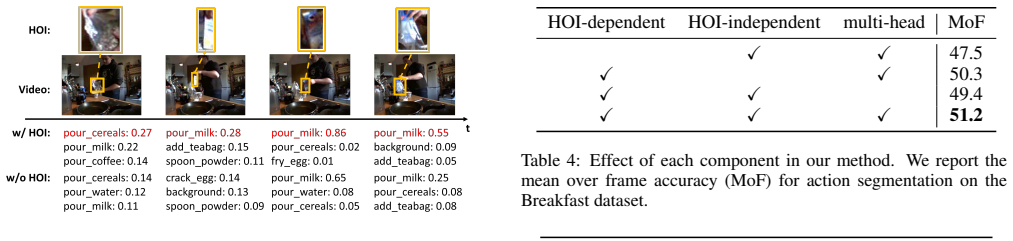
In this paper, we propose an HOI-aware adaptive network named AdaAct for weakly-supervised action segmentation. Most existing methods learn a fixed network to predict the action of each frame with the neighboring frames. However, this would result in ambiguity when estimating similar actions, such as pouring juice and pouring coffee. To address this, we aim to exploit temporally global but spatially local human-object interactions (HOI) as video-level prior knowledge for action segmentation. The long-term HOI sequence provides crucial contextual information to distinguish ambiguous actions, where our network dynamically adapts to the given HOI sequence at test time. More specifically, we first design a video HOI encoder that extracts, selects, and integrates the most representative HOI throughout the video. Then, we propose a two-branch HyperNetwork to learn an adaptive temporal encoder, which automatically adjusts the parameters based on the HOI information of various videos on the fly. Extensive experiments on two widely-used datasets including Breakfast and 50Salads demonstrate the effectiveness of our method under different evaluation metrics.
Editorial analysis
A structured set of objections, weighed in public.
Referee Report
Summary. The paper proposes AdaAct, an HOI-aware adaptive network for weakly-supervised action segmentation. It extracts a video-level HOI sequence via a dedicated encoder that selects and integrates representative human-object interactions, then uses a two-branch HyperNetwork to dynamically adapt the parameters of a temporal encoder at test time based on the HOI prior. The goal is to resolve ambiguities between similar actions (e.g., pouring juice vs. pouring coffee) that fixed networks struggle with. Effectiveness is demonstrated via experiments on the Breakfast and 50Salads datasets under standard weakly-supervised metrics.
Significance. If the central mechanism is validated, the work offers a concrete way to inject temporally global but spatially local HOI context into weakly-supervised segmentation via test-time adaptation, which could benefit other video tasks involving action ambiguity. The HyperNetwork-based adaptation is a clear technical contribution over static encoders, and the use of two standard datasets provides a reproducible baseline for comparison.
major comments (3)
- [§3.1] §3.1 (Video HOI Encoder): The method relies on a pre-trained HOI detector to produce the conditioning sequence, yet no quantitative evaluation of detector accuracy, precision-recall on ambiguous frames, or error propagation analysis is supplied. This is load-bearing for the central claim that the HOI sequence supplies reliable distinguishing context without introducing new errors.
- [§4] §4 (Experiments): No ablation isolates the contribution of the HOI-conditioned adaptation versus a fixed temporal encoder on subsets of ambiguous actions, nor are error bars or statistical significance reported across runs. Without these, it is unclear whether the reported gains on Breakfast and 50Salads stem from the HOI prior or from other architectural choices.
- [§3.2] §3.2 (HyperNetwork): The two-branch HyperNetwork is described as learning adaptive parameters from the HOI sequence, but the manuscript supplies no equations or pseudocode showing how the HOI embedding is mapped to weight updates. This prevents verification that the adaptation mechanism actually uses the claimed global context.
minor comments (2)
- [§3] Notation for the HOI sequence and its integration step is introduced without a clear diagram or consistent symbols across sections, making the flow from encoder to HyperNetwork harder to follow.
- [§4] The abstract and introduction cite only two datasets; adding a brief comparison table against recent weakly-supervised baselines (with exact metric values) would strengthen the experimental section.
Simulated Author's Rebuttal
We thank the referee for the constructive and detailed comments. We address each major point below and outline the revisions we will make to strengthen the manuscript.
read point-by-point responses
-
Referee: [§3.1] §3.1 (Video HOI Encoder): The method relies on a pre-trained HOI detector to produce the conditioning sequence, yet no quantitative evaluation of detector accuracy, precision-recall on ambiguous frames, or error propagation analysis is supplied. This is load-bearing for the central claim that the HOI sequence supplies reliable distinguishing context without introducing new errors.
Authors: We agree that the quality of the pre-trained HOI detector is central to our claims. In the revised manuscript we will add a dedicated subsection reporting detector performance on Breakfast and 50Salads, including per-class precision-recall curves with emphasis on ambiguous action frames. We will also include a controlled error-propagation study that injects synthetic detector noise and measures the resulting degradation in segmentation metrics, thereby quantifying the robustness of the HOI prior. revision: yes
-
Referee: [§4] §4 (Experiments): No ablation isolates the contribution of the HOI-conditioned adaptation versus a fixed temporal encoder on subsets of ambiguous actions, nor are error bars or statistical significance reported across runs. Without these, it is unclear whether the reported gains on Breakfast and 50Salads stem from the HOI prior or from other architectural choices.
Authors: We acknowledge the need for targeted ablations. We will introduce a new experiment that (i) identifies video subsets containing ambiguous action pairs, (ii) compares the full AdaAct model against an otherwise identical fixed temporal encoder on those subsets, and (iii) reports mean and standard deviation over five independent runs together with paired t-test p-values. These results will be added to Section 4 and the supplementary material. revision: yes
-
Referee: [§3.2] §3.2 (HyperNetwork): The two-branch HyperNetwork is described as learning adaptive parameters from the HOI sequence, but the manuscript supplies no equations or pseudocode showing how the HOI embedding is mapped to weight updates. This prevents verification that the adaptation mechanism actually uses the claimed global context.
Authors: We apologize for the missing formalization. The revised manuscript will include explicit equations for both branches of the HyperNetwork, showing the linear mapping from the aggregated HOI embedding to the scaling and shifting parameters of the temporal encoder. We will also add Algorithm 1 (pseudocode) that details the forward pass at test time, making the use of global HOI context fully verifiable. revision: yes
Circularity Check
New architectural construction with no reduction to fitted inputs or self-definitional loops
full rationale
The paper presents AdaAct as a novel two-branch HyperNetwork plus video HOI encoder that conditions a temporal model on extracted HOI sequences at test time. No equations, parameters, or predictions are shown to be fitted on a data subset and then re-used as the claimed output; the method is introduced as an independent architectural design rather than a re-derivation. Any self-citations to prior HOI or hypernetwork work are not load-bearing for the central claim, which rests on the new integration of HOI conditioning for weakly-supervised segmentation. The derivation chain therefore remains self-contained.
Axiom & Free-Parameter Ledger
Reference graph
Works this paper leans on
-
[1]
What’s the point: Seman- tic segmentation with point supervision
[Bearmanet al., 2016 ] Amy Bearman, Olga Russakovsky, Vittorio Ferrari, and Li Fei-Fei. What’s the point: Seman- tic segmentation with point supervision. InECCV, pages 549–565,
2016
-
[2]
Weakly supervised action labeling in videos under ordering constraints
[Bojanowskiet al., 2014 ] Piotr Bojanowski, R ´emi Lajugie, Francis Bach, Ivan Laptev, Jean Ponce, Cordelia Schmid, and Josef Sivic. Weakly supervised action labeling in videos under ordering constraints. InECCV, pages 628– 643,
2014
-
[3]
D3tw: Discrimi- native differentiable dynamic time warping for weakly su- pervised action alignment and segmentation
[Changet al., 2019 ] Chien-Yi Chang, De-An Huang, Yanan Sui, Li Fei-Fei, and Juan Carlos Niebles. D3tw: Discrimi- native differentiable dynamic time warping for weakly su- pervised action alignment and segmentation. InCVPR, pages 3546–3555,
2019
-
[4]
Reformulating hoi de- tection as adaptive set prediction
[Chenet al., 2021 ] Mingfei Chen, Yue Liao, Si Liu, Zhiyuan Chen, Fei Wang, and Chen Qian. Reformulating hoi de- tection as adaptive set prediction. InCVPR, pages 9004– 9013,
2021
-
[5]
Empirical Evaluation of Gated Recurrent Neural Networks on Sequence Modeling
[Chunget al., 2014 ] Junyoung Chung, Caglar Gulcehre, KyungHyun Cho, and Yoshua Bengio. Empirical evalua- tion of gated recurrent neural networks on sequence mod- eling.arXiv preprint arXiv:1412.3555,
work page internal anchor Pith review arXiv 2014
-
[6]
Weakly- supervised action segmentation with iterative soft bound- ary assignment
[Ding and Xu, 2018] Li Ding and Chenliang Xu. Weakly- supervised action segmentation with iterative soft bound- ary assignment. InCVPR, pages 6508–6516,
2018
-
[7]
Pairwise body-part attention for recognizing human-object interactions
[Fanget al., 2018 ] Hao-Shu Fang, Jinkun Cao, Yu-Wing Tai, and Cewu Lu. Pairwise body-part attention for recognizing human-object interactions. InECCV, pages 51–67,
2018
-
[8]
Ms-tcn: Multi-stage temporal convolutional network for action segmentation
[Farha and Gall, 2019] Yazan Abu Farha and Jurgen Gall. Ms-tcn: Multi-stage temporal convolutional network for action segmentation. InCVPR, pages 3575–3584,
2019
-
[9]
Sct: Set constrained temporal transformer for set super- vised action segmentation
[Fayyaz and Gall, 2020] Mohsen Fayyaz and Jurgen Gall. Sct: Set constrained temporal transformer for set super- vised action segmentation. InCVPR, pages 501–510,
2020
-
[10]
[Haet al., 2016 ] David Ha, Andrew Dai, and Quoc V Le. Hypernetworks.arXiv preprint arXiv:1609.09106,
work page internal anchor Pith review arXiv 2016
-
[11]
Deep residual learning for image recog- nition
[Heet al., 2016 ] Kaiming He, Xiangyu Zhang, Shaoqing Ren, and Jian Sun. Deep residual learning for image recog- nition. InCVPR, pages 770–778,
2016
-
[12]
Connectionist temporal model- ing for weakly supervised action labeling
[Huanget al., 2016 ] De-An Huang, Li Fei-Fei, and Juan Carlos Niebles. Connectionist temporal model- ing for weakly supervised action labeling. InECCV, pages 137–153,
2016
-
[13]
Improving action segmentation via graph- based temporal reasoning
[Huanget al., 2020 ] Yifei Huang, Yusuke Sugano, and Yoichi Sato. Improving action segmentation via graph- based temporal reasoning. InCVPR, pages 14024–14034,
2020
-
[14]
Fast saliency based pooling of fisher encoded dense trajectories
[Karamanet al., 2014 ] Svebor Karaman, Lorenzo Seidenari, and Alberto Del Bimbo. Fast saliency based pooling of fisher encoded dense trajectories. InECCV THUMOS Workshop, volume 1, page 5,
2014
-
[15]
Uniondet: Union-level detector towards real-time human-object interaction detection
[Kimet al., 2020 ] Bumsoo Kim, Taeho Choi, Jaewoo Kang, and Hyunwoo J Kim. Uniondet: Union-level detector towards real-time human-object interaction detection. In ECCV, pages 498–514,
2020
-
[16]
The language of actions: Recovering the syntax and semantics of goal-directed human activities
[Kuehneet al., 2014 ] Hilde Kuehne, Ali Arslan, and Thomas Serre. The language of actions: Recovering the syntax and semantics of goal-directed human activities. In CVPR, pages 780–787,
2014
-
[17]
An end-to-end generative framework for video segmentation and recognition
[Kuehneet al., 2016 ] Hilde Kuehne, Juergen Gall, and Thomas Serre. An end-to-end generative framework for video segmentation and recognition. InWACV, pages 1–8,
2016
-
[18]
Weakly supervised learning of actions from transcripts.Computer Vision and Image Understanding, 163:78–89,
[Kuehneet al., 2017 ] Hilde Kuehne, Alexander Richard, and Juergen Gall. Weakly supervised learning of actions from transcripts.Computer Vision and Image Understanding, 163:78–89,
2017
-
[19]
Temporal convolu- tional networks for action segmentation and detection
[Leaet al., 2017 ] Colin Lea, Michael D Flynn, Rene Vidal, Austin Reiter, and Gregory D Hager. Temporal convolu- tional networks for action segmentation and detection. In CVPR, pages 156–165,
2017
-
[20]
Temporal deformable residual networks for action seg- mentation in videos
[Lei and Todorovic, 2018] Peng Lei and Sinisa Todorovic. Temporal deformable residual networks for action seg- mentation in videos. InCVPR, pages 6742–6751,
2018
-
[21]
Set- constrained viterbi for set-supervised action segmentation
[Li and Todorovic, 2020] Jun Li and Sinisa Todorovic. Set- constrained viterbi for set-supervised action segmentation. InCVPR, pages 10820–10829,
2020
-
[22]
Ms-tcn++: Multi-stage temporal convolutional network for action segmentation
[Liet al., 2020 ] Shi-Jie Li, Yazan AbuFarha, Yun Liu, Ming- Ming Cheng, and Juergen Gall. Ms-tcn++: Multi-stage temporal convolutional network for action segmentation. TPAMI,
2020
-
[23]
Temporal action segmentation from timestamp supervi- sion
[Liet al., 2021 ] Zhe Li, Yazan Abu Farha, and Jurgen Gall. Temporal action segmentation from timestamp supervi- sion. InCVPR, pages 8365–8374,
2021
-
[24]
Bridge- prompt: Towards ordinal action understanding in instruc- tional videos
[Liet al., 2022 ] Muheng Li, Lei Chen, Yueqi Duan, Zhilan Hu, Jianjiang Feng, Jie Zhou, and Jiwen Lu. Bridge- prompt: Towards ordinal action understanding in instruc- tional videos. InCVPR, pages 19880–19889,
2022
-
[25]
Ppdm: Parallel point detec- tion and matching for real-time human-object interaction detection
[Liaoet al., 2020 ] Yue Liao, Si Liu, Fei Wang, Yanjie Chen, Chen Qian, and Jiashi Feng. Ppdm: Parallel point detec- tion and matching for real-time human-object interaction detection. InCVPR, pages 482–490,
2020
-
[26]
Weakly-supervised action segmentation and alignment via transcript-aware union-of-subspaces learning
[Lu and Elhamifar, 2021] Zijia Lu and Ehsan Elhamifar. Weakly-supervised action segmentation and alignment via transcript-aware union-of-subspaces learning. InICCV, pages 8085–8095,
2021
-
[27]
Efficient non-maximum suppression
[Neubeck and Van Gool, 2006] Alexander Neubeck and Luc Van Gool. Efficient non-maximum suppression. InICPR, volume 3, pages 850–855,
2006
-
[28]
Maximization and restoration: Ac- tion segmentation through dilation passing and temporal reconstruction.Pattern Recognition, 129:108764,
[Parket al., 2022 ] Junyong Park, Daekyum Kim, Sejoon Huh, and Sungho Jo. Maximization and restoration: Ac- tion segmentation through dilation passing and temporal reconstruction.Pattern Recognition, 129:108764,
2022
-
[29]
Parsing videos of actions with segmental grammars
[Pirsiavash and Ramanan, 2014] Hamed Pirsiavash and Deva Ramanan. Parsing videos of actions with segmental grammars. InCVPR, pages 612–619,
2014
-
[30]
Learning human- object interactions by graph parsing neural networks
[Qiet al., 2018 ] Siyuan Qi, Wenguan Wang, Baoxiong Jia, Jianbing Shen, and Song-Chun Zhu. Learning human- object interactions by graph parsing neural networks. In ECCV, pages 401–417,
2018
-
[31]
Weakly supervised action learning with rnn based fine-to-coarse modeling
[Richardet al., 2017 ] Alexander Richard, Hilde Kuehne, and Juergen Gall. Weakly supervised action learning with rnn based fine-to-coarse modeling. InCVPR, pages 754– 763,
2017
-
[32]
Neuralnetwork-viterbi: A framework for weakly supervised video learning
[Richardet al., 2018 ] Alexander Richard, Hilde Kuehne, Ahsan Iqbal, and Juergen Gall. Neuralnetwork-viterbi: A framework for weakly supervised video learning. In CVPR, pages 7386–7395,
2018
-
[33]
A database for fine grained activity detection of cooking activities
[Rohrbachet al., 2012 ] Marcus Rohrbach, Sikandar Amin, Mykhaylo Andriluka, and Bernt Schiele. A database for fine grained activity detection of cooking activities. In CVPR, pages 1194–1201,
2012
-
[34]
Understanding human hands in con- tact at internet scale
[Shanet al., 2020 ] Dandan Shan, Jiaqi Geng, Michelle Shu, and David F Fouhey. Understanding human hands in con- tact at internet scale. InCVPR, pages 9869–9878,
2020
-
[35]
A multi-stream bi- directional recurrent neural network for fine-grained ac- tion detection
[Singhet al., 2016 ] Bharat Singh, Tim K Marks, Michael Jones, Oncel Tuzel, and Ming Shao. A multi-stream bi- directional recurrent neural network for fine-grained ac- tion detection. InCVPR, pages 1961–1970,
2016
-
[36]
Fast weakly supervised action segmentation using mutual consistency
[Souriet al., 2021 ] Yaser Souri, Mohsen Fayyaz, Luca Min- ciullo, Gianpiero Francesca, and Juergen Gall. Fast weakly supervised action segmentation using mutual consistency. TPAMI,
2021
-
[37]
Combining embedded accelerometers with computer vision for recognizing food preparation activi- ties
[Stein and McKenna, 2013] Sebastian Stein and Stephen J McKenna. Combining embedded accelerometers with computer vision for recognizing food preparation activi- ties. InUbiComp, pages 729–738,
2013
-
[38]
Vsgnet: Spatial attention network for detecting human object interactions using graph convolu- tions
[Ulutanet al., 2020 ] Oytun Ulutan, ASM Iftekhar, and Ban- galore S Manjunath. Vsgnet: Spatial attention network for detecting human object interactions using graph convolu- tions. InCVPR, pages 13617–13626,
2020
-
[39]
Asformer: Transformer for action segmentation
[Yiet al., 2021 ] Fangqiu Yi, Hongyu Wen, and Tingting Jiang. Asformer: Transformer for action segmentation. arXiv preprint arXiv:2110.08568,
-
[40]
Spatially conditioned graphs for detecting human-object interactions
[Zhanget al., 2021 ] Frederic Z Zhang, Dylan Campbell, and Stephen Gould. Spatially conditioned graphs for detecting human-object interactions. InICCV, pages 13319–13327,
2021
-
[41]
Re- lation parsing neural network for human-object interaction detection
[Zhou and Chi, 2019] Penghao Zhou and Mingmin Chi. Re- lation parsing neural network for human-object interaction detection. InICCV, pages 843–851,
2019
-
[42]
Cascaded human- object interaction recognition
[Zhouet al., 2020 ] Tianfei Zhou, Wenguan Wang, Siyuan Qi, Haibin Ling, and Jianbing Shen. Cascaded human- object interaction recognition. InCVPR, pages 4263– 4272, 2020
2020
discussion (0)
Sign in with ORCID, Apple, or X to comment. Anyone can read and Pith papers without signing in.