Recognition: unknown
Institutional Floors and Partisan Lenses: Cross-National Online Discourse on Political Violence in France and the United States
Pith reviewed 2026-05-07 12:31 UTC · model grok-4.3
The pith
France maintains a cross-partisan civic focus in online discussions of political violence, while the United States shows stronger partisan divisions.
A machine-rendered reading of the paper's core claim, the machinery that carries it, and where it could break.
Core claim
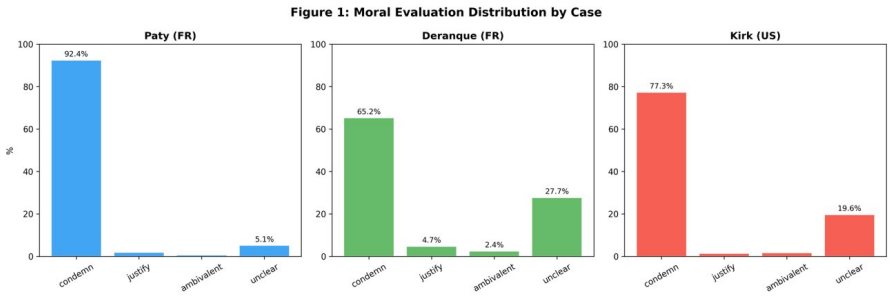
The analysis of discourse on the 2020 killing of Samuel Paty, the 2026 murder of Quentin Deranque in France, and the 2025 shooting of Charlie Kirk in the United States demonstrates that France's institutional framework upholds a cross-partisan civic baseline in moral evaluations, as shown by consistent focus on civic identity even for the politically-affiliated victim, unlike the ideologically divided patterns in the US.
What carries the argument
The civic floor hypothesis, tested through comparison of a civic victim and a politically-affiliated victim in France against a US case, using zero-shot GPT classification of moral evaluations and semantic network analysis.
If this is right
- Discourse in France focuses on the victim's civic role rather than political affiliation.
- US conversations reflect moral judgments aligned with partisan lines.
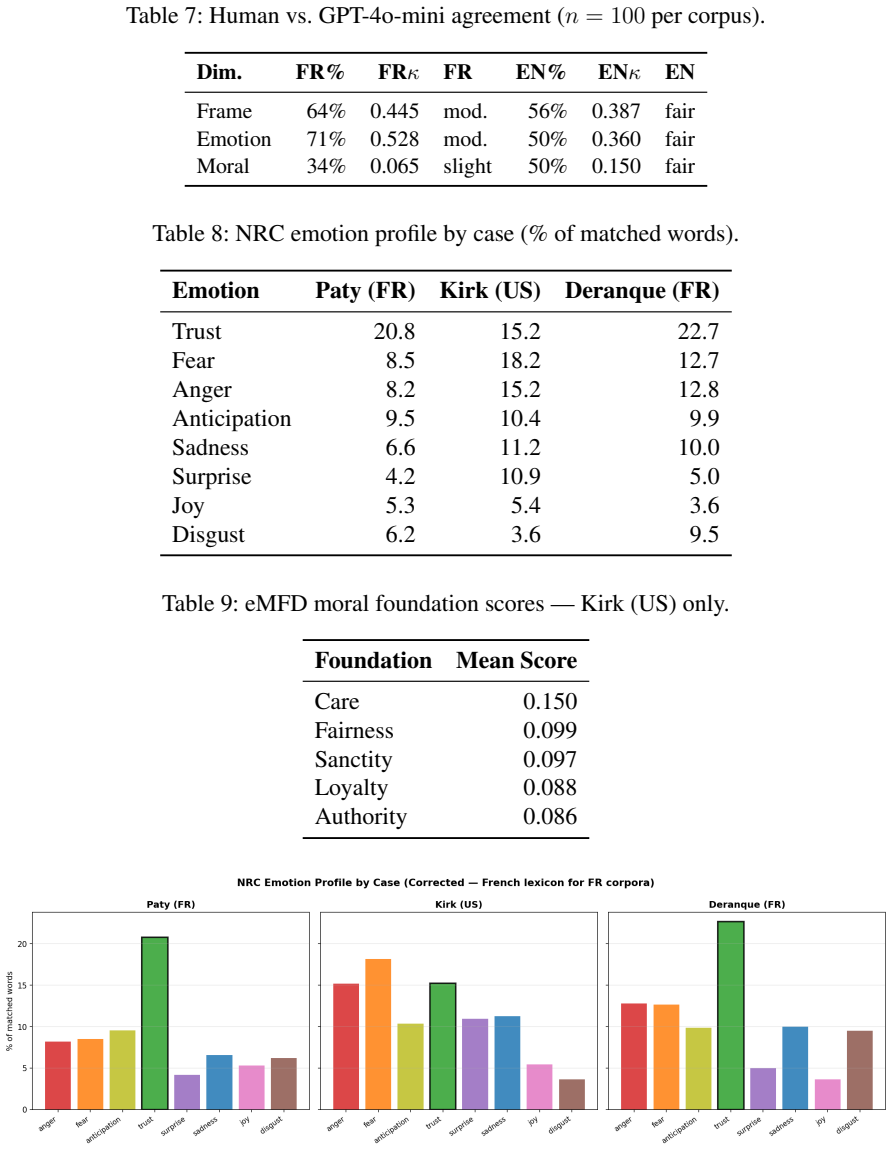
- Cross-national differences appear in perceptions of moral values, emotional intensity, and institutional framing.
- Semantic networks of discussion show distinct structures between the two countries.
- The approach has implications for studying moral judgment in multilingual digital political discourse.
Where Pith is reading between the lines
- This pattern may indicate that republican institutions in France create a stronger shared civic identity that resists partisan framing of violence.
- Similar methods could test whether other countries with centralized civic education show comparable effects.
- If the civic floor holds, it suggests policy efforts to emphasize shared national values could mitigate online polarization around political violence.
Load-bearing premise
That the zero-shot GPT-4o-mini classifications reliably and without bias detect moral evaluations, emotional intensity, and institutional framing in posts about political violence.
What would settle it
Observing equivalent levels of partisan moral division in French discourse about both Paty and Deranque, matching the US patterns, would falsify the civic floor hypothesis.
Figures


read the original abstract
This paper studies how online discussion shapes and assesses political violence across different settings, particularly how moral evaluation, as a social perception, varies across institutional contexts. We take France and the United States as case studies, both democracies, and three incidents of political violence: the 2020 killing of Samuel Paty in France, the 2025 shooting of Charlie Kirk in the United States, and the 2026 murder of Quentin Deranque in France. Using publicly available posts on Instagram and Facebook, we use GPT-4o-mini for zero-shot classification and social network analysis. Our research demonstrates clear cross-national differences in how moral values are perceived, the emotional intensity expressed, the framing of institutions, and the structure of semantic networks. In France, the discourse tends to focus on the victim's civic role rather than their political affiliation, whilst in the U.S., the conversation is more ideologically divided, with moral judgments frequently reflecting partisan lines. By comparing the two French cases -- a civic victim (Paty) versus the politically-affiliated victim (Deranque) -- we find evidence consistent with the \textit{civic floor hypothesis}, which demonstrates France's institutional framework upholds a cross-partisan civic baseline regardless of the victim's political ties. We conclude by analyzing the implications of computational social perception for multilingual NLP and by exploring moral judgment in cross-national digital political discourse.
Editorial analysis
A structured set of objections, weighed in public.
Referee Report
Summary. The paper analyzes online discourse on three incidents of political violence (Samuel Paty and Quentin Deranque in France; Charlie Kirk in the US) using zero-shot GPT-4o-mini classification of Instagram and Facebook posts to compare moral evaluations, emotional intensity, institutional framing, and semantic networks. It reports cross-national differences, with French discourse emphasizing victims' civic roles over partisan ties, and presents evidence from the two French cases as consistent with a 'civic floor hypothesis' that France's institutions maintain a cross-partisan civic baseline.
Significance. If the LLM-based classifications prove reliable, the work offers a computational approach to studying how institutional contexts shape moral perceptions in digital political discourse, with potential implications for multilingual NLP and cross-national comparisons of social media responses to violence. The use of real public post data and network analysis provides a concrete empirical basis for the interpretive claims.
major comments (2)
- [Methods] Methods section: The zero-shot GPT-4o-mini classification of moral evaluations, emotional intensity, institutional framing, and semantic structures lacks any reported validation (e.g., human annotation agreement, accuracy metrics on a held-out set, or bias checks for multilingual political content). This is load-bearing for the central claim, as the observed differences between the Paty and Deranque cases—and thus support for the civic floor hypothesis—rest entirely on these unvalidated labels.
- [Results/Discussion] Results and Discussion sections: The cross-partisan civic baseline in France is inferred from differences in LLM outputs between the two French cases, but no analysis addresses potential systematic biases in zero-shot prompting on short, context-poor, multilingual social media text (e.g., sarcasm, local idioms, or training-data skews toward English-centric moral framing).
minor comments (2)
- [Abstract] Abstract and introduction: The dates for the Kirk (2025) and Deranque (2026) incidents appear to be in the future relative to the current date; clarify if these are hypothetical or correct the timeline.
- [Introduction] The paper introduces the 'civic floor hypothesis' as an interpretive frame but does not specify how it was pre-registered or distinguished from post-hoc interpretation of the LLM results.
Simulated Author's Rebuttal
We thank the referee for their constructive comments, which highlight important areas for improvement in our methods and discussion of limitations. We provide point-by-point responses below and commit to revisions that address the concerns raised.
read point-by-point responses
-
Referee: [Methods] Methods section: The zero-shot GPT-4o-mini classification of moral evaluations, emotional intensity, institutional framing, and semantic structures lacks any reported validation (e.g., human annotation agreement, accuracy metrics on a held-out set, or bias checks for multilingual political content). This is load-bearing for the central claim, as the observed differences between the Paty and Deranque cases—and thus support for the civic floor hypothesis—rest entirely on these unvalidated labels.
Authors: We recognize the critical importance of validating the zero-shot classifications, as they underpin our comparative findings and the civic floor hypothesis. Although the original manuscript did not include such validation, we will perform a post-hoc validation by randomly sampling 300 posts across the three cases and having them independently annotated by two human coders fluent in the respective languages. We will report Cohen's kappa for inter-annotator agreement and accuracy relative to the LLM labels in a new subsection of the Methods. This addresses the load-bearing nature of the classifications. revision: yes
-
Referee: [Results/Discussion] Results and Discussion sections: The cross-partisan civic baseline in France is inferred from differences in LLM outputs between the two French cases, but no analysis addresses potential systematic biases in zero-shot prompting on short, context-poor, multilingual social media text (e.g., sarcasm, local idioms, or training-data skews toward English-centric moral framing).
Authors: We concur that systematic biases in zero-shot prompting for social media text, especially multilingual and abbreviated content, could influence the results. To mitigate this in the revision, we will include an analysis of potential biases by manually reviewing a sample of posts for sarcasm and idioms, and discuss how the French and English contexts might interact with the model's training data. Additionally, we will test the robustness by re-running classifications with varied prompts and report if the cross-national patterns hold. revision: yes
Circularity Check
No circularity: empirical test of interpretive hypothesis on external data
full rationale
The paper conducts an empirical study by applying zero-shot GPT-4o-mini classification to public Instagram and Facebook posts about three specific incidents, then compares moral evaluations, emotional intensity, institutional framing, and semantic networks across cases and countries to assess consistency with the civic floor hypothesis. No equations, parameters fitted to subsets of the target data, self-citations, or ansatzes are invoked in a load-bearing manner. The hypothesis functions as an interpretive frame tested against independent observations rather than being defined by or derived from the classification outputs themselves. The derivation chain remains self-contained against external benchmarks.
Axiom & Free-Parameter Ledger
axioms (2)
- domain assumption Zero-shot GPT-4o-mini classification produces valid labels for moral values, emotional intensity, institutional framing, and semantic networks in social media text across English and French.
- domain assumption The three chosen incidents and their associated public posts are representative of national-level discourse on political violence.
invented entities (1)
-
civic floor hypothesis
no independent evidence
Reference graph
Works this paper leans on
-
[1]
Almond and Sidney Verba.The Civic Culture: Political Attitudes and Democracy in Five Nations
Gabriel A. Almond and Sidney Verba.The Civic Culture: Political Attitudes and Democracy in Five Nations. Princeton University Press, Princeton, NJ, 1963
1963
-
[2]
Conservative influencer charlie kirk shot dead in ‘political assassination’.Reuters, September 2025
Joseph Ax, Brian Brooks, and Andrea Shalal. Conservative influencer charlie kirk shot dead in ‘political assassination’.Reuters, September 2025
2025
-
[3]
Charlie kirk shot dead at utah university event.BBC News, September 2025
BBC News. Charlie kirk shot dead at utah university event.BBC News, September 2025
2025
-
[4]
France’s ideals, and what it saw as an attack on them.The New York Times, October 2020
Aurelien Breeden and Constant M ´eheut. France’s ideals, and what it saw as an attack on them.The New York Times, October 2020
2020
-
[5]
A coefficient of agreement for nominal scales.Educational and Psychological Measurement, 20(1):37–46, 1960
Jacob Cohen. A coefficient of agreement for nominal scales.Educational and Psychological Measurement, 20(1):37–46, 1960. 12
1960
-
[6]
The indivisibility of the french republic as political theory and constitutional doctrine.European Constitutional Law Review, 11(3):458–481, 2015
Eoin Daly. The indivisibility of the french republic as political theory and constitutional doctrine.European Constitutional Law Review, 11(3):458–481, 2015
2015
-
[7]
Shades of american identity: Implicit relations between ethnic and national identities.Social and Personality Psychology Compass, 8(12):739–754, 2014
Thierry Devos and Hafsa Mohamed. Shades of american identity: Implicit relations between ethnic and national identities.Social and Personality Psychology Compass, 8(12):739–754, 2014
2014
-
[8]
Susan T. Fiske. Social cognition and social perception.Annual Review of Psychology, 44:155–194, 1993
1993
-
[9]
Eight people go on trial in Paris over beheading of teacher Samuel Paty.France 24, November 2024
France 24. Eight people go on trial in Paris over beheading of teacher Samuel Paty.France 24, November 2024
2024
-
[10]
Accounting for change in diverse societies: France
Global Centre for Pluralism. Accounting for change in diverse societies: France. Technical report, Global Centre for Pluralism, Ottawa, 2018
2018
-
[11]
Democracy and the deferral of justice in France and the United States.Yale French Studies, 100:65–87, 2001
Daniel Gordon. Democracy and the deferral of justice in France and the United States.Yale French Studies, 100:65–87, 2001
2001
-
[12]
Wojcik, and Pe- ter H
Jesse Graham, Jonathan Haidt, Sena Koleva, Matt Motyl, Ravi Iyer, Sean P. Wojcik, and Pe- ter H. Ditto. Moral foundations theory: The pragmatic validity of moral pluralism. In Patricia Devine and Ashby Plant, editors,Advances in Experimental Social Psychology, volume 47, pages 55–130. Academic Press, 2013
2013
-
[13]
Assassination of Charlie Kirk
Ted Grant. Assassination of Charlie Kirk. Encyclopædia Britannica, 2025
2025
-
[14]
The public sphere: An encyclopedia article.New German Critique, 3:49– 55, 1974
J ¨urgen Habermas. The public sphere: An encyclopedia article.New German Critique, 3:49– 55, 1974. Trans. S. Lennox and F. Lennox
1974
-
[15]
Hopp, Jacob T
Frederic R. Hopp, Jacob T. Fisher, Devin Cornell, Richard Huskey, and Ren ´e Weber. The extended moral foundations dictionary (eMFD): Development and applications of a crowd- sourced approach to extracting moral intuitions from text.Behavior Research Methods, 53:232–246, 2021
2021
-
[16]
Hutto and Eric Gilbert
Clayton J. Hutto and Eric Gilbert. V ADER: A parsimonious rule-based model for sentiment analysis of social media text. InProceedings of the Eighth International Conference on Weblogs and Social Media (ICWSM). AAAI Press, 2014
2014
-
[17]
Oxford University Press, New York, 2008
C ´ecile Laborde.Critical Republicanism: The Hijab Controversy and Political Philosophy. Oxford University Press, New York, 2008
2008
-
[18]
Color-blind: France’s approach to race.Harvard International Review, Febru- ary 2021
Anna LaBreck. Color-blind: France’s approach to race.Harvard International Review, Febru- ary 2021
2021
-
[19]
Samuel Paty’s beheading: The limits of speech and religion.Religion Un- plugged, December 2024
Paul Marshall. Samuel Paty’s beheading: The limits of speech and religion.Religion Un- plugged, December 2024
2024
-
[20]
Content library and API
Meta Platforms, Inc. Content library and API. Meta Platforms, Inc., 2024. 13
2024
-
[21]
Mohammad and Peter D
Saif M. Mohammad and Peter D. Turney. Crowdsourcing a word-emotion association lexi- con.Computational Intelligence, 29(3):436–465, 2013
2013
-
[22]
Pietro S. Nivola. Why federalism matters. Technical Report 150, Brookings Institution, Washington, DC, 2005
2005
-
[23]
GPT-4o mini
OpenAI. GPT-4o mini. OpenAI, 2024
2024
-
[24]
Minute de silence pour Quentin Deranque: Les d ´eput´es ont-ils compris `a qui ils rendaient aussi hommage?Ouest-France, 2026
Ouest-France. Minute de silence pour Quentin Deranque: Les d ´eput´es ont-ils compris `a qui ils rendaient aussi hommage?Ouest-France, 2026
2026
-
[25]
frame":
Elisabeth Zoller. La¨ıcit´e in the United States or the separation of church and state in a pluralist society.Indiana Journal of Global Legal Studies, 13(2):561–594, 2006. A GPT-4o-mini Classification Prompt The following prompt was used for all zero-shot classifications across all three corpora. Tempera- ture was set to 0 for full reproducibility. System...
2006
discussion (0)
Sign in with ORCID, Apple, or X to comment. Anyone can read and Pith papers without signing in.