Recognition: unknown
Trapping, Irregular Waveforms, and Efficient Radiation in Ultra-relativistic Black Hole Encounters
Pith reviewed 2026-05-07 12:42 UTC · model grok-4.3
The pith
Ultra-relativistic black hole flybys radiate over 65% of their energy as gravitational waves via transient trapping.
A machine-rendered reading of the paper's core claim, the machinery that carries it, and where it could break.
Core claim
Evolving equal-mass nonspinning black holes with initial center-of-mass Lorentz factors up to γ≈5.1, the encounters at nonzero impact parameter produce prolonged irregular gravitational wave emission and significant horizon absorption without coalescence. These effects are driven by transient null trapping and repeated lensing of radiation in the binary interaction region. The simulations indicate that over 65% of the initial ADM energy can be radiated as gravitational waves at γ≈5.1.
What carries the argument
transient null trapping and repeated lensing of radiation in the binary interaction region
If this is right
- Gravitational waveforms from such encounters exhibit prolonged irregular emission rather than a prompt transition to Kerr ringdown.
- Black hole horizons absorb substantial energy even in non-merging ultra-relativistic flybys.
- Radiation efficiency grows with boost and reaches over 65% of initial ADM energy at γ≈5.1, exceeding lower-boost extrapolations.
- The two-body problem enters a distinct ultra-relativistic regime not described by standard post-Newtonian expectations.
Where Pith is reading between the lines
- The trapping and lensing mechanism may appear in other high-energy gravitational systems such as neutron-star encounters or dense cluster dynamics.
- Search templates for gravitational-wave detectors may need to accommodate irregular, extended signals from high-velocity black-hole flybys.
- Higher radiation efficiency at large boosts could alter energy-loss estimates in models of cosmic ultra-relativistic collisions.
Load-bearing premise
The numerical relativity evolutions at Lorentz factors up to 5.1 are free of significant truncation errors, gauge artifacts, or resolution-dependent features that could artificially enhance the reported radiation efficiency or produce spurious trapping.
What would settle it
Re-evolving the γ≈5.1 case at substantially higher grid resolution or with an independent gauge choice and finding the radiated fraction drops well below 65% of the ADM energy would falsify the high-efficiency result.
Figures


read the original abstract
We demonstrate that ultra-relativistic black hole encounters reveal a new regime of the two-body interaction in general relativity. Evolving equal-mass, nonspinning black holes with initial center-of-mass Lorentz factors up to $\gamma\approx 5.1$ using numerical relativity, we find that the resulting waveforms defy the standard expectation of a post-Newtonian description followed by a smooth transition to a prompt Kerr ringdown. Instead, at nonzero impact parameter, the system can exhibit prolonged, highly irregular emission and significant horizon absorption, even without coalescence. We show these phenomena are driven by transient null trapping and repeated lensing of radiation in the binary interaction region. Furthermore, our simulations indicate that over $65\%$ of the initial ADM energy can be radiated as gravitational waves at $\gamma\approx 5.1$, which is substantially larger than previously estimated by extrapolating from lower boost data.
Editorial analysis
A structured set of objections, weighed in public.
Referee Report
Summary. The manuscript reports numerical relativity simulations of ultra-relativistic encounters between equal-mass, non-spinning black holes with center-of-mass Lorentz factors up to approximately 5.1. It finds that at nonzero impact parameters, the gravitational waveforms are prolonged and irregular due to transient null trapping and repeated lensing of radiation, rather than following a standard post-Newtonian to Kerr ringdown transition. The simulations indicate that more than 65% of the initial ADM energy can be radiated as gravitational waves at γ ≈ 5.1, substantially higher than extrapolations from lower-boost data.
Significance. If validated, this result reveals a previously unexplored high-boost regime in binary black hole dynamics characterized by enhanced radiation efficiency through trapping mechanisms. The work is grounded in direct numerical evolution of the Einstein equations without fitted parameters or self-referential derivations, providing a parameter-free exploration of this regime that could inform models of extreme gravitational encounters.
major comments (1)
- [Abstract] Abstract: The central quantitative claim that over 65% of the initial ADM energy is radiated at γ≈5.1 lacks any reported convergence tests, error budgets, or sensitivity analysis to grid resolution, gauge choice, or finite-radius wave extraction. Given the prolonged and irregular waveforms described at these boosts, this omission is load-bearing for attributing the high efficiency to physical trapping rather than numerical artifacts.
minor comments (1)
- [Abstract] The specific numerical values of the impact parameter for the reported runs are not stated in the abstract, which would aid in assessing the regime of nonzero impact parameter.
Simulated Author's Rebuttal
We thank the referee for their careful reading of the manuscript and for identifying the need to strengthen the support for the abstract's central quantitative claim. We address the major comment below and have incorporated revisions to clarify the numerical validation.
read point-by-point responses
-
Referee: [Abstract] Abstract: The central quantitative claim that over 65% of the initial ADM energy is radiated at γ≈5.1 lacks any reported convergence tests, error budgets, or sensitivity analysis to grid resolution, gauge choice, or finite-radius wave extraction. Given the prolonged and irregular waveforms described at these boosts, this omission is load-bearing for attributing the high efficiency to physical trapping rather than numerical artifacts.
Authors: We agree that the abstract would be improved by explicit reference to the supporting convergence analysis, especially given the irregular waveforms at high boosts. The manuscript body (Sections 3.3 and 4.2, including resolution studies in Table II and finite-radius comparisons in Figure 9) already reports grid-convergence tests for the radiated energy at γ ≈ 5.1, showing second-order convergence with an estimated uncertainty of 3–5% between the two highest resolutions, as well as consistency across extraction radii from 50M to 200M. Gauge sensitivity is addressed via the standard moving-puncture gauge with multiple damping parameters, though a broader gauge survey was not feasible at these computational costs. We have revised the abstract to include a brief parenthetical statement on the estimated numerical error, thereby reinforcing that the >65% efficiency is attributable to the physical trapping and lensing mechanisms rather than artifacts. revision: yes
Circularity Check
No circularity: results from direct numerical evolution of Einstein equations
full rationale
The paper reports outcomes from numerical relativity simulations of boosted black hole encounters, computing radiated energy by integrating gravitational-wave flux extracted from the evolved spacetime. No analytical derivation chain, parameter fitting, or self-referential definitions are present; the >65% radiation efficiency at γ≈5.1 is an output of the evolution, not an input renamed or forced by construction. Self-citations, if any, concern prior numerical methods rather than load-bearing uniqueness theorems or ansatze that reduce the central claim. The derivation is self-contained against external benchmarks of numerical GR.
Axiom & Free-Parameter Ledger
axioms (2)
- standard math The Einstein field equations govern the spacetime dynamics of the binary system
- domain assumption The chosen numerical relativity code and gauge remain stable and accurate at Lorentz factors up to 5.1
Reference graph
Works this paper leans on
-
[1]
A. Buonanno and T. Damour, Phys. Rev. D62, 064015 (2000), arXiv:gr-qc/0001013
-
[2]
Post-Newtonian Theory for Gravitational Waves
L. Blanchet, Living Rev. Rel.17, 2 (2014), arXiv:1310.1528 [gr-qc]
work page internal anchor Pith review arXiv 2014
-
[3]
S. A. Teukolsky, Astrophys. J.185, 635 (1973). 10 FIG. 8.Top:Number of orbits as a function of impact pa- rameter; one can clearly see the sharp peak near the merger threshold, indicated by dashed lines.Middle:Irreducible mass of the remnant black hole for the scattering cases, high- lighting strong absorption at the merger threshold due to the increased ...
1973
-
[4]
Quasinormal modes of black holes and black branes
E. Berti, V. Cardoso, and A. O. Starinets, Class. Quant. Grav.26, 163001 (2009), arXiv:0905.2975 [gr-qc]
work page internal anchor Pith review arXiv 2009
-
[5]
Pretorius, Phys
F. Pretorius, Phys. Rev. Lett.95, 121101 (2005)
2005
-
[6]
M. Campanelli, C. O. Lousto, P. Marronetti, and Y. Zlo- chower, Phys. Rev. Lett.96, 111101 (2006), arXiv:gr- qc/0511048 [gr-qc]
-
[7]
J. G. Baker, J. Centrella, D.-I. Choi, M. Koppitz, and J. van Meter, Phys. Rev. Lett.96, 111102 (2006), arXiv:gr-qc/0511103 [gr-qc]
work page Pith review arXiv 2006
- [8]
-
[9]
U. Sperhake, Class. Quant. Grav.32, 124011 (2015), arXiv:1411.3997 [gr-qc]
-
[10]
S. W. Hawking, Phys. Rev. Lett.26, 1344 (1971)
1971
-
[11]
Penrose (1974) unpublished
R. Penrose (1974) unpublished. FIG. 9.L 2 norm of the Z4c collective constraint (top) and the estimated convergence order (bottom) for the three gauge conditions atγ≈5.1. While the telegrapher gauge maintains stability and convergence throughout, the1 + logand SSL crash at different stages of evolution. At very early times, the evolution-generated truncat...
1974
-
[12]
U. Sperhake, V. Cardoso, F. Pretorius, E. Berti, and J. A. Gonzalez, Phys. Rev. Lett.101, 161101 (2008), arXiv:0806.1738 [gr-qc]
- [13]
-
[14]
S. Dimopoulos and G. L. Landsberg, Phys. Rev. Lett. 87, 161602 (2001), arXiv:hep-ph/0106295
- [15]
- [16]
- [17]
-
[18]
P. D. D’Eath, Phys. Rev. D18, 990 (1978)
1978
-
[19]
P. D. D’Eath and P. N. Payne, Phys. Rev. D46, 658 (1992)
1992
-
[20]
P. D. D’Eath and P. N. Payne, Phys. Rev. D46, 694 (1992)
1992
-
[21]
W. E. East and F. Pretorius, Phys. Rev. Lett.110, 101101 (2013), arXiv:1210.0443 [gr-qc]. 11 FIG. 10. Convergence of dominant waveform modes with the telegrapher gauge for theγ≈5.1prompt merger encounter. The black lines show the real part of the waveform for the highest resolution run, while the blue and orange lines show the differences between the medi...
-
[22]
F. Pretorius and W. E. East, Phys. Rev. D98, 084053 (2018), arXiv:1807.11562 [gr-qc]
- [23]
- [24]
-
[25]
V. Cardoso, E. Berti, and M. Cavaglia, Class. Quant. Grav.22, L61 (2005), arXiv:hep-ph/0505125
-
[26]
M. Shibata, H. Okawa, and T. Yamamoto, Phys. Rev. D 78, 101501 (2008), arXiv:0810.4735 [gr-qc]
-
[27]
U. Sperhake, V. Cardoso, F. Pretorius, E. Berti, T. Hin- derer, and N. Yunes, Phys. Rev. Lett.103, 131102 (2009), arXiv:0907.1252 [gr-qc]
-
[28]
U. Sperhake, E. Berti, V. Cardoso, and F. Pretorius, Phys. Rev. Lett.111, 041101 (2013), arXiv:1211.6114 [gr-qc]
-
[29]
C. Gundlach, S. Akcay, L. Barack, and A. Nagar, Phys. Rev. D86, 084022 (2012), arXiv:1207.5167 [gr-qc]
- [30]
- [31]
-
[32]
K. Slinker, C. R. Evans, and M. Hannam, Phys. Rev. D 98, 044014 (2018), arXiv:1806.08364 [gr-qc]
-
[33]
Zhu and C
H. Zhu and C. Truong, Telegrapher gauge for punc- ture evolutions of ultra-relativistic black holes (2026), in preparation
2026
-
[34]
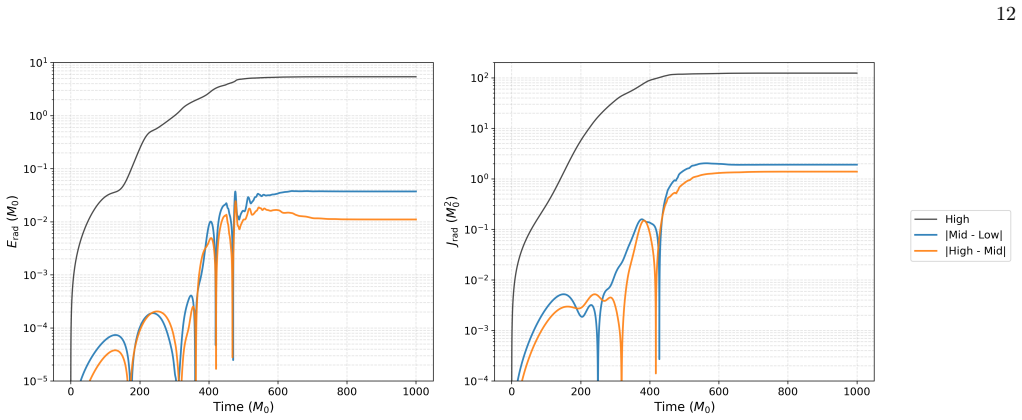
B. P. Abbottet al. (LIGO Scientific, Virgo), Phys. Rev. Lett.116, 061102 (2016), arXiv:1602.03837 [gr-qc]. 12 FIG. 11. Accumulated radiated energy (left) and angular momentum (right) at three different resolutions. The truncation error from the evolution is on the order of 1%, much less than that associated with the junk radiation subtraction despite the ...
work page internal anchor Pith review arXiv 2016
- [35]
-
[36]
A. N. Kolmogorov, Soviet Physics Uspekhi10, 734 (1968)
1968
- [37]
- [38]
- [39]
- [40]
-
[41]
B. Daszuta, F. Zappa, W. Cook, D. Radice, S. Bernuzzi, and V. Morozova, Astrophys. J. Suppl. Ser.257, 25 (2021), arXiv:2101.08289 [gr-qc]
- [42]
-
[43]
S. Bernuzzi and D. Hilditch, Phys. Rev. D81, 084003 (2010), arXiv:0912.2920 [gr-qc]
-
[44]
A. Weyhausen, S. Bernuzzi, and D. Hilditch, Phys. Rev. D85, 024038 (2012), arXiv:1107.5539 [gr-qc]
-
[45]
D. Hilditch, S. Bernuzzi, M. Thierfelder, Z. Cao, W. Tichy, and B. Bruegmann, Phys. Rev. D88, 084057 (2013), arXiv:1212.2901 [gr-qc]
-
[46]
M. Alcubierre, Phys. Rev. D55, 5981 (1997), arXiv:gr- qc/9609015
-
[47]
M. Alcubierre, Class. Quant. Grav.22, 129 (2005), arXiv:gr-qc/0405024 [gr-qc]
- [48]
- [49]
-
[50]
J. M. Bowen and J. W. York, Phys. Rev. D21, 2047 (1980)
2047
-
[51]
S. Brandt and B. Bruegmann, Phys. Rev. Lett.78, 3606 (1997), arXiv:gr-qc/9703066 [gr-qc]
- [52]
-
[53]
G. Lovelace, R. Owen, H. P. Pfeiffer, and T. Chu, Phys. Rev. D78, 084017 (2008), arXiv:0805.4192 [gr-qc]
- [54]
-
[55]
I. Ruchlin, J. Healy, C. O. Lousto, and Y. Zlochower, Phys. Rev. D95, 024033 (2017), arXiv:1410.8607 [gr-qc]
-
[56]
Isolated and dynamical horizons and their applications
A. Ashtekar and B. Krishnan, Living Rev. Rel.7, 10 (2004), arXiv:gr-qc/0407042
work page Pith review arXiv 2004
-
[57]
J. Thornburg, Class. Quant. Grav.21, 743 (2004), arXiv:gr-qc/0306056
-
[58]
Smarr, Phys
L. Smarr, Phys. Rev. D15, 2069 (1977)
2069
- [59]
- [60]
- [61]
- [62]
- [63]
- [64]
-
[65]
Bel, Comptes Rendus de l’Académie des Sciences247, 1094 (1958)
L. Bel, Comptes Rendus de l’Académie des Sciences247, 1094 (1958)
1958
-
[66]
Robinson, Class
I. Robinson, Class. Quant. Grav.14, A331 (1997), origi- nally based on unpublished lectures from 1958
1997
-
[67]
R. Maartens and B. A. Bassett, Class. Quant. Grav.15, 705 (1998), arXiv:gr-qc/9704059 [gr-qc]
-
[68]
S. Boyeneni, J. Wu, and E. R. Most, Phys. Rev. Lett. 135, 101401 (2025), arXiv:2504.15978 [gr-qc]
-
[69]
B. Krishnan, C. O. Lousto, and Y. Zlochower, Phys. Rev. D76, 081501 (2007), arXiv:0707.0876 [gr-qc]
discussion (0)
Sign in with ORCID, Apple, or X to comment. Anyone can read and Pith papers without signing in.