Recognition: unknown
Dispersion Splitting of Phonon Polaritons in van der Waals Heterostructure
Pith reviewed 2026-05-07 12:48 UTC · model grok-4.3
The pith
Two α-MoO3 slabs placed close together split their phonon-polariton dispersion into two branches with different momenta and field symmetry.
A machine-rendered reading of the paper's core claim, the machinery that carries it, and where it could break.
Core claim
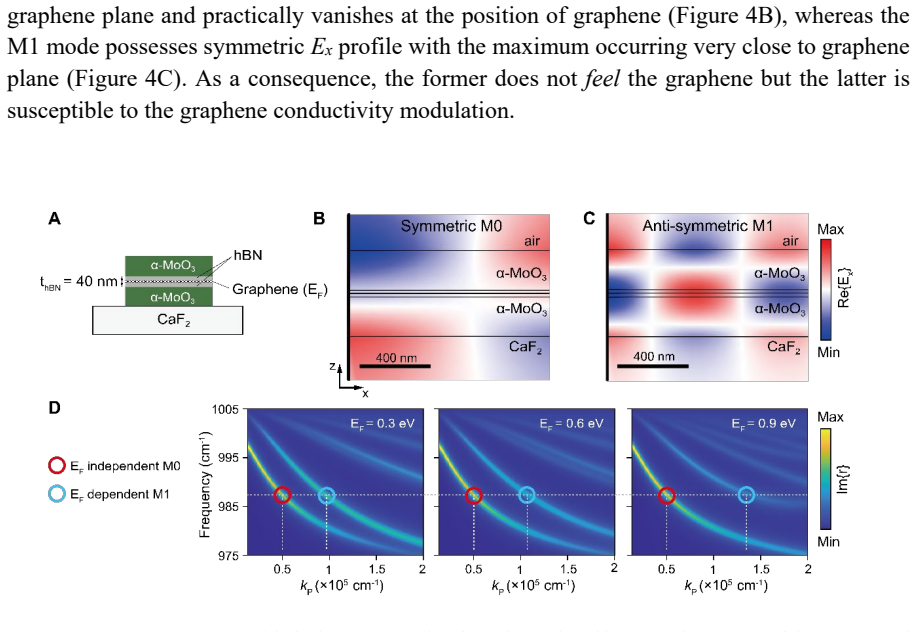
The eigenmodes of hyperbolic phonon-polaritons in two α-MoO3 slabs hybridize when the slabs are placed in close proximity, splitting the dispersion into two branches distinguished by different momenta and field symmetry. This splitting is observed in the Type-I Reststrahlen band using a heterostructure with an hBN spacer layer and scattering-type scanning near-field optical microscopy. The work further proposes that inserting graphene into the stack enables active, mode-selective tailoring of the dispersion through electrostatic tuning of the graphene Fermi energy.
What carries the argument
Eigenmode hybridization between the hyperbolic phonon-polariton modes supported by two proximate α-MoO3 slabs, which produces two dispersion branches of distinct momentum and field symmetry.
If this is right
- Hyperbolic phonon-polariton dispersion in the Type-I Reststrahlen band becomes controllable by adjusting slab separation.
- The two resulting branches carry different momenta and opposite field parity, enabling selective excitation or propagation.
- Adding a graphene layer permits electrical switching between the branches by changing the Fermi energy.
- The same hybridization principle supplies a general route to dispersion engineering of hyperbolic phonon-polaritons in other van der Waals crystals.
Where Pith is reading between the lines
- The split branches could be used to route polariton energy along paths that depend on their symmetry, creating simple mode sorters without external gratings.
- Because the splitting is tunable by interlayer distance, the platform may allow dynamic control if the spacer thickness can be modulated mechanically or electrostatically.
- Extending the method to multilayer stacks might produce multiple split branches whose momenta form a ladder usable for broadband or multi-frequency devices.
Load-bearing premise
The observed splitting arises purely from hybridization of the eigenmodes of the two α-MoO3 slabs and is not dominated by the dielectric response of the hBN spacer, interface defects, or fabrication strain.
What would settle it
If the measured dispersion in the heterostructure remains split even when the two α-MoO3 slabs are separated by distances much larger than the polariton decay length while the hBN spacer is retained, the hybridization mechanism would be ruled out.
Figures


read the original abstract
The biaxial van der Waals crystal {\alpha}-phase molybdenum trioxide ({\alpha}-MoO3) supports hyperbolic phonon-polaritons with anomalous dispersion in the Type-I Reststrahlen band (RB-I). Despite the low loss and long lifetime of these polaritons, dispersion engineering in this regime has remained largely unexplored. In this work, we show that when two {\alpha}-MoO3 slabs are placed in close proximity, their eigenmodes hybridize and the dispersion splits into two branches with different momenta and field symmetry, providing a powerful platform for dispersion manipulation. We experimentally demonstrate the polaritonic mode splitting in {\alpha}-MoO3 within a heterostructure with hexagonal boron nitride (hBN) employed as a spacer, probed by a scattering-type scanning near-field optical microscope. Furthermore, we propose a design framework for active and mode-selective tailoring of the polaritonic dispersion in the heterostructure incorporating graphene, achieved through tuning its Fermi energy. Our work experimentally demonstrates the feasibility of phonon-polariton mode splitting in the RB-I and suggests a new platform for dispersion engineering of hyperbolic phonon-polaritons in general.
Editorial analysis
A structured set of objections, weighed in public.
Referee Report
Summary. The manuscript reports an experimental demonstration of dispersion splitting for hyperbolic phonon polaritons in the Type-I Reststrahlen band of α-MoO3 within a van der Waals heterostructure consisting of two α-MoO3 slabs separated by an hBN spacer. The authors attribute the observed splitting into two branches (with distinct momenta and field symmetries) to hybridization of the eigenmodes from the two α-MoO3 layers. This is probed via scattering-type scanning near-field optical microscopy (s-SNOM). A conceptual design is also proposed for active, mode-selective dispersion tuning by integrating a graphene layer and electrostatically varying its Fermi energy.
Significance. If validated, the result establishes a practical route to passive dispersion engineering of low-loss hyperbolic phonon polaritons via proximity-induced hybridization, extending beyond single-slab behavior. The graphene-based active control sketch adds a promising tunability dimension for nanophotonic devices. The work is grounded in direct near-field imaging rather than purely theoretical modeling, which strengthens its potential impact if the experimental controls are made rigorous.
major comments (3)
- [Experimental Methods] Experimental Methods section: no description is provided of the s-SNOM setup parameters (tip radius, demodulation harmonics, scan conditions), raw near-field amplitude/phase data, or the fitting procedure used to extract the two dispersion branches from the measured spectra. These details are load-bearing for the central claim of hybridization-induced splitting.
- [Results] Results section: the contribution of the hBN spacer dielectric response is not quantified, despite overlap between hBN Reststrahlen bands and the α-MoO3 RB-I. No thickness-dependent control measurements, reference single-slab data, or electromagnetic simulations isolating the hybridization term from spacer or interface effects are presented.
- [Proposed design] Proposed graphene design (final section): the tuning framework is described only conceptually; no quantitative dispersion calculations, estimates of required Fermi-energy range, or mode-selectivity metrics are given, leaving the practicality of the active-control proposal unassessed.
minor comments (2)
- [Abstract] The abstract states that hBN is 'employed as a spacer' but omits the spacer thickness and exact layer sequence, which are required for reproducibility.
- [Introduction] Notation for the two hybrid branches (e.g., symmetric/antisymmetric labeling) should be defined explicitly when first introduced in the text.
Simulated Author's Rebuttal
We are grateful to the referee for their thorough review and valuable suggestions, which will help improve the clarity and rigor of our manuscript. Below, we provide point-by-point responses to the major comments.
read point-by-point responses
-
Referee: [Experimental Methods] Experimental Methods section: no description is provided of the s-SNOM setup parameters (tip radius, demodulation harmonics, scan conditions), raw near-field amplitude/phase data, or the fitting procedure used to extract the two dispersion branches from the measured spectra. These details are load-bearing for the central claim of hybridization-induced splitting.
Authors: We agree with the referee that these experimental details are essential for reproducibility and to substantiate the observed splitting. In the revised manuscript, we will expand the Experimental Methods section to include the s-SNOM tip radius (approximately 25 nm), the demodulation harmonics (2nd and 3rd order), scan parameters (e.g., 10 nm pixel size, 1 μm/s scan speed), and a detailed description of the fitting procedure used to extract the dispersion branches from the near-field amplitude and phase spectra. Additionally, representative raw near-field data will be included in the Supplementary Information. revision: yes
-
Referee: [Results] Results section: the contribution of the hBN spacer dielectric response is not quantified, despite overlap between hBN Reststrahlen bands and the α-MoO3 RB-I. No thickness-dependent control measurements, reference single-slab data, or electromagnetic simulations isolating the hybridization term from spacer or interface effects are presented.
Authors: The referee correctly identifies a potential ambiguity in attributing the splitting solely to hybridization. To address this, we will perform and include electromagnetic simulations (e.g., using COMSOL Multiphysics or a transfer-matrix approach) that compare the heterostructure dispersion with and without the hybridization effect, while accounting for the hBN dielectric function. We will also add reference measurements on single α-MoO3 slabs and discuss the role of hBN thickness. These additions will be presented in the revised Results section and Supplementary Information to clearly isolate the hybridization contribution. revision: yes
-
Referee: [Proposed design] Proposed graphene design (final section): the tuning framework is described only conceptually; no quantitative dispersion calculations, estimates of required Fermi-energy range, or mode-selectivity metrics are given, leaving the practicality of the active-control proposal unassessed.
Authors: We acknowledge that the active tuning proposal is currently conceptual. In the revised manuscript, we will enhance this section by including quantitative calculations of the dispersion for varying graphene Fermi energies (e.g., using a Drude model for graphene conductivity), providing estimates of the required E_F range (0.2–0.6 eV) for achieving mode selectivity, and defining metrics such as the momentum shift between branches. This will better assess the feasibility of the proposed active control. revision: yes
Circularity Check
No circularity: empirical demonstration without derivation chain
full rationale
The paper's core claim rests on direct experimental observation of dispersion splitting via s-SNOM in an α-MoO3/hBN heterostructure, with hybridization presented as the observed outcome rather than a derived prediction. No analytic equations, parameter fits, self-citations, or ansatzes are invoked in the provided text to reduce the splitting result to inputs by construction. The proposed graphene-based design framework is forward-looking and does not serve as load-bearing justification for the experimental finding. The work is therefore self-contained as an empirical report.
Axiom & Free-Parameter Ledger
Reference graph
Works this paper leans on
-
[1]
M.; Nolen, R.; Wasserroth, S.; Wolf, M.; Alonso- Gonzalez, P.; Paarmann, A.; Alù, A., Extreme light confinement and control in low-symmetry phonon-polaritonic crystals
Galiffi, E.; Carini, G.; Ni, X.; Álvarez -Pérez, G.; Yves, S.; Renzi, E. M.; Nolen, R.; Wasserroth, S.; Wolf, M.; Alonso- Gonzalez, P.; Paarmann, A.; Alù, A., Extreme light confinement and control in low-symmetry phonon-polaritonic crystals. Nat. Rev. Mater. 2023, 9 (1), 9-28
2023
-
[2]
Y.; Yuan, J.; Martin- Sanchez, J.; Taboada -Gutierrez, J.; Amenabar, I.; Li, P.; Velez, S.; Tollan, C.; Dai, Z.; Zhang, Y.; Sriram, S.; Kalantar -Zadeh, K.; Lee, S
Ma, W.; Alonso- Gonzalez, P.; Li, S.; Nikitin, A. Y.; Yuan, J.; Martin- Sanchez, J.; Taboada -Gutierrez, J.; Amenabar, I.; Li, P.; Velez, S.; Tollan, C.; Dai, Z.; Zhang, Y.; Sriram, S.; Kalantar -Zadeh, K.; Lee, S. T.; Hillenbrand, R.; Bao, Q., In-plane anisotropic and ultra -low-loss polaritons in a natural van der Waals crystal. Nature 2018, 562 (7728), 557-562
2018
-
[3]
D.; Kretinin, A
Caldwell, J. D.; Kretinin, A. V.; Chen, Y.; Giannini, V.; Fogler, M. M.; Francescato, Y.; Ellis, C. T.; Tischler, J. G.; Woods, C. R.; Giles, A. J.; Hong, M.; Watanabe, K.; Taniguchi, T.; Maier, S. A.; Novoselov, K. S., Sub- diffractional volume-confined polaritons in the natural hyperbolic material hexagonal boron nitride. Nat. Commun. 2014, 5, 5221
2014
-
[4]
G.; Errea, I.; Taboada -Gutierrez, J.; Duan, J.; Martin-Sanchez, J.; Tresguerres- Mata, A
Álvarez-Pérez, G.; Folland, T. G.; Errea, I.; Taboada -Gutierrez, J.; Duan, J.; Martin-Sanchez, J.; Tresguerres- Mata, A. I. F.; Matson, J . R.; Bylinkin, A.; He, M.; Ma, W.; Bao, Q.; Martin, J. I.; Caldwell, J. D.; Nikitin, A. Y.; Alonso- Gonzalez, P., Infrared Permittivity of the Biaxial van der Waals Semiconductor α‐MoO 3 from Near- and Far-Field Corre...
2020
-
[5]
C.; Ni, X.; Hu, G.; Matson, J
Passler, N. C.; Ni, X.; Hu, G.; Matson, J. R.; Carini, G.; Wolf, M.; Schubert, M.; Alu, A.; Caldwell, J. D.; Folland, T. G.; Paarmann, A., Hyperbolic shear polaritons in low-symmetry crystals. Nature 2022, 602 (7898), 595-600
2022
-
[6]
W.; Alu, A., Topological polaritons and photonic magic angles in twisted α‐MoO 3 bilayers
Hu, G.; Ou, Q.; Si, G.; Wu, Y.; Wu, J.; Dai, Z.; Krasnok, A.; Mazor, Y.; Zhang, Q.; Bao, Q.; Qiu, C. W.; Alu, A., Topological polaritons and photonic magic angles in twisted α‐MoO 3 bilayers. Nature 2020, 582 (7811), 209-213
2020
-
[7]
G.; Boroviks, S.; Ahn, J.; Heiden, J
Menabde, S. G.; Boroviks, S.; Ahn, J.; Heiden, J. T.; Watanabe, K.; Taniguchi, T.; Low, T.; Hwang, D. K.; Mortensen, N. A.; Jang, M. S., Near -field probing of image phonon-polaritons in hexagonal boron nitride on gold crystals. Sci. Adv. 2022, 8 (28), eabn0627
2022
-
[8]
G.; Jahng, J.; Boroviks, S.; Ahn, J.; Heiden, J
Menabde, S. G.; Jahng, J.; Boroviks, S.; Ahn, J.; Heiden, J. T.; Hwang, D. K.; Lee, E. S.; Mortensen, N. A.; Jang, M. S., Low‐Loss Anisotropic Image Polaritons in van der Waals Crystal α‐MoO
-
[9]
Adv. Opt. Mater. 2022, 10 (21), 2201492
2022
-
[10]
H.; He, M.; Zhang, X.; Luo, Y.; Liu, S.; Edgar, J
Lee, I. H.; He, M.; Zhang, X.; Luo, Y.; Liu, S.; Edgar, J. H.; Wang, K.; Avouris, P.; Low, T.; Caldwell, J. D.; Oh, S. H., Image polaritons in boron nitride for extreme polariton confinement with low losses. Nat. Commun. 2020, 11 (1), 3649
2020
-
[11]
G.; Lim, Y.; Voronin, K.; Heiden, J
Menabde, S. G.; Lim, Y.; Voronin, K.; Heiden, J. T.; Nikitin, A. Y.; Lee, S.; Jang, M. S., Polaritonic Fourier crystal. Nat. Commun. 2025, 16 (1), 2530
2025
-
[12]
G.; Lim, Y.; Nikitin, A
Menabde, S. G.; Lim, Y.; Nikitin, A. Y.; Alonso‐González, P.; Heiden, J. T.; Noh, H.; Lee, S.; Jang, M. S., Quasi‐Single‐Mode Polaritonic Crystal for Hyperbolic Phonon‐Polaritons. Adv. Opt. Mater. 2026, e02662
2026
-
[13]
J.; Dai, Q., Doping- driven topological polaritons in graphene/ α‐MoO 3 heterostructures
Hu, H.; Chen, N.; Teng, H.; Yu, R.; Qu, Y.; Sun, J.; Xue, M.; Hu, D.; Wu, B.; Li, C.; Chen, J.; Liu, M.; Sun, Z.; Liu, Y.; Li, P.; Fan, S.; Garcia de Abajo, F. J.; Dai, Q., Doping- driven topological polaritons in graphene/ α‐MoO 3 heterostructures. Nat. Nanotechnol. 2022, 17 (9), 940-946
2022
-
[14]
Y.; Huang, C
Tu, P. Y.; Huang, C. C., Analysis of hybrid plasmon- phonon-polariton modes in hBN/graphene/hBN stacks for mid- infrared waveguiding. Opt. Express 2022, 30 (2), 2863-2876
2022
-
[15]
npj Nanophoton
Zheng, Y.; Zeng, Y.; Hu, Y.; Liu, L.; Dai, Z.; Chen, H., Hyperbolic polaritons in twisted β-Ga2O3. npj Nanophoton. 2025, 2 (1), 10
2025
-
[16]
M.; Alonso- Gonzalez, P.; Bao, Q., Chemical switching of low -loss phonon polaritons in α‐MoO3 by hydrogen intercalation
Wu, Y.; Ou, Q.; Yin, Y.; Li, Y.; Ma, W.; Yu, W.; Liu, G.; Cui, X.; Bao, X.; Duan, J.; Alvarez -Perez, G.; Dai, Z.; Shabbir, B.; Medhekar, N.; Li, X.; Li, C. M.; Alonso- Gonzalez, P.; Bao, Q., Chemical switching of low -loss phonon polaritons in α‐MoO3 by hydrogen intercalation. Nat. Commun. 2020, 11 (1), 2646
2020
-
[17]
Passler, N. C.; Paarmann, A., Generalized 4 × 4 matrix formalism for light propagation in anisotropic stratified media: study of surface phonon polaritons in polar dielectric heterostructures: erratum. J. Opt. Soc. Am. B 2019, 36 (11), 3246–3248
2019
-
[18]
Optical Electronics in Modern Communications, 6th edition; Oxford University Press: 2007
Yariv, A.; Yeh, P. Optical Electronics in Modern Communications, 6th edition; Oxford University Press: 2007
2007
-
[19]
G.; Kiani, F.; Heiden, J
Jang, M.; Menabde, S. G.; Kiani, F.; Heiden, J. T.; Zenin, V. A.; Asger Mortensen, N.; Tagliabue, G.; Jang, M. S., Fourier analysis of near -field patterns generated by propagating polaritons. Phys. Rev. Appl. 2024, 22 (1), 014076
2024
-
[20]
Huber, A.; Ocelic, N.; Kazantsev, D.; Hillenbrand, R., Near -field imaging of mid- 11 infrared surface phonon polariton propagation. Appl. Phys. Lett. 2005, 87 (8), 081103
2005
-
[21]
D.; McLeod, A.; Sun, Z.; Andersen, T
Dai, S.; Ma, Q.; Yang, Y.; Rosenfeld, J.; Goldflam, M. D.; McLeod, A.; Sun, Z.; Andersen, T. I.; Fei, Z.; Liu, M.; Shao, Y.; Watanabe, K.; Taniguchi, T.; Thiemens, M.; Keilmann, F.; Jarillo- Herrero, P.; Fogler, M. M.; Basov, D. N., Efficiency of Launching Highly Confined Polaritons by Infrared Light Incident on a Hyperbolic Material. Nano Lett. 2017, 17 ...
2017
-
[22]
V.; Volkov, V
Álvarez-Pérez, G.; Voronin, K. V.; Volkov, V. S.; Alonso- González, P.; Nikitin, A. Y., Analytical approximations for the dispersion of electromagnetic modes in slabs of biaxial crystals. Phys. Rev. B 2019, 100 (23), 235408
2019
-
[23]
H.; Chang, D
Koppens, F. H.; Chang, D. E.; Garcia de Abajo, F. J., Graphene plasmonics: a platform for strong light-matter interactions. Nano Lett. 2011, 11 (8), 3370-7
2011
-
[24]
W.; Jang, M
Brar, V. W.; Jang, M. S.; Sherrott, M.; Lopez, J. J.; Atwater, H. A., Highly confined tunable mid-infrared plasmonics in graphene nanoresonators. Nano Lett. 2013, 13, 2541– 2547
2013
-
[25]
S.; Brar, V
Kim, S.; Jang, M. S.; Brar, V. W.; Mauser, K. W.; Kim, L.; Atwater, H. A., Electronically tunable perfect absorption in graphene. Nano Lett. 2018, 18, 971–979
2018
-
[26]
A.; Hon, P
Siegel, J.; Kim, S.; Fortman, M.; Wan, C.; Kats, M. A.; Hon, P. W. C.; Sweatlock, L.; Jang, M. S.; Brar, V. W., Electrostatic steering of thermal emission with active metasurface control of delocalized modes. Nat. Commun. 2024, 15, 3376
2024
-
[27]
S., Single -gate electro -optic beam switching metasurfaces
Han, S.; Kong, J.; Choi, J.; Chegal, W.; Jang, M. S., Single -gate electro -optic beam switching metasurfaces. Light Sci. Appl. 2025, 14, 292
2025
discussion (0)
Sign in with ORCID, Apple, or X to comment. Anyone can read and Pith papers without signing in.