Recognition: unknown
Blinded Mock Data Challenge: Is the Spectral Siren Technique Robust for Measuring the Hubble Constant?
Pith reviewed 2026-05-07 13:08 UTC · model grok-4.3
The pith
The spectral siren technique requires independent inference of binary black hole mass distributions at every redshift to avoid biasing the Hubble constant.
A machine-rendered reading of the paper's core claim, the machinery that carries it, and where it could break.
Core claim
In order to have a reliable measurement of the Hubble constant at the level required to resolve the Hubble tension in the future, the mass distribution of the BBHs needs to be independently inferred at all relevant redshifts with an accuracy less than the statistical uncertainty. Otherwise, a mismatch of the true model and the underlying assumption made in the analysis can lead to a best-fit model for the wrong value of both BBH population parameters as well as the Hubble constant. The blinded mock data challenge analysis demonstrates the criticality in capturing the underlying metallicity dependence of the BBH mass distribution and its interplay with time-delay distribution for a robust use
What carries the argument
The spectral siren technique, which infers gravitational-wave source redshifts from the observed binary black hole mass distribution in order to convert luminosity distances into a Hubble constant measurement.
If this is right
- Incomplete capture of metallicity effects on black hole masses produces a biased Hubble constant estimate.
- The time-delay distribution between formation and merger must be modeled jointly with mass evolution to prevent systematic offsets in the expansion rate.
- Population parameters of binary black holes and the Hubble constant can be misestimated together when the redshift-dependent mass model is incomplete.
- Independent determination of the mass distribution at each redshift is required before spectral sirens can contribute to resolving the Hubble tension.
Where Pith is reading between the lines
- Spectral siren analyses will likely need cross-calibration with electromagnetic surveys of stellar populations to pin down the mass-redshift relation.
- Without such auxiliary constraints, spectral sirens may need to be combined with bright-siren or standard-siren methods to produce trustworthy Hubble constant results.
- Improved theoretical models of black hole formation that track metallicity evolution across cosmic time become essential inputs for unbiased cosmological inference.
Load-bearing premise
The assumption that the underlying metallicity dependence of the BBH mass distribution and its interplay with the time-delay distribution can be captured accurately enough in the analysis model to keep the Hubble-constant bias below the statistical uncertainty.
What would settle it
If real gravitational-wave data analyzed with a fixed mass-distribution model produces a Hubble constant that differs from independent cosmological probes by more than the combined statistical and systematic uncertainties, the claimed robustness is falsified.
Figures


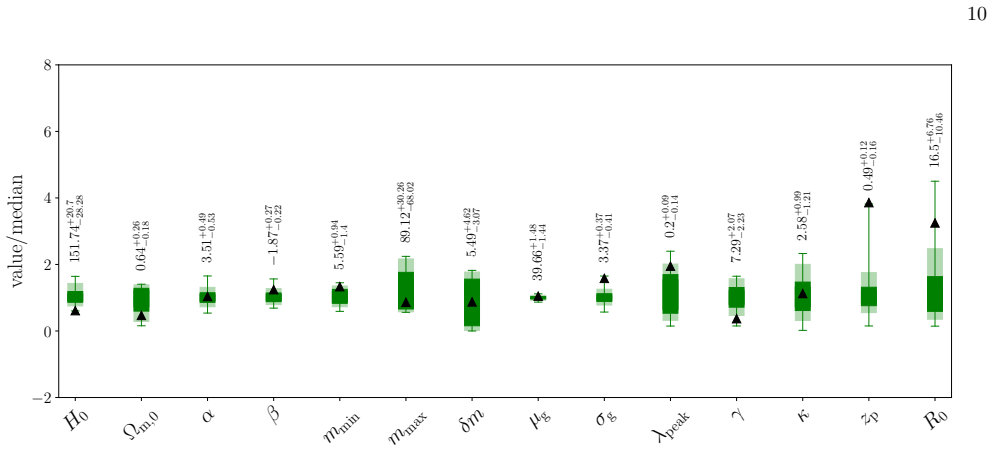

read the original abstract
The measurement of the Hubble constant from gravitational wave (GW) sources is one of the independent avenues to shed light on the Hubble tension, which is associated with about an $8\%$ mismatch in the value of the Hubble constant inferred from low-redshift and high-redshift cosmological probes. Such a key measurement is expected from GW sources as it is a direct measurement of the Hubble constant using the luminosity distance without the need for any luminosity distance calibration. However, such a measurement relies strongly on the reliability of the independent inference of the source redshift of the GW source. As a result, it becomes pertinent to gauge the accuracy and precision of techniques in understanding their reliability in inferring redshifts of GW sources. In this work, we show the requirement of the spectral siren technique in knowing the mass distribution of BBHs across cosmic redshifts in order to make a reliable inference of the Hubble constant. We show by a blinded mock data challenge analysis the criticality in capturing the underlying metallicity dependence of the BBH mass distribution and its interplay with time-delay distribution for a robust inference of the Hubble constant using the spectral siren technique. In order to have a reliable measurement of the Hubble constant at the level required to resolve the Hubble tension in the future, the mass distribution of the BBHs needs to be independently inferred at all relevant redshifts with an accuracy less than the statistical uncertainty. Otherwise, a mismatch of the true model and the underlying assumption made in the analysis can lead to a best-fit model for the wrong value of both BBH population parameters as well as the Hubble constant.
Editorial analysis
A structured set of objections, weighed in public.
Referee Report
Summary. The paper claims that the spectral siren technique for measuring the Hubble constant from binary black hole gravitational wave sources requires precise knowledge of the redshift evolution of the BBH mass distribution. Through a blinded mock data challenge, it demonstrates that mismatches in the assumed metallicity dependence and time-delay distribution lead to biased inferences of both the BBH population parameters and H0. The authors conclude that independent inference of the mass distribution at all relevant redshifts with accuracy better than the statistical uncertainty is necessary to achieve reliable H0 measurements at the precision needed to address the Hubble tension.
Significance. This result is significant because it highlights a critical model dependence in an otherwise promising method for independent H0 measurement. The blinded nature of the challenge is a positive aspect, ensuring the analysis is not tuned to known truths. If the required independent constraints on BBH populations can be obtained (e.g., from electromagnetic observations or improved population models), this could strengthen the case for using spectral sirens in cosmology. However, without evidence that such constraints are feasible at the needed level, the practical impact remains uncertain.
major comments (1)
- [§5 (Conclusions)] §5 (Conclusions): The central claim that 'the mass distribution of the BBHs needs to be independently inferred at all relevant redshifts with an accuracy less than the statistical uncertainty' is not supported by any quantitative demonstration or proposed method in the manuscript. While the mock challenge shows bias from mismatch, the load-bearing step for the recommendation to resolve the Hubble tension is the achievability of this independent inference, which is not addressed.
minor comments (2)
- [Abstract] The abstract mentions 'a blinded mock data challenge analysis' but does not specify the number of events or the magnitude of the bias observed, which would help readers assess the severity.
- Some notation for the mass distribution parameters could be clarified in the methods section to avoid ambiguity with standard BBH population models.
Simulated Author's Rebuttal
We thank the referee for their careful review and constructive feedback on our manuscript. We address the major comment point by point below.
read point-by-point responses
-
Referee: The central claim that 'the mass distribution of the BBHs needs to be independently inferred at all relevant redshifts with an accuracy less than the statistical uncertainty' is not supported by any quantitative demonstration or proposed method in the manuscript. While the mock challenge shows bias from mismatch, the load-bearing step for the recommendation to resolve the Hubble tension is the achievability of this independent inference, which is not addressed.
Authors: We appreciate the referee's comment. The blinded mock data challenge provides a quantitative demonstration that mismatches in the assumed redshift evolution of the BBH mass distribution (arising from incorrect metallicity dependence or time-delay distributions) produce biases in both the inferred population parameters and H0. This directly supports the necessity of independent inference of the mass distribution at all relevant redshifts with accuracy better than the statistical uncertainty to avoid such biases. We agree that the manuscript does not propose or quantitatively assess a specific method for achieving this independent inference in practice, as that would require detailed integration with electromagnetic data or population synthesis models and lies outside the scope of the present work, which focuses on the mock challenge to reveal model dependence. In the revised manuscript, we will update §5 to clarify that our results establish this as a necessary condition for reliable H0 measurements at the precision needed for the Hubble tension, while explicitly noting that the feasibility of obtaining such constraints remains an open question for future research. We will add a brief discussion of potential avenues, such as host-galaxy identification and metallicity measurements from upcoming surveys, without claiming to solve the achievability issue. revision: partial
Circularity Check
No significant circularity; analysis uses independent blinded mocks to demonstrate mismatch bias.
full rationale
The paper's core demonstration relies on blinded mock data challenges where true parameters (including redshift-dependent BBH mass distributions and time-delay effects) are hidden from the analysis. Biases in H0 and population parameters are shown to arise explicitly from mismatches between the assumed model and the true underlying model, rather than from any re-use of fitted quantities as predictions. The requirement for independent mass inference at sub-statistical accuracy is stated as a necessary condition illustrated by the mocks, not derived circularly from the same data or self-citations. No self-definitional steps, fitted inputs renamed as predictions, or load-bearing self-citation chains appear in the abstract or described methodology. The derivation chain is self-contained via external mock benchmarks.
Axiom & Free-Parameter Ledger
axioms (2)
- domain assumption The spectral siren technique infers source redshift statistically from the observed mass distribution of binary black holes.
- domain assumption Metallicity and time-delay distributions govern the redshift evolution of the BBH mass function.
Reference graph
Works this paper leans on
-
[1]
samplerdynesty[78] within theicarogwpackage [24]. A. Spectral sirens method:icarogwsetup The joint posterior of the cosmological and popula- tion parameters Λ, givenN obs GW observations, each described by individual source parametersθ, with data {x}for a given observation timeT obs, is given by ([20, 24, 79, 80]) p(Λ|{x})∝π(Λ)e −Nexp(Λ) NobsY i=1 Tobs Z ...
2000
-
[2]
A relation between distance and radial velocity among extra-galactic nebulae.Proc
Edwin Hubble. A relation between distance and radial velocity among extra-galactic nebulae.Proc. Nat. Acad. Sci., 15:168–173, 1929. 12
1929
-
[3]
B. F. Schutz. Determining the Hubble constant from gravitational wave observations.Nature, 323(6086):310– 311, September 1986
1986
-
[4]
B. P. Abbott et al. A gravitational-wave standard siren measurement of the Hubble constant.Nature, 551(7678):85–88, 2017
2017
-
[5]
Suvodip Mukherjee and Benjamin D. Wandelt. Be- yond the classical distance-redshift test: cross-correlating redshift-free standard candles and sirens with redshift surveys.arXiv:1808.06615, 8 2018
work page Pith review arXiv 2018
-
[6]
Wandelt, and Joseph Silk
Suvodip Mukherjee, Benjamin D. Wandelt, and Joseph Silk. Probing the theory of gravity with gravitational lensing of gravitational waves and galaxy surveys.Mon. Not. Roy. Astron. Soc., 494(2):1956–1970, 2020
1956
-
[7]
Wandelt, Samaya M
Suvodip Mukherjee, Benjamin D. Wandelt, Samaya M. Nissanke, and Alessandra Silvestri. Accurate precision Cosmology with redshift unknown gravitational wave sources.Phys. Rev. D, 103(4):043520, 2021
2021
-
[8]
Incompleteness Matters Not: Inference ofH 0 from Binary Black Hole–Galaxy Cross-correlations.Astrophys
Sayantani Bera, Divya Rana, Surhud More, and Sukanta Bose. Incompleteness Matters Not: Inference ofH 0 from Binary Black Hole–Galaxy Cross-correlations.Astrophys. J., 902(1):79, 2020
2020
-
[9]
Wan- delt, and Joseph Silk
Suvodip Mukherjee, Alex Krolewski, Benjamin D. Wan- delt, and Joseph Silk. Cross-correlating dark sirens and galaxies: constraints onH 0 from GWTC-3 of LIGO- Virgo-KAGRA.Astrophys. J., 975(2):189, 2024
2024
-
[10]
Tashiro, L
Jo˜ ao Ferri, Ian L. Tashiro, L. Raul Abramo, Isabela Matos, Miguel Quartin, and Riccardo Sturani. A ro- bust cosmic standard ruler from the cross-correlations of galaxies and dark sirens. 11 2024
2024
-
[11]
Prospect of precision cosmology and testing general relativity using binary black holes – galaxies cross-correlation.Mon
Samsuzzaman Afroz and Suvodip Mukherjee. Prospect of precision cosmology and testing general relativity using binary black holes – galaxies cross-correlation.Mon. Not. Roy. Astron. Soc., 534(2):1283–1298, 2024
2024
-
[12]
Fishbach et al
M. Fishbach et al. A Standard Siren Measurement of the Hubble Constant from GW170817 without the Electro- magnetic Counterpart.Astrophys. J. Lett., 871(1):L13, 2019
2019
-
[13]
Soares-Santos et al
M. Soares-Santos et al. First Measurement of the Hubble Constant from a Dark Standard Siren using the Dark En- ergy Survey Galaxies and the LIGO/Virgo Binary–Black- hole Merger GW170814.Astrophys. J. Lett., 876(1):L7, 2019
2019
-
[14]
Brady, Hsin-Yu Chen, Will M
Rachel Gray, Ignacio Maga˜ na Hernandez, Hong Qi, Ankan Sur, Patrick R. Brady, Hsin-Yu Chen, Will M. Farr, Maya Fishbach, Jonathan R. Gair, Archisman Ghosh, Daniel E. Holz, Simone Mastrogiovanni, Christo- pher Messenger, Dani` ele A. Steer, and John Veitch. Cos- mological inference using gravitational wave standard sirens: A mock data analysis.Phys. Rev. ...
2020
-
[15]
Bom, Sunil Mucesh, and William G
Antonella Palmese, Clecio R. Bom, Sunil Mucesh, and William G. Hartley. A standard siren measurement of the Hubble constant using gravitational wave events from the first three LIGO/Virgo observing runs and the DESI Legacy Survey. 11 2021
2021
-
[16]
Abbott et al
R. Abbott et al. Constraints on the Cosmic Expansion History from GWTC–3.Astrophys. J., 949(2):76, 2023
2023
-
[17]
Joint cosmological and gravitational- wave population inference using dark sirens and galaxy catalogues.JCAP, 12:023, 2023
Rachel Gray et al. Joint cosmological and gravitational- wave population inference using dark sirens and galaxy catalogues.JCAP, 12:023, 2023
2023
-
[18]
Hanselman, Aditya Vijaykumar, Maya Fishbach, and Daniel E
Alexandra G. Hanselman, Aditya Vijaykumar, Maya Fishbach, and Daniel E. Holz. Gravitational-wave dark siren cosmology systematics from galaxy weighting. 5 2024
2024
-
[19]
A. G. Abac et al. GWTC-4.0: Constraints on the Cosmic Expansion Rate and Modified Gravitational-wave Prop- agation. 9 2025
2025
-
[20]
Farr, Maya Fishbach, Jiani Ye, and Daniel Holz
Will M. Farr, Maya Fishbach, Jiani Ye, and Daniel Holz. A Future Percent-Level Measurement of the Hubble Ex- pansion at Redshift 0.8 With Advanced LIGO.Astro- phys. J. Lett., 883(2):L42, 2019
2019
-
[21]
S. Mastrogiovanni, K. Leyde, C. Karathanasis, E. Chassande-Mottin, D. A. Steer, J. Gair, A. Ghosh, R. Gray, S. Mukherjee, and S. Rinaldi. Cosmology in the dark: On the importance of source population models for gravitational-wave cosmology.arXiv:2103.14663, 3 2021
-
[22]
The redshift dependence of black hole mass distribution: Is it reliable for standard sirens cosmology? 12 2021
Suvodip Mukherjee. The redshift dependence of black hole mass distribution: Is it reliable for standard sirens cosmology? 12 2021
2021
-
[23]
Steer, Eric Chassande-Mottin, and Christos Karathana- sis
Konstantin Leyde, Simone Mastrogiovanni, Dani` ele A. Steer, Eric Chassande-Mottin, and Christos Karathana- sis. Current and future constraints on cosmology and modified gravitational wave friction from binary black holes. 1 2022
2022
-
[24]
Jose Mar´ ıa Ezquiaga and Daniel E. Holz. Spectral sirens: cosmology from the full mass distribution of compact bi- naries. 2 2022
2022
-
[25]
ICAROGW: A python package for inference of astrophysical population properties of noisy, heterogeneous, and incomplete observations.Astron
Simone Mastrogiovanni, Gr´ egoire Pierra, St´ ephane Perri` es, Danny Laghi, Giada Caneva Santoro, Archis- man Ghosh, Rachel Gray, Christos Karathanasis, and Konstantin Leyde. ICAROGW: A python package for inference of astrophysical population properties of noisy, heterogeneous, and incomplete observations.Astron. As- trophys., 682:A167, 2024
2024
-
[26]
Green, Alexandre Toubiana, and Jonathan Gair
Konstantin Leyde, Stephen R. Green, Alexandre Toubiana, and Jonathan Gair. Gravitational wave popu- lations and cosmology with neural posterior estimation. Phys. Rev. D, 109(6):064056, 2024
2024
-
[27]
Study of systematics on the cosmological inference of the Hubble constant from gravitational wave standard sirens.Phys
Gr´ egoire Pierra, Simone Mastrogiovanni, St´ ephane Perri` es, and Michela Mapelli. Study of systematics on the cosmological inference of the Hubble constant from gravitational wave standard sirens.Phys. Rev. D, 109(8):083504, 2024
2024
-
[28]
Beyond Gaps and Bumps: Spectral Siren Cosmology with Non- Parametric Population Models
Ignacio Maga˜ na Hernandez and Anarya Ray. Beyond Gaps and Bumps: Spectral Siren Cosmology with Non- Parametric Population Models. 4 2024
2024
-
[29]
Farah, Thomas A
Amanda M. Farah, Thomas A. Callister, Jose Mar´ ıa Ezquiaga, Michael Zevin, and Daniel E. Holz. No need to know: astrophysics-free gravitational-wave cosmology. 4 2024
2024
-
[30]
Striking a Chord with Spectral Sirens: multiple features in the compact binary population correlate withH 0
Utkarsh Mali and Reed Essick. Striking a Chord with Spectral Sirens: multiple features in the compact binary population correlate withH 0. 10 2024
2024
-
[31]
Blinded mock data chal- lenge for gravitational-wave cosmology
Aman Agarwal, Ulyana Dupletsa, Konstantin Leyde, Su- vodip Mukherjee, Benoit Revenu, Juan Esteban Rivera, Antonio Enea Romano, Mohit Raj Sah, Sergio Vallejo- Pe˜ na, Adrian Avendano, et al. Blinded mock data chal- lenge for gravitational-wave cosmology. i. assessing the robustness of methods using binary black hole mass spec- trum.The Astrophysical Journa...
2025
-
[32]
Aasi et al
J. Aasi et al. Advanced LIGO.Class. Quant. Grav., 32:074001, 2015
2015
-
[33]
Acernese et al
F. Acernese et al. Advanced Virgo: a second-generation interferometric gravitational wave detector.Class. Quant. Grav., 32(2):024001, 2015. 13
2015
-
[34]
Interferometer design of the kagra gravitational wave detector.Phys
Yoichi Aso, Yuta Michimura, Kentaro Somiya, Masaki Ando, Osamu Miyakawa, Takanori Sekiguchi, Daisuke Tatsumi, and Hiroaki Yamamoto. Interferometer design of the kagra gravitational wave detector.Phys. Rev. D, 88:043007, Aug 2013
2013
-
[35]
Verde, T
L. Verde, T. Treu, and A.G. Riess. InTensions between the Early and the Late Universe, 7 2019
2019
-
[36]
Mota, Adam G
Eleonora Di Valentino, Olga Mena, Supriya Pan, Luca Visinelli, Weiqiang Yang, Alessandro Melchiorri, David F. Mota, Adam G. Riess, and Joseph Silk. In the realm of the Hubble tension—a review of solutions. Class. Quant. Grav., 38(15):153001, 2021
2021
-
[37]
Aghanim et al
N. Aghanim et al. Planck 2018 results. VI. Cosmological parameters.Astron. Astrophys., 641:A6, 2020. [Erratum: Astron.Astrophys. 652, C4 (2021)]
2018
-
[38]
Riess, Stefano Casertano, Wenlong Yuan, Lu- cas M
Adam G. Riess, Stefano Casertano, Wenlong Yuan, Lu- cas M. Macri, and Dan Scolnic. Large Magellanic Cloud Cepheid Standards Provide a 1% Foundation for the Determination of the Hubble Constant and Stronger Evidence for Physics beyond ΛCDM.Astrophys. J., 876(1):85, 2019
2019
-
[39]
Cosmic Star Forma- tion History.Ann
Piero Madau and Mark Dickinson. Cosmic Star Forma- tion History.Ann. Rev. Astron. Astrophys., 52:415–486, 2014
2014
-
[40]
A. G. Abac et al. GWTC-4.0: Population Properties of Merging Compact Binaries. 8 2025
2025
-
[41]
Gwsim: Python package for creating mock gw samples for different astrophysical pop- ulations and cosmological models of binary black holes
Christos Karathanasis, Benoˆ ıt Revenu, Suvodip Mukher- jee, and Federico Stachurski. Gwsim: Python package for creating mock gw samples for different astrophysical pop- ulations and cosmological models of binary black holes. Astronomy & Astrophysics, 677:A124, 2023
2023
-
[42]
Observation of gravitational waves from a binary black hole merger.Physical review letters, 116(6):061102, 2016
Benjamin P Abbott, Richard Abbott, Thomas D Ab- bott, Matthew R Abernathy, Fausto Acernese, Kendall Ackley, Carl Adams, Thomas Adams, Paolo Addesso, Rana X Adhikari, et al. Observation of gravitational waves from a binary black hole merger.Physical review letters, 116(6):061102, 2016
2016
-
[43]
Abbott, T
R. Abbott, T. D. Abbott, S. Abraham, F. Acernese, K. Ackley, A. Adams, C. Adams, R. X. Adhikari, V. B. Adya, C. Affeldt, and et al. Gwtc-2: Compact binary coalescences observed by ligo and virgo during the first half of the third observing run.Physical Review X, 11(2), Jun 2021
2021
-
[44]
B. P. Abbott, R. Abbott, T. D. Abbott, S. Abraham, F. Acernese, K. Ackley, C. Adams, R. X. Adhikari, V. B. Adya, C. Affeldt, and et al. Gwtc-1: A gravitational-wave transient catalog of compact binary mergers observed by ligo and virgo during the first and second observing runs. Physical Review X, 9(3), Sep 2019
2019
-
[45]
Abbott et al
R. Abbott et al. GWTC-3: Compact Binary Coales- cences Observed by LIGO and Virgo During the Second Part of the Third Observing Run. 11 2021
2021
-
[46]
GWTC-4.0: Population Properties of Merging Compact Binaries
AG Abac, I Abouelfettouh, F Acernese, K Ackley, C Adamcewicz, S Adhicary, D Adhikari, N Adhikari, RX Adhikari, VK Adkins, et al. Gwtc-4.0: Population properties of merging compact binaries.arXiv preprint arXiv:2508.18083, 2025
work page internal anchor Pith review arXiv 2025
-
[47]
BILBY: A user-friendly Bayesian inference library for gravitational-wave astronomy.As- trophys
Gregory Ashton et al. BILBY: A user-friendly Bayesian inference library for gravitational-wave astronomy.As- trophys. J. Suppl., 241(2):27, 2019
2019
-
[49]
Frequency-domain gravitational waves from nonprecessing black-hole binaries
Sascha Husa, Sebastian Khan, Mark Hannam, Michael P¨ urrer, Frank Ohme, Xisco Jim´ enez Forteza, and Ale- jandro Boh´ e. Frequency-domain gravitational waves from nonprecessing black-hole binaries. i. new numeri- cal waveforms and anatomy of the signal.Phys. Rev. D, 93:044006, Feb 2016
2016
-
[50]
Simple model of complete precessing black-hole-binary gravitational waveforms.Phys
Mark Hannam, Patricia Schmidt, Alejandro Boh´ e, Le¨ ıla Haegel, Sascha Husa, Frank Ohme, Geraint Pratten, and Michael P¨ urrer. Simple model of complete precessing black-hole-binary gravitational waveforms.Phys. Rev. Lett., 113:151101, Oct 2014
2014
-
[51]
Double com- pact objects
Michal Dominik, Krzysztof Belczynski, Christopher Fryer, Daniel E Holz, Emanuele Berti, Tomasz Bulik, Ilya Mandel, and Richard O’shaughnessy. Double com- pact objects. i. the significance of the common envelope on merger rates.The Astrophysical Journal, 759(1):52, 2012
2012
-
[52]
The cosmic merger rate of stellar black hole binaries from the illustris simulation.Monthly Notices of the Royal Astronomical Society, 472(2):2422– 2435, 2017
Michela Mapelli, Nicola Giacobbo, Emanuele Ripamonti, and Mario Spera. The cosmic merger rate of stellar black hole binaries from the illustris simulation.Monthly Notices of the Royal Astronomical Society, 472(2):2422– 2435, 2017
2017
-
[53]
Measuring the star formation rate with gravi- tational waves from binary black holes.The Astrophysical Journal Letters, 886(1):L1, 2019
Salvatore Vitale, Will M Farr, Ken KY Ng, and Carl L Rodriguez. Measuring the star formation rate with gravi- tational waves from binary black holes.The Astrophysical Journal Letters, 886(1):L1, 2019
2019
-
[54]
The binary black hole merger rate deviates from the cos- mic star formation rate: A tug of war between metallicity and delay times.The Astrophysical Journal, 976(1):23, 2024
Adam P Boesky, Floor S Broekgaarden, and Edo Berger. The binary black hole merger rate deviates from the cos- mic star formation rate: A tug of war between metallicity and delay times.The Astrophysical Journal, 976(1):23, 2024
2024
-
[55]
Binary black holes population and cos- mology in new lights: signature of PISN mass and forma- tion channel in GWTC-3.Mon
Christos Karathanasis, Suvodip Mukherjee, and Simone Mastrogiovanni. Binary black holes population and cos- mology in new lights: signature of PISN mass and forma- tion channel in GWTC-3.Mon. Not. Roy. Astron. Soc., 523(3):4539–4555, 2023
2023
-
[56]
Abbott et al
R. Abbott et al. Population of Merging Compact Binaries Inferred Using Gravitational Waves through GWTC-3. Phys. Rev. X, 13(1):011048, 2023
2023
-
[57]
The nucle- osynthetic signature of population iii.The Astrophysical Journal, 567(1):532, 2002
Alexander Heger and Stanford E Woosley. The nucle- osynthetic signature of population iii.The Astrophysical Journal, 567(1):532, 2002
2002
-
[58]
Pair instability supernovae: light curves, spectra, and shock breakout.The Astrophysical Journal, 734(2):102, 2011
Daniel Kasen, SE Woosley, and Alexander Heger. Pair instability supernovae: light curves, spectra, and shock breakout.The Astrophysical Journal, 734(2):102, 2011
2011
-
[59]
Mind the gap: the location of the lower edge of the pair-instability supernova black hole mass gap.The Astrophysical Journal, 887(1):53, 2019
R Farmer, M Renzo, SE de Mink, P Marchant, and S Justham. Mind the gap: the location of the lower edge of the pair-instability supernova black hole mass gap.The Astrophysical Journal, 887(1):53, 2019
2019
-
[60]
The empirical metallicity dependence of the mass-loss rate of o-and early b-type stars.Astron- omy & Astrophysics, 473(2):603–614, 2007
MR Mokiem, Alex de Koter, JS Vink, J Puls, CJ Evans, SJ Smartt, PA Crowther, A Herrero, N Langer, DJ Lennon, et al. The empirical metallicity dependence of the mass-loss rate of o-and early b-type stars.Astron- omy & Astrophysics, 473(2):603–614, 2007
2007
-
[61]
Jacco Th van Loon. On the metallicity dependence of the winds from red supergiants and asymptotic giant branch stars.arXiv preprint astro-ph/0512326, 2005
-
[62]
Mass-loss predictions for o and b stars as a function of metallicity.Astronomy & Astrophysics, 369(2):574–588, 2001
Jorick S Vink, Alex de Koter, and HJGLM Lamers. Mass-loss predictions for o and b stars as a function of metallicity.Astronomy & Astrophysics, 369(2):574–588, 2001. 14
2001
-
[63]
Maiolino, T
R. Maiolino, T. Nagao, A. Grazian, and F. Cocchia. The metallicity evolution at high redshift. In Alan Moorwood, editor,Science with the VLT in the ELT Era, pages 49– 53, Dordrecht, 2009. Springer Netherlands
2009
-
[64]
F Mannucci, G Cresci, R Maiolino, Alessandro Marconi, and Alessio Gnerucci. A fundamental relation between mass, star formation rate and metallicity in local and high-redshift galaxies.Monthly Notices of the Royal As- tronomical Society, 408(4):2115–2127, 2010
2010
-
[65]
Evidence of evolu- tion of the black hole mass function with redshift.Astron
Stefano Rinaldi, Walter Del Pozzo, Michela Mapelli, Ana Lorenzo-Medina, and Thomas Dent. Evidence of evolu- tion of the black hole mass function with redshift.Astron. Astrophys., 684:A204, 2024
2024
-
[66]
The Non Parametric Reconstruction of Binary Black Hole Mass Evolution from GWTC-4.0 Gravitational Wave Catalog
Samsuzzaman Afroz and Suvodip Mukherjee. The Non Parametric Reconstruction of Binary Black Hole Mass Evolution from GWTC-4.0 Gravitational Wave Catalog. 9 2025
2025
-
[67]
Searching for additional structure and redshift evolution in the observed binary black hole population with a parametric time-dependent mass distribution.Phys
Vasco Gennari, Simone Mastrogiovanni, Nicola Tamanini, Sylvain Marsat, and Gr´ egoire Pierra. Searching for additional structure and redshift evolution in the observed binary black hole population with a parametric time-dependent mass distribution.Phys. Rev. D, 111(12):123046, 2025
2025
-
[68]
Stellar initial mass function varies with metallicity and time.Nature, 613(7944):460–462, January 2023
Jiadong Li, Chao Liu, Zhi-Yu Zhang, Hao Tian, Xi- aoting Fu, Jiao Li, and Zhi-Qiang Yan. Stellar initial mass function varies with metallicity and time.Nature, 613(7944):460–462, January 2023
2023
-
[69]
Matthew R. Bate. Variation of the low-mass end of the stellar initial mass function with redshift and metallicity. Mon. Not. Roy. Astron. Soc., 537(2):752–778, 2025
2025
-
[70]
Mannucci, G
F. Mannucci, G. Cresci, R. Maiolino, A. Marconi, and A. Gnerucci. A fundamental relation between mass, star formation rate and metallicity in local and high-redshift galaxies.MNRAS, 408(4):2115–2127, November 2010
2010
-
[71]
Chru´ sli´ nska, T
M. Chru´ sli´ nska, T. Jeˇ r´ abkov´ a, G. Nelemans, and Z. Yan. The effect of the environment-dependent IMF on the for- mation and metallicities of stars over the cosmic history. A&A, 636:A10, April 2020
2020
-
[72]
Fryer, Daniel E
Krzysztof Belczynski, Alessandra Buonanno, Matteo Cantiello, Chris L. Fryer, Daniel E. Holz, Ilya Mandel, M. Coleman Miller, and Marek Walczak. The Forma- tion and Gravitational-Wave Detection of Massive Stellar Black-Hole Binaries.Astrophys. J., 789(2):120, 2014
2014
-
[73]
Michela Mapelli.Formation Channels of Single and Bi- nary Stellar-Mass Black Holes. 2021
2021
-
[74]
Ilya Mandel and Selma E. de Mink. Merging binary black holes formed through chemically homogeneous evolution in short-period stellar binaries.Mon. Not. Roy. Astron. Soc., 458(3):2634–2647, 2016
2016
-
[75]
Boesky, Floor S
Adam P. Boesky, Floor S. Broekgaarden, and Edo Berger. The Binary Black Hole Merger Rate Deviates from the Cosmic Star Formation Rate: A Tug of War between Metallicity and Delay Times.Astrophys. J., 976(1):23, 2024
2024
-
[76]
Vink and A
Jorick S. Vink and A. de Koter. On the metallicity de- pendence of Wolf-Rayet winds.A&A, 442(2):587–596, November 2005
2005
-
[77]
M. R. Mokiem, A. de Koter, J. S. Vink, J. Puls, C. J. Evans, S. J. Smartt, P. A. Crowther, A. Herrero, N. Langer, D. J. Lennon, F. Najarro, and M. R. Villama- riz. The empirical metallicity dependence of the mass-loss rate of O- and early B-type stars.A&A, 473(2):603–614, October 2007
2007
-
[78]
Johnston
C. Johnston. One size does not fit all: Evidence for a range of mixing efficiencies in stellar evolution calcula- tions.A&A, 655:A29, November 2021
2021
-
[79]
Joshua S. Speagle. DYNESTY: a dynamic nested sam- pling package for estimating Bayesian posteriors and ev- idences.MNRAS, 493(3):3132–3158, April 2020
2020
-
[80]
Farr, and Jonathan R
Ilya Mandel, Will M. Farr, and Jonathan R. Gair. Ex- tracting distribution parameters from multiple uncertain observations with selection biases.Mon. Not. Roy. As- tron. Soc., 486(1):1086–1093, 2019
2019
-
[81]
Farr, and Stephen R
Salvatore Vitale, Davide Gerosa, Will M. Farr, and Stephen R. Taylor. Inferring the properties of a popula- tion of compact binaries in presence of selection effects. 7 2020
2020
discussion (0)
Sign in with ORCID, Apple, or X to comment. Anyone can read and Pith papers without signing in.