Recognition: unknown
High-Dimensional Noise to Low-Dimensional Manifolds: A Manifold-Space Diffusion Framework for Degraded Hyperspectral Image Classification
Pith reviewed 2026-05-07 14:03 UTC · model grok-4.3
The pith
Degraded hyperspectral images are first mapped to a low-dimensional manifold and then regularized by diffusion to separate degradations from class features.
A machine-rendered reading of the paper's core claim, the machinery that carries it, and where it could break.
Core claim
The manifold-space diffusion framework first embeds degradation-affected HSI data into a low-dimensional manifold via discriminative spectral-spatial reconstruction that preserves class semantics and reduces redundant variations, after which a diffusion-based generative model regularizes the spectral-spatial distribution on the manifold to enable progressive refinement and stabilization of latent features against residual degradations.
What carries the argument
Manifold-space diffusion (MSDiff), which performs distribution modeling and refinement directly on the low-dimensional manifold produced by the reconstruction step.
If this is right
- Latent features gain stability because diffusion operates only on the manifold after redundant variations have been reduced.
- Class semantics remain intact during projection because the reconstruction task is explicitly discriminative.
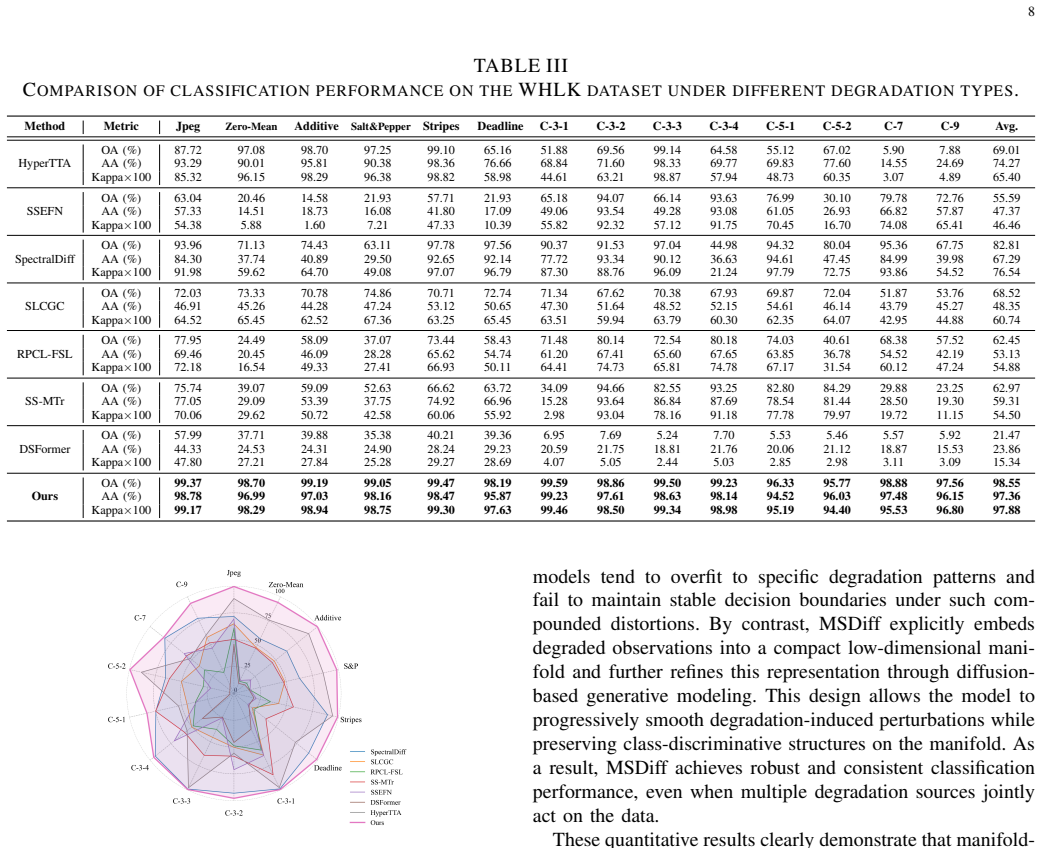
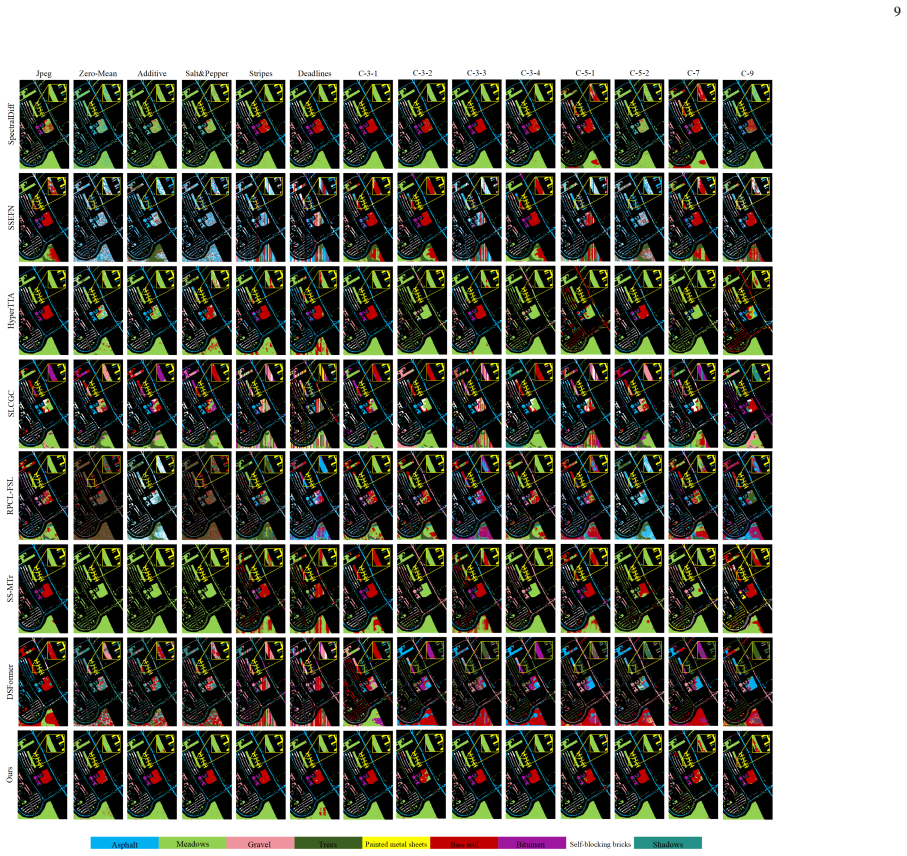
- Performance improves consistently on multiple benchmarks when multiple degradation factors are superimposed.
- The approach decouples degradation disturbances from intrinsic structures more effectively than full-space methods.
Where Pith is reading between the lines
- The same separation of manifold extraction from diffusion regularization could apply to other high-dimensional imaging domains that suffer composite degradations.
- If manifold dimension selection becomes automatic, the framework might scale to larger scenes without manual tuning.
- Focusing generative regularization on the intrinsic low-dimensional space rather than raw data offers a general route to robustness in noisy remote sensing tasks.
Load-bearing premise
Hyperspectral image data are inherently high-dimensional yet low-rank with discriminative information concentrated on a low-dimensional latent manifold that diffusion can regularize to decouple degradations from class structure.
What would settle it
Classification accuracy on standard HSI datasets such as Indian Pines or Pavia University fails to improve or declines relative to strong baselines when the same composite degradations are applied and the manifold-diffusion steps are removed.
Figures





read the original abstract
Recently, Hyperspectral Image (HSI) classification has attracted increasing attention in remote sensing. However, HSI data are inherently high-dimensional but low-rank, with discriminative information concentrated on a low-dimensional latent manifold. In real-world remote sensing scenarios, the superposition of multiple degradation factors disrupts this intrinsic manifold structure, driving samples away from their original low-dimensional distribution and introducing substantial redundant and non-discriminative variations. To better handle this challenge, this paper proposes a manifold-space diffusion framework (MSDiff) for robust hyperspectral classification under complex degradation conditions. Specifically, the proposed method first maps high-dimensional, degradation-affected HSI data into a compact low-dimensional manifold through a discriminative spectral-spatial reconstruction task, preserving class semantics and reducing redundant variations. A diffusion-based generative model is then applied to regularize the spectral-spatial distribution within the manifold, enabling progressive refinement and stabilization of latent features against residual degradations. The key advantage of the proposed framework lies in performing diffusion-based distribution modeling directly on the low-dimensional manifold, effectively decoupling degradation-induced disturbances from intrinsic discriminative structures and enhancing representation stability under complex degradations. Experimental results on multiple hyperspectral benchmarks demonstrate consistent performance improvements over state-of-the-art methods under diverse composite degradation settings. The code will be available at https://github.com/yangboxiang1207/MSDiff
Editorial analysis
A structured set of objections, weighed in public.
Referee Report
Summary. The manuscript proposes MSDiff, a two-stage manifold-space diffusion framework for robust hyperspectral image (HSI) classification under composite degradations. High-dimensional degraded HSI data are first mapped to a compact low-dimensional manifold via a discriminative spectral-spatial reconstruction task that preserves class semantics while reducing redundant variations. A diffusion-based generative model is then applied directly on this manifold to regularize the spectral-spatial distribution, enabling progressive refinement and stabilization of latent features. The central advantage claimed is that diffusion on the manifold decouples degradation disturbances from intrinsic discriminative structures. Experiments on multiple HSI benchmarks are reported to show consistent gains over state-of-the-art methods under diverse degradation settings, with code promised for release.
Significance. If the empirical gains and the manifold-diffusion decoupling hold under scrutiny, the work would offer moderate significance for remote-sensing HSI classification by providing a principled way to handle real-world composite degradations without directly modeling each degradation type. The approach leverages the known low-rank structure of HSI data and shifts diffusion modeling to a semantics-preserving latent space, which could generalize to other high-dimensional degraded imagery tasks. Explicit credit is due for the promised public code release, which supports reproducibility.
major comments (2)
- Abstract and §3 (method overview): the claim that the discriminative reconstruction 'preserves class semantics and reduces redundant variations' is load-bearing for the subsequent diffusion step, yet no loss function, architecture diagram, or quantitative validation (e.g., manifold dimensionality, reconstruction error per class) is referenced to confirm that class-discriminative information is retained rather than collapsed.
- §4 (experiments): the abstract asserts 'consistent performance improvements' under 'diverse composite degradation settings,' but without tabulated results, specific degradation models (e.g., noise levels, blur kernels), or statistical significance tests, it is impossible to assess whether the gains are robust or merely marginal on the chosen benchmarks.
minor comments (2)
- The abstract states that 'the code will be available' but provides only a GitHub placeholder; confirming the repository link and including a reproducibility checklist would strengthen the submission.
- Notation for the manifold dimension and diffusion timestep schedule is not introduced in the visible text; adding a short notation table would aid readability.
Simulated Author's Rebuttal
We thank the referee for the constructive and detailed feedback on our manuscript. We address each major comment point by point below, providing clarifications and committing to revisions that strengthen the presentation without altering the core contributions.
read point-by-point responses
-
Referee: Abstract and §3 (method overview): the claim that the discriminative reconstruction 'preserves class semantics and reduces redundant variations' is load-bearing for the subsequent diffusion step, yet no loss function, architecture diagram, or quantitative validation (e.g., manifold dimensionality, reconstruction error per class) is referenced to confirm that class-discriminative information is retained rather than collapsed.
Authors: We acknowledge that the current description in §3 could be more explicit to substantiate the claim. The discriminative spectral-spatial reconstruction is implemented via a network whose training objective combines a reconstruction term with a classification loss to retain class semantics while suppressing redundant variations; however, the manuscript does not currently include the precise loss formulation, an architecture diagram, or supporting quantitative metrics. We will revise §3 to add the full loss equation, a network architecture diagram, the chosen manifold dimensionality, per-class reconstruction errors, and visualizations (e.g., t-SNE) demonstrating class separation in the manifold. These additions will directly confirm that discriminative information is preserved. revision: yes
-
Referee: §4 (experiments): the abstract asserts 'consistent performance improvements' under 'diverse composite degradation settings,' but without tabulated results, specific degradation models (e.g., noise levels, blur kernels), or statistical significance tests, it is impossible to assess whether the gains are robust or merely marginal on the chosen benchmarks.
Authors: The experiments section already contains tabulated comparisons on multiple benchmarks under composite degradations, but we agree that greater specificity is needed for rigorous evaluation. We will revise §4 to explicitly list the degradation parameters (noise variances, blur kernel sizes and types), ensure all result tables are complete and self-contained, and incorporate statistical significance tests (e.g., paired t-tests with p-values) to establish that the reported gains are robust rather than marginal. These changes will allow readers to fully assess the strength of the empirical evidence. revision: yes
Circularity Check
No significant circularity detected in the framework description
full rationale
The provided abstract and description outline a two-stage process—discriminative spectral-spatial reconstruction to a low-dimensional manifold followed by diffusion-based regularization—without any equations, derivations, or parameter-fitting steps that reduce outputs to inputs by construction. No self-definitional mappings, fitted predictions renamed as results, or load-bearing self-citations appear. The claims rest on the conceptual decoupling of degradations via manifold projection and reported empirical gains on benchmarks, remaining independent of the target classification performance and self-contained against external validation.
Axiom & Free-Parameter Ledger
axioms (1)
- domain assumption HSI data are inherently high-dimensional but low-rank with discriminative information concentrated on a low-dimensional latent manifold
Reference graph
Works this paper leans on
-
[1]
Uav hyperspectral remote sensing image classification: A systematic review,
Z. Zhang, L. Huang, Q. Wang, L. Jiang, Y . Qi, S. Wang, T. Shen, B.-H. Tang, and Y . Gu, “Uav hyperspectral remote sensing image classification: A systematic review,”IEEE J. Sel. Top. Appl. Earth Obs. Remote Sens., vol. 18, pp. 3099–3124, 2025
2025
-
[2]
A systematic review of hyperspectral imaging in precision agriculture: Analysis of its current state and future prospects,
B. G. Ram, P. Oduor, C. Igathinathane, K. Howatt, and X. Sun, “A systematic review of hyperspectral imaging in precision agriculture: Analysis of its current state and future prospects,”Comput. Electron. Agric., vol. 222, p. 109037, 2024. [Online]. Available: https: //www.sciencedirect.com/science/article/pii/S0168169924004289
2024
-
[3]
Exhype: A tool for mineral classification using hyperspectral data,
R. N. Adep, A. shetty, and H. Ramesh, “Exhype: A tool for mineral classification using hyperspectral data,”ISPRS J. Photogramm. Remote Sens., vol. 124, pp. 106–118, 2017. [Online]. Available: https://www.sciencedirect.com/science/article/pii/S0924271616306645
2017
-
[4]
Improving prisma hyperspectral spatial resolution and geolocation by using sentinel-2: development and test of an operational procedure in urban and rural areas,
G. De Luca, F. Carotenuto, L. Genesio, M. Pepe, P. Toscano, M. Boschetti, F. Miglietta, and B. Gioli, “Improving prisma hyperspectral spatial resolution and geolocation by using sentinel-2: development and test of an operational procedure in urban and rural areas,”ISPRS J. Photogramm. Remote Sens., vol. 215, pp. 112–135, 2024. [Online]. Available: https:/...
2024
-
[5]
Fusing hyperspectral proximal sensing to enhance chlorophyll-a estimation from sentinel-2,
N. Li, Y . Zhang, K. Shi, Y . Zhang, W. Lin, X. Luo, B. Qin, G. Zhu, and H. Duan, “Fusing hyperspectral proximal sensing to enhance chlorophyll-a estimation from sentinel-2,”IEEE Trans. Geosci. Remote Sens., vol. 64, pp. 1–15, 2026
2026
-
[6]
Spa- tial–spectral feature-enhanced mamba and sam-guided hyperspectral multiclass change detection,
T. Zhan, J. Qi, J. Zhang, X. Yu, Q. Du, and Z. Wu, “Spa- tial–spectral feature-enhanced mamba and sam-guided hyperspectral multiclass change detection,”IEEE Trans. Geosci. Remote Sens., vol. 63, pp. 1–13, 2025
2025
-
[7]
Deep learning for hyperspectral image classification: A comprehensive review and future predictions,
Y . Song, J. Zhang, Z. Liu, Y . Xu, S. Quan, L. Sun, J. Bi, and X. Wang, “Deep learning for hyperspectral image classification: A comprehensive review and future predictions,”Inf. Fusion, vol. 123, p. 103285, 2025. [Online]. Available: https://www.sciencedirect.com/ science/article/pii/S1566253525003586 13
2025
-
[8]
Fasthymix: Fast and parameter-free hyper- spectral image mixed noise removal,
L. Zhuang and M. K. Ng, “Fasthymix: Fast and parameter-free hyper- spectral image mixed noise removal,”IEEE Trans. Neural Networks Learn. Syst., vol. 34, no. 8, pp. 4702–4716, 2023
2023
-
[9]
Two-stage domain alignment single-source domain generalization network for cross-scene hyperspectral images classification,
X. Wang, J. Liu, Y . Ni, W. Chi, and Y . Fu, “Two-stage domain alignment single-source domain generalization network for cross-scene hyperspectral images classification,”IEEE Trans. Geosci. Remote Sens., vol. 62, pp. 1–14, 2024
2024
-
[10]
Iterative low-rank network for hyperspectral image denoising,
J. Ye, F. Xiong, J. Zhou, and Y . Qian, “Iterative low-rank network for hyperspectral image denoising,”IEEE Trans. Geosci. Remote Sens., vol. 62, pp. 1–15, 2024
2024
-
[11]
Fusing hyperspectral and multispectral images via coupled sparse tensor factorization,
S. Li, R. Dian, L. Fang, and J. M. Bioucas-Dias, “Fusing hyperspectral and multispectral images via coupled sparse tensor factorization,”IEEE Trans. Image Process., vol. 27, no. 8, pp. 4118–4130, 2018
2018
-
[12]
Learning a low tensor-train rank repre- sentation for hyperspectral image super-resolution,
R. Dian, S. Li, and L. Fang, “Learning a low tensor-train rank repre- sentation for hyperspectral image super-resolution,”IEEE Trans. Neural Networks Learn. Syst., vol. 30, no. 9, pp. 2672–2683, 2019
2019
-
[13]
Dimensionality reduction of hyperspectral imagery based on spatial–spectral manifold learning,
H. Huang, G. Shi, H. He, Y . Duan, and F. Luo, “Dimensionality reduction of hyperspectral imagery based on spatial–spectral manifold learning,”IEEE Trans. Cybern., vol. 50, no. 6, pp. 2604–2616, 2020
2020
-
[14]
Multi-degradation oriented deep unfolding model for hyperspectral image reconstruction,
X.-H. Han and J. Wang, “Multi-degradation oriented deep unfolding model for hyperspectral image reconstruction,” inProc. IEEE ICASSP, 2025, pp. 1–5
2025
-
[15]
Back to Basics: Let Denoising Generative Models Denoise
T. Li and K. He, “Back to basics: Let denoising generative models denoise,”arXiv:2511.13720, 2025. [Online]. Available: https: //arxiv.org/abs/2511.13720
work page internal anchor Pith review arXiv 2025
-
[16]
Efficient evolutionary multi-scale spectral-spatial attention fusion network for hyperspectral image classification,
M. Zhang, Z. Lei, L. Liu, K. Ma, R. Shang, and L. Jiao, “Efficient evolutionary multi-scale spectral-spatial attention fusion network for hyperspectral image classification,”Expert Syst. Appl., no. Mar., p. 262, 2025
2025
-
[17]
Mctgcl: Mixed cnn–transformer for mars hyperspec- tral image classification with graph contrastive learning,
B. Xi, Y . Zhang, J. Li, T. Zheng, X. Zhao, H. Xu, C. Xue, Y . Li, and J. Chanussot, “Mctgcl: Mixed cnn–transformer for mars hyperspec- tral image classification with graph contrastive learning,”IEEE Trans. Geosci. Remote Sens., vol. 63, pp. 1–14, 2025
2025
-
[18]
Fusing spatial attention with spectral-channel attention mechanism for hyperspectral image classification via encoder–decoder networks,
J. Sun, J. Zhang, X. Gao, M. Wang, D. Ou, X. Wu, and D. Zhang, “Fusing spatial attention with spectral-channel attention mechanism for hyperspectral image classification via encoder–decoder networks,”Remote Sens., vol. 14, no. 9, 2022. [Online]. Available: https://www.mdpi.com/2072-4292/14/9/1968
2022
-
[19]
Spectral–spatial feature tokenization transformer for hyperspectral image classification,
L. Sun, G. Zhao, Y . Zheng, and Z. Wu, “Spectral–spatial feature tokenization transformer for hyperspectral image classification,”IEEE Trans. Geosci. Remote Sens., vol. 60, pp. 1–14, 2022
2022
-
[20]
A comprehensive survey for hyperspectral image classification: The evolution from conventional to transformers and mamba models,
M. Ahmad, S. Distefano, A. M. Khan, M. Mazzara, C. Li, H. Li, J. Aryal, Y . Ding, G. Vivone, and D. Hong, “A comprehensive survey for hyperspectral image classification: The evolution from conventional to transformers and mamba models,”Neurocomputing, p. 130428, 2025
2025
-
[21]
Hsi-mformer: Integrating mamba and transformer experts for hyperspectral image classification,
Y . He, B. Tu, B. Liu, J. Li, and A. Plaza, “Hsi-mformer: Integrating mamba and transformer experts for hyperspectral image classification,” IEEE Trans. Geosci. Remote Sens., vol. 63, pp. 1–16, 2025
2025
-
[22]
The influence of image degradation on hyperspectral image classification,
C. Li, Z. Li, X. Liu, and S. Li, “The influence of image degradation on hyperspectral image classification,”Remote Sens., vol. 14, no. 20, 2022. [Online]. Available: https://www.mdpi.com/2072-4292/14/20/5199
2022
-
[23]
Hyperspectral image clas- sification with data augmentation and classifier fusion,
C. Wang, L. Zhang, W. Wei, and Y . Zhang, “Hyperspectral image clas- sification with data augmentation and classifier fusion,”IEEE Geosci. Remote Sens. Lett., vol. 17, no. 8, pp. 1420–1424, 2020
2020
-
[24]
Progressive spatial–spectral joint network for hy- perspectral image reconstruction,
T. Li and Y . Gu, “Progressive spatial–spectral joint network for hy- perspectral image reconstruction,”IEEE Trans. Geosci. Remote Sens., vol. 60, pp. 1–14, 2022
2022
-
[25]
Hybrid convolutional and attention network for hyperspectral image denoising,
S. Hu, F. Gao, X. Zhou, J. Dong, and Q. Du, “Hybrid convolutional and attention network for hyperspectral image denoising,”IEEE Geosci. Remote Sens. Lett., vol. 21, pp. 1–5, 2024
2024
-
[26]
Hsi-denet: Hyperspectral image restoration via convolutional neural network,
Y . Chang, L. Yan, H. Fang, S. Zhong, and W. Liao, “Hsi-denet: Hyperspectral image restoration via convolutional neural network,”IEEE Trans. Geosci. Remote Sens., vol. 57, no. 2, pp. 667–682, 2019
2019
-
[27]
Nonlocal band attention network for hyperspectral image band selection,
T. Li, Y . Cai, Z. Cai, X. Liu, and Q. Hu, “Nonlocal band attention network for hyperspectral image band selection,”IEEE J. Sel. Top. Appl. Earth Obs. Remote Sens., vol. 14, pp. 3462–3474, 2021
2021
-
[28]
Classification of hyperspec- tral images via multitask generative adversarial networks,
R. Hang, F. Zhou, Q. Liu, and P. Ghamisi, “Classification of hyperspec- tral images via multitask generative adversarial networks,”IEEE Trans. Geosci. Remote Sens., vol. 59, no. 2, pp. 1424–1436, 2021
2021
-
[29]
Hypertta: Test-time adaptation for hyperspectral image classification under distribution shifts,
X. Yue, A. Liu, N. Chen, C. Huang, H. Liu, Z. Huang, and L. Fang, “Hypertta: Test-time adaptation for hyperspectral image classification under distribution shifts,”arXiv:2509.08436, 2025. [Online]. Available: https://arxiv.org/abs/2509.08436
-
[30]
Data augmentation for hyperspectral image classification with deep cnn,
W. Li, C. Chen, M. Zhang, H. Li, and Q. Du, “Data augmentation for hyperspectral image classification with deep cnn,”IEEE Geosci. Remote Sens. Lett., vol. 16, no. 4, pp. 593–597, 2019
2019
-
[31]
Deep manifold embedding for hyperspectral image classification,
Z. Gong, W. Hu, X. Du, P. Zhong, and P. Hu, “Deep manifold embedding for hyperspectral image classification,”IEEE Trans. Cybern., vol. 52, no. 10, pp. 10 430–10 443, 2022
2022
-
[32]
Spectral- spatial self-supervised learning for few-shot hyperspectral image classification,
W. Chen, Y . Zhang, Z. Xiao, J. Chu, and X. Wang, “Spectral- spatial self-supervised learning for few-shot hyperspectral image classification,”arXiv:2505.12482, 2025. [Online]. Available: https: //arxiv.org/abs/2505.12482
-
[33]
Few-shot hyperspectral image classification with self-supervised learning,
Z. Li, H. Guo, Y . Chen, C. Liu, Q. Du, Z. Fang, and Y . Wang, “Few-shot hyperspectral image classification with self-supervised learning,”IEEE Trans. Geosci. Remote Sens., vol. 61, pp. 1–17, 2023
2023
-
[34]
Hierarchical and bidirectional contrastive learning for hyperspectral image classification,
J. Dong, M. Liang, Z. He, and C. Zhou, “Hierarchical and bidirectional contrastive learning for hyperspectral image classification,”IEEE Trans. Geosci. Remote Sens., vol. 63, pp. 1–17, 2025
2025
-
[35]
Graph- weighted contrastive learning for semi-supervised hyperspectral image classification,
Y . Zhang, Q. Han, L. Wang, K. Cheng, B. Wang, and K. Zhan, “Graph- weighted contrastive learning for semi-supervised hyperspectral image classification,”J. Electron. Imaging, vol. 34, no. 2, pp. 023 044–023 044, 2025
2025
-
[36]
Enhancing contrastive learning with positive pair mining for few-shot hyperspectral image classification,
N. A. A. Braham, J. Mairal, J. Chanussot, L. Mou, and X. X. Zhu, “Enhancing contrastive learning with positive pair mining for few-shot hyperspectral image classification,”IEEE J. Sel. Top. Appl. Earth Obs. Remote Sens., vol. 17, pp. 8509–8526, 2024
2024
-
[37]
Spectraldiff: A generative framework for hyperspectral image classification with diffusion models,
N. Chen, J. Yue, L. Fang, and S. Xia, “Spectraldiff: A generative framework for hyperspectral image classification with diffusion models,” IEEE Trans. Geosci. Remote Sens., vol. 61, pp. 1–16, 2023
2023
-
[38]
Data and knowledge-driven deep multiview fusion network based on diffusion model for hyperspectral image classification,
J. Zhang, F. Zhao, H. Liu, and J. Yu, “Data and knowledge-driven deep multiview fusion network based on diffusion model for hyperspectral image classification,”Expert Syst. Appl., vol. 249, p. 123796, 2024
2024
-
[39]
Beyond dimensionality explosion: A latent diffusion framework for hyperspectral image classification,
M. Lu, N. Chen, X. Yue, Y . Li, J. Yue, and L. Fang, “Beyond dimensionality explosion: A latent diffusion framework for hyperspectral image classification,”Neurocomputing, p. 131249, 2025
2025
-
[40]
Mtlsc-diff: Multitask learning with diffusion models for hyperspectral image super-resolution and classification,
J. Qu, L. Xiao, W. Dong, and Y . Li, “Mtlsc-diff: Multitask learning with diffusion models for hyperspectral image super-resolution and classification,”Knowledge-Based Syst., vol. 303, p. 112415, 2024
2024
-
[41]
Recent advances in diffusion models for hyperspectral image processing and analysis: A review,
X. Hu, X. Liu, D. Hong, Q. Duan, L. Jiang, H. Yang, and D. Zhan, “Recent advances in diffusion models for hyperspectral image processing and analysis: A review,”arXiv:2505.11158, 2025. [Online]. Available: https://arxiv.org/abs/2505.11158
-
[42]
Mini-uav-borne hyperspectral remote sensing: From observation and processing to applications,
Y . Zhong, X. Wang, Y . Xu, S. Wang, T. Jia, X. Hu, J. Zhao, L. Wei, and L. Zhang, “Mini-uav-borne hyperspectral remote sensing: From observation and processing to applications,”IEEE Geosci. Remote Sens. Mag., vol. 6, no. 4, pp. 46–62, 2018
2018
-
[43]
Zhong, X
Y . Zhong, X. Hu, C. Luo, X. Wang, J. Zhao, and L. Zhang, “Whu-hi: Uav-borne hyperspectral with high spatial resolution (h2) benchmark datasets and classifier for precise crop identification based on deep convolutional neural network with crf,”Remote Sens. Environ., vol. 250, p. 112012, 2020
2020
-
[44]
Spectral–spatial masked transformer with supervised and contrastive learning for hyperspectral image classi- fication,
L. Huang, Y . Chen, and X. He, “Spectral–spatial masked transformer with supervised and contrastive learning for hyperspectral image classi- fication,”IEEE Trans. Geosci. Remote Sens., vol. 61, pp. 1–18, 2023
2023
-
[45]
Dual selective fusion transformer network for hyperspectral image classification,
Y . Xu, D. Wang, L. Zhang, and L. Zhang, “Dual selective fusion transformer network for hyperspectral image classification,” Neural Networks, vol. 187, p. 107311, 2025. [Online]. Available: https://www.sciencedirect.com/science/article/pii/S089360802500190X
2025
-
[46]
Slcgc: A lightweight self-supervised low-pass contrastive graph cluster- ing network for hyperspectral images,
Y . Ding, Z. Zhang, A. Yang, Y . Cai, X. Xiao, D. Hong, and J. Yuan, “Slcgc: A lightweight self-supervised low-pass contrastive graph cluster- ing network for hyperspectral images,”IEEE Trans. Multimedia, vol. 27, pp. 8251–8262, 2025
2025
-
[47]
Refined prototypical contrastive learning for few-shot hyperspectral image classification,
Q. Liu, J. Peng, Y . Ning, N. Chen, W. Sun, Q. Du, and Y . Zhou, “Refined prototypical contrastive learning for few-shot hyperspectral image classification,”IEEE Trans. Geosci. Remote Sens., vol. 61, pp. 1–14, 2023
2023
-
[48]
Spatial–spectral enhancement and fusion network for hyperspectral image classification with few labeled samples,
S. Liu, C. Fu, Y . Duan, X. Wang, and F. Luo, “Spatial–spectral enhancement and fusion network for hyperspectral image classification with few labeled samples,”IEEE Trans. Geosci. Remote Sens., vol. 63, pp. 1–14, 2025
2025
discussion (0)
Sign in with ORCID, Apple, or X to comment. Anyone can read and Pith papers without signing in.