Recognition: unknown
Towards Low-Cost Low-Power Activity-Aware Soil Moisture Sensing Platform for Large-scale Farming
Pith reviewed 2026-05-07 13:31 UTC · model grok-4.3
The pith
A platform of $35 buried sensors uses solar power and farm vehicle passes to gather soil moisture data at scale.
A machine-rendered reading of the paper's core claim, the machinery that carries it, and where it could break.
Core claim
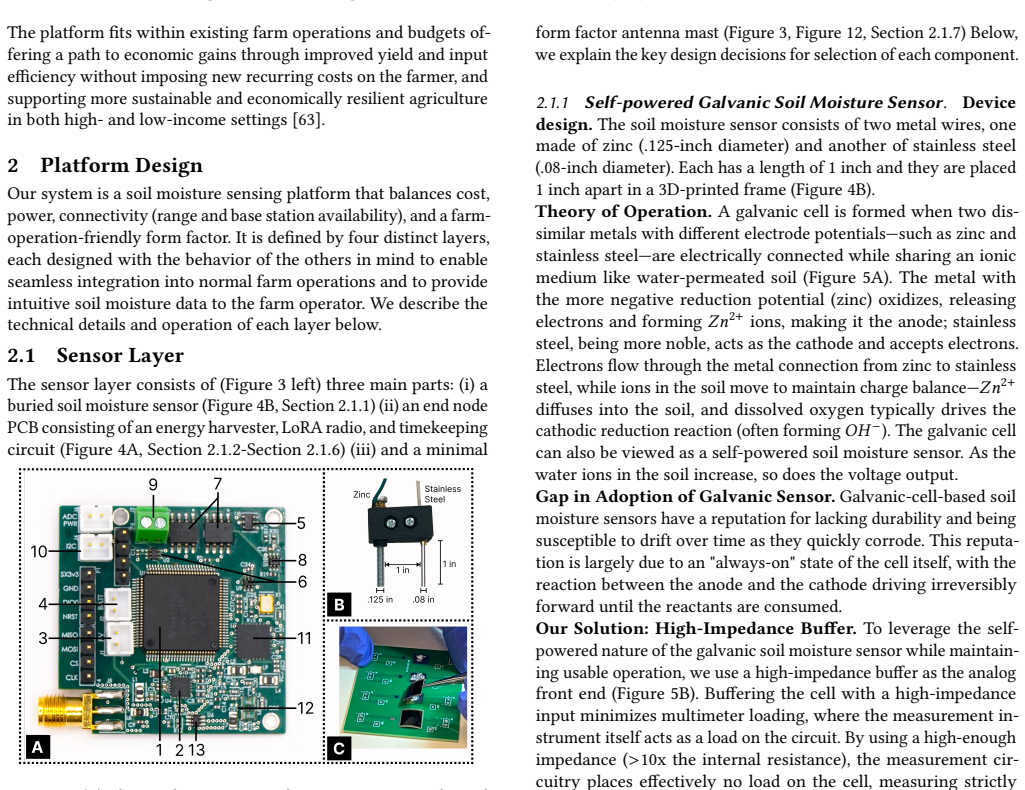
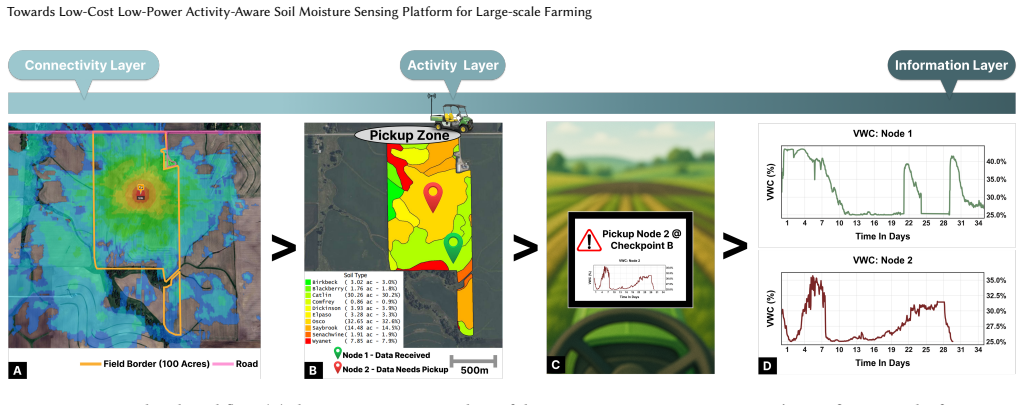
The platform consists of buried sensor nodes costing less than $35 each, featuring a self-powered galvanic soil-moisture probe with high-impedance analog front end, operating on solar-harvested energy stored in a capacitor for up to 21 days. Data is retrieved using a finite-state machine handshake with a mobile basestation on farming vehicles, enabling persistent collection and integration into farmer routines, with experimental validation of 1 km reliable communication at 2 dBm power and stable readings over 70 days.
What carries the argument
The combination of a solar-powered galvanic probe in each buried node and a predictable finite-state machine handshake for data exchange with a vehicle-mounted mobile basestation.
Load-bearing premise
That the buried probes remain durable, accurate, and solar-powered in diverse real farm soil conditions over long times, while the handshake reliably works with moving vehicles without missing nodes or requiring extra farmer intervention.
What would settle it
Long-term outdoor deployment across multiple farms and seasons where probes fail to maintain accuracy or data is lost due to missed handshakes during vehicle passes.
Figures






read the original abstract
Deep understanding of a field's soil moisture content is the leading indicator for predicting crop yields and making data driven decisions for irrigation and application of topical chemicals for drought resilience. Despite this importance, the cost of adopting and maintaining IoT infrastructure prevents modern farms from employing widespread real time soil moisture sensors. We present an end-to-end platform of buried battery-free sensor nodes and a mobile basestation that leverages the farmer's daily routine for data retrieval. Each node features a self-powered galvanic soil-moisture probe, employing a high impedance analog front end to enable durability. Operating entirely on harvested solar energy for up to 21 days on a single capacitor charge, each node collects soil moisture, temperature, and environment condition data. Using a predictable finite-state machine, handshake-based data exchanges occur with a basestation affixed to standard farming vehicles designed to listen for the nodes while moving through the farm. Our platform organizes all sensor, link-quality, and location data into an easy-to-interpret dashboard to seamlessly integrate with the farmer's everyday routine. Costing less than $35, the platform is a financially accessible, accurate, and easily scalable platform that enables persistent, regular data collection from the most rural plots without adding to or impeding farming operations. Experimental evaluation demonstrates reliable communication over 1 km at 2 dBm transmit power, stable sensor readings over 70 days of indoor operation, and continuous data recovery during multiple periods of intermittent connection.
Editorial analysis
A structured set of objections, weighed in public.
Referee Report
Summary. The manuscript presents a low-cost (<$35) battery-free soil moisture sensing platform for large-scale farming. Buried galvanic probe nodes with high-impedance analog front-ends harvest solar energy to operate for up to 21 days on a capacitor, collecting moisture, temperature, and environmental data. A mobile basestation mounted on standard farming vehicles retrieves data via a predictable finite-state machine handshake while moving through fields. The platform includes a dashboard for data visualization. Experimental claims include reliable 1 km communication at 2 dBm transmit power, stable indoor sensor readings over 70 days, and continuous data recovery despite intermittent connections, enabling persistent monitoring without impeding farm operations.
Significance. If the self-powered buried operation and vehicle-integrated retrieval hold under real conditions, the work could meaningfully lower barriers to widespread soil monitoring in rural agriculture by providing an affordable, zero-maintenance alternative to existing IoT systems. The activity-aware design that aligns with daily farming routines is a notable conceptual strength for scalability and adoption.
major comments (3)
- [Experimental Evaluation] Experimental Evaluation section: The 70-day stability result is reported only for indoor operation; no data on buried deployment in soil, incident light levels under soil cover, harvested power measurements, or accuracy against reference probes over time are provided. This directly undermines the central claim of up to 21 days capacitor-based operation and persistent self-powered performance in farm environments.
- [Experimental Evaluation] Communication and system evaluation: The 1 km range at 2 dBm lacks reported details on test environment (open field, obstacles, soil attenuation), number of trials, packet success rates, or performance under moving basestation conditions simulating vehicle motion. Without these, the reliability for intermittent farm traversal cannot be assessed.
- [System Design] System Design and Evaluation: No long-term field results from actual buried nodes in varying farm soils are presented, including probe durability, solar harvesting efficacy, or data completeness over weeks/months. This is load-bearing for the zero-maintenance and scalability assertions.
minor comments (3)
- [Hardware Design] The hardware cost breakdown would benefit from an explicit table listing component prices and sources to substantiate the <$35 claim.
- [System Design] Figures depicting the node enclosure and probe would be clearer with scale bars, material specifications, and burial depth annotations.
- [Discussion] The manuscript would be strengthened by a brief discussion of potential long-term failure modes such as capacitor leakage, probe corrosion in soil, or FSM handshake failures with variable vehicle speeds.
Simulated Author's Rebuttal
We thank the referee for the constructive feedback on our manuscript. The comments highlight important aspects of experimental rigor that we address point-by-point below. Where possible, we commit to revisions that add clarity and details without misrepresenting the scope of the presented work, which focuses on platform design and initial validation rather than exhaustive multi-year field trials.
read point-by-point responses
-
Referee: [Experimental Evaluation] Experimental Evaluation section: The 70-day stability result is reported only for indoor operation; no data on buried deployment in soil, incident light levels under soil cover, harvested power measurements, or accuracy against reference probes over time are provided. This directly undermines the central claim of up to 21 days capacitor-based operation and persistent self-powered performance in farm environments.
Authors: We acknowledge that the 70-day stability evaluation was performed indoors to characterize the sensor electronics and high-impedance front-end in isolation from variable soil and weather factors. The up to 21-day capacitor operation claim is based on laboratory measurements of solar panel output under simulated daylight conditions representative of farm environments combined with measured capacitor discharge curves. We will revise the manuscript to include these harvested power measurements, estimated incident light levels, and a discussion of expected translation to outdoor buried conditions. Comprehensive long-term accuracy data against reference probes in actual soil burial is not presented, as the study emphasizes platform feasibility and the activity-aware retrieval mechanism. revision: partial
-
Referee: [Experimental Evaluation] Communication and system evaluation: The 1 km range at 2 dBm lacks reported details on test environment (open field, obstacles, soil attenuation), number of trials, packet success rates, or performance under moving basestation conditions simulating vehicle motion. Without these, the reliability for intermittent farm traversal cannot be assessed.
Authors: The referee is correct that the communication section would benefit from expanded details. The 1 km tests occurred in an open agricultural field with line-of-sight conditions and minimal obstacles or soil attenuation effects at the tested heights. We conducted 15 trials, obtaining an average packet delivery ratio exceeding 90% at 2 dBm. The finite-state machine handshake was additionally evaluated using a mobile transmitter setup to emulate vehicle traversal speeds and intermittent connectivity. We will update the manuscript with these specifics, including environment description, trial counts, and success rates. revision: yes
-
Referee: [System Design] System Design and Evaluation: No long-term field results from actual buried nodes in varying farm soils are presented, including probe durability, solar harvesting efficacy, or data completeness over weeks/months. This is load-bearing for the zero-maintenance and scalability assertions.
Authors: The manuscript reports initial validation rather than extended multi-month deployments across heterogeneous farm soils. Probe durability relies on material selection and high-impedance design intended to reduce electrochemical degradation, supported by short-term burial observations. Solar harvesting performance draws from component specifications and controlled lab characterizations. We will incorporate a dedicated limitations subsection addressing the absence of long-term field data and outlining how the vehicle-mounted, routine-aligned retrieval supports scalability and zero-maintenance goals. The demonstrated handling of intermittent connections provides evidence for persistent operation potential. revision: partial
- Long-term buried field deployment results across varying farm soils, including multi-week probe durability, in-situ solar harvesting, and data completeness metrics, are not available from the current evaluation and cannot be supplied without conducting additional experiments.
Circularity Check
No circularity; empirical hardware description without derivations
full rationale
The paper presents a hardware platform for soil moisture sensing with experimental evaluations of cost, communication range, and operational stability. No mathematical derivations, equations, fitted parameters, or predictions appear in the provided text. Claims rest on direct physical measurements and system descriptions rather than any self-referential definitions, self-citations, or reductions of outputs to inputs by construction. This is the most common honest finding for descriptive systems papers.
Axiom & Free-Parameter Ledger
axioms (2)
- domain assumption Solar energy harvesting can sustain node operation for up to 21 days on a single capacitor charge under typical farm conditions
- domain assumption The high-impedance analog front end enables long-term durability of the buried galvanic probe
Reference graph
Works this paper leans on
-
[1]
[n. d.]. Broadband — Infrastructure. https://www.usda.gov/sustainability/ infrastructure/broadband. Accessed: 2025-11-13
2025
-
[2]
[n. d.]. CloudRF — Online radio planning software. https://cloudrf.com/. Ac- cessed: 2025-11-13
2025
-
[3]
[n. d.]. Sensing — Soil Scanning Sensors for Agriculture. https://www.veristech. com/sensing. Accessed: 2025-11-13
2025
-
[4]
Meshtastic: Open Source Off-grid Mesh Network
2025. Meshtastic: Open Source Off-grid Mesh Network. https://meshtastic.org/. Accessed: 2025-11-13
2025
-
[5]
Ayele, Nirvana Meratnia, and Paul J.M
Eyuel D. Ayele, Nirvana Meratnia, and Paul J.M. Havinga. 2018. Towards a New Opportunistic IoT Network Architecture for Wildlife Monitoring System. In 2018 9th IFIP International Conference on New Technologies, Mobility and Security (NTMS). IEEE, Paris, 1–5. doi:10.1109/NTMS.2018.8328721
-
[6]
Mattia Barezzi, Alessandro Sanginario, Davide Canone, Davide Gisolo, Alessio Gentile, Luca Nari, Francesca Pettiti, and Umberto Garlando. 2024. WAPPFRUIT—An Automatic System for Drip Irrigation in Orchards Based on Real-Time Soil Matric Potential Data.IEEE Transactions on AgriFood Electronics 2, 2 (Sept. 2024), 293–305. doi:10.1109/TAFE.2024.3455171
-
[7]
Lars Baumgartner, Patrick Lieser, Julian Zobel, Bastian Bloessl, Ralf Steinmetz, and Mira Mezini. 2020. LoRAgent: A DTN-based Location-aware Communication System using LoRa. In2020 IEEE Global Humanitarian Technology Conference (GHTC). IEEE, Seattle, WA, USA, 1–8. doi:10.1109/GHTC46280.2020.9342886
-
[8]
M Benallegue, O Taconet, D Vidal-Madjar, and M Normand. 1995. The use of radar backscattering signals for measuring soil moisture and surface roughness.Remote Sensing of Environment53, 1 (July 1995), 61–68. doi:10.1016/0034-4257(94)00113-2
-
[9]
Deepak Bhadauria, Onur Tekdas, and Volkan Isler. 2011. Robotic data mules for collecting data over sparse sensor fields.Journal of Field Robotics28, 3 (May 2011), 388–404. doi:10.1002/rob.20384
-
[10]
Martin C Bor, John Vidler, and Utz Roedig. 2016. LoRa for the Internet of Things.. InEwsn, Vol. 16. 361–366
2016
-
[11]
G. J. Bouyoucos. 1926. Rapid Determination of the Moisture Content of Soils. Science64, 1670 (Dec. 1926), 651–652. doi:10.1126/science.64.1670.651 Publisher: American Association for the Advancement of Science
-
[12]
Irene Cappelli, Ada Fort, Marco Mugnaini, Enza Panzardi, Alessandro Pozzebon, Marco Tani, and Valerio Vignoli. 2021. Battery-Less HF RFID Sensor Tag for Soil Moisture Measurements.IEEE Transactions on Instrumentation and Measurement 70 (2021), 1–13. doi:10.1109/TIM.2020.3036061
-
[13]
Zhaoxin Chang, Fusang Zhang, Jie Xiong, Junqi Ma, Beihong Jin, and Daqing Zhang. 2022. Sensor-free Soil Moisture Sensing Using LoRa Signals.Proc. ACM Interact. Mob. Wearable Ubiquitous Technol.6, 2 (July 2022), 45:1–45:27. doi:10.1145/3534608
-
[14]
Baicheng Chen, John Nolan, Xinyu Zhang, and Wan Du. 2024. MetaSoil: Passive mmWave Metamaterial Multi-layer Soil Moisture Sensing. InProceedings of the 22nd ACM Conference on Embedded Networked Sensor Systems (SenSys ’24). Association for Computing Machinery, New York, NY, USA, 225–238. doi:10. 1145/3666025.3699334
-
[15]
Po-Yu Chen, Laksh Bhatia, Roman Kolcun, David Boyle, and Julie A. McCann
-
[16]
In2020 IEEE 40th International Conference on Distributed Com- puting Systems (ICDCS)
Contact-Aware Opportunistic Data Forwarding in Disconnected LoRaWAN Mobile Networks. In2020 IEEE 40th International Conference on Distributed Com- puting Systems (ICDCS). 574–583. doi:10.1109/ICDCS47774.2020.00110 ISSN: 2575-8411
-
[17]
Wenyao Chen, Yimeng Feng, Mark Cardamis, Cheng Jiang, Wei Song, Oula Ghannoum, and Wen Hu. 2022. Soil moisture sensing with mmWave radar. In Proceedings of the 6th ACM Workshop on Millimeter-Wave and Terahertz Networks and Sensing Systems. ACM, Sydney NSW Australia, 19–24. doi:10.1145/3555077. 3556472
-
[18]
KEMET Corporation. 2018. Supercap to the Rescue. https://www.mouser. com/pdfdocs/KEMET-SupercapBlog.pdf?srsltid=AfmBOooquS8F85MTRmVs- VVv0FMi35ru6dL4nDbY_apSppOywe6rDMue3. Blog post; Accessed: 2025-11-13
2018
-
[19]
Madeleine Daepp, Alex Cabral, Vaishnavi Ranganathan, Vikram Iyer, Scott Counts, Paul Johns, Asta Roseway, Charlie Catlett, Gavin Jancke, Darren Gehring, Chuck Needham, Curtis von Veh, Tracy Tran, Lex Story, Gabriele D’Amone, and Bichlien Nguyen. 2022. Eclipse: An End-to-End Platform for Low-Cost, Hyperlocal Environmental Sensing in Cities. In2022 Internat...
2022
-
[20]
Madeleine IG Daepp, Alex Cabral, Vaishnavi Ranganathan, Vikram Iyer, Scott Counts, Paul Johns, Asta Roseway, Charlie Catlett, Gavin Jancke, Darren Gehring, et al. 2022. Eclipse: An end-to-end platform for low-cost, hyperlocal environ- mental sensing in cities. In2022 21st ACM/IEEE International Conference on Information Processing in Sensor Networks (IPSN...
2022
-
[21]
Tuan Dang, Trung Tran, Khang Nguyen, Tien Pham, Nhat Pham, Tam Vu, and Phuc Nguyen. 2022. IoTree: a battery-free wearable system with biocompatible sensors for continuous tree health monitoring. InProceedings of the 28th Annual International Conference on Mobile Computing And Networking. ACM, Sydney NSW Australia, 352–366. doi:10.1145/3495243.3567652
-
[22]
Spyridon Nektarios Daskalakis, George Goussetis, Stylianos D. Assimonis, Manos M. Tentzeris, and Apostolos Georgiadis. 2018. A uW Backscatter-Morse- Leaf Sensor for Low-Power Agricultural Wireless Sensor Networks.IEEE Sensors Journal18, 19 (Oct. 2018), 7889–7898. doi:10.1109/JSEN.2018.2861431
-
[24]
Jian Ding and Ranveer Chandra. 2019. Towards Low Cost Soil Sensing Using Wi-Fi. InThe 25th Annual International Conference on Mobile Computing and Networking. ACM, Los Cabos Mexico, 1–16. doi:10.1145/3300061.3345440
-
[25]
Rong Ding, Haiming Jin, Dong Xiang, Xiaocheng Wang, Yongkui Zhang, Ding- man Shen, Lu Su, Wentian Hao, Mingyuan Tao, Xinbing Wang, and Chenghu Zhou. 2023. Soil Moisture Sensing with UAV-Mounted IR-UWB Radar and Deep Learning.Proceedings of the ACM on Interactive, Mobile, Wearable and Ubiquitous Technologies7, 1 (March 2023), 1–25. doi:10.1145/3580867
-
[26]
Marek Doniec, Iulian Topor, Mandar Chitre, and Daniela Rus. 2013. Autonomous, Localization-Free Underwater Data Muling Using Acoustic and Optical Commu- nication. InExperimental Robotics, Jaydev P. Desai, Gregory Dudek, Oussama Khatib, and Vijay Kumar (Eds.). Vol. 88. Springer International Publishing, Heidel- berg, 841–857. doi:10.1007/978-3-319-00065-7_...
-
[27]
Renata Duffková, Lucie Poláková, Vojtěch Lukas, and Petr Fučík. 2022. The Effect of Controlled Tile Drainage on Growth and Grain Yield of Spring Barley as Detected by UAV Images, Yield Map and Soil Moisture Content.Remote Sensing 14, 19 (Jan. 2022), 4959. doi:10.3390/rs14194959 Publisher: Multidisciplinary Digital Publishing Institute
-
[28]
Salah Eddine Elgharbi, Mauricio Iturralde, Yohan Dupuis, and Alain Gaugue
-
[29]
Maritime monitoring through LoRaWAN: Resilient decentralised mesh networks for enhanced data transmission.Computer Communications241 (Sept. 2025), 108276. doi:10.1016/j.comcom.2025.108276
-
[30]
Elhoucaine Elkharrouba, Aliihsan Sekertekin, Jamila Fathi, Yassine Tounsi, Hamid Bioud, and Abdelkrim Nassim. 2022. Surface soil moisture estima- tion using dual-Polarimetric Stokes parameters and backscattering coefficient. Remote Sensing Applications: Society and Environment26 (April 2022), 100737. doi:10.1016/j.rsase.2022.100737
-
[31]
Federal Communications Commission. 2024. Rural Call Completion: Problems with Long Distance or Wireless Calling to Rural Areas. https://www.fcc.gov/general/rural-call-completion-problems-long-distance- or-wireless-calling-rural-areas. Accessed: 2025-11-08
2024
-
[32]
A-S Feiner and AJ McEvoy. 1994. The nernst equation.Journal of chemical education71, 6 (1994), 493
1994
-
[33]
Yuda Feng, Yaxiong Xie, Deepak Ganesan, and Jie Xiong. 2022. LTE-Based Low-Cost and Low-Power Soil Moisture Sensing. InProceedings of the 20th ACM Conference on Embedded Networked Sensor Systems. ACM, Boston Massachusetts, 421–434. doi:10.1145/3560905.3568525
-
[34]
Nikki John B. Florita, Alyssa Nicole M. Senatin, Angela Margaret A. Zabala, and Wilson M. Tan. 2020. Opportunistic LoRa-based gateways for delay-tolerant sensor data collection in urban settings.Computer Communications154 (March 2020), 410–432. doi:10.1016/j.comcom.2020.02.066
-
[35]
Nathan Fourniol, Luc Jaulin, Andreas Arnold-Bos, and Pierre-Jean Bouvet. 2023. Underwater Data Muling: Scenarios, Implementation, and Performances. In OCEANS 2023 - MTS/IEEE U.S. Gulf Coast. 1–7. doi:10.23919/OCEANS52994.2023. 10336964 ISSN: 0197-7385
-
[36]
Pramod Gaikwad, Mruthyunjayachari Chattanahalli Devendrachari, Ravikumar Thimmappa, Bhuneshwar Paswan, Alagar Raja Kottaichamy, Harish Makri Nim- begondi Kotresh, and Musthafa Ottakam Thotiyl. 2015. Galvanic Cell Type Sensor for Soil Moisture Analysis.Analytical Chemistry87, 14 (July 2015), 7439–7445. doi:10.1021/acs.analchem.5b01653 Publisher: American C...
-
[37]
Azhar Hasan, Rahul Bhattacharyya, and Sanjay Sarma. 2015. Towards pervasive soil moisture sensing using RFID tag antenna-based sensors. In2015 IEEE In- ternational Conference on RFID Technology and Applications (RFID-TA). 165–170. doi:10.1109/RFID-TA.2015.7379812
-
[38]
M. E. Holzman, R. Rivas, and M. C. Piccolo. 2014. Estimating soil moisture and the relationship with crop yield using surface temperature and vegetation index. International Journal of Applied Earth Observation and Geoinformation28 (May 2014), 181–192. doi:10.1016/j.jag.2013.12.006 Thoene et al
-
[39]
Fahim Ferdous Hossain, Russ Messenger, George L. Captain, Sabit Ekin, Jamey D. Jacob, Saleh Taghvaeian, and John F. O’Hara. 2022. Soil Moisture Monitoring Through UAS-Assisted Internet of Things LoRaWAN Wireless Underground Sen- sors.IEEE Access10 (2022), 102107–102118. doi:10.1109/ACCESS.2022.3208109
-
[40]
Yuncai Hu, Zoltan Burucs, and Urs Schmidhalter. 2008. Effect of foliar fertilization application on the growth and mineral nutrient content of maize seedlings under drought and salinity.Soil Science and Plant Nutrition54, 1 (Feb. 2008), 133–
2008
-
[41]
doi:10.1111/j.1747-0765.2007.00224.x Publisher: Taylor & Francis _eprint: https://doi.org/10.1111/j.1747-0765.2007.00224.x
-
[42]
Thomas Hänel and Lennart Kaiser. 2024. Estimating Soil Moisture with COTS Hardware using BLE’s Angle-of-Arrival Feature. In2024 IEEE 49th Conference on Local Computer Networks (LCN). 1–6. doi:10.1109/LCN60385.2024.10639811 ISSN: 2832-1421
-
[43]
Texas Instruments Incorporated. 2017. How Does Bluetooth®5 Increase the Achievable Range of a Bluetooth Low Energy Connection? https://www.ti.com/ lit/html/SSZTAG2. Application note SSZTAG2 – JANUARY 2017; Accessed: 2025-11-13
2017
-
[44]
IRTOV. [n. d.]. 4-in-1 Soil Moisture Meter Digital PH Meter/Soil Moisture/Plant Temperature/Sunlight Intensity, Backlight LCD Display, Soil Test Meter for Garden, Lawn, Plant Care, Farm and Indoor Outdoor Plants. https://www. amazon.com/dp/B0DCNX5M45. Accessed: 2025-11-10
2025
-
[45]
Colleen Josephson, Bradley Barnhart, Keith Winstein, Sachin Katti, and Ranveer Chandra. 2020. Time-of-Flight Soil Moisture Estimation Using RF Backscatter Tags. InIGARSS 2020 - 2020 IEEE International Geoscience and Remote Sensing Symposium. 5049–5052. doi:10.1109/IGARSS39084.2020.9323308 ISSN: 2153-7003
-
[46]
Colleen Josephson, Manikanta Kotaru, Keith Winstein, Sachin Katti, and Ranveer Chandra. 2021. Low-cost In-ground Soil Moisture Sensing with Radar Backscatter Tags. InACM SIGCAS Conference on Computing and Sustainable Societies. ACM, Virtual Event Australia, 299–311. doi:10.1145/3460112.3472326
-
[47]
Rasool Keshavarz, Tadashi Okudaira, and Negin Shariati. 2025. Dynamic Soil Moisture Estimation Using BLE RSSI Signals: A Machine Learning-Based Frame- work for Real-Time Monitoring and Flood Detection.IEEE Transactions on Geoscience and Remote Sensing63 (2025), 1–13. doi:10.1109/TGRS.2025.3612100
-
[48]
Schmidt, and Matthias Wählisch
Peter Kietzmann, Jose Alamos, Dirk Kutscher, Thomas C. Schmidt, and Matthias Wählisch. 2022. Delay-Tolerant ICN and Its Application to LoRa. InProceedings of the 9th ACM Conference on Information-Centric Networking. 125–136. doi:10. 1145/3517212.3558081 arXiv:2209.00863 [cs]
-
[49]
Tentzeris, Amal Harrabi, Ana Collado, and Apostolos Georgiadis
Sangkil Kim, Taolan Le, Manos M. Tentzeris, Amal Harrabi, Ana Collado, and Apostolos Georgiadis. 2014. An RFID-enabled inkjet-printed soil moisture sensor on paper for “smart” agricultural applications. In2014 IEEE SENSORS. 1507–1510. doi:10.1109/ICSENS.2014.6985301 ISSN: 1930-0395
-
[50]
Daniel Kiv, Garvita Allabadi, Berkay Kaplan, and Robin Kravets. 2021. smol: Sensing Soil Moisture using LoRa. InProceedings of the 1st ACM Workshop on No Power and Low Power Internet-of-Things (LP-IoT’21). Association for Computing Machinery, New York, NY, USA, 21–27. doi:10.1145/3477085.3478991
-
[51]
Gaël Loubet, Alexandru Takacs, Ethan Gardner, Andrea De Luca, Florin Udrea, and Daniela Dragomirescu. 2019. LoRaWAN Battery-Free Wireless Sensors Network Designed for Structural Health Monitoring in the Construction Domain. Sensors19, 7 (Jan. 2019), 1510. doi:10.3390/s19071510 Publisher: Multidisciplinary Digital Publishing Institute
-
[52]
Marko Malajner, Dusan Gleich, and Peter Planinsic. 2019. Soil type charac- terization for moisture estimation using machine learning and UWB-Time of Flight measurements.Measurement146 (Nov. 2019), 537–543. doi:10.1016/j. measurement.2019.06.042
work page doi:10.1016/j 2019
-
[53]
USA 2018.TEROS 12 User Manual
METER Group, Inc. USA 2018.TEROS 12 User Manual. METER Group, Inc. USA, Pullman, WA, USA. https://www.labcell.com/media/140632/teros12%20manual. pdf Revision date: 2018-03-01
2018
-
[54]
MicroLink Devices, Inc. [n. d.]. Photovoltaics. https://mldevices.com/ photovoltaics-2/. Accessed: 2025-11-10
2025
-
[55]
William T. Moody. 1966. Nonlinear Differential Equation of Drain Spacing. Journal of the Irrigation and Drainage Division92, 2 (June 1966), 1–10. doi:10. 1061/JRCEA4.0000420 Publisher: American Society of Civil Engineers
1966
-
[56]
Mohamed Msaad, Muhammad Waleed, and Sokol Kosta. 2021. Enabling Lo- RaWAN Communication with Out-of-coverage End Nodes in DTN Scenarios Through an Optimised Duty-cycle. In2021 14th CMI International Conference - Critical ICT Infrastructures and Platforms (CMI). 1–6. doi:10.1109/CMI53512.2021. 9663774
-
[57]
National Instruments. [n. d.]. Entry-Level, Plug-and-Play USB Data Acquisition (DAQ) Multifunction I/O Devices. https://www.ni.com/en/shop/data-acquisition/ entry-level-usb-daq.html. Accessed: 2025-11-10
2025
-
[58]
Thanh Vinh Nguyen, Junye Li, Deepak Mishra, and Aruna Seneviratne. 2023. Frequency-Sensitive Soil Moisture Profiling Using WiFi Sensing. In2023 Joint European Conference on Networks and Communications & 6G Summit (EuCNC/6G Summit). 641–646. doi:10.1109/EuCNC/6GSummit58263.2023.10188284 ISSN: 2575-4912
work page doi:10.1109/eucnc/6gsummit58263.2023.10188284 2023
-
[59]
William David Paredes, Hemani Kaushal, Iman Vakilinia, and Zornitza Prodanoff
-
[60]
LoRa Technology in Flying Ad Hoc Networks: A Survey of Challenges and Open Issues.Sensors23, 5 (Jan. 2023), 2403. doi:10.3390/s23052403 Publisher: Multidisciplinary Digital Publishing Institute
-
[61]
John Pender, Joshua Goldstein, Devika Mahoney-Nair, and Hanna Charankevich
-
[62]
Three USDA rural broadband programs: areas and populations served. (2023)
2023
-
[63]
Juha Petajajarvi, Konstantin Mikhaylov, Antti Roivainen, Tuomo Hanninen, and Marko Pettissalo. 2015. On the Coverage of LPWANs: Range Evaluation and Channel Attenuation Model for LoRa Technology. In2015 14th International Conference on ITS Telecommunications (ITST). 55–59. doi:10.1109/ITST.2015. 7377400
-
[64]
Sérgio Francisco Pichorim, Nathan J. Gomes, and John C. Batchelor. 2018. Two Solutions of Soil Moisture Sensing with RFID for Landslide Monitoring.Sensors 18, 2 (Feb. 2018), 452. doi:10.3390/s18020452 Publisher: Multidisciplinary Digital Publishing Institute
-
[65]
Yidong Ren, Gen Li, Yimeng Liu, Younsuk Dong, and Zhichao Cao. [n. d.]. AeroE- cho: Towards Agricultural Low-power Wide-area Backscatter with Aerial Exci- tation Source. ([n. d.])
-
[66]
J. D. Rhoades and J. van Schilfgaarde. 1976. An Electrical Conductivity Probe for Determining Soil Salinity.Soil Science Society of America Journal40, 5 (1976), 647–651. doi:10.2136/sssaj1976.03615995004000050016x
-
[67]
Salman, Mohammed Al-Jumaili, Magdalena Sut-Lohmann, and Wolfgang Durner
Adil K. Salman, Mohammed Al-Jumaili, Magdalena Sut-Lohmann, and Wolfgang Durner. 2024. Wi-Fi signal for soil moisture sensing.Environmental Monitoring and Assessment197, 1 (Dec. 2024), 109. doi:10.1007/s10661-024-13587-x
-
[68]
Mary Sanyaolu and Arkadiusz Sadowski. 2024. The Role of Precision Agricul- ture Technologies in Enhancing Sustainable Agriculture.Sustainability16, 15 (Jan. 2024), 6668. doi:10.3390/su16156668 Publisher: Multidisciplinary Digital Publishing Institute
-
[69]
2016.SX1276/77/78/79 — 137 MHz to 1020 MHz Low Power Long Range Transceiver
Semtech Corporation. 2016.SX1276/77/78/79 — 137 MHz to 1020 MHz Low Power Long Range Transceiver. Technical Report Rev. 5. Semtech Corpora- tion. https://www.mouser.com/datasheet/2/761/sx1276-1278113.pdf?srsltid= AfmBOoo4yH01yD-YyPwFqs2vOjmmriYQmOfDnu9Qy9Gn5KU9FpG75v5B Datasheet
2016
-
[70]
R.C. Shah, S. Roy, S. Jain, and W. Brunette. 2003. Data MULEs: modeling a three-tier architecture for sparse sensor networks. InProceedings of the First IEEE International Workshop on Sensor Network Protocols and Applications, 2003.IEEE, Anchorage, AK, USA, 30–41. doi:10.1109/SNPA.2003.1203354
-
[71]
Reliable evaluation of adversarial robustness with an ensemble of diverse parameter-free attacks
Emerson Sie, Bill Tao, Aganze Mihigo, Parithimaal Karmehan, Max Zhang, Arun N. Sivakumar, Girish Chowdhary, and Deepak Vasisht. 2025. BYON: Bring Your Own Networks for Digital Agriculture Applications. doi:10.48550/arXiv. 2502.01478 arXiv:2502.01478 [cs] version: 1
work page internal anchor Pith review doi:10.48550/arxiv 2025
-
[72]
Soulis, Stamatios Elmaloglou, and Nicholas Dercas
Konstantinos X. Soulis, Stamatios Elmaloglou, and Nicholas Dercas. 2015. In- vestigating the effects of soil moisture sensors positioning and accuracy on soil moisture based drip irrigation scheduling systems.Agricultural Water Manage- ment148 (Jan. 2015), 258–268. doi:10.1016/j.agwat.2014.10.015
-
[73]
G. C. Topp, J. L. Davis, and A. P. Annan. 1980. Electromagnetic determination of soil water content: Measurements in coaxial transmission lines.Water Re- sources Research16, 3 (1980), 574–582. doi:10.1029/WR016i003p00574 _eprint: https://agupubs.onlinelibrary.wiley.com/doi/pdf/10.1029/WR016i003p00574
-
[74]
2020.Rural Connections: Challenges and Opportunities in America’s Heart- land
TRIP. 2020.Rural Connections: Challenges and Opportunities in America’s Heart- land. Technical Report. TRIP. https://tripnet.org/wp-content/uploads/2020/04/ TRIP_Rural_Roads_Report_2020.pdf Report No. 2020 (May)
2020
-
[75]
Emmanuel Tuyishimire, Antoine Bagula, and Adiel Ismail. 2019. Clustered Data Muling in the Internet of Things in Motion.Sensors19, 3 (Jan. 2019), 484. doi:10.3390/s19030484 Publisher: Multidisciplinary Digital Publishing Institute
-
[76]
United Nations. 2015. Sustainable Development Goal 2: Zero Hunger. https: //sdgs.un.org/goals/goal2. Accessed: 2025-11-08
2015
-
[77]
Deepak Vasisht, Zerina Kapetanovic, Jongho Won, Xinxin Jin, Ranveer Chandra, Sudipta Sinha, Ashish Kapoor, Madhusudhan Sudarshan, and Sean Stratman
-
[78]
In14th USENIX Symposium on Networked Systems Design and Implementation (NSDI 17)
{FarmBeats}: an {IoT} platform for {Data-Driven} agriculture. In14th USENIX Symposium on Networked Systems Design and Implementation (NSDI 17). 515–529
-
[79]
G. Vellidis, M. Tucker, C. Perry, D. Reckford, C. Butts, H. Henry, V. Liakos, R.W. Hill, and W. Edwards. 2013. A soil moisture sensor-based variable rate irrigation scheduling system. InPrecision agriculture ’13, John V. Stafford (Ed.). Brill | Wageningen Academic, 713–720. doi:10.3920/9789086867783_090
-
[80]
Ju Wang, Liqiong Chang, Shourya Aggarwal, Omid Abari, and Srinivasan Keshav
-
[81]
DarkneTZ: Towards model privacy at the edge using trusted execution environments,
Soil moisture sensing with commodity RFID systems. InProceedings of the 18th International Conference on Mobile Systems, Applications, and Services. ACM, Toronto Ontario Canada, 273–285. doi:10.1145/3386901.3388940
discussion (0)
Sign in with ORCID, Apple, or X to comment. Anyone can read and Pith papers without signing in.