Recognition: unknown
Turing patterns on non-fluctuating surfaces under mechanical stresses
Pith reviewed 2026-05-07 12:39 UTC · model grok-4.3
The pith
Turing patterns on fixed lattices respond to mechanical stress via Finsler modeling with directional internal degrees of freedom.
A machine-rendered reading of the paper's core claim, the machinery that carries it, and where it could break.
Core claim
Turing patterns formed by the activator-inhibitor system on non-fluctuating lattices, when equipped with Finsler geometry containing the internal degree of freedom τ for stress orientation and a Gaussian bond potential stress formula, produce entropy values that capture stress relaxation and yield pattern responses to external mechanical forces that parallel those observed on fluctuating surfaces.
What carries the argument
Finsler geometry modeling with internal vector τ that supplies the direction of mechanical stress on fixed lattices, combined with the Gaussian bond potential stress formula that remains well-defined without vertex fluctuations.
If this is right
- Mechanical forces can reorganize Turing patterns on rigid biological structures such as pigment cells whose positions do not fluctuate.
- Entropy associated with stress relaxation can be computed directly on non-fluctuating discrete lattices.
- The same qualitative response to external stress previously seen on fluctuating membranes extends to static lattices.
- Biological patterns in fixed-position systems remain sensitive to mechanical boundary conditions.
Where Pith is reading between the lines
- The modeling choice suggests that stress effects on pattern formation need not rely on membrane undulations and may operate through directional biases alone.
- The fixed-lattice formulation could be adapted to study pattern stability in other discrete biological or material systems under controlled loads.
- If the entropy calculation holds, it offers a route to quantify how quickly stressed patterns relax toward equilibrium shapes on rigid substrates.
Load-bearing premise
The Finsler geometry with internal degree of freedom τ together with the Gaussian bond potential stress formula correctly represent mechanical stress effects on lattices that have no vertex fluctuations.
What would settle it
Running the reaction-diffusion simulation on a fixed lattice with and without the τ field under identical boundary stresses and checking whether the resulting pattern wavelengths, orientations, or relaxation entropies differ as predicted by the Finsler term.
Figures


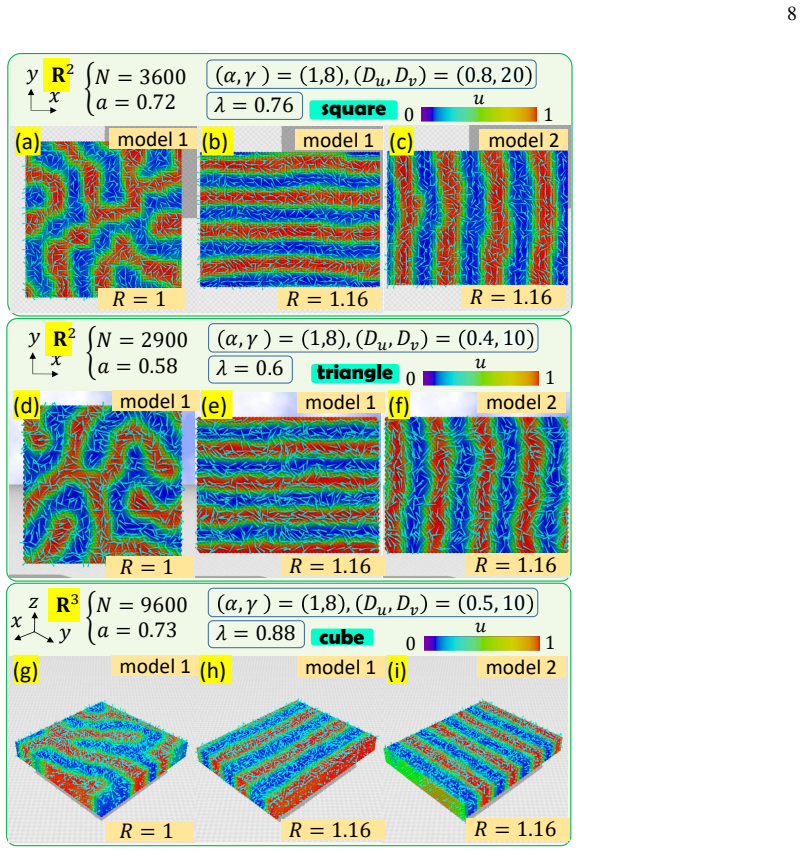


read the original abstract
This paper presents a numerical investigation of Turing patterns (TPs) utilizing the reaction-diffusion equation for the activator $u$ and the inhibitor $v$ on two- and three-dimensional lattices, discarding vertex fluctuations. The absence of vertex fluctuations means the absence of positional movement of $u$ and $v$. Consequently, $u$ and $v$ have values at spatially discrete points, such as the pigment cells in zebrafish and sea shells. Furthermore, the mechanical property is implemented through the Finsler geometry modeling technique. This technique incorporates the internal degree of freedom $\vec{\tau}$, corresponding to the direction of mechanical stress. Additionally, a stress formula based on Gaussian bond potential is shown to be well-defined on the non-fluctuating lattices, and therefore, it enables the calculation of entropy for capturing the stress relaxation phenomenon in a manner analogous to that on fluctuating surfaces. The results of the study indicate that these biological patterns also exhibit responses to external mechanical forces similar to TPs on fluctuating membranes.
Editorial analysis
A structured set of objections, weighed in public.
Referee Report
Summary. The paper numerically studies Turing patterns formed by reaction-diffusion equations for activator u and inhibitor v on fixed 2D and 3D lattices (no vertex fluctuations), incorporating mechanical stress via Finsler geometry with an internal degree of freedom τ representing stress direction. A Gaussian bond potential is used to define a stress that is claimed to be well-defined on non-fluctuating lattices, permitting an entropy calculation for stress relaxation analogous to the fluctuating-membrane case. The central claim is that the resulting patterns respond to external mechanical forces in a manner similar to Turing patterns on fluctuating surfaces, with implications for biological examples such as zebrafish pigmentation and sea-shell patterns.
Significance. If the Finsler-plus-Gaussian-bond modeling on fixed lattices can be shown to produce a mechanically analogous stress-relaxation mechanism, the work would usefully extend Turing-pattern studies to non-fluctuating biological contexts under stress. The direct numerical approach and the attempt to define entropy without positional fluctuations are positive features; however, the absence of validation against known limiting cases and quantitative comparisons leaves the similarity claim only partially supported at present.
major comments (3)
- [Abstract / stress-formula section] Abstract and the section introducing the stress formula: the claim that the Gaussian bond potential 'is shown to be well-defined on the non-fluctuating lattices' and 'enables the calculation of entropy for capturing the stress relaxation phenomenon in a manner analogous to that on fluctuating surfaces' is load-bearing for the central claim, yet the manuscript provides no explicit derivation or numerical check showing how the potential (normally dependent on length fluctuations) produces a comparable entropy when vertex positions are fixed and only τ orientations vary.
- [Results / numerical comparisons] Results section (comparison of patterns with and without stress): the similarity to fluctuating-membrane Turing patterns is presented as an observational outcome of the simulations, but no quantitative metrics (e.g., wavelength shifts, amplitude changes, or correlation coefficients with reference fluctuating cases) or error analysis are reported, nor are the specific values of reaction rates, diffusion constants, and Finsler stress parameters listed, making it impossible to assess robustness or reproducibility of the claimed mechanical response.
- [Finsler geometry / entropy calculation] Method section on Finsler implementation: the internal degree of freedom τ is introduced to capture stress direction, but the manuscript does not address the skeptic's concern that, on a fixed lattice, the entropy reduces to a combinatorial average over discrete τ states rather than a genuine mechanical relaxation; a concrete test (e.g., comparison of entropy scaling with system size or with an explicitly fluctuating reference) is needed to confirm the analogy.
minor comments (2)
- [Abstract] The abstract states that u and v 'have values at spatially discrete points, such as the pigment cells in zebrafish and sea shells,' but does not clarify whether the lattice spacing is chosen to match biological length scales or is purely numerical.
- [Figures] Figure captions (presumed) should explicitly state the lattice sizes, boundary conditions, and the precise functional form of the added Finsler stress term used in each panel.
Simulated Author's Rebuttal
We thank the referee for the careful reading and valuable comments, which have helped us improve the manuscript. We address each major comment below and will make the necessary revisions to strengthen the presentation of our results.
read point-by-point responses
-
Referee: [Abstract / stress-formula section] Abstract and the section introducing the stress formula: the claim that the Gaussian bond potential 'is shown to be well-defined on the non-fluctuating lattices' and 'enables the calculation of entropy for capturing the stress relaxation phenomenon in a manner analogous to that on fluctuating surfaces' is load-bearing for the central claim, yet the manuscript provides no explicit derivation or numerical check showing how the potential (normally dependent on length fluctuations) produces a comparable entropy when vertex positions are fixed and only τ orientations vary.
Authors: We agree that an explicit derivation would clarify this key point. In the revised manuscript, we will add a dedicated subsection deriving the stress formula from the Gaussian bond potential under the Finsler geometry framework, demonstrating its well-defined nature on fixed lattices where only the internal variable τ varies. We will also include numerical verifications showing how the entropy is computed and its analogy to the fluctuating case. revision: yes
-
Referee: [Results / numerical comparisons] Results section (comparison of patterns with and without stress): the similarity to fluctuating-membrane Turing patterns is presented as an observational outcome of the simulations, but no quantitative metrics (e.g., wavelength shifts, amplitude changes, or correlation coefficients with reference fluctuating cases) or error analysis are reported, nor are the specific values of reaction rates, diffusion constants, and Finsler stress parameters listed, making it impossible to assess robustness or reproducibility of the claimed mechanical response.
Authors: We acknowledge the need for quantitative support. The revised version will include tables listing all parameter values (reaction rates, diffusion constants, Finsler parameters) used in the simulations. Additionally, we will report quantitative metrics including wavelength shifts, amplitude changes, and correlation coefficients comparing patterns with and without stress, along with error bars from multiple runs to assess robustness. revision: yes
-
Referee: [Finsler geometry / entropy calculation] Method section on Finsler implementation: the internal degree of freedom τ is introduced to capture stress direction, but the manuscript does not address the skeptic's concern that, on a fixed lattice, the entropy reduces to a combinatorial average over discrete τ states rather than a genuine mechanical relaxation; a concrete test (e.g., comparison of entropy scaling with system size or with an explicitly fluctuating reference) is needed to confirm the analogy.
Authors: We will clarify this distinction in the revision. Although the lattice is fixed in position, the continuous or discrete orientations of τ provide the degrees of freedom for stress relaxation, and the entropy is derived from the Boltzmann weight over these configurations, analogous to the positional entropy in fluctuating membranes. We will add a concrete test by showing the scaling of entropy with system size and, if feasible, a brief comparison to a fluctuating reference case to support the analogy. revision: yes
Circularity Check
No significant circularity; derivation is self-contained numerical simulation
full rationale
The paper's central results arise from direct numerical integration of the reaction-diffusion system on fixed lattices with an added Finsler stress term constructed from the Gaussian bond potential and internal variable τ. No step equates a claimed prediction or first-principles outcome to its own inputs by construction, nor does any load-bearing premise reduce to a self-citation whose validity is presupposed. The entropy calculation is asserted to be well-defined on non-fluctuating lattices and to capture stress relaxation analogously, but this is presented as an enabling modeling choice whose consequences are then observed in simulation rather than a tautological identity. The similarity claim to fluctuating-membrane Turing patterns is observational, not a statistical fit or definitional renaming.
Axiom & Free-Parameter Ledger
free parameters (2)
- reaction rates and diffusion constants
- Finsler stress parameters
axioms (2)
- domain assumption Finsler geometry can incorporate mechanical stress direction on non-fluctuating lattices
- domain assumption Gaussian bond potential stress formula is well-defined and allows entropy calculation on fixed lattices
Reference graph
Works this paper leans on
-
[1]
In this subsection, we demonstrate that the mechanical anisotropy in 3D rigid plates deformed oblong along thex-direction is equivalent to that observed in 2D soft surfaces in Refs
The magnitude of the unit Finsler lengthχ G i1 along bondi1 depends on the model, thereby determining the ⃗τdirection and the coupling constantΓ G i1, as shown in (c) and (d). In this subsection, we demonstrate that the mechanical anisotropy in 3D rigid plates deformed oblong along thex-direction is equivalent to that observed in 2D soft surfaces in Refs....
-
[2]
Discrete Finsler metric We present how the discrete expression ofH 1 in Eq. (5) is obtained from the continuous Hamiltonian H1 = 1 2 Z p gGd2xgab G ∂⃗r ∂x a · ∂⃗r ∂x b ,(A1) whereg ab G is the inverse of the Finsler metricg G ab at vertexi, and it is given by (Fig. 10(a)) gG ab = (χ G i1)−2 0 0(χ G i2)−2 , p gG = q detg G ab = 1 χG i1 χG i2 ,g ab G = (gG ...
-
[3]
10(b), andℓ i j =∥⃗rj −⃗ri∥
Discrete Hamiltonian on square lattice Replacing the integral with the sum over squares and the differential with the difference such that Z p gGd3x→ ∑ □ p gG ∂⃗ri ∂x j →⃗rj−⃗ri, (A6) we obtain ∑□ p gG gi1 Gℓ2 i1+gi2 Gℓ2 i2 , where the local coordinate(x 1,x 2)is assumed as shown in Fig. 10(b), andℓ i j =∥⃗rj −⃗ri∥. The factor 1/2 is dropped because it is...
-
[4]
10(c), we have H1 → ∑ △ 1 χG i1 χG i2 (χ G i1)2ℓ2 i1 + (χG i2)2ℓ2 i2 = ∑ △ χG i1 χG i2 ℓ2 i1 + χG i2 χG i1 ℓ2 i2 , (A11) which is the same as that in Eq
Discrete Hamiltonian on triangular lattice Using the local coordinate(x 1,x 2)of the trianglei12 in Fig. 10(c), we have H1 → ∑ △ 1 χG i1 χG i2 (χ G i1)2ℓ2 i1 + (χG i2)2ℓ2 i2 = ∑ △ χG i1 χG i2 ℓ2 i1 + χG i2 χG i1 ℓ2 i2 , (A11) which is the same as that in Eq. (A7). Since there are three possible local coordinates on a triangle, by replacing(i1,i2)with (12,...
-
[5]
In contrast, in 3D case, the lattice structure as well as the expression ofγ G i j differs from the 2D cases
Discrete Hamiltonian on 3D cubic lattice As shown in the preceding subsections in this Appendix, the difference in the lattice structure between square and triangular lattices is reflected inγ G i j. In contrast, in 3D case, the lattice structure as well as the expression ofγ G i j differs from the 2D cases. Therefore, in this section, we show how the 3D ...
-
[6]
Normalized effective tension coefficient of the Gaussian bond potential As shown in the preceding subsection in the square lattice case, the summation convention can be changed from the sum over squares to the sum over bonds using the relation∑□ ∑i j(□)=∑i j ∑□(i j), where ∑□(i j) denotes the sum over squares sharing bond i j(Fig. 10(b)). Letn i j(= ∑□(i ...
-
[7]
From the discrete expression ofH D u ,△uis obtained by the variation ofH D u = ∑i jDu i j(ui −u j)2 in Eq
Discrete Laplacian We describe the discrete expression of Laplacian△uin this subsection. From the discrete expression ofH D u ,△uis obtained by the variation ofH D u = ∑i jDu i j(ui −u j)2 in Eq. (6). Using the relation ∑ jk = 1 2 ∑ j ∑k(j) , we obtain 0=δH D u =δu i δ δu i HD u =δu i δ δu i ∑ jk Du jk(uk −u j)2 =2δu i ∑ jk Du jk (ukδki −u jδki −u kδ ji +...
-
[8]
(4) is ui(t+∆t)←u i(t) +∆t(D u△ui(t) +f(u i(t),v i(t))), vi(t+∆t)←v i(t) +∆t(D v△vi(t) +g(u i(t),v i(t)))
Discrete RD equations and hybrid numerical technique The discrete form of RD equation in Eq. (4) is ui(t+∆t)←u i(t) +∆t(D u△ui(t) +f(u i(t),v i(t))), vi(t+∆t)←v i(t) +∆t(D v△vi(t) +g(u i(t),v i(t))). (C1) The discrete Laplacian△u i is given by Eq. (A24). The hybrid simulation procedure is as follows: (i) The discrete time evolution of Eq. (C1) is iterated...
-
[9]
Meinhardt, Models of biological pattern formation, (Acadimic Press, London, 1982), https://www.bio.mpg.de/255364/download-of- models-of-biological-pattern-formation
H. Meinhardt, Models of biological pattern formation, (Acadimic Press, London, 1982), https://www.bio.mpg.de/255364/download-of- models-of-biological-pattern-formation
1982
-
[10]
M. C. Cross and P. C. Hohenberg,Pattern formation outside of equilibrium, Rev. Mod. Phys.65, 851-1112 (1993), https://doi.org/10.1103/RevModPhys.65.851
-
[11]
Koch and H
A. Koch and H. Meinhardt,Rev. Mod. Phys., 1994;66No. 4: 1491-1507
1994
-
[12]
Meinhardt, The Algorithmic Beauty of Sea Shells, (Springer, Berlin Heidelberg, 2009)
H. Meinhardt, The Algorithmic Beauty of Sea Shells, (Springer, Berlin Heidelberg, 2009)
2009
-
[13]
A. F. Taylor and M. R. Tinsley,A path to patterns, Nat. Chem..1, 340-341 (2009), https://doi.org/10.1038/nchem.310
-
[14]
G. Falasco, R. Rao, and M. Espo,Information Thermodynamics of Turing Patterns, Phys. Rev. Lett.121, 108301 (2018), https://doi.org/10.1103/PhysRevLett.121.108301
-
[15]
F. Avanzini, T. Aslyamov, ´E. Fodor, and M. Esposito,Nonequilibrium thermodynamics of non-ideal reaction–diffusion systems: Implica- tions for active self-organization, J. Chem. Phys. 161, 174108 (2024), https://doi.org/10.1063/5.0231520
-
[16]
Fitzhugh, Impulses and Physiological States in Theoretical Models of Nerve membrane,Biophysical J., 1961;1: 446-466
D. Fitzhugh, Impulses and Physiological States in Theoretical Models of Nerve membrane,Biophysical J., 1961;1: 446-466
1961
-
[17]
Nagumo, S
J. Nagumo, S. Arimioto, and S. Yoshizawa, An Active Pulse Transmission Line Simulating Nerve Axon,Proc. of the IRE., 1962; 2061- 2070
1962
-
[18]
A. Gierer, and H. Meinhardt, A theory of biological pattern formation,Kybernetik, 1972;12: 30-39, https://doi.org/10.1007/BF00289234
-
[19]
Kondo and R
S. Kondo and R. Asai, A reaction-diffusion wave on the skin of the marine anglefish Pomacanthus ,Nature, 1995;376: 765-768
1995
-
[20]
S. Kondo and T. Miura, Reaction-Diffusion Model as a Framework for Understanding Biological Pattern Formation,Science, 2010;329: 1616-1620, DOI: 10.1126/science.1179047
-
[21]
T. Sekimura, A. Madzvamuse, A.J. Wathen and P.K. Maini, A model for colour pattern formation in the butterfly wing of Papilio dardanus, Proc. R. Soc. Lond. B, 2000;267: 851-859, DOI: 10.1098/rspb.2000.1081
-
[22]
Shoji, A
H. Shoji, A. Mochizuki, Y . Iwasa, M. Hirata, T. Watanabe, S. Hioki, and S. Kondo, Origin of Directionality in the Fish Stripe Pattern, Developemental Dynamics, 2003;226: 627-633
2003
-
[23]
Shoji and Y
H. Shoji and Y . Iwasa, Pattern Selection and the Direction of Stripes in Two-Dimensional Turing Systems for Skin Pattern Formation of Fishes,Forma, 2003;18: 3-18, https://forma.katachi-jp.com/pdf/1801/18010003.pdf
2003
-
[24]
Iwamoto and H
R. Iwamoto and H. Shoji, Kakusan Ihousei Turing Pattern,RIMS Kokyuroku(in Japanese), 2018;2087: 108-117
2018
-
[25]
A. Nakamasu, G. Takahashi, A. Kanbe, and S. Kondo, Interactions between zebrafish pigment cells responsible for the generation of Turing patterns,PNAS, 2009;106: 8429-8434, https://www.pnas.org/doi/10.1073/pnas.0808622106
-
[26]
P. Mahalwar, B. Walderich, A.P. Singh, C.N. V olhard, Local reorganization of xanthophores fine-tunes and colors the striped pattern of zebrafish,Science, 2014;345: 1362-1364, https://www.science.org/doi/10.1126/science.1254837
-
[27]
H. Yamanaka and S. Kondo, In vitro analysis suggests that difference in cell movement during direct interaction can generate various pigment patterns in vivo,PNAS, 2014;111: 1867-18724, https://www.pnas.org/doi/full/10.1073/pnas.1315416111
-
[28]
R. Sawada, T. Aramaki and S. Kondo, Flexibility of pigment cell behavior permits the robustness of skin pattern formation,Genes to Cells, 2018;23: 537-545, https://doi.org/10.1111/gtc.12596
-
[29]
Z. Tan, S. Chen, X. Peng, L. Zhang, C. Gao, Polyamide membranes with nanoscale Turing structures for water purification,Science, 2018;360: 518-521, DOI: 10.1126/science.aar6308
-
[30]
Y . Fuseya, H. Katsuno, K. Behnia and A. Kapitulnik, Nanoscale Turing patterns in a bismuth monolayer,Nature Phys., 2021;17: 1031- 1036, https://doi.org/10.1038/s41567-021-01288-y
-
[31]
M. W. Noble, M. R. Tonks and S. P. Fitzgerald, Turing Instability in the Solid State: V oid Lattices in Irradiated Metals, Phts. Rev. Lett. 124, 167401 (2020), https://doi.org/10.1103/PhysRevLett.124.167401
-
[32]
H.G. Othmer and L.E. Scriven, Instability and Dynamic Pattern in Cellular Networks,J. theor. Biol., 1971;32: 507-5370, https://doi.org/10.1016/0022-5193(71)90154-8
-
[33]
H. Nakao, and A.S. Mikhailov, Turing patterns in network-organized activator-inhibitor systems,Nature Phys., 2010;6: 544-550, DOI: 10.1038/NPHYS1651
-
[35]
T. Carletti and H. Nakao, Turing patterns in a network-reduced FitzHugh-Nagumo model,Phys, Rev. E, 2020;101: 022203, DOI: 10.1103/PhysRevE.101.022203
-
[36]
M. Asllani, J.D. Challenger, F.S. Pavone, L. Sacconi and D. Fanelli, The theory of pattern formation on directed networks,Nature Comm., 2014;5: 4517, DOI: 10.1038/ncomms5517
-
[37]
M. Asllani, D.M. Busiello, T. Carletti, D. Fanelli, and G. Planchon, Turing patterns in multiplex networks,Phys. Rev. E, 2014;90: 042814, DOI: 10.1103/PhysRevE.90.042814
-
[38]
J. Petit, M. Asllani, D. Fanelli, B. Lauwens, T. Carletti, Pattern formation in a two-component reaction-diffusion system with delayed processes on a network,Physica A, 2016;462: 230-249, http://dx.doi.org/10.1016/j.physa.2016.06.003. 20
-
[39]
G. Diguet, M. Nakayama, S. Tasaki, F. Kato, H. Koibuchi, and T. Uchimoto, Numerical study of anisotropic diffusion in Turing patterns based on Finsler geometry modeling,Phys. Rev. E, 2024;109: 014213, https://doi.org/10.1103/physreve.109.014213
-
[40]
F. Kato, H. Koibuchi, E. Bretin, C. Carvalho, R. Denis, S. Masnou, M. Nakayama, S. Tasaki and T. Uchimoto,Turing patterns on polymerized membranes: a coarse-grained lattice modelling with internal degree of freedom for polymer direction,Soft Matter, 21, (2025) 2317-2338, https://doi.org/10.1039/D4SM01309C
-
[41]
H. Koibuchi and H. Sekino, Monte Carlo studies of a Finsler geometric surface model,Physica A, 2014;303: 37-50, https://doi.org/10.1016/j.physa.2013.08.006
-
[42]
E. Proutorov, N. Matsuyama and H. Koibuchi, Finsler geometry modeling and Monte Carlo study of liquid crystal elastomers under electric fields,J. Phys. Cond. Mat., 2018;30: 405101, https://doi.org/10.1088/1361-648X/aadcba
-
[43]
G. Diguet, B. Ducharne, S. El Hog, F. Kato, H. Koibuchi, T. Uchimoto, and H.T. Diep, Monte Carlo Studies on Geometri- cally Confined Skyrmions in Nanodots: Stability and Morphology under Radial Stresses,Comp. Matt. Sci., 2024;30: 405101, https://doi.org/10.1016/j.commatsci.2024.113137
-
[44]
Chern, Finsler Geometry Is Just Riemannian Geometry without the Quadratic Restriction, InNotices of the AMS, 1996; 959-963, https://www.ams.org/notices/199609/chern.pdf
S.-S. Chern, Finsler Geometry Is Just Riemannian Geometry without the Quadratic Restriction, InNotices of the AMS, 1996; 959-963, https://www.ams.org/notices/199609/chern.pdf
1996
-
[45]
Y . Kantor and D.R. Nelson, Phase transitions in flexible polymeric surfaces,Phys. Rev. A, 1987;36: 4020, DOI:https://doi.org/10.1103/PhysRevA.36.4020
-
[46]
G. Gompper and D. M. Kroll, Shape of inflated vesicles,Phys. Rev. A1992;46: 7466, DOI:https://doi.org/10.1103/PhysRevA.46.7466
-
[47]
W. Z. Helfrich, Elastic Properties of Lipid Bilayers: Theory and Possible Experiment,Naturforsch, 1973;28c: 693, DOI: 10.1515/znc- 1973-11-1209
-
[48]
A.M. Polyakov, Fine structure of strings,Nucl. Phys. B, 1986;268: 406-412, https://doi.org/10.1016/0550-3213(86)90162-8
-
[49]
L. Peliti and S. Leibler, Effects of Thermal Fluctuations on Systems with Small Surface Tension,Phys. Rev. Lett., 1985;54: 1690, DOI:https://doi.org/10.1103/PhysRevLett.54.1690
-
[50]
M.J. Bowick and A. Travesset, The statistical mechanics of membranes,Phys. Rep., 2001;144: 255-308, https://doi.org/10.1016/S0370- 1573(00)00128-9
-
[51]
Nelson, The Statistical Mechanics of Membranes and Interfaces, inStatistical Mechanics of Membranes and Surfaces, Second Edition, eds
D. Nelson, The Statistical Mechanics of Membranes and Interfaces, inStatistical Mechanics of Membranes and Surfaces, Second Edition, eds. D. Nelson, T. Piran, and S. Weinberg (World Scientific, Singapore, 2004), p. 1
2004
-
[52]
J.F. Wheater, Random surfaces: from polymer membranes to strings,J. Phys. A: Math. Gen., 1994;27: 3323, DOI 10.1088/0305- 4470/27/10/009
-
[53]
H. Koibuchi and T. Kuwahata, First-order phase transition in the tethered surface model on a sphere,Phys. Rev. E, 2005;72: 026124, DOI:https://doi.org/10.1103/PhysRevE.72.026124
-
[54]
B. Peleg, A. Disanza, G. Scita, and N. Gov, Propagating Cell-Membrane Waves Driven by Curved Activators of Actin Polymerization, PLoS One, 2011;6: e18635. https://doi.org/10.1371/journal.pone.0018635
-
[56]
N. Tamemoto and H. Noguchi, Pattern formation in reaction–diffusion system on membrane with mechanochemical feedback,Scientific Reports, 2020;10: 19582, https://doi.org/10.1038/s41467-017-02469-1
-
[57]
N. Tamemoto and H. Noguchi, Soft Matter 17, 6589 (2021) Reaction-diffusion waves coupled with membrane curvature,Soft Matter, 2021;179: 6589, https://doi.org/10.1039/D1SM00540E
-
[58]
N. Tamemoto and H. Noguchi, Excitable reaction-diffusion waves of curvature-inducing proteins on deformable membrane tubes,Phys. Rev. E, 2022;106: 024403, https://doi.org/10.1103/PhysRevE.106.024403
-
[59]
N. Tamemoto and H. Noguchi, Disappearance, division, and route change of excitable reaction-diffusion waves in deformable membranes, Scientific Reports, 2023;13: 6207, https://doi.org/10.1038/s41598-023-33376-9
-
[60]
Orlandini, D
E. Orlandini, D. Marenduzzo and A. B. Goryachevc, Domain formation on curved membranes: phase separation or Turing patterns?,Soft Matter,9, 9311 (2013), https://doi.org/0.1039/c3sm50650a
2013
-
[61]
C. Varea, J.L. Aragˇon, and R.A. Barrio, Turing patterns on a sphere,Phys. Rev. E, 1999;60: 4588-4592, DOI: 10.1103/physreve.60.4588
-
[62]
A.L. Krause, M.A. Ellis, R.A. Van Gorder, Influence of Curvature, Growth, and Anisotropy on the Evolution of Turing Patterns on Growing Manifolds,Bulletin of Mathematical Biology, 2019;81: 759-799, https://doi.org/10.1007/s11538-018-0535-y
-
[63]
A.L. Krause, E.A. Gaffney, P.K. Maini and V . Klica, Modern perspectives on near-equilibrium analysis of Turing systems,Phil. Trans. R. Soc. A, 2021;379: 20200268, https://doi.org/10.1098/rsta.2020.0268
-
[64]
R. Nishide and S. Ishihara, Pattern Propagation Driven by Surface Curvature,Phys. Rev. Lett., 2022;128: 224101, https://doi.org/10.1103/PhysRevLett.128.224101
-
[65]
D. Bullara and Y . De Decker, Pigment cell movement is not required for generation of Turing patterns in zebrafish skin,Nature Comm., 2015;6: 6971, DOI: 10.1038/ncomms7971
-
[66]
Doi and F
M. Doi and F. Edwards,The Theory of Polymer Dynamics(Oxford University Press, 1986)
1986
-
[67]
Doi,Soft Matter Physics, (Oxford University Press, 2013)
M. Doi,Soft Matter Physics, (Oxford University Press, 2013)
2013
-
[68]
The Journal of Chemical Physics21(6), 1087–1092 (1953) https://doi.org/10.1063/1.1699114
N. Metropolis, A.W. Rosenbluth, M.N. Rosenbluth, and A.H. Teller,Equation of State Calculations by Fast Computing Machines, J. Chem. Phys.21, 1087 (1953), https://doi.org/10.1063/1.1699114
-
[69]
Landau,Finite-size behavior of the simple-cubic Ising lattice, Phys
D.P. Landau,Finite-size behavior of the simple-cubic Ising lattice, Phys. Rev. B13, 2997 (1976), DOI:https://doi.org/10.1103/PhysRevB.14.255
-
[70]
For more detailed information on the derivation, please refer to Appendix A of Ref. [32]
discussion (0)
Sign in with ORCID, Apple, or X to comment. Anyone can read and Pith papers without signing in.