Recognition: unknown
Dirac monopole potentials with high charges underlying nonlinear waves
Pith reviewed 2026-05-07 11:31 UTC · model grok-4.3
The pith
Poles in nonlinear wave density functions create virtual monopoles with charges of ±3/2 and ±5/2.
A machine-rendered reading of the paper's core claim, the machinery that carries it, and where it could break.
Core claim
Performing Dirac's magnetic monopole theory in the extended complex plane for nonlinear waves that include self-steepening but omit cubic nonlinearities shows that the simple poles and third-order poles of the density function form virtual monopole fields carrying magnetic charges of ±3/2 and ±5/2. This stands in contrast to earlier findings that associated simple zeros of the density function with charges of ±1/2. Scalar and vector rogue waves along with bright solitons serve to illustrate the Dirac monopole potentials, confirming a series of quantized magnetic charges for virtual monopoles and new links between density poles and topological charges.
What carries the argument
Virtual monopole fields formed by simple poles and third-order poles of the density function in the extended complex plane.
If this is right
- Quantized magnetic charges for virtual monopoles are confirmed across a series of values tied to pole order.
- New relations link poles of density functions directly to topological charges in nonlinear waves.
- The same potentials appear in scalar rogue waves, vector rogue waves, and bright solitons.
- Topological vector potentials underlie wave phases once self-steepening is included.
Where Pith is reading between the lines
- Higher-order poles could produce still larger charges in other nonlinear wave equations if the same mapping holds.
- The construction might extend to optical or fluid systems where density poles can be engineered.
- Including cubic nonlinearities back in would test whether the higher charges survive or require adjustment.
Load-bearing premise
Dirac's magnetic monopole construction applies directly in the extended complex plane to nonlinear waves when cubic nonlinearities are ignored and only self-steepening is retained.
What would settle it
Compute or measure the phase winding number around a simple pole in the density of a self-steepening nonlinear wave and check whether it equals 3/2 instead of the previously reported 1/2.
Figures

read the original abstract
We investigate topological vector potentials underlying the phases of nonlinear waves by performing Dirac's magnetic monopole theory in an extended complex plane, taking into account self-steepening effects while ignoring the usual cubic nonlinearities. We uncover that the simple poles and third-order poles of the density function constitute virtual monopole fields with higher charges $\pm3/2$ and $\pm5/2$, respectively. These results are in sharp contrast to the previous findings, where the simple zeros of the density function yield charges $\pm1/2$. We choose scalar and vector rogue waves as well as bright solitons to demonstrate the Dirac monopole potentials. These results confirm a series of quantized magnetic charges for virtual monopoles underlying nonlinear waves, and reveal new relations between poles of density functions and topological charges.
Editorial analysis
A structured set of objections, weighed in public.
Referee Report
Summary. The manuscript applies Dirac's magnetic monopole construction to the phases of nonlinear waves in an extended complex plane, retaining only self-steepening effects while omitting cubic nonlinearities. It claims that simple poles of the density function yield virtual monopoles with charges ±3/2 and third-order poles yield ±5/2, in contrast to prior results associating simple zeros with charges ±1/2. Concrete demonstrations are given for scalar and vector rogue waves as well as bright solitons, supporting a series of quantized magnetic charges linked to pole orders.
Significance. If the central mapping from pole order to magnetic charge holds under the stated approximations, the work would extend topological interpretations of nonlinear wave phases to higher-order singularities and suggest new quantized charge series for virtual monopoles. The provision of explicit examples with rogue waves and solitons offers concrete illustrations that could aid verification, though the selective neglect of cubic terms limits direct applicability to standard NLSE-based models.
major comments (2)
- [Abstract and derivation of monopole potentials] The central claim that simple poles produce charges ±3/2 rests on performing Dirac's construction while dropping cubic nonlinearities. No explicit calculation is supplied showing that the phase winding number or residue structure around the pole remains unchanged when the cubic terms (normally dominant) are omitted; if these terms alter the analytic continuation of the phase, the reported charges would not apply to the physical models used for the rogue-wave examples.
- [Introduction and results on pole charges] The contrast with previous findings (simple zeros yielding ±1/2) is asserted, but the manuscript provides no side-by-side comparison of the vector potential or flux integral for zeros versus poles under the same self-steepening-only approximation. This omission makes it impossible to confirm that the charge increase is due solely to pole order rather than the approximation itself.
minor comments (1)
- [Abstract] Notation for the extended complex plane and the precise definition of the density function should be introduced earlier with explicit formulas to aid readability.
Simulated Author's Rebuttal
We thank the referee for the careful reading and constructive comments on our manuscript. We address each major comment below and indicate the revisions we will make to strengthen the presentation.
read point-by-point responses
-
Referee: [Abstract and derivation of monopole potentials] The central claim that simple poles produce charges ±3/2 rests on performing Dirac's construction while dropping cubic nonlinearities. No explicit calculation is supplied showing that the phase winding number or residue structure around the pole remains unchanged when the cubic terms (normally dominant) are omitted; if these terms alter the analytic continuation of the phase, the reported charges would not apply to the physical models used for the rogue-wave examples.
Authors: We appreciate the referee highlighting the need for explicit verification. Under the self-steepening-only approximation employed in the manuscript, the phase evolution is governed exclusively by the imaginary part of the governing equation in the extended complex plane; the cubic nonlinearity enters only as a real-valued term affecting amplitude and does not contribute to the phase gradient or its winding. Consequently, the residue structure and topological flux around a simple pole remain determined solely by the pole order, yielding charge ±3/2. To address the concern directly, we will insert a new subsection in the revised manuscript that computes the phase winding number and the Dirac vector potential explicitly for both the full and approximated equations, confirming that the cubic terms do not modify the analytic continuation of the phase around the poles. This addition will also reaffirm applicability to the scalar and vector rogue-wave examples. revision: yes
-
Referee: [Introduction and results on pole charges] The contrast with previous findings (simple zeros yielding ±1/2) is asserted, but the manuscript provides no side-by-side comparison of the vector potential or flux integral for zeros versus poles under the same self-steepening-only approximation. This omission makes it impossible to confirm that the charge increase is due solely to pole order rather than the approximation itself.
Authors: We agree that an explicit side-by-side comparison is necessary for clarity. In the revised manuscript we will add a dedicated paragraph (or short appendix) that evaluates the Dirac vector potential and the integrated magnetic flux for simple zeros and simple poles (as well as third-order poles) under identical self-steepening-only conditions. This direct comparison will demonstrate that the quantized charges (±1/2 for zeros versus ±3/2 for simple poles) arise from the nature and order of the singularity rather than from the choice of approximation. revision: yes
Circularity Check
No significant circularity; derivation applies external Dirac construction to explicit solutions
full rationale
The paper's central derivation applies Dirac's magnetic monopole procedure directly to the phase structure of given nonlinear wave solutions (rogue waves, solitons) in the extended complex plane, after retaining only the self-steepening term. The resulting charges (±3/2 for simple poles, ±5/2 for third-order poles) are obtained by explicit computation on concrete examples rather than by redefining the charges in terms of the input singularities or by fitting parameters. The reference to prior findings on zeros of the density function is a contrast, not a load-bearing premise for the new pole results. No step reduces the claimed charges to a self-citation chain, an ansatz smuggled from prior work, or a fitted quantity renamed as a prediction. The derivation remains self-contained against the external Dirac framework and the provided wave-function examples.
Axiom & Free-Parameter Ledger
axioms (1)
- domain assumption Dirac's magnetic monopole theory can be performed in an extended complex plane for the phases of nonlinear waves that include self-steepening but exclude cubic nonlinearity
invented entities (1)
-
virtual monopole fields with charges ±3/2 and ±5/2
no independent evidence
Reference graph
Works this paper leans on
-
[1]
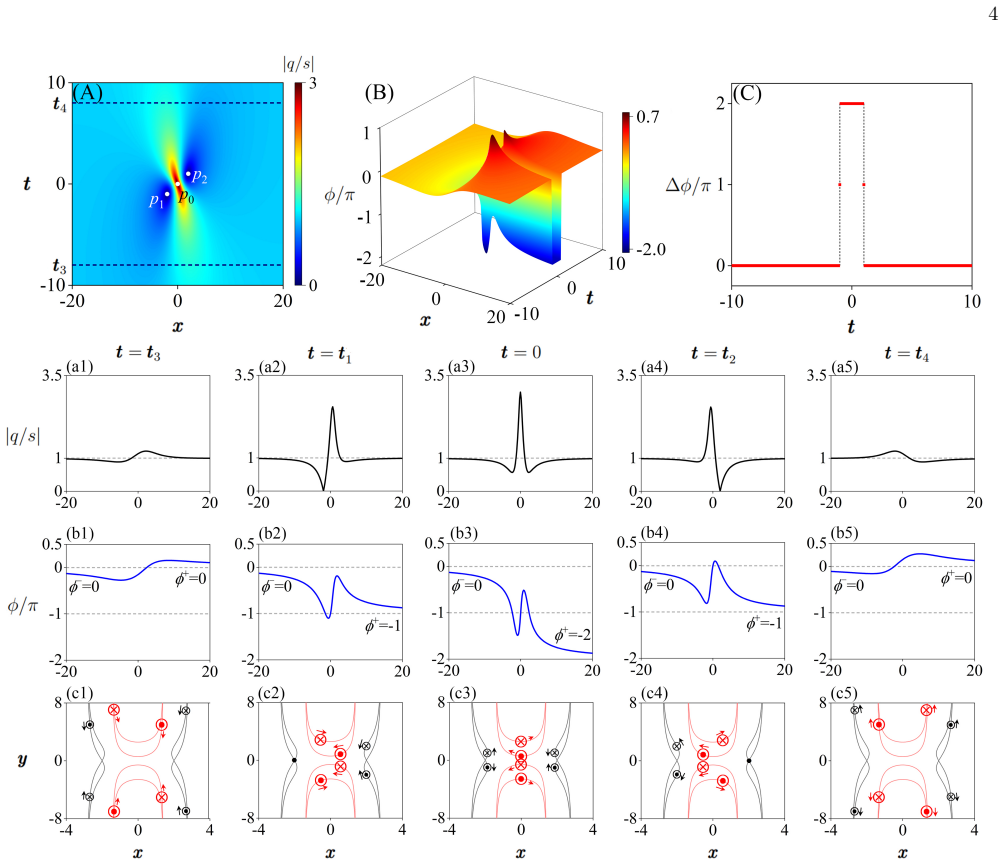
Two mergers result in a time interval during which the phase shift ∆ϕ= 2π
The lat- ter collide and merge when valleys emerge. Two mergers result in a time interval during which the phase shift ∆ϕ= 2π. In Sec. III, we extend our study to the vec- tor system, focusing on the four-petaled (FP)-ES RW. For vector RWs, we uncover that the monopoles carrying ±1/2 charges merge on the imaginary axis in FPRWs and on the real axis in ESR...
-
[2]
Typical examples are illustrated by con- sidering three types of static symmetric DHBSs
We establish that simple zeros, simple poles, and third-order poles of the density function correspond precisely to these distinct charge values. Typical examples are illustrated by con- sidering three types of static symmetric DHBSs. Results are summarized and discussed in Sec. VI. II. TOPOLOGICAL PHASE OF SCALAR ROGUE WAVE We begin with a scalar system ...
-
[3]
Here,v 1 andω 1 represent the velocity and width parameter of the BS, respectively
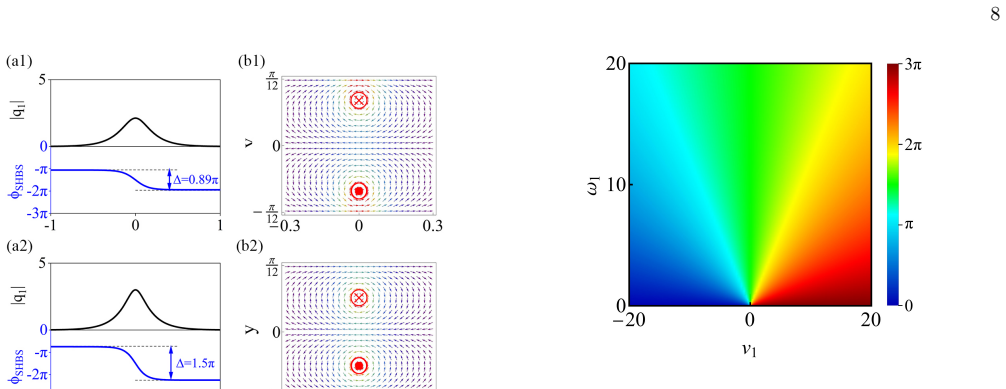
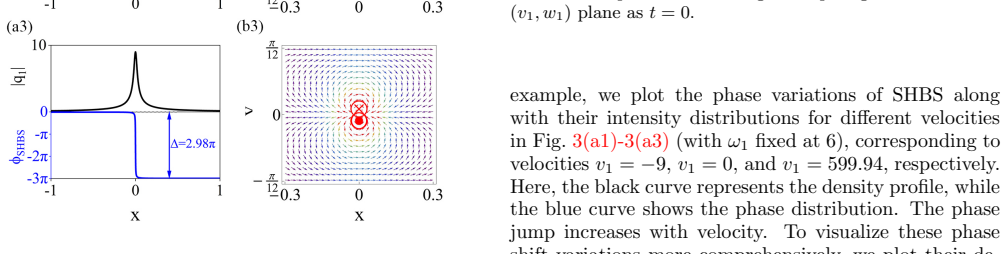
cosh(2κ1) +a 2 1 −b 2 1]2 ,(7) withκ 1 =ω 1(x−v 1t), ω1 = 6a1b1, v1 = 6(b2 1 −a 2 1), and R1 = v1 2 x+ ω2 1 − v2 1 4 t. Here,v 1 andω 1 represent the velocity and width parameter of the BS, respectively. The density profile of this solution exhibits the typical SHBS structure. Then, we focus on the topological phase properties by analyzing the exact SHBS ...
-
[4]
To illus- trate this high charge dynamics, Fig
Such high charges are markedly different from the±1/2 charges typical of pre- viously studied solitons, such as dark solitons [14, 16], W- shaped solitons in the Sasa-Satsuma and Hirota models [15], and BS of the Chen-Lee-Liu equation [17]. To illus- trate this high charge dynamics, Fig. 3(b1)-(b3) present the topological vector potentials of the SHBS und...
-
[5]
Case 2: ΓR= 0, monopoles carrying±3/2 charge
Further- more, these singularities correspond to the simple zeros of the density function|q 1(z)|2. Case 2: ΓR= 0, monopoles carrying±3/2 charge. The analysis becomes more complex whenΓR= 0 under the condition thate 2ω1zϖ2 +e −2ω1z|γ1|4 ̸= 0. It is essential to determine whether each zeroz=z 1,n of ΓR= 0 also satisfiesΛ 1(z) = 0. If, instead,Λ 1(z1,n)̸= 0...
-
[6]
Case 3:S 1=ΓR=0, monopoles carrying±5/2 charge
Several illustrative examples will be presented later. Case 3:S 1=ΓR=0, monopoles carrying±5/2 charge. The most challenging scenario arises when bothS 1 = e2ω1zϖ2 +e −2ω1z|γ1|4 = 0 andΓR= 0 are simultane- ously satisfied. Here, we analyze this case under the sym- metric condition given by 2ω1 ln|β 2| −2ω2 ln|γ 1|= (ω 1 − ω2) ln ω1−ω2 ω1+ω2 , withω= 4n1+1 ...
-
[7]
Therefore, virtual monopoles within the topological vector potential of vector DHBS can admit charges of ±1/2,±3/2, and±5/2, though not all necessarily simul- taneously
They also coincide with fourth-order zeros ofΓR and simple zeros ofS 1, indicating that they are in fact third-order poles of the density function|q 1(z)|2. Therefore, virtual monopoles within the topological vector potential of vector DHBS can admit charges of ±1/2,±3/2, and±5/2, though not all necessarily simul- taneously. Their appearance depends on sp...
-
[8]
The singularities of the corresponding analytic extensions F1(z) andF 2(z) can then be accurately calculated from these expressions
Combining this with the sym- metric condition, the resulting gradient flows in the two components areF 1(x) = ω1−4ω1 cosh[ 2 3 (2ω1x−ln|χ|) ] cosh(2ω1x−ln|χ|) and F2(x) =− 5ω2 cosh(2ω2x−ln|χ|) , with|χ|= 2|γ 1|2 = 8|β 2|6. The singularities of the corresponding analytic extensions F1(z) andF 2(z) can then be accurately calculated from these expressions. F...
-
[9]
Moreover, unlike the virtual monopole fields reported in Refs
However, this type of monopole is confined to componentq 1. Moreover, unlike the virtual monopole fields reported in Refs. [13, 14, 16– 18], these magnetic monopoles with positive and negative charges are not alternately distributed along the imagi- nary axis but are symmetrically distributed about the real axis. Strikingly, virtual monopoles with charge∓...
-
[10]
The above analysis reveals that the point-like magnetic field in Fig
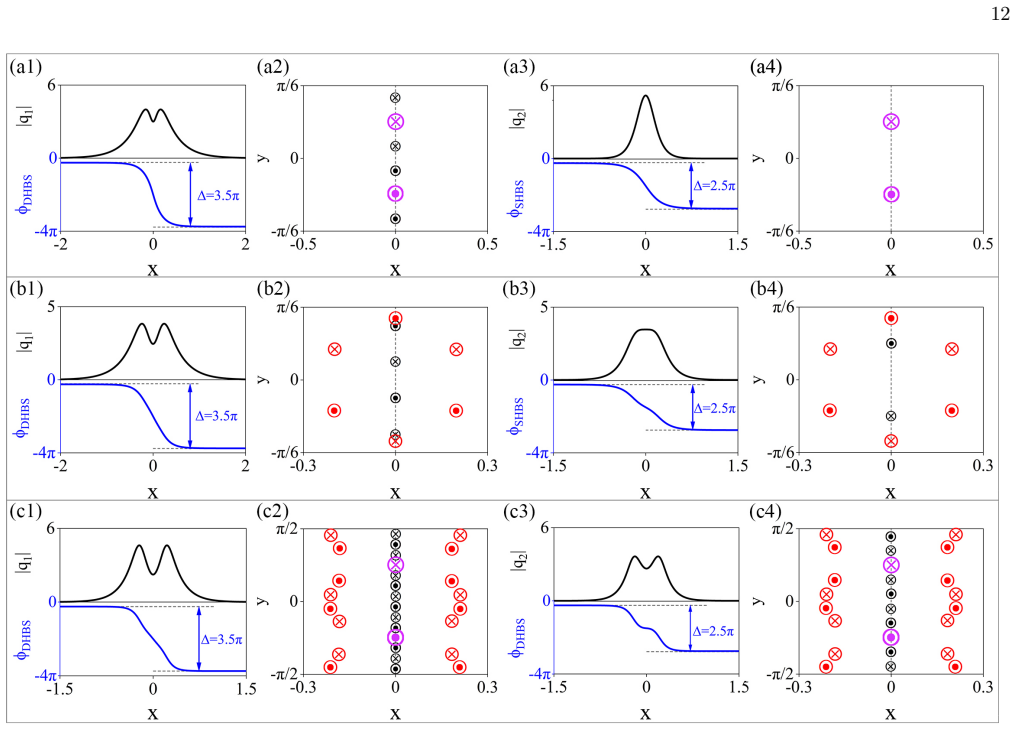
in both components, and are indi- cated by big purple symbols. The above analysis reveals that the point-like magnetic field in Fig. 5(a2) originates from the simple zeros and triple poles of the DHBS den- sity function in componentq 1. In contrast, the field in Fig. 5(a4) is solely due to the triple poles of the SHBS density function in componentq 2. The...
-
[11]
(10) yields another symmetric DHBS-SHBS pattern, as depicted in Fig
With this parameter choice, the so- lution Eq. (10) yields another symmetric DHBS-SHBS pattern, as depicted in Fig. 5(b1) and 5(b3) with black curves. The density profile of the SHBS in component q2 possesses a triple pole atx= 0, which is distinct from the structures shown in Fig. 5(a3). In this case, the equationΓR= 0 reduces to a cubic equation in cosh...
-
[12]
Tianchi Tal- ent
The corresponding density pro- files exhibit a symmetric DHBS-DHBS pattern, as shown by the black curves in Figs. 5(c1) and 5(c3). Surpris- ingly, by examining the singularities of the phase gra- dient, we find that they arise from simple zeros, simple poles, and a third-order poles of the density function, respectively. Consequently, the topological phas...
-
[13]
+ 25√ 3xxx2 i , G[5] 1 = 216√ 3xxx, G[4] 1 =210 ·3 h 32(17−6 √
-
[14]
The functionG 2(xxx, ttt) in Sec
+ 25xxx2 i , G[6] 1 = 3×2 15. The functionG 2(xxx, ttt) in Sec. III B is given by G2(xxx, ttt) = 3 217 6X j=0 G[j] 2 (xxx)tttj, where G[0] 2 =37(43 + 24 √ 3)−2 536(17 + 10 √ 3)xxx2 + 21034(3 + 2 √ 3)xxx4 −2 15 ·3xxx6, G[1] 2 =26xxx −34(71 √ 3+126)+2 632(18+11 √ 3)xxx2+210√ 3xxx4 , G[2] 2 =25 35(59+30 √ 3)−2632(21+14 √ 3)xxx2 −215 ·3xxx4 , G[3] 2 =−2 12xxx...
-
[15]
±” sign iny ± n corresponds to positive and negative values, while the “±
+ 25xxx2 i , G[6] 2 = 3×2 15. The exact expressions in Eq. (10) are given by H=|ϱ 1e−κ+ +ϱ2eκ+ +ϱ3e−κ− +ϱ4eκ− |2, ϱ1 =|β 2γ1|2 q (v2 + 4ω2 1)(v2 + 4ω2 2), ϱ2 =ϖ 2 (v−2iω 1) (v−2iω 2), ϱ3 =|γ 1|2(−v+ 2iω 2) q v2 + 4ω2 1, ϱ4 =|β 2|2(−v+ 2iω 1) q v2 + 4ω2 2, V1 =e −ω1x−iθ1 |γ1|2 −e ω1x+iθ1 ϖ , V2 =e −ω2x−iθ2 |β2|2 +eω2x+iθ2 ϖ , N=e −κ++i(θ1+θ2)|β2γ1|2 + eκ+−...
-
[16]
This is also the reason why the phase shift of solitons differs from that of RWs
Moreover, unlike the finite summation for RWs, the infinite summation of the soliton topological vector po- tential prevents the interchangeability of integration and summation orders. This is also the reason why the phase shift of solitons differs from that of RWs. For RWs, we can only obtain phase shifts that are integer multiples of π, while for solito...
-
[17]
P. A. M. Dirac, Quantised singularities in the electro- magnetic field. Proc. R. Soc. Lond. A133, 60 (1931)
1931
-
[18]
R. P. Feynman, Space-Time Approach to Non- Relativistic Quantum Mechanics, Rev. Mod. Phys. 20, 367 (1948)
1948
-
[19]
Wu, Y.-F
D. Wu, Y.-F. Jiang, X.-M. Gu, L. Huang, B. Bai, Q.-C. Sun, X. Zhang, S.-Q. Gong, Y. Mao, H.-S. Zhong, M.-C. Chen, J. Zhang, Q. Zhang, C.-Y. Lu, J.-W. Pan, Jian- Wei, Experimental Refutation of Real-Valued Quantum Mechanics under Strict Locality Conditions, Phys. Rev. Lett. 129, 140401(2022)
2022
-
[20]
K. A. Milton, Theoretical and experimental status of magnetic monopoles, Rep. Prog. Phys. 69, 1637-1711 (2006)
2006
-
[21]
Z. Fang, N. Nagaosa, K. S. Takahashi, A. Asamitsu, R. Mathieu, T. Ogasawara, H. Yamada, M. Kawasaki, Y. Tokura, and K. Terakura, The anomalous Hall effect and magnetic monopoles in momentum space. Science, 302(5642), 92-95 (2003)
2003
-
[22]
G. E. Volovik, The Universe in a Helium Droplet (Claren- don Press, Oxford, 2003)
2003
-
[23]
B´ erard, H
A. B´ erard, H. Mohrbach, Monopole and Berry phase in momentum space in noncommutative quantum mechan- ics, Phys. Rev. D 69, 127701 (2004)
2004
-
[24]
Dubˇ cek, C
T. Dubˇ cek, C. J. Kennedy, L. Lu, W. Ketterle, M. Soljaˇ ci´ c, and H. Buljan, Weyl Points in Three- Dimensional Optical Lattices: Synthetic Magnetic Monopoles in Momentum Space, Phys. Rev. Lett. 114, 225301 (2015)
2015
-
[25]
M. V. Berry, Quantal phase factors accompanying adia- batic changes, Proc. R. Soc. London Ser. A 392, 45-57 (1984)
1984
-
[26]
Xiao, M.-C
D. Xiao, M.-C. Chang, and Q. Niu, Berry phase effects on electronic properties, Rev. Mod. Phys. 82, 1959 (2010)
1959
-
[27]
Bruno, Nonquantized Dirac Monopoles and Strings in the Berry Phase of Anisotropic Spin Systems, Phys
P. Bruno, Nonquantized Dirac Monopoles and Strings in the Berry Phase of Anisotropic Spin Systems, Phys. Rev. Lett. 93, 247202 (2004)
2004
-
[28]
B. Wu, Q. Zhang, J. Liu, Anomalous monopoles of an interacting boson system, Phys. Lett. A 375, 545-548 (2011)
2011
-
[29]
Zhao, L.-Z
L.-C. Zhao, L.-Z. Meng, Y.-H. Qin, Z.-Y. Yang and J. Liu, Virtual Dirac Monopoles underlying the Nontrivial Phases of Rogue Waves. Chin. Phys. Lett.42, 110002, (2025)
2025
-
[30]
Zhao, Y.-H
L.-C. Zhao, Y.-H. Qin, C. Lee, and J. Liu, Classification of dark solitons via topological vector potentials. Phys. Rev. E103, L040204 (2021)
2021
-
[31]
Li, L.-Z
J.-D. Li, L.-Z. Meng, and L.-C. Zhao, Phase properties of several nonlinear optical waves described by rational solutions. Phys. Rev. A107, 013511 (2023)
2023
-
[32]
Y.-H. Qin, X. Zhang, L. Ling, and L.-C. Zhao, Phase characters of optical dark solitons with third-order dis- persion and delayed nonlinear response. Phys. Rev. E 106, 024213 (2022)
2022
-
[33]
Wu, L.-C
Y.-H. Wu, L.-C. Zhao, C. Liu, Z.-Y. Yang, and W.-L. Yang, The topological phase of bright solitons. Phys. Lett. A434, 128045 (2022)
2022
-
[34]
Yu and L.-C
H. Yu and L.-C. Zhao, Aharonov-Anandan phase and topological vector potentials underlying an Akhmediev breather. Phys. Rev. A110, 053504 (2024)
2024
-
[35]
M. W. Ray, E. Ruokokoski, S. Kandel, M. M¨ ott¨ onen, and D. S. Hall, Observation of Dirac monopoles in a synthetic magnetic field, Nature 505, 657-660 (2014)
2014
-
[36]
V Pietil¨ a and M M¨ ott¨ onen, Creation of Dirac monopoles in spinor Bose-Einstein condensates, Phys. Rev. Lett. 103, 030401 (2009)
2009
-
[37]
M. W. Ray, E. Ruokokoski, K. Tiurev, M. M¨ ott¨ onen, and D. S. Hall, Observation of isolated monopoles in a quantum field, Science 348, 544-547 (2015)
2015
-
[38]
X-Y Chen, L Jiang, W.-K. Bai, T. Yang, and J.-H. Zheng, Synthetic half-integer magnetic monopole and single-vortex dynamics in spherical Bose-Einstein con- densates, Phys. Rev. A 111, 033322 (2025)
2025
-
[39]
Rogister, Parallel Propagation of Nonlinear LowFre- quency Waves in High-βPlasma
A. Rogister, Parallel Propagation of Nonlinear LowFre- quency Waves in High-βPlasma. Phys. Fluids14, 2733 (1971)
1971
-
[40]
Mjølhus, On the modulational instability of hydro- magnetic waves parallel to the magnetic field
E. Mjølhus, On the modulational instability of hydro- magnetic waves parallel to the magnetic field. J. Plasma Phys.16, 321-334 (1976)
1976
-
[41]
W. Mio, T. Ogino, K. Minami and S. Takeda, Modified nonlinear Schr¨ odinger equation for Alfv´ en waves propa- gating along the magnetic field in cold plasmas. J. Phys. Sot. Japan41, 265 (1976)
1976
-
[42]
Y. H. Ichikawa and S. Watanabe, Solitons, envelope soli- tons in collisionless plasmas, J. Phys. Colloques 38, C6- 15-C6-26 (1977)
1977
-
[43]
Verheest, B
F. Verheest, B. Buti, Parallel solitary Alfv´ en waves in warm multi-species beam-plasma systems. Part 1, J. Plasma Physics 47, 15-24 (1992)
1992
-
[44]
S. R. Spangler and B. B. Plapp, Characteristics of obliquely propagating, nonlinear Alfv´ en waves, Phys. Fluids B 4, 3356 (1992)
1992
-
[45]
Deconinck, P
B. Deconinck, P. Meuris, F. Verheest, Oblique nonlinear Alfv´ en waves in strongly magnetized beam plasmas. part
-
[46]
Plasma Physics 50, 445-455 (1993)
nonlinear vector evolution equation, J. Plasma Physics 50, 445-455 (1993)
1993
-
[47]
Krishan, L
V. Krishan, L. Nocera, Relaxed states of Alfv´ enic turbu- lence, Phys. Lett. A 315, 389-394 (2003)
2003
-
[48]
A. C.-L. Chian, W. M. Santana, E. L. Rempel, F. A. Borotto, T. Hada, and Y. Kamide, Chaos in driven Alfv´ en systems: unstable periodic orbits and chaotic sad- dles, Nonlin. Processes Geophys. 14, 17–29 (2007)
2007
-
[49]
Mihalache, N
D. Mihalache, N. Truta, N.-C. Panoiu and D.-M. Baboiu, Analytic method for solving the modified nonlin- ear Schr¨ odinger equation describing soliton propagation along optical fibers, Phys. Rev. A 47, 3190 (1993)
1993
-
[50]
X.-J. Chen, J. Yang, Direct perturbation theory for soli- tons of the derivative nonlinear Schr¨ odinger equation and the modified nonlinear Schr¨ odinger equation, Phys. Rev. E 65, 066608 (2002)
2002
-
[51]
Tzoar and M
N. Tzoar and M. Jain, Self-phase modulation in long- geometry optical waveguides, Phys. Rev. A 23, 1266 (1981)
1981
-
[52]
Ohkuma, Y
K. Ohkuma, Y. H. Ichikawa, and Y. Abe, Soliton propa- gation along optical fibers, Opt. Lett. 12, 516-518 (1987)
1987
-
[53]
Kavitha, M
L. Kavitha, M. Saravanan, V. Senthilkumar, R. Ravichandran, and D. Gopi, Collision of electromagnetic solitons in a weak ferromagnetic medium, J. Magn. Magn. Mater. 355, 37-50 (2014)
2014
-
[54]
Saravanan, Current-driven electromagnetic soliton collision in a ferromagnetic nanowire, Phys
M. Saravanan, Current-driven electromagnetic soliton collision in a ferromagnetic nanowire, Phys. Rev. E 92, 012923 (2015). 18
2015
-
[55]
Kavitha, M
L. Kavitha, M. Saravanan, B. Srividya, and D. Gopi, Breatherlike electromagnetic wave propagation in an an- tiferromagnetic medium with Dzyaloshinsky-Moriya in- teraction, Phys. Rev. E 84, 066608 (2011)
2011
-
[56]
D. J. Kaup and A. C. Newell, An exact solution for a derivative nonlinear Schr¨ odinger equation, J. Math. Phys. 19, 798-801 (1978)
1978
-
[57]
B. Guo, L. Ling, Q. P. Liu, High-order solutions and gen- eralized Darboux transformations of derivative nonlinear Schr¨ odinger equations, Stud. Appl. Math. 130, 317–344 (2012)
2012
-
[58]
S. Xu, J. He, L. Wang, The Darboux transformation of the derivative nonlinear Schr¨ odinger equation, J. Phys. A: Math. Theor. 44, 305203 (2011)
2011
-
[59]
L. Guo, L. Wang, Y. Cheng, and J. He, Higher-order rogue waves and modulation instability of the two- component derivative nonlinear Schr¨ odinger equation. Commun Nonlinear Sci.79, 104915 (2019)
2019
-
[60]
Liu and D
Q. Liu and D. W. Zuo, Semi-rational solutions of the coupled derivative nonlinear Schr¨ odinger equation. Op- tik.277, 170680 (2023)
2023
-
[61]
H. N. Chan, K. W. Chow, D. J. Kedziora, R. H. J. Grimshaw, and E. Ding, Rogue wave modes for a deriva- tive nonlinear Schr¨ odinger model. Phys. Rev. E89, 032914 (2014)
2014
-
[62]
Li, J.-H
M. Li, J.-H. Xiao, W.-J. Liu, P. Wang, B. Qin, and B. Tian, Mixed-type vector solitons of the N-coupled mixed derivative nonlinear Schr¨ odinger equations from optical fibers. Phys. Rev. E87, 032914 (2013)
2013
-
[63]
Lin and L
H. Lin and L. Ling, Rogue wave pattern of multi- component derivative nonlinear Schr¨ odinger equations, Chaos34, 043126 (2024)
2024
-
[64]
Akhmediev, A
N. Akhmediev, A. Ankiewicz, and M. Taki, Waves that appear from nowhere and disappear without a trace, Phys. Lett. A373, 675 (2009)
2009
-
[65]
Baronio, M
F. Baronio, M. Conforti, A. Degasperis, S. Lombardo, M. Onorato, and S. Wabnitz, Vector Rogue Waves and Base- band Modulation Instability in the Defocusing Regime, Phys. Rev. Lett.113, 034101 (2014)
2014
-
[66]
Guo and L.-M
B.-L. Guo and L.-M. Ling, Rogue Wave, Breathers and Bright-Dark-Rogue Solutions for the Coupled Schr¨ odinger Equations, Chin. Phys. Lett.28, 110202 (2011)
2011
-
[67]
Zhao and J
L.-C. Zhao and J. Liu, Localized nonlinear waves in a two-mode nonlinear fiber, J. Opt. Soc. Am. B29, 3119 (2012)
2012
-
[68]
Zhao and J
L.-C. Zhao and J. Liu, Rogue-wave solutions of a three-component coupled nonlinear Schr¨ odinger equa- tion, Phys. Rev. E87, 013201 (2013)
2013
-
[69]
Zhao, G.-G
L.-C. Zhao, G.-G. Xin, and Z.-Y. Yang, Rogue-wave pat- tern transition induced by relative frequency, Phys. Rev. E90, 022918 (2014)
2014
-
[70]
S. Chen, C. Pan, P. Grelu, F. Baronio, and N Akhme- diev, Fundamental Peregrine Solitons of Ultrastrong Am- plitude Enhancement through Self-Steepening in Vector Nonlinear Systems, Phys. Rev. Lett. 124, 113901 (2020)
2020
-
[71]
S. Chen, Y. Ye, J. M. Soto-Crespo, P. Grelu, and F. Baronio, Peregrine Solitons Beyond the Threefold Limit and Their Two-Soliton Interactions, Phys. Rev. Lett. 121, 104101 (2018)
2018
-
[72]
H. C. Morris and R. K. Dodd, The Two Component Derivative Nonlinear Schr¨ odinger Equation. Phys. Scr. 20, 505 (1979)
1979
-
[73]
Ling and Q
L. Ling and Q. P. Liu, Darboux transformation for a two- component derivative nonlinear Schr¨ odinger equation. J. Phys. A: Math. Theor.43, 434023 (2010)
2010
-
[74]
Y. S. Kivshar and B. Luther-Davies, Dark optical soli- tons: physics and applications. Phys. Rep.298, 81 (1998)
1998
-
[75]
Y. S. Kivshar, Dark Solitons in Nonlinear Optics, IEEE Journal of Quantum Electronics 29(1): 250-264, 1993
1993
-
[76]
Qin, L.-C
Y.-H. Qin, L.-C. Zhao, Z.-Q. Yang, and L. Ling, Mul- tivalley dark solitons in multicomponent Bose-Einstein condensates with repulsive interactions. Phys. Rev. E 104, 014201 (2021)
2021
-
[77]
Yang and Y.-H
J.-P. Yang and Y.-H. Qin, State transition dynamics of double-hump bright soliton in the coupled derivative Schr¨ odinger equation, Nonlinear Dyn.113, 32763-32781 (2025)
2025
discussion (0)
Sign in with ORCID, Apple, or X to comment. Anyone can read and Pith papers without signing in.