Exact formula for the 2-marginal second moment function of the multidimensional symmetric Markov random flight
Pith reviewed 2026-05-07 12:54 UTC · model grok-4.3
The pith
An explicit closed-form expression exists for the 2-marginal second moment function of any two coordinates in the m-dimensional symmetric Markov random flight.
A machine-rendered reading of the paper's core claim, the machinery that carries it, and where it could break.
Core claim
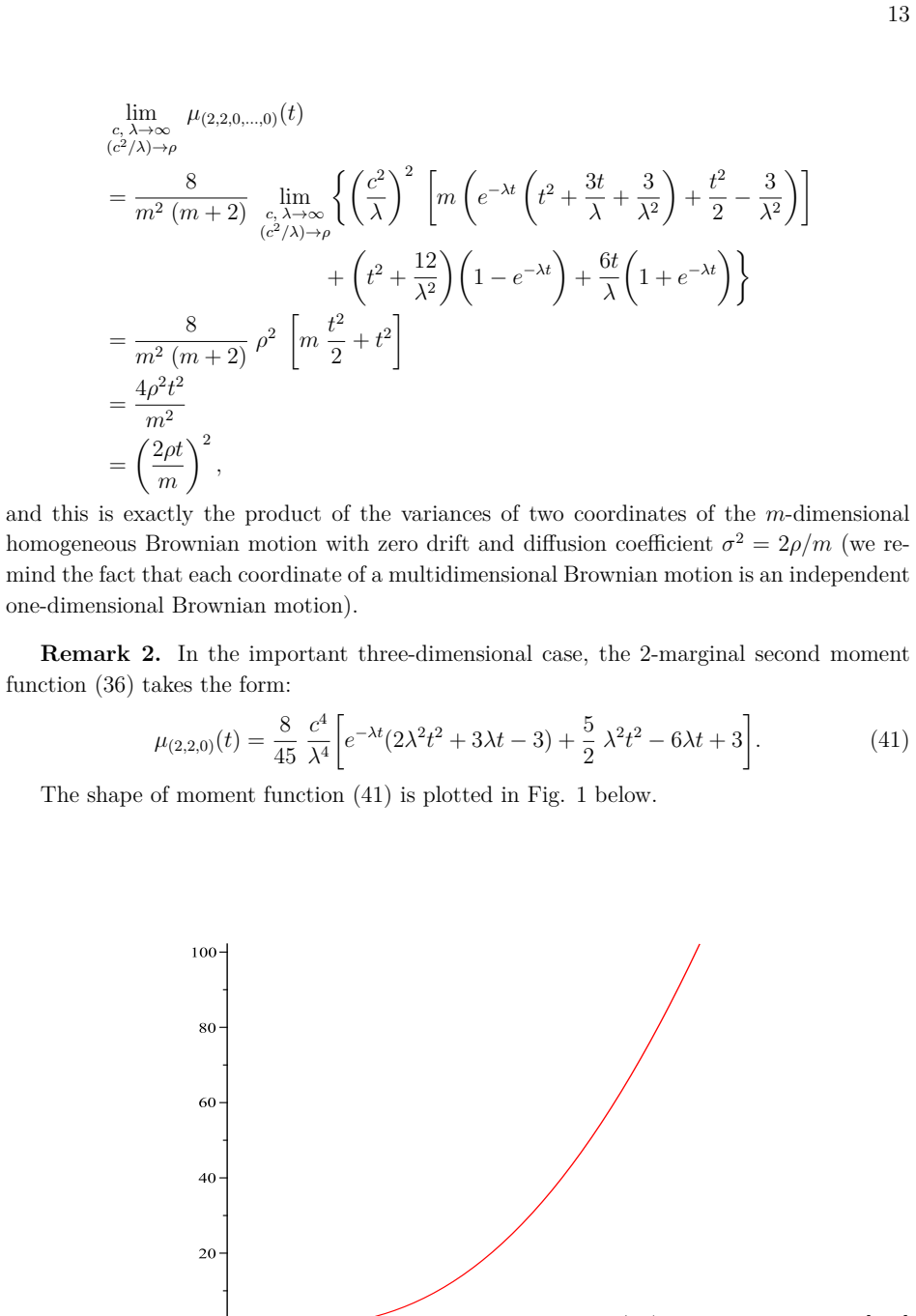
For the symmetric Markov random flight X(t) in R^m with m ≥ 3, the 2-marginal second moment function μ_{(2,2,0,…,0)}(t) admits an explicit formula. The same expression holds for every other 2-marginal function whose multi-index contains exactly two 2’s. Under the Kac scaling condition the function converges to the product of the variances of two coordinates of m-dimensional Brownian motion.
What carries the argument
The 2-marginal second moment function μ_{(2,2,0,…,0)}(t), obtained by averaging the squared coordinate products over the Poisson arrival times and the uniform measure on the unit sphere.
If this is right
- Exact finite-time expressions for all pairwise coordinate second moments become available for any m ≥ 3.
- The second-moment structure of the random flight matches that of Brownian motion after Kac scaling, confirming the diffusion limit at the level of covariances.
- The formula supplies a concrete tool for calculating variances and cross terms without solving the full Kolmogorov forward equation.
- The same averaging technique over Poisson times and spherical directions can be applied to obtain other low-order moment functions.
Where Pith is reading between the lines
- The explicit moment formula could be used to construct approximate finite-dimensional distributions or to test higher-moment closures in transport models.
- Because the expression is valid for every coordinate pair, it immediately gives the full covariance matrix of the position vector at any time t.
- The result opens a route to exact calculations of mean-square displacement and related quantities before the long-time Gaussian regime is reached.
Load-bearing premise
The particle keeps constant finite speed and chooses each new direction independently and uniformly at random on the sphere after every Poisson reorientation.
What would settle it
Monte Carlo simulation of many independent trajectories in R^3, computation of the sample average of X_1(t)^2 X_2(t)^2 at several fixed t, and direct numerical comparison against the closed-form expression.
Figures
read the original abstract
We consider the symmetric Markov random flight $\bold X(t), \; t>0,$ in the Euclidean space $\Bbb R^m, \; m\ge 3$, performed by a particle that moves in $\Bbb R^m$ with constant finite speed and changes its directions at Poisson-distributed random time instants by choosing the initial and each new direction at random according to the uniform distribution on the unit $(m-1)$-dimensional sphere. The 2-marginal second moment function $\mu_{(2,2,0,\dots,0)}(t), \; t>0,$ of $\bold X(t)$, corresponding to the multi-index $(2,2,0,\dots,0)$, is examined. An explicit formula for function $\mu_{(2,2,0,\dots,0)}(t)$ is obtained. This formula is also valid for all other 2-marginal second moment functions corresponding to any multi-indices of the form $(0,\dots,0,2,0,\dots,0,2,0,\dots,0)$. It is also shown that this moment function, under the standard Kac scaling condition, turns into the product of the variances of two coordinates of the $m$-dimensional homogeneous Brownian motion.
Editorial analysis
A structured set of objections, weighed in public.
Referee Report
Summary. The manuscript derives an explicit closed-form expression for the 2-marginal second moment function μ_{(2,2,0,…,0)}(t) of the symmetric Markov random flight X(t) in R^m (m ≥ 3), where the particle moves at constant speed and reorients at Poisson times according to the uniform measure on the unit sphere. The same formula is stated to apply to all other 2-marginal second moments with multi-indices containing exactly two 2's. Under the standard Kac scaling, the expression is shown to converge to the product of the variances of two distinct coordinates of m-dimensional Brownian motion.
Significance. If the derivation holds, the result supplies a rare explicit formula for a mixed second-moment function of a persistent random flight, extending the literature on exact moment calculations for telegraph-type processes. The confirmation of the Kac limit to the Brownian product provides a concrete check on the scaling regime and may serve as a building block for higher-moment or correlation analyses in stochastic modeling.
minor comments (2)
- The abstract and introduction should explicitly define the ordering convention for the multi-index (2,2,0,…,0) and state whether the coordinates are labeled in a fixed basis or up to permutation; this would clarify the scope of the claim that the formula covers all similar indices.
- The Kac scaling condition is invoked without restating the precise parameter relation (speed and intensity) used in the limit; including the exact scaling in the statement of the theorem would improve self-contained readability.
Simulated Author's Rebuttal
We thank the referee for the positive summary, recognition of the significance of the explicit formula for μ_{(2,2,0,…,0)}(t) and its Kac-scaling limit, and the recommendation of minor revision. No specific major comments appear in the report.
Circularity Check
Derivation is self-contained from explicit process definition
full rationale
The paper defines the symmetric Markov random flight process directly via constant finite speed, Poisson-distributed direction changes, and uniform selection on the unit sphere in R^m (m≥3). It then derives the explicit formula for the 2-marginal second-moment function μ_{(2,2,0,…,0)}(t) from the process properties and shows the Kac-scaling limit to the product of coordinate variances of m-dimensional Brownian motion as an independent, previously established convergence. No self-definitional reductions, fitted inputs renamed as predictions, or load-bearing self-citations appear in the derivation chain; the central claims rest on the standard construction whose moment equations close under the given symmetry.
Axiom & Free-Parameter Ledger
axioms (3)
- domain assumption Direction changes occur according to a Poisson process.
- domain assumption Each new direction is chosen uniformly on the unit sphere.
- domain assumption The particle travels at constant finite speed.
Reference graph
Works this paper leans on
-
[1]
Run-and-tumble motion in one dimension with space-dependent speed
Angelani L., Garra R. Run-and-tumble motion in one dimension with space-dependent speed. Phys. Rev. E , 100 (2019), iss. 5, Paper No. 052147
work page 2019
-
[2]
Brasiello A., Crescitelli S., Giona M. One-dimensional hyperbolic transport: positivity and admissible boundary conditions derived from the wave formulation. Phys. A , 449 (2016), 176-191
work page 2016
-
[3]
Spherically restricted random hyperbolic diffusion
Broadbridge P., Kolesnik A.D., Leonenko N., Olenko A., Omari D. Spherically restricted random hyperbolic diffusion. Entropy, 22 (2020), 217-248
work page 2020
-
[4]
Random spherical hyperbolic diffusion
Broadbridge P., Kolesnik A.D., Leonenko N., Olenko A. Random spherical hyperbolic diffusion. J. Statist. Phys. , 177 (2019), 889-916
work page 2019
-
[5]
Random walks and physical processes
Cane V. Random walks and physical processes. Bull. Int. Statist. Inst. , 42 (1967), 622-640
work page 1967
-
[6]
Diffusion models with relativity effects
Cane V. Diffusion models with relativity effects. In: Perspectives in Probability and Statistics, Applied Probability Trust, 1975, Sheffield, pp. 263-273
work page 1975
-
[7]
Radioactive transfer in half spaces of arbitrary dimensions
d’Eon E., McCormick N.J. Radioactive transfer in half spaces of arbitrary dimensions. J. Comput. Theoret. Transport , 48 (2019), 280-337
work page 2019
-
[8]
Dhar A., Kundu A., Majumdar S.N., Sabhapandit S., Schehr G. Run-and-tumble par- ticle in one-dimensional confining potentials: Steady-state, relaxation and first-passage properties. Phys. Rev. E , 99 (2019), iss. 3, Paper No. 032132
work page 2019
-
[9]
Fock V.A. The solution of a problem of diffusion theory by the finite-difference method and its application to light diffusion. In: Proceedings of the State Optics Institute , Leningrad, 1926, 4(34), 31 pp. (In Russian)
work page 1926
-
[10]
Relativistic analysis of stochastic kinematics
Giona M. Relativistic analysis of stochastic kinematics. Phys. Rev. E , 96 (2017), iss. 4, Paper No. 042133
work page 2017
-
[11]
Giona M., Brasiello A., Crescitelli S. Markovian nature, completeness, regularity and correlation properties of generalized Poisson-Kac processes. J. Stat. Mech.: Theory and Experiment, 2 (2017), iss. 2, Paper No. 023205
work page 2017
-
[12]
Giona M., Brasiello A., Crescitelli S. Stochastic foundations of undulatory transport phenomena: generalized Poisson-Kac processes - Part I: Basic theory.J. Phys. A: Math- ematical and Theoretical, 50 (2017), no. 33, Paper No. 335002. 17
work page 2017
-
[13]
Giona M., Brasiello A., Crescitelli S. Stochastic foundations of undulatory transport phenomena: generalized Poisson-Kac processes - Part II: Irreversibility, norms and en- tropies. J. Phys. A: Mathematical and Theoretical , 50 (2017), no. 33, Paper No. 335003
work page 2017
-
[14]
Giona M., Brasiello A., Crescitelli S. Stochastic foundations of undulatory transport phenomena: generalized Poisson-Kac processes - Part III: Extensions and applications to kinetic theory and transport. J. Phys. A: Mathematical and Theoretical , 50 (2017), no. 33, Paper No. 335004
work page 2017
-
[15]
On diffusion by discontinuous movements and on the telegraph equation
Goldstein S. On diffusion by discontinuous movements and on the telegraph equation. Quart. J. Mech. Appl. Math. , 4 (1951), 129-156
work page 1951
-
[16]
Gzyl H. Quantum random evolutions. J. Statist. Phys. , 191 (2024), Article 67, 14 pp
work page 2024
-
[17]
Estimation for the discretely observed telegraph process.Theory Probab
Iacus S.M., Yoshida N. Estimation for the discretely observed telegraph process.Theory Probab. Math. Stat. , 78 (2009), 37-47
work page 2009
-
[18]
A stochastic model related to the telegrapher’s equation.Rocky Mount
Kac M. A stochastic model related to the telegrapher’s equation.Rocky Mount. J. Math., 4 (1974), 497-509. (Reprinted from: Kac M. Some stochastic problems in physics and mathematics. In: Magnolia Petroleum Company Colloquium Lectures in the Pure and Applied Sciences, No. 2, October 1956)
work page 1974
-
[19]
Kolesnik A.D. Series representations for the characteristic function of the multidimen- sional Markov random flight. J. Statist. Phys., 191 (2024), Article 76, 23 pp
work page 2024
-
[20]
Kolesnik A.D. Markov Random Flights. Taylor & Francis Group/CRC Press, 2021, London-New York-Boca Raton
work page 2021
-
[21]
Moment analysis of the telegraph random process
Kolesnik A.D. Moment analysis of the telegraph random process. Bull. Acad. Sci. Moldova, Ser. Math., 2012, 1(68), 90-107
work page 2012
-
[22]
The explicit probability distribution of a six-dimensional random flight
Kolesnik A.D. The explicit probability distribution of a six-dimensional random flight. Theory Stoch. Process., 15(31) (2009), 33-39
work page 2009
-
[23]
Random motions at finite speed in higher dimensions
Kolesnik A.D. Random motions at finite speed in higher dimensions. J. Statist. Phys., 131 (2008), 1039-1065
work page 2008
-
[24]
Moments of the Markovian random evolutions in two and four dimensions
Kolesnik A.D. Moments of the Markovian random evolutions in two and four dimensions. Bull. Acad. Sci. Moldova, Ser. Math. , 2(57) (2008), 68-80
work page 2008
-
[25]
A four-dimensional random motion at finite speed
Kolesnik A.D. A four-dimensional random motion at finite speed. J. Appl. Probab., 43 (2006), 1107-1118
work page 2006
-
[26]
Kolesnik A.D., Orsingher E. A planar random motion with an infinite number of direc- tions controlled by the damped wave equation. J. Appl. Probab., 42 (2005), 1168-1182
work page 2005
-
[27]
Telegraph Processes and Option Pricing
Kolesnik A.D., Ratanov N. Telegraph Processes and Option Pricing. Springer, 2013, Berlin-Heidelberg (see also the 2nd edition, Springer, 2022). 18
work page 2013
-
[28]
Chiral run-and-tumble walker: Transport and optimizing search
Mallikarjun R., Pal A. Chiral run-and-tumble walker: Transport and optimizing search. Phys. A, 622 (2023), Paper No. 128821
work page 2023
-
[29]
Continuous time persistent random walk: a review and some generalizations
Masoliver J., Lindenberg K. Continuous time persistent random walk: a review and some generalizations. Eur. Phys. J. B , 90 (2017), 107-119
work page 2017
-
[30]
A continuous-time generalization of the per- sistent random walk
Masoliver J., Lindenberg K., Weiss G.H. A continuous-time generalization of the per- sistent random walk. Phys. A, 157 (1989), 891-898
work page 1989
-
[31]
Some two and three-dimensional persistent random walks
Masoliver J., Porrá J.M., Weiss G.H. Some two and three-dimensional persistent random walks. Phys. A, 193 (1993), 469-482
work page 1993
-
[32]
CMB and random flights: temperature and polarization in position space
Reimberg P.H.F., Abramo L.R. CMB and random flights: temperature and polarization in position space. J. Cosmol. Astropart. Phys. , 2013 (2013), iss. 6, 043
work page 2013
-
[33]
Exact probability distributions for non-correlated random walk models
Stadje W. Exact probability distributions for non-correlated random walk models. J. Statist. Phys., 56 (1989), 415-435
work page 1989
-
[34]
The exact probability distribution of a two-dimensional random walk
Stadje W. The exact probability distribution of a two-dimensional random walk. J. Statist. Phys., 46 (1987), 207-216
work page 1987
-
[35]
Field theory of free run and tumble particles in d dimensions
Zhang Z., Pruessner G. Field theory of free run and tumble particles in d dimensions. J. Phys. A: Math. Theor. 55 (2022), no. 4, Paper No. 045204, 19 pp
work page 2022
discussion (0)
Sign in with ORCID, Apple, or X to comment. Anyone can read and Pith papers without signing in.