Multiscale Modeling for Time-harmonic Maxwell equations with impedance boundary conditions in highly heterogeneous media
Pith reviewed 2026-05-07 13:03 UTC · model grok-4.3
The pith
A multiscale method for time-harmonic Maxwell equations achieves O(H) convergence independent of contrast by constructing auxiliary spectral spaces that ensure coercivity without explicit divergence-free constraints.
A machine-rendered reading of the paper's core claim, the machinery that carries it, and where it could break.
Core claim
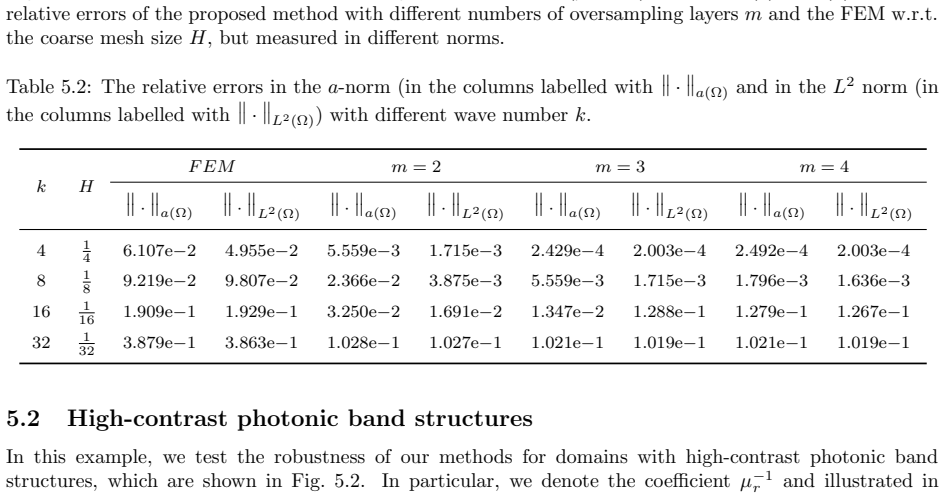
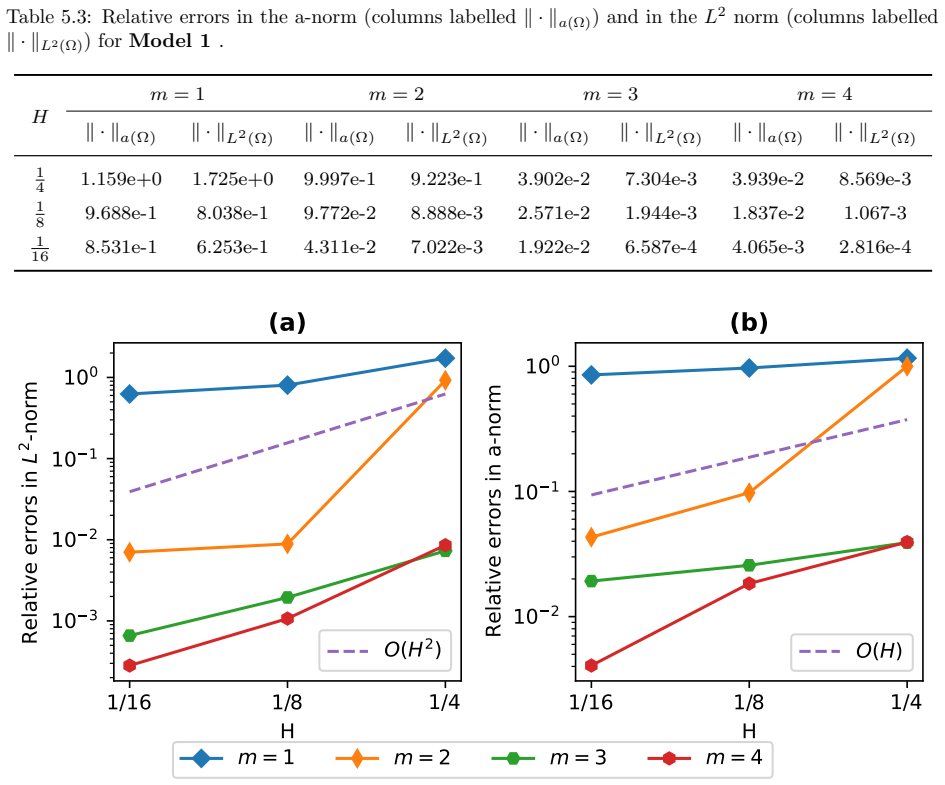
By constructing an auxiliary space through local spectral problems incorporating a mass term and a Silver-Müller-type boundary penalty, the approach guarantees coercivity of the bilinear form and excludes the kernel of the curl operator from the leading eigenspaces. This allows the construction of a multiscale space without explicit divergence-free constraints, and with appropriate oversampling satisfying a resolution condition, the modified bilinear form is coercive, leading to an O(H) convergence rate independent of the local contrast, with the approximation error increasing as the wave number k grows.
What carries the argument
The auxiliary space constructed via local spectral problems with a mass term and Silver-Müller boundary penalty, which ensures coercivity and kernel exclusion to support the multiscale approximation and its analysis.
If this is right
- The scheme remains stable and accurate in high-contrast media without contrast-dependent deterioration in the error bound.
- The error grows with wave number k, indicating that mesh or oversampling adjustments may be required for high-frequency regimes.
- Basis functions can be constructed without explicit divergence-free enforcement while preserving the necessary stability properties.
- The method applies directly to impedance boundary conditions and yields well-conditioned discrete systems under the stated assumptions.
Where Pith is reading between the lines
- The auxiliary-space technique could be adapted to other non-coercive wave problems such as Helmholtz or elastic equations in heterogeneous media.
- Adaptive choice of oversampling size based on local contrast or local wave number might further reduce computational cost while preserving the O(H) rate.
- Implementation in three dimensions or with complex geometries would provide a direct test of practical scalability beyond the reported experiments.
Load-bearing premise
The resolution condition on the oversampling region together with the key norm relationships between the auxiliary and multiscale spaces hold, enabling the proof of coercivity for the modified bilinear form.
What would settle it
A numerical test with insufficient oversampling or extremely high contrast in which the observed error either fails to scale as O(H) or shows dependence on the contrast value would disprove the convergence claim.
Figures





read the original abstract
Modeling time-harmonic Maxwell problems in heterogeneous media presents significant mathematical and computational challenges. Due to the inherent non-elliptic structure and non-coercive nature of Maxwell equations, conventional methods face severe numerical instabilities, particularly in high-contrast media and at high wave numbers. These challenges often lead to ill-conditioned discrete systems and prohibitively high computational costs, limiting their practical applicability. To overcome these challenges, we introduce an efficient multiscale framework for time-harmonic Maxwell equations with impedance boundary conditions in high-contrast media. A major novelty of this study lies in circumventing the need for an explicit divergence-free constraint on multiscale basis functions. To achieve this, an auxiliary space is constructed via local spectral problems incorporating a mass term and a Silver-M\"uller-type boundary penalty. This novel design guarantees the coercivity of the corresponding bilinear form and automatically excludes the kernel of the curl operator from the leading eigenspaces. Building upon the auxiliary space, we then construct the multiscale space by using a distinct bilinear form. By exploiting a resolution condition and establishing key norm relationships, we rigorously prove the coercivity of this modified bilinear form a crucial property that underpins the whole analysis. Theoretical analysis shows that, with appropriate oversampling, the method achieves $O (H)$ convergence independent of the local contrast and the approximation error increases with the wave number $k$. Extensive numerical experiments are reported to validate the effectiveness of the proposed approach.
Editorial analysis
A structured set of objections, weighed in public.
Referee Report
Summary. The manuscript develops a multiscale finite element method for time-harmonic Maxwell equations with impedance boundary conditions in highly heterogeneous high-contrast media. It constructs an auxiliary space via local spectral problems that include a mass term and Silver-Müller penalty to guarantee coercivity while automatically excluding the curl kernel. A distinct bilinear form is then used to build the multiscale space; coercivity of this form is proved by invoking a resolution condition on the oversampling region together with norm equivalences between the auxiliary and multiscale spaces. The analysis establishes O(H) convergence independent of the local contrast, with the error bound growing in the wave number k, and the claims are illustrated by numerical experiments.
Significance. If the central coercivity proof and the norm-equivalence arguments hold, the work supplies a practical route to stable, contrast-robust discretizations of non-coercive Maxwell problems without explicit divergence-free constraints. The contrast-independent O(H) rate is a notable theoretical feature for high-contrast electromagnetic modeling, and the explicit acknowledgment of k-growth in the error is useful for practical assessment.
minor comments (3)
- Abstract: the notation “O (H)” contains an extraneous space; standard mathematical typesetting writes O(H).
- The resolution condition on the oversampling region is central to the coercivity argument yet is only alluded to in the abstract; a concise statement of its precise form (e.g., the minimal number of layers or the dependence on k) should appear in the introduction or the statement of the main theorem.
- Numerical experiments: the abstract states that the approximation error increases with k, but the manuscript should include a dedicated table or figure that isolates this dependence (e.g., error versus k for fixed H and contrast) to make the claim directly verifiable.
Simulated Author's Rebuttal
We thank the referee for the positive and accurate summary of our manuscript, the recognition of its significance for contrast-robust discretizations of Maxwell problems, and the recommendation of minor revision. No specific major comments were provided in the report.
Circularity Check
No significant circularity in derivation chain
full rationale
The paper constructs an auxiliary space via local spectral problems (with mass term and Silver-Müller penalty) that directly guarantees coercivity and excludes the curl kernel by design of the eigenproblem. It then defines a distinct bilinear form on the multiscale space and derives coercivity from an explicit resolution condition on the oversampling region plus norm equivalences between the two spaces. These steps are forward derivations from the problem formulation and local constructions; the O(H) contrast-independent convergence follows from the established coercivity and approximation properties without reducing to self-definition, fitted inputs renamed as predictions, or load-bearing self-citations. The analysis is self-contained against the stated assumptions.
Axiom & Free-Parameter Ledger
axioms (1)
- domain assumption A resolution condition on the oversampling region holds
Reference graph
Works this paper leans on
-
[1]
A. Bensoussan, J.-L. Lions, and G. Papanicolaou,Asymptotic analysis for periodic structures, AMS Chelsea Publishing, American Mathematical Society, Providence, RI, (2011). Vol. 374. 23
work page 2011
-
[2]
L. Cao, Y. Zhang, W. Allegretto, and Y. Lin,Multiscale asymptotic method for Maxwell’s equations in composite materials, SIAM J. Numer. Anal.47(2010), pp. 4257–4289
work page 2010
- [3]
-
[4]
E. T. Chung, Y. Efendiev and W. T. Leung,Constraint energy minimizing generalized multiscale finite element method, Computer Methods in Applied Mechanics and Engineering.339(2018), pp. 298–319
work page 2018
-
[5]
E. T. Chung, C. Ye and X. Zhong,A locking free multiscale method for linear elasticity in stress- displacement formulation with high contrast coefficients, Computer Methods in Applied Mechanics and Engineering.447(2025)
work page 2025
-
[6]
P. G. Ciarlet,Linear and nonlinear functional analysis with applications, SIAM.130(2013)
work page 2013
-
[7]
P. Ciarlet, S. Fliss, and C. Stohrer,On the approximation of electromagnetic fields by edge finite ele- ments. Part 2: A heterogeneous multiscale method for Maxwell’s equations, Comput. Math. Appl.73 (2017), pp. 1900–1919
work page 2017
-
[8]
W. E and B. Engquist,The heterognous multiscale methods, Communications in Mathematical Sciences. 1(1)(2003), pp. 87–132
work page 2003
-
[9]
W. E, B. Engquist and Z. Huang,Heterogeneous multiscale method: a general methodology for multiscale modeling, Physical Review B.67(9)(2003), pp. 092101
work page 2003
-
[10]
Y. Efendiev and T. Y. Hou,Multiscale finite element methods: theory and applications, Springer Science & Business Media.4(2009)
work page 2009
-
[11]
B. Engquist and Y. H. Tsai,Heterogeneous multiscale methods for stiff ordinary differential equations. Mathematics of computation, Mathematics of computation.74(252)(2005), pp. 1707–1742
work page 2005
-
[12]
J. Galvis and Y. Efendiev,Domain decomposition preconditioners for multiscale flows in high-contrast media, SIAM Multiscale Modeling & Simulation.8(4)(2010), pp. 1461–1483
work page 2010
-
[13]
P. Henning, M. Ohlberger, and B. Verf¨ urth,A new heterogeneous multiscale method for time-harmonic Maxwell’s equations, SIAM J. Numer. Anal.54(2016), pp. 3493–3522
work page 2016
-
[14]
P. Henning and A. Persson,Computational homogenization of time-harmonic Maxwell’s equations, SIAM Journal on Scientific Computing.42(3)(2020), pp. B581–B607
work page 2020
-
[15]
Hiptmair,Finite elements in computational electromagnetism, Acta Numer.11(2002), pp
R. Hiptmair,Finite elements in computational electromagnetism, Acta Numer.11(2002), pp. 237–339
work page 2002
-
[16]
M. Hochbruck and C. Stohrer,Finite element heterogeneous multiscale method for time depen- dent Maxwell’s equations, in Spectral and High Order Methods for Partial Differential Equations— ICOSAHOM 2016, Lect. Notes Comput. Sci. Eng.119(2017), pp. 269–281
work page 2016
-
[17]
T. Y. Hou and X. H. Wu,A multiscale finite element method for elliptic problems in composite materials and porous media, Journal of computational physics.134(1)(1997), pp. 169–189
work page 1997
-
[18]
T. J. Hughes, G. R. Feij´ oo, L. Mazzei, and J. B. Quincy,The variational multiscale method—a paradigm for computational mechanics, Computer methods in applied mechanics and engineering.166(1-2) (1998), pp. 3–24
work page 1998
-
[19]
S. G. Johnson, S. Fan, P. R. Villeneuve, J. D. Joannopoulos, and L. A. Kolodziejski,Guided modes in photonic crystal slabs, Phys. Rev. B60(1999), pp. 5751–5758
work page 1999
-
[20]
A. Lamacz and B. Schweizer,A negative index meta-material for Maxwell’s equations, SIAM J. Math. Anal.48(6)(2016), pp. 4155–4174. 24
work page 2016
-
[21]
Leonhardt,Optical conformal mapping, Science312(5781)(2006), pp
U. Leonhardt,Optical conformal mapping, Science312(5781)(2006), pp. 1777–1780
work page 2006
-
[22]
R. Lipton and B. Schweizer,Effective Maxwell’s equations for perfectly conducting split ring resonators, Arch. Ration. Mech. Anal.229(3)(2018), pp. 1197–1221
work page 2018
-
[23]
Multiscale model reduction and two-level
C. Ma and Y. Zhang,Multiscale model reduction and two-level Schwarz preconditioner for H(curl) elliptic problems, preprint, arXiv:2506.07381 (2025)
-
[24]
A. M˚ alqvist and D. Peterseim,Localization of elliptic multiscale problems, Mathematics of Computation. 83(290)(2014), pp. 2583–2603
work page 2014
-
[25]
R. D. Meade, S. G. Johnson, and J. N. Winn,Photonic crystals: Molding the flow of light, Princeton University Press, Princeton, NJ, (2008)
work page 2008
-
[26]
Monk,Finite element methods for Maxwell’s equations, Oxford university press
P. Monk,Finite element methods for Maxwell’s equations, Oxford university press. (2003)
work page 2003
-
[27]
J. B. Pendry,Negative refraction makes a perfect lens, Phys. Rev. Lett.85(18)(2000), pp. 3966
work page 2000
-
[28]
D. Peterseim,Eliminating the pollution effect in Helmholtz problems by local subscale correction, Math- ematics of Computation.86(305)(2017), pp. 1005–1036
work page 2017
-
[29]
D. Peterseim, and R. Scheichl,Robust numerical upscaling of elliptic multiscale problems at high con- trast, Computational Methods in Applied Mathematics.16(4)(2016), pp. 579–603
work page 2016
-
[30]
Sakoda,Optical properties of photonic crystals, Springer, Berlin, Heidelberg, (2005)
K. Sakoda,Optical properties of photonic crystals, Springer, Berlin, Heidelberg, (2005)
work page 2005
-
[31]
D. R. Smith, J. B. Pendry, and M. C. Wiltshire,Metamaterials and negative refractive index, Science 305(5685)(2004), pp. 788–792
work page 2004
-
[32]
Verf¨ urth,Heterogeneous multiscale method for the Maxwell equations with high contrast, ESAIM: Math
B. Verf¨ urth,Heterogeneous multiscale method for the Maxwell equations with high contrast, ESAIM: Math. Model. Numer. Anal.53(1)(2019), pp. 35–61
work page 2019
-
[33]
V. G. Veselago,The electrodynamics of substances with simultaneously negative values ofεandµ, Uspekhi Fizicheskikh Nauk.92(3)(1967), pp. 517–526
work page 1967
-
[34]
C. Ye, X. Jin, P. Ciarlet Jr., and E. T. Chung,Multiscale modeling for a class of high-contrast hetero- geneous sign-changing problems, preprint, arXiv:2407.17130 (2024)
work page internal anchor Pith review arXiv 2024
-
[35]
X. Jin, L. Liu, X. Zhong, and E. T. Chung,Efficient numerical method for the Schr¨ odinger equation with high-contrast potentials, SIAM Multiscale Modeling & Simulation.23(4)(2025), pp. 1581–1606. 25
work page 2025
discussion (0)
Sign in with ORCID, Apple, or X to comment. Anyone can read and Pith papers without signing in.