Recognition: unknown
Linear poroelastic response of thin permeable gel films
Pith reviewed 2026-05-07 12:47 UTC · model grok-4.3
The pith
A point force applied to a thin permeable poroelastic gel film bonded to a rigid base deforms the surface only within a distance set by the film thickness.
A machine-rendered reading of the paper's core claim, the machinery that carries it, and where it could break.
Core claim
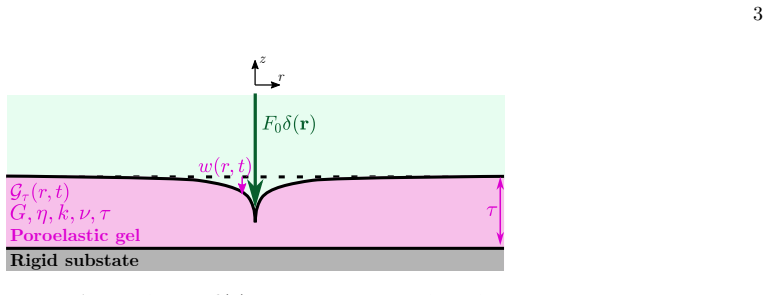
We derive the point-force mechanical response of a thin, permeable and poroelastic layer bounded to a rigid substrate. We show that the gel surface is only deformed around the indentation point, within a radius on the order of the layer thickness. The obtained Green's function can be directly used to predict the space- and time-dependent surface deformation of the gel.
What carries the argument
The Green's function for vertical surface displacement, obtained by solving the linearized poroelastic equations under the thin-film approximation with no-slip bonding at the rigid base.
If this is right
- Any distributed or time-varying load on the film can be handled by linear superposition of the Green's function to give the instantaneous surface profile.
- Indentation experiments on such films yield local poroelastic moduli and permeability without contamination from distant boundaries.
- Lubrication problems involving a soft porous wall reduce to a localized interaction whose effective stiffness and dissipation are set by the film thickness.
- The same framework applies directly to ultra-thin hydrogel coatings whose thickness is the only relevant length scale in the plane.
Where Pith is reading between the lines
- The same localization should appear in any thin porous elastic coating whose permeability allows solvent to escape only through the free surface, suggesting a general rule for confined poroelastic bodies.
- One could test the prediction by fabricating gels of systematically varied thickness and checking that the radius of observable deformation scales linearly with thickness under slow loading.
- Oscillatory forces at frequencies set by the poroelastic time could be used to map frequency-dependent surface compliance without solving the full three-dimensional problem.
Load-bearing premise
Linear poroelastic relations between stress, strain, and fluid pressure hold exactly, the layer is thin compared with its lateral extent, and it remains perfectly bonded to the substrate while remaining permeable to solvent.
What would settle it
An indentation measurement on a thin gel film in which the deformed region extends many times farther than the film thickness, or in which the deformation fails to relax on the predicted poroelastic time scale, would contradict the localization result.
Figures


read the original abstract
When a hydrophilic and deformable porous material is immersed in a bath, it may absorb the solvent and expand by several times its volume, thus forming a highly soft and porous hydrogel. A stress applied on the soft hydrogel surface deforms it and forces the absorbed solvent to move by flowing through the network of pores. This coupled phenomenon sets the framework of poroelasticity. Moreover, polymeric gels are often used in ultra-thin coatings to tune surface properties. Together with the characteristic poroelastic coupling, this thinness challenges the modelling of their response. In this article, we derive the point-force mechanical response of a thin, permeable and poroelastic layer bounded to a rigid substrate. We show that the gel surface is only deformed around the indentation point, within a radius on the order of the layer thickness. The obtained Green's function can be directly used to predict the space- and time-dependent surface deformation of the gel. Our findings are relevant for a broad range of applications, such as indentation experiments on swollen gels, thin membranes or soft and living systems, as well as lubrication problems involving a soft and porous wall, for instance in microfluidics.
Editorial analysis
A structured set of objections, weighed in public.
Referee Report
Summary. The manuscript derives a closed-form Green's function for the linear poroelastic response of a thin permeable gel film bonded to a rigid substrate under point-force indentation. It claims that the surface deformation localizes within a radial distance of order the film thickness h, with the result obtained by reducing the 3D poroelastic equations via thin-layer scaling and solving the resulting 2D problem; the Green's function is presented as directly usable for space- and time-dependent surface predictions.
Significance. If the derivation holds under the stated approximations, the result supplies a practical analytical tool for modeling contact, indentation, and lubrication in thin poroelastic layers. The localization finding is useful for applications in soft coatings, microfluidics, and biological interfaces, where it could simplify boundary-value problems without requiring full 3D numerics.
major comments (1)
- [Derivation of the Green's function (around the thin-layer scaling and solution steps)] The thin-layer reduction (implicitly assuming in-plane derivatives ≪ through-thickness derivatives) is applied to obtain the Green's function, yet a true point force introduces singular lateral gradients at the origin that violate the slow-variation assumption exactly where the response is computed. The manuscript should either demonstrate consistency of the solution with the scaling (e.g., by showing that the derived displacement field satisfies the neglected terms being small away from r=0) or quantify the local error; without this, the claimed localization radius O(h) rests on an uncontrolled approximation.
minor comments (1)
- [Abstract] The abstract states the localization result but does not preview the governing equations or boundary conditions; adding a brief outline would improve accessibility.
Simulated Author's Rebuttal
We thank the referee for their careful reading and constructive feedback on our manuscript. We address the single major comment below and will revise the manuscript accordingly to strengthen the presentation of the thin-layer approximation.
read point-by-point responses
-
Referee: [Derivation of the Green's function (around the thin-layer scaling and solution steps)] The thin-layer reduction (implicitly assuming in-plane derivatives ≪ through-thickness derivatives) is applied to obtain the Green's function, yet a true point force introduces singular lateral gradients at the origin that violate the slow-variation assumption exactly where the response is computed. The manuscript should either demonstrate consistency of the solution with the scaling (e.g., by showing that the derived displacement field satisfies the neglected terms being small away from r=0) or quantify the local error; without this, the claimed localization radius O(h) rests on an uncontrolled approximation.
Authors: We agree that the point-force singularity formally challenges the slow-variation assumption at r=0. The thin-layer reduction is an asymptotic approximation valid when the film thickness h is the smallest scale; the resulting 2D Green's function captures the leading-order response. In the revised manuscript we will add a dedicated subsection that substitutes the derived displacement and pressure fields back into the original 3D poroelastic equations and explicitly evaluates the magnitude of the neglected in-plane derivative terms. This analysis will show that, for r/h ≳ 0.1, the neglected terms remain small (O(h/L) with L the local radial scale), while the singular core occupies a vanishingly small area whose integrated contribution to the total deformation is negligible. The localization to O(h) is therefore robust within the stated thin-film regime. We will also include a brief discussion of the expected microscopic cutoff (e.g., mesh size) that regularizes the origin in any physical realization. revision: yes
Circularity Check
Derivation proceeds from poroelastic equations via thin-layer scaling without reduction to inputs
full rationale
The paper states that it derives the Green's function for point-force response by reducing the 3D linear poroelastic equations (momentum balance, Darcy's law, continuity) under the thin-layer approximation with bonding to a rigid substrate. This yields a closed-form expression for localized surface deformation of radius O(h) directly from the scaled PDEs and boundary conditions. No fitted parameters are renamed as predictions, no self-citations bear the central load, and the result is not equivalent to its inputs by construction. The thin-film scaling is an explicit modeling choice whose validity can be assessed externally; it does not create circularity.
Axiom & Free-Parameter Ledger
axioms (2)
- domain assumption Linear poroelastic constitutive relations govern the coupled solid deformation and fluid flow
- domain assumption The gel layer is thin, permeable, and perfectly bonded to a rigid impermeable substrate
Reference graph
Works this paper leans on
-
[1]
Water transport, respiration and energetics of three tropical marine sponges,
H. M. Reiswig, “Water transport, respiration and energetics of three tropical marine sponges,” Journal of experimental marine Biology and Ecology , vol. 14, no. 3, pp. 231–249, 1974
1974
-
[2]
Formation and function of bacterial organelles,
C. Greening and T. Lithgow, “Formation and function of bacterial organelles,” Nature Reviews Microbiology , vol. 18, no. 12, pp. 677–689, 2020
2020
-
[3]
An analysis of the squeeze-film lubrication mechanism for articular cartilage,
J. Hou, V. C. Mow, W. Lai, and M. Holmes, “An analysis of the squeeze-film lubrication mechanism for articular cartilage,” Journal of biomechanics , vol. 25, no. 3, pp. 247–259, 1992. 11
1992
-
[4]
Lubrication of articular cartilage,
S. Jahn, J. Seror, and J. Klein, “Lubrication of articular cartilage,” Annual review of biomedical engineering, vol. 18, no. 1, pp. 235–258, 2016
2016
-
[5]
A new look at lubrication of the ocular surface: fluid mechanics behind the blinking eyelids,
I. Cher, “A new look at lubrication of the ocular surface: fluid mechanics behind the blinking eyelids,” The ocular surface, vol. 6, no. 2, pp. 79–86, 2008
2008
-
[6]
Flow in foams and flowing foams,
S. Cohen-Addad, R. H¨ ohler, and O. Pitois, “Flow in foams and flowing foams,”Annual Review of Fluid Mechanics, vol. 45, no. 1, pp. 241–267, 2013
2013
-
[7]
Multiaxial crushing of open-cell foams,
C. Yang and S. Kyriakides, “Multiaxial crushing of open-cell foams,” International Journal of Solids and Structures , vol. 159, pp. 239–256, 2019
2019
-
[8]
Surface-responsive materials,
T. Russell, “Surface-responsive materials,” Science, vol. 297, no. 5583, pp. 964–967, 2002
2002
-
[9]
P (aam-co-eg) interpenetrating polymer networks grafted to oxide surfaces: Surface characterization, protein adsorption, and cell detachment studies,
J. Bearinger, D. Castner, S. Golledge, A. Rezania, S. Hubchak, and K. Healy, “P (aam-co-eg) interpenetrating polymer networks grafted to oxide surfaces: Surface characterization, protein adsorption, and cell detachment studies,” Langmuir, vol. 13, no. 19, pp. 5175–5183, 1997
1997
-
[10]
Elastohydrodynamic lift at a soft wall,
H. Davies-Strickleton, D. D´ ebarre, N. El Amri, C. Verdier, R. P. Richter, and L. Bureau, “Elastohydrodynamic lift at a soft wall,” Physical review letters, vol. 120, no. 19, p. 198001, 2018
2018
-
[11]
Lift at low reynolds number,
L. Bureau, G. Coupier, and T. Salez, “Lift at low reynolds number,” The European Physical Journal E , vol. 46, no. 11, p. 111, 2023
2023
-
[12]
Functional hydrogel structures for autonomous flow control inside microfluidic channels,
D. J. Beebe, J. S. Moore, J. M. Bauer, Q. Yu, R. H. Liu, C. Devadoss, and B.-H. Jo, “Functional hydrogel structures for autonomous flow control inside microfluidic channels,” nature, vol. 404, no. 6778, pp. 588–590, 2000
2000
-
[13]
Microfluidic valves comprising nanolayered thermoresponsive polymer-grafted capillaries,
N. Idota, A. Kikuchi, J. Kobayashi, K. Sakai, and T. Okano, “Microfluidic valves comprising nanolayered thermoresponsive polymer-grafted capillaries,” Advanced Materials, vol. 17, no. 22, pp. 2723–2727, 2005
2005
-
[14]
Microfluidic actuators based on temperature-responsive hydrogels,
L. D’eramo, B. Chollet, M. Leman, E. Martwong, M. Li, H. Geisler, J. Dupire, M. Kerdraon, C. Vergne, F. Monti, et al., “Microfluidic actuators based on temperature-responsive hydrogels,” Microsystems & Nanoengineering, vol. 4, no. 1, p. 17069, 2018
2018
-
[15]
Hydrogels in biology and medicine: from molecular principles to bionanotechnology,
N. A. Peppas, J. Z. Hilt, A. Khademhosseini, and R. Langer, “Hydrogels in biology and medicine: from molecular principles to bionanotechnology,” Advanced materials, vol. 18, no. 11, pp. 1345–1360, 2006
2006
-
[16]
Elastic field of a thin-film/substrate system under an axisymmetric loading,
J. Li and T.-W. Chou, “Elastic field of a thin-film/substrate system under an axisymmetric loading,” International Journal of Solids and Structures , vol. 34, no. 35-36, pp. 4463–4478, 1997
1997
-
[17]
‘soft’contact problems in linear elasticity,
B. Hughes and L. White, “‘soft’contact problems in linear elasticity,” The Quarterly Journal of Mechanics and Applied Mathematics, vol. 32, no. 4, pp. 445–471, 1979
1979
-
[18]
Regimes of soft lubrication,
M. H. Essink, A. Pandey, S. Karpitschka, C. H. Venner, and J. H. Snoeijer, “Regimes of soft lubrication,” Journal of fluid mechanics, vol. 915, p. A49, 2021
2021
-
[19]
Hydrodynamic interactions for the measurement of thin film elastic properties,
S. Leroy and E. Charlaix, “Hydrodynamic interactions for the measurement of thin film elastic properties,” Journal of Fluid Mechanics, vol. 674, pp. 389–407, 2011
2011
-
[20]
Fluid-elastic interactions near contact at low reynolds number,
B. Rallabandi, “Fluid-elastic interactions near contact at low reynolds number,”Annual Review of Fluid Mechanics, vol. 56, no. 1, pp. 491–519, 2024
2024
-
[21]
Elastic deformation of soft coatings due to lubrication forces,
Y. Wang, M. R. Tan, and J. Frechette, “Elastic deformation of soft coatings due to lubrication forces,” Soft Matter, vol. 13, no. 38, pp. 6718–6729, 2017
2017
-
[22]
Hydrodynamic force between a sphere and a soft, elastic surface,
K. Farzaneh, A. Javed, K. Michael, and B. Hans-Jurgen, “Hydrodynamic force between a sphere and a soft, elastic surface,” Langmuir, vol. 30, no. 939, pp. 11619–11624, 2014
2014
-
[23]
Elastohydrodynamics of a sliding, spinning and sedimenting cylinder near a soft wall,
T. Salez and L. Mahadevan, “Elastohydrodynamics of a sliding, spinning and sedimenting cylinder near a soft wall,” Journal of Fluid Mechanics , vol. 779, pp. 181–196, 2015
2015
-
[24]
Soft lubrication: The elastohydrodynamics of nonconforming and conforming con- tacts,
J. M. Skotheim and L. Mahadevan, “Soft lubrication: The elastohydrodynamics of nonconforming and conforming con- tacts,” Physics of Fluids , vol. 17, no. 9, 2005
2005
-
[25]
Soft-lubrication interactions between a rigid sphere and an elastic wall,
V. Bertin, Y. Amarouchene, E. Rapha¨ el, and T. Salez, “Soft-lubrication interactions between a rigid sphere and an elastic wall,” Journal of fluid mechanics , vol. 933, p. A23, 2022
2022
-
[26]
Lubrication of soft viscoelastic solids,
A. Pandey, S. Karpitschka, C. H. Venner, and J. H. Snoeijer, “Lubrication of soft viscoelastic solids,” Journal of fluid mechanics, vol. 799, pp. 433–447, 2016
2016
-
[27]
Effect of fluid viscoelasticity, shear stress, and interface tension on the lift force in lubricated contacts,
S. Hu, F. Meng, et al. , “Effect of fluid viscoelasticity, shear stress, and interface tension on the lift force in lubricated contacts,” The Journal of Chemical Physics , vol. 159, no. 16, 2023
2023
-
[28]
Lift forces on three-dimensional elastic and viscoelastic lubricated contacts,
A. Kargar-Estahbanati and B. Rallabandi, “Lift forces on three-dimensional elastic and viscoelastic lubricated contacts,” Physical Review Fluids, vol. 6, no. 3, p. 034003, 2021
2021
-
[29]
Elastic deformation during dynamic force measurements in viscous fluids,
Y. Wang, G. A. Pilkington, C. Dhong, and J. Frechette, “Elastic deformation during dynamic force measurements in viscous fluids,” Current opinion in colloid & interface science , vol. 27, pp. 43–49, 2017
2017
-
[30]
Out-of-contact elastohydrodynamic deformation due to lubrication forces,
Y. Wang, C. Dhong, and J. Frechette, “Out-of-contact elastohydrodynamic deformation due to lubrication forces,”Physical review letters, vol. 115, no. 24, p. 248302, 2015
2015
-
[31]
P. J. Flory, Principles of polymer chemistry . Cornell university press, 1953
1953
-
[32]
Rubinstein and R
M. Rubinstein and R. H. Colby, Polymer physics. Oxford university press, 2003
2003
-
[33]
Doi, Soft matter physics
M. Doi, Soft matter physics . oxford university press, 2013
2013
-
[34]
Wall slip in polymer melts,
L. L´ eger, H. Hervet, G. Massey, and E. Durliat, “Wall slip in polymer melts,” Journal of Physics: Condensed Matter , vol. 9, no. 37, pp. 7719–7740, 1997
1997
-
[35]
Slip in entangled polymer solutions,
V. Mhetar and L. Archer, “Slip in entangled polymer solutions,” Macromolecules, vol. 31, no. 19, pp. 6639–6649, 1998
1998
-
[36]
Water slippage versus contact angle: A quasiuniversal relationship,
D. M. Huang, C. Sendner, D. Horinek, R. R. Netz, and L. Bocquet, “Water slippage versus contact angle: A quasiuniversal relationship,” Physical review letters, vol. 101, no. 22, p. 226101, 2008
2008
-
[37]
Nanofluidics, from bulk to interfaces,
L. Bocquet and E. Charlaix, “Nanofluidics, from bulk to interfaces,” Chemical Society Reviews, vol. 39, no. 3, pp. 1073– 12 1095, 2010
2010
-
[38]
Boundary conditions at a naturally permeable wall,
G. S. Beavers and D. D. Joseph, “Boundary conditions at a naturally permeable wall,” Journal of fluid mechanics , vol. 30, no. 1, pp. 197–207, 1967
1967
-
[39]
Squeeze-film flow between a curved impermeable bearing and a flat porous bed,
D. Knox, B. Duffy, S. McKee, and S. Wilson, “Squeeze-film flow between a curved impermeable bearing and a flat porous bed,” Physics of Fluids , vol. 29, no. 2, 2017
2017
-
[40]
General theory of three-dimensional consolidation,
M. A. Biot, “General theory of three-dimensional consolidation,” Journal of applied physics , vol. 12, no. 2, pp. 155–164, 1941
1941
-
[41]
General solutions of the equations of elasticity and consolidation for a porous material,
M. A. Biot, “General solutions of the equations of elasticity and consolidation for a porous material,” Journal of applied mechanics, 1956
1956
-
[42]
A. E. H. Love, A treatise on the mathematical theory of elasticity . Cambridge university press, 2013
2013
-
[43]
L. D. Landau, L. Pitaevskii, A. M. Kosevich, and E. M. Lifshitz, Theory of elasticity: volume 7 , vol. 7. Elsevier, 2012
2012
-
[44]
Some basic stress diffusion solutions for fluid-saturated elastic porous media with compressible constituents,
J. R. Rice and M. P. Cleary, “Some basic stress diffusion solutions for fluid-saturated elastic porous media with compressible constituents,” Reviews of Geophysics, vol. 14, no. 2, pp. 227–241, 1976
1976
-
[45]
Wang, Theory of linear poroelasticity with applications to geomechanics and hydrogeology , vol
H. Wang, Theory of linear poroelasticity with applications to geomechanics and hydrogeology , vol. 2. Princeton university press, 2000
2000
-
[46]
Moving wetting ridges on ultrasoft gels,
H. Jeon, Y. Chao, and S. Karpitschka, “Moving wetting ridges on ultrasoft gels,” Physical Review E , vol. 108, no. 2, p. 024611, 2023
2023
-
[47]
Transpiration through hydrogels,
M. A. Etzold, P. F. Linden, and M. G. Worster, “Transpiration through hydrogels,” Journal of Fluid Mechanics , vol. 925, p. A8, 2021
2021
-
[48]
Friction of poroelastic contacts with thin hydrogel films,
J. Delavoipi` ere, Y. Tran, E. Verneuil, B. Heurtefeu, C. Y. Hui, and A. Chateauminois, “Friction of poroelastic contacts with thin hydrogel films,” Langmuir, vol. 34, no. 33, pp. 9617–9626, 2018
2018
-
[49]
Transient sliding of thin hydrogel films: the role of poroelasticity,
L. Ciapa, J. Delavoipi` ere, Y. Tran, E. Verneuil, and A. Chateauminois, “Transient sliding of thin hydrogel films: the role of poroelasticity,” Soft Matter, vol. 16, no. 28, pp. 6539–6548, 2020
2020
-
[50]
Poroelastic indentation of mechanically confined hydrogel layers,
J. Delavoipiere, Y. Tran, E. Verneuil, and A. Chateauminois, “Poroelastic indentation of mechanically confined hydrogel layers,” Soft Matter, vol. 12, no. 38, pp. 8049–8058, 2016
2016
-
[51]
Pore-size dependence and slow relaxation of hydrogel friction on smooth surfaces,
N. L. Cuccia, S. Pothineni, B. Wu, J. M´ endez Harper, and J. C. Burton, “Pore-size dependence and slow relaxation of hydrogel friction on smooth surfaces,” Proceedings of the National Academy of Sciences, vol. 117, no. 21, pp. 11247–11256, 2020
2020
-
[52]
Using indentation to characterize the poroelasticity of gels,
Y. Hu, X. Zhao, J. J. Vlassak, and Z. Suo, “Using indentation to characterize the poroelasticity of gels,” Applied Physics Letters, vol. 96, no. 12, 2010
2010
-
[53]
Geometrical control of dissipation during the spreading of liquids on soft solids,
M. Zhao, J. Dervaux, T. Narita, F. Lequeux, L. Limat, and M. Roch´ e, “Geometrical control of dissipation during the spreading of liquids on soft solids,” Proceedings of the National Academy of Sciences, vol. 115, no. 8, pp. 1748–1753, 2018
2018
-
[54]
Swelling and evaporation determine surface morphology of grafted hydrogel thin films,
C. Kopecz-Muller, C. Gaunand, Y. Tran, M. Labousse, E. Raphael, T. Salez, F. Box, and J. D. Mcgraw, “Swelling and evaporation determine surface morphology of grafted hydrogel thin films,” Langmuir, vol. 41, no. 4, pp. 2400–2410, 2025
2025
-
[55]
Spontaneous localized fluid release on swelling fibres,
P. Van De Velde, J. Dervaux, S. Proti` ere, and C. Duprat, “Spontaneous localized fluid release on swelling fibres,” Soft Matter, vol. 18, no. 24, pp. 4565–4571, 2022
2022
-
[56]
Spreading on textiles: Dynamics of drops on model poroelastic fibrous materials,
P. Van de Velde, H. Madkour, S. Proti` ere, and C. Duprat, “Spreading on textiles: Dynamics of drops on model poroelastic fibrous materials,” Physical Review Fluids, vol. 10, no. 4, p. 040501, 2025
2025
-
[57]
Theory of phase transition in polymer gels,
A. Onuki, “Theory of phase transition in polymer gels,” in Responsive Gels: Volume Transitions I , pp. 63–121, Springer, 2005
2005
-
[58]
The shearing resistance of saturated soils and the angle between the planes of shear,
K. V. Terzaghi, “The shearing resistance of saturated soils and the angle between the planes of shear,” inFirst international conference on soil Mechanics, 1936 , vol. 1, pp. 54–59, 1936
1936
-
[59]
Bulk modulus of poly (n- isopropylacrylamide) microgels through the swelling transition,
B. Sierra-Martin, Y. Laporte, A. South, L. A. Lyon, and A. Fern´ andez-Nieves, “Bulk modulus of poly (n- isopropylacrylamide) microgels through the swelling transition,”Physical Review E—Statistical, Nonlinear, and Soft Matter Physics, vol. 84, no. 1, p. 011406, 2011
2011
-
[60]
Friction coefficient of polymer networks of gels,
M. Tokita and T. Tanaka, “Friction coefficient of polymer networks of gels,” The Journal of chemical physics , vol. 95, no. 6, pp. 4613–4619, 1991
1991
-
[61]
Free-evolution kinetics in a high-swelling polymeric hydrogel,
M. Engelsberg and W. Barros Jr, “Free-evolution kinetics in a high-swelling polymeric hydrogel,” Physical Review E , vol. 88, no. 6, p. 062602, 2013
2013
-
[62]
Dynamics of swelling and drying in a spherical gel,
T. Bertrand, J. Peixinho, S. Mukhopadhyay, and C. W. MacMinn, “Dynamics of swelling and drying in a spherical gel,” Physical Review Applied, vol. 6, no. 6, p. 064010, 2016
2016
-
[63]
Large deformations of a soft porous material,
C. W. MacMinn, E. R. Dufresne, and J. S. Wettlaufer, “Large deformations of a soft porous material,” Physical Review Applied, vol. 5, no. 4, p. 044020, 2016
2016
-
[64]
Characterizing hydrogel behavior under compression with gel-freezing osmometry,
Y. Feng, D. Gerber, S. Heyden, M. Kr¨ oger, E. R. Dufresne, L. Isa, and R. W. Style, “Characterizing hydrogel behavior under compression with gel-freezing osmometry,” Journal of the Mechanics and Physics of Solids , vol. 201, p. 106166, 2025
2025
-
[65]
A linear-elastic-nonlinear-swelling theory for hydrogels. part 1. modelling of super- absorbent gels,
J. J. Webber and M. G. Worster, “A linear-elastic-nonlinear-swelling theory for hydrogels. part 1. modelling of super- absorbent gels,” Journal of Fluid Mechanics , vol. 960, p. A37, 2023
2023
-
[66]
A linear-elastic–nonlinear-swelling theory for hydrogels. part 2. displace- ment formulation,
J. J. Webber, M. A. Etzold, and M. G. Worster, “A linear-elastic–nonlinear-swelling theory for hydrogels. part 2. displace- ment formulation,” Journal of Fluid Mechanics , vol. 960, p. A38, 2023
2023
-
[67]
Viscoelasticity and poroelasticity in elastomeric gels,
Y. Hu and Z. Suo, “Viscoelasticity and poroelasticity in elastomeric gels,” Acta Mechanica Solida Sinica , vol. 25, no. 5, pp. 441–458, 2012
2012
-
[68]
Mechanical response of a thick poroelastic gel in contactless colloidal-probe rheology,
C. Kopecz-Muller, V. Bertin, E. Rapha¨ el, J. D. McGraw, and T. Salez, “Mechanical response of a thick poroelastic gel in contactless colloidal-probe rheology,” Proceedings of the Royal Society A: Mathematical, Physical and Engineering Sciences, vol. 479, no. 2271, 2023. 13
2023
-
[69]
Kopecz-Muller, Mechanics of hydrogel films: swelling-induced instabilities, finite-size effects, and contactless rheology to indentation-induced dehydration
C. Kopecz-Muller, Mechanics of hydrogel films: swelling-induced instabilities, finite-size effects, and contactless rheology to indentation-induced dehydration. PhD thesis, Universit´ e de Bordeaux, 2024
2024
-
[70]
Plane strain and axially symmetric problems of the consolidation of a semi-infinite clay stratum,
J. McNamee and R. Gibson, “Plane strain and axially symmetric problems of the consolidation of a semi-infinite clay stratum,” The Quarterly Journal of Mechanics and Applied Mathematics , vol. 13, no. 2, pp. 210–227, 1960
1960
-
[71]
Displacement functions and linear transforms applied to diffusion through porous elastic media,
J. McNamee and R. Gibson, “Displacement functions and linear transforms applied to diffusion through porous elastic media,” The Quarterly Journal of Mechanics and Applied Mathematics , vol. 13, no. 1, pp. 98–111, 1960
1960
-
[72]
A unified framework for numerically inverting laplace transforms,
J. Abate and W. Whitt, “A unified framework for numerically inverting laplace transforms,” INFORMS Journal on Computing, vol. 18, no. 4, pp. 408–421, 2006
2006
-
[73]
Theory and operational rules for the discrete hankel transform,
N. Baddour and U. Chouinard, “Theory and operational rules for the discrete hankel transform,” Journal of the Optical Society of America A , vol. 32, no. 4, pp. 611–622, 2015
2015
-
[74]
Measuring electrostatic, van der waals, and hydration forces in electrolyte solutions with an atomic force microscope,
H.-J. Butt, “Measuring electrostatic, van der waals, and hydration forces in electrolyte solutions with an atomic force microscope,” Biophysical journal, vol. 60, no. 6, pp. 1438–1444, 1991
1991
-
[75]
Direct measurement of colloidal forces using an atomic force microscope,
W. A. Ducker, T. J. Senden, and R. M. Pashley, “Direct measurement of colloidal forces using an atomic force microscope,” nature, vol. 353, no. 6341, pp. 239–241, 1991
1991
-
[76]
Recent advances in the surface forces apparatus (sfa) technique,
J. Israelachvili, Y. Min, M. Akbulut, A. Alig, G. Carver, W. Greene, K. Kristiansen, E. Meyer, N. Pesika, K. Rosenberg, et al. , “Recent advances in the surface forces apparatus (sfa) technique,” Reports on Progress in Physics , vol. 73, no. 3, p. 036601, 2010
2010
-
[77]
Poroelasticity of highly confined hydrogel films measured with a surface forces apparatus,
G. D. Degen, Y.-T. Chen, A. L. Chau, L. K. M˚ ansson, and A. A. Pitenis, “Poroelasticity of highly confined hydrogel films measured with a surface forces apparatus,” Soft Matter, vol. 16, no. 35, pp. 8096–8100, 2020
2020
-
[78]
Experimental study of a nanometric liquid bridge with a surface force apparatus,
J. Crassous, E. Charlaix, H. Gayvallet, and J. L. Loubet, “Experimental study of a nanometric liquid bridge with a surface force apparatus,” Langmuir, vol. 9, no. 8, pp. 1995–1998, 1993. 14 SUPPLEMENTARY INFORMATION SI-1. Detailed resolution In this section, we detail the calculation path to compute the finite-size poroelastic Green’s function, which is b...
1995
discussion (0)
Sign in with ORCID, Apple, or X to comment. Anyone can read and Pith papers without signing in.