Recognition: unknown
Directional curvature and medial axis
Pith reviewed 2026-05-07 12:43 UTC · model grok-4.3
The pith
A criterion using directional curvature in camber directions characterizes when the medial axis reaches the singularities of a definable closed set.
A machine-rendered reading of the paper's core claim, the machinery that carries it, and where it could break.
Core claim
We obtain a general criterion based on a generalisation of the notion of superquadraticity by introducing a notion of directional curvature in some naturally chosen camber directions. This allows us in particular to complete the study of the plane case for characterising the points of the set of singularities given by the intersection of the closure of the medial axis with X.
What carries the argument
Directional curvature measured in naturally chosen camber directions, serving as the generalization of superquadraticity that detects medial-axis singularities without any smoothness assumption on X.
Load-bearing premise
The set X is definable in a polynomially bounded structure.
What would settle it
A concrete closed set X definable in a polynomially bounded structure together with an explicit point in the closure of its medial axis that lies in X, yet fails to satisfy the directional-curvature criterion in the chosen camber directions.
Figures
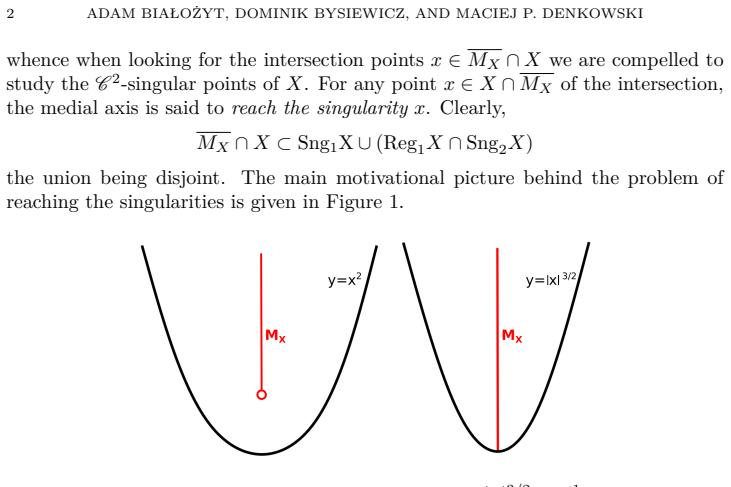

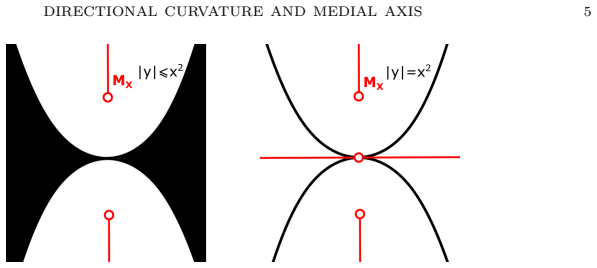
read the original abstract
The medial axis $M_X$ of a closed set $X\subset \mathbb{R}^n$ is the set of points from the ambient space that admit more than one closest point in $X$. We study the problem of reaching the singularities, i.e. of characterising the points of the set $\overline{M_X}\cap X$. In order to tame the geometry, we assume that $X$ is definable in a polynomially bounded structure and obtain a general criterion based on a generalisation of the notion of superquadraticity previously introduced by Birbrair and Denkowski for $C^1$-smooth hypersurfaces and extended to any codimension by Bia{\l}o\.zyt. We do not require any smoothness as we achieve our goal by introducing a notion of directional curvature in some naturally chosen camber directions. This allows us in particular to complete the study of the plane case.
Editorial analysis
A structured set of objections, weighed in public.
Referee Report
Summary. The paper claims to characterize points in the closure of the medial axis M_X intersected with a closed set X in R^n by deriving a general criterion that generalizes the notion of superquadraticity. This is achieved by introducing directional curvature along naturally chosen camber directions, under the standing assumption that X is definable in a polynomially bounded o-minimal structure; the approach requires no smoothness and is used in particular to complete the study of the plane case.
Significance. If the derivation holds, the work supplies a concrete, non-smooth criterion for medial-axis singularities inside tame geometries, extending the superquadraticity results of Birbrair-Denkowski and Białozyt. The introduction of directional curvature as a new, geometrically natural object is a positive contribution that may find use in other questions involving singularities of distance functions or reach sets within o-minimal settings.
minor comments (2)
- The abstract and introduction introduce 'camber directions' and 'directional curvature' without a preliminary informal description; adding one or two sentences that indicate how these objects are chosen from the geometry of the distance function would improve accessibility for readers outside the immediate subfield.
- In the statement of the main criterion (presumably Theorem X or the central result in the section following the definitions), it would be helpful to include a short remark confirming that the new notion reduces to the classical superquadraticity condition when X is C^1-smooth, so that the generalization is manifestly consistent with prior work.
Simulated Author's Rebuttal
We thank the referee for their positive evaluation of the manuscript and for recommending minor revision. The referee summary accurately captures the main contributions, and we appreciate the recognition of the significance of directional curvature as a new geometric object in the o-minimal setting. Since the major comments section contains no specific points, we have no revisions to make in response to the report.
read point-by-point responses
-
Referee: The paper claims to characterize points in the closure of the medial axis M_X intersected with a closed set X in R^n by deriving a general criterion that generalizes the notion of superquadraticity. This is achieved by introducing directional curvature along naturally chosen camber directions, under the standing assumption that X is definable in a polynomially bounded o-minimal structure; the approach requires no smoothness and is used in particular to complete the study of the plane case.
Authors: We thank the referee for this precise summary of our results. The generalization of superquadraticity through directional curvature in camber directions is indeed the core of the paper, and we are pleased that its applicability to the plane case and lack of smoothness assumptions are highlighted. revision: no
Circularity Check
No significant circularity detected
full rationale
The paper states upfront the tameness assumption that X is definable in a polynomially bounded o-minimal structure. It then introduces a new notion of directional curvature in camber directions to generalize the prior superquadraticity concept (cited from Birbrair-Denkowski and Białożyt) and derives a criterion for points in closure(M_X) ∩ X. This new directional curvature supplies the independent step that handles the non-smooth case; the plane-case completion is listed as a corollary. Self-citations to overlapping-author prior work are present but not load-bearing, as the central derivation rests on the freshly defined curvature rather than reducing to a fit, self-definition, or unverified self-citation chain. The argument is self-contained against the explicit tameness hypothesis and external benchmarks.
Axiom & Free-Parameter Ledger
axioms (1)
- domain assumption X is definable in a polynomially bounded structure
invented entities (1)
-
directional curvature
no independent evidence
Reference graph
Works this paper leans on
-
[1]
Białożyt, The tangent cone, the dimension and the frontier of the medial axis , Nonlinear Differ
A. Białożyt, The tangent cone, the dimension and the frontier of the medial axis , Nonlinear Differ. Equ. Appl. 30 (2023), 27
2023
-
[2]
Białożyt, On the singular points approached by the medial axis , J
A. Białożyt, On the singular points approached by the medial axis , J. Math. Imaging Vision 67 (2025)
2025
-
[3]
Medial axis detects non-Lipschitz normally embedded points
A. Białożyt, Medial axis detects non-Lipschitz normally embedded points , arXiv:2405.12682 (2024)
work page internal anchor Pith review Pith/arXiv arXiv 2024
-
[4]
A. Białożyt, A. Denkowska, M. P. Denkowski, The Kuratowski convergence of medial axis and conflict sets , Ann. Scuola Norm.-Sci. (2023), 21, DOI 10.2422/2036 − 2145.202310002
-
[5]
Birbrair, M
L. Birbrair, M. P. Denkowski, Medial axis and singularities , J. Geom. Anal. 27 no. 3 (2017), 2339-2380
2017
-
[6]
L. Birbrair, M. P. Denkowski, Erratum to: Medial axis and singularities , arXiv:1705.02788 (2017)
-
[7]
Birbrair, D
L. Birbrair, D. Siersma, Metric properties of conflict sets , Houston J. Math. 35 (1) (2009), 73-80; (2017)
2009
-
[8]
An introduction to o-minimal geometry
M. Coste, “An introduction to o-minimal geometry”, Dip. Mat. Univ. Pisa, Dottorato di Ricerca in Matematica, Istituti Editoriali e Poligrafici Internazionali, Pisa (2000)
2000
-
[9]
Denkowska, M
Z. Denkowska, M. P. Denkowski, A long and winding road to o-minimal structures , J. Sing. 13 (2015), 57-86
2015
-
[10]
M. P. Denkowski, On the points realizing the distance to a definable set , J. Math. Anal. Appl. 378 (2011), 592-602
2011
-
[11]
Analytic and Algebraic Geometry 3
M. P. Denkowski, When the medial axis meets the singularities , “Analytic and Algebraic Geometry 3”, University of Łódź Press (2019)
2019
-
[12]
Ghomi, R
M. Ghomi, R. Howard, Tangent cones and regularity of hypersurfaces , J. Reine Angew. Math. 687 (2014)
2014
-
[13]
M. Kosiba, Lipschitz normally embedded sets do not need to have Lipschitz normally embedded medial axis , arXiv:2403.10734 (2024)
-
[14]
Lieutier Any open bounded subset of Rn has the same homotopy type as its medial axis, Computer-Aided Design 36 (2004), 1029-1046
A. Lieutier Any open bounded subset of Rn has the same homotopy type as its medial axis, Computer-Aided Design 36 (2004), 1029-1046
2004
-
[15]
Elementary topics in differential geometry
J. A. Thorpe, “Elementary topics in differential geometry”, Springer Verlag 1979. AGH University of Krakow, F aculty of Applied Mathematics, al. Mickiewicza 30, 30-059 Kraków, Poland Email address : bialozyt@agh.edu.pl Jagiellonian University, F aculty of Mathematics and Computer Science, Łojasiewicza 6, 30-348 Kraków, Poland Email address : dominik.bysie...
1979
discussion (0)
Sign in with ORCID, Apple, or X to comment. Anyone can read and Pith papers without signing in.