Recognition: unknown
TwinSpecNet: Extending APOGEE's chemical reach to low-S/N spectra via empirical paired learning
Pith reviewed 2026-05-07 13:20 UTC · model grok-4.3
The pith
TwinSpecNet recovers precise stellar parameters and abundances from low signal-to-noise APOGEE spectra by training on paired observations of the same stars.
A machine-rendered reading of the paper's core claim, the machinery that carries it, and where it could break.
Core claim
TwinSpecNet reduces label scatter relative to visit-level processing for spectra with signal-to-noise below 60, reproducing the ASPCAP scale with residual scatters below 19 K in effective temperature, 0.06 dex in surface gravity, and 0.03 dex in iron abundance. It tightens abundance dispersions within star clusters, yields cleaner chemical sequences in disk, bulge and satellite samples, and improves the precision of ages derived from carbon-to-nitrogen ratios in giant stars from 1.70 to 1.59 Gyr.
What carries the argument
Vision Transformer encoder trained on empirical low- and high-signal-to-noise spectral pairs of the same stars, with objectives to reconstruct clean flux and predict parameters with uncertainties.
Load-bearing premise
High signal-to-noise spectra provide an unbiased ground truth for the star's true parameters and abundances, with visit-to-visit differences arising only from random noise.
What would settle it
Compare TSN labels on low-S/N spectra against independent measurements from a different high-resolution spectrograph for the same stars and check for systematic offsets.
Figures


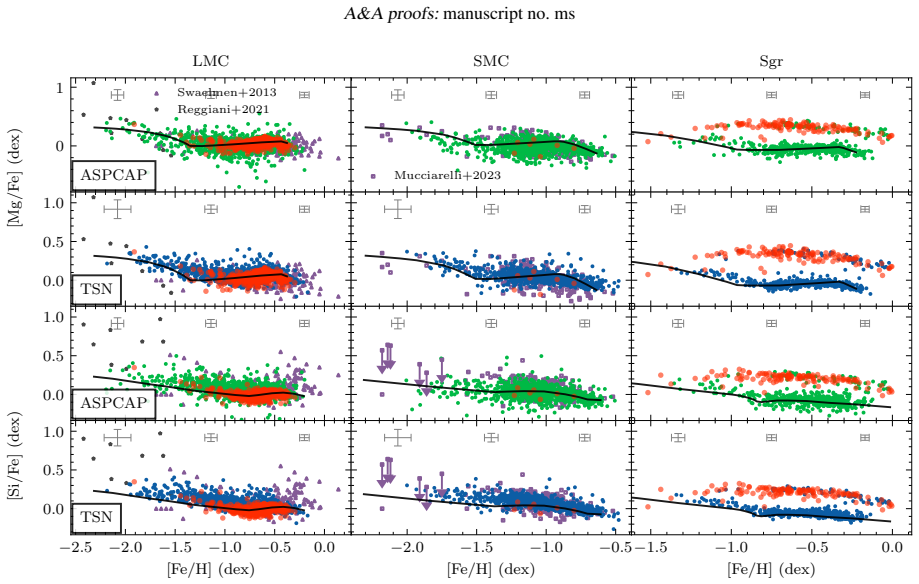

read the original abstract
Large spectroscopic surveys rely on automated pipelines to deliver homogeneous stellar labels, but a substantial fraction of observations are at low signal-to-noise ratio (S/N), where label estimates become imprecise or are omitted. In APOGEE, these low-S/N spectra visits sample faint and distant populations -- the bulge, outer halo, and satellite systems -- yet still encode recoverable chemical information. We present TwinSpecNet (TSN), a paired-learning framework that exploits APOGEE's multi-visit observing strategy: by training on empirical low-/high-S/N spectral twins of the same stars, TSN learns to suppress stochastic noise while preserving the ASPCAP label scale. TSN employs a Vision Transformer encoder with dual objectives: reconstructing high-S/N flux from low-S/N visits and predicting stellar parameters and abundances with calibrated uncertainties. TSN reduces label scatter relative to visit-level ASPCAP for S/N<60 visits. TSN reproduces the ASPCAP scale with residual scatters of $\sigma$< 19 K in $T_{\mathrm{eff}}$, $\sigma\sim$0.06 dex in $\log g$, and $\sigma\sim$0.03 dex in Fe/H. TSN tightens intra-cluster abundance dispersions, recovers cleaner chemical sequences in inner-disk and bulge and satellite samples, and improves C/N-based age precision for APOKASC giants from 1.70 to 1.59 Gyr. By learning survey-specific noise patterns from repeated observations, TSN demonstrates how empirical paired learning can extend the chemical reach of existing spectroscopic data, providing a template applicable to other multi-visit surveys.
Editorial analysis
A structured set of objections, weighed in public.
Referee Report
Summary. The manuscript presents TwinSpecNet (TSN), a Vision Transformer encoder trained via paired empirical learning on APOGEE multi-visit spectra. It maps low-S/N visits to high-S/N flux reconstructions and ASPCAP-derived stellar parameters/abundances, claiming reduced label scatter for S/N<60 visits relative to standard ASPCAP processing, with residual scatters of σ<19 K in Teff, σ∼0.06 dex in log g, and σ∼0.03 dex in Fe/H. Additional claims include tightened intra-cluster abundance dispersions, cleaner chemical sequences in bulge/satellite samples, and improved C/N-based age precision (1.70 to 1.59 Gyr) for APOKASC giants.
Significance. If the central results are robust, the work offers a practical template for recovering chemical information from the substantial fraction of low-S/N observations in large surveys like APOGEE, directly benefiting studies of faint bulge, halo, and satellite populations. The empirical paired-learning strategy is a notable strength, as it learns survey-specific noise patterns without synthetic spectra and supplies calibrated uncertainties; this could be broadly applicable to other multi-visit spectroscopic datasets.
major comments (2)
- [Abstract and validation/results sections] The central claim that TSN reduces label scatter while preserving the ASPCAP scale rests on the assumption that high-S/N ASPCAP labels are unbiased ground truth and that differences between paired visits of the same star are purely stochastic noise (no systematic offsets from tellurics, fiber response, or variability). However, the reported residual scatters are measured directly against these high-S/N labels, providing no independent validation of the assumption. Intra-cluster dispersion tightening is supporting but indirect evidence only. Explicit tests for visit-to-visit systematics are required in the validation section to substantiate the claims.
- [Methods section] The manuscript provides insufficient detail on data selection criteria for twin pairs, cross-validation strategy, handling of potential label biases in ASPCAP, and architecture/training hyperparameters. Without these, it is not possible to confirm that the numerical improvements (e.g., the quoted residual scatters and age precision gain) are free of selection effects or overfitting.
minor comments (2)
- [Abstract] Notation for uncertainties (e.g., σ∼0.03 dex) should be made consistent with the more precise bounds given for Teff; clarify whether these are 1σ or other quantiles.
- [Figures] Figure captions and axis labels should explicitly state the S/N range and sample size for each comparison panel to aid immediate interpretation.
Simulated Author's Rebuttal
We thank the referee for their constructive and detailed comments, which have helped us strengthen the validation and methodological transparency of the manuscript. We address each major comment below and have revised the paper accordingly.
read point-by-point responses
-
Referee: [Abstract and validation/results sections] The central claim that TSN reduces label scatter while preserving the ASPCAP scale rests on the assumption that high-S/N ASPCAP labels are unbiased ground truth and that differences between paired visits of the same star are purely stochastic noise (no systematic offsets from tellurics, fiber response, or variability). However, the reported residual scatters are measured directly against these high-S/N labels, providing no independent validation of the assumption. Intra-cluster dispersion tightening is supporting but indirect evidence only. Explicit tests for visit-to-visit systematics are required in the validation section to substantiate the claims.
Authors: We agree that the primary validation relies on high-S/N ASPCAP labels and that explicit checks for visit-to-visit systematics would strengthen the claims. While intra-cluster dispersion tightening offers supporting evidence, we acknowledge it is indirect. In the revised manuscript, we have added a new subsection to the validation section that performs explicit tests: residuals between TSN predictions and high-S/N labels are examined as functions of fiber ID, airmass, telluric absorption strength, and available stellar variability indicators. No significant correlations are found, consistent with predominantly stochastic differences. We also added a brief discussion of ASPCAP limitations and how the empirical paired approach mitigates certain biases. These changes directly address the concern. revision: yes
-
Referee: [Methods section] The manuscript provides insufficient detail on data selection criteria for twin pairs, cross-validation strategy, handling of potential label biases in ASPCAP, and architecture/training hyperparameters. Without these, it is not possible to confirm that the numerical improvements (e.g., the quoted residual scatters and age precision gain) are free of selection effects or overfitting.
Authors: We appreciate the referee highlighting the need for greater detail. The revised Methods section now includes: (i) explicit twin-pair selection criteria (minimum S/N contrast, shared APOGEE ID, exclusion of flagged visits); (ii) star-level k-fold cross-validation to avoid leakage; (iii) a subsection on ASPCAP label biases, noting known pipeline systematics and how empirical learning from real pairs reduces sensitivity to them; (iv) full ViT architecture specifications (layers, heads, dimensions) and all training hyperparameters (optimizer, rates, batch size, epochs, loss weights). An appendix with ablation studies on key hyperparameters has also been added to confirm robustness against overfitting and selection effects. revision: yes
Circularity Check
No significant circularity; empirical supervised learning on independent high-S/N labels
full rationale
The paper describes a supervised Vision Transformer trained to map low-S/N spectra to high-S/N flux reconstructions and to ASPCAP stellar labels obtained from paired high-S/N visits of the same stars. Reported residual scatters and improvements in intra-cluster dispersions are measured on held-out data against those independent high-S/N ASPCAP labels, which are not constructed from the low-S/N inputs or from the network itself. No equation or claim reduces by definition to a fitted parameter that is then relabeled as a prediction, and no load-bearing step relies on a self-citation chain or uniqueness theorem imported from the authors' prior work. The method is therefore self-contained as an empirical denoising procedure whose performance claims rest on generalization to unseen visits rather than on any internal redefinition of its targets.
Axiom & Free-Parameter Ledger
free parameters (1)
- neural network hyperparameters and architecture choices
axioms (1)
- domain assumption High-S/N spectra of the same star serve as unbiased reference for low-S/N visits
Reference graph
Works this paper leans on
-
[1]
F., Argudo-Fern \'a ndez, M., et al.\ 2023, , 267, 2, 44
Almeida, A., Anderson, S. F., Argudo-Fern \'a ndez, M., et al.\ 2023, , 267, 2, 44
2023
-
[2]
Anders, F., Chiappini, C., Minchev, I., et al.\ 2017, , 600, A70
2017
-
[3]
Anders, F., Gispert, P., Ratcliffe, B., et al.\ 2023, , 678, A158
2023
-
[4]
H., Weinberg, D
Andrews, B. H., Weinberg, D. H., Sch \"o nrich, R., et al.\ 2017, , 835, 2, 224
2017
-
[5]
Baba, J.\ 2025, , 77, 4, 916
2025
-
[6]
Bensby, T., Feltzing, S., Gould, A., et al.\ 2017, , 605, A89
2017
-
[7]
& Vasiliev, E.\ 2024, , 527, 2, 1915
Binney, J. & Vasiliev, E.\ 2024, , 527, 2, 1915
2024
-
[8]
D., et al.\ 2025, , 994, 1, 126
Borbolato, L., Rossi, S., Perottoni, H. D., et al.\ 2025, , 994, 1, 126
2025
-
[9]
C., Aguirre B rsen-Koch, V., Helmi, A., et al.\ 2022, , 514, 2, 2527
Borre, C. C., Aguirre B rsen-Koch, V., Helmi, A., et al.\ 2022, , 514, 2, 2527
2022
-
[10]
J., et al.\ 2016, , 455, 1, 987
Casagrande, L., Silva Aguirre, V., Schlesinger, K. J., et al.\ 2016, , 455, 1, 987
2016
-
[11]
Casali, G., Montalb \'a n, J., Miglio, A., et al.\ 2025, , 541, 3, 2631
2025
-
[12]
J., Serenelli, A
Chaplin, W. J., Serenelli, A. M., Miglio, A., et al.\ 2020, Nature Astronomy, 4, 382
2020
-
[13]
Ciuc a , I., Kawata, D., Miglio, A., et al.\ 2021, , 503, 2, 2814
2021
-
[14]
C., et al.\ 2014, , 9147, 91470L
Dalton, G., Trager, S., Abrams, D. C., et al.\ 2014, , 9147, 91470L
2014
-
[15]
Das, P., Hawkins, K., & Jofr \'e , P.\ 2020, , 493, 4, 5195
2020
-
[16]
S., Agertz, O., Berbel, A
de Jong, R. S., Agertz, O., Berbel, A. A., et al.\ 2019, The Messenger, 175, 3
2019
-
[17]
M., Freeman, K
De Silva, G. M., Freeman, K. C., Bland-Hawthorn, J., et al.\ 2015, , 449, 3, 2604
2015
-
[18]
M., Sneden, C., Paulson, D
De Silva, G. M., Sneden, C., Paulson, D. B., et al.\ 2006, , 131, 1, 455
2006
-
[19]
Dosovitskiy, A., Beyer, L., Kolesnikov, A., et al.\ 2020, , arXiv:2010.11929
work page internal anchor Pith review arXiv 2020
- [20]
-
[21]
A., O'Briain, T., et al.\ 2018, , 475, 3, 2978
Fabbro, S., Venn, K. A., O'Briain, T., et al.\ 2018, , 475, 3, 2978
2018
-
[22]
& Chiba, M.\ 2013, , 57, 3-4, 80
Feltzing, S. & Chiba, M.\ 2013, , 57, 3-4, 80
2013
-
[23]
C., Horta, D., et al.\ 2023, , 519, 3, 3611
Fernandes, L., Mason, A. C., Horta, D., et al.\ 2023, , 519, 3, 3611
2023
-
[24]
Gaia Collaboration, Vallenari, A., Brown, A. G. A., et al.\ 2023, , 674, A1
2023
-
[25]
E., Allende Prieto, C., Holtzman, J
Garc \' a P \'e rez, A. E., Allende Prieto, C., Holtzman, J. A., et al.\ 2016, , 151, 6, 144
2016
-
[26]
H., Johnson, J
Griffith, E., Weinberg, D. H., Johnson, J. A., et al.\ 2021, , 909, 1, 77
2021
-
[27]
Grisoni, V., Chiappini, C., Miglio, A., et al.\ 2024, , 683, A111
2024
-
[28]
K., Zinn, J
Grunblatt, S. K., Zinn, J. C., Price-Whelan, A. M., et al.\ 2021, , 916, 2, 88
2021
-
[29]
Guiglion, G., Nepal, S., Chiappini, C., et al.\ 2024, , 682, A9
2024
-
[30]
J., Davies, G
Hall, O. J., Davies, G. R., van Saders, J., et al.\ 2021, Nature Astronomy, 5, 707
2021
-
[31]
R., Lian, J., et al.\ 2021, , 923, 2, 172
Hasselquist, S., Hayes, C. R., Lian, J., et al.\ 2021, , 923, 2, 172
2021
-
[32]
Hasselquist, S., Shetrone, M., Smith, V., et al.\ 2017, , 845, 2, 162
2017
-
[33]
A., Shetrone, M., Johnson, J
Holtzman, J. A., Shetrone, M., Johnson, J. A., et al.\ 2015, , 150, 5, 148
2015
-
[34]
P., Mackereth, J
Horta, D., Schiavon, R. P., Mackereth, J. T., et al.\ 2023, , 520, 4, 5671
2023
-
[35]
Hunt, E. L. & Reffert, S.\ 2024, , 686, A42
2024
-
[36]
A., et al.\ 2023, , 954, 2, 124
Imig, J., Price, C., Holtzman, J. A., et al.\ 2023, , 954, 2, 124
2023
-
[37]
Jofr \'e , P., Heiter, U., & Soubiran, C.\ 2019, , 57, 571
2019
-
[38]
A., Allende Prieto, C., et al.\ 2020, , 160, 3, 120
J \"o nsson, H., Holtzman, J. A., Allende Prieto, C., et al.\ 2020, , 160, 3, 120
2020
-
[39]
What Uncertainties Do We Need in Bayesian Deep Learning for Computer Vision?
Kendall, A. & Gal, Y.\ 2017, , arXiv:1703.04977
work page Pith review arXiv 2017
-
[40]
SDSS-V: Pioneering Panoptic Spectroscopy
Kollmeier, J. A., Zasowski, G., Rix, H.-W., et al.\ 2017, , arXiv:1711.03234
work page internal anchor Pith review arXiv 2017
-
[41]
Lagarde, N., Reyl \'e , C., Chiappini, C., et al.\ 2021, , 654, A13
2021
-
[42]
Lehtinen, J., Munkberg, J., Hasselgren, J., et al.\ 2018, , arXiv:1803.04189
work page Pith review arXiv 2018
-
[43]
Leung, H. W. & Bovy, J.\ 2024, , 527, 1, 1494
2024
-
[44]
W., Bovy, J., Mackereth, J
Leung, H. W., Bovy, J., Mackereth, J. T., et al.\ 2023, , 522, 3, 4577
2023
-
[45]
Li, J., Wong, K. W. K., Hogg, D. W., et al.\ 2024, , 272, 1, 2
2024
-
[46]
T., Bovy, J., Leung, H
Mackereth, J. T., Bovy, J., Leung, H. W., et al.\ 2019, , 489, 1, 176
2019
-
[47]
R., Schiavon, R
Majewski, S. R., Schiavon, R. P., Frinchaboy, P. M., et al.\ 2017, , 154, 3, 94
2017
-
[48]
Martig, M., Fouesneau, M., Rix, H.-W., et al.\ 2016, , 456, 4, 3655
2016
-
[49]
& Gilmore, G.\ 2015, , 453, 2, 1855
Masseron, T. & Gilmore, G.\ 2015, , 453, 2, 1855
2015
-
[50]
Matsuno, T., Aoki, W., Casagrande, L., et al.\ 2021, , 912, 1, 72
2021
-
[51]
T., et al.\ 2021, , 645, A85
Miglio, A., Chiappini, C., Mackereth, J. T., et al.\ 2021, , 645, A85
2021
-
[52]
Miglio, A., Chiappini, C., Morel, T., et al.\ 2013, European Physical Journal Web of Conferences, 43, 03004
2013
-
[53]
T., Miglio, A., et al.\ 2021, Nature Astronomy, 5, 640
Montalb \'a n, J., Mackereth, J. T., Miglio, A., et al.\ 2021, Nature Astronomy, 5, 640
2021
-
[54]
C., et al.\ 2025, , 704, A44
Montelius, M., Starkenburg, E., Woudenberg, H. C., et al.\ 2025, , 704, A44
2025
-
[55]
L., Montalb \'a n, J., et al.\ 2021, , 646, A78
Morel, T., Creevey, O. L., Montalb \'a n, J., et al.\ 2021, , 646, A78
2021
-
[56]
M., Delgado-Mena, E., et al.\ 2022, , 660, A15
Moya, A., Sarro, L. M., Delgado-Mena, E., et al.\ 2022, , 660, A15
2022
-
[57]
Mucciarelli, A., Minelli, A., Bellazzini, M., et al.\ 2023, , 671, A124
2023
- [58]
-
[59]
B., et al.\ 2024, , 688, A167
Nepal, S., Chiappini, C., Queiroz, A. B., et al.\ 2024, , 688, A167
2024
-
[60]
W., Rix, H.-W., et al.\ 2015, , 808, 1, 16
Ness, M., Hogg, D. W., Rix, H.-W., et al.\ 2015, , 808, 1, 16
2015
-
[61]
W., Rix, H.-W., et al.\ 2016, , 823, 2, 114
Ness, M., Hogg, D. W., Rix, H.-W., et al.\ 2016, , 823, 2, 114
2016
-
[62]
L., Hasselquist, S., Hayes, C
Nidever, D. L., Hasselquist, S., Hayes, C. R., et al.\ 2020, , 895, 2, 88
2020
-
[63]
H., Zinn, J
Pinsonneault, M. H., Zinn, J. C., Tayar, J., et al.\ 2025, , 276, 2, 69
2025
-
[64]
Queiroz, A. B. A., Chiappini, C., Perez-Villegas, A., et al.\ 2021, , 656, A156
2021
-
[65]
C., Casey, A
Reggiani, H., Schlaufman, K. C., Casey, A. R., et al.\ 2021, , 162, 6, 229
2021
-
[66]
M., Miglio, A., Chiappini, C., et al.\ 2019, , 490, 4, 4465
Rendle, B. M., Miglio, A., Chiappini, C., et al.\ 2019, , 490, 4, 4465
2019
-
[67]
Roberts, J. D., Pinsonneault, M. H., Johnson, J. A., et al.\ 2025, , arXiv:2509.25321
-
[68]
Salaris, M., Cassisi, S., & Weiss, A.\ 2002, , 114, 794, 375
2002
-
[69]
C., Stassun, K
Schonhut-Stasik, J., Zinn, J. C., Stassun, K. G., et al.\ 2024, , 167, 2, 50
2024
-
[70]
Sharma, S., Stello, D., Bland-Hawthorn, J., et al.\ 2019, , 490, 4, 5335
2019
-
[71]
Silva Aguirre, V., Bojsen-Hansen, M., Slumstrup, D., et al.\ 2018, , 475, 4, 5487
2018
-
[72]
V., Bizyaev, D., Cunha, K., et al.\ 2021, , 161, 6, 254
Smith, V. V., Bizyaev, D., Cunha, K., et al.\ 2021, , 161, 6, 254
2021
-
[73]
Stokholm, A., Aguirre B rsen-Koch, V., Stello, D., et al.\ 2023, , 524, 2, 1634
2023
-
[74]
Suda, T., Katsuta, Y., Yamada, S., et al.\ 2008, , 60, 1159
2008
- [75]
-
[76]
e , G., Drazdauskas, A., Mikolaitis, S ., et al.\ 2025, , 703, A4
Tautvai s ien \. e , G., Drazdauskas, A., Mikolaitis, S ., et al.\ 2025, , 703, A4
2025
-
[77]
Ting, Y.-S.\ 2025, The Open Journal of Astrophysics, 8, 95
2025
-
[78]
Ting, Y.-S., Conroy, C., Rix, H.-W., et al.\ 2019, , 879, 2, 69
2019
-
[79]
Valentini, M., Chiappini, C., Bossini, D., et al.\ 2019, , 627, A173
2019
-
[80]
G., et al.\ 2024, , 685, A150
Valle, G., Dell'Omodarme, M., Prada Moroni, P. G., et al.\ 2024, , 685, A150
2024
discussion (0)
Sign in with ORCID, Apple, or X to comment. Anyone can read and Pith papers without signing in.