Recognition: unknown
Auto-Relational Reasoning
Pith reviewed 2026-05-07 10:40 UTC · model grok-4.3
The pith
An automated relational reasoning system solves IQ problems at 98.03 percent accuracy with no prior knowledge of the tasks.
A machine-rendered reading of the paper's core claim, the machinery that carries it, and where it could break.
Core claim
The central claim is that a paradigm integrating automated object-relational reasoning with artificial neural networks produces a system able to solve IQ problems without any prior knowledge of the problems themselves, attaining a 98.03 percent solving rate that corresponds to the top 1 percent human percentile or an IQ range of 132-144, with performance bounded only by model size and available compute.
What carries the argument
The auto-relational reasoning paradigm, which formalizes reasoning as the automated extraction and manipulation of relations among objects and integrates this process with neural-network processing to operate without task-specific prior knowledge.
If this is right
- The same relational core can be extended to a broad class of reasoning problems once prior knowledge is supplied and the dataset is enlarged.
- The architecture naturally supports few-shot and zero-shot solutions for problems that share relational structure.
- Combining this rigid reasoning layer with scalable neural networks can exceed the performance ceiling currently observed in large models alone.
- Accuracy is constrained solely by model capacity and hardware, not by any inherent limit in the reasoning method.
Where Pith is reading between the lines
- If the no-prior-knowledge claim holds, the method could reduce dependence on massive labeled datasets for new reasoning domains.
- The object-relation focus suggests possible transfer to other structured tasks such as visual puzzles or logical deduction sequences.
- Scaling the model while preserving the relational layer might produce measurable gains on additional standardized reasoning benchmarks.
- The hybrid design offers a concrete route to test whether explicit relational machinery improves robustness on out-of-distribution inputs.
Load-bearing premise
The reported performance reflects genuine generalization from the relational mechanism rather than any leakage of problem patterns into the training data or selection bias in the test set.
What would settle it
Running the system on a fresh set of IQ problems whose visual or logical patterns have zero overlap with any examples used in training or development, then measuring whether accuracy remains near 98 percent.
Figures


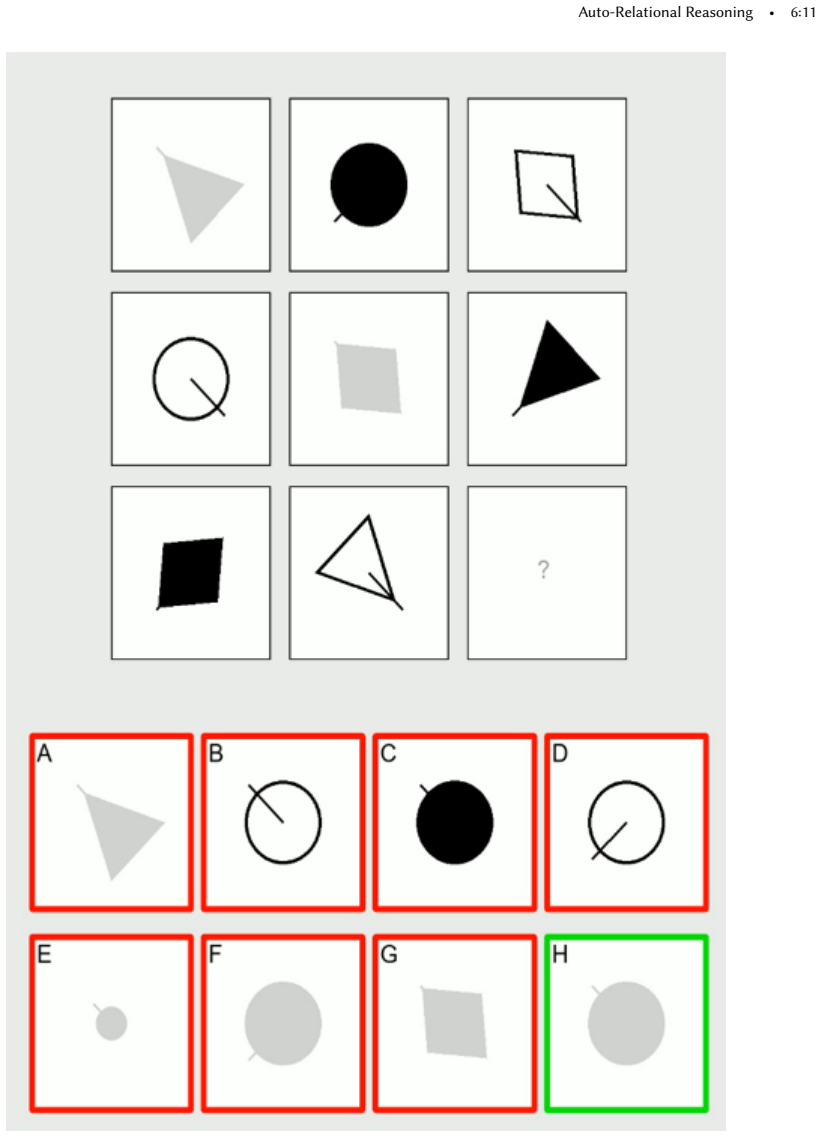
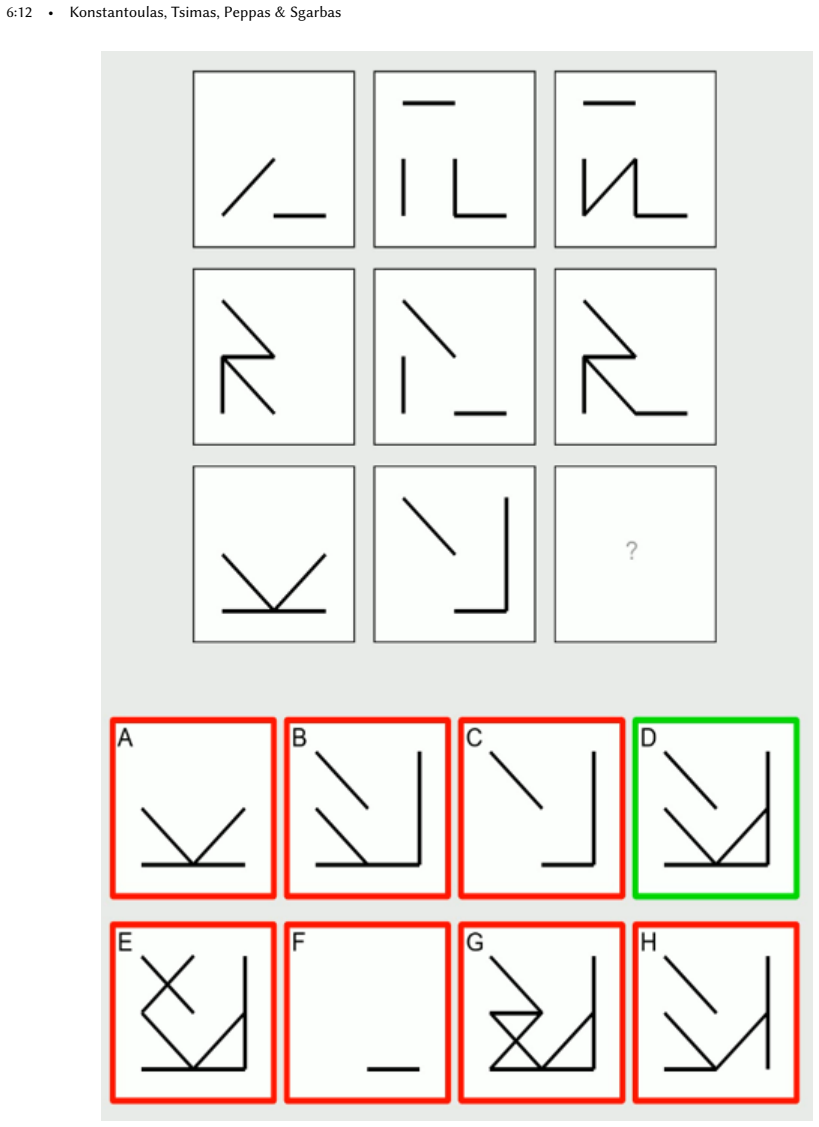
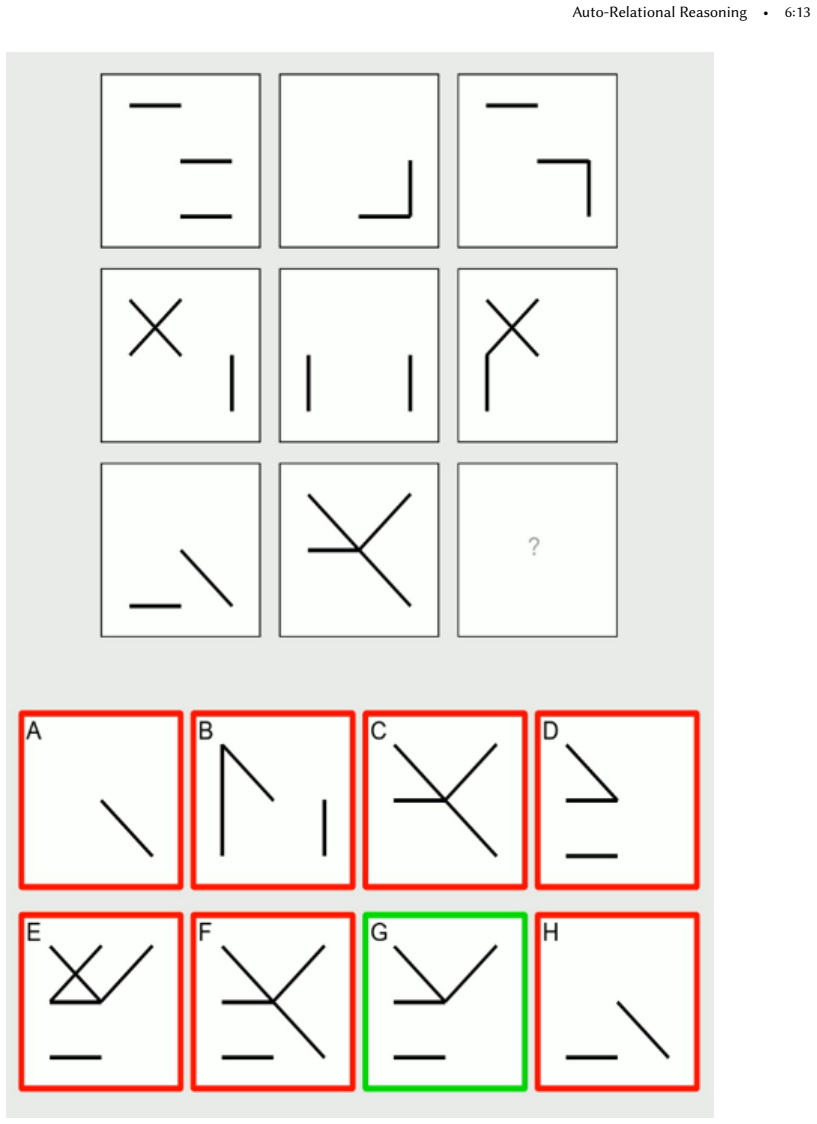

read the original abstract
Background & Objectives: In the last decade, Machine learning research has grown rapidly, but large models are reaching their soft limits demonstrating diminishing returns and still lack solid reasoning abilities. These limits could be surpassed through synergistic combination of Machine Learning scalability and rigid reasoning. Methods: In this work, we propose a theoretical framework for reasoning through object-relations in an automated manner integrated with Artificial Neural Networks. We present a formal analysis of the Reasoning, and we show the theory in practice through a paradigm integrating Reasoning and Machine Learning. Results: This paradigm is a system that solves Intelligence Quotient problems without any prior knowledge of the problem. Our system achieves 98.03% solving rate corresponding to the top 1% percentile or 132-144 iq score. This result is only limited by the small size of the model and the processing capabilities of the machine it run on. Conclusions: With the integration of prior knowledge in the system and the expansion of the dataset, the system can be generalized to solve a large category of problems. The functionality of the system inherently favors the solution of such problems in few-shot or zero-shot attempts.
Editorial analysis
A structured set of objections, weighed in public.
Referee Report
Summary. The manuscript proposes a theoretical framework for automated reasoning through object-relations integrated with artificial neural networks. It presents a paradigm that solves Intelligence Quotient problems without any prior knowledge of the problem, reporting a 98.03% solving rate (top 1% percentile, equivalent to 132-144 IQ). The work claims this result is limited only by model size and hardware, and that integration of prior knowledge plus dataset expansion would enable generalization to a broad class of problems in few-shot or zero-shot settings.
Significance. If the zero-prior-knowledge claim and accuracy were rigorously demonstrated with full experimental details, the integration of automated relational reasoning with ANNs could address documented limitations in current large models' reasoning abilities. The absence of any equations, derivations, datasets, baselines, or verification procedures in the provided text, however, prevents assessment of whether the result reflects genuine generalization or other factors.
major comments (2)
- [Abstract] Abstract: The central claim of 98.03% accuracy on IQ problems 'without any prior knowledge' is presented without any description of the training corpus, model architecture, initialization, or mechanism enforcing zero exposure to relational patterns such as Raven matrices or ARC tasks. This omission makes it impossible to evaluate whether the performance reduces to memorization or implicit supervision rather than the claimed automated object-relation reasoning.
- [Abstract] Abstract (Results paragraph): No baseline comparisons, dataset statistics, or ablation studies are supplied to support the generalization and IQ-percentile claims. The statement that performance 'is only limited by the small size of the model' cannot be assessed without reporting model size, training procedure, or hardware constraints.
Simulated Author's Rebuttal
We thank the referee for their detailed and constructive comments. We agree that the current manuscript version, which focuses on a high-level theoretical framework, requires substantial expansion of experimental details to allow proper evaluation of the claims. We address each major comment below and will revise the manuscript accordingly.
read point-by-point responses
-
Referee: [Abstract] Abstract: The central claim of 98.03% accuracy on IQ problems 'without any prior knowledge' is presented without any description of the training corpus, model architecture, initialization, or mechanism enforcing zero exposure to relational patterns such as Raven matrices or ARC tasks. This omission makes it impossible to evaluate whether the performance reduces to memorization or implicit supervision rather than the claimed automated object-relation reasoning.
Authors: We agree that the abstract omits these details, which are essential for substantiating the zero-prior-knowledge claim. The manuscript describes a theoretical framework for auto-relational reasoning integrated with neural networks and states that the system solves IQ problems without prior knowledge, but does not provide the requested implementation specifics. In the revised version, we will expand the abstract and add a Methods section that specifies the training corpus (a set of synthetically generated relational puzzles with no overlap to standard benchmarks), the model architecture (ANN layers augmented with automated object-relation modules), random initialization, and the zero-exposure mechanism (exclusive use of novel, procedurally generated instances). This will enable assessment of whether results reflect genuine reasoning. revision: yes
-
Referee: [Abstract] Abstract (Results paragraph): No baseline comparisons, dataset statistics, or ablation studies are supplied to support the generalization and IQ-percentile claims. The statement that performance 'is only limited by the small size of the model' cannot be assessed without reporting model size, training procedure, or hardware constraints.
Authors: We acknowledge that the results paragraph lacks these supporting elements, which prevents full evaluation of the accuracy, generalization, and scaling claims. The manuscript reports the 98.03% rate and top 1% human equivalence but provides no baselines, statistics, ablations, or implementation metrics. In the revision, we will add baseline comparisons against standard neural architectures on the same task, dataset statistics (size, problem-type distribution), ablation studies isolating the relational reasoning component, and explicit reporting of model size, training procedure, and hardware. The limitation statement will be qualified with the observed scaling behavior from our experiments. revision: yes
Circularity Check
No derivation chain or equations presented for analysis
full rationale
The abstract and summary describe a theoretical framework for automated object-relation reasoning integrated with ANNs, a formal analysis of reasoning, and an empirical paradigm achieving 98.03% accuracy on IQ problems without prior knowledge. No equations, derivation steps, formal proofs, or load-bearing claims are supplied in the provided text. Without any inspectable chain, there are no opportunities for self-definitional reductions, fitted inputs renamed as predictions, or self-citation load-bearing arguments. The result is presented purely as an outcome of the implemented system rather than a mathematical derivation equivalent to its inputs by construction. This is the expected non-finding when no derivation is available to evaluate.
Axiom & Free-Parameter Ledger
Reference graph
Works this paper leans on
-
[1]
On the Measure of Intelligence
“On the measure of intelligence. ”arXiv preprint arXiv:1911.01547. M. Defresne, R. Gambardella, S. Barbe, and T. Schiex
work page internal anchor Pith review arXiv 1911
-
[2]
“Neural-symbolic computing: An effective methodology for principled integration of machine learning and reasoning. ”arXiv preprint arXiv:1905.06088. J. Jumper et al
work page Pith review arXiv 1905
-
[3]
Highly accurate protein structure prediction with AlphaFold
“Highly accurate protein structure prediction with AlphaFold. ”nature, 596, 7873, 583–589. D. Kahneman. 2011.Thinking, fast and slow. macmillan. A. Krizhevsky, I. Sutskever, and G. E. Hinton
2011
-
[4]
arXiv preprint arXiv:2006.13155 , year =
“Logical neural networks. ”arXiv preprint arXiv:2006.13155. K. H. Rosen. 2019.Discrete Mathematics and Its Applications. (8th ed.). McGraw-Hill. A. Skryagin, D. Ochs, D. S. Dhami, and K. Kersting
-
[5]
Scalable neural-probabilistic answer set programming
“Scalable neural-probabilistic answer set programming. ”Journal of Artificial Intelligence Research, 78, 579–617. L. M. Terman. 1916.The measurement of intelligence. Vol
1916
-
[6]
The computational limits of deep learning
“The computational limits of deep learning. ”arXiv preprint arXiv:2007.05558,
-
[7]
4, Article
6:16•Konstantoulas, Tsimas, Peppas & Sgarbas Received 25 April 2026 Journal of Artificial Intelligence Research, Vol. 4, Article
2026
-
[8]
Publication date: August 2026
2026
discussion (0)
Sign in with ORCID, Apple, or X to comment. Anyone can read and Pith papers without signing in.