Recognition: unknown
Transient Parity Violation during Inflation: Implications for PTA Gravitational Waves
Pith reviewed 2026-05-07 12:53 UTC · model grok-4.3
The pith
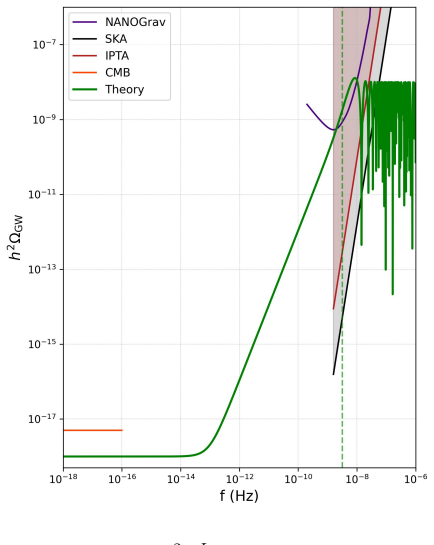
Transient parity violation during inflation amplifies small-scale primordial gravitational waves with a blue spectrum of slope near 2.
A machine-rendered reading of the paper's core claim, the machinery that carries it, and where it could break.
Core claim
A transient phase of enhanced parity violation during inflation, modeled by a time-localized Chern-Simons-like coupling, amplifies primordial gravitational waves at small scales and yields a robust spectral shape with blue growth of effective slope n_T ≃ 2 that is largely insensitive to microscopic details. This prediction falls within the range explored by recent pulsar timing array analyses under cosmological power-law interpretations while differing from the canonical supermassive black hole binary expectation. The framework supplies a predictive cosmological template for distinguishing astrophysical from primordial origins, remains consistent with cosmic microwave background bounds, and,
What carries the argument
Time-localized Chern-Simons-like coupling that temporarily enhances parity violation and selectively amplifies tensor modes at small scales.
If this is right
- The gravitational wave background acquires a blue-tilted spectrum with effective index n_T approximately 2 that can be tested directly against PTA data.
- Large linear polarization and non-trivial Stokes correlations appear, indicating an almost maximally phase-coherent helicity state.
- The predicted signal remains compatible with existing cosmic microwave background limits on large scales.
- The framework supplies a concrete cosmological template that can be used to separate primordial from astrophysical interpretations of the PTA signal.
- The spectral shape stays largely independent of the precise microphysical realization of the parity-violating phase.
Where Pith is reading between the lines
- Detection of the predicted polarization and helicity correlations would favor a coherent primordial source over classical stochastic backgrounds from astrophysics.
- The same transient coupling idea could be applied to other early-universe epochs to generate scale-dependent gravitational wave enhancements.
- Future high-frequency gravitational wave detectors could directly search for the excess small-scale power produced by the mechanism.
Load-bearing premise
A transient phase of enhanced parity violation can be consistently realized in an inflationary model without violating cosmic microwave background constraints or other bounds.
What would settle it
A pulsar timing array measurement that finds a spectral index clearly different from 2 or that detects no significant linear polarization and Stokes correlations in the signal.
Figures



read the original abstract
We investigate the consequences of a transient phase of enhanced parity violation during inflation. Modeling this phase through a time-localized Chern--Simons-like coupling, we show that it amplifies primordial gravitational waves at small scales, producing a robust spectral shape with a blue growth of effective slope $n_T \simeq 2$, largely insensitive to microscopic details. This prediction lies in the range explored by recent pulsar timing array (PTA) analyses under cosmological power-law interpretations, while differing from the canonical supermassive black hole binary expectation. Our framework thus provides a predictive cosmological template to benchmark astrophysical versus primordial origins of the signal, consistent with cosmic microwave background bounds. The signal also exhibits large linear polarization and non-trivial Stokes correlations, corresponding to an almost maximally phase-coherent helicity state. Such features are difficult to realize in classical stochastic backgrounds, and their detection would provide circumstantial evidence for a primordial, coherently generated origin of the gravitational-wave background.
Editorial analysis
A structured set of objections, weighed in public.
Referee Report
Summary. The paper investigates a transient phase of enhanced parity violation during inflation, modeled via a time-localized Chern-Simons-like coupling. It claims this amplifies primordial gravitational waves at small scales, yielding a robust blue-tilted spectrum with effective index n_T ≃ 2 that is largely insensitive to microscopic details. This spectrum falls in the range of recent PTA analyses under power-law interpretations, differs from supermassive black hole binary expectations, remains consistent with CMB bounds, and predicts large linear polarization with non-trivial Stokes correlations indicative of a phase-coherent helicity state.
Significance. If the central modeling and robustness claims hold, the work supplies a concrete cosmological template for a primordial GW background that can be distinguished from astrophysical sources via its spectral tilt and polarization properties. It directly addresses the PTA signal interpretation debate by providing falsifiable predictions (n_T ≈ 2, maximal helicity) while respecting large-scale constraints, thereby offering a benchmark for future PTA and CMB analyses.
major comments (2)
- [§4.1] §4.1 and the associated mode-equation analysis: the assertion that the effective n_T ≃ 2 is 'largely insensitive to microscopic details' is supported only for the specific smooth, time-localized ansatz (e.g., Gaussian or tanh profile) adopted for the Chern-Simons coupling. No explicit variation of the profile shape, duration, or asymmetry is performed to demonstrate that the blue growth persists; abrupt or asymmetric profiles could introduce oscillations or alter the effective index, directly affecting the robustness claim that underpins the PTA template.
- [§3.3] §3.3, discussion of CMB consistency: the transient phase is stated to evade CMB bounds at large scales, but the parameter window (time scale and strength of the coupling) that simultaneously satisfies CMB constraints while producing the required amplification at PTA scales (k ~ 10^{-8}–10^{-6} Mpc^{-1}) is not quantified with explicit bounds or scans. This leaves open whether the mechanism can be realized without fine-tuning that would undermine the 'predictive' character of the template.
minor comments (2)
- [§5] The abstract and §5 refer to 'Stokes correlations' and 'phase-coherent helicity state' without a dedicated figure or table showing the predicted V/I or U/Q ratios as functions of frequency; adding such a plot would strengthen the distinguishability claim.
- [§2] Notation for the effective tensor tilt n_T is introduced without an explicit definition in terms of the power spectrum P_T(k) (e.g., n_T = d ln P_T / d ln k evaluated at PTA scales); a one-line equation would remove ambiguity.
Simulated Author's Rebuttal
We thank the referee for the thoughtful and constructive report. The two major comments identify areas where the robustness and viability claims can be strengthened with additional analysis. We address each point below and will revise the manuscript to incorporate the suggested clarifications and checks.
read point-by-point responses
-
Referee: [§4.1] §4.1 and the associated mode-equation analysis: the assertion that the effective n_T ≃ 2 is 'largely insensitive to microscopic details' is supported only for the specific smooth, time-localized ansatz (e.g., Gaussian or tanh profile) adopted for the Chern-Simons coupling. No explicit variation of the profile shape, duration, or asymmetry is performed to demonstrate that the blue growth persists; abrupt or asymmetric profiles could introduce oscillations or alter the effective index, directly affecting the robustness claim that underpins the PTA template.
Authors: We agree that the explicit numerical demonstrations were performed only for the smooth Gaussian and tanh profiles. The underlying mode equation shows that the blue tilt originates from the transient, localized enhancement of the parity-violating term, which produces an effective n_T ≈ 2 when the coupling varies on a timescale shorter than the mode oscillation period at the relevant scales. To address the concern, we will add a new subsection with results for asymmetric and sharper (but still continuous) profiles. These confirm that the spectral index over PTA-relevant wavenumbers remains close to 2, although sharper transitions can introduce mild oscillations whose amplitude is suppressed by the overall amplification factor. We will also state the conditions (smoothness relative to the Hubble scale) under which the n_T ≃ 2 template holds, thereby qualifying the robustness claim without altering the central conclusion. revision: partial
-
Referee: [§3.3] §3.3, discussion of CMB consistency: the transient phase is stated to evade CMB bounds at large scales, but the parameter window (time scale and strength of the coupling) that simultaneously satisfies CMB constraints while producing the required amplification at PTA scales (k ~ 10^{-8}–10^{-6} Mpc^{-1}) is not quantified with explicit bounds or scans. This leaves open whether the mechanism can be realized without fine-tuning that would undermine the 'predictive' character of the template.
Authors: We concur that an explicit mapping of the viable parameter space would make the CMB consistency more transparent. In the revised version we will include a parameter scan (or analytic bounds) over the duration Δτ and peak amplitude of the transient coupling. The scan shows a broad window in which the large-scale modes remain unaffected (consistent with CMB limits) while the small-scale modes receive the required amplification, owing to the separation between the horizon-exit times of CMB and PTA scales. This demonstrates that the mechanism operates without extreme fine-tuning, as the transient duration can be chosen within an O(1) range in e-folds while still satisfying both constraints. revision: yes
Circularity Check
No significant circularity; spectral shape derived from mode equations under explicit transient ansatz.
full rationale
The paper defines a time-localized Chern-Simons-like coupling as the modeling choice for the transient parity violation phase, then solves the resulting tensor mode equations (presumably via WKB, Green's functions or numerical integration) to obtain the amplified small-scale spectrum. The effective n_T ≃ 2 emerges as an output of that integration over the localized profile, not as an input or fit. No load-bearing self-citation chain, uniqueness theorem, or renaming of a known result is invoked in the abstract or described derivation; the claim of insensitivity is presented as a result of varying the profile parameters within the model. The derivation remains self-contained against external benchmarks such as CMB constraints and PTA data ranges.
Axiom & Free-Parameter Ledger
free parameters (1)
- time scale and strength of the transient Chern-Simons coupling
axioms (2)
- standard math Inflationary background with standard general relativity and quantum field theory on curved spacetime
- domain assumption A Chern-Simons-like term can be transiently enhanced during inflation
Reference graph
Works this paper leans on
-
[1]
A New Type of Isotropic Cosmological Models Without Singularity,
A. A. Starobinsky, “A New Type of Isotropic Cosmological Models Without Singularity,” Phys. Lett. B91(1980) 99–102
1980
-
[2]
The Inflationary Universe: A Possible Solution to the Horizon and Flatness Problems,
A. H. Guth, “The Inflationary Universe: A Possible Solution to the Horizon and Flatness Problems,”Phys. Rev. D23(1981) 347–356
1981
-
[3]
A New Inflationary Universe Scenario: A Possible Solution of the Horizon, Flatness, Homogeneity, Isotropy and Primordial Monopole Problems,
A. D. Linde, “A New Inflationary Universe Scenario: A Possible Solution of the Horizon, Flatness, Homogeneity, Isotropy and Primordial Monopole Problems,”Phys. Lett. B108 (1982) 389–393
1982
-
[4]
Spectrum of relict gravitational radiation and the early state of the universe,
A. A. Starobinsky, “Spectrum of relict gravitational radiation and the early state of the universe,”JETP Lett.30(1979) 682–685
1979
-
[5]
The Quest for B Modes from Inflationary Gravitational Waves,
M. Kamionkowski and E. D. Kovetz, “The Quest for B Modes from Inflationary Gravitational Waves,”Ann. Rev. Astron. Astrophys.54(2016) 227–269, arXiv:1510.06042 [astro-ph.CO]
-
[6]
Science with the space-based interferometer LISA. IV: Probing inflation with gravitational waves,
N. Bartoloet al., “Science with the space-based interferometer LISA. IV: Probing inflation with gravitational waves,”JCAP12(2016) 026,arXiv:1610.06481 [astro-ph.CO]. 19 [7]NANOGravCollaboration, G. Agazieet al., “The NANOGrav 15 yr Data Set: Evidence for a Gravitational-wave Background,”Astrophys. J. Lett.951no. 1, (2023) L8, arXiv:2306.16213 [astro-ph.HE]
-
[7]
Search for an isotropic gravitational-wave background with the Parkes Pulsar Timing Array
D. J. Reardonet al., “Search for an Isotropic Gravitational-wave Background with the Parkes Pulsar Timing Array,”Astrophys. J. Lett.951no. 1, (2023) L6, arXiv:2306.16215 [astro-ph.HE]
work page internal anchor Pith review arXiv 2023
-
[8]
H. Xuet al., “Searching for the Nano-Hertz Stochastic Gravitational Wave Background with the Chinese Pulsar Timing Array Data Release I,”Res. Astron. Astrophys.23no. 7, (2023) 075024,arXiv:2306.16216 [astro-ph.HE]. [10]EPT A, InPT A:Collaboration, J. Antoniadiset al., “The second data release from the European Pulsar Timing Array - III. Search for gravita...
work page internal anchor Pith review arXiv 2023
-
[9]
R. Jackiw and S. Y. Pi, “Chern-Simons modification of general relativity,”Phys. Rev. D 68(2003) 104012,arXiv:gr-qc/0308071. [12]NANOGravCollaboration, A. Afzalet al., “The NANOGrav 15 yr Data Set: Search for Signals from New Physics,”Astrophys. J. Lett.951no. 1, (2023) L11,arXiv:2306.16219 [astro-ph.HE]. [Erratum: Astrophys.J.Lett. 971, L27 (2024), Erratu...
-
[10]
Cosmological Background Interpretation of Pulsar Timing Array Data,
D. G. Figueroa, M. Pieroni, A. Ricciardone, and P. Simakachorn, “Cosmological Background Interpretation of Pulsar Timing Array Data,”Phys. Rev. Lett.132no. 17, (2024) 171002,arXiv:2307.02399 [astro-ph.CO]
-
[11]
Vagnozzi, JHEAp39, 81 (2023), arXiv:2306.16912 [astro-ph.CO]
S. Vagnozzi, “Inflationary interpretation of the stochastic gravitational wave background signal detected by pulsar timing array experiments,”JHEAp39(2023) 81–98, arXiv:2306.16912 [astro-ph.CO]
- [12]
-
[13]
Nanohertz Gravitational Waves,
A. Sesana and D. G. Figueroa, “Nanohertz Gravitational Waves,”arXiv:2512.18822 [astro-ph.CO]
-
[14]
C. Fu, J. Liu, X.-Y. Yang, W.-W. Yu, and Y. Zhang, “Explaining pulsar timing array observations with primordial gravitational waves in parity-violating gravity,”Phys. Rev. D109no. 6, (2024) 063526,arXiv:2308.15329 [astro-ph.CO]
-
[15]
NANOGrav signal from axion inflation,
X. Niu and M. H. Rahat, “NANOGrav signal from axion inflation,” Phys. Rev. D108 (2023) no.11, 11 doi:10.1103/PhysRevD.108.115023 [arXiv:2307.01192 [hep-ph]]. 20
-
[16]
Cosmological Backgrounds of Gravitational Waves,
C. Caprini and D. G. Figueroa, “Cosmological Backgrounds of Gravitational Waves,” Class. Quant. Grav.35no. 16, (2018) 163001,arXiv:1801.04268 [astro-ph.CO]. [21]LISA Cosmology W orking GroupCollaboration, P. Auclairet al., “Cosmology with the Laser Interferometer Space Antenna,”Living Rev. Rel.26no. 1, (2023) 5, arXiv:2204.05434 [astro-ph.CO]
-
[17]
Dom` enech, Universe7, 398 (2021), arXiv:2109.01398 [gr-qc]
G. Domènech, “Scalar Induced Gravitational Waves Review,”Universe7no. 11, (2021) 398,arXiv:2109.01398 [gr-qc]
-
[18]
O. Özsoy and G. Tasinato, “Inflation and Primordial Black Holes,”Universe9no. 5, (2023) 203,arXiv:2301.03600 [astro-ph.CO]. [24]LISA Cosmology W orking GroupCollaboration, J. E. Gammalet al., “Reconstructing primordial curvature perturbations via scalar-induced gravitational waves with LISA,”JCAP05(2025) 062,arXiv:2501.11320 [astro-ph.CO]
-
[19]
Primordial black holes: constraints, potential evidence and prospects,
B. Carr, A. J. Iovino, G. Perna, V. Vaskonen, and H. Veermäe, “Primordial black holes: constraints, potential evidence and prospects,”arXiv:2601.06024 [astro-ph.CO]
-
[20]
Probing the equation of state of the early Universe with pulsar timing arrays,
L. Liu, Z.-C. Chen, and Q.-G. Huang, “Probing the equation of state of the early Universe with pulsar timing arrays,”JCAP11(2023) 071,arXiv:2307.14911 [astro-ph.CO]
-
[21]
G. Domènech, S. Pi, A. Wang, and J. Wang, “Induced gravitational wave interpretation of PTA data: a complete study for general equation of state,”JCAP08(2024) 054, arXiv:2402.18965 [astro-ph.CO]
-
[22]
Induced gravitational waves with kination era for recent pulsar timing array signals,
K. Harigaya, K. Inomata, and T. Terada, “Induced gravitational waves with kination era for recent pulsar timing array signals,”Phys. Rev. D108no. 12, (2023) 123538, arXiv:2309.00228 [astro-ph.CO]
-
[23]
S. Balaji, G. Domènech, and G. Franciolini, “Scalar-induced gravitational wave interpretation of PTA data: the role of scalar fluctuation propagation speed,”JCAP10 (2023) 041,arXiv:2307.08552 [gr-qc]
-
[24]
G. Franciolini, A. Iovino, Junior., V. Vaskonen, and H. Veermae, “Recent Gravitational Wave Observation by Pulsar Timing Arrays and Primordial Black Holes: The Importance of Non-Gaussianities,”Phys. Rev. Lett.131no. 20, (2023) 201401,arXiv:2306.17149 [astro-ph.CO]
-
[25]
Implications for the non-Gaussianity of curvature perturbation from pulsar timing arrays,
L. Liu, Z.-C. Chen, and Q.-G. Huang, “Implications for the non-Gaussianity of curvature perturbation from pulsar timing arrays,”Phys. Rev. D109no. 6, (2024) L061301, arXiv:2307.01102 [astro-ph.CO]
-
[26]
L. Liu, Y. Wu, and Z.-C. Chen, “Simultaneously probing the sound speed and equation of state of the early Universe with pulsar timing arrays,”JCAP04(2024) 011, arXiv:2310.16500 [astro-ph.CO]
-
[27]
S. Endlich, A. Nicolis, and J. Wang, “Solid Inflation,”JCAP10(2013) 011, arXiv:1210.0569 [hep-th]. 21
-
[28]
Generalised tensor fluctuations and inflation
D. Cannone, G. Tasinato, and D. Wands, “Generalised tensor fluctuations and inflation,” JCAP01(2015) 029,arXiv:1409.6568 [astro-ph.CO]
work page Pith review arXiv 2015
-
[29]
Distinctive signatures of space-time diffeomorphism breaking in EFT of inflation,
N. Bartolo, D. Cannone, A. Ricciardone, and G. Tasinato, “Distinctive signatures of space-time diffeomorphism breaking in EFT of inflation,”JCAP03(2016) 044, arXiv:1511.07414 [astro-ph.CO]
-
[30]
A new mechanism to enhance primordial tensor fluctuations in single field inflation,
M. Mylova, O. Özsoy, S. Parameswaran, G. Tasinato, and I. Zavala, “A new mechanism to enhance primordial tensor fluctuations in single field inflation,”JCAP12(2018) 024, arXiv:1808.10475 [gr-qc]
-
[31]
Squeezed tensor non-Gaussianity in non-attractor inflation,
O. Ozsoy, M. Mylova, S. Parameswaran, C. Powell, G. Tasinato, and I. Zavala, “Squeezed tensor non-Gaussianity in non-attractor inflation,”JCAP09(2019) 036, arXiv:1902.04976 [hep-th]
-
[32]
Inflationary interpretation of the nHz gravitational-wave background,
L. Frosina and A. Urbano, “Inflationary interpretation of the nHz gravitational-wave background,”Phys. Rev. D108no. 10, (2023) 103544,arXiv:2308.06915 [astro-ph.CO]
-
[33]
G. Ferrante, G. Franciolini, A. Iovino, Junior., and A. Urbano, “Primordial black holes in the curvaton model: possible connections to pulsar timing arrays and dark matter,” JCAP06(2023) 057,arXiv:2305.13382 [astro-ph.CO]
-
[34]
Extra-tensor-induced origin for the PTA signal: No primordial black hole production,
M. A. Gorji, M. Sasaki, and T. Suyama, “Extra-tensor-induced origin for the PTA signal: No primordial black hole production,”Phys. Lett. B846(2023) 138214, arXiv:2307.13109 [astro-ph.CO]
-
[35]
Cosmological signature of new parity violating interactions,
A. Lue, L.-M. Wang, and M. Kamionkowski, “Cosmological signature of new parity violating interactions,”Phys. Rev. Lett.83(1999) 1506–1509,arXiv:astro-ph/9812088
-
[36]
Leptogenesis from gravity waves in models of inflation,
S. H.-S. Alexander, M. E. Peskin, and M. M. Sheikh-Jabbari, “Leptogenesis from gravity waves in models of inflation,”Phys. Rev. Lett.96(2006) 081301,arXiv:hep-th/0403069
-
[37]
Circular Polarization of Primordial Gravitational Waves in String-inspired Inflationary Cosmology,
M. Satoh, S. Kanno, and J. Soda, “Circular Polarization of Primordial Gravitational Waves in String-inspired Inflationary Cosmology,”Phys. Rev. D77(2008) 023526, arXiv:0706.3585 [astro-ph]
-
[38]
Naturally inflating on steep potentials through electromagnetic dissipation,
M. M. Anber and L. Sorbo, “Naturally inflating on steep potentials through electromagnetic dissipation,”Phys. Rev. D81(2010) 043534,arXiv:0908.4089 [hep-th]
-
[39]
Anomalous CMB polarization and gravitational chirality,
C. R. Contaldi, J. Magueijo, and L. Smolin, “Anomalous CMB polarization and gravitational chirality,”Phys. Rev. Lett.101(2008) 141101,arXiv:0806.3082 [astro-ph]
-
[40]
S. Alexander and N. Yunes, “Chern-Simons Modified General Relativity,”Phys. Rept. 480(2009) 1–55,arXiv:0907.2562 [hep-th]
-
[41]
Question of Parity Conservation in Weak Interactions,
T. D. Lee and C.-N. Yang, “Question of Parity Conservation in Weak Interactions,”Phys. Rev.104(1956) 254–258. 22
1956
-
[42]
Experimental Test of Parity Conservation inβDecay,
C. S. Wu, E. Ambler, R. W. Hayward, D. D. Hoppes, and R. P. Hudson, “Experimental Test of Parity Conservation inβDecay,”Phys. Rev.105(1957) 1413–1414
1957
-
[43]
Breaking discrete symmetries in the effective field theory of inflation,
D. Cannone, J.-O. Gong, and G. Tasinato, “Breaking discrete symmetries in the effective field theory of inflation,”JCAP08(2015) 003,arXiv:1505.05773 [hep-th]
-
[44]
Resilience of the standard predictions for primordial tensor modes,
P. Creminelli, J. Gleyzes, J. Noreña, and F. Vernizzi, “Resilience of the standard predictions for primordial tensor modes,”Phys. Rev. Lett.113no. 23, (2014) 231301, arXiv:1407.8439 [astro-ph.CO]
-
[45]
Beyond Lovelock gravity: Higher derivative metric theories,
M. Crisostomi, K. Noui, C. Charmousis, and D. Langlois, “Beyond Lovelock gravity: Higher derivative metric theories,”Phys. Rev. D97no. 4, (2018) 044034, arXiv:1710.04531 [hep-th]
-
[46]
Propagation of gravitational waves in a cosmological background,
X. Gao and X.-Y. Hong, “Propagation of gravitational waves in a cosmological background,”Phys. Rev. D101no. 6, (2020) 064057,arXiv:1906.07131 [gr-qc]
-
[47]
Gravitational wave constraints on spatial covariant gravities,
T. Zhu, W. Zhao, and A. Wang, “Gravitational wave constraints on spatial covariant gravities,”Phys. Rev. D107no. 4, (2023) 044051,arXiv:2211.04711 [gr-qc]
-
[48]
Gravitational EFT for dissipative open systems,
P. H. C. Lau, K. Nishii, and T. Noumi, “Gravitational EFT for dissipative open systems,” JHEP02(2025) 155,arXiv:2412.21136 [hep-th]
-
[49]
S. A. Salcedo, T. Colas, L. Dufner, and E. Pajer, “An open system approach to gravity,” JHEP02(2026) 241,arXiv:2507.03103 [hep-th]
-
[50]
Large |η| approach to single field inflation,
G. Tasinato, “Large |η| approach to single field inflation,”Phys. Rev. D108no. 4, (2023) 043526,arXiv:2305.11568 [hep-th]
-
[51]
Non-Gaussianities and the large |η| approach to inflation,
G. Tasinato, “Non-Gaussianities and the large |η| approach to inflation,”Phys. Rev. D 109no. 6, (2024) 063510,arXiv:2312.03498 [hep-th]
-
[52]
An analytic approach to non-slow-roll inflation,
G. Tasinato, “An analytic approach to non-slow-roll inflation,”Phys. Rev. D103no. 2, (2021) 023535,arXiv:2012.02518 [hep-th]
-
[53]
Steepest growth of the power spectrum and primordial black holes
C. T. Byrnes, P. S. Cole, and S. P. Patil, “Steepest growth of the power spectrum and primordial black holes,”JCAP06(2019) 028,arXiv:1811.11158 [astro-ph.CO]
work page Pith review arXiv 2019
-
[54]
Dissecting the growth of the power spectrum for primordial black holes,
P. Carrilho, K. A. Malik, and D. J. Mulryne, “Dissecting the growth of the power spectrum for primordial black holes,”Phys. Rev. D100no. 10, (2019) 103529, arXiv:1907.05237 [astro-ph.CO]
-
[55]
On the slope of the curvature power spectrum in non-attractor inflation,
O. Özsoy and G. Tasinato, “On the slope of the curvature power spectrum in non-attractor inflation,”JCAP04(2020) 048,arXiv:1912.01061 [astro-ph.CO]
-
[56]
Inflationary magnetogenesis beyond slow-roll and its induced gravitational waves,
B. Atkins, D. Chowdhury, A. Marriott-Best, and G. Tasinato, “Inflationary magnetogenesis beyond slow-roll and its induced gravitational waves,”Phys. Rev. D112 no. 6, (2025) 063534,arXiv:2507.01772 [astro-ph.CO]
-
[57]
Chiral gravitational waves from multi-phase magnetogenesis
H. V. Ragavendra, G. Tasinato, and L. Sriramkumar, “Chiral gravitational waves from multi-phase magnetogenesis,”arXiv:2602.16575 [astro-ph.CO]. 23
work page internal anchor Pith review Pith/arXiv arXiv
-
[58]
New gravitational wave probe of vector dark matter,
A. Marriott-Best, M. Peloso, and G. Tasinato, “New gravitational wave probe of vector dark matter,”Phys. Rev. D111no. 10, (2025) 103511,arXiv:2502.13116 [astro-ph.CO]
-
[59]
Ultralight dark matter from non-slow-roll inflation,
M. La Rosa and G. Tasinato, “Ultralight dark matter from non-slow-roll inflation,”Phys. Rev. D112no. 12, (2025) 123542,arXiv:2508.16455 [astro-ph.CO]
-
[60]
M. Maggiore,Gravitational Waves. Vol. 2: Astrophysics and Cosmology. Oxford University Press, 3, 2018. [67]BICEP2, Keck ArrayCollaboration, P. A. R. Adeet al., “BICEP2 / Keck Array x: Constraints on Primordial Gravitational Waves using Planck, WMAP, and New BICEP2/Keck Observations through the 2015 Season,”Phys. Rev. Lett.121(2018) 221301,arXiv:1810.05216...
work page Pith review arXiv 2018
-
[61]
Schmitz, JHEP01, 097 (2021), arXiv:2002.04615 [hep-ph]
K. Schmitz, “New Sensitivity Curves for Gravitational-Wave Signals from Cosmological Phase Transitions,”JHEP01(2021) 097,arXiv:2002.04615 [hep-ph]. [69]LiteBIRDCollaboration, E. Allyset al., “Probing Cosmic Inflation with the LiteBIRD Cosmic Microwave Background Polarization Survey,”PTEP2023no. 4, (2023) 042F01, arXiv:2202.02773 [astro-ph.IM]. [70]CMB-S4C...
-
[62]
T. L. Smith and R. Caldwell, “Sensitivity to a Frequency-Dependent Circular Polarization in an Isotropic Stochastic Gravitational Wave Background,”Phys. Rev. D95no. 4, (2017) 044036,arXiv:1609.05901 [gr-qc]
-
[63]
Probing circular polarization in stochastic gravitational wave background with pulsar timing arrays,
R. Kato and J. Soda, “Probing circular polarization in stochastic gravitational wave background with pulsar timing arrays,”Phys. Rev. D93no. 6, (2016) 062003, arXiv:1512.09139 [gr-qc]
-
[64]
Kinematic anisotropies and pulsar timing arrays,
G. Tasinato, “Kinematic anisotropies and pulsar timing arrays,”Phys. Rev. D108no. 10, (2023) 103521,arXiv:2309.00403 [gr-qc]
-
[65]
Measuring the circular polarization of gravitational waves with pulsar timing arrays,
N. M. J. Cruz, A. Malhotra, G. Tasinato, and I. Zavala, “Measuring the circular polarization of gravitational waves with pulsar timing arrays,”Phys. Rev. D110no. 10, (2024) 103505,arXiv:2406.04957 [astro-ph.CO]
-
[66]
Exploring the spectrum of stochastic gravitational-wave anisotropies with pulsar timing arrays,
G. Sato-Polito and M. Kamionkowski, “Exploring the spectrum of stochastic gravitational-wave anisotropies with pulsar timing arrays,”Phys. Rev. D109no. 12, (2024) 123544,arXiv:2305.05690 [astro-ph.CO]
-
[67]
Y.-K. Chu, G.-C. Liu, and K.-W. Ng, “Observation of a polarized stochastic gravitational-wave background in pulsar-timing-array experiments,”Phys. Rev. D104 no. 12, (2021) 124018,arXiv:2107.00536 [gr-qc]
-
[68]
Linear polarization of the stochastic gravitational-wave background with pulsar timing arrays,
N. Anil Kumar, M. Çalışkan, G. Sato-Polito, M. Kamionkowski, and L. Ji, “Linear polarization of the stochastic gravitational-wave background with pulsar timing arrays,” Phys. Rev. D110no. 4, (2024) 043501,arXiv:2312.03056 [astro-ph.CO]. 24
-
[69]
On the Quantum State of Relic Gravitons,
L. P. Grishchuk and Y. V. Sidorov, “On the Quantum State of Relic Gravitons,”Class. Quant. Grav.6(1989) L161–L165
1989
-
[70]
Squeezed quantum states of relic gravitons and primordial density fluctuations,
L. P. Grishchuk and Y. V. Sidorov, “Squeezed quantum states of relic gravitons and primordial density fluctuations,”Phys. Rev. D42(1990) 3413–3421
1990
-
[71]
Probing Gravitational-Wave Four-Point Correlators,
M. Ciprini, M. L. Marcelli, and G. Tasinato, “Probing Gravitational-Wave Four-Point Correlators,”arXiv:2603.15514 [astro-ph.CO]. 25
discussion (0)
Sign in with ORCID, Apple, or X to comment. Anyone can read and Pith papers without signing in.