Recognition: 2 theorem links
· Lean TheoremChiral gravitational waves from multi-phase magnetogenesis
Pith reviewed 2026-05-15 21:08 UTC · model grok-4.3
The pith
Brief non-slow-roll phases during inflation, combined with parity-violating interactions, amplify chiral primordial magnetic fields and induce a stochastic gravitational-wave background containing both intensity and circular polarization.
A machine-rendered reading of the paper's core claim, the machinery that carries it, and where it could break.
Core claim
In the multi-phase magnetogenesis model, brief non-slow-roll epochs amplify vector modes at small scales. Adding parity-violating interactions makes the resulting magnetic fields chiral, with boosted amplitudes and distinct polarization-dependent spectra. These fields source gravitational waves at second order, yielding both an intensity component and a circularly polarized contribution whose profiles are obtained through combined numerical and analytical methods.
What carries the argument
Chiral vector mode functions during the non-slow-roll phases, which set the amplified magnetic spectra and source the second-order gravitational waves with circular polarization.
Load-bearing premise
The brief non-slow-roll phases stay free of strong coupling and backreaction while still producing the claimed amplification of chiral magnetic fields.
What would settle it
Absence of a circularly polarized component in the stochastic gravitational-wave background at the frequencies predicted for future detectors would falsify the mechanism.
Figures




read the original abstract
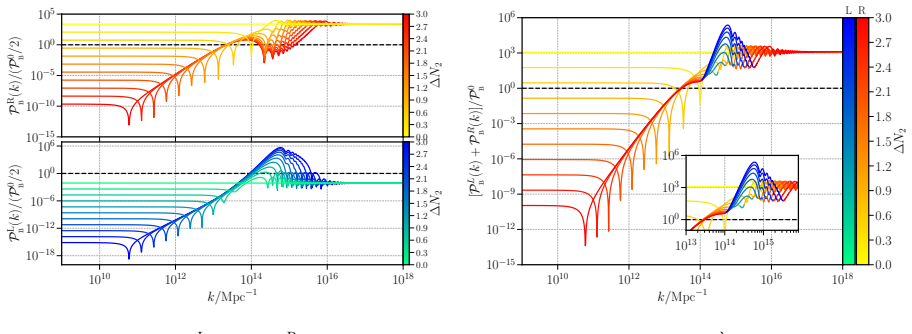
Cosmological vector fields are central to many early-Universe phenomena, including inflationary dynamics, primordial magnetogenesis, and dark-matter scenarios. However, constructing models able to generate cosmological magnetic fields while avoiding strong coupling, backreaction, and cosmic microwave background constraints remains challenging. We study a novel mechanism in which brief non--slow-roll phases during inflation amplify primordial magnetic fields at small scales, while maintaining theoretical consistency and observational viability. We incorporate parity-violating interactions in the vector sector and demonstrate, for the first time in a non--slow-roll framework, that chirality can significantly boost magnetic-field amplitudes and imprint distinctive polarization-dependent spectral features. We complement detailed numerical computations with an analytical treatment yielding compact expressions for chiral vector mode functions that reproduce the main spectral properties. We then develop a systematic formalism to evaluate the stochastic gravitational-wave background naturally induced at second order by these amplified fields, identifying both an intensity component and a circularly polarized contribution with characteristic frequency profiles. We discuss detection prospects with future multiband gravitational-wave observatories, showing that chiral signatures could provide a distinctive observational probe. Our results introduce new avenues for enhancing primordial magnetic fields and their associated gravitational-wave signals, opening promising possibilities for their future detection and interpretation, both with cosmological and gravitational wave probes.
Editorial analysis
A structured set of objections, weighed in public.
Referee Report
Summary. The paper claims that brief non-slow-roll phases during inflation, combined with parity-violating vector interactions, amplify chiral primordial magnetic fields at small scales while remaining theoretically consistent. Analytic expressions for the chiral vector mode functions are derived and shown to reproduce key spectral features, which are then used to compute the second-order stochastic gravitational-wave background, including both an intensity spectrum and a circularly polarized component with characteristic frequency dependence. Detection prospects for future multiband GW observatories are discussed.
Significance. If the non-slow-roll amplification proceeds without backreaction or instabilities, the work introduces a new route to chiral magnetogenesis that imprints observable polarization-dependent features on the GW spectrum. The analytic mode-function expressions and systematic second-order formalism are strengths that could make the predictions testable and falsifiable with upcoming detectors.
major comments (2)
- [Model setup and non-slow-roll phases] The central claim that brief non-slow-roll phases produce the stated small-scale chiral amplification while keeping vector energy density sub-dominant rests on an unverified assumption. Explicit calculations of ρ_B/ρ_inf throughout the non-slow-roll intervals for the chosen durations and coupling strengths must be shown to confirm consistency with the inflationary background.
- [GW background calculation] In the second-order GW formalism, the mapping from the chiral magnetic spectrum to the circularly polarized GW component requires verification that no additional instabilities or parity-mixing terms arise at second order; the paper should provide the explicit kernel or integral expression used and demonstrate its convergence for the amplified small-scale modes.
minor comments (2)
- The abstract states that the analytic mode functions 'reproduce the main spectral properties'; the main text should include a direct side-by-side comparison (e.g., a figure or table) of the analytic versus numerical spectra to quantify the level of agreement.
- Notation for the parity-violating coupling and the non-slow-roll parameters should be introduced once with a clear table of symbols and their physical ranges.
Simulated Author's Rebuttal
We thank the referee for the careful reading of our manuscript and the constructive comments. We address each major point below and have revised the manuscript to strengthen the presentation of our results.
read point-by-point responses
-
Referee: [Model setup and non-slow-roll phases] The central claim that brief non-slow-roll phases produce the stated small-scale chiral amplification while keeping vector energy density sub-dominant rests on an unverified assumption. Explicit calculations of ρ_B/ρ_inf throughout the non-slow-roll intervals for the chosen durations and coupling strengths must be shown to confirm consistency with the inflationary background.
Authors: We agree that explicit verification is essential. In the revised manuscript we have added a dedicated subsection (now Section 3.3) containing numerical evaluations of ρ_B/ρ_inf for the exact parameter sets used in the main results. These calculations, performed with the analytic mode-function expressions derived in Section 2, show that the ratio remains below 10^{-3} throughout the non-slow-roll intervals and returns to negligible values once slow-roll is restored. The plots confirm the absence of backreaction for the durations and coupling strengths considered, thereby substantiating the consistency assumption. revision: yes
-
Referee: [GW background calculation] In the second-order GW formalism, the mapping from the chiral magnetic spectrum to the circularly polarized GW component requires verification that no additional instabilities or parity-mixing terms arise at second order; the paper should provide the explicit kernel or integral expression used and demonstrate its convergence for the amplified small-scale modes.
Authors: We appreciate this request for explicit detail. The revised manuscript now includes the full integral expression for the second-order tensor power spectrum (Eq. (4.12) and Appendix B), separating the intensity and circular-polarization kernels. Because the magnetic source is purely chiral (parity-odd), the parity-even and parity-odd contributions to the GW spectrum decouple at second order; no parity-mixing terms appear. Convergence for the amplified small-scale modes is demonstrated by explicit numerical integration up to k_max = 10^3 k_* with an exponential ultraviolet cutoff, showing that the high-k tail contributes less than 1% to the total signal. These checks are reported in the new Figure 5 and accompanying text. revision: yes
Circularity Check
No significant circularity in derivation chain
full rationale
The paper presents analytic expressions for chiral vector mode functions derived directly from the model equations under the non-slow-roll phases with parity-violating interactions, followed by a systematic second-order formalism for the induced stochastic GW background (intensity and circular polarization components). No load-bearing step reduces by construction to a fitted parameter, self-citation chain, or ansatz smuggled from prior work; the amplification and spectral features emerge from the dynamics rather than being imposed to match outputs. The central claims rest on explicit numerical computations and the developed formalism, which remain independent of the final GW predictions.
Axiom & Free-Parameter Ledger
free parameters (2)
- duration and amplitude of non-slow-roll phases
- strength of parity-violating coupling
axioms (2)
- domain assumption Standard slow-roll inflation background can be perturbed by brief non-slow-roll intervals without destabilizing the overall dynamics.
- standard math Second-order gravitational waves are sourced solely by the quadratic stress-energy of the amplified vector fields.
Lean theorems connected to this paper
-
IndisputableMonolith/Cost/FunctionalEquation.leanwashburn_uniqueness_aczel unclear?
unclearRelation between the paper passage and the cited Recognition theorem.
S[Aµ] = −1/4 ∫ dτ d³x √−g J² [Fμν F^{μν} − (γ/2) Fμν ~F^{μν}] (Eq. 2.1); mode eq. Aλ''_k + (k² + 2λγ k J'/J − J''/J) Aλ_k =0 (Eq. 2.3)
-
IndisputableMonolith/Foundation/AlexanderDuality.leanalexander_duality_circle_linking unclear?
unclearRelation between the paper passage and the cited Recognition theorem.
Chiral GW intensity Ω_GW and circular polarization Ω^V_GW from magnetic stress convolution (Eqs. 5.29–5.40)
What do these tags mean?
- matches
- The paper's claim is directly supported by a theorem in the formal canon.
- supports
- The theorem supports part of the paper's argument, but the paper may add assumptions or extra steps.
- extends
- The paper goes beyond the formal theorem; the theorem is a base layer rather than the whole result.
- uses
- The paper appears to rely on the theorem as machinery.
- contradicts
- The paper's claim conflicts with a theorem or certificate in the canon.
- unclear
- Pith found a possible connection, but the passage is too broad, indirect, or ambiguous to say the theorem truly supports the claim.
Forward citations
Cited by 2 Pith papers
-
The Magnetic Origin of Primordial Black Holes: Ultralight PBHs and Secondary GWs
Inflationary magnetic fields induce curvature perturbations that form ultralight PBHs, generating a stochastic GW background with model-specific features.
-
Transient Parity Violation during Inflation: Implications for PTA Gravitational Waves
A transient parity-violating phase during inflation generates a robust blue-tilted (n_T ≃ 2) primordial gravitational wave spectrum at small scales with nearly maximal helicity coherence and linear polarization, offer...
Reference graph
Works this paper leans on
-
[1]
A. Maleknejad, M. M. Sheikh-Jabbari, and J. Soda, “Gauge Fields and Inflation,” Phys. Rept.528(2013) 161–261,arXiv:1212.2921 [hep-th]
work page internal anchor Pith review Pith/arXiv arXiv 2013
-
[2]
Inflation Produced, Large Scale Magnetic Fields,
M. S. Turner and L. M. Widrow, “Inflation Produced, Large Scale Magnetic Fields,” Phys. Rev. D37(1988) 2743
work page 1988
-
[3]
Cosmological ’seed’ magnetic field from inflation,
B. Ratra, “Cosmological ’seed’ magnetic field from inflation,” Astrophys. J. Lett.391(1992) L1–L4
work page 1992
-
[4]
Resonant Amplification of Gauge Fields in Expanding Universe
F. Finelli and A. Gruppuso, “Resonant amplification of gauge fields in expanding universe,” Phys. Lett. B 502(2001) 216–222,arXiv:hep-ph/0001231
work page internal anchor Pith review Pith/arXiv arXiv 2001
-
[5]
Primordial magnetic fields from metric perturbations
A. L. Maroto, “Primordial magnetic fields from metric perturbations,” Phys. Rev. D64(2001) 083006, arXiv:hep-ph/0008288
work page internal anchor Pith review Pith/arXiv arXiv 2001
-
[6]
Cosmological magnetic fields induced by metric perturbations after inflation
A. L. Maroto, “Cosmological magnetic fields induced by metric perturbations after inflation,” in 5th International Conference on Particle Physics and the Early Universe. 11, 2001.arXiv:hep-ph/0111268
work page internal anchor Pith review Pith/arXiv arXiv 2001
-
[7]
Large-scale magnetic fields from density perturbations
S. Matarrese, S. Mollerach, A. Notari, and A. Riotto, “Large-scale magnetic fields from density perturbations,” Phys. Rev. D71(2005) 043502,arXiv:astro-ph/0410687
work page internal anchor Pith review Pith/arXiv arXiv 2005
-
[8]
Generation of Large-Scale Magnetic Fields in Single-Field Inflation
J. Martin and J. Yokoyama, “Generation of Large-Scale Magnetic Fields in Single-Field Inflation,” JCAP01 (2008) 025,arXiv:0711.4307 [astro-ph]
work page internal anchor Pith review Pith/arXiv arXiv 2008
-
[9]
Magnetic fields from inflation?
V. Demozzi, V. Mukhanov, and H. Rubinstein, “Magnetic fields from inflation?,” JCAP08(2009) 025, arXiv:0907.1030 [astro-ph.CO]
work page internal anchor Pith review Pith/arXiv arXiv 2009
-
[10]
Cosmological Magnetic Fields from Inflation and Backreaction
S. Kanno, J. Soda, and M.-a. Watanabe, “Cosmological Magnetic Fields from Inflation and Backreaction,” JCAP12(2009) 009,arXiv:0908.3509 [astro-ph.CO]
work page internal anchor Pith review Pith/arXiv arXiv 2009
-
[11]
Large-scale magnetic fields in the inflationary universe
K. Bamba and M. Sasaki, “Large-scale magnetic fields in the inflationary universe,” JCAP02(2007) 030, arXiv:astro-ph/0611701
work page internal anchor Pith review Pith/arXiv arXiv 2007
-
[12]
Large-scale magnetic fields from inflation due to Chern-Simons-like effective interaction
K. Bamba, C. Q. Geng, and S. H. Ho, “Large-scale magnetic fields from inflation due to Chern-Simons-like effective interaction,” JCAP11(2008) 013,arXiv:0806.1856 [astro-ph]
work page internal anchor Pith review Pith/arXiv arXiv 2008
-
[13]
N. Barnaby, R. Namba, and M. Peloso, “Observable non-gaussianity from gauge field production in slow roll inflation, and a challenging connection with magnetogenesis,” Phys. Rev. D85(2012) 123523, arXiv:1202.1469 [astro-ph.CO]
work page internal anchor Pith review Pith/arXiv arXiv 2012
-
[14]
Inflationary Magnetogenesis without the Strong Coupling Problem
R. J. Z. Ferreira, R. K. Jain, and M. S. Sloth, “Inflationary magnetogenesis without the strong coupling problem,” JCAP10(2013) 004,arXiv:1305.7151 [astro-ph.CO]
work page internal anchor Pith review Pith/arXiv arXiv 2013
-
[15]
R. J. Z. Ferreira, R. K. Jain, and M. S. Sloth, “Inflationary Magnetogenesis without the Strong Coupling Problem II: Constraints from CMB anisotropies and B-modes,” JCAP06(2014) 053,arXiv:1403.5516 [astro-ph.CO]. 20
work page internal anchor Pith review Pith/arXiv arXiv 2014
-
[16]
Vector Dark Matter from Inflationary Fluctuations
P. W. Graham, J. Mardon, and S. Rajendran, “Vector Dark Matter from Inflationary Fluctuations,” Phys. Rev. D93no. 10, (2016) 103520,arXiv:1504.02102 [hep-ph]
work page internal anchor Pith review Pith/arXiv arXiv 2016
-
[17]
Cosmological Magnetic Fields: Their Generation, Evolution and Observation
R. Durrer and A. Neronov, “Cosmological Magnetic Fields: Their Generation, Evolution and Observation,” Astron. Astrophys. Rev.21(2013) 62,arXiv:1303.7121 [astro-ph.CO]
work page internal anchor Pith review Pith/arXiv arXiv 2013
-
[18]
The origin, evolution and signatures of primordial magnetic fields
K. Subramanian, “The origin, evolution and signatures of primordial magnetic fields,” Rept. Prog. Phys.79 no. 7, (2016) 076901,arXiv:1504.02311 [astro-ph.CO]
work page internal anchor Pith review Pith/arXiv arXiv 2016
-
[19]
Inflation and Primordial Black Holes,
O. ¨Ozsoy and G. Tasinato, “Inflation and Primordial Black Holes,” Universe9no. 5, (2023) 203, arXiv:2301.03600 [astro-ph.CO]
-
[20]
Challenges in the choice of the nonconformal coupling function in inflationary magnetogenesis,
S. Tripathy, D. Chowdhury, R. K. Jain, and L. Sriramkumar, “Challenges in the choice of the nonconformal coupling function in inflationary magnetogenesis,” Phys. Rev. D105no. 6, (2022) 063519, arXiv:2111.01478 [astro-ph.CO]
-
[21]
S. Tripathy, D. Chowdhury, H. V. Ragavendra, R. K. Jain, and L. Sriramkumar, “Circumventing the challenges in the choice of the nonconformal coupling function in inflationary magnetogenesis,” Phys. Rev. D 107no. 4, (2023) 043501,arXiv:2211.05834 [astro-ph.CO]
-
[22]
Inflationary magnetogenesis beyond slow-roll and its induced gravitational waves,
B. Atkins, D. Chowdhury, A. Marriott-Best, and G. Tasinato, “Inflationary magnetogenesis beyond slow-roll and its induced gravitational waves,”arXiv:2507.01772 [astro-ph.CO]
-
[23]
An analytic approach to non-slow-roll inflation,
G. Tasinato, “An analytic approach to non-slow-roll inflation,” Phys. Rev. D103no. 2, (2021) 023535, arXiv:2012.02518 [hep-th]
-
[24]
Large —η— approach to single field inflation,
G. Tasinato, “Large —η— approach to single field inflation,” Phys. Rev. D108no. 4, (2023) 043526, arXiv:2305.11568 [hep-th]
-
[25]
Parity violation in the Cosmic Microwave Background from a pseudoscalar inflaton
L. Sorbo, “Parity violation in the Cosmic Microwave Background from a pseudoscalar inflaton,” JCAP06 (2011) 003,arXiv:1101.1525 [astro-ph.CO]
work page internal anchor Pith review Pith/arXiv arXiv 2011
-
[26]
Adding helicity to inflationary magnetogenesis
C. Caprini and L. Sorbo, “Adding helicity to inflationary magnetogenesis,” JCAP10(2014) 056, arXiv:1407.2809 [astro-ph.CO]
work page internal anchor Pith review Pith/arXiv arXiv 2014
-
[27]
Inflationary dilaton-axion magnetogenesis
K.-W. Ng, S.-L. Cheng, and W. Lee, “Inflationary dilaton-axion magnetogenesis,” Chin. J. Phys.53(2015) 110105,arXiv:1409.2656 [astro-ph.CO]
work page internal anchor Pith review Pith/arXiv arXiv 2015
-
[28]
A scenario for inflationary magnetogenesis without strong coupling problem
G. Tasinato, “A scenario for inflationary magnetogenesis without strong coupling problem,” JCAP03(2015) 040,arXiv:1411.2803 [hep-th]
work page internal anchor Pith review Pith/arXiv arXiv 2015
-
[29]
Magnetic fields in the early universe
K. Subramanian, “Magnetic fields in the early universe,” Astron. Nachr.331(2010) 110–120, arXiv:0911.4771 [astro-ph.CO]
work page internal anchor Pith review Pith/arXiv arXiv 2010
-
[30]
The generation of helical magnetic field in a viable scenario of Inflationary Magnetogenesis
R. Sharma, K. Subramanian, and T. R. Seshadri, “Generation of helical magnetic field in a viable scenario of inflationary magnetogenesis,” Phys. Rev. D97no. 8, (2018) 083503,arXiv:1802.04847 [astro-ph.CO]
work page internal anchor Pith review Pith/arXiv arXiv 2018
-
[31]
D. Chowdhury, L. Sriramkumar, and M. Kamionkowski, “Enhancing the cross-correlations between magnetic fields and scalar perturbations through parity violation,” JCAP10(2018) 031,arXiv:1807.07477 [astro-ph.CO]
work page internal anchor Pith review Pith/arXiv arXiv 2018
-
[32]
Chiral Gravitational Waves Produced in a Helical Magnetogenesis Model,
S. Okano and T. Fujita, “Chiral Gravitational Waves Produced in a Helical Magnetogenesis Model,” JCAP 03(2021) 026,arXiv:2005.13833 [astro-ph.CO]
-
[33]
Simulations of Helical Inflationary Magnetogenesis and Gravitational Waves,
A. Brandenburg, Y. He, and R. Sharma, “Simulations of Helical Inflationary Magnetogenesis and Gravitational Waves,” Astrophys. J.922no. 2, (2021) 192,arXiv:2107.12333 [astro-ph.CO]
-
[34]
S. Tripathy, D. Chowdhury, H. V. Ragavendra, and L. Sriramkumar, “Cross-correlation between the curvature perturbations and magnetic fields in pure ultraslow roll inflation,” Phys. Rev. D111no. 6, (2025) 063550,arXiv:2409.20232 [astro-ph.CO]
-
[35]
Gravitational-wave signatures of gravito-electromagnetic couplings,
T. Papanikolaou, C. Tzerefos, S. Capozziello, and G. Lambiase, “Gravitational-wave signatures of gravito-electromagnetic couplings,” JCAP01(2025) 051,arXiv:2408.17259 [astro-ph.CO]
-
[36]
H. V. Ragavendra and L. Sriramkumar, “Observational Imprints of Enhanced Scalar Power on Small Scales in Ultra Slow Roll Inflation and Associated Non-Gaussianities,” Galaxies11no. 1, (2023) 34, arXiv:2301.08887 [astro-ph.CO]
-
[37]
N. Bhaumik and R. K. Jain, “Primordial black holes dark matter from inflection point models of inflation and the effects of reheating,”arXiv:1907.04125 [astro-ph.CO]. [JCAP2001,037(2020)]. 21
-
[38]
H. V. Ragavendra, P. Saha, L. Sriramkumar, and J. Silk, “Primordial black holes and secondary gravitational waves from ultraslow roll and punctuated inflation,” Phys. Rev. D103no. 8, (2021) 083510, arXiv:2008.12202 [astro-ph.CO]
-
[39]
New gravitational wave probe of vector dark matter,
A. Marriott-Best, M. Peloso, and G. Tasinato, “New gravitational wave probe of vector dark matter,” Phys. Rev. D111no. 10, (2025) 103511,arXiv:2502.13116 [astro-ph.CO]
-
[40]
Ultralight dark matter from non-slow-roll inflation,
M. La Rosa and G. Tasinato, “Ultralight dark matter from non-slow-roll inflation,” Phys. Rev. D112 no. 12, (2025) 123542,arXiv:2508.16455 [astro-ph.CO]
-
[41]
Steepest growth of the power spectrum and primordial black holes
C. T. Byrnes, P. S. Cole, and S. P. Patil, “Steepest growth of the power spectrum and primordial black holes,” JCAP06(2019) 028,arXiv:1811.11158 [astro-ph.CO]
work page internal anchor Pith review Pith/arXiv arXiv 2019
-
[42]
On the slope of the curvature power spectrum in non-attractor inflation,
O. ¨Ozsoy and G. Tasinato, “On the slope of the curvature power spectrum in non-attractor inflation,” JCAP 04(2020) 048,arXiv:1912.01061 [astro-ph.CO]
-
[43]
Constraining ultra slow roll inflation using cosmological datasets,
H. V. Ragavendra, A. K. Sarkar, and S. K. Sethi, “Constraining ultra slow roll inflation using cosmological datasets,” JCAP07(2024) 088,arXiv:2404.00933 [astro-ph.CO]
-
[44]
Axion ultraslow-roll inflation,
A. Talebian and H. Firouzjahi, “Axion ultraslow-roll inflation,” Phys. Rev. D112no. 12, (2025) 123548, arXiv:2507.02685 [astro-ph.CO]. [45]MAGICCollaboration, V. A. Acciari et al., “A lower bound on intergalactic magnetic fields from time variability of 1ES 0229+200 from MAGIC and Fermi/LAT observations,” Astron. Astrophys.670(2023) A145,arXiv:2210.03321 ...
-
[45]
Constraints on the intergalactic magnetic field from Fermi-LAT observations of GRB 221009A,
L. Burmeister, P. Da Vela, F. Longo, G. Marti-Devesa, M. Meyer, F. Saturni, A. Stamerra, and P. Veres, “Constraints on the intergalactic magnetic field from Fermi-LAT observations of GRB 221009A,” arXiv:2512.11128 [astro-ph.HE]
-
[46]
A. Zucca, Y. Li, and L. Pogosian, “Constraints on Primordial Magnetic Fields from Planck combined with the South Pole Telescope CMB B-mode polarization measurements,” Phys. Rev. D95no. 6, (2017) 063506, arXiv:1611.00757 [astro-ph.CO]
work page internal anchor Pith review Pith/arXiv arXiv 2017
-
[47]
D. Paoletti, J. Chluba, F. Finelli, and J. A. Rubino-Martin, “Improved CMB anisotropy constraints on primordial magnetic fields from the post-recombination ionization history,” Mon. Not. Roy. Astron. Soc.484 no. 1, (2019) 185–195,arXiv:1806.06830 [astro-ph.CO]
work page internal anchor Pith review Pith/arXiv arXiv 2019
-
[48]
D. Paoletti and F. Finelli, “Constraints on primordial magnetic fields from magnetically-induced perturbations: current status and future perspectives with LiteBIRD and future ground based experiments,” JCAP11(2019) 028,arXiv:1910.07456 [astro-ph.CO]
-
[49]
Can slow roll inflation induce relevant helical magnetic fields?
R. Durrer, L. Hollenstein, and R. K. Jain, “Can slow roll inflation induce relevant helical magnetic fields?,” JCAP03(2011) 037,arXiv:1005.5322 [astro-ph.CO]
work page internal anchor Pith review Pith/arXiv arXiv 2011
-
[50]
On inflating magnetic fields, and the backreactions thereof
F. R. Urban, “On inflating magnetic fields, and the backreactions thereof,” JCAP12(2011) 012, arXiv:1111.1006 [astro-ph.CO]
work page internal anchor Pith review Pith/arXiv arXiv 2011
-
[51]
Parity-violating CMB correlators with non-decaying statistical anisotropy
N. Bartolo, S. Matarrese, M. Peloso, and M. Shiraishi, “Parity-violating CMB correlators with non-decaying statistical anisotropy,” JCAP07(2015) 039,arXiv:1505.02193 [astro-ph.CO]
work page internal anchor Pith review Pith/arXiv arXiv 2015
-
[52]
A Planar Diagram Theory for Strong Interactions,
G. ’t Hooft, “A Planar Diagram Theory for Strong Interactions,” Nucl. Phys. B72(1974) 461
work page 1974
-
[53]
Gravitational wave production: A strong constraint on primordial magnetic fields
C. Caprini and R. Durrer, “Gravitational wave production: A Strong constraint on primordial magnetic fields,” Phys. Rev. D65(2001) 023517,arXiv:astro-ph/0106244
work page internal anchor Pith review Pith/arXiv arXiv 2001
-
[54]
Microwave Background Signatures of a Primordial Stochastic Magnetic Field
A. Mack, T. Kahniashvili, and A. Kosowsky, “Microwave background signatures of a primordial stochastic magnetic field,” Phys. Rev. D65(2002) 123004,arXiv:astro-ph/0105504
work page internal anchor Pith review Pith/arXiv arXiv 2002
-
[55]
Scalar Induced Gravitational Waves Review,
G. Dom` enech, “Scalar Induced Gravitational Waves Review,”Universe7no. 11, (2021) 398, arXiv:2109.01398 [gr-qc]
-
[56]
The rise of the primordial tensor spectrum from an early scalar-tensor epoch,
D. Chowdhury, G. Tasinato, and I. Zavala, “The rise of the primordial tensor spectrum from an early scalar-tensor epoch,” JCAP08no. 08, (2022) 010,arXiv:2204.10218 [gr-qc]
-
[57]
A. Marriott-Best, D. Chowdhury, A. Ghoshal, and G. Tasinato, “Exploring cosmological gravitational wave backgrounds through the synergy of LISA and the Einstein Telescope,” Phys. Rev. D111no. 10, (2025) 103001,arXiv:2409.02886 [astro-ph.CO]. 22
-
[58]
A new cosmic microwave background constraint to primordial gravitational waves
T. L. Smith, E. Pierpaoli, and M. Kamionkowski, “A new cosmic microwave background constraint to primordial gravitational waves,” Phys. Rev. Lett.97(2006) 021301,arXiv:astro-ph/0603144. [60]LISA Cosmology W orking GroupCollaboration, P. Auclair et al., “Cosmology with the Laser Interferometer Space Antenna,” Living Rev. Rel.26no. 1, (2023) 5,arXiv:2204.05...
work page internal anchor Pith review Pith/arXiv arXiv 2006
-
[59]
T. L. Smith and R. Caldwell, “Sensitivity to a Frequency-Dependent Circular Polarization in an Isotropic Stochastic Gravitational Wave Background,” Phys. Rev. D95no. 4, (2017) 044036,arXiv:1609.05901 [gr-qc]
work page internal anchor Pith review Pith/arXiv arXiv 2017
-
[60]
Probing circular polarization in stochastic gravitational wave background with pulsar timing arrays
R. Kato and J. Soda, “Probing circular polarization in stochastic gravitational wave background with pulsar timing arrays,” Phys. Rev. D93no. 6, (2016) 062003,arXiv:1512.09139 [gr-qc]. [65]LISA Cosmology W orking GroupCollaboration, J. E. Gammal et al., “Reconstructing primordial curvature perturbations via scalar-induced gravitational waves with LISA,” J...
work page internal anchor Pith review Pith/arXiv arXiv 2016
-
[61]
Bayesian reconstruction of primordial perturbations from induced gravitational waves,
A. Ghaleb, A. Malhotra, G. Tasinato, and I. Zavala, “Bayesian reconstruction of primordial perturbations from induced gravitational waves,” Phys. Rev. D112no. 12, (2025) 123538,arXiv:2505.22534 [astro-ph.CO]
-
[62]
Prospects for direct detection of circular polarization of gravitational-wave background
N. Seto, “Prospects for direct detection of circular polarization of gravitational-wave background,” Phys. Rev. Lett.97(2006) 151101,arXiv:astro-ph/0609504
work page internal anchor Pith review Pith/arXiv arXiv 2006
-
[63]
N. Seto, “Quest for circular polarization of gravitational wave background and orbits of laser interferometers in space,” Phys. Rev. D75(2007) 061302,arXiv:astro-ph/0609633
work page internal anchor Pith review Pith/arXiv arXiv 2007
-
[64]
V. Domcke, J. Garcia-Bellido, M. Peloso, M. Pieroni, A. Ricciardone, L. Sorbo, and G. Tasinato, “Measuring the net circular polarization of the stochastic gravitational wave background with interferometers,” JCAP 05(2020) 028,arXiv:1910.08052 [astro-ph.CO]
-
[65]
Measuring the circular polarization of gravitational waves with pulsar timing arrays,
N. M. J. Cruz, A. Malhotra, G. Tasinato, and I. Zavala, “Measuring the circular polarization of gravitational waves with pulsar timing arrays,” Phys. Rev. D110no. 10, (2024) 103505,arXiv:2406.04957 [astro-ph.CO]
-
[66]
H. V. Ragavendra and N. Bartolo, “Twisted echoes of an odd quartet: Scalar-induced gravitational waves as a probe of primordial parity-violation,”arXiv:2507.02733 [astro-ph.CO]
-
[67]
Pure chromo-natural inflation: signatures of particle production from weak to strong backreaction,
E. Dimastrogiovanni, M. Fasiello, A. Papageorgiou, and C. Z. Gatica, “Pure chromo-natural inflation: signatures of particle production from weak to strong backreaction,” JCAP09(2025) 042, arXiv:2504.17750 [astro-ph.CO]. 23
discussion (0)
Sign in with ORCID, Apple, or X to comment. Anyone can read and Pith papers without signing in.