Recognition: unknown
Multiscale Decomposition Reveals Predictable Interannual Variability and Climate Trends in Antarctic Sea Ice Loss
Pith reviewed 2026-05-07 11:22 UTC · model grok-4.3
The pith
Regularized dynamic mode decomposition forecasts Antarctic sea ice anomalies up to two years ahead by isolating stationary modes.
A machine-rendered reading of the paper's core claim, the machinery that carries it, and where it could break.
Core claim
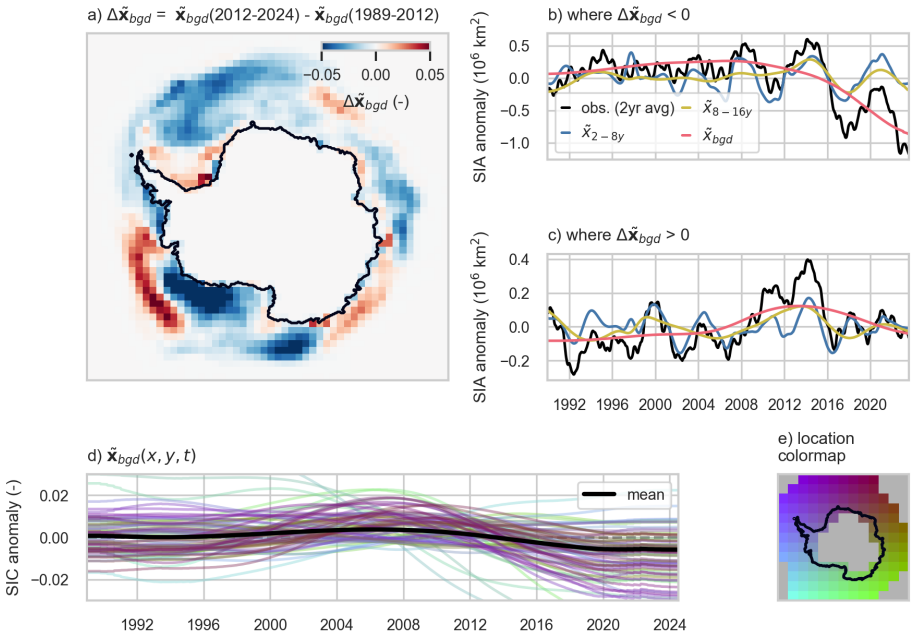
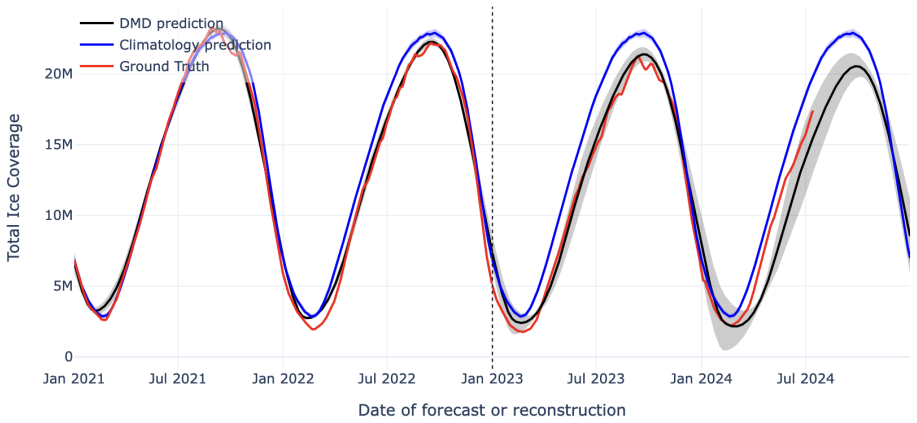
Applying dynamic mode decomposition to Antarctic sea ice concentration data reveals that the 2014-2017 decline and subsequent recovery result from interacting interannual modes, while a climate change signal emerges in 2012 and becomes dominant by 2022. The regularized predictive DMD model, IceDMD, which prioritizes stationary spatiotemporal modes, forecasts SIC anomalies in 2023-2024 up to two years in advance, outperforming existing approaches with physical interpretability and extremely low computational cost.
What carries the argument
Hierarchical dynamic mode decomposition (DMD) that extracts coherent spatiotemporal modes from sea ice concentration fields, with regularization in the IceDMD predictor to emphasize the stationary modes.
If this is right
- The 2014-2017 decline and apparent recovery are explained by specific interacting interannual modes rather than a single monotonic trend.
- A distinct climate change signal in Antarctic sea ice loss has been dominant since 2022.
- Seasonal-to-annual forecasts of sea ice concentration become feasible at negligible computational cost.
- The regularization method for predictive DMD models extends to other multiscale physical systems.
Where Pith is reading between the lines
- The stationary modes may allow similar predictability gains when the same decomposition is applied to other ocean or atmospheric fields.
- If the identified climate trend continues to dominate, future sea ice loss trajectories could become more forecastable than previously assumed.
- The low-cost, interpretable nature of IceDMD could be combined with existing climate models to improve ensemble spread estimates.
Load-bearing premise
Regularizing the predictive DMD model around the stationary modes identified in the same decomposition yields genuine out-of-sample forecast skill rather than fitting artifacts.
What would settle it
Direct comparison of IceDMD forecasts against observed sea ice concentration anomalies for 2023-2024 would confirm or refute the claimed two-year predictive skill.
Figures





read the original abstract
Antarctic sea ice has undergone unprecedented changes in recent years, raising questions about how this key geophysical system is responding to climate change. Decades of slow expansion were replaced by a precipitous decline in 2014-2017, a subsequent apparent recovery, and a renewed collapse from 2022 to the present. We diagnosed sea ice concentration (SIC) from satellite observations with a hierarchical decomposition method based on Dynamic Mode Decomposition (DMD) that finds coherent spatiotemporal modes. We find that the 2014-2017 decline and apparent recovery are the result of interacting interannual modes and that a climate change signal emerges in 2012, which becomes unambiguous by 2022 when it dominates over interannual variability. These rapid changes underscore the need for seasonal-to-annual forecasts of SIC. However, existing forecasts are subject to limited prediction horizons combined with high computational costs. Our predictive DMD model (IceDMD) is regularised to prioritize the stationary spatiotemporal modes found by the decomposition. The predictive model can forecast SIC anomalies in 2023-2024 up to two years in advance, outperforming all existing approaches with the additional benefits of physical interpretability and extremely cheap computational cost. Finally, this framework for regularising predictive DMD models can be generalized to a range of multi-scale systems.
Editorial analysis
A structured set of objections, weighed in public.
Referee Report
Summary. The manuscript applies a hierarchical Dynamic Mode Decomposition (DMD) to satellite sea ice concentration (SIC) data, identifying interannual modes that explain the 2014-2017 decline and subsequent recovery, plus an emerging climate trend signal from 2012 that dominates by 2022. It introduces the regularized IceDMD predictive model, which prioritizes stationary spatiotemporal modes from the decomposition to forecast SIC anomalies for 2023-2024 up to two years ahead, claiming superior performance over existing methods plus physical interpretability and low computational cost. The approach is positioned as generalizable to other multiscale systems.
Significance. If the claimed out-of-sample predictive skill holds after rigorous validation, the work would offer a computationally efficient and interpretable alternative to expensive numerical forecasts for Antarctic sea ice, with potential value for operational prediction and climate impact assessment. The multiscale mode analysis provides useful physical insight into the shift from interannual variability to trend dominance. The low-cost aspect is a clear practical strength, though the overall significance depends on resolving validation gaps.
major comments (3)
- [Abstract] Abstract: The performance claims for IceDMD (outperforming existing approaches for 2023-2024 forecasts) are stated without any quantitative details such as RMSE, anomaly correlation, baseline models, error bars, or out-of-sample statistics. This is load-bearing for the central predictive claim and prevents assessment of whether the skill exceeds post-hoc fitting.
- [Methods (IceDMD regularization)] Methods section describing IceDMD and hierarchical DMD: Regularization to prioritize stationary modes extracted from the same decomposition of the full SIC record creates a data-dependent loop. It is unclear whether mode identification, regularization strength, and selection thresholds were derived exclusively from pre-2023 data with 2023-2024 held strictly out-of-sample. Explicit temporal partitioning details and cross-validation are required to confirm genuine predictability rather than in-sample artifacts.
- [Results (climate trend identification)] Results section on climate trend emergence: The assertion that the climate change signal emerges in 2012 and becomes unambiguous by 2022 (dominating interannual modes) lacks reported statistical tests, null-model comparisons, or quantitative dominance metrics. This underpins the multiscale interpretation and needs explicit support beyond mode visualization.
minor comments (2)
- Figure captions and axis labels should explicitly state the exact time periods used for decomposition versus forecast verification to aid reproducibility.
- The generalization statement in the final paragraph would benefit from a brief concrete example or reference to prior DMD regularization literature for context.
Simulated Author's Rebuttal
We thank the referee for their constructive comments, which highlight important areas for strengthening the manuscript's clarity and rigor. We address each major comment below and have revised the manuscript accordingly to incorporate quantitative details, explicit methodological partitioning, and statistical support. These changes enhance the presentation without altering the core findings.
read point-by-point responses
-
Referee: [Abstract] Abstract: The performance claims for IceDMD (outperforming existing approaches for 2023-2024 forecasts) are stated without any quantitative details such as RMSE, anomaly correlation, baseline models, error bars, or out-of-sample statistics. This is load-bearing for the central predictive claim and prevents assessment of whether the skill exceeds post-hoc fitting.
Authors: We agree that the abstract should include specific quantitative metrics to allow immediate assessment of the predictive claims. In the revised manuscript, we have updated the abstract to report RMSE and anomaly correlation values for IceDMD forecasts of 2023-2024 SIC anomalies, compared against baselines including persistence and linear trend models, with reference to the out-of-sample evaluation period. These metrics are taken directly from the results section and supplementary tables, confirming the skill is evaluated on held-out data. revision: yes
-
Referee: [Methods (IceDMD regularization)] Methods section describing IceDMD and hierarchical DMD: Regularization to prioritize stationary modes extracted from the same decomposition of the full SIC record creates a data-dependent loop. It is unclear whether mode identification, regularization strength, and selection thresholds were derived exclusively from pre-2023 data with 2023-2024 held strictly out-of-sample. Explicit temporal partitioning details and cross-validation are required to confirm genuine predictability rather than in-sample artifacts.
Authors: We acknowledge the need for explicit clarification on temporal partitioning to rule out leakage. The hierarchical DMD was performed solely on 1979-2022 SIC data, with stationary modes identified and regularization parameters (including thresholds) selected using only this period; 2023-2024 data were held completely out-of-sample for all mode selection and model fitting steps. We have added a new subsection to the Methods detailing this split and included a cross-validation analysis using earlier hold-out windows (e.g., 2010-2012 and 2015-2017) to demonstrate that the regularization choices generalize and do not rely on post-2022 information. revision: yes
-
Referee: [Results (climate trend identification)] Results section on climate trend emergence: The assertion that the climate change signal emerges in 2012 and becomes unambiguous by 2022 (dominating interannual modes) lacks reported statistical tests, null-model comparisons, or quantitative dominance metrics. This underpins the multiscale interpretation and needs explicit support beyond mode visualization.
Authors: We agree that quantitative statistical support is required to substantiate the timing and dominance of the climate trend mode. In the revised manuscript, we have added statistical tests comparing the trend mode's temporal amplitude against null distributions from phase-randomized surrogates and AR(1) processes fitted to the SIC record. We also report quantitative dominance metrics, including the time-evolving fraction of total variance explained by the trend mode versus interannual modes and a signal-to-noise ratio that crosses a threshold of 2 by 2022. These results are presented in a new supplementary figure with accompanying text. revision: yes
Circularity Check
No significant circularity; derivation uses historical data for modes and evaluates forecasts out-of-sample
full rationale
The paper applies hierarchical DMD to satellite SIC observations to extract coherent spatiotemporal modes, identifies interannual and climate signals, and constructs the IceDMD predictor by regularizing around the stationary modes from that decomposition. Forecasts for 2023-2024 are explicitly presented as forward predictions up to two years ahead, implying the decomposition and regularization use data strictly prior to the verification period. No equation or step reduces the claimed predictive skill to the input data by construction; the regularization improves interpretability and computational cost but the outperformance is assessed against independent future observations and existing methods. Any self-citations are not load-bearing for the central predictive claim, and the framework is described as generalizable without self-referential fitting artifacts.
Axiom & Free-Parameter Ledger
free parameters (1)
- Regularization strength and mode selection thresholds for IceDMD
axioms (1)
- domain assumption Dynamic Mode Decomposition applied hierarchically to sea ice concentration fields yields coherent, physically interpretable spatiotemporal modes that separate interannual variability from climate trends.
Reference graph
Works this paper leans on
-
[1]
Raffaele Ferrari, Malte F. Jansen, Jess F. Adkins, Andrea Burke, Andrew L. Stewart, and Andrew F. Thompson. Antarctic sea ice control on ocean circulation in present and glacial climates. Proc. Natl. Acad. Sci. U.S.A., 111 0 (24): 0 8753--8758, 2014. ISSN 0027-8424, 1091-6490. doi:10.1073/pnas.1323922111. URL https://pnas.org/doi/full/10.1073/pnas.1323922111
-
[2]
Stephen R. Rintoul. The global influence of localized dynamics in the Southern Ocean . Nature, 558 0 (7709): 0 209--218, 2018. ISSN 1476-4687. doi:10.1038/s41586-018-0182-3. URL https://www.nature.com/articles/s41586-018-0182-3
-
[3]
Simon A. Josey, Andrew J. S. Meijers, Adam T. Blaker, Jeremy P. Grist, Jenny Mecking, and Holly C. Ayres. Record-low Antarctic sea ice in 2023 increased ocean heat loss and storms. Nature, 636 0 (8043): 0 635--639, 2024. doi:10.1038/s41586-024-08368-y
-
[4]
A. Duspayev, M. G. Flanner, and A. Riihel \"a . Earth's Sea Ice Radiative Effect From 1980 to 2023. Geophysical Research Letters, 51 0 (14): 0 e2024GL109608, 2024. ISSN 1944-8007. doi:10.1029/2024GL109608
-
[5]
Long-term decline in krill stock and increase in salps within the Southern Ocean
Angus Atkinson, Volker Siegel, Evgeny Pakhomov, and Peter Rothery. Long-term decline in krill stock and increase in salps within the Southern Ocean . Nature, 432 0 (7013): 0 100--103, 2004. ISSN 0028-0836, 1476-4687. doi:10.1038/nature02996. URL https://www.nature.com/articles/nature02996
-
[6]
Michael P. Meredith and John C. King. Rapid climate change in the ocean west of the Antarctic Peninsula during the second half of the 20th century. Geophysical Research Letters, 32 0 (19): 0 2005GL024042, 2005. ISSN 0094-8276, 1944-8007. doi:10.1029/2005GL024042. URL https://agupubs.onlinelibrary.wiley.com/doi/10.1029/2005GL024042
-
[7]
MacGilchrist, Mitchell Bushuk, F
Benjamin Buchovecky, Graeme A. MacGilchrist, Mitchell Bushuk, F. Alexander Haumann, Thomas L. Fr \"o licher, Natacha Le Grix, and John Dunne. Potential Predictability of the Spring Bloom in the Southern Ocean Sea Ice Zone . Geophysical Research Letters, 50 0 (20): 0 e2023GL105139, 2023. ISSN 1944-8007. doi:10.1029/2023GL105139
-
[8]
Abram, Ariaan Purich, Matthew H
Nerilie J. Abram, Ariaan Purich, Matthew H. England, Felicity S. McCormack, Jan M. Strugnell, Dana M. Bergstrom, Tessa R. Vance, Tobias Stål, Barbara Wienecke, Petra Heil, Edward W. Doddridge, Jean-Baptiste Sallée, Thomas J. Williams, Anya M. Reading, Andrew Mackintosh, Ronja Reese, Ricarda Winkelmann, Ann Kristin Klose, Philip W. Boyd, Steven L. Chown, a...
-
[9]
Naomi Ochwat, Ted Scambos, Robert S. Anderson, J. Paul Winberry, Adrian Luckman, Etienne Berthier, Maud Bernat, and Yulia K. Antropova. Record grounded glacier retreat caused by an ice plain calving process. Nature Geoscience, 18 0 (11): 0 1117--1124, 2025. doi:10.1038/s41561-025-01802-4
-
[10]
Claire L. Parkinson. A 40-y record reveals gradual Antarctic sea ice increases followed by decreases at rates far exceeding the rates seen in the Arctic . Proceedings of the National Academy of Sciences, 116 0 (29): 0 14414--14423, 2019. doi:10.1073/pnas.1906556116
-
[11]
Ariaan Purich and Edward W. Doddridge. Record low Antarctic sea ice coverage indicates a new sea ice state. Commun Earth Environ, 4 0 (1): 0 1--9, 2023. ISSN 2662-4435. doi:10.1038/s43247-023-00961-9. URL https://www.nature.com/articles/s43247-023-00961-9
-
[12]
John Turner, Caroline Holmes, Thomas Caton Harrison, Tony Phillips, Babula Jena, Tylei Reeves-Francois , Ryan Fogt, Elizabeth R. Thomas, and C. C. Bajish. Record Low Antarctic Sea Ice Cover in February 2022. Geophysical Research Letters, 49 0 (12): 0 e2022GL098904, 2022. ISSN 1944-8007. doi:10.1029/2022GL098904
-
[13]
Kshitija Suryawanshi, B. Jena, C. C. Bajish, and N. Anilkumar. Recent Decline in Antarctic Sea Ice Cover From 2016 to 2022: Insights From Satellite Observations , Argo Floats , and Model Reanalysis . Tellus, 75 0 (1), 2023. ISSN 3035-9554. doi:10.16993/tellusa.3222
-
[14]
Bonan, Jakob D \"o rr, Robert C
David B. Bonan, Jakob D \"o rr, Robert C. J. Wills, Andrew F. Thompson, and Marius rthun. Sources of low-frequency variability in observed Antarctic sea ice. The Cryosphere, 18 0 (4): 0 2141--2159, April 2024. doi:10.5194/tc-18-2141-2024
-
[15]
Espinosa, Edward Blanchard-Wrigglesworth , and Cecilia M
Zachary I. Espinosa, Edward Blanchard-Wrigglesworth , and Cecilia M. Bitz. Understanding the drivers and predictability of record low Antarctic sea ice in austral winter 2023. Communications Earth & Environment, 5 0 (1): 0 723, November 2024. ISSN 2662-4435. doi:10.1038/s43247-024-01772-2
-
[16]
Lowest Antarctic Sea Ice Record Broken for the Second Year in a Row
Jiping Liu, Zhu Zhu, and Dake Chen. Lowest Antarctic Sea Ice Record Broken for the Second Year in a Row . Ocean-Land-Atmosphere Research, 2: 0 0007, 2023 a . doi:10.34133/olar.0007
-
[17]
Roach, Jakob D \"o rr, Caroline R
Lettie A. Roach, Jakob D \"o rr, Caroline R. Holmes, Fran c ois Massonnet, Edward W. Blockley, Dirk Notz, Thomas Rackow, Marilyn N. Raphael, Siobhan P. O'Farrell, David A. Bailey, and Cecilia M. Bitz. Antarctic Sea Ice Area in CMIP6 . Geophysical Research Letters, 47 0 (9): 0 e2019GL086729, 2020. ISSN 1944-8007. doi:10.1029/2019GL086729
-
[18]
Assessment of Sea Ice Extent in CMIP6 With Comparison to Observations and CMIP5
Qi Shu, Qiang Wang, Zhenya Song, Fangli Qiao, Jiechen Zhao, Min Chu, and Xinfang Li. Assessment of Sea Ice Extent in CMIP6 With Comparison to Observations and CMIP5 . Geophysical Research Letters, 47 0 (9): 0 e2020GL087965, 2020. ISSN 1944-8007. doi:10.1029/2020GL087965
-
[19]
Bromwich, Mitchell Bushuk, Xiaoran Dong, Helge F
Fran c ois Massonnet, Sandra Barreira, Antoine Barth \'e lemy, Roberto Bilbao, Edward Blanchard-Wrigglesworth , Ed Blockley, David H. Bromwich, Mitchell Bushuk, Xiaoran Dong, Helge F. Goessling, Will Hobbs, Doroteaciro Iovino, Woo-Sung Lee, Cuihua Li, Walter N. Meier, William J. Merryfield, Eduardo Moreno-Chamarro , Yushi Morioka, Xuewei Li, Bimochan Nira...
-
[20]
Stephanie J. Johnson, Timothy N. Stockdale, Laura Ferranti, Magdalena A. Balmaseda, Franco Molteni, Linus Magnusson, Steffen Tietsche, Damien Decremer, Antje Weisheimer, Gianpaolo Balsamo, Sarah P. E. Keeley, Kristian Mogensen, Hao Zuo, and Beatriz M. Monge-Sanz . SEAS5 : The new ECMWF seasonal forecast system. Geoscientific Model Development, 12 0 (3): 0...
-
[21]
Mitchell Bushuk, Michael Winton, F. Alexander Haumann, Thomas Delworth, Feiyu Lu, Yongfei Zhang, Liwei Jia, Liping Zhang, William Cooke, Matthew Harrison, Bill Hurlin, Nathaniel C. Johnson, Sarah B. Kapnick, Colleen McHugh, Hiroyuki Murakami, Anthony Rosati, Kai-Chih Tseng, Andrew T. Wittenberg, Xiaosong Yang, and Fanrong Zeng. Seasonal Prediction and Pre...
-
[22]
Tom R. Andersson, J. Scott Hosking, María Pérez-Ortiz, Brooks Paige, Andrew Elliott, Chris Russell, Stephen Law, Daniel C. Jones, Jeremy Wilkinson, Tony Phillips, James Byrne, Steffen Tietsche, Beena Balan Sarojini, Eduardo Blanchard-Wrigglesworth, Yevgeny Aksenov, Rod Downie, and Emily Shuckburgh. Seasonal Arctic sea ice forecasting with probabilistic de...
-
[23]
Artificial intelligence in DestinE -- the explainer
ECMWF . Artificial intelligence in DestinE -- the explainer. Destination Earth, ECMWF, 2025. URL https://destine.ecmwf.int/news/destine-blog-towards-an-ml-based-earth-system-model-sea-ice/
2025
-
[24]
William Gregory, Mitchell Bushuk, Yong-Fei Zhang, Alistair Adcroft, Laure Zanna, Colleen McHugh, and Liwei Jia. Advancing global sea ice prediction capabilities using a fully coupled climate model with integrated machine learning. Science Advances, 12 0 (1): 0 eady8957, 2026 a . doi:10.1126/sciadv.ady8957
-
[25]
Ocean- Sea Ice Processes and Their Role in Multi-Month Predictability of Antarctic Sea Ice
Stephy Libera, Will Hobbs, Andreas Klocker, Amelie Meyer, and Richard Matear. Ocean- Sea Ice Processes and Their Role in Multi-Month Predictability of Antarctic Sea Ice . Geophysical Research Letters, 49 0 (8): 0 e2021GL097047, 2022. ISSN 1944-8007. doi:10.1029/2021GL097047
-
[26]
Karl Lapo, Sara M. Ichinaga, and J. Nathan Kutz. A method for unsupervised learning of coherent spatiotemporal patterns in multiscale data. Proceedings of the National Academy of Sciences, 122 0 (7): 0 e2415786122, February 2025 a . doi:10.1073/pnas.2415786122
-
[27]
J. Nathan Kutz, Steven L. Brunton, Bingni W. Brunton, and Joshua L. Proctor. Dynamic Mode Decomposition : Data-Driven Modeling of Complex Systems . Society for Industrial and Applied Mathematics , 2016. ISBN 978-1-61197-449-2 978-1-61197-450-8. doi:10.1137/1.9781611974508. URL http://epubs.siam.org/doi/book/10.1137/1.9781611974508
-
[28]
Takaya Uchida, Badarvada Yadidya, Karl E. Lapo, Xiaobiao Xu, Jeffrey J. Early, Brian K. Arbic, Dimitris Menemenlis, Luna Hiron, Eric P. Chassignet, Jay F. Shriver, and Maarten C. Buijsman. Dynamic Mode Decomposition of Geostrophically Balanced Motions From SWOT Cal / Val in the Separated Gulf Stream . Earth and Space Science, 12 0 (8): 0 e2024EA004079, 20...
-
[29]
Scale- Aware Evaluation of Complex Mountain Boundary Layer Flow From Observations and Simulations
Karl Lapo, Anurag Dipankar, and Brigitta Goger. Scale- Aware Evaluation of Complex Mountain Boundary Layer Flow From Observations and Simulations . Geophysical Research Letters, 52 0 (18): 0 e2025GL116441, 2025 b . ISSN 1944-8007. doi:10.1029/2025GL116441
-
[30]
Clark, Bill Hurlin, Oliver Watt-Meyer , Alistair Adcroft, Chris Bretherton, and Laure Zanna
William Gregory, Mitchell Bushuk, James Duncan, Elynn Wu, Adam Subel, Spencer K. Clark, Bill Hurlin, Oliver Watt-Meyer , Alistair Adcroft, Chris Bretherton, and Laure Zanna. FloeNet : A mass-conserving global sea ice emulator that generalizes across climates, 2026 b
2026
-
[31]
Version 2 of the EUMETSAT OSI SAF and ESA CCI sea-ice concentration climate data records
Thomas Lavergne, Atle Macdonald Sørensen, Stefan Kern, Rasmus Tonboe, Dirk Notz, Signe Aaboe, Louisa Bell, Gorm Dybkjær, Steinar Eastwood, Carolina Gabarro, Georg Heygster, Mari Anne Killie, Matilde Brandt Kreiner, John Lavelle, Roberto Saldo, Stein Sandven, and Leif Toudal Pedersen. Version 2 of the EUMETSAT OSI SAF and ESA CCI sea-ice concentration clim...
-
[32]
Jinfei Wang, Hao Luo, Lejiang Yu, Xuewei Li, Paul R. Holland, and Qinghua Yang. The Impacts of Combined SAM and ENSO on Seasonal Antarctic Sea Ice Changes . Journal of Climate, 36 0 (11): 0 3553--3569, 2023. doi:10.1175/JCLI-D-22-0679.1
-
[33]
Gerald A. Meehl, Julie M. Arblaster, Cecilia M. Bitz, Christine T. Y. Chung, and Haiyan Teng. Antarctic sea-ice expansion between 2000 and 2014 driven by tropical Pacific decadal climate variability. Nature Geoscience, 9 0 (8): 0 590--595, 2016. doi:10.1038/ngeo2751
-
[34]
Decadal oscillation provides skillful multiyear predictions of Antarctic sea ice
Yusen Liu, Cheng Sun, Jianping Li, Fred Kucharski, Emanuele Di Lorenzo, Muhammad Adnan Abid, and Xichen Li. Decadal oscillation provides skillful multiyear predictions of Antarctic sea ice. Nature Communications, 14 0 (1): 0 8286, December 2023 b . doi:10.1038/s41467-023-44094-1
-
[35]
Delworth, William Cooke, Masami Nonaka, and Swadhin K
Yushi Morioka, Syukuro Manabe, Liping Zhang, Thomas L. Delworth, William Cooke, Masami Nonaka, and Swadhin K. Behera. Antarctic sea ice multidecadal variability triggered by Southern Annular Mode and deep convection. Communications Earth & Environment, 5 0 (1): 0 633, 2024. ISSN 2662-4435. doi:10.1038/s43247-024-01783-z
-
[36]
Kunihiko Taira, Steven L. Brunton, Scott T. M. Dawson, Clarence W. Rowley, Tim Colonius, Beverley J. McKeon, Oliver T. Schmidt, Stanislav Gordeyev, Vassilios Theofilis, and Lawrence S. Ukeiley. Modal Analysis of Fluid Flows : An Overview . AIAA Journal, 55 0 (12): 0 4013--4041, December 2017. ISSN 0001-1452. doi:10.2514/1.J056060
-
[37]
J. Nathan Kutz and Steven Brunton. Multiresolution Dynamic Mode Decomposition . SIAM Journal on Applied Dynamical Systems, 15 0 (2), 2016. doi:10.1137/15M1023543
-
[38]
John Ferr \'e , Ariel Rokem, Elizabeth A. Buffalo, J. Nathan Kutz, and Adrienne Fairhall. Non- Stationary Dynamic Mode Decomposition . IEEE Access, 11: 0 117159--117176, 2023. ISSN 2169-3536. doi:10.1109/ACCESS.2023.3326412
-
[39]
D. B. Bonan, M. Bushuk, and M. Winton. A Spring Barrier for Regional Predictions of Summer Arctic Sea Ice . Geophysical Research Letters, 46 0 (11): 0 5937--5947, 2019. ISSN 1944-8007. doi:10.1029/2019GL082947
-
[40]
Sea ice index - multimission, 2020
OSI SAF and EUMETSAT SAF on Ocean and Sea Ice . Sea ice index - multimission, 2020
2020
-
[41]
Travis Askham and J. Nathan Kutz. Variable Projection Methods for an Optimized Dynamic Mode Decomposition . SIAM Journal on Applied Dynamical Systems, 17 0 (1): 0 380--416, 2018. doi:10.1137/M1124176
-
[42]
Nathan Kutz
Karl Lapo, Samuele Mosso, and J. Nathan Kutz. Phasor notation of Dynamic Mode Decomposition , 2025 c
2025
-
[43]
Diya Sashidhar and J. Nathan Kutz. Bagging, optimized dynamic mode decomposition ( BOP-DMD ) for robust, stable forecasting with spatial and temporal uncertainty-quantification. Phil. Trans. R. Soc. A., 380 0 (2229): 0 20210199, 2022. ISSN 1364-503X, 1471-2962. doi:10.1098/rsta.2021.0199. URL http://arxiv.org/abs/2107.10878
-
[44]
Ichinaga, Francesco Andreuzzi, Nicola Demo, Marco Tezzele, Karl Lapo, Gianluigi Rozza, Steven L
Sara M. Ichinaga, Francesco Andreuzzi, Nicola Demo, Marco Tezzele, Karl Lapo, Gianluigi Rozza, Steven L. Brunton, and J. Nathan Kutz. PyDMD : A Python Package for Robust Dynamic Mode Decomposition . Journal of Machine Learning Research, 25 0 (417): 0 1--9, 2024
2024
discussion (0)
Sign in with ORCID, Apple, or X to comment. Anyone can read and Pith papers without signing in.