Recognition: unknown
Impact of Attitude and Bounded Rationality on Collective Behavioral Transitions
Pith reviewed 2026-05-07 11:26 UTC · model grok-4.3
The pith
Collective behavioral transitions can be controlled by adjusting two parameters for attitude influence and decision rationality.
A machine-rendered reading of the paper's core claim, the machinery that carries it, and where it could break.
Core claim
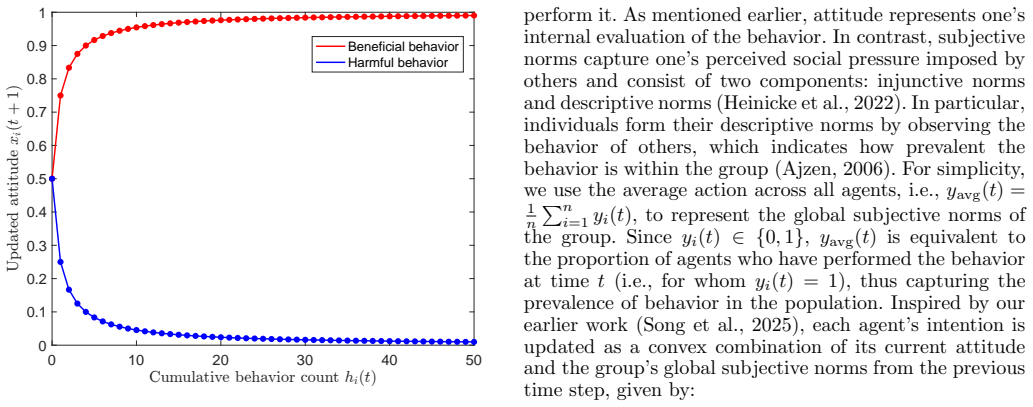
We develop a dynamic agent-based modeling framework that integrates the core principles of TPB with a behavior-to-attitude feedback mechanism. Specifically, we define behaviors based on their feedback effects on attitude and examine when the population undergoes collective transitions by either adopting a beneficial behavior or rejecting a harmful one. Results from our model demonstrate that collective transitions can be effectively controlled by adjusting two key behavioral parameters that reflect agents' attitude influence and decision rationality. These findings provide quantitative insights on TPB, highlighting the key factors that drive collective behavioral transitions.
What carries the argument
The behavior-to-attitude feedback mechanism inside an agent-based population model of TPB, where each agent's chosen behavior updates its own attitude and decisions are made under varying levels of rationality to produce group-level transitions.
Load-bearing premise
The chosen behavior-to-attitude feedback rule together with the two adjustable parameters accurately captures real socio-psychological processes and that no dominant unmodeled factors such as external events or network structure override the internal dynamics.
What would settle it
A real-world population study or controlled experiment in which measured changes to attitude influence and decision rationality fail to produce the model's predicted collective transition patterns, or where external shocks or network structure alone drive the observed shifts.
Figures




read the original abstract
The theory of planned behavior (TPB) is one of the most influential frameworks in social psychology, stating that a person's behavior is driven by intention, which is primarily shaped by attitude, subjective norms, and perceived behavioral control. Despite its strong empirical support, TPB remains a static conceptual framework without explicit mathematical formulations that capture the temporal evolution of its components. To address this gap, we develop a dynamic agent-based modeling framework that integrates the core principles of TPB with a behavior-to-attitude feedback mechanism. Specifically, we define behaviors based on their feedback effects on attitude and examine when the population undergoes collective transitions by either adopting a beneficial behavior or rejecting a harmful one. Results from our model demonstrate that collective transitions can be effectively controlled by adjusting two key behavioral parameters that reflect agents' attitude influence and decision rationality. These findings provide quantitative insights on TPB, highlighting the key factors that drive collective behavioral transitions and the need for further socio-psychological case studies.
Editorial analysis
A structured set of objections, weighed in public.
Referee Report
Summary. The manuscript develops a dynamic agent-based modeling framework extending the Theory of Planned Behavior (TPB) with a behavior-to-attitude feedback mechanism. It examines collective transitions in a population adopting beneficial behaviors or rejecting harmful ones and claims that these transitions can be controlled by tuning two parameters reflecting attitude influence and decision rationality.
Significance. If the internal simulation results are robust, the work supplies a quantitative, dynamic formalization of TPB that identifies leverage points for collective change. This could inform computational social science and policy-oriented modeling by showing how individual-level attitude and rationality parameters scale to macro transitions.
major comments (2)
- Abstract: the central claim that 'results from our model demonstrate that collective transitions can be effectively controlled by adjusting two key behavioral parameters' is asserted without any equations, simulation setup details, output figures, tables, or sensitivity analysis, which is load-bearing for evaluating the result.
- Model section: the reported controllability is achieved by varying the two free parameters (attitude influence and decision rationality) that are defined as the adjustable behavioral factors; without independent calibration against empirical data or literature values, the demonstration risks circularity with the model definition itself.
minor comments (2)
- The abstract mentions integration of TPB components but does not clarify whether subjective norms and perceived behavioral control are explicitly modeled or omitted; a short justification would improve clarity.
- Consider adding a limitations paragraph addressing unmodeled factors such as network structure or external events, as these are noted as potentially dominant in the modeling assumptions.
Simulated Author's Rebuttal
We thank the referee for the constructive feedback on our manuscript. The comments highlight important aspects of clarity and grounding that we address point by point below. We believe these revisions will strengthen the presentation without altering the core contributions of the agent-based TPB extension.
read point-by-point responses
-
Referee: Abstract: the central claim that 'results from our model demonstrate that collective transitions can be effectively controlled by adjusting two key behavioral parameters' is asserted without any equations, simulation setup details, output figures, tables, or sensitivity analysis, which is load-bearing for evaluating the result.
Authors: We agree that the abstract, as a concise summary, does not embed the supporting technical details. The full manuscript provides the model equations (Section 2), simulation protocols and parameter ranges (Section 3), transition figures, and sensitivity analyses (Section 4). To improve accessibility, we will revise the abstract to include a brief clause referencing the simulation-based evidence and key thresholds identified. revision: yes
-
Referee: Model section: the reported controllability is achieved by varying the two free parameters (attitude influence and decision rationality) that are defined as the adjustable behavioral factors; without independent calibration against empirical data or literature values, the demonstration risks circularity with the model definition itself.
Authors: We respectfully disagree that the demonstration is circular. The two parameters are theoretically motivated by distinct TPB constructs (attitude-behavior feedback strength and bounded-rationality noise in intention formation) drawn from the social-psychology literature. The model then generates emergent collective transitions—such as critical thresholds and hysteresis—not directly stipulated by the parameter definitions but arising from agent interactions. Nevertheless, we acknowledge the absence of direct empirical calibration and will add a new subsection in the discussion that (i) justifies parameter ranges via cited TPB meta-analyses and (ii) explicitly flags the need for future empirical validation as a limitation. revision: partial
Circularity Check
No significant circularity; model exploration is self-contained
full rationale
The paper constructs an agent-based model that incorporates TPB components plus an explicit behavior-to-attitude feedback rule, then runs simulations to show how collective transitions respond to two defined parameters (attitude influence and decision rationality). This is ordinary model sensitivity analysis rather than a derivation that reduces to its own inputs by construction. No equations are quoted that equate a 'prediction' to a fitted parameter, no self-citation chain bears the central claim, and no uniqueness theorem or ansatz is smuggled in. The work is presented as a modeling framework providing quantitative insights, not as an empirical prediction tested against independent data; therefore it remains internally consistent without circular reduction.
Axiom & Free-Parameter Ledger
free parameters (2)
- attitude influence parameter
- decision rationality parameter
axioms (2)
- domain assumption A person's behavior is driven by intention shaped by attitude, subjective norms, and perceived behavioral control.
- ad hoc to paper Performed behaviors exert a direct feedback effect on future attitudes.
Reference graph
Works this paper leans on
-
[1]
Ajzen, I. (1991). The theory of planned behavior.Organ. Behav. Hum. Decis. Process., 50(2), 179–211. Ajzen, I. (2006). Constructing a theory of planned behav- ior questionnaire. Technical report, UMass Amherst. Asch, S.E. (1951). Effects of group pressure upon the modification and distortion of judgments. In H. Guet- zkow (ed.),Groups, Leadership and Men:...
1991
-
[2]
Fetherstonhaugh, D., Slovic, P., Johnson, S.M., and Friedrich, J. (1997). Insensitivity to the value of hu- man life: A study of psychological numbing.J. Risk Uncertain., 14(3), 283–300. Fishbein, M. and Ajzen, I. (1977). Belief, attitude, in- tention, and behavior: An introduction to theory and research.Philos. Rhetor., 10(2), 130–132. Fontan, A., Cvetko...
1997
-
[3]
and Tversky, A
Kahneman, D. and Tversky, A. (1979). Prospect theory: An analysis of decision under risk.Econometrica, 47(2), 263–291. McFadden, D. (1974). Conditional logit analysis of quali- tative choice behavior. In P. Zarembka (ed.),Frontiers in Econometrics, 105–142. Academic Press, New York, NY, USA. Si, H., Shi, J., Tang, D., Wen, S., Miao, W., and Duan, K. (2019...
1979
-
[4]
Simon, H.A. (1955). A behavioral model of rational choice. Q. J. Econ., 69(1), 99–118. Skinner, B.F. (1953).Science and Human Behavior. Macmillan, New York, NY, USA. Song, C., Cvetkovic, V., and Su, R. (2025). Why do opinions and actions diverge? a dynamic framework to explore the impact of subjective norms.IEEE Transactions on Computational Social System...
discussion (0)
Sign in with ORCID, Apple, or X to comment. Anyone can read and Pith papers without signing in.