Recognition: unknown
Large-eddy simulation nets (LESnets) based on physics-informed neural operator for wall-bounded turbulence
Pith reviewed 2026-05-07 10:52 UTC · model grok-4.3
The pith
A physics-informed neural operator embeds large-eddy simulation equations to predict wall-bounded turbulence without labeled data.
A machine-rendered reading of the paper's core claim, the machinery that carries it, and where it could break.
Core claim
The LESnets framework integrates the large-eddy simulation equations directly into the loss function of the factorized Fourier neural operator and incorporates the law of the wall through an explicit wall model. This data-free approach generates temporal solutions over flexible time horizons and enables reliable coarse-grid simulations of wall-bounded turbulence at high Reynolds numbers. Tests on channel flows demonstrate accuracy and efficiency comparable to both data-driven Fourier neural operators and traditional large-eddy simulation.
What carries the argument
The LESnets model, which embeds the large-eddy simulation equations and a wall-model loss term into the training objective of the factorized Fourier neural operator.
If this is right
- The model generates stable long-term temporal predictions for wall-bounded turbulence without requiring labeled flow-field data.
- It maintains accuracy at friction Reynolds numbers up to 1000 when using coarse grids and a wall model.
- Computational cost is lower than traditional LES while prediction statistics remain comparable.
- Training proceeds over flexible time horizons because the physics loss replaces supervised targets.
Where Pith is reading between the lines
- The same embedding strategy could be tested on other canonical wall-bounded flows such as pipe or boundary-layer turbulence to check generalization beyond channel geometry.
- Eliminating the need for labeled data removes dependence on costly direct numerical simulation databases for training.
- If the wall model remains effective at higher Reynolds numbers, the framework might enable engineering-scale predictions on modest hardware.
- Coupling LESnets with adaptive mesh refinement could further reduce cost while preserving near-wall accuracy.
Load-bearing premise
Embedding the LES equations and law of the wall into the F-FNO loss function produces stable, accurate long-term temporal predictions at high Reynolds numbers on coarse grids without any labeled data.
What would settle it
A side-by-side long-time integration at Re_tau = 1000 on the same coarse grid where LESnets statistics deviate systematically from a well-resolved traditional LES run would falsify the claim of comparable accuracy.
Figures




read the original abstract
Accurate and efficient prediction of three-dimensional (3D) wall-bounded turbulent flows poses a significant challenge for machine learning methods, particularly in scenarios where flow field data are limited. Physics-informed neural operator (PINO) combines neural operator and physics constraint methods, and shows great potential for solving a wide range of partial differential equations. Nevertheless, the multi-scale vortex structures in wall-bounded turbulence make it difficult for most existing PINO methods to make stable and accurate long-term predictions at high Reynolds numbers. To address this challenge, we develop the large-eddy simulation nets (LESnets) that integrates large-eddy simulation (LES) equations into the factorized Fourier neural operator (F-FNO) for wall-bounded turbulence. The LESnets framework does not rely on labeled data for training, which enables it to generate temporal solutions over flexible time horizons during the training process. Moreover, the law of the wall is integrated into the LESnets framework through a wall model for the physics-informed loss, thus enabling reliable simulations of wall-bounded turbulence at high Reynolds number using coarse grids. The proposed LESnets methods are demonstrated in turbulent channel flows at three friction Reynolds numbers: 180, 590, and 1000. Numerical experiments show that the performance of the LESnets in terms of prediction accuracy and efficiency is comparable to that of two data-driven models, namely the implicit U-Net enhanced Fourier neural operator (IUFNO) and F-FNO. Meanwhile, the LESnets model achieves prediction accuracy comparable to traditional LES methods while offering a higher computational efficiency. Thus, the LESnets model demonstrates strong potential for efficient and long-term prediction of wall-bounded turbulent flows.
Editorial analysis
A structured set of objections, weighed in public.
Referee Report
Summary. The paper proposes LESnets, a physics-informed neural operator that embeds the filtered large-eddy simulation (LES) equations and a law-of-the-wall wall model into the factorized Fourier neural operator (F-FNO). Trained without any labeled data, the framework is intended to produce stable long-term temporal predictions of three-dimensional wall-bounded turbulence on coarse grids at friction Reynolds numbers up to 1000, achieving accuracy comparable to traditional LES while offering higher computational efficiency than data-driven baselines such as IUFNO and F-FNO.
Significance. If the central claims are substantiated, the work would represent a meaningful step toward data-free, physics-constrained neural operators for high-Reynolds-number wall-bounded flows. Successful integration of LES closures and wall models could reduce reliance on expensive labeled datasets and enable more scalable long-horizon simulations in computational fluid dynamics.
major comments (3)
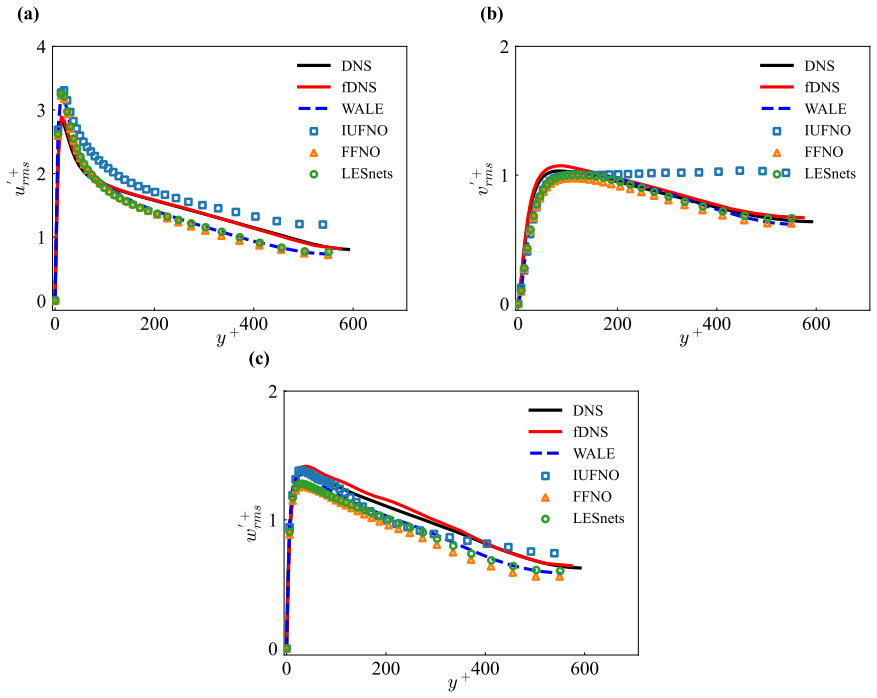
- [Abstract and numerical experiments] Abstract and numerical experiments: The claim that LESnets produces stable, accurate long-term predictions at Re_tau=1000 on coarse grids with accuracy comparable to traditional LES is not supported by quantitative diagnostics such as time-averaged U+ profiles, RMS velocity fluctuations, Reynolds stress distributions, or blow-up times; without these metrics the stability of the physics-informed rollouts cannot be verified.
- [Physics-informed loss formulation] Physics-informed loss: The manuscript does not provide sufficient detail on how the filtered LES equations and pointwise wall-model term are combined in the F-FNO training loss, nor does it demonstrate that residual SGS errors do not accumulate over long time horizons in chaotic turbulence; this is load-bearing for the no-labeled-data claim.
- [Numerical experiments] Grid and stability analysis: No grid resolutions, time-step sizes, or explicit stability analysis (e.g., energy spectra or mean-profile drift) are reported for the Re_tau=590 and 1000 cases, making it impossible to assess whether the coarse-grid, physics-only training actually closes the system at the highest Reynolds number.
minor comments (3)
- Clarify the precise modifications made to the original F-FNO architecture and the exact weighting of the physics loss terms relative to any data terms (even if zero).
- Add explicit comparison tables or figures showing error norms against both the data-driven baselines and a reference traditional LES simulation at each Re_tau.
- Include a brief discussion of how the flexible time-horizon training is implemented without labeled data and any safeguards against divergence during rollout.
Simulated Author's Rebuttal
We thank the referee for the careful and constructive review. The comments have helped us identify areas where additional detail and quantitative support will strengthen the presentation of our results. We address each major comment below and have revised the manuscript accordingly.
read point-by-point responses
-
Referee: [Abstract and numerical experiments] Abstract and numerical experiments: The claim that LESnets produces stable, accurate long-term predictions at Re_tau=1000 on coarse grids with accuracy comparable to traditional LES is not supported by quantitative diagnostics such as time-averaged U+ profiles, RMS velocity fluctuations, Reynolds stress distributions, or blow-up times; without these metrics the stability of the physics-informed rollouts cannot be verified.
Authors: We agree that these specific diagnostics provide stronger verification of long-term stability. In the revised manuscript we have added time-averaged U+ profiles, RMS velocity fluctuations, and Reynolds stress profiles for the Re_tau=1000 case, all of which show close quantitative agreement with reference LES data. We also report that no blow-up occurred in rollouts extending to 2000 time units, with mean-profile drift remaining below 0.8% and kinetic energy spectra remaining stationary after the initial transient. revision: yes
-
Referee: [Physics-informed loss formulation] Physics-informed loss: The manuscript does not provide sufficient detail on how the filtered LES equations and pointwise wall-model term are combined in the F-FNO training loss, nor does it demonstrate that residual SGS errors do not accumulate over long time horizons in chaotic turbulence; this is load-bearing for the no-labeled-data claim.
Authors: We have expanded the methodology section with an explicit equation for the composite loss: L = L_LES + lambda * L_wall, where L_LES is the L2 residual of the filtered continuity and momentum equations (with the SGS term left implicit) and L_wall enforces the law-of-the-wall at the first off-wall points. To address error accumulation, we now include a supplementary analysis tracking the pointwise residual norm and total kinetic energy over 1000 time units; both quantities remain bounded, confirming that the physics constraints prevent secular growth of SGS errors in the chaotic regime. revision: yes
-
Referee: [Numerical experiments] Grid and stability analysis: No grid resolutions, time-step sizes, or explicit stability analysis (e.g., energy spectra or mean-profile drift) are reported for the Re_tau=590 and 1000 cases, making it impossible to assess whether the coarse-grid, physics-only training actually closes the system at the highest Reynolds number.
Authors: We have added a new subsection detailing the numerical setup. For Re_tau=590 the coarse grid is 48x48x48 with Delta t = 0.005; for Re_tau=1000 it is 64x64x64 with Delta t = 0.01. Explicit stability diagnostics now include kinetic-energy spectra at t=0, 500, and 1000 (showing no pile-up at high wavenumbers) and mean-velocity-profile drift (less than 1% over the full horizon). These additions confirm that the physics-informed training closes the system on the reported coarse grids. revision: yes
Circularity Check
No significant circularity; derivation embeds external LES equations and wall model
full rationale
The LESnets framework trains an F-FNO by minimizing a loss that penalizes residuals of the filtered LES equations plus a standard law-of-the-wall wall-model term. These governing relations are taken from established fluid mechanics and are not derived from or defined in terms of the network outputs. No parameter is fitted to a data subset and then relabeled as a prediction, no uniqueness theorem is imported from the authors' prior work, and no ansatz is smuggled via self-citation. The reported accuracy on Re_tau = 180/590/1000 channel flows is therefore an empirical result of the physics-constrained optimization rather than a tautological restatement of the inputs.
Axiom & Free-Parameter Ledger
axioms (2)
- domain assumption LES equations provide a sufficient physics constraint for stable long-term neural-operator evolution of wall-bounded turbulence
- domain assumption The law of the wall supplies an adequate near-wall model for coarse-grid high-Re simulations
Reference graph
Works this paper leans on
-
[1]
S. B. Pope, Turbulent flows, Cambridge University Press, 2000
2000
-
[2]
C. Meneveau, J. Katz, Scale-invariance and turbulence models for large-eddy simulation, Annual Review of Fluid Mechanics 32 (2000) 1–32.doi:https://doi.org/10.1146/annurev.fluid.32.1.1
-
[3]
R. D. Moser, S. W. Haering, G. R. Yalla, Statistical properties of subgrid-scale turbulence mod- els, Annual Review of Fluid Mechanics 53 (2021) 255–286.doi:https://doi.org/10.1146/ annurev-fluid-060420-023735
2021
-
[4]
O. M. Reynolds, On the dynamical theory of incompressible viscous fluids and the determination of the crite- rion, Proceedings of the Royal Society of London. Series A: Mathematical and Physical Sciences 451 (1995) 5–47.doi:10.1098/rspa.1995.0116
-
[5]
M. Germano, U. Piomelli, P. Moin, W. H. Cabot, A dynamic subgrid-scale eddy viscosity model, Physics of Fluids A: Fluid Dynamics 3 (7) (1991) 1760–1765.doi:10.1063/1.857955
-
[6]
P. A. Durbin, Some recent developments in turbulence closure modeling, Annual Review of Fluid Mechanics 50 (2018) 77–103.doi:https://doi.org/10.1146/annurev-fluid-122316-045020
-
[7]
Turbulence Modeling in the Age of Data
K. Duraisamy, G. Iaccarino, H. Xiao, Turbulence modeling in the age of data, Annual review of fluid mechanics 51 (1) (2019) 357–377.doi:https://doi.org/10.1146/annurev-fluid-010518-040547
-
[8]
Smagorinsky, General circulation experiments with the primitive equations: I
J. Smagorinsky, General circulation experiments with the primitive equations: I. The basic experiment, Monthly weather review 91 (3) (1963) 99–164.doi:10.1175/1520-0493(1963)091<0099:GCEWTP>2.3.CO;2
-
[9]
J. W. Deardorff, A numerical study of three-dimensional turbulent channel flow at large Reynolds numbers, Journal of Fluid Mechanics 41 (2) (1970) 453–480.doi:10.1017/S0022112070000691. 35
-
[10]
P. Moin, K. Squires, W. Cabot, S. Lee, A dynamic subgrid-scale model for compressible turbulence and scalar transport, Physics of Fluids A: Fluid Dynamics 3 (11) (1991) 2746–2757.doi:10.1063/1.858164
-
[11]
J. Ling, A. Kurzawski, J. Templeton, Reynolds averaged turbulence modelling using deep neural networks with embedded invariance, Journal of Fluid Mechanics 807 (2016) 155–166.doi:10.1017/jfm.2016.615
-
[12]
Z. Wang, K. Luo, D. Li, J. Tan, J. Fan, Investigations of data-driven closure for subgrid-scale stress in large- eddy simulation, Physics of Fluids 30 (12) (2018) 125101.doi:10.1063/1.5054835
-
[13]
C. Xie, J. Wang, K. Li, C. Ma, Artificial neural network approach to large-eddy simulation of compressible isotropic turbulence, Physical Review E 99 (2019) 053113.doi:10.1103/PhysRevE.99.053113
-
[14]
X. I. A. Yang, S. Zafar, J.-X. Wang, H. Xiao, Predictive large-eddy-simulation wall modeling via physics- informed neural networks, Phys. Rev. Fluids 4 (2019) 034602.doi:10.1103/PhysRevFluids.4.034602
-
[15]
Z. Yuan, C. Xie, J. Wang, Deconvolutional artificial neural network models for large eddy simulation of turbu- lence, Physics of Fluids 32 (11) (2020) 115106.doi:10.1063/5.0027146
-
[16]
S. L. Brunton, B. R. Noack, P. Koumoutsakos, Machine learning for fluid mechanics, Annual review of fluid mechanics 52 (1) (2020) 477–508.doi:https://doi.org/10.1146/annurev-fluid-010719-060214
-
[17]
J. Ling, R. Jones, J. Templeton, Machine learning strategies for systems with invariance properties, Journal of Computational Physics 318 (2016) 22–35.doi:https://doi.org/10.1016/j.jcp.2016.05.003
-
[19]
R. Maulik, O. San, A neural network approach for the blind deconvolution of turbulent flows, Journal of Fluid Mechanics 831 (2017) 151–181.doi:10.1017/jfm.2017.637
-
[20]
A. Beck, D. Flad, C.-D. Munz, Deep neural networks for data-driven LES closure models, Journal of Compu- tational Physics 398 (2019) 108910.doi:https://doi.org/10.1016/j.jcp.2019.108910
-
[21]
J. Wu, H. Xiao, R. Sun, Q. Wang, Reynolds-averaged Navier–Stokes equations with explicit data-driven Reynolds stress closure can be ill-conditioned, Journal of Fluid Mechanics 869 (2019) 553–586.doi: 10.1017/jfm.2019.205
-
[22]
Z. Zhou, G. He, X. Yang, Wall model based on neural networks for LES of turbulent flows over periodic hills, Phys. Rev. Fluids 6 (2021) 054610.doi:10.1103/PhysRevFluids.6.054610
-
[23]
M. Raissi, P. Perdikaris, G. Karniadakis, Physics-informed neural networks: A deep learning framework for solving forward and inverse problems involving nonlinear partial differential equations, Journal of Computa- tional Physics 378 (2019) 686–707.doi:https://doi.org/10.1016/j.jcp.2018.10.045
-
[24]
L. Lu, P. Jin, G. Pang, Z. Zhang, G. E. Karniadakis, Learning nonlinear operators via DeepONet based on the universal approximation theorem of operators, Nature machine intelligence 3 (3) (2021) 218–229.doi: 10.1038/s42256-021-00302-5
-
[25]
Z. Li, N. Kovachki, K. Azizzadenesheli, B. Liu, K. Bhattacharya, A. Stuart, A. Anandkumar, Fourier neural operator for parametric partial differential equations, arXiv preprint arXiv:2010.08895 (2020).doi:https: //doi.org/10.48550/arXiv.2010.08895
work page internal anchor Pith review doi:10.48550/arxiv.2010.08895 2010
-
[26]
Z. Li, H. Zheng, N. Kovachki, D. Jin, H. Chen, B. Liu, K. Azizzadenesheli, A. Anandkumar, Physics-informed neural operator for learning partial differential equations, ACM/JMS Journal of Data Science 1 (3) (2024) 1–27. doi:10.1145/3648506. 36
-
[27]
C. Rao, H. Sun, Y . Liu, Physics-informed deep learning for incompressible laminar flows, Theoretical and Applied Mechanics Letters 10 (3) (2020) 207–212.doi:https://doi.org/10.1016/j.taml.2020.01. 039
-
[28]
M. Raissi, Z. Wang, M. S. Triantafyllou, G. E. Karniadakis, Deep learning of vortex-induced vibrations, Journal of Fluid Mechanics 861 (2019) 119–137.doi:10.1017/jfm.2018.872
-
[29]
X. Jin, S. Cai, H. Li, G. E. Karniadakis, NSFnets (Navier-Stokes flow nets): Physics-informed neural networks for the incompressible Navier-Stokes equations, Journal of Computational Physics 426 (2021) 109951.doi: https://doi.org/10.1016/j.jcp.2020.109951
-
[30]
M. Raissi, A. Yazdani, G. E. Karniadakis, Hidden fluid mechanics: Learning velocity and pressure fields from flow visualizations, Science 367 (6481) (2020) 1026–1030.doi:10.1126/science.aaw4741
-
[31]
Z. Zhang, X. Yan, P. Liu, K. Zhang, R. Han, S. Wang, A physics-informed convolutional neural network for the simulation and prediction of two-phase darcy flows in heterogeneous porous media, Journal of Computational Physics 477 (2023) 111919.doi:https://doi.org/10.1016/j.jcp.2023.111919
-
[32]
H. Feng, P. Hu, Y . Wang, D. Fan, T. Wu, Y . Zhang, Physics-informed super-resolution and forecasting method based on inaccurate partial differential equations and partial observation, Physics of Fluids 37 (6) (2025) 066625.doi:10.1063/5.0276721
-
[33]
H.-L. Wu, A. Xu, H.-D. Xi, Super-resolution reconstruction of turbulent flows from a single lagrangian trajec- tory, Journal of Fluid Mechanics 1026 (2026) A46.doi:10.1017/jfm.2025.11033
-
[34]
S. Wang, X. Yu, P. Perdikaris, When and why PINNs fail to train: A neural tangent kernel perspective, Journal of Computational Physics 449 (2022) 110768.doi:https://doi.org/10.1016/j.jcp.2021.110768
-
[35]
H. Gao, L. Sun, J.-X. Wang, PhyGeoNet: Physics-informed geometry-adaptive convolutional neural networks for solving parameterized steady-state PDEs on irregular domain, Journal of Computational Physics 428 (2021) 110079.doi:https://doi.org/10.1016/j.jcp.2020.110079
-
[36]
K. Shukla, A. D. Jagtap, G. E. Karniadakis, Parallel physics-informed neural networks via domain decom- position, Journal of Computational Physics 447 (2021) 110683.doi:https://doi.org/10.1016/j.jcp. 2021.110683
-
[37]
L. Yang, X. Meng, G. E. Karniadakis, B-PINNs: Bayesian physics-informed neural networks for forward and inverse PDE problems with noisy data, Journal of Computational Physics 425 (2021) 109913.doi:https: //doi.org/10.1016/j.jcp.2020.109913
-
[38]
L. D. McClenny, U. M. Braga-Neto, Self-adaptive physics-informed neural networks, Journal of Computational Physics 474 (2023) 111722.doi:https://doi.org/10.1016/j.jcp.2022.111722
-
[39]
D. Zhang, Y . Chen, S. Chen, Filtered partial differential equations: a robust surrogate constraint in physics- informed deep learning framework, Journal of Fluid Mechanics 999 (2024) A40.doi:10.1017/jfm.2024. 471
-
[40]
J. Song, W. Cao, F. Liao, W. Zhang, VW-PINNs: A volume weighting method for PDE residuals in physics-informed neural networks, Acta Mechanica Sinica 41 (3) (2024) 324140.doi:10.1007/ s10409-024-24140-x
2024
-
[41]
Z. Zou, X. Meng, G. E. Karniadakis, Uncertainty quantification for noisy inputs-outputs in physics-informed neural networks and neural operators, Computer Methods in Applied Mechanics and Engineering 433 (2025) 117479.doi:https://doi.org/10.1016/j.cma.2024.117479
-
[42]
J. Song, W. Cao, W. Zhang, FENN: Feature-enhanced neural network for solving partial differential equations involving fluid mechanics, Journal of Computational Physics 542 (2025) 114370.doi:https://doi.org/ 10.1016/j.jcp.2025.114370. 37
-
[43]
W. Cao, W. Zhang, An analysis and solution of ill-conditioning in physics-informed neural networks, Journal of Computational Physics 520 (2025) 113494.doi:https://doi.org/10.1016/j.jcp.2024.113494
- [44]
-
[45]
Neural operator: Learning maps between function spaces
N. Kovachki, Z. Li, B. Liu, K. Azizzadenesheli, K. Bhattacharya, A. Stuart, A. Anandkumar, Neural Operator: Learning Maps Between Function Spaces, arXiv preprint arXiv:2108.0848 (2021).doi:https://doi.org/ 10.48550/arXiv.2108.08481
-
[46]
arXiv preprint arXiv:2111.13587 , year=
J. Guibas, M. Mardani, Z. Li, A. Tao, A. Anandkumar, B. Catanzaro, Adaptive Fourier neural operators: Ef- ficient token mixers for transformers, arXiv preprint arXiv:2111.13587 (2021).doi:https://doi.org/10. 48550/arXiv.2111.13587
-
[47]
A. Tran, A. Mathews, L. Xie, C. S. Ong, Factorized Fourier neural operators, arXiv preprint arXiv:2111.13802 (2021).doi:https://doi.org/10.48550/arXiv.2111.13802
-
[48]
W. Peng, Z. Yuan, J. Wang, Attention-enhanced neural network models for turbulence simulation, Physics of Fluids 34 (2) (2022) 025111.doi:10.1063/5.0079302
-
[49]
D. Meng, Y . Zhu, J. Wang, Y . Shi, Fast flow prediction of airfoil dynamic stall based on Fourier neural operator, Physics of Fluids 35 (11) (2023) 115126.doi:10.1063/5.0172117
-
[50]
Azizzadenesheli, N
K. Azizzadenesheli, N. Kovachki, Z. Li, M. Liu-Schiaffini, J. Kossaifi, A. Anandkumar, Neural operators for accelerating scientific simulations and design, Nature Reviews Physics 6 (5) (2024) 320–328.doi:10.1038/ s42254-024-00712-5
2024
-
[51]
A. Zhou, C. Lorsung, A. Hemmasian, A. B. Farimani, Strategies for pretraining neural operators, arXiv preprint arXiv:2406.08473 (2024).doi:https://doi.org/10.48550/arXiv.2406.08473
-
[52]
J. Huang, Y . Qiu, Resolution invariant deep operator network for PDEs with complex geometries, Journal of Computational Physics 522 (2025) 113601.doi:https://doi.org/10.1016/j.jcp.2024.113601
-
[53]
J. Chen, W. Xu, Z. Xu, N. Grande Gutiérrez, S. P. Narra, C. McComb, Enforcing the principle of locality for physical simulations with neural operators, Journal of Computational Physics 538 (2025) 114131.doi: https://doi.org/10.1016/j.jcp.2025.114131
-
[54]
Learning Physical Operators using Neural Operators
V . Gopakumar, A. Gray, D. Giles, L. Zanisi, M. J. Kusner, T. Betcke, S. Pamela, M. P. Deisenroth, Learning Physical Operators using Neural Operators, arXiv preprint arXiv:2602.23113 (2026).doi:https://doi. org/10.48550/arXiv.2602.23113
work page internal anchor Pith review Pith/arXiv arXiv doi:10.48550/arxiv.2602.23113 2026
-
[55]
Z. Li, W. Peng, Z. Yuan, J. Wang, Fourier neural operator approach to large eddy simulation of three- dimensional turbulence, Theoretical and Applied Mechanics Letters 12 (6) (2022) 100389.doi:https: //doi.org/10.1016/j.taml.2022.100389
-
[56]
W. Peng, Z. Yuan, Z. Li, J. Wang, Linear attention coupled Fourier neural operator for simulation of three- dimensional turbulence, Physics of Fluids 35 (1) (2023) 015106.doi:10.1063/5.0130334
-
[57]
Z. Li, W. Peng, Z. Yuan, J. Wang, Long-term predictions of turbulence by implicit U-Net enhanced Fourier neural operator, Physics of Fluids 35 (7) (2023) 075145.doi:10.1063/5.0158830
-
[58]
T. Luo, Z. Li, Z. Yuan, W. Peng, T. Liu, L. L. Wang, J. Wang, Fourier neural operator for large eddy simulation of compressible Rayleigh–Taylor turbulence, Physics of Fluids 36 (7) (2024) 075165.doi: 10.1063/5.0213412. 38
-
[59]
Y . Wang, Z. Li, Z. Yuan, W. Peng, T. Liu, J. Wang, Prediction of turbulent channel flow using Fourier neu- ral operator-based machine-learning strategy, Physical Review Fluids 9 (8) (2024) 084604.doi:10.1103/ PhysRevFluids.9.084604
2024
-
[60]
Y . Wang, H. Yang, Z. Yuan, Z. Li, W. Peng, J. Wang, Machine-learning-based simulation of turbulent flows over periodic hills using a hybrid U-Net and Fourier neural operator framework, Phys. Rev. Fluids 11 (2026) 024601.doi:10.1103/ymlb-wn4s
-
[61]
S. Wang, H. Wang, P. Perdikaris, Learning the solution operator of parametric partial differential equations with physics-informed DeepONets, Science Advances 7 (40) (2021) eabi8605.doi:10.1126/sciadv.abi8605
-
[62]
Z. Zhao, X. Ding, B. A. Prakash, PINNsFormer: A Transformer-Based Framework For Physics-Informed Neural Networks, in: B. Kim, Y . Yue, S. Chaudhuri, K. Fragkiadaki, M. Khan, Y . Sun (Eds.), International Conference on Learning Representations, V ol. 2024, 2024, pp. 38475–38491
2024
-
[63]
S. G. Rosofsky, H. Al Majed, E. Huerta, Applications of physics informed neural operators, Machine Learning: Science and Technology 4 (2) (2023) 025022.doi:10.1088/2632-2153/acd168
-
[64]
Goswami, A
S. Goswami, A. Bora, Y . Yu, G. E. Karniadakis, Physics-Informed Deep Neural Operator Net- works, Springer International Publishing, Cham, 2023, pp. 219–254.doi:https://doi.org/10.1007/ 978-3-031-36644-4
2023
-
[65]
S. Ehlers, M. Stender, N. Hoffmann, Bridging ocean wave physics and deep learning: Physics-informed neural operators for nonlinear wavefield reconstruction in real-time, Physics of Fluids 37 (10) (2025) 107119.doi: 10.1063/5.0294655
-
[66]
R. Zhang, Q. Meng, H. Wan, Y . Liu, Z.-M. Ma, H. Sun, Omnifluids: Physics pre-trained modeling of fluid dy- namics, arXiv preprint arXiv:2506.10862 (2025).doi:https://doi.org/10.48550/arXiv.2506.10862
-
[67]
Y . Wang, Y . Li, Y . Peng, S. Ying, Sliding physical invariant neural operator for long-term prediction of complex dynamics in physical systems, National Science Review 13 (5) (2026) nwag027.doi:10.1093/nsr/nwag027
-
[68]
Q. Liu, W. Zhong, H. Meidani, D. Abueidda, S. Koric, P. Geubelle, Geometry-informed neural operator trans- former for partial differential equations on arbitrary geometries, Computer Methods in Applied Mechanics and Engineering 451 (2026) 118668.doi:https://doi.org/10.1016/j.cma.2025.118668
- [69]
-
[70]
S. Chen, P. Givi, C. Zheng, X. Jia, Physics-enhanced Neural Operator for Simulating Turbulent Transport, arXiv preprint arXiv:2406.04367 (2024).doi:https://doi.org/10.48550/arXiv.2406.04367
-
[71]
C. Wang, J. Berner, Z. Li, D. Zhou, J. Wang, J. Bae, A. Anandkumar, Beyond closure models: Learning chaotic systems via physics-informed neural operators, in: NeurIPS 2024 Workshop on Data-driven and Differentiable Simulations, Surrogates, and Solvers, 2024
2024
-
[72]
S. Zhao, Z. Li, B. Fan, Y . Wang, H. Yang, J. Wang, LESnets (large-eddy simulation nets): Physics-informed neural operator for large-eddy simulation of turbulence, Journal of Computational Physics 537 (2025) 114125. doi:https://doi.org/10.1016/j.jcp.2025.114125
-
[73]
M. S. Eshaghi, C. Anitescu, M. Thombre, Y . Wang, X. Zhuang, T. Rabczuk, Variational Physics-informed Neural Operator (VINO) for solving partial differential equations, Computer Methods in Applied Mechanics and Engineering 437 (2025) 117785.doi:https://doi.org/10.1016/j.cma.2025.117785
-
[74]
S. Roy, B. Bahmani, I. G. Kevrekidis, M. D. Shields, A Physics-informed Multi-resolution Neural Operator, arXiv preprint arXiv:2510.23810 (2025).doi:https://doi.org/10.48550/arXiv.2510.23810. 39
-
[75]
Z. Guo, S. Zhao, H. Yang, Y . Wang, J. Wang, Physics-Informed Transformer operator for the prediction of three-dimensional turbulence, arXiv preprint arXiv:2601.19351 (2026).doi:https://doi.org/10.48550/ arXiv.2601.19351
work page internal anchor Pith review Pith/arXiv arXiv 2026
-
[76]
Y . Dai, S. Chen, X. Jia, P. Givi, R. Yu, PEST: Physics-Enhanced Swin Transformer for 3D Turbulence Simula- tion, arXiv preprint arXiv:2602.10150 (2026).doi:https://doi.org/10.48550/arXiv.2602.10150
-
[77]
H. Choi, P. Moin, Grid-point requirements for large eddy simulation: Chapman’s estimates revisited, Physics of Fluids 24 (1) (2012) 011702.doi:10.1063/1.3676783
-
[78]
U. Piomelli, E. Balaras, Wall-layer models for large-eddy simulations, Annual Review of Fluid Mechanics 34 (V olume 34, 2002) (2002) 349–374.doi:https://doi.org/10.1146/annurev.fluid.34.082901. 144919
-
[79]
X. I. A. Yang, J. Sadique, R. Mittal, C. Meneveau, Integral wall model for large eddy simulations of wall- bounded turbulent flows, Physics of Fluids 27 (2) (2015) 025112.doi:10.1063/1.4908072
-
[80]
S. T. Bose, G. I. Park, Wall-modeled large-eddy simulation for complex turbulent flows, Annual Re- view of Fluid Mechanics 50 (V olume 50, 2018) (2018) 535–561.doi:https://doi.org/10.1146/ annurev-fluid-122316-045241
2018
-
[81]
S.-G. Cai, J. Jacob, P. Sagaut, Immersed boundary based near-wall modeling for large eddy simulation of turbulent wall-bounded flow, Computers & Fluids 259 (2023) 105893.doi:https://doi.org/10.1016/j. compfluid.2023.105893
work page doi:10.1016/j 2023
discussion (0)
Sign in with ORCID, Apple, or X to comment. Anyone can read and Pith papers without signing in.