Recognition: unknown
Inferring bifurcation diagrams of two distinct chaotic systems by a single machine
Pith reviewed 2026-05-07 12:29 UTC · model grok-4.3
The pith
Augmenting a reservoir computer with system-label and parameter-control channels enables reconstruction of bifurcation diagrams for two distinct chaotic systems from partial observations.
A machine-rendered reading of the paper's core claim, the machinery that carries it, and where it could break.
Core claim
A reservoir computer augmented with a system-label channel and a parameter-control channel, when trained on time series from a few sampled states of two distinct chaotic systems, predicts the short-time evolution of the sampled states and reproduces the long-term statistical properties of unseen states, enabling the reconstruction of the bifurcation diagrams of both systems from partial observations.
What carries the argument
The dual-channel augmentation of a standard reservoir computer, consisting of a system-label channel and a parameter-control channel, which separates the dynamics of the two systems and allows parameter generalization.
If this is right
- The trained machine reproduces long-term statistics for unseen states in both systems.
- Bifurcation diagrams can be reconstructed for both the Lorenz and Rössler systems numerically.
- The method works in physical experiments with Chua and Rossler circuits.
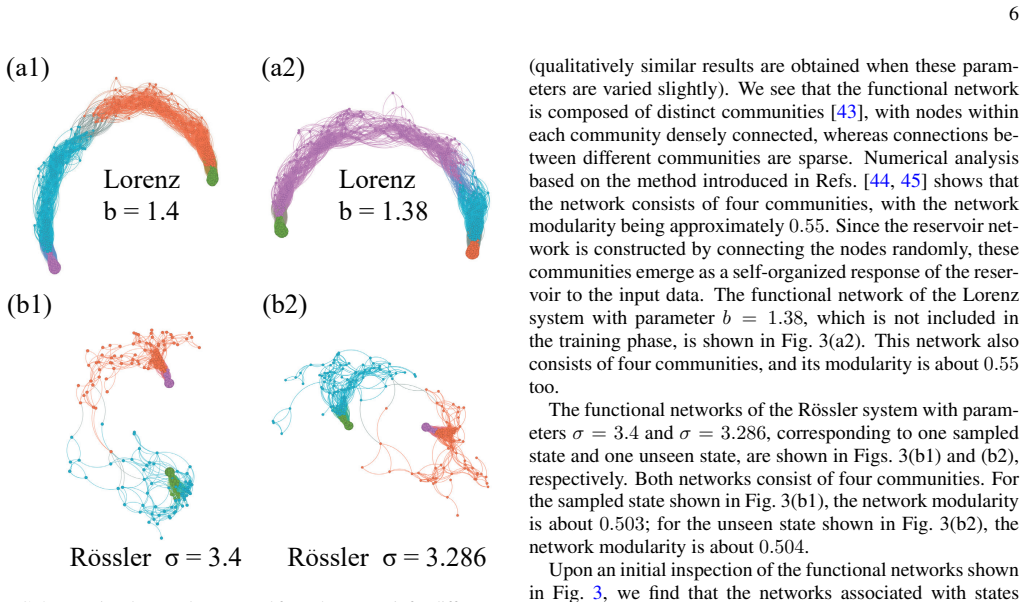
- Distinct dynamical patterns in the reservoir encode the two target systems separately.
- This extends multifunctional and parameter-aware reservoir computing to multiple nonlinear systems.
Where Pith is reading between the lines
- The approach may allow a single hardware device to monitor and predict multiple chaotic processes in applications like secure communications.
- Adding more label channels could enable handling of additional chaotic systems without retraining separate machines.
- The distinct encoding patterns suggest that reservoir states could be analyzed to classify which system is active in mixed observations.
Load-bearing premise
The system-label and parameter-control channels enable the reservoir to accurately generalize to unseen parameter values while maintaining separation between the dynamics of the two systems without interference or overfitting.
What would settle it
A direct comparison showing that the bifurcation diagram generated by the machine for a parameter value not used in training deviates significantly from the diagram obtained by solving the system's equations or from additional measurements.
Figures



read the original abstract
We propose a dual-channel reservoir-computing scheme for inferring the dynamics of two distinct chaotic systems with a single machine. By augmenting a standard reservoir with a system-label channel and a parameter-control channel, the machine can be trained from time series collected from a few sampled states of the two systems. We show that the trained machine not only predicts the short-time evolution of the sampled states, but also reproduces the long-term statistical properties of unseen states, thereby enabling reconstruction of the bifurcation diagrams of both systems from partial observations. The effectiveness of the scheme is demonstrated for the Lorenz and R\"ossler systems in numerical simulations and for the Chua and Rossler circuits in experiments. Functional-network analysis further shows that the two target systems are encoded by distinct dynamical patterns in the reservoir. These results extend multifunctional and parameter-aware reservoir computing, and provide a route to data-driven inference of multiple nonlinear systems using a single machine.
Editorial analysis
A structured set of objections, weighed in public.
Referee Report
Summary. The manuscript proposes a dual-channel reservoir-computing architecture augmented by a system-label input channel and a parameter-control input channel. A single reservoir is trained on short time series sampled from a few states of two distinct chaotic oscillators; the trained machine is then asserted to forecast short-time trajectories and, crucially, to reproduce the long-term attractor statistics of both systems at parameter values never seen during training, thereby permitting reconstruction of their bifurcation diagrams. Numerical demonstrations are given for the Lorenz and Rössler systems; experimental demonstrations are given for Chua’s circuit and the Rössler oscillator. A functional-network analysis of the reservoir is included to argue that the two target systems are encoded by distinct internal dynamical patterns.
Significance. If the extrapolation property holds, the work meaningfully extends multifunctional and parameter-aware reservoir computing by showing that a single machine can separate and generalize the attractors of two qualitatively different chaotic flows. The numerical and experimental demonstrations, together with the functional-network evidence of distinct encoding, constitute concrete strengths that would be of interest to the nonlinear-dynamics community.
major comments (2)
- [Numerical results] The central claim that long-term statistical properties are reproduced for unseen parameter values rests on the parameter-control channel enabling genuine extrapolation. The results section presents visual agreement between inferred and true bifurcation diagrams, but does not report quantitative measures (e.g., Wasserstein distance between reconstructed and reference attractors, or error in estimated Lyapunov exponents) that would confirm the statistics are accurate rather than merely plausible within the convex hull of training parameters.
- [Experimental validation] In the experimental section the parameter-control channel is driven by a voltage or resistance setting, yet the manuscript does not specify whether the “unseen” parameter values lie outside the range used in training or are simply interpolated. Without this information or an explicit extrapolation test, it is impossible to judge whether the reported reproduction of attractor statistics for the Chua and Rössler circuits supports the generalization asserted in the abstract.
minor comments (2)
- [Methods] The reservoir update equations and the precise form of the input matrix that incorporates the two additional channels are described only at a high level; an explicit equation or pseudocode block would improve reproducibility.
- [Figures] Figure captions for the bifurcation diagrams should explicitly label which branches were used for training and which were inferred, and should include the number of independent reservoir realizations averaged.
Simulated Author's Rebuttal
We thank the referee for the constructive report and the positive assessment of the work's potential interest to the nonlinear-dynamics community. We address each major comment below and will revise the manuscript to incorporate the suggested improvements.
read point-by-point responses
-
Referee: [Numerical results] The central claim that long-term statistical properties are reproduced for unseen parameter values rests on the parameter-control channel enabling genuine extrapolation. The results section presents visual agreement between inferred and true bifurcation diagrams, but does not report quantitative measures (e.g., Wasserstein distance between reconstructed and reference attractors, or error in estimated Lyapunov exponents) that would confirm the statistics are accurate rather than merely plausible within the convex hull of training parameters.
Authors: We agree that quantitative metrics would strengthen the evidence for accurate reproduction of long-term statistics beyond visual inspection. In the revised manuscript we will add the Wasserstein distance between the reconstructed and reference attractor distributions for the unseen parameters in both the Lorenz and Rössler cases. We will also report the relative errors in the largest Lyapunov exponents computed from the inferred trajectories versus the true values. These additions will be placed in the numerical results section to confirm that the statistics lie outside mere interpolation. revision: yes
-
Referee: [Experimental validation] In the experimental section the parameter-control channel is driven by a voltage or resistance setting, yet the manuscript does not specify whether the “unseen” parameter values lie outside the range used in training or are simply interpolated. Without this information or an explicit extrapolation test, it is impossible to judge whether the reported reproduction of attractor statistics for the Chua and Rössler circuits supports the generalization asserted in the abstract.
Authors: We thank the referee for highlighting the need for explicit clarification. The manuscript states that the tested parameters are unseen during training, but we acknowledge that the training and test ranges are not tabulated. In the revision we will add a table listing the exact training intervals for resistance/voltage in both circuits together with the specific unseen values used for testing, confirming that all test points lie outside the training intervals. This will make the extrapolation explicit and support the generalization claim. revision: yes
Circularity Check
No significant circularity detected in the derivation or claims.
full rationale
The paper presents an empirical machine-learning scheme (dual-channel reservoir computing) trained on partial time-series data from Lorenz/Rössler systems and Chua/Rössler circuits. It reports short-term prediction accuracy and long-term statistical reproduction for unseen parameter values, validated by direct numerical/experimental tests and functional-network analysis. No equations or results are defined in terms of the target bifurcation diagrams; the generalization property is demonstrated rather than assumed by construction. No self-citation chains, fitted inputs renamed as predictions, or ansatzes smuggled via prior work appear in the load-bearing steps. The method is self-contained against external benchmarks (simulations and hardware experiments).
Axiom & Free-Parameter Ledger
free parameters (1)
- reservoir hyperparameters
axioms (1)
- domain assumption A linear readout trained on a fixed random reservoir can approximate the input-output map of chaotic systems.
invented entities (2)
-
system-label channel
no independent evidence
-
parameter-control channel
no independent evidence
Reference graph
Works this paper leans on
-
[1]
Maass, T
W. Maass, T. Natschl¨ager, and H. Markram, Real-time comput- ing without stable states: A new framework for neural compu- tation based on perturbations, Neural Comput.14, 2531 (2002)
2002
-
[2]
Jaeger and H
H. Jaeger and H. Haas, Harnessing nonlinearity: Predicting chaotic systems and saving energy in wireless communication, Science304, 78 (2004)
2004
-
[3]
Pathak, Z
J. Pathak, Z. Lu, B. Hunt, M. Girvan, and E. Ott, Using machine learning to replicate chaotic attractors and calculate Lyapunov exponents from data, Chaos27, 121102 (2017)
2017
-
[4]
Z. Lu, B. R. Hunt, and E. Ott, Attractor reconstruction by ma- chine learning, Chaos28, 061104 (2018)
2018
-
[5]
H. Fan, J. Jiang, C. Zhang, X. G. Wang, and Y .-C. Lai, Long- term prediction of chaotic systems with machine learning, Phys. Rev. Res.2, 012080(R) (2020)
2020
-
[6]
L.-W. Kong, Y . Weng, B. Glaz, M. Haile, and Y .-C. Lai, Reser- voir computing as digital twins for nonlinear dynamical sys- tems, Chaos33, 033111 (2023)
2023
-
[7]
Y . Du, Q. Li, H. Fan, M. Zhan, J. Xiao, and X. G. Wang, Infer- ring attracting basins of power system with machine learning, Phys. Rev. Res.6, 013181 (2024)
2024
-
[8]
Panahi and Y .-C
S. Panahi and Y .-C. Lai, Adaptable reservoir computing: A paradigm for model-free data-driven prediction of critical tran- sitions in nonlinear dynamical systems, Chaos34, 051501 (2024)
2024
-
[9]
M. Yan, C. Huang, P. Bienstman, P. Tino, W. Lin, and J. Sun, Emerging opportunities and challenges for the future of reser- voir computing, Nat. Commun.15, 2056 (2024)
2056
-
[10]
Tanaka, T
G. Tanaka, T. Yamane, J. B. Heroux, R. Nakane, N. Kanazawa, S. Takeda, H. Numata, D. Nakano, and A. Hirose, Recent ad- vances in physical reservoir computing: A review, Neural Netw. 115, 100 (2019)
2019
-
[11]
Pathak, B
J. Pathak, B. Hunt, M. Girvan, Z. Lu, and E. Ott, Model-free prediction of large spatiotemporally chaotic systems from data: A reservoir computing approach, Phys. Rev. Lett.120, 024102 (2018)
2018
-
[12]
R. S. Zimmermann and U. Parlitz, Observing spatio-temporal dynamics of excitable media using reservoir computing, Chaos 28, 043118 (2018)
2018
-
[13]
Srinivasan, N
K. Srinivasan, N. Coble, J. Hamlin, T. Antonsen, E. Ott, and M. Girvan, Parallel machine learning for forecasting the dynamics of complex networks, Phys. Rev. Lett.128, 164101 (2022)
2022
-
[14]
C. Klos, Y . F. K. Kossio, S. Goedeke, A. Gilra, and R.-M. Memmesheimer, Dynamical learning of dynamics, Phys. Rev. Lett.125, 088103 (2020). 10
2020
-
[15]
Y . L. Guo, H. Zhang, L. Wang, H. W. Fan, J. H. Xiao, and X. G. Wang, Transfer learning of chaotic systems, Chaos31, 011104 (2021)
2021
-
[16]
Kong, H.-W
L.-W. Kong, H.-W. Fan, C. Grebogi, and Y .-C. Lai, Machine learning prediction of critical transition and system collapse, Phys. Rev. Res.3, 013090 (2021)
2021
-
[17]
J. Z. Kim, Z. Lu, E. Nozari, G. J. Pappas, and D. S. Bassett, Teaching recurrent neural networks to infer global temporal structure from local examples, Nat. Mach. Intell.3, 316 (2021)
2021
-
[18]
Fan, L.-W
H. Fan, L.-W. Kong, Y .-C. Lai, and X. G. Wang, Anticipat- ing synchronization with machine learning, Phys. Rev. Res.3, 023237 (2021)
2021
-
[19]
H. Luo, Y . Du, H. Fan, X. Wang, J. Guo, and X. G. Wang, Re- constructing bifurcation diagrams of chaotic circuits with reser- voir computing, Phys. Rev. E109, 024210 (2024)
2024
-
[20]
H. Luo, M. Wang, Y . Du, H. Fan, Y . Yu, and X. G. Wang, Sus- taining the chaotic dynamics of the Kuramoto model by adapt- able reservoir computer, Phys. Rev. E112, 054218 (2025)
2025
-
[21]
Lu and D
Z. Lu and D. S. Bassett, Invertible generalized synchronization: A putative mechanism for implicit learning in neural systems, Chaos30, 063133 (2020)
2020
-
[22]
Flynn, V
A. Flynn, V . A. Tsachouridis, and A. Amann, Multifunctional- ity in a reservoir computer, Chaos31, 013125 (2021)
2021
-
[23]
L.-W. Kong, G. A. Brewer, and Y .-C. Lai, Reservoir-computing based associative memory and itinerancy for complex dynami- cal attractors, Nat. Commun.15, 4840 (2024)
2024
-
[24]
Y . Du, H. Luo, J. Guo, J. Xiao, Y . Yu, and X. G. Wang, Mul- tifunctional reservoir computing, Phys. Rev. E111, 035303 (2025)
2025
-
[25]
P. A. Getting, Emerging principles governing the operation of neural networks, Annu. Rev. Neurosci.12, 185 (1989)
1989
-
[26]
R. M. Shiffrin and R. C. Atkinson, Storage and retrieval pro- cesses in long-term memory, Psychol. Rev.76, 179 (1969)
1969
-
[27]
Chaudhuri and I
R. Chaudhuri and I. Fiete, Computational principles of memory, Nat. Neurosci.19, 394 (2016)
2016
-
[28]
Chisvin and R
L. Chisvin and R. J. Duckworth, Content-addressable and asso- ciative memory, Adv. Comput.34, 159 (1992)
1992
-
[29]
Nyberg, R
L. Nyberg, R. Habib, A. R. McIntosh, and E. Tulving, Reactiva- tion of encoding-related brain activity during memory retrieval, Proc. Natl. Acad. Sci. U.S.A.97, 11120 (2000)
2000
-
[30]
Pisarchik and U
N. Pisarchik and U. Feudel, Control of multistability, Phys. Rep.540, 167 (2014)
2014
-
[31]
Zhai, L.-W
Z.-M. Zhai, L.-W. Kong, and Y .-C. Lai, Emergence of a stochastic resonance in machine learning, Phys. Rev. Res.5, 033127 (2023)
2023
-
[32]
Ranganath, A
C. Ranganath, A. Heller, M. X. Cohen, C. J. Brozinsky, and J. Rissman, Functional connectivity with the hippocampus during successful memory formation, Hippocampus15, 997 (2005)
2005
-
[33]
Bullmore and O
E. Bullmore and O. Sporns, Complex brain networks: Graph theoretical analysis of structural and functional systems, Nat. Rev. Neurosci.10, 186 (2009)
2009
-
[34]
S. Y . Huo and Z. H. Liu, Condensation of eigenmodes in func- tional brain network and its correlation to chimera state, Com- mun. Phys.6, 285 (2023)
2023
-
[35]
C. S. Zhou, L. Zemanova, G. Zamora, C. C. Hilgetag, and J. Kurths, Hierarchical organization unveiled by functional connectivity in complex brain networks, Phys. Rev. Lett.97, 238103 (2006)
2006
-
[36]
M. Li, X. G. Wang, and C. H. Lai, Evolution of functional sub- networks in complex systems, Chaos20, 045114 (2010)
2010
-
[37]
W. Lin, Y . Wang, H. Ying, Y .-C. Lai, and X. G. Wang, Con- sistency between functional and structural networks of coupled nonlinear oscillators, Phys. Rev. E92, 012912 (2015)
2015
-
[38]
Biswal, F
B. Biswal, F. Z. Yetkin, V . M. Haughton, and J. S. Hyde, Func- tional connectivity in the motor cortex of resting human brain using echo-planar MRI, Magn. Reson. Med.34, 537 (1995)
1995
-
[39]
K. J. Friston, Functional and effective connectivity: A review, Brain Connect.1, 13 (2011)
2011
-
[40]
V . M. Eguiluz, D. R. Chialvo, G. A. Cecchi, M. Baliki, and A. V . Apkarian, Scale-free brain functional networks, Phys. Rev. Lett.94, 018102 (2005)
2005
-
[41]
L. Wang, H. Fan, J. Xiao, Y . Lan, and X. G. Wang, Criticality in reservoir computer of coupled phase oscillators, Phys. Rev. E105, L052201 (2022)
2022
-
[42]
Arenas, A
A. Arenas, A. D ´ıaz-Guilera, and C. J. P´erez-Vicente, Synchro- nization reveals topological scales in complex networks, Phys. Rev. Lett.96, 114102 (2006)
2006
-
[43]
M. E. J. Newman, The structure and function of complex net- works, SIAM Rev.45, 167 (2003)
2003
-
[44]
V . D. Blondel, J.-L. Guillaume, R. Lambiotte, and E. Lefebvre, Fast unfolding of communities in large networks, J. Stat. Mech. Theory Exp. (2008) P10008
2008
-
[45]
Lambiotte, J.-C
R. Lambiotte, J.-C. Delvenne, and M. Barahona, Random walks, Markov processes, and the multiscale modular organi- zation of complex networks, IEEE Trans. Netw. Sci. Eng.1, 76 (2014)
2014
-
[46]
M. E. J. Newman and M. Girvan, Finding and evaluating com- munity structure in networks, Phys. Rev. E69, 026113 (2004)
2004
-
[47]
Karrer, E
B. Karrer, E. Levina, and M. E. J. Newman, Robustness of com- munity structure in networks, Phys. Rev. E77, 046119 (2008)
2008
-
[48]
Meil ˘a, Comparing clusterings—an information based dis- tance, J
M. Meil ˘a, Comparing clusterings—an information based dis- tance, J. Multivar. Anal.98, 873 (2007)
2007
-
[49]
I. A. Heisler, T. Braun, Y . Zhang, G. Hu, and H. A. Cerdeira, Experimental investigation of partial synchronization in cou- pled chaotic oscillators, Chaos13, 185 (2003)
2003
-
[50]
Y . Du, H. Fan, and X. G. Wang, Versatile reservoir comput- ing for heterogeneous complex networks, Phys. Rev. Appl.24, L031002 (2025). [51]https://github.com/Xingang-Wang/Dual_ Channel_RC
2025
discussion (0)
Sign in with ORCID, Apple, or X to comment. Anyone can read and Pith papers without signing in.