Recognition: unknown
Development of a compact cryogenic Penning trap with permanent magnets: An intermediate step toward the Shanghai Penning Trap
Pith reviewed 2026-05-07 11:28 UTC · model grok-4.3
The pith
A compact Penning trap cooled to cryogenic temperatures operates using permanent magnets for the confining field.
A machine-rendered reading of the paper's core claim, the machinery that carries it, and where it could break.
Core claim
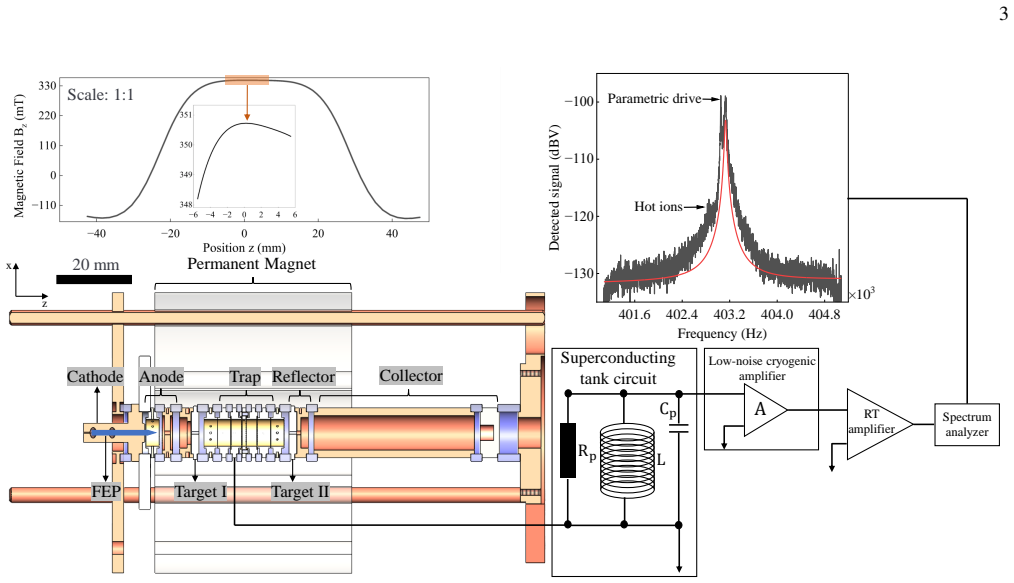
We have developed a compact cryogenic Penning trap that uses a permanent magnet assembly to supply the confining magnetic field and have shown that the complete sequence of ion generation, transport, confinement, manipulation, and signal detection works in this system at cryogenic temperatures.
What carries the argument
The compact cryogenic Penning trap with permanent-magnet assembly, which supplies the magnetic field while the trap is cooled and operated at low temperatures.
If this is right
- The trap serves as a technical testbed for the development of the larger Shanghai Penning Trap project.
- It creates an operational platform for ion trapping, cooling, and spectroscopic measurements at cryogenic temperatures.
- The design supplies a lower-cost and simpler alternative to superconducting-magnet Penning traps for selected precision experiments.
- Successful operation confirms that all core ion-handling steps can be performed inside a permanent-magnet, cryogenically cooled enclosure.
Where Pith is reading between the lines
- Laboratories without access to large superconducting facilities could still perform selected high-precision ion mass or magnetic-moment measurements.
- The same permanent-magnet approach might be scaled or adapted to create more portable or modular Penning-trap instruments.
- Cryogenic operation paired with permanent magnets could improve vacuum quality and reduce thermal noise for longer ion storage times in future experiments.
Load-bearing premise
The permanent-magnet assembly continues to produce a magnetic field that is homogeneous and stable enough for useful ion confinement once the system reaches cryogenic temperatures.
What would settle it
A measurement showing that ion cyclotron frequencies remain stable to within the expected precision over hours or that resonance linewidths match those obtained in superconducting traps would support the claim; loss of confinement within seconds or inability to resolve the expected signals at cryogenic temperatures would refute it.
Figures


read the original abstract
Penning traps, renowned for their unparalleled precision in determining fundamental properties such as mass and magnetic moments, are cornerstone instruments in modern physics. Their applications span from nuclear structure studies to stringent tests of quantum electrodynamics and CPT invariance. Although Penning traps have been demonstrated for fundamental studies, often employing superconducting magnets, their high cost and operational complexity remain challenges. In this work, we report the development of a compact cryogenic Penning trap that utilizes a permanent magnet to provide a confining magnetic field, offering a more economical and flexible alternative. We have successfully demonstrated all core functionalities of this system, including ion generation, transport, confinement, manipulation, and signal detection. This compact trap not only serves as a vital technical testbed for the development of the Shanghai Penning Trap, but also establishes a cryogenic Penning-trap experiment platform for ion trapping and cooling applications as well as envisaged spectroscopic studies applications.
Editorial analysis
A structured set of objections, weighed in public.
Referee Report
Summary. The manuscript describes the development and initial testing of a compact cryogenic Penning trap that employs a permanent-magnet assembly rather than a superconducting magnet to generate the confining field. The authors report successful demonstration of ion generation, transport, confinement, manipulation, and signal detection, framing the device as both a technical testbed for the Shanghai Penning Trap and a platform for ion-trapping, cooling, and spectroscopic studies.
Significance. If the performance data substantiate the claims, the work offers a lower-cost, more flexible route to cryogenic Penning-trap operation. This could expand access to precision ion experiments in mass spectrometry, QED tests, and CPT studies while serving as a practical stepping stone toward larger-scale traps such as the Shanghai Penning Trap.
major comments (2)
- [Abstract and experimental results] Abstract and results description: the assertion that 'all core functionalities' have been successfully demonstrated is unsupported by any quantitative metrics (trapping lifetimes, resonance linewidths, signal-to-noise ratios, or ion-cloud sizes). Without these data it is impossible to judge whether the observed confinement meets the homogeneity and stability requirements of a functional Penning trap.
- [Magnetic-field characterization] Magnetic-field characterization (presumably §3 or §4): no post-cooling field maps, Hall-probe scans, or temperature-dependent remanence measurements are presented. Mechanical contraction and possible changes in magnetization at 4 K could degrade homogeneity below the 10^{-5}–10^{-6} level needed for useful trapping; the absence of such data leaves the central technical claim unverified.
minor comments (1)
- [Results] A dedicated table summarizing the achieved trap parameters (B-field strength, homogeneity estimate, trapping time, detection sensitivity) would improve readability and allow direct comparison with superconducting-magnet benchmarks.
Simulated Author's Rebuttal
We thank the referee for the careful and constructive review of our manuscript. The comments highlight important areas for clarification and strengthening of the presentation. We address each major comment below and have made revisions to the manuscript where appropriate.
read point-by-point responses
-
Referee: [Abstract and experimental results] Abstract and results description: the assertion that 'all core functionalities' have been successfully demonstrated is unsupported by any quantitative metrics (trapping lifetimes, resonance linewidths, signal-to-noise ratios, or ion-cloud sizes). Without these data it is impossible to judge whether the observed confinement meets the homogeneity and stability requirements of a functional Penning trap.
Authors: We agree that the abstract and results would be strengthened by explicit quantitative metrics. The manuscript demonstrates the core functionalities through the observation of persistent ion signals, their transport, confinement over multiple cycles, voltage-based manipulation, and detection, but we acknowledge that numerical values were not highlighted in the text. In the revised version we have added available quantitative indicators, including signal-to-noise ratios from the detection electronics and estimates of confinement duration derived from the signal persistence. Resonance linewidths were not measured in this initial testbed experiment. We have also revised the abstract to state that the functionalities have been demonstrated with supporting initial quantitative indicators rather than claiming unqualified success. revision: yes
-
Referee: [Magnetic-field characterization] Magnetic-field characterization (presumably §3 or §4): no post-cooling field maps, Hall-probe scans, or temperature-dependent remanence measurements are presented. Mechanical contraction and possible changes in magnetization at 4 K could degrade homogeneity below the 10^{-5}–10^{-6} level needed for useful trapping; the absence of such data leaves the central technical claim unverified.
Authors: The referee is correct that post-cooling field maps are absent. The manuscript reports room-temperature Hall-probe characterization of the magnet assembly. We have added a dedicated paragraph discussing the expected effects of cooling to 4 K on the NdFeB permanent magnets, including references to literature on temperature-dependent remanence and mechanical contraction. While direct cryogenic mapping was not performed due to the integrated design of this compact testbed, the successful ion confinement and detection at cryogenic temperatures provide indirect evidence that the field quality suffices for the reported operations. We have updated the text to frame this as an intermediate development step and to note that full cryogenic homogeneity verification will be addressed in the larger Shanghai Penning Trap project. revision: partial
Circularity Check
No circularity: experimental demonstration with no derivation chain
full rationale
The manuscript is a technical report on the construction and basic operation of a compact cryogenic Penning trap using permanent magnets. It claims successful demonstration of ion generation, transport, confinement, manipulation, and signal detection, but presents no mathematical derivations, first-principles predictions, fitted parameters, or theoretical results. The abstract and described content contain no equations, ansatzes, or claims that reduce to self-defined quantities or self-citations. All load-bearing statements are empirical observations from the built apparatus rather than predictions derived from within the work. This is a standard experimental paper with no identifiable circular steps.
Axiom & Free-Parameter Ledger
Reference graph
Works this paper leans on
-
[1]
S. H. Hooger- heide et al. employed a room-temperature permanent magnet Penning trap for laser spectroscopy of highly charged ions 20 and successfully determined the life time of Ar 9+21. With the ion trapping and manipulation techniques demonstrated in the compact cryogenic Penning trap, we can envisage future applications such as laser cooling and spect...
work page internal anchor Pith review Pith/arXiv arXiv 2026
-
[2]
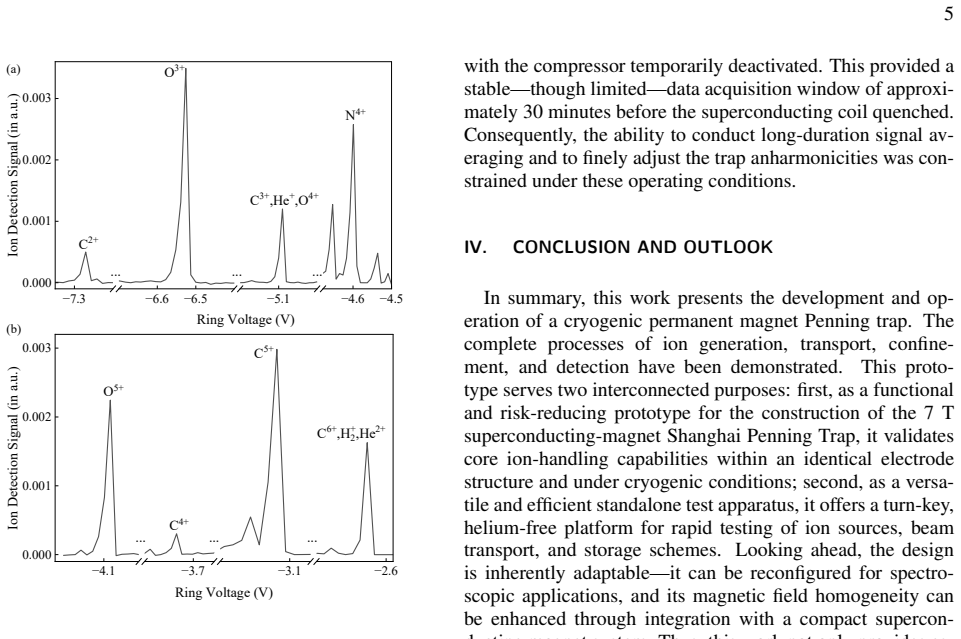
The charge-to-mass ratio of the 5 −4.1 −3.7 −3.1 −2.60.0000.0010.0020.003Ion Detection Signal (in a.u.)Ring Voltage (V)O5+C4+C5+C6+,H+2,He2+... ... ... −7.3 −6.6 −6.5 −5.1 −4.6 −4.50.0000.0010.0020.003Ion Detection Signal (in a.u.)Ring Voltage (V)... ... ...C2+O3+C3+,He+,O4+N4+(a) (b) FIG
-
[3]
Ring voltage scan spectrum. Panels (a) and (b) together dis- play the ring voltage scan results spanning from -7.5 V to -2.6 V . By varying the voltages applied to the ring and correction electrodes, the axial oscillation frequency of the ions is progressively shifted. The sum of the differences between each spectrum (recorded at a specific ring voltage) ...
-
[4]
High-precision measurement of the atomic mass of the electron,
33S. Sturm, F. Köhler, J. Zatorski, A. Wagner, Z. Harman, G. Werth, W. Quint, C. H. Keitel, and K. Blaum, “High-precision measurement of the atomic mass of the electron,” Nature506, 467–470 (2014). 34P. Bushev, S. Stahl, R. Natali, G. Marx, E. Stachowska, G. Werth, M. Hell- wig, and F. Schmidt-Kaler, “Electrons in a cryogenic planar Penning trap and exper...
2014
discussion (0)
Sign in with ORCID, Apple, or X to comment. Anyone can read and Pith papers without signing in.