Recognition: unknown
Fixed points of orientation-preserving full transformation
Pith reviewed 2026-05-07 11:33 UTC · model grok-4.3
The pith
The number of orientation-preserving full transformations on n elements with exactly m fixed points equals binom(2n, n-m) for 2 ≤ m ≤ n.
A machine-rendered reading of the paper's core claim, the machinery that carries it, and where it could break.
Core claim
For the monoid OP_n of orientation-preserving full transformations on X_n = {1, ..., n} with the natural order, the number F(n, m) of elements α with |F(α)| = m satisfies F(n, m) = binom(2n, n-m) whenever 2 ≤ m ≤ n. The same enumeration supplies closed-form expressions for the expectation and the probability distribution of the random variable |F(α)| over uniform choice of α in OP_n.
What carries the argument
The enumeration function F(n, m) that partitions OP_n according to the exact number of fixed points of each transformation, shown to coincide with the binomial coefficient binom(2n, n-m).
If this is right
- The expected number of fixed points for a uniform random element of OP_n is obtained by summing m times F(n, m) over m and dividing by the order of OP_n.
- The probability that a random element has exactly m fixed points is F(n, m) divided by the total size of OP_n, for each m from 2 to n.
- The binomial expression supplies the dominant terms in any complete enumeration or generating function for the monoid OP_n.
- Asymptotic concentration or limit laws for the number of fixed points follow from the explicit distribution when n grows.
Where Pith is reading between the lines
- The same binomial may count fixed-point statistics in other families of order-related maps once the preservation condition is relaxed or strengthened.
- The formula for m ≥ 2 leaves open whether a uniform expression continues to hold for m = 0 or m = 1, which could be checked by direct computation for small n.
- Probabilistic statements about random elements of OP_n become elementary once the distribution is known, allowing questions about typical cycle structure or image size to be posed in the same setting.
Load-bearing premise
The definition of an orientation-preserving full transformation on the ordered set X_n with its natural order must be fixed in a way that makes the fixed-point count reduce exactly to the binomial formula.
What would settle it
Explicit enumeration of all elements of OP_3 and direct count of how many have exactly two fixed points; the formula predicts binom(6, 1) = 6 such elements.
Figures
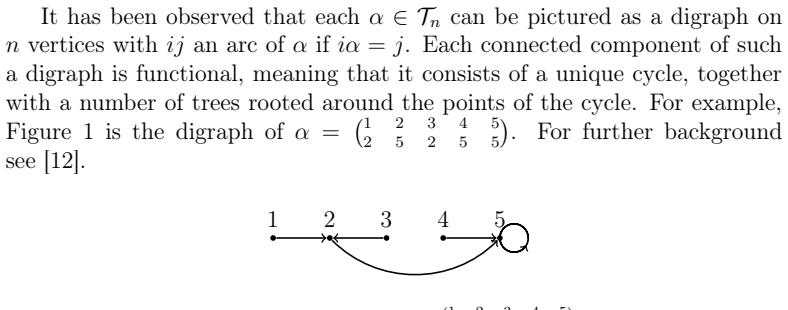

read the original abstract
Let $\mathcal{OP}_n$ be the monoid of all orientation-preserving full transformations on $X_n=\{1,\dots, n\}$ with the natural order. For $\alpha \in \mathcal{OP}_n$, let $F(\alpha)=\{y\in X_n: y\alpha=y\}$ and $F(n,m)=|\{\alpha:|F(\alpha)|=m\}|$. Umar posed the question about the number $F(n,m)$ of elements of $\mathcal{OP}_n$ with $m$ fixed points. In this paper, we show that the number $F(n,m)$ of $\mathcal{OP}_n$ is $\binom{2n}{n-m}$ for $2\leqslant m\leqslant n$ and get the expectation and probability distribution of the cardinality of fixed-point set $F(\alpha)$ for $\alpha\in\mathcal{OP}_n$.
Editorial analysis
A structured set of objections, weighed in public.
Referee Report
Summary. The manuscript defines the monoid OP_n of orientation-preserving full transformations on the ordered set X_n = {1, ..., n}. It introduces F(n,m) as the number of elements with exactly m fixed points and establishes that F(n,m) equals binom(2n, n-m) for 2 ≤ m ≤ n. The paper additionally derives the expectation and the full probability distribution of the cardinality of the fixed-point set for a random element of OP_n.
Significance. If the central enumeration holds, the result supplies an explicit binomial formula for fixed-point counts in this transformation monoid, directly addressing Umar's question and indicating a combinatorial bijection with (n-m)-subsets of a 2n-set. The accompanying expectation and distribution results add probabilistic content of independent interest in combinatorial semigroup theory. The manuscript delivers a clean, closed-form statement together with the derived statistics.
minor comments (3)
- The abstract asserts the binomial formula and the distribution results; a one-sentence indication of the proof technique (bijection, recurrence, or generating function) would improve readability without lengthening the abstract.
- The precise definition of an orientation-preserving full transformation (including how the natural order on X_n is used) should be recalled or restated in the introduction or §2 to ensure the combinatorial argument is self-contained for readers unfamiliar with the literature on OP_n.
- Verify that the cases m = 0 and m = 1 are either shown to be zero or explicitly computed, since the main formula begins at m = 2; this would complete the probability distribution statement.
Simulated Author's Rebuttal
We thank the referee for the careful review and for recommending minor revision. The referee's summary accurately captures the definition of OP_n, the enumeration F(n,m), and the derived expectation and distribution results.
Circularity Check
No significant circularity in the fixed-point count for OP_n
full rationale
The paper defines the monoid OP_n of orientation-preserving full transformations on the ordered set X_n and the counting function F(n,m). It then asserts that F(n,m) equals the binomial coefficient binom(2n, n-m) for 2 ≤ m ≤ n, presented as a direct combinatorial enumeration solving Umar's open question. No equations reduce the claimed count to a fitted parameter, self-referential definition, or load-bearing self-citation; the result follows from the order-preserving property under the natural order without circular reduction to its own inputs. The derivation is self-contained as a standard combinatorial argument.
Axiom & Free-Parameter Ledger
axioms (1)
- standard math Binomial coefficients satisfy the usual identities and count lattice paths or subsets.
Reference graph
Works this paper leans on
-
[1]
P. M. Higgins, Combinatorial results for semigroups of order-preserving mappings,Math. Proc. Camb. Philos. Soc.113(1993) 281–296
1993
-
[2]
Howie, Products of idempotents in certain semigroups of order- preserving transformations,Proc
J. Howie, Products of idempotents in certain semigroups of order- preserving transformations,Proc. Edinburgh Math. Soc.17(1971) 223– 236
1971
-
[3]
G. M. S. Gomes and J. Howie, On the ranks of certain semigroups of order-preserving transformations,Semigroup Forum45(1992) 272–282
1992
-
[4]
P. M. Catarino and P. M. Higgins, The monoid of orientation-perserving mappings on a chain,Semigroup Forum58(1999) 190–206
1999
-
[5]
Laradji and A
A. Laradji and A. Umar, Combinatorial results for semigroups of order- preserving full transformations,Semigroup Forum72(2006) 51–62
2006
-
[6]
G. U. Garba, Nilpotents in semigroups of partial one-to-one order- preserving mappings,Semigroup Forum48(1994) 37–49
1994
-
[7]
Laradji and A
A. Laradji and A. Umar, Combinatorial results for semigroups of order- preserving or order-reversing subpermutations,J. Difference Equ. Appl. 21(2015) 269–283
2015
-
[8]
Umar, Some combinatorial problems in the theory of partial transfor- mation semigroups,Algebra Discrete Math.17(2014) 110–134
A. Umar, Some combinatorial problems in the theory of partial transfor- mation semigroups,Algebra Discrete Math.17(2014) 110–134
2014
-
[9]
Laradji, Fixed points of order-preserving transformations,J
A. Laradji, Fixed points of order-preserving transformations,J. Algebra Appl.21(2022) 2250082
2022
-
[10]
Howie, Fundamentals of Semigroup Theory, Oxford University Press, Oxford, 1995
J. Howie, Fundamentals of Semigroup Theory, Oxford University Press, Oxford, 1995. 12
1995
-
[11]
Riordan, Combinatorial Identities, Wiley, New York, 1968
J. Riordan, Combinatorial Identities, Wiley, New York, 1968
1968
-
[12]
P. M. Higgins, Techniques of Semigroup Theory, Oxford University Press, Oxford, 1992. 13
1992
discussion (0)
Sign in with ORCID, Apple, or X to comment. Anyone can read and Pith papers without signing in.