Recognition: unknown
Wave Vortices Around Oscillating Subwavelength Holes: Water-Wave Observation
Pith reviewed 2026-05-07 12:38 UTC · model grok-4.3
The pith
Combining an oscillating subwavelength hole with an incident plane wave produces type-II wave vortices whose handedness is controlled by their relative phase.
A machine-rendered reading of the paper's core claim, the machinery that carries it, and where it could break.
Core claim
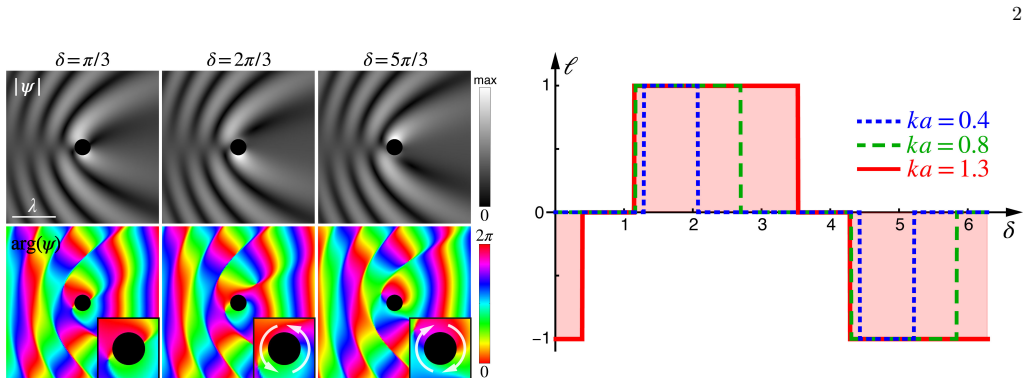
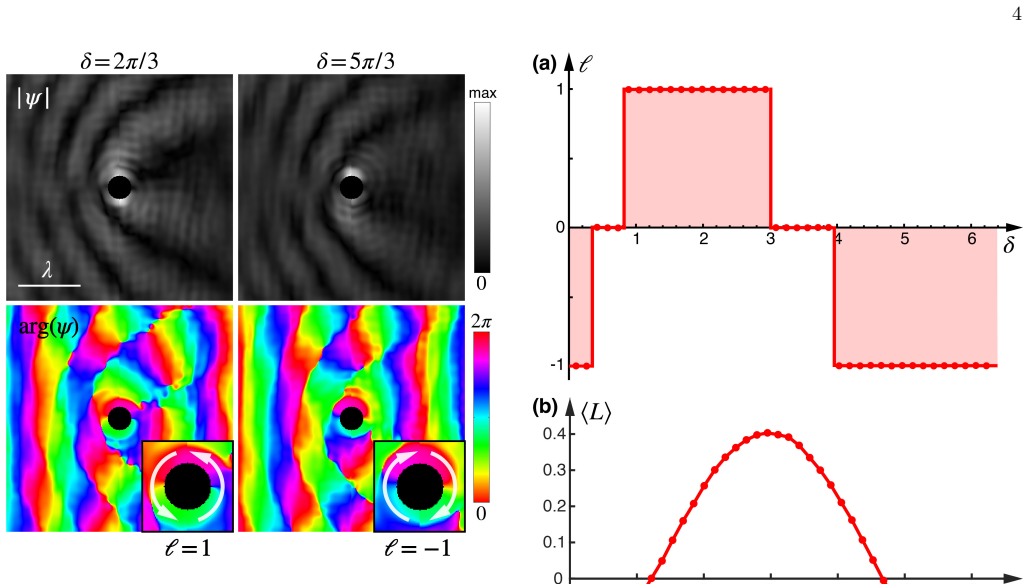
A minimal setup consisting of a dipole-oscillating subwavelength hole and a single incident plane wave generates type-II wave vortices around the hole. The emergence and handedness of these vortices, characterized by a 2π phase increase around the structure, are controlled by the relative phase between the dipolar source and the incident wave. Laboratory observations with gravity-capillary waves confirm the phase structure, topological charge, and wave angular momentum associated with these vortices.
What carries the argument
The relative phase between the dipolar oscillation of the subwavelength hole and the incident plane wave, which determines the superposition leading to the vortex phase winding.
If this is right
- The handedness of the vortex can be switched by changing the relative phase.
- Direct measurement of phase winding, topological charge, and angular momentum is possible in water waves.
- This mechanism applies to electromagnetic, acoustic, and other 2D wave systems.
- It offers a versatile way to engineer subwavelength wave vortices without relying on large-scale effects like Coriolis force.
Where Pith is reading between the lines
- Similar phase control could be used in photonic or acoustic devices to manipulate wave angular momentum at small scales.
- This might provide insight into tidal phenomena around islands by showing that rotation of Earth is not strictly necessary for type-II vortices.
- Extending the setup to active sources could enable dynamic switching of vortex states in real-time applications.
- Testing the robustness against different wave types could lead to universal design principles for 2D wave vortices.
Load-bearing premise
The phase winding measured around the oscillating island truly represents type-II vortices and is not significantly changed by effects from the lab boundaries, water viscosity, or extra resonances in the wave tank.
What would settle it
Repeating the experiment in a much larger wave tank with lower viscosity fluid and observing no phase winding or a winding independent of the source phase would falsify the claim that the relative phase controls genuine type-II vortices.
Figures


read the original abstract
We consider a two-dimensional wave system containing a subwavelength hole, such as an aperture in an interface supporting surface electromagnetic or acoustic waves, or an island in a fluid surface sustaining gravity-capillary waves. Recent studies have revealed the emergence of pronounced wave vortices around such structures, termed type-II vortices, in contrast to conventional (type-I) vortices associated with phase singularities and intensity nulls. A striking natural manifestation of type-II vortices occurs in ocean tides around islands such as New Zealand, Madagascar, and Iceland, where the tidal phase increases by $\pm 2\pi$ around the island. Although this phenomenon is usually associated with the Coriolis effect from the rotation of the Earth, here we demonstrate the controlled generation of type-II vortices using a minimal and tunable setup: a dipole-oscillating subwavelength hole and a single incident plane wave. Using laboratory gravity-capillary waves and an oscillating subwavelength `island', we directly measure the resulting phase structure, topological charge, and wave angular momentum. We show that the emergence and handedness of the vortices can be precisely controlled via the relative phase between the dipolar source and the incident wave. Our results offer a simple and versatile mechanism for engineering subwavelength wave vortices, with potential applications in a variety of two-dimensional wave systems.
Editorial analysis
A structured set of objections, weighed in public.
Referee Report
Summary. The manuscript reports laboratory observations of type-II wave vortices around an oscillating subwavelength island in a gravity-capillary wave tank. A dipole source combined with an incident plane wave produces vortices characterized by ±2π phase winding; the emergence and handedness of these vortices are controlled by the relative phase between the dipolar oscillation and the incident wave. Direct measurements of phase structure, topological charge, and wave angular momentum are presented, along with a connection to natural tidal vortices around islands.
Significance. If the phase windings are confirmed to arise purely from the intended control mechanism, the work supplies a minimal, tunable experimental platform for generating and manipulating subwavelength wave vortices in two-dimensional systems. This has potential relevance across fluid, acoustic, and electromagnetic wave platforms. The direct laboratory measurement of phase winding and handedness control, together with the explicit link to observed natural phenomena, constitutes a concrete strength of the study.
major comments (2)
- [phase-structure measurements and experimental setup] The central claim that vortex handedness is precisely controlled by the relative phase between the dipolar source and incident wave (abstract and results) rests on the observed ±2π phase winding being free of appreciable distortion. In the finite gravity-capillary tank, boundary reflections, viscous damping, and possible unintended resonances can impose additional phase gradients; the manuscript provides no quantitative checks (e.g., tank-size variation, absorber tests, or comparison with unbounded simulations) to rule these out, which directly affects the reliability of the control demonstration.
- [data analysis and angular-momentum calculation] The extraction of topological charge and wave angular momentum from the measured phase fields is presented as direct evidence, yet the precise integration contours, handling of amplitude variations, and any filtering applied to suppress tank-induced gradients are not specified in sufficient detail to allow independent verification of the reported values.
minor comments (2)
- Figure captions should explicitly state the wave frequency, water depth, and surface-tension regime used, as these parameters govern the dispersion relation and are essential for reproducing the subwavelength regime.
- A short paragraph comparing the observed vortex size to the wavelength and to the island diameter would help readers assess the subwavelength character claimed in the title and abstract.
Simulated Author's Rebuttal
We thank the referee for their positive assessment of the significance of our study and for the constructive major comments. We address each point below and have revised the manuscript accordingly to strengthen the presentation of the experimental controls and analysis procedures.
read point-by-point responses
-
Referee: The central claim that vortex handedness is precisely controlled by the relative phase between the dipolar source and incident wave (abstract and results) rests on the observed ±2π phase winding being free of appreciable distortion. In the finite gravity-capillary tank, boundary reflections, viscous damping, and possible unintended resonances can impose additional phase gradients; the manuscript provides no quantitative checks (e.g., tank-size variation, absorber tests, or comparison with unbounded simulations) to rule these out, which directly affects the reliability of the control demonstration.
Authors: We agree that explicit checks against tank artifacts are necessary to support the reliability of the phase-winding control. In the revised manuscript we have added a new paragraph in the experimental methods describing the wave-absorbing boundaries, their calibration, and measured reflection coefficients. We have also included a direct comparison of the experimental phase fields with numerical simulations of the identical dipole-plus-plane-wave configuration in an unbounded domain; the simulated ±2π windings and their dependence on relative phase match the laboratory data closely. A full tank-size variation series was not feasible within the existing facility, but the subwavelength localization of the vortices and the consistency of the observed topological features across multiple realizations indicate that boundary-induced gradients do not alter the reported handedness control. revision: partial
-
Referee: The extraction of topological charge and wave angular momentum from the measured phase fields is presented as direct evidence, yet the precise integration contours, handling of amplitude variations, and any filtering applied to suppress tank-induced gradients are not specified in sufficient detail to allow independent verification of the reported values.
Authors: We thank the referee for noting the lack of procedural detail. The revised manuscript now contains an expanded Data Analysis section that specifies the circular integration contours (centered on the island at a radius of 1.5 times the island diameter), the amplitude-thresholding procedure used to exclude regions below 10 % of the local maximum amplitude, and the two-dimensional low-pass filter applied to the unwrapped phase maps to suppress residual tank-scale gradients. These additions allow independent reproduction of the reported topological charge and angular-momentum values. revision: yes
Circularity Check
No circularity: experimental observation of controlled type-II vortices
full rationale
The paper is an experimental demonstration using laboratory gravity-capillary waves around an oscillating subwavelength island. Central claims rest on direct measurements of phase structure, topological charge, and handedness control via relative phase between dipolar source and incident wave. No derivation chain, equations, or first-principles results are presented that reduce by construction to fitted inputs, self-definitions, or self-citation load-bearing premises. The work is self-contained as an empirical observation; external benchmarks (lab measurements) are independent of any internal fitting or renaming. Minor self-citations, if present, are not load-bearing for the reported results.
Axiom & Free-Parameter Ledger
axioms (1)
- standard math Linear wave equations govern propagation and interference in the two-dimensional gravity-capillary system
Reference graph
Works this paper leans on
-
[1]
Dislocations in wave trains,
J. F. Nye and M. V. Berry, “Dislocations in wave trains,” Proc. R. Soc. Lond. A336, 165 (1974)
1974
-
[2]
Laser beams with screw dislocations in their wave- fronts,
V. Y. Bazhenov, M. V. Vasnetsov, and M. S. Soskin, “Laser beams with screw dislocations in their wave- fronts,” JETP Lett.52, 429–431 (1990)
1990
-
[3]
Rotating waves,
P. H. Ceperley, “Rotating waves,” Am. J. Phys.60, 938 (1992)
1992
-
[4]
Orbital angular momentum of light and the transformation of Laguerre-Gaussian laser modes,
L. Allen, M. W. Beijersbergen, R. J. C. Spereeuw, and J. P. Woerdman, “Orbital angular momentum of light and the transformation of Laguerre-Gaussian laser modes,” Phys. Rev. A45, 8185–8189 (1992)
1992
-
[5]
Allen, S
L. Allen, S. M. Barnett, and M. J. Padgett,Optical Angular Momentum(IoP Publishing, 2003)
2003
-
[6]
J. P. Torres and L. Torner,Twisted Photons: Applica- tions of Light with Orbital Angular Momentum(Wiley- VCH, Weinheim, 2011)
2011
-
[7]
Sin- gular Optics: Optical Vortices and Polarization Singular- ities,
M. R. Dennis, K. O’Holleran, and M. J. Padgett, “Sin- gular Optics: Optical Vortices and Polarization Singular- ities,” Prog. Opt.53, 293 (2009)
2009
-
[8]
An acoustical helicoidal wave transducer with applications for the alignment of ultrasonic and underwater systems,
B. T. Hefner and P. L. Marston, “An acoustical helicoidal wave transducer with applications for the alignment of ultrasonic and underwater systems,” J. Acoust. Soc. Am. 106, 3313–3316 (1999)
1999
-
[9]
A review on acoustic vortices: Generation, characterization, applications and perspectives,
S. Guo, Z. Ya, P. Wu, and M. Wan, “A review on acoustic vortices: Generation, characterization, applications and perspectives,” J. Appl. Phys.132, 3475–3478 (2022)
2022
-
[10]
Study of surface plasmon chirality induced by Archimedes’ spiral grooves,
T. Ohno and S. Miyanishi, “Study of surface plasmon chirality induced by Archimedes’ spiral grooves,” Opt. Express14, 6285–6290 (2006)
2006
-
[11]
Orbital angular momentum in nanoplasmonic vortices,
E. Prinz, M. Hartelt, G. Spektor, M. Orenstein, and M. Aeschlimann, “Orbital angular momentum in nanoplasmonic vortices,” ACS Photonics10, 340–367 (2023)
2023
-
[12]
Theory and applications of free-electron vortex states,
K. Y. Bliokh, I. P. Ivanov, G. Guzzinati, L. Clark, R. Van Boxem, A. B´ ech´ e, R. Juchtmans, M. A. Alonso, P. Schattschneider, F. Nori, and J. Verbeeck, “Theory and applications of free-electron vortex states,” Phys. Rep.690, 1–70 (2017)
2017
-
[13]
Phase sad- dles and dislocations in two-dimensional waves such as the tides,
J. F. Nye, J. V. Hajnal, and J. H. Hannay, “Phase sad- dles and dislocations in two-dimensional waves such as the tides,” Proc. R. Soc. Lond. A417, 7–20 (1988)
1988
-
[14]
Geometry of phase and polarization sin- gularities illustrated by edge diffraction and the tides,
M. V. Berry, “Geometry of phase and polarization sin- gularities illustrated by edge diffraction and the tides,” Proc. SPIE4403, 1–12 (2001)
2001
-
[15]
Water-wave vortices and skyrmions,
D. A. Smirnova, F. Nori, and K. Y. Bliokh, “Water-wave vortices and skyrmions,” Phys. Rev. Lett.132, 054003 (2024)
2024
-
[16]
Topological water-wave structures manipulating particles,
B. Wang, Z. Che, C. Cheng, C. Tong, L. Shi, Y. Shen, K. Y. Bliokh, and J. Zi, “Topological water-wave structures manipulating particles,” Nature638, 394–400 (2025)
2025
-
[17]
Optical vortex generation by three plane wave interference,
J. Masajada and B. Dubik, “Optical vortex generation by three plane wave interference,” Opt. Commun.198, 21–27 (2001)
2001
-
[18]
Phase singularities in isotropic random waves,
M. V. Berry and M. R. Dennis, “Phase singularities in isotropic random waves,” Proc. R. Soc. A456, 2059–2079 (2000)
2059
-
[19]
High-intensity wave vortices around subwavelength holes: From ocean tides to nanooptics,
K. Domina, P. Alonso-Gonz´ alez, A. Bylinkin, M. Barra- Burillo, A. I. F. Tresguerres-Mata, F. Javier Alfaro- Mozaz, S. V´ elez, F. Casanova, L. E. Hueso, R. Hillen- brand, K. Y. Bliokh, and A. Y. Nikitin, “High-intensity wave vortices around subwavelength holes: From ocean tides to nanooptics,” Newton1, 100060 (2025)
2025
-
[20]
D. E. Cartwright,Tides: A Scientific History(Cam- bridge University Press, 1999)
1999
-
[21]
The New Zealand semi- diurnal tide,
J. A. T. Bye and R. A. Heath, “The New Zealand semi- diurnal tide,” J. Mar. Res.33, 423–442 (1975)
1975
-
[22]
Phase distribution of tidal constituents around New Zealand,
R. A. Heath, “Phase distribution of tidal constituents around New Zealand,” New Zeal. J. Mar. Freshw. Res. 11, 383–392 (1977)
1977
-
[23]
A review of the physical oceanography of the seas around New Zealand – 1982,
R. A. Heath, “A review of the physical oceanography of the seas around New Zealand – 1982,” New Zeal. J. Mar. 6 Freshw. Res.19, 79–124 (1985)
1982
-
[24]
Ocean tides around New Zealand,
R. A. Walters, D. G. Goring, and R. G. Bell, “Ocean tides around New Zealand,” New Zeal. J. Mar. Freshw. Res.35, 567–579 (2001)
2001
-
[25]
Physical oceanography of New Zealand/Aotearoa shelf seas – a review,
C. L. Stevens, J. M. O’Callaghan, S. M. Chiswell, and M. G. Hadfield, “Physical oceanography of New Zealand/Aotearoa shelf seas – a review,” New Zeal. J. Mar. Freshw. Res.55, 6–45 (2021)
2021
-
[26]
Plasmonic Aharonov-Bohm effect: Optical spin as the magnetic flux parameter,
Y. Gorodetski, S. Nechayev, V. Kleiner, and E. Has- man, “Plasmonic Aharonov-Bohm effect: Optical spin as the magnetic flux parameter,” Phys. Rev. B82, 125433 (2010)
2010
-
[27]
Ul- trafast generation and control of an electron vortex beam via chiral plasmonic near fields,
G. M. Vanacore, G. Berruto, I. Madan, E. Pomarico, P. Biagioni, R. J. Lamb, D. McGrouther, O. Rein- hardt, I. Kaminer, B. Barwick, H. Larocque, V. Grillo, E. Karimi, F. J. Garc´ ıa de Abajo, and F. Carbone, “Ul- trafast generation and control of an electron vortex beam via chiral plasmonic near fields,” Nat. Mater.18, 573–579 (2019)
2019
-
[28]
Near-field imaging of surface-plasmon vortex- modes around a single elliptical nanohole in a gold film,
C. Triolo, S. Savasta, A. Settineri, S. Trusso, R. Saija, N.R. Agarwal, and S. Patan` e, “Near-field imaging of surface-plasmon vortex- modes around a single elliptical nanohole in a gold film,” Sci. Rep.9, 5320 (2019)
2019
-
[29]
On the trapping of wave energy round islands,
M. S. Longuet-Higgins, “On the trapping of wave energy round islands,” J. Fluid Mech.29, 781–821 (1967)
1967
-
[30]
On the trapping of long-period waves round islands,
M. S. Longuet-Higgins, “On the trapping of long-period waves round islands,” J. Fluid Mech.37, 773–784 (1969)
1969
-
[31]
Earth tides,
P. Melchior, “Earth tides,” Geophys. Surv.1, 275–303 (1974)
1974
-
[32]
Real-time quantitative Schlieren imaging by fast Fourier demodulation of a checkered backdrop,
S. Wildeman, “Real-time quantitative Schlieren imaging by fast Fourier demodulation of a checkered backdrop,” Exp. Fluids59, 97 (2018)
2018
discussion (0)
Sign in with ORCID, Apple, or X to comment. Anyone can read and Pith papers without signing in.