Recognition: unknown
Invariant Sets and Boundary Systems of Nonautonomous Differential Inclusions
Pith reviewed 2026-05-07 10:58 UTC · model grok-4.3
The pith
Nonautonomous differential inclusions correspond uniquely to backward invariant unit normal cones of an associated boundary system of ODEs.
A machine-rendered reading of the paper's core claim, the machinery that carries it, and where it could break.
Core claim
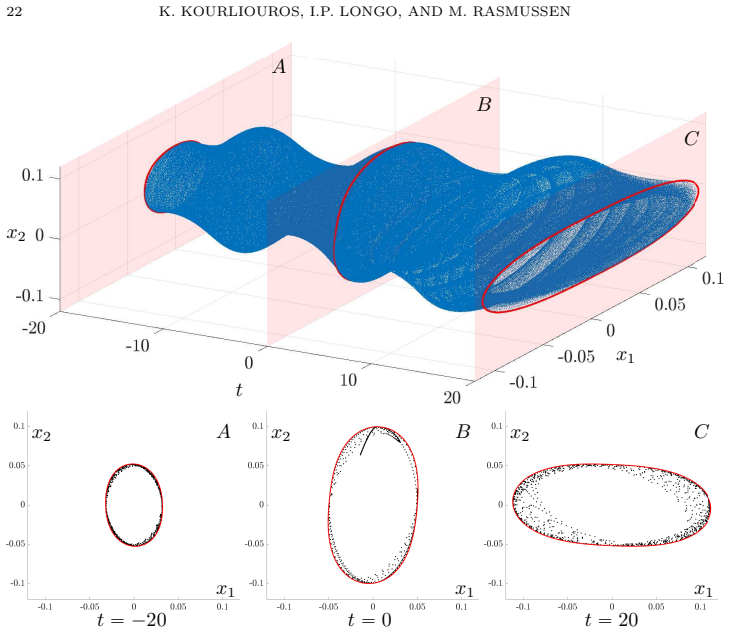
To any nonautonomous differential inclusion we associate a finite-dimensional deterministic system of nonautonomous ordinary differential equations called the boundary system. Invariant sets of the differential inclusion lift in a unique way to backward invariant unit normal cones of the associated boundary system, and these are even invariant if the boundary is smooth. Under the natural assumption of exponential stability for the unperturbed problem, there exists a unique minimal attractor for the differential inclusion with fiberwise strictly convex, closed, and continuously differentiable boundaries, with the unit normal bundle being the pullback attractor.
What carries the argument
The boundary system, a finite-dimensional deterministic system of nonautonomous ODEs associated to the differential inclusion, that carries invariant information via unit normal cones.
If this is right
- Invariant sets of the inclusion lift uniquely to backward invariant unit normal cones of the boundary system.
- The unit normal cones are invariant when the boundary is smooth.
- Under exponential stability, there is a unique minimal attractor for inclusions with fiberwise strictly convex, closed, C1 boundaries.
- The unit normal bundle is the pullback attractor for the skew-product flow associated to the boundary system.
- It extends to the global attractor when the underlying system admits a compact base.
Where Pith is reading between the lines
- This framework could reduce the study of invariant sets in uncertain dynamical systems to standard ODE analysis techniques.
- It may provide new tools for understanding minimal attractors in nonautonomous control systems by focusing on boundary behavior.
- Extensions could involve applying similar boundary systems to stochastic differential inclusions for random attractors.
Load-bearing premise
The boundaries of the sets in the inclusion are fiberwise strictly convex, closed, and continuously differentiable, and the unperturbed problem is exponentially stable.
What would settle it
Constructing a nonautonomous differential inclusion with strictly convex C1 boundaries where an invariant set does not correspond to a unique backward invariant unit normal cone, or where multiple minimal attractors exist despite exponential stability.
Figures
read the original abstract
In this paper we propose a finite-dimensional and deterministic approach to the study of invariant sets of certain nonautonomous differential inclusions naturally arising in the context of random and control dynamical systems, as well as in systems modeling the dynamical propagation of uncertainty. In particular, to any such differential inclusion, we associate a finite-dimensional and deterministic system of nonautonomous ordinary differential equations, which we call the boundary system, due to its following characteristic property: invariant sets of the differential inclusion lift in a unique way to backward invariant unit normal cones of the associated boundary system, and these are even invariant if the boundary is smooth. We further illustrate the strength of this approach in the study of minimal attractors of nonautonomous linear differential inclusions. Under the natural assumption of exponential stability for the unperturbed problem, we establish existence and uniqueness of a minimal attractor for the differential inclusion with fiberwise strictly convex, closed, and continuously differentiable boundaries. We also show that the unit normal bundle is in fact the pullback attractor for the skew-product flow associated to the boundary system which extends to the global attractor when the underlying admits a compact base.
Editorial analysis
A structured set of objections, weighed in public.
Referee Report
Summary. The paper associates a finite-dimensional deterministic 'boundary system' of nonautonomous ODEs to certain nonautonomous differential inclusions. It claims that invariant sets of the inclusion lift uniquely to backward-invariant unit normal cones of this boundary system (invariant when the boundary is smooth). Under exponential stability of the unperturbed linear system, for inclusions with fiberwise strictly convex, closed, C¹ boundaries, it establishes existence and uniqueness of a minimal attractor, with the unit normal bundle being the pullback attractor for the skew-product flow (extending to the global attractor on a compact base).
Significance. If the correspondence and attractor results hold, the boundary-system reduction supplies a concrete deterministic finite-dimensional tool for analyzing invariant sets and minimal attractors in set-valued nonautonomous dynamics. This is potentially useful for random dynamical systems, control problems, and uncertainty propagation, as it converts set-valued questions into standard ODE questions on normal cones under the stated convexity and stability hypotheses.
minor comments (3)
- The abstract states that 'the unit normal bundle is in fact the pullback attractor'; please add a forward reference to the precise theorem number and any required hypotheses on the base space in the introduction or statement of results.
- The phrase 'the underlying admits a compact base' is unclear; specify whether 'underlying' refers to the driving system, the skew-product base, or another object.
- Consider adding a low-dimensional illustrative example (e.g., a planar linear inclusion) early in the paper to show explicitly how the boundary system is constructed from the inclusion and how the normal-cone correspondence appears.
Simulated Author's Rebuttal
We thank the referee for their careful summary of our manuscript and for recognizing the potential utility of the boundary-system approach for studying invariant sets and minimal attractors in nonautonomous differential inclusions. We are pleased with the recommendation for minor revision and will prepare a revised version accordingly. As no specific major comments were listed in the report, we have no point-by-point rebuttals to provide at this stage.
Circularity Check
No significant circularity in the derivation chain
full rationale
The paper constructs the boundary system explicitly from the given differential inclusion and then derives the lifting property for invariant sets and the correspondence with normal cones as a stated characteristic of that construction. Under the external assumptions of exponential stability and fiberwise strict convexity with C1 boundaries, existence/uniqueness of the minimal attractor and identification of the unit normal bundle as pullback attractor are obtained via standard skew-product arguments on the extended flow; none of these steps reduces by definition or by self-citation to the input data or to a fitted quantity. The derivation therefore remains self-contained against the stated hypotheses.
Axiom & Free-Parameter Ledger
axioms (1)
- standard math Standard existence and uniqueness results for nonautonomous ODEs and differential inclusions hold under the stated regularity (C1 boundaries, exponential stability).
invented entities (1)
-
Boundary system
no independent evidence
Reference graph
Works this paper leans on
-
[1]
Adrianova, Introduction to linear systems of differential equations , Translations of math- ematical monographs, (1995)
L. Adrianova, Introduction to linear systems of differential equations , Translations of math- ematical monographs, (1995)
1995
-
[2]
Anagnostopoulou, C
V. Anagnostopoulou, C. P ¨otzsche, and M. Rasmussen , Nonautonomous bifurcation the- ory, in Concepts and tools, vol. 10, Springer, 2023
2023
-
[3]
Arnold , Random dynamical systems , Springer-Verlag Berlin Heidelberg, 1998
L. Arnold , Random dynamical systems , Springer-Verlag Berlin Heidelberg, 1998. 24 K. KOURLIOUROS, I.P. LONGO, AND M. RASMUSSEN
1998
-
[4]
Ashwin, S
P. Ashwin, S. Wieczorek, R. Vitolo, and P. Cox , Tipping points in open systems: bi- furcation, noise-induced and rate-dependent examples in t he climate system , Philosophical Transactions of the Royal Society A: Mathematical, Physica l and Engineering Sciences, 370 (2012), pp. 1166–1184
2012
-
[5]
Aubin and A
J.-P. Aubin and A. Cellina , Differential Inclusions Set-Valued Maps and Viability Theo ry, Springer-Verlag Berlin Heidelberg, 1984
1984
-
[6]
H. T. Banks, H. Shuhua, and W. C. Thomson , Modeling and inverse problems in the presence of uncertainty , CRC Press, Taylor and Francis Group, 2014
2014
-
[7]
Bressan and B
A. Bressan and B. Piccoli , Introduction to the mathematical theory of control , vol. 1, American institute of mathematical sciences Springfield, 2 007
-
[8]
Carvalho, J
A. Carvalho, J. A. Langa, and J. Robinson , Attractors for infinite-dimensional non- autonomous dynamical systems , vol. 182, Springer Science & Business Media, 2012
2012
-
[9]
P. Catuogno, A. d. N. Oliveira-Sousa, and P. Ruffino , Minimal jointly uniform attractor for nonautonomous random dynamical systems , arXiv preprint arXiv:2511.22784, (2025)
-
[10]
Chappelle , Rate-induced phenomena in oscillatory and random dynamica l systems , PhD thesis, Imperial College London, 2023
G. Chappelle , Rate-induced phenomena in oscillatory and random dynamica l systems , PhD thesis, Imperial College London, 2023
2023
-
[11]
D. N. Cheban, P. E. Kloeden, and B. Schmalfuß , The relationship between pullback, forwards and global attractors of nonautonomous dynamical systems, Nonlinear Dyn. Syst. Theory, 2 (2002), pp. 125–144
2002
-
[12]
Clarke , The Pontryagin maximum principle and a unified theory of dyna mic optimiza- tion, Proceedings of the Steklov Institute of Mathematics, 268 ( 2010), pp
F. Clarke , The Pontryagin maximum principle and a unified theory of dyna mic optimiza- tion, Proceedings of the Steklov Institute of Mathematics, 268 ( 2010), pp. 58–69
2010
-
[13]
Colonius and W
F. Colonius and W. Kliemann , The Dynamics of Control , Springer Science & Business Media, 2012
2012
-
[14]
Cui and J
H. Cui and J. A. Langa , Uniform attractors for non-autonomous random dynamical sy s- tems, Journal of Differential Equations, 263 (2017), pp. 1225–12 68
2017
-
[15]
Deimling , Multivalued differential equations , vol
K. Deimling , Multivalued differential equations , vol. 1, W alter de Gruyter, 2011
2011
-
[16]
Due ˜nas, I
J. Due ˜nas, I. P. Longo, and R. Obaya , Rate-induced tracking for concave or d-concave transitions in a time-dependent environment with applicat ion in ecology , Chaos: An Inter- disciplinary Journal of Nonlinear Science, 33 (2023)
2023
-
[17]
Due ˜nas, C
J. Due ˜nas, C. N ´u˜nez, and R. Obaya , Critical transitions in d-concave nonautonomous scalar ordinary differential equations appearing in popula tion dynamics , SIAM Journal on Applied Dynamical Systems, 22 (2023), pp. 2649–2692
2023
- [18]
-
[19]
, Critical transitions for asymptotically concave or d-conc ave nonautonomous differ- ential equations with applications in ecology , Journal of Nonlinear Science, 34 (2024), p. 105
2024
-
[20]
A. M. Fink , Almost periodic differential equations , vol. 377, Springer, 2006
2006
-
[21]
Gayer, Control sets and their boundaries under parameter variatio n, Journal of differen- tial equations, 201 (2004), pp
T. Gayer, Control sets and their boundaries under parameter variatio n, Journal of differen- tial equations, 201 (2004), pp. 177–200
2004
-
[22]
1361–1375
, Controllability and invariance properties of time-period ic systems , International jour- nal of bifurcations and Chaos, 15 (2005), pp. 1361–1375
2005
-
[23]
J. K. Hale , Ordinary differential equations , Courier Corporation, 2009
2009
-
[24]
A. J. Homburg and T. R. Young , Bifurcations of random differential equations with bounded noise on surfaces , Topological methods in nonlinear analysis, 35 (2010), pp. 77– 79
2010
-
[25]
A. J. Homburg, T. R. Young, and M. Gharaei , Bifurcations of random differential equa- tions with bounded noise , in Bounded Noises in Physics, Biology and Engineering, Spr inger Nature, 2013
2013
-
[26]
A. J. Homgurg and T. R. Young , Hard bifurcations in dynamical systems with random bounded perturbations, Regular and Chaotic Dynamics, 11 (2006), pp. 247–258
2006
-
[27]
P. E. Kloeden and P. Mar ´ın-Rubio, Negatively invariant sets and entire trajectories of set-valued dynamical systems , Set-Valued and Variational Analysis, 19 (2011), pp. 43–57
2011
-
[28]
K. Kourliouros, J. S. Lamb, M. Rasmussen, W. Tey, K. Timperi, and D. Turaev , Smooth persistence of attractors for set-valued dynamical systems: a boundary map approach , arXiv preprint arXiv:2303.01895, (2025)
-
[29]
K. Kourliouros, J. S. Lamb, M. Rasmussen, and W. H. Tey , Attractors of linear maps with bounded noise , arXiv preprint arXiv:2310.03437, (2026). INV ARIANT SETS OF DIFFERENTIAL INCLUSIONS – BOUNDARY SYSTE MS 25
-
[30]
Kuehn and I
C. Kuehn and I. P. Longo , Estimating rate-induced tipping via asymptotic series and a Melnikov-like method , Nonlinearity, 35 (2022), p. 2559
2022
-
[31]
J. S. Lamb, M. Rasmussen, and W. H. Tey , Bifurcations of the H´ enon map with additive bounded noise, To appear in SIAM Journal on Applied Dynamical Systems, (20 25)
-
[32]
J. W. S. Lamb, M. Rasmussen, and C. Rodrigues , Topological bifurcations of minimal invariant sets for set-valued dynamical systems , Proceedings of the A. M. S., 143 (2015), pp. 3927–3937
2015
-
[33]
E. L. Lee and L. Markus , Foundations of optimal control theory , Robert E. Krieger Pub- lishing Company, 1986
1986
-
[34]
Li and B
D. Li and B. W ang , Pullback measure attractors for non-autonomous stochasti c reaction- diffusion equations on thin domains , Journal of Differential Equations, 397 (2024), pp. 232– 261
2024
-
[35]
I. P. Longo , Topologies of continuity for Carath´ eodory differential eq uations with applica- tions in non-autonomous dynamics , (2018)
2018
-
[36]
I. P. Longo, S. Novo, and R. Obaya , Topologies of llocp type for Carath´ eodory functions with applications in non-autonomous differential equation s, Journal of Differential Equations, 263 (2017), pp. 7187–7220
2017
-
[37]
1617–1651
, Weak topologies for Carath´ eodory differential equations: continuous dependence, ex- ponential dichotomy and attractors , Journal of Dynamics and Differential Equations, 31 (2019), pp. 1617–1651
2019
-
[38]
I. P. Longo, C. N ´u˜nez, and R. Obaya , Critical transitions for scalar nonautonomous systems with concave nonlinearities: some rigorous estima tes, Nonlinearity, 37 (2024), p. 045017
2024
-
[39]
2153– 2192
, Critical transitions in piecewise uniformly continuous co ncave quadratic ordinary differential equations , Journal of Dynamics and Differential Equations, 36 (2024), pp. 2153– 2192
2024
-
[40]
I. P. Longo, C. N ´unez, R. Obaya, and M. Rasmussen , Rate-induced tipping and saddle- node bifurcation for quadratic differential equations with nonautonomous asymptotic dynam- ics, SIAM Journal on Applied Dynamical Systems, 20 (2021), pp. 5 00–540
2021
-
[41]
S. J. Losajiewicz , The sufficiency of the maximum primciple , Ast´ erisque, 75–76 (1980), pp. 187–197
1980
-
[42]
L. S. Pontryagin, V. G. Boltyanskii, R. V. Gamkrelidze, and E. F . Mishchenko , The mathematical theory of optimal processes , John Wiley and Sons, London, UK, 1962
1962
-
[43]
W. H. Tey , On Minimal Invariant Sets of Certain Set-Valued Dynamical S ystems: A Bound- ary Map Approach , PhD Thesis, Imperial College London, 2022. Email address , Konstantinos Kourliouros: k.kourliouros10@imperial.ac.uk Email address , Iacopo P. Longo: i.longo@exeter.ac.uk Email address , Martin Rasmussen: m.rasmussen@imperial.ac.uk (K. Kourliouros) I...
2022
discussion (0)
Sign in with ORCID, Apple, or X to comment. Anyone can read and Pith papers without signing in.