Recognition: no theorem link
The Nesting Bird Box Problem is ER-complete: Sharp Hardness Results for the Hidden Set Problem
Pith reviewed 2026-05-14 21:24 UTC · model grok-4.3
The pith
The Nesting Bird Box problem of placing k mutually invisible points in a polygonal domain is ER-complete.
A machine-rendered reading of the paper's core claim, the machinery that carries it, and where it could break.
Core claim
The central claim is that the Nesting Bird Box problem is ER-complete. Given a polygonal domain P (possibly with holes) and integer k, the task is to decide whether there exists a set B of k points inside P such that no two points in B see each other. Two points a and b see each other when the open segment ab intersects neither the exterior of P nor any vertex of P. The proof proceeds by polynomial-time reduction from known ER-complete problems, constructing domains with holes whose visibility constraints encode exactly the solution set of the original polynomial system.
What carries the argument
A reduction from ER-complete polynomial satisfiability to the hidden-set decision problem that encodes real solutions as sets of mutually invisible points inside a polygonal domain with holes.
If this is right
- The hidden-set problem remains ER-complete even when the input is restricted to polygonal domains with holes.
- Exact computation of the maximum number of mutually invisible points is ER-hard.
- The same reduction technique yields ER-completeness for the decision version of the problem for every fixed k at least some constant.
- No algorithm running in time polynomial in the input size and the bit length of the coordinates can solve the problem unless the existential theory of the reals itself lies in P.
Where Pith is reading between the lines
- The same style of reduction may extend to other visibility-based selection problems such as maximum independent sets in visibility graphs of polygons with holes.
- Allowing holes appears to simplify the construction of exact encodings for real-algebraic constraints compared with simple polygons.
- The result suggests that approximation versions of the hidden-set problem may still be NP-hard even when the exact version sits in ER.
Load-bearing premise
The reduction from known ER-complete problems constructs polygonal domains with holes whose visibility constraints exactly encode the original polynomial system without introducing extraneous solutions or visibility artifacts.
What would settle it
An explicit polynomial system that has a real solution together with the corresponding constructed polygon instance that admits no valid set of k mutually invisible points (or vice versa) would show the reduction fails.
Figures


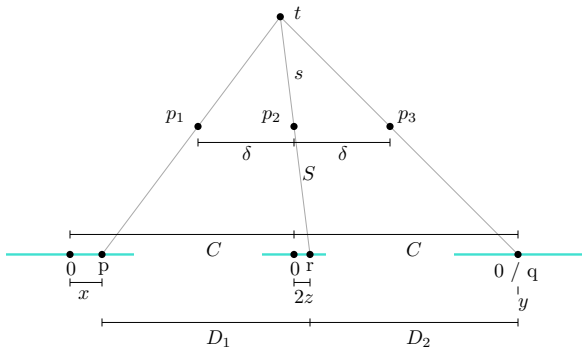
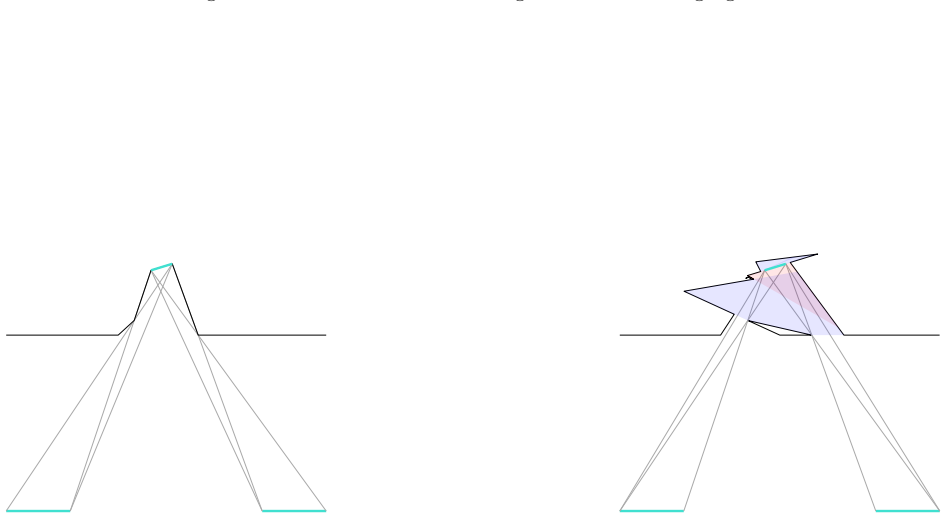
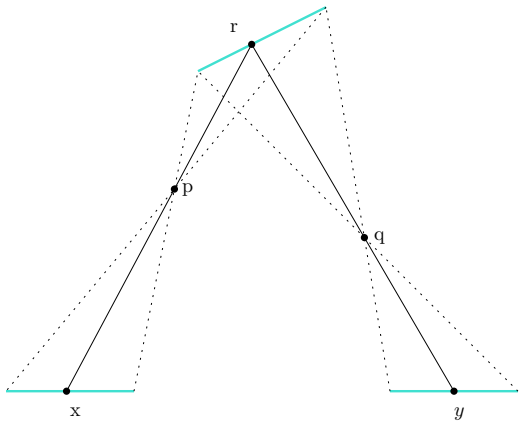
read the original abstract
In the (Nesting) Bird Box Problem we are given a polygonal domain P and a number k and we want to know if there is a set B of k points inside P such that no two points in B can see each other. The underlying idea is that each point represents a birdhouse and many birds only use a birdhouse if there is no other occupied birdhouse in its vicinity. We say two points a,b see each other if the open segment ab intersects neither the exterior of P nor any vertex of P. We show that the Nesting Bird Box problem is ER-complete. The complexity class ER can be defined by the set of problems that are polynomial time equivalent to finding a solution to the equation $p(x) = 0$, with $x\in R^n$ and $p\in $Z[X_1,...,X_n]$. The proof builds on the techniques developed in the original ER-completeness proof of the Art Gallery problem. However our proof is significantly shorter for two reasons. First, we can use recently developed tools that were not available at the time. Second, we consider polygonal domains with holes instead of simple polygons.
Editorial analysis
A structured set of objections, weighed in public.
Referee Report
Summary. The paper proves that the Nesting Bird Box problem—given a polygonal domain P (with holes) and integer k, decide if there exists a hidden set of k mutually invisible points inside P—is ER-complete. Visibility is defined via open segments that intersect neither the exterior of P nor any vertex. The proof is a many-one reduction from known ER-complete problems (e.g., deciding real solutions to polynomial systems p(x)=0), and is claimed to be significantly shorter than the prior ER-completeness proof for the Art Gallery problem by exploiting holes and recently developed tools.
Significance. If the reduction holds, the result supplies sharp ER-completeness for the hidden-set problem in domains with holes, extending the line of work on visibility problems begun with the Art Gallery ER-completeness result. The use of holes and modern tools to shorten the argument is a technical contribution; the paper also supplies a clean, falsifiable geometric encoding of algebraic constraints.
major comments (2)
- [§3] §3 (Reduction from ER-complete polynomial systems): the central claim requires that the hole-based gadgets enforce exactly the algebraic constraints without extraneous hidden-set solutions. The construction must be shown to block all unintended lines of sight that could place mutually invisible points failing to satisfy p(x)=0; the manuscript should supply an explicit case analysis or invariant (e.g., for each gadget type) proving the “only if” direction.
- [§3.2] §3.2 (Gadget definitions): because holes are used (unlike the simple-polygon Art Gallery reduction), any hole geometry that permits a line of sight “around” a constraint gadget would falsify the equivalence. The paper must verify that the chosen hole placements and vertex placements eliminate such artifacts for every variable and equation gadget.
minor comments (2)
- [Abstract] Abstract and §1: the visibility definition (“open segment ab intersects neither the exterior of P nor any vertex”) should explicitly state whether the segment may touch the boundary of P at non-vertex points; this affects the precise notion of “hidden.”
- [§4] §4 (Conclusion): the statement that the proof is “significantly shorter” would be strengthened by a brief comparison table or paragraph quantifying the number of gadgets or lemmas versus the prior Art Gallery proof.
Simulated Author's Rebuttal
We thank the referee for the careful reading and constructive feedback. The comments highlight the need for more explicit verification of the gadget correctness in the reduction. We address each point below and will revise the manuscript to strengthen the proof of equivalence.
read point-by-point responses
-
Referee: [§3] §3 (Reduction from ER-complete polynomial systems): the central claim requires that the hole-based gadgets enforce exactly the algebraic constraints without extraneous hidden-set solutions. The construction must be shown to block all unintended lines of sight that could place mutually invisible points failing to satisfy p(x)=0; the manuscript should supply an explicit case analysis or invariant (e.g., for each gadget type) proving the “only if” direction.
Authors: We agree that an explicit case analysis strengthens the 'only if' direction. The holes are placed to intersect any potential bypassing segment, but the manuscript's current argument is somewhat implicit. In the revision we will add a new subsection to §3 containing an invariant for each gadget type (variable, equation, and auxiliary), proving that any hidden set of size k must encode a real solution to p(x)=0. The argument proceeds by contradiction: any extraneous mutually invisible point would require a visibility segment crossing a hole boundary or vertex, which is forbidden by definition. revision: yes
-
Referee: [§3.2] §3.2 (Gadget definitions): because holes are used (unlike the simple-polygon Art Gallery reduction), any hole geometry that permits a line of sight “around” a constraint gadget would falsify the equivalence. The paper must verify that the chosen hole placements and vertex placements eliminate such artifacts for every variable and equation gadget.
Authors: The construction deliberately positions holes in convex position relative to each gadget so that any line of sight attempting to circumvent a constraint must intersect either the exterior of P or a vertex. We will expand §3.2 in the revision with a short geometric verification for every variable and equation gadget, showing that the chosen vertex coordinates and hole boundaries block all such artifacts. This verification uses only elementary convex geometry and does not lengthen the overall proof substantially. revision: yes
Circularity Check
No circularity: standard many-one reduction from known ER-complete problems
full rationale
The paper establishes ER-completeness of the Nesting Bird Box problem via an explicit polynomial-time reduction that constructs polygonal domains with holes whose visibility relations encode an arbitrary polynomial system p(x)=0. The derivation chain relies on geometric gadgets and visibility constraints that are defined independently of the target result; the proof cites prior ER-completeness results for Art Gallery (with holes) and uses recently developed tools, but does not reduce any equation, parameter, or central claim back to a fit or self-citation that is itself defined by the present result. The argument is self-contained against external benchmarks and contains no self-definitional, fitted-prediction, or load-bearing self-citation steps.
Axiom & Free-Parameter Ledger
axioms (2)
- standard math Visibility is defined by open line segments that intersect neither the exterior of the polygon nor any vertex.
- domain assumption Polynomial-time reductions from known ER-complete problems can be realized by constructing polygonal gadgets with holes that enforce exact visibility constraints.
Reference graph
Works this paper leans on
-
[1]
The art gallery problem is ∃R-complete
[AAM18] Mikkel Abrahamsen, Anna Adamaszek, and Tillmann Miltzow. The art gallery problem is ∃R-complete. InSTOC’18—Proceedings of the 50th Annual ACM SIGACT Symposium on Theory of Computing, pages 65–73. ACM, New York, 2018.doi:10.1145/3188745.3188868. [AAM22] Mikkel Abrahamsen, Anna Adamaszek, and Tillmann Miltzow. The art gallery problem is ∃R-complete....
-
[2]
Covering polygons is even harder
[Abr22] Mikkel Abrahamsen. Covering polygons is even harder. In2021 IEEE 62nd Annual Symposium on Foundations of Computer Science—FOCS 2021, pages 375–386. IEEE Computer Soc., Los Alamitos, CA, 2022.doi:10.1109/FOCS52979.2021.00045. [AKM21] Mikkel Abrahamsen, Linda Kleist, and Tillmann Miltzow. Training neural networks is er- complete. InAdvances in Neura...
-
[3]
[AKM23] Mikkel Abrahamsen, Linda Kleist, and Tillmann Miltzow
URL:https://proceedings.neurips.cc/paper/2021/hash/ 9813b270ed0288e7c0388f0fd4ec68f5-Abstract.html. [AKM23] Mikkel Abrahamsen, Linda Kleist, and Tillmann Miltzow. Geometric embeddability of com- plexes is∃R-complete. In39th International Symposium on Computational Geometry, volume 258 ofLIPIcs. Leibniz Int. Proc. Inform., pages Art. No. 1,
work page 2021
-
[4]
Schloss Dagstuhl. Leibniz-Zent. Inform., Wadern, 2023.doi:10.4230/lipics.socg.2023.1. [BCHM07] Antonio L Bajuelos, Santiago Canales, Gregorio Hern´ andez, and Ana Mafalda Martins. Solving some combinatorial problems in grid n-ogons. InProceedings of the 7th International Confer- ence on Applied Computer Science (ACS’07), volume 7, pages 151–156,
-
[5]
Twin-width viii: delineation and win-wins.arXiv preprint arXiv:2204.00722,
[BCK+22] ´Edouard Bonnet, Dibyayan Chakraborty, Eun Jung Kim, Noleen K¨ ohler, Raul Lopes, and St´ ephan Thomass´ e. Twin-width viii: delineation and win-wins.arXiv preprint arXiv:2204.00722,
-
[6]
Karp.doi:10.1007/ 978-1-4612-0701-6
With a foreword by Richard M. Karp.doi:10.1007/ 978-1-4612-0701-6. [BEMM+22] Daniel Bertschinger, Nicolas El Maalouly, Tillmann Miltzow, Patrick Schnider, and Simon Weber. Topological art in simple galleries. In Karl Bringmann and Timothy M. Chan, editors, 5th Symposium on Simplicity in Algorithms, SOSA@SODA 2022, Virtual Conference, January 10-11, 2022, ...
-
[7]
A catalog of∃R-complete decision problems about nash equilibria in multi-player games
[BM16] Vittorio Bil` o and Marios Mavronicolas. A catalog of∃R-complete decision problems about nash equilibria in multi-player games. In Nicolas Ollinger and Heribert Vollmer, editors,33rd Symposium on Theoretical Aspects of Computer Science, STACS 2016, February 17-20, 2016, Orl´ eans, France, volume 47 ofLIPIcs, pages 17:1–17:13. Schloss Dagstuhl - Lei...
work page 2016
-
[8]
An Overview of Minimum Convex Cover and Maximum Hidden Set
URL:https://doi.org/10.4230/LIPIcs.STACS.2016.17,doi:10.4230/ LIPICS.STACS.2016.17. 22 [Bro24] Reilly Browne. An overview of minimum convex cover and maximum hidden set.arXiv preprint arXiv:2403.01354,
work page internal anchor Pith review Pith/arXiv arXiv doi:10.4230/lipics.stacs.2016.17 2016
-
[9]
Springer-Verlag, Berlin, 1989.doi:10.1007/BFb0089253
[BS89] J¨ urgen Bokowski and Bernd Sturmfels.Computational synthetic geometry, volume 1355 of Lecture Notes in Mathematics. Springer-Verlag, Berlin, 1989.doi:10.1007/BFb0089253. [Can88a] John Canny.The complexity of robot motion planning, volume 1987 ofACM Doctoral Disser- tation Awards. MIT Press, Cambridge, MA,
-
[10]
[CFM+18] Jean Cardinal, Stefan Felsner, Tillmann Miltzow, Casey Tompkins, and Birgit Vogtenhuber
ACM.doi:10.1145/62212.62257. [CFM+18] Jean Cardinal, Stefan Felsner, Tillmann Miltzow, Casey Tompkins, and Birgit Vogtenhuber. Intersection graphs of rays and grounded segments.J. Graph Algorithms Appl., 22(2):273–295, 2018.doi:10.7155/jgaa.00470. [CH17] Jean Cardinal and Udo Hoffmann. Recognition and complexity of point visibility graphs. Discrete Comput...
-
[11]
[DHM19] Michael Gene Dobbins, Andreas F. Holmsen, and Tillmann Miltzow. A universality theorem for nested polytopes.CoRR, abs/1908.02213, 2019.arXiv:1908.02213. [EHP06] Alon Efrat and Sariel Har-Peled. Guarding galleries and terrains.Information Processing Letters, 100(6):238–245,
-
[12]
URL:https://www.sciencedirect.com/science/article/ pii/S0020019006001359,doi:10.1016/j.ipl.2006.05.014. [Eid99] Stephan Eidenbenz. How many people can hide in a terrain?Lecture Notes in Computer Science, pages 184–194,
-
[13]
Inapproximability of finding maximum hidden sets on polygons and ter- rains.Comput
[Eid02] Stephan Eidenbenz. Inapproximability of finding maximum hidden sets on polygons and ter- rains.Comput. Geom., 21(3):139–153, 2002.doi:10.1016/S0925-7721(01)00029-3. [Eid06] Stephan Eidenbenz. Finding minimum hidden guard sets in polygons—tight approximability results.Computational Geometry, 34(2):49–57,
-
[14]
Smoothing the gap between NP and ER
[EvdHM20] Jeff Erickson, Ivor van der Hoog, and Tillmann Miltzow. Smoothing the gap between NP and ER. In2020 IEEE 61st Annual Symposium on Foundations of Computer Science, pages 1022–1033. IEEE Computer Soc., Los Alamitos, CA, 2020.doi:10.1137/20M1385287. [Fis78] Steve Fisk. A short proof of Chv´ atal’s watchman theorem.J. Comb. Theory, Ser. B, 24(3):374,
-
[15]
URL:http://dx.doi.org/10.1016/0095-8956(78)90059-X,doi:10.1016/ 0095-8956(78)90059-X. [FKM+23] Henry F¨ orster, Philipp Kindermann, Tillmann Miltzow, Irene Parada, Soeren Terziadis, and Birgit Vogtenhuber. Geometric thickness of multigraphs is∃R-complete.CoRR, abs/2312.05010, 2023.arXiv:2312.05010,doi:10.48550/arXiv.2312.05010. [HM21] Simon B. Hengeveld a...
-
[16]
Intersection graphs of segments.J
[KM94] Jan Kratochv´ ıl and Jiˇ r´ ı Matouˇ sek. Intersection graphs of segments.J. Combin. Theory Ser. B, 62(2):289–315, 1994.doi:10.1006/jctb.1994.1071. [LMM18] Anna Lubiw, Tillmann Miltzow, and Debajyoti Mondal. The complexity of drawing a graph in a polygonal region. InGraph Drawing and Network Visualization: 26th International Symposium, GD 2018, Bar...
-
[17]
Intersection graphs of segments and $\exists\mathbb{R}$
[LMM22] Anna Lubiw, Tillmann Miltzow, and Debajyoti Mondal. The complexity of drawing a graph in a polygonal region.J. Graph Algorithms Appl., 26(4):421–446, 2022.doi:10.7155/jgaa.00602. [Mat14] Jiˇ r´ ı Matouˇ sek. Intersection graphs of segments and∃R.CoRR, abs/1406.2636, 2014.arXiv: 1406.2636. [Mil26] Tillmann Miltzow. Beyond bits: An introduction to c...
work page internal anchor Pith review Pith/arXiv arXiv doi:10.7155/jgaa.00602 2022
-
[18]
URL: https://arxiv.org/abs/2603.29427,arXiv:2603.29427. [Mn¨ e88] N. E. Mn¨ ev. The universality theorems on the classification problem of configuration varieties and convex polytopes varieties. InTopology and geometry—Rohlin Seminar, volume 1346 of Lecture Notes in Math., pages 527–543. Springer, Berlin, 1988.doi:10.1007/BFb0082792. [MS24] Tillmann Miltz...
-
[19]
URL:https: //api.semanticscholar.org/CorpusID:118947850. [Shi17] Yaroslav Shitov. The nonnegative rank of a matrix: hard problems, easy solutions.SIAM Rev., 59(4):794–800, 2017.doi:10.1137/16M1080999. [Sho91] Peter W. Shor. Stretchability of pseudolines is NP-hard. InApplied geometry and discrete mathematics, volume 4 ofDIMACS Ser. Discrete Math. Theoret....
-
[20]
[vdZBL23] Benito van der Zander, Markus Bl¨ aser, and Maciej Liskiewicz
doi:10.48550/arXiv.2210.12817. [vdZBL23] Benito van der Zander, Markus Bl¨ aser, and Maciej Liskiewicz. The hardness of reasoning about probabilities and causality.CoRR, abs/2305.09508, 2023.doi:10.48550/arXiv.2305.09508. [Zha92] Xiao-Dong Zhang. Complexity of neural network learning in the real number model. In Workshop on Physics and Computation, pages ...
discussion (0)
Sign in with ORCID, Apple, or X to comment. Anyone can read and Pith papers without signing in.