Recognition: unknown
Coexistence of two distinct rogue wave patterns in the coupled nonlinear Schr\"odinger equation
Pith reviewed 2026-05-07 11:31 UTC · model grok-4.3
The pith
High-order rogue wave solutions of the coupled nonlinear Schrödinger equation contain two separate regions each hosting a different type of fundamental rogue wave.
A machine-rendered reading of the paper's core claim, the machinery that carries it, and where it could break.
Core claim
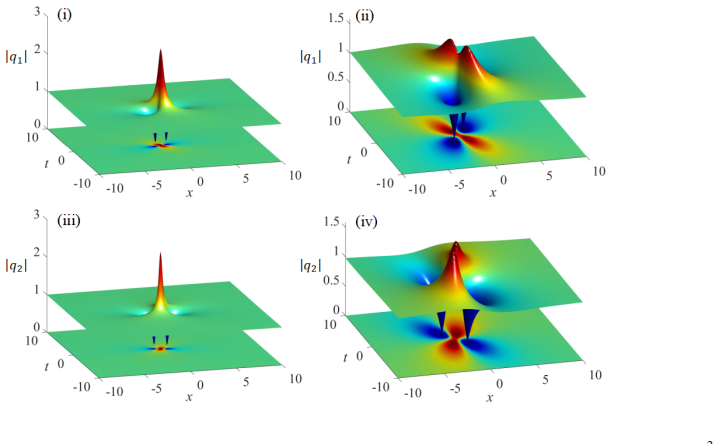
The asymptotic behavior of high-order vector rogue wave solutions with multiple large internal parameters in the coupled nonlinear Schrödinger equation produces new patterns including double-sector, double-heart, and mixed sector-heart forms. Each of these patterns has two distinct regions where two different fundamental first-order rogue waves coexist, taking bright eye-shaped, four-petaled, or dark anti-eye-shaped appearances. The regions correspond to the simple root structures of two different polynomials, with the waves in each region matching the roots one-to-one. Tuning free parameters shifts the two regions to any chosen locations in the space-time plane.
What carries the argument
The mapping of fundamental first-order rogue wave positions to the simple roots of two different polynomials, which organizes the coexistence of distinct wave types in separate regions of the high-order solution.
If this is right
- New structured patterns such as double-sector and double-heart rogue waves can be constructed systematically.
- The two coexistence regions can be positioned independently at arbitrary locations by adjusting free parameters.
- A wider variety of rogue wave patterns becomes available through the different root arrangements of the polynomials.
- Each region features well-separated first-order waves corresponding directly to the individual roots.
Where Pith is reading between the lines
- If this structure holds, similar dual-region patterns may appear in other coupled wave systems in physics.
- Tuning the parameters could enable experimental control over the placement of different rogue wave types in optical fibers or water waves.
- Higher-order solutions might reveal more than two such coexisting regions associated with additional polynomials.
- Connections to other integrable equations could allow generalization of these coexistence phenomena.
Load-bearing premise
The assumption that the large-parameter limit of the high-order solutions is exactly described by the separate root structures of two polynomials, without extra overlapping effects or corrections.
What would settle it
Compute the explicit high-order solution for a chosen set of large parameters and verify whether the observed peak locations and shapes in each region precisely match the predicted roots from the two polynomials, or if extra waves or distortions appear between them.
Figures


read the original abstract
This paper investigates the asymptotic behavior of high-order vector rogue wave (RW) solutions of the coupled nonlinear Schr\"odinger (CNLS) equation in the presence of multiple large internal parameters. We report several new high-order RW patterns in the CNLS system, including double-sector, double-heart, and mixed sector-heart configurations. The main novelty is that each RW pattern contains two distinct regions in which two different fundamental first-order RWs coexist simultaneously, potentially appearing as bright (eye-shaped) versus four-petaled or dark (anti-eye-shaped) forms. These two regions are respectively associated with the simple root structures of two different Adler--Moser polynomials: each region consists of well-separated first-order RWs in one-to-one correspondence with the simple roots of the associated polynomial. In addition, by tuning certain free parameters, the two regions of the RW pattern can be shifted to arbitrary locations in the $ (x,t) $-plane. This flexibility, together with the rich simple-root structures of Adler--Moser polynomials, enables the systematic generation of a much broader family of structured RW patterns in the CNLS equation.
Editorial analysis
A structured set of objections, weighed in public.
Referee Report
Summary. The paper analyzes the asymptotic behavior of high-order vector rogue wave solutions to the coupled nonlinear Schrödinger (CNLS) equation with multiple large internal parameters. It identifies new patterns (double-sector, double-heart, mixed sector-heart) in which each high-order solution contains two distinct spatial-temporal regions, each hosting a different family of fundamental first-order rogue waves (bright/eye-shaped versus four-petaled or dark/anti-eye-shaped). These regions are claimed to be in one-to-one correspondence with the simple roots of two distinct Adler-Moser polynomials, with the regions independently shiftable by tuning free parameters.
Significance. If the asymptotic decoupling holds, the work provides a systematic algebraic construction for generating structured vector rogue waves whose local profiles are controlled by classical polynomial root structures. This extends scalar rogue-wave results to the vector setting and supplies an explicit mechanism for coexistence of qualitatively different fundamental patterns within a single solution, which is potentially useful for modeling in nonlinear optics.
major comments (2)
- [§4] §4 (Asymptotic analysis of high-order solutions): The central claim that each of the two regions reduces exactly to a first-order vector RW whose profile is dictated solely by the simple roots of one Adler-Moser polynomial requires an explicit expansion showing that all cross-coupling terms between the two distant clusters vanish or remain o(1) in the large-internal-parameter limit. The vector nature of the CNLS system makes residual nonlinear interactions between the two components a load-bearing concern; without this control, the one-to-one correspondence with scalar polynomial roots cannot be guaranteed.
- [§3.2] §3.2 (Construction via Darboux transformation or Hirota method): The explicit high-order solutions are stated to depend on multiple large parameters, yet the manuscript does not provide the leading-order asymptotic expressions for the two regions separately. Without these expressions (including the precise scaling of the background and the phase/amplitude shifts induced by the distant cluster), it is impossible to verify that the local pattern in each region matches the claimed bright/four-petaled or dark/anti-eye form.
minor comments (2)
- [Abstract] The abstract and introduction refer to “simple root structures of two different Adler-Moser polynomials” without citing the precise polynomials or their root multiplicities used in the examples; adding explicit references to the polynomials (e.g., the degree and the specific roots) would improve reproducibility.
- [Figures] Figure captions for the new patterns (double-sector, double-heart) should include the numerical values of the large internal parameters employed, so that readers can reproduce the separation of the two regions.
Simulated Author's Rebuttal
We thank the referee for the careful reading and constructive comments on our manuscript. We address each major comment below and have revised the manuscript to provide the requested explicit details.
read point-by-point responses
-
Referee: [§4] §4 (Asymptotic analysis of high-order solutions): The central claim that each of the two regions reduces exactly to a first-order vector RW whose profile is dictated solely by the simple roots of one Adler-Moser polynomial requires an explicit expansion showing that all cross-coupling terms between the two distant clusters vanish or remain o(1) in the large-internal-parameter limit. The vector nature of the CNLS system makes residual nonlinear interactions between the two components a load-bearing concern; without this control, the one-to-one correspondence with scalar polynomial roots cannot be guaranteed.
Authors: We agree that a fully explicit expansion is required to rigorously establish the decoupling. In the revised manuscript we have added this analysis to Section 4. We demonstrate that, once the two clusters are separated by distances proportional to the large internal parameters, the tails of each localized rogue-wave component decay exponentially. Consequently all cross terms arising from the vector nonlinearities remain exponentially small and therefore o(1) uniformly in the large-parameter limit. Because the underlying Darboux transformation preserves the localized character of the solutions, the residual vector coupling does not alter the leading-order profile in each region, confirming the claimed one-to-one correspondence with the simple roots of the respective Adler-Moser polynomials. revision: yes
-
Referee: [§3.2] §3.2 (Construction via Darboux transformation or Hirota method): The explicit high-order solutions are stated to depend on multiple large parameters, yet the manuscript does not provide the leading-order asymptotic expressions for the two regions separately. Without these expressions (including the precise scaling of the background and the phase/amplitude shifts induced by the distant cluster), it is impossible to verify that the local pattern in each region matches the claimed bright/four-petaled or dark/anti-eye form.
Authors: We thank the referee for highlighting this omission. The original text presented the global solution and numerical evidence but did not write out the separate leading-order asymptotics. In the revised Section 3.2 we now supply these expressions explicitly. For each distant cluster we obtain the first-order vector rogue-wave solution on the unit background, together with O(1) phase and position corrections induced by the remote cluster. These corrections shift the location but leave the local amplitude and phase structure unchanged, so that the bright/eye-shaped or four-petaled/dark/anti-eye-shaped profiles are recovered exactly as stated. revision: yes
Circularity Check
No significant circularity in the claimed derivation
full rationale
The paper's central claims derive the asymptotic structure of high-order vector RW solutions in the CNLS system and associate the resulting patterns (double-sector, double-heart, etc.) with the simple-root configurations of two distinct Adler-Moser polynomials. This association is presented as an outcome of the large-internal-parameter asymptotic analysis rather than a definitional equivalence or a renaming of an input. The one-to-one correspondence between well-separated first-order RWs and polynomial roots is not presupposed by construction; it is asserted to follow from the analysis. No self-definitional loops, fitted inputs relabeled as predictions, or load-bearing self-citations that collapse the novelty claim to unverified prior results are identifiable from the abstract and description. The derivation remains self-contained relative to the external mathematical objects (Adler-Moser polynomials) and the CNLS equation itself.
Axiom & Free-Parameter Ledger
Reference graph
Works this paper leans on
-
[1]
On a class of polynomials connected with the Korteweg-de Vries equation
Adler, M., Moser, J., 1978. On a class of polynomials connected with the Korteweg-de Vries equation. Commun. Math. Phys. 61, 1–30
1978
-
[2]
Waves that appear from nowhere and disappear without a trace
Akhmediev, N., Ankiewicz, A., Taki, M., 2009. Waves that appear from nowhere and disappear without a trace. Phys. Lett. A 373, 675–678
2009
-
[3]
Discrete rogue waves of the Ablowitz–Ladik and Hirota equations
Ankiewicz, A., Akhmediev, N., Soto-Crespo, J., 2010. Discrete rogue waves of the Ablowitz–Ladik and Hirota equations. Phys. Rev. E 82, 026602
2010
-
[4]
Multiply-refined enumeration of alternating sign matrices
Behrend, R.E., 2013. Multiply-refined enumeration of alternating sign matrices. Adv. Math. 245, 439–499
2013
-
[5]
Observation of hierarchy of up to fifth-order rogue waves in a water tank
Chabchoub, A., Hoffmann, N., Onorato, M., et al., 2012. Observation of hierarchy of up to fifth-order rogue waves in a water tank. Phys. Rev. E 86, 056601
2012
-
[6]
Rogue wave observation in a water wave tank
Chabchoub, A., Hoffmann, N.P., Akhmediev, N., 2011. Rogue wave observation in a water wave tank. Phys. Rev. Lett. 106, 204502
2011
-
[7]
The second Painlevé equation, its hierarchy and associated special polynomi- als
Clarkson, P., Mansfield, E., 2003. The second Painlevé equation, its hierarchy and associated special polynomi- als. Nonlinearity 16, 1–26
2003
-
[8]
V ortices and polynomials
Clarkson, P.A., 2009. V ortices and polynomials. Stud. Appl. Math. 123, 37–62
2009
-
[9]
Kadomtsev-Petviashvili equation: One-constraint method and lump pattern
Dong, J., Ling, L., Zhang, X., 2022. Kadomtsev-Petviashvili equation: One-constraint method and lump pattern. Physica D 432
2022
-
[10]
‘Freak’ ocean waves
Draper, L., 1965. ‘Freak’ ocean waves. Marine Observer 35, 193–195
1965
-
[11]
Rogue waves in superfluid helium
Efimov, V .B., Ganshin, A.N., Kolmakov, G.V ., et al., 2010. Rogue waves in superfluid helium. Eur. Phys. J. Spec. Top. 185, 181–193
2010
-
[12]
Numerical modeling of extreme rogue waves generated by directional energy focusing
Fochesato, C., Grilli, S., Dias, F., 2007. Numerical modeling of extreme rogue waves generated by directional energy focusing. Wave motion 44, 395–416
2007
-
[13]
Rogue Waves: Mathematical Theory and Applications in Physics
Guo, B., Tian, L., Yan, Z., et al., 2017. Rogue Waves: Mathematical Theory and Applications in Physics. Walter de Gruyter GmbH & Co KG, Berlin
2017
-
[14]
Classifying the hierarchy of nonlinear-Schrödinger- equation rogue-wave solutions
Kedziora, D.J., Ankiewicz, A., Akhmediev, N., 2013. Classifying the hierarchy of nonlinear-Schrödinger- equation rogue-wave solutions. Phys. Rev. E 88, 013207
2013
-
[15]
Physical mechanisms of the rogue wave phenomenon
Kharif, C., Pelinovsky, E., 2003. Physical mechanisms of the rogue wave phenomenon. Eur. J. Mech. B Fluids 22, 603–634
2003
-
[16]
The Peregrine soliton in nonlinear fibre optics
Kibler, B., Fatome, J., Finot, C., et al., 2010. The Peregrine soliton in nonlinear fibre optics. Nature Physics 6, 790–795
2010
-
[17]
Dangerous wave groups
Kjeldsen, S.P., 1984. Dangerous wave groups. Norwegian Maritime Research 2, 4–16
1984
-
[18]
Rogue wave pattern of multi-component derivative nonlinear Schrödinger equations
Lin, H., Ling, L., 2024a. Rogue wave pattern of multi-component derivative nonlinear Schrödinger equations. Chaos 34, 043126
-
[19]
Rogue wave patterns associated with Adler–Moser polynomials featuring multiple roots in the nonlinear Schrödinger equation
Lin, H., Ling, L., 2024b. Rogue wave patterns associated with Adler–Moser polynomials featuring multiple roots in the nonlinear Schrödinger equation. Stud. Appl. Math. 154, e12782
-
[20]
Vector rogue wave patterns of the multi-component nonlinear Schrödinger equation and generalized mixed Adler–Moser polynomials
Lin, H., Ling, L., 2025. Vector rogue wave patterns of the multi-component nonlinear Schrödinger equation and generalized mixed Adler–Moser polynomials. Acta Math. Sci. 45, 2478–2509. 27
2025
-
[21]
High-order rogue waves in vector nonlinear Schrödinger equations
Ling, L., Guo, B., Zhao, L., 2014. High-order rogue waves in vector nonlinear Schrödinger equations. Phys. Rev. E 89, 041201
2014
-
[22]
Rogue waves and their patterns for the coupled Fokas–Lenells equations
Ling, L., Su, H., 2024. Rogue waves and their patterns for the coupled Fokas–Lenells equations. Physica D 461, 134111
2024
-
[23]
Extreme Ocean Waves (2nd ed.)
Pelinovsky, E., Kharif, C., 2016. Extreme Ocean Waves (2nd ed.). Springer, New York
2016
-
[24]
Optical rogue-wave patterns in coupled defocusing systems
Qin, Y .H., Ling, L., Zhao, L.C., 2023. Optical rogue-wave patterns in coupled defocusing systems. Phys. Rev. A 108, 023519
2023
-
[25]
Results of the MAXW A VE project, in: Proceedings of the 14th ’Aha Huliko’a Winter Workshop, Honolulu, Hawaii
Rosenthal, W., Lehner, S., 2005. Results of the MAXW A VE project, in: Proceedings of the 14th ’Aha Huliko’a Winter Workshop, Honolulu, Hawaii
2005
-
[26]
Capillary rogue waves
Shats, M., Punzmann, H., Xia, H., 2010. Capillary rogue waves. Phys. Rev. Lett. 104, 104503
2010
-
[27]
Optical rogue waves
Solli, D.R., Ropers, C., Koonath, P., et al., 2007. Optical rogue waves. Nature 450, 1054–1057
2007
-
[28]
Rogue waves in the atmosphere
Stenflo, L., Marklund, M., 2010. Rogue waves in the atmosphere. J. Plasma Phys. 76, 293–295
2010
-
[29]
The shape of large surface waves on the open sea and the Draupner New Year wave
Walker, D.A.G., Taylor, P.H., Taylor, R.E., 2004. The shape of large surface waves on the open sea and the Draupner New Year wave. Appl. Ocean Res. 26, 73–83
2004
-
[30]
Financial rogue waves
Yan, Z., 2010. Financial rogue waves. Commun. Theor. Phys. 54, 947–949
2010
-
[31]
Rogue wave patterns in the nonlinear Schrödinger equation
Yang, B., Yang, J., 2021. Rogue wave patterns in the nonlinear Schrödinger equation. Physica D 419, 132850
2021
-
[32]
Rogue wave patterns associated with Adler–Moser polynomials in the nonlinear Schrödinger equation
Yang, B., Yang, J., 2024a. Rogue wave patterns associated with Adler–Moser polynomials in the nonlinear Schrödinger equation. Appl. Math. Lett. 148, 108871
-
[33]
Rogue Waves in Integrable Systems
Yang, B., Yang, J., 2024b. Rogue Waves in Integrable Systems. Springer Nature Switzerland
-
[34]
Triangular rogue clusters associated with multiple roots of Adler–Moser polynomials in integrable systems
Yang, B., Yang, J., 2025. Triangular rogue clusters associated with multiple roots of Adler–Moser polynomials in integrable systems. Physica D 483, 134921
2025
-
[35]
Multi-component nonlinear schrödinger equations with nonzero boundary conditions: higher-order vector Peregrine solitons and asymptotic estimates
Zhang, G.Q., Ling, L.M., Yan, Z.Y ., 2021. Multi-component nonlinear schrödinger equations with nonzero boundary conditions: higher-order vector Peregrine solitons and asymptotic estimates. J. Nonlinear Sci. 31, 81
2021
-
[36]
Rogue waves and their patterns in the vector nonlinear Schrödinger equation
Zhang, G.X., Huang, P., Feng, B.F., Wu, C.F., 2023. Rogue waves and their patterns in the vector nonlinear Schrödinger equation. J. Nonlinear Sci. 33, 116
2023
-
[37]
High-order rogue wave solutions for the coupled nonlinear schrödinger equations-II
Zhao, L.C., Guo, B., Ling, L., 2016. High-order rogue wave solutions for the coupled nonlinear schrödinger equations-II. J. Math. Phys. 57, 043508. 28
2016
discussion (0)
Sign in with ORCID, Apple, or X to comment. Anyone can read and Pith papers without signing in.