Recognition: unknown
Exploring the link between coil non-planarity and magnetic surface geometry across a dataset of QI stellarators
Pith reviewed 2026-05-07 10:44 UTC · model grok-4.3
The pith
The principal-direction rotation rate of the plasma boundary is the strongest single predictor of coil non-planarity in quasi-isodynamic stellarators.
A machine-rendered reading of the paper's core claim, the machinery that carries it, and where it could break.
Core claim
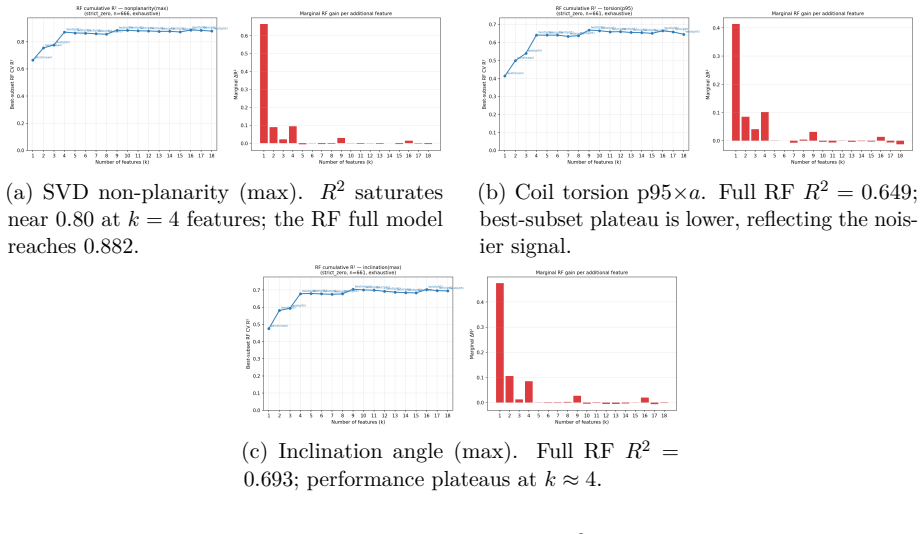
In the Constellaration collection of quasi-isodynamic stellarator equilibria, the principal-direction rotation rate of the plasma boundary emerges as the single best univariate predictor of coil non-planarity. When up to four surface and magnetic geometry features are combined in a random forest model, coil non-planarity is predicted with R-squared equal to 0.882. The results indicate that the spatial variation of principal curvatures across the boundary surface is the dominant driver of the torsion and inclination needed in the supporting coils.
What carries the argument
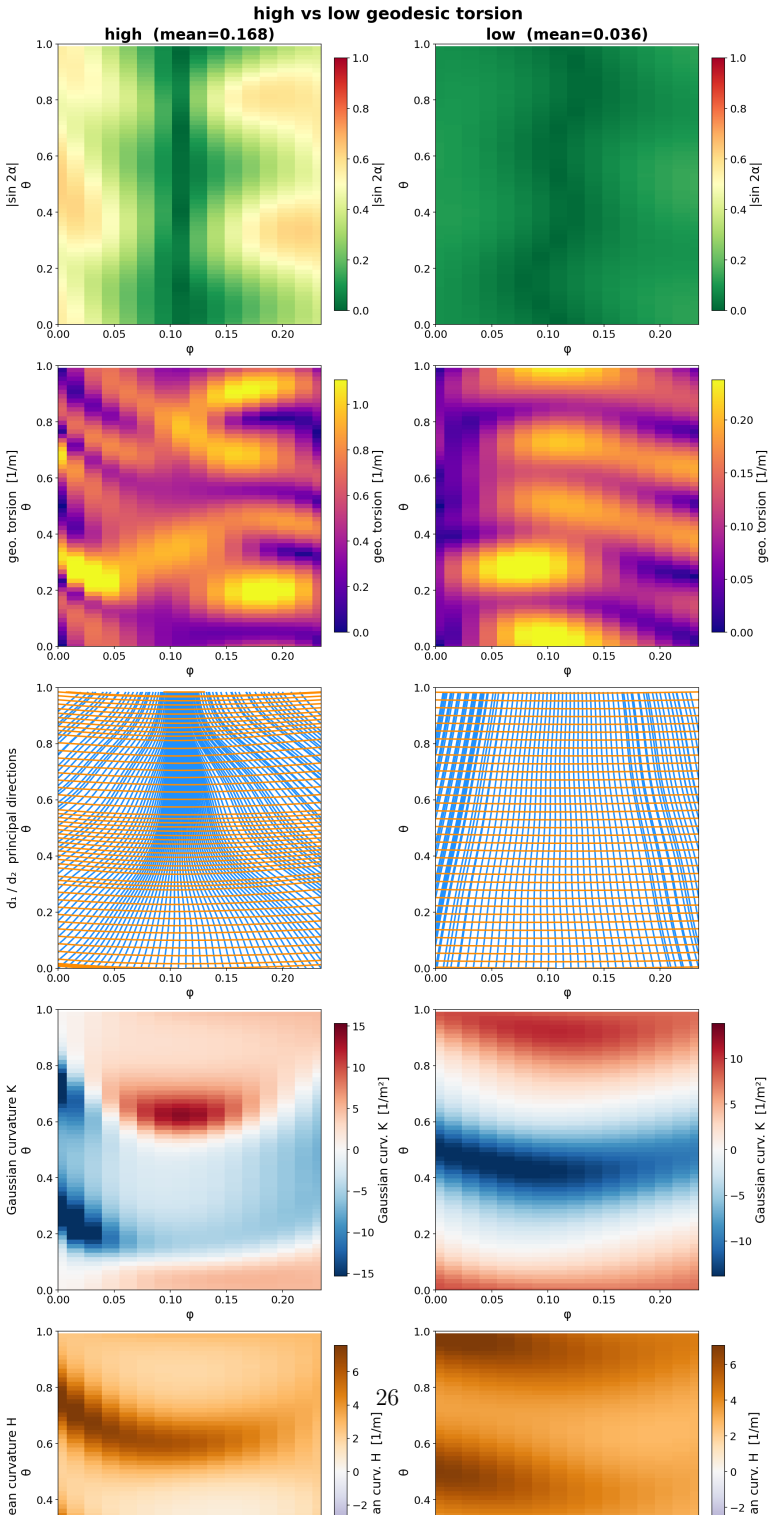
Principal-direction rotation rate of the plasma boundary: the rate at which the directions of maximum and minimum curvature turn as one moves over the surface, serving as the leading quantitative link to required coil non-planarity.
If this is right
- Coil non-planarity in QI stellarators is driven primarily by how fast the principal curvature directions change across the plasma boundary.
- A small number of surface geometry features suffice to forecast coil complexity with high accuracy.
- Stellarator design can prioritize control of principal curvature variation on the boundary to reduce coil requirements.
- The observed statistical relations hold across the sampled range of quasi-isodynamic equilibria.
Where Pith is reading between the lines
- Designers could screen candidate plasma boundaries using these surface metrics before running full coil optimizations.
- The same curvature-rotation diagnostic might usefully be applied to non-QI stellarators or to tokamak coil sets.
- Targeted reduction of principal-direction rotation could yield simpler, more planar coils while preserving quasi-isodynamic properties.
- The relation could be tested by relaxing the filamentary-coil assumption or by imposing additional engineering constraints such as minimum bend radius.
Load-bearing premise
The filamentary coils obtained from constrained optimization faithfully represent the minimal non-planarity required to support each plasma boundary, and the chosen dataset adequately covers the space of realistic quasi-isodynamic configurations.
What would settle it
A new quasi-isodynamic boundary in which the principal-direction rotation rate is varied while other surface features are held fixed, yet the optimized coils show coil non-planarity that deviates substantially from the reported correlation, would falsify the central claim.
Figures








read the original abstract
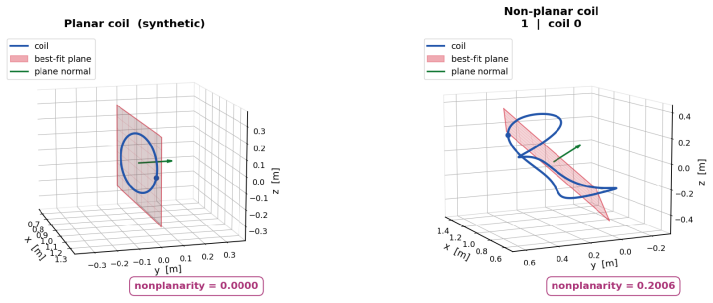
Stellarator fusion devices confine plasma by means of complex, non-planar electromagnetic coils. Understanding how the shape of the plasma boundary determines the required complexity of the coil set is a central open question in stellarator design, with direct implications for engineering feasibility and the prospects of building next-generation fusion power plants. In this work we address this question using a large data-driven study. Starting from the Constellaration dataset of quasi-isodynamic (QI) stellarator plasma boundaries, we compute a set of filamentary coil configurations using constrained optimisation within SIMSOPT, and define quantitative coil-complexity metrics (torsion, SVD non-planarity score, inboard-side inclination angle, spectral width) together with a rich set of surface and magnetic geometry features (second fundamental form, principal-direction rotation rate, surface curvatures, and magnetic axis properties). Univariate and multivariate statistical analyses, reveal a strong, central role of the surface geometry: the principal-direction rotation rate of the plasma boundary is the single best predictor of coil non-planarity, while a Random Forest model using up to four surface features achieves R2 = 0.882 for the same target. These results provide quantitative evidence that the rate of change of the principal curvatures cross the plasma boundary are the primary drivers of coil non-planarity in this dataset of quasi-isodynamic stellarators.
Editorial analysis
A structured set of objections, weighed in public.
Referee Report
Summary. The manuscript analyzes a dataset of quasi-isodynamic stellarator plasma boundaries from Constellaration. Filamentary coil configurations are generated via constrained optimization in SIMSOPT, from which four quantitative non-planarity metrics (torsion, SVD score, inboard inclination angle, spectral width) are computed. These are correlated against surface geometry features including the second fundamental form, principal-direction rotation rate, curvatures, and magnetic axis properties. Univariate analysis identifies the principal-direction rotation rate as the strongest single predictor of coil non-planarity; a Random Forest regressor using at most four surface features achieves R² = 0.882. The authors conclude that the rate of change of principal curvatures across the boundary is the primary driver of coil complexity in this QI dataset.
Significance. If the central correlations hold under minimal-coil assumptions, the work supplies the first large-scale quantitative mapping from plasma-boundary geometry to coil non-planarity in QI stellarators. The multi-metric approach and Random Forest result (R² = 0.882) constitute a concrete, falsifiable benchmark that could guide future coil-optimization objectives. The use of an existing public dataset and explicit statistical pipeline are strengths that facilitate reproducibility.
major comments (2)
- [Section 2] Section 2 (Coil Generation and Metrics): The central claim that surface geometry drives coil non-planarity requires that the four non-planarity metrics faithfully measure the minimal coil complexity needed to support each boundary. The manuscript describes constrained SIMSOPT optimization but does not state whether torsion, SVD score, inclination, or spectral width enter the objective function, nor does it demonstrate that the optimizer reaches configurations with provably minimal values of these quantities under the imposed constraints (coil length, current, field error). If the constraints systematically increase non-planarity for surfaces with high principal-direction rotation rate, the reported univariate correlations and RF performance could be optimization artifacts rather than intrinsic geometric drivers.
- [Section 4.2] Section 4.2 (Multivariate Analysis): The Random Forest model reports R² = 0.882 using up to four surface features, yet the text provides no information on cross-validation procedure, feature-selection protocol, hyperparameter tuning, or sensitivity to the train/test split. Without these controls, it is impossible to assess whether the quoted performance is robust or inflated by post-hoc choices, directly affecting the strength of the claim that surface features are primary drivers.
minor comments (2)
- [Abstract] The abstract states R² = 0.882 but omits the number of features retained and any validation method; adding one sentence would allow readers to gauge the result immediately.
- [Section 2.1] Notation for the principal-direction rotation rate (introduced in §2.1) is used without an explicit equation reference in the results; a single inline equation would improve clarity.
Simulated Author's Rebuttal
We thank the referee for the constructive and detailed review. We address each major comment below and have revised the manuscript to improve clarity and methodological transparency.
read point-by-point responses
-
Referee: [Section 2] Section 2 (Coil Generation and Metrics): The central claim that surface geometry drives coil non-planarity requires that the four non-planarity metrics faithfully measure the minimal coil complexity needed to support each boundary. The manuscript describes constrained SIMSOPT optimization but does not state whether torsion, SVD score, inclination, or spectral width enter the objective function, nor does it demonstrate that the optimizer reaches configurations with provably minimal values of these quantities under the imposed constraints (coil length, current, field error). If the constraints systematically increase non-planarity for surfaces with high principal-direction rotation rate, the reported univariate correlations and RF performance could be optimization artifacts rather than intrinsic geometric drivers.
Authors: The SIMSOPT optimization minimizes the squared magnetic field error on the plasma boundary subject to explicit constraints on coil length and current; the four non-planarity metrics are computed only after the optimization has converged and do not appear in the objective function. We have added an explicit statement to this effect in the revised Section 2. We agree that the optimizer is a local numerical method and cannot guarantee globally minimal values of the post-processed metrics. By applying identical optimization settings and convergence criteria to every surface, however, the observed variation in the metrics across the dataset remains attributable to differences in boundary geometry rather than to inconsistent optimization effort. We have added a short discussion acknowledging that the reported non-planarity levels reflect those achieved by standard constrained optimization rather than provably minimal configurations. revision: partial
-
Referee: [Section 4.2] Section 4.2 (Multivariate Analysis): The Random Forest model reports R² = 0.882 using up to four surface features, yet the text provides no information on cross-validation procedure, feature-selection protocol, hyperparameter tuning, or sensitivity to the train/test split. Without these controls, it is impossible to assess whether the quoted performance is robust or inflated by post-hoc choices, directly affecting the strength of the claim that surface features are primary drivers.
Authors: We agree that these details are required to evaluate robustness. In the revised Section 4.2 we now describe the 5-fold cross-validation used to obtain the reported R², the recursive feature elimination procedure that selected the four most important surface features, the grid-search hyperparameter tuning (number of estimators, maximum depth, minimum samples per leaf), and the results of repeated random train/test splits (R² range 0.85–0.91). The full analysis script and data splits have been deposited in the public repository. revision: yes
- Demonstrating that the obtained coil configurations achieve provably minimal values of the non-planarity metrics under the stated constraints, as this would require either exhaustive global search or theoretical bounds beyond the scope of the numerical optimization performed.
Circularity Check
No significant circularity: independent computation of coil metrics and surface features followed by statistical correlation
full rationale
The paper performs a data-driven empirical study. Coil non-planarity metrics (torsion, SVD score, inclination angle, spectral width) are obtained by running constrained optimization in SIMSOPT on each plasma boundary from the Constellaration dataset. Surface and magnetic geometry features (principal-direction rotation rate, curvatures, etc.) are computed directly from the boundary geometry. Univariate correlations and Random Forest regression are then used to quantify relationships between these two independently derived sets of quantities. No equation, fit, or claim reduces the target coil metric to a parameter of the surface features by construction. No load-bearing step invokes a self-citation chain or uniqueness theorem. The central result (principal-direction rotation rate as best predictor, RF R²=0.882) is a statistical outcome on held-out data, not a definitional identity. This is the normal, non-circular outcome for an observational dataset analysis.
Axiom & Free-Parameter Ledger
axioms (2)
- domain assumption Constrained optimization within SIMSOPT yields filamentary coil sets whose non-planarity metrics are representative of engineering-relevant coil complexity for the given plasma boundary.
- domain assumption The Constellaration dataset provides a sufficiently diverse and representative sample of quasi-isodynamic stellarator plasma boundaries.
Reference graph
Works this paper leans on
-
[1]
J. M. García-Regaña, I. Calvo, E. Sánchez, H. Thienpondt, J. L. Velasco, and J. A. Capitán. Reduced electrostatic turbulence in the quasi-isodynamic stellarator configuration CIEMAT-QI4.Nuclear Fusion, 65:016036, 2024
2024
-
[2]
Warmer et al
F. Warmer et al. Overview of european efforts and advances in stellarator power plant studies.Fusion Engineering and Design, 203:114386, 2024
2024
-
[3]
A. G. Goodman, K. Camacho Mata, S. A. Henneberg, R. Jorge, M. Landreman, G. G. Plunk, H. M. Smith, R. J. J. Mackenbach, C. D. Beidler, and P. Helander. Constructing precisely quasi-isodynamic magnetic fields.Journal of Plasma Physics, 89(5):905890504, 2023. doi: 10.1017/S002237782300065X
-
[4]
A. G. Goodman, P. Xanthopoulos, G. G. Plunk, H. M. Smith, C. Nührenberg, C. D. Beidler, S. A. Henneberg, G. Roberg-Clark, M. Drevlak, and P. Helander. Quasi- isodynamic stellarators with low turbulence as fusion reactor candidates.PRX Energy, 3:023010, 2024. doi: 10.1103/PRXEnergy.3.023010
-
[5]
A. G. Goodman, G. G. Plunk, P. Xanthopoulos, M. Drevlak, J. Geiger, R. Davies, H. M. Smith, C. Nührenberg, C. D. Beidler, S. A. Henneberg, and P. Helander. A quasi-isodynamic stellarator configuration towards a fusion power plant.Journal of Plasma Physics, 91(6):E153, 2026. doi: 10.1017/S0022377825100974. 24
-
[6]
Kappel, M
J. Kappel, M. Landreman, and D. Malhotra. The magnetic gradient scale length explains why certain plasmas require close external magnetic coils.Plasma Physics and Controlled Fusion, 66(2):025018, 2024
2024
- [7]
-
[8]
S. A. Cadena, A. Merlo, E. Laude, A. Bauer, A. Agrawal, M. Pascu, M. Savtchouk, E. Guiraud, L. Bonauer, S. Hudson, and M. Kaiser. ConStellaration: A dataset of QI-like stellarator plasma boundaries and optimization benchmarks.Advances in Neural Information Processing Systems (NeurIPS), 2025. HuggingFace dataset https://huggingface.co/datasets/proxima-fusi...
2025
- [9]
-
[10]
Landreman, B
M. Landreman, B. Medasani, F. Wechsung, A. Giuliani, R. Jorge, and C. Zhu. SIMSOPT: A flexible framework for stellarator optimization.Journal of Open Source Software, 6(65):3525, 2021
2021
-
[11]
Gil, Weiping Li, Julianne Stratton, Alan A
Pedro F. Gil, Weiping Li, Julianne Stratton, Alan A. Kaptanoglu, and Eve V. Stenson. Efficient computation of stellarator coils with an augmented Lagrangian optimization method.Physical Review E, Apr 2026. doi: 10.1103/838f-vbq3
-
[12]
M. P. do Carmo.Differential Geometry of Curves and Surfaces. Prentice-Hall, 1976
1976
-
[13]
Theproofandmeasurementofassociationbetweentwothings.American Journal of Psychology, 15:72–101, 1904
C.Spearman. Theproofandmeasurementofassociationbetweentwothings.American Journal of Psychology, 15:72–101, 1904
1904
-
[14]
L. Breiman. Random forests.Machine Learning, 45(1):5–32, 2001
2001
-
[15]
Estimating coil features from an equilibrium
Eduardo Rodríguez and Wrick Sengupta. Estimating coil features from an equilibrium. arXiv preprint arXiv:2604.12339, 2026. doi: 10.48550/arXiv.2604.12339. 25 Figure 20: Geometric torsion of the surface (related to the rate of change of the surface normal along the boundary) visualised on plasma boundaries. This quantity provides complementary geometric in...
work page internal anchor Pith review Pith/arXiv arXiv doi:10.48550/arxiv.2604.12339 2026
discussion (0)
Sign in with ORCID, Apple, or X to comment. Anyone can read and Pith papers without signing in.