Recognition: unknown
IQUEYE at Gemini South: instrument, science commission, and first results
Pith reviewed 2026-05-07 11:32 UTC · model grok-4.3
The pith
Mounting the IQUEYE fast photon counter on the 8.1 m Gemini South telescope delivers an order of magnitude increase in sensitivity for ultra-fast optical astronomy.
A machine-rendered reading of the paper's core claim, the machinery that carries it, and where it could break.
Core claim
The central claim is that installing IQUEYE on the Gemini South 8.1-m dish reaches an order of magnitude sensitivity increase from previous operations. The instrument preserves its ~0.5 ns/h photon time of arrival accuracy while observing giant pulse emitters, millisecond pulsars, and transitional millisecond pulsars for over 40 hours in the span of a week.
What carries the argument
IQUEYE, the fast photon counter based on single photon avalanche diode detectors that records photon arrival times with high precision and whose performance improves directly with the size of the telescope's collecting area.
If this is right
- More photons per second allow for higher signal-to-noise ratios in timing measurements of pulsars.
- Observations of transitional millisecond pulsars can be extended to fainter objects.
- Intensity interferometry applications benefit from the increased light collection.
- The week-long campaign demonstrates the feasibility of sustained use for ultra-fast astronomy programs.
Where Pith is reading between the lines
- With this sensitivity, it may become possible to search for optical flashes associated with fast radio bursts at greater distances.
- Similar visitor instrument deployments on other large telescopes could replicate the sensitivity gain for other fast-timing experiments.
- The combination of large aperture and precise timing could lead to new constraints on the physics of pulsar emission regions.
Load-bearing premise
Mounting IQUEYE on the larger telescope produces a clean order-of-magnitude sensitivity gain without major new limitations from the larger aperture, atmosphere, or instrument interface.
What would settle it
If the number of detected photons or the achieved timing accuracy in the Gemini South data does not reflect an approximately tenfold improvement over prior observations with smaller telescopes, the sensitivity gain would not hold.
Figures


read the original abstract
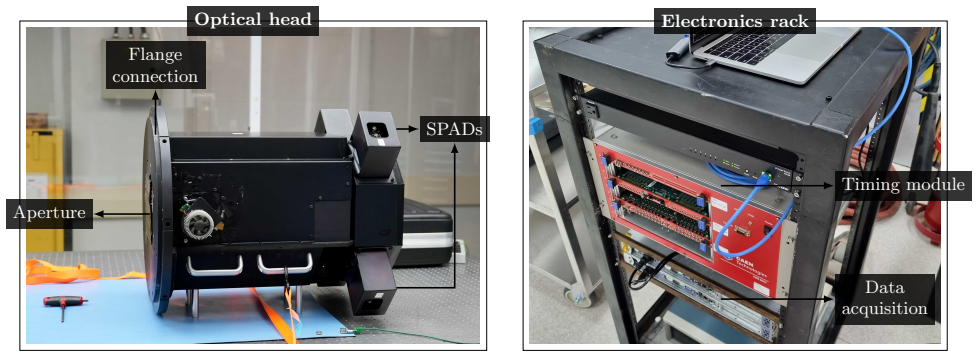
The Italian quantum eye (IQUEYE) is a fast photon counter based on the single photon avalanche diode detectors and capable of preserving a ~0.5 ns/h accuracy photon time of arrival. IQUEYE was originally developed for intensity interferometry experiments, but now its scientific scope has been extended towards ultra fast astronomy, including optical pulsars, millisecond pulsars and the enigmatic fast radio bursts. IQUEYE's capabilities are mainly restricted by the number of photons detected, a quantity that scales with the collector size of an optical telescope. Through the visitor instrument program at Gemini South (Cerro Pach\'on, Chile) we brought IQUEYE to the 8.1-m dish, reaching an order magnitude sensitivity increased from previous operations. At Gemini South we installed IQUEYE to observe giant pulse emitters, millisecond pulsars, and transitional millisecond pulsars for over 40 hours in the span of a week.
Editorial analysis
A structured set of objections, weighed in public.
Referee Report
Summary. The manuscript describes the installation of the IQUEYE fast photon counter (based on single-photon avalanche diodes with ~0.5 ns/h timing accuracy) on the Gemini South 8.1-m telescope via the visitor instrument program. It covers the instrument's extension from intensity interferometry to ultra-fast astronomy applications (optical pulsars, millisecond pulsars, fast radio bursts), the commissioning process, and over 40 hours of observations on giant pulse emitters, millisecond pulsars, and transitional millisecond pulsars within a one-week campaign. The central claim is an order-of-magnitude sensitivity increase relative to prior operations, attributed to the larger collecting area.
Significance. If the sensitivity gain is demonstrated with quantitative data, this work would establish the viability of deploying high-time-resolution single-pixel detectors on 8-m class telescopes, enabling improved photon statistics for studies of fast optical transients. The accumulation of >40 hours of data in a short visitor run represents a practical strength for time-domain instrumentation papers.
major comments (2)
- [Abstract] Abstract: The claim of 'an order magnitude sensitivity increased from previous operations' is presented without any supporting measurements, such as detected photon count rates, signal-to-noise ratios, or direct before/after comparisons to earlier IQUEYE deployments on smaller telescopes. This is load-bearing for the primary result.
- [Observations and first results] Section on observations and first results: No throughput measurement, error budget, or analysis is provided to confirm that photon collection scales cleanly with aperture area (D²) without significant offsets from visitor-instrument interface losses, increased sky background for the single-pixel SPAD, or atmospheric effects. The assumption of a clean ~10x gain remains untested.
minor comments (3)
- [Abstract] Abstract: 'sensitivity increased' is grammatically incorrect and should be revised to 'sensitivity increase'.
- [Abstract] Abstract: The LaTeX rendering of 'Pachón' should be checked for proper accent display in the final version.
- General: The manuscript would be strengthened by adding a table or figure in the results section that quantifies achieved count rates or sensitivity metrics against prior runs.
Simulated Author's Rebuttal
We thank the referee for the detailed review and the opportunity to strengthen the presentation of our sensitivity claims. We address each major comment below and indicate the revisions we will make.
read point-by-point responses
-
Referee: [Abstract] The claim of 'an order magnitude sensitivity increased from previous operations' is presented without any supporting measurements, such as detected photon count rates, signal-to-noise ratios, or direct before/after comparisons to earlier IQUEYE deployments on smaller telescopes. This is load-bearing for the primary result.
Authors: We agree the abstract statement is insufficiently qualified. The claimed gain follows directly from the D² scaling of photon collection rate for a single-pixel detector; the 8.1 m Gemini aperture yields approximately ten times the collecting area of the 2.5 m telescopes used in prior IQUEYE runs. No direct photon-count-rate comparison is possible within the present dataset because the earlier observations were obtained with different telescope-instrument combinations and target lists. We will revise the abstract to read “expected order-of-magnitude sensitivity increase based on aperture scaling” and insert a concise paragraph in the observations section that (i) recalls the prior telescope diameters, (ii) states the area ratio, and (iii) notes that the 40 h of new data were acquired under the visitor-instrument constraints that precluded dedicated throughput calibrations. revision: partial
-
Referee: [Observations and first results] No throughput measurement, error budget, or analysis is provided to confirm that photon collection scales cleanly with aperture area (D²) without significant offsets from visitor-instrument interface losses, increased sky background for the single-pixel SPAD, or atmospheric effects. The assumption of a clean ~10x gain remains untested.
Authors: We acknowledge that a quantitative throughput or error-budget analysis is absent. Because IQUEYE is a single-pixel SPAD with a narrow field stop, the dominant background term remains the sky contribution within that stop; the visitor interface was aligned to preserve the nominal optical path, and the targets (bright millisecond pulsars and giant-pulse emitters) are sufficiently bright that the increased photon rate from the larger aperture dominates over plausible interface or atmospheric losses. We will add a short discussion paragraph that (i) lists the main potential offsets, (ii) argues they are second-order for the observed sources, and (iii) states that a full end-to-end throughput calibration was outside the scope of the one-week visitor run. This will make the scaling assumption explicit rather than implicit. revision: partial
Circularity Check
No circularity: purely descriptive instrument report with no derivations or fitted quantities
full rationale
The manuscript is an observational and technical report on the installation of IQUEYE at Gemini South and subsequent pulsar observations. It contains no equations, derivations, parameter fits, or predictive models. The stated sensitivity increase is presented as a direct consequence of the larger collecting area without any internal mathematical reduction or self-referential construction. No load-bearing steps reduce to prior inputs by definition or self-citation chains. This is a standard non-circular descriptive paper.
Axiom & Free-Parameter Ledger
Reference graph
Works this paper leans on
-
[1]
Type Ia supernova progenitors: a contemporary view of a long-standing puzzle,
Ruiter, A. J. and Seitenzahl, I. R., “Type Ia supernova progenitors: a contemporary view of a long-standing puzzle,” A&A Rev.33, 1 (Dec. 2025)
2025
-
[2]
Spectra and Light Curves of Gamma-Ray Burst Afterglows,
Sari, R., Piran, T., and Narayan, R., “Spectra and Light Curves of Gamma-Ray Burst Afterglows,” ApJ497, L17–L20 (Apr. 1998)
1998
-
[3]
Observations of Gamma-Ray Bursts of Cosmic Origin,
Klebesadel, R. W., Strong, I. B., and Olson, R. A., “Observations of Gamma-Ray Bursts of Cosmic Origin,” ApJ182, L85 (June 1973)
1973
-
[4]
A Bright Millisecond Radio Burst of Extragalactic Origin,
Lorimer, D. R., Bailes, M., McLaughlin, M. A., Narkevic, D. J., and Crawford, F., “A Bright Millisecond Radio Burst of Extragalactic Origin,”Science318, 777 (Nov. 2007)
2007
-
[5]
Transient radio bursts from rotating neutron stars,
McLaughlin, M. A., Lyne, A. G., Lorimer, D. R., Kramer, M., Faulkner, A. J., Manchester, R. N., Cordes, J. M., Camilo, F., Possenti, A., Stairs, I. H., Hobbs, G., D’Amico, N., Burgay, M., and O’Brien, J. T., “Transient radio bursts from rotating neutron stars,” Nature439, 817–820 (Feb. 2006)
2006
-
[6]
A fast radio burst associated with a Galactic magnetar,
Bochenek, C. D., Ravi, V., Belov, K. V., Hallinan, G., Kocz, J., Kulkarni, S. R., and McKenna, D. L., “A fast radio burst associated with a Galactic magnetar,” Nature587, 59–62 (Nov. 2020)
2020
-
[7]
A bright millisecond-duration radio burst from a Galactic magnetar,
CHIME/FRB Collaboration, Andersen, B. C., Bandura, K. M., Bhardwaj, M., Bij, A., Boyce, M. M., Boyle, P. J., Brar, C., Cassanelli, T., Chawla, P., Chen, T., Cliche, J. F., Cook, A., Cubranic, D., Curtin, A. P., Denman, N. T., Dobbs, M., Dong, F. Q., Fandino, M., Fonseca, E., Gaensler, B. M., Giri, U., Good, D. C., Halpern, M., Hill, A. S., Hinshaw, G. F.,...
2020
-
[8]
A census of baryons in the Universe from localized fast radio bursts,
Macquart, J. P., Prochaska, J. X., McQuinn, M., Bannister, K. W., Bhandari, S., Day, C. K., Deller, A. T., Ekers, R. D., James, C. W., Marnoch, L., Os lowski, S., Phillips, C., Ryder, S. D., Scott, D. R., Shannon, R. M., and Tejos, N., “A census of baryons in the Universe from localized fast radio bursts,” Nature581, 391–395 (May 2020)
2020
-
[9]
On the Fast Radio Burst and Persistent Radio Source Popula- tions,
Law, C. J., Connor, L., and Aggarwal, K., “On the Fast Radio Burst and Persistent Radio Source Popula- tions,” ApJ927, 55 (Mar. 2022)
2022
-
[10]
Periodic activity from a fast radio burst source,
CHIME/FRB Collaboration, Amiri, M., Andersen, B. C., Bandura, K. M., Bhardwaj, M., Boyle, P. J., Brar, C., Chawla, P., Chen, T., Cliche, J. F., Cubranic, D., Deng, M., Denman, N. T., Dobbs, M., Dong, F. Q., Fandino, M., Fonseca, E., Gaensler, B. M., Giri, U., Good, D. C., Halpern, M., Hessels, J. W. T., Hill, A. S., H¨ ofer, C., Josephy, A., Kania, J. W.,...
2020
-
[11]
Repeating behaviour of FRB 121102: periodicity, waiting times, and energy distribution,
Cruces, M., Spitler, L. G., Scholz, P., Lynch, R., Seymour, A., Hessels, J. W. T., Gouiff´ es, C., Hilmarsson, G. H., Kramer, M., and Munjal, S., “Repeating behaviour of FRB 121102: periodicity, waiting times, and energy distribution,” MNRAS500, 448–463 (Jan. 2021)
2021
-
[12]
A direct localization of a fast radio burst and its host,
Chatterjee, S., Law, C. J., Wharton, R. S., Burke-Spolaor, S., Hessels, J. W. T., Bower, G. C., Cordes, J. M., Tendulkar, S. P., Bassa, C. G., Demorest, P., Butler, B. J., Seymour, A., Scholz, P., Abruzzo, M. W., Bogdanov, S., Kaspi, V. M., Keimpema, A., Lazio, T. J. W., Marcote, B., McLaughlin, M. A., Paragi, Z., Ransom, S. M., Rupen, M., Spitler, L. G.,...
2017
-
[13]
The host galaxy and persistent radio counterpart of FRB 20201124A,
Ravi, V., Law, C. J., Li, D., Aggarwal, K., Bhardwaj, M., Burke-Spolaor, S., Connor, L., Lazio, T. J. W., Simard, D., Somalwar, J., and Tendulkar, S. P., “The host galaxy and persistent radio counterpart of FRB 20201124A,” MNRAS513, 982–990 (June 2022)
2022
-
[14]
A repeating fast radio burst associated with a persistent radio source,
Niu, C. H., Aggarwal, K., Li, D., Zhang, X., Chatterjee, S., Tsai, C. W., Yu, W., Law, C. J., Burke-Spolaor, S., Cordes, J. M., Zhang, Y. K., Ocker, S. K., Yao, J. M., Wang, P., Feng, Y., Niino, Y., Bochenek, C., Cruces, M., Connor, L., Jiang, J. A., Dai, S., Luo, R., Li, G. D., Miao, C. C., Niu, J. R., Anna-Thomas, R., Sydnor, J., Stern, D., Wang, W. Y.,...
2022
-
[15]
Detection and localization of the highly active FRB 20240114A with MeerKAT,
Tian, J., Rajwade, K. M., Pastor-Marazuela, I., Stappers, B. W., Bezuidenhout, M. C., Caleb, M., Jankowski, F., Barr, E. D., and Kramer, M., “Detection and localization of the highly active FRB 20240114A with MeerKAT,” MNRAS533, 3174–3193 (Sept. 2024)
2024
-
[16]
A Repeating Fast Radio Burst Source in a Low-luminosity Dwarf Galaxy,
Hewitt, D. M., Bhardwaj, M., Gordon, A. C., Kirichenko, A., Nimmo, K., Bhandari, S., Cognard, I., Fong, W.-f., Gil de Paz, A., Gopinath, A., Hessels, J. W. T., Kirsten, F., Marcote, B., Bezrukovs, V., Blaauw, R., Bray, J. D., Buttaccio, S., Cassanelli, T., Chawla, P., Corongiu, A., Deng, W., Didehbani, H. N., Dong, Y., Gawro´ nski, M. P., Giroletti, M., G...
2024
-
[17]
A Repeating Fast Radio Burst Source in the Outskirts of a Quiescent Galaxy,
Shah, V., Shin, K., Leung, C., Fong, W.-f., Eftekhari, T., Amiri, M., Andersen, B. C., Andrew, S., Bhardwaj, M., Brar, C., Cassanelli, T., Chatterjee, S., Curtin, A., Dobbs, M., Dong, Y., Dong, F. A., Fonseca, E., Gaensler, B. M., Halpern, M., Hessels, J. W. T., Ibik, A. L., Jain, N., Joseph, R. C., Kaczmarek, J., Kahinga, L. A., Kaspi, V. M., Kharel, B.,...
2025
-
[18]
Localizing FRBs through VLBI with the Algonquin Radio Observatory 10 m Telescope,
Cassanelli, T., Leung, C., Rahman, M., Vanderlinde, K., Mena-Parra, J., Cary, S., Masui, K. W., Luo, J., Lin, H. H., Bij, A., Gill, A., Baker, D., Bandura, K., Berger, S., Boyle, P. J., Brar, C., Chatterjee, S., Cubranic, D., Dobbs, M., Fonseca, E., Good, D. C., Kaczmarek, J. F., Kaspi, V. M., Landecker, T. L., Lanman, A. E., Li, D., McKee, J. W., Meyers,...
2022
-
[19]
A fast radio burst localized at detection to an edge-on galaxy using very-long-baseline interferometry,
Cassanelli, T., Leung, C., Sanghavi, P., Mena-Parra, J., Cary, S., Mckinven, R., Bhardwaj, M., Masui, K. W., Michilli, D., Bandura, K., Chatterjee, S., Peterson, J. B., Kaczmarek, J., Rahman, M., Shin, K., Vanderlinde, K., Berger, S., Brar, C., Boyle, P. J., Breitman, D., Chawla, P., Curtin, A. P., Dobbs, M., Dong, F. A., Fonseca, E., Gaensler, B. M., Ibi...
2024
-
[20]
CHIME/FRB Outriggers: Design Overview,
CHIME/FRB Collaboration, Amiri, M., Andersen, B. C., Andrew, S., Bandura, K., Bhardwaj, M., Bhopi, K., Bidula, V., Boyle, P. J., Brar, C., Carlson, M., Cassanelli, T., Cassity, A., Chatterjee, S., Cliche, J.-F., Curtin, A. P., Darlinger, R., DeBoer, D. R., Dobbs, M., Dong, F. A., Eadie, G., Fonseca, E., Gaensler, B. M., Gusinskaia, N., Halpern, M., Hendri...
-
[21]
A luminous fast radio burst that probes the Universe at redshift 1,
Ryder, S. D., Bannister, K. W., Bhandari, S., Deller, A. T., Ekers, R. D., Glowacki, M., Gordon, A. C., Gourdji, K., James, C. W., Kilpatrick, C. D., Lu, W., Marnoch, L., Moss, V. A., Prochaska, J. X., Qiu, H., Sadler, E. M., Simha, S., Sammons, M. W., Scott, D. R., Tejos, N., and Shannon, R. M., “A luminous fast radio burst that probes the Universe at re...
2023
-
[22]
Contemporaneous optical-radio observations of a fast radio burst in a close galaxy pair,
Hanmer, K. Y., Pastor-Marazuela, I., Brink, J., Malesani, D., Stappers, B. W., Groot, P. J., Cooper, A. J., Tejos, N., Buckley, D. A. H., Barr, E. D., Bezuidenhout, M. C., Bloemen, S., Caleb, M., Driessen, L. N., Fender, R., Jankowski, F., Kramer, M., Pieterse, D. L. A., Rajwade, K. M., Tian, J., Vreeswijk, P. M., Wijnands, R., and Woudt, P. A., “Contempo...
2025
-
[23]
Limits on Optical Counterparts to the Repeating Fast Radio Burst 20180916B from High-speed Imaging with Gemini-North/’Alopeke,
Kilpatrick, C. D., Tejos, N., Andersen, B. C., Prochaska, J. X., N´ u˜ nez, C., Fonseca, E., Hartman, Z., Howell, S. B., Seccull, T., and Tendulkar, S. P., “Limits on Optical Counterparts to the Repeating Fast Radio Burst 20180916B from High-speed Imaging with Gemini-North/’Alopeke,” ApJ964, 121 (Apr. 2024)
2024
-
[24]
Limits on Simultaneous and Delayed Optical Emission from Well-Localized Fast Radio Bursts,
Hiramatsu, D., “Limits on Simultaneous and Delayed Optical Emission from Well-Localized Fast Radio Bursts,” in [AAS/High Energy Astrophysics Division],AAS/High Energy Astrophysics Division20, 117.18 (Sept. 2023)
2023
-
[25]
Simultaneous and panchromatic observations of the fast radio burst FRB 20180916B,
Trudu, M., Pilia, M., Nicastro, L., Guidorzi, C., Orlandini, M., Zampieri, L., Marthi, V. R., Ambrosino, F., Possenti, A., Burgay, M., Casentini, C., Mereminskiy, I., Savchenko, V., Palazzi, E., Panessa, F., Ridolfi, A., Verrecchia, F., Anedda, M., Bernardi, G., Bachetti, M., Burenin, R., Burtovoi, A., Casella, P., Fiori, M., Frontera, F., Gajjar, V., Gar...
2023
-
[26]
Deep Simultaneous Limits on Optical Emission from FRB 20190520B by 24.4 fps Observations with Tomo-e Gozen,
Niino, Y., Doi, M., Sako, S., Ohsawa, R., Arima, N., Jiang, J.-a., Tominaga, N., Tanaka, M., Li, D., Niu, C.-H., Tsai, C.-W., Kobayashi, N., Takahashi, H., Kondo, S., Mori, Y., Aoki, T., Arimatsu, K., Kasuga, T., and Okumura, S.-i., “Deep Simultaneous Limits on Optical Emission from FRB 20190520B by 24.4 fps Observations with Tomo-e Gozen,” ApJ931, 109 (J...
2022
-
[27]
Constraining bright optical counterparts of fast radio bursts,
N´ u˜ nez, C., Tejos, N., Pignata, G., Kilpatrick, C. D., Prochaska, J. X., Heintz, K. E., Bannister, K. W., Bhandari, S., Day, C. K., Deller, A. T., Flynn, C., Mahony, E. K., Majewski, D., Marnoch, L., Qiu, H., Ryder, S. D., and Shannon, R. M., “Constraining bright optical counterparts of fast radio bursts,” A&A653, A119 (Sept. 2021)
2021
-
[28]
Associating Fast Radio Bursts with Ex- tragalactic Radio Sources: General Methodology and a Search for a Counterpart to FRB 170107,
Eftekhari, T., Berger, E., Williams, P. K. G., and Blanchard, P. K., “Associating Fast Radio Bursts with Ex- tragalactic Radio Sources: General Methodology and a Search for a Counterpart to FRB 170107,” ApJ860, 73 (June 2018)
2018
-
[29]
A search for optical bursts from the repeating fast radio burst FRB 121102,
Hardy, L. K., Dhillon, V. S., Spitler, L. G., Littlefair, S. P., Ashley, R. P., De Cia, A., Green, M. J., Jaroenjittichai, P., Keane, E. F., Kerry, P., Kramer, M., Malesani, D., Marsh, T. R., Parsons, S. G., Possenti, A., Rattanasoon, S., and Sahman, D. I., “A search for optical bursts from the repeating fast radio burst FRB 121102,” MNRAS472, 2800–2807 (...
2017
-
[30]
How bright are fast optical bursts associated with fast radio bursts?,
Yang, Y.-P., Zhang, B., and Wei, J.-Y., “How bright are fast optical bursts associated with fast radio bursts?,”The Astrophysical Journal878, 89 (jun 2019)
2019
-
[31]
Unveiling the origin of fast radio bursts by optical follow-up observations,
Niino, Y., Totani, T., and Okumura, J. E., “Unveiling the origin of fast radio bursts by optical follow-up observations,” PASJ66, L9 (Dec. 2014)
2014
-
[32]
Noise and Interferometry,
Radhakrishnan, V., “Noise and Interferometry,” in [Synthesis Imaging in Radio Astronomy II], Taylor, G. B., Carilli, C. L., and Perley, R. A., eds.,Astronomical Society of the Pacific Conference Series180, 671 (Jan. 1999)
1999
-
[33]
Iqueye, a single photon-counting photometer applied to the ESO new technology telescope,
Naletto, G., Barbieri, C., Occhipinti, T., Capraro, I., di Paola, A., Facchinetti, C., Verroi, E., Zoccarato, P., Anzolin, G., Belluso, M., Billotta, S., Bolli, P., Bonanno, G., da Deppo, V., Fornasier, S., German` a, C., Giro, E., Marchi, S., Messina, F., Pernechele, C., Tamburini, F., Zaccariotto, M., and Zampieri, L., “Iqueye, a single photon-counting ...
2009
-
[34]
Gemini Observatory instrumentation: a review of the past, present, and future on our 10th anniversary,
Tollestrup, E. V., Kleinman, S. J., Goodsell, S. J., Arriagada, G., Lazo, M., Rogers, R., Galvez, R., and White, J. K., “Gemini Observatory instrumentation: a review of the past, present, and future on our 10th anniversary,” in [Ground-based and Airborne Instrumentation for Astronomy III], McLean, I. S., Ramsay, S. K., and Takami, H., eds.,Society of Phot...
2010
-
[35]
Twin High-resolution, High-speed Imagers for the Gemini Telescopes: Instrument description and science verification results,
Scott, N. J., Howell, S. B., Gnilka, C. L., Stephens, A. W., Salinas, R., Matson, R. A., Furlan, E., Horch, E. P., Everett, M. E., Ciardi, D. R., Mills, D., and Quigley, E. A., “Twin High-resolution, High-speed Imagers for the Gemini Telescopes: Instrument description and science verification results,”Frontiers in Astronomy and Space Sciences8, 138 (Sept. 2021)
2021
-
[36]
New technique for determining a pulsar period: Waterfall principal component analysis,
Cassanelli, T., Naletto, G., Codogno, G., Barbieri, C., Verroi, E., and Zampieri, L., “New technique for determining a pulsar period: Waterfall principal component analysis,” A&A663, A106 (July 2022)
2022
-
[37]
Timing analysis and pulse profile of the Vela pulsar in the optical band from Iqueye observations,
Spolon, A., Zampieri, L., Burtovoi, A., Naletto, G., Barbieri, C., Barbieri, M., Patruno, A., and Verroi, E., “Timing analysis and pulse profile of the Vela pulsar in the optical band from Iqueye observations,” MNRAS482, 175–183 (Jan. 2019)
2019
-
[38]
Optical phase coherent timing of the Crab nebula pulsar with Iqueye at the ESO New Technology Telescope,
Zampieri, L., ˇCadeˇ z, A., Barbieri, C., Naletto, G., Calvani, M., Barbieri, M., Verroi, E., Zoccarato, P., and Occhipinti, T., “Optical phase coherent timing of the Crab nebula pulsar with Iqueye at the ESO New Technology Telescope,” MNRAS439, 2813–2821 (Apr. 2014)
2014
-
[39]
Stellar intensity interferometry of Vega in photon counting mode,
Zampieri, L., Naletto, G., Burtovoi, A., Fiori, M., and Barbieri, C., “Stellar intensity interferometry of Vega in photon counting mode,” MNRAS506, 1585–1594 (Sept. 2021)
2021
-
[40]
Measurement of the second-order g (2) correlation function of visible light from Vega in photon counting mode,
Fiori, M., Barbieri, C., Zampieri, L., Naletto, G., and Burtovoi, A., “Measurement of the second-order g (2) correlation function of visible light from Vega in photon counting mode,” in [Quantum Communications and Quantum Imaging XIX], Deacon, K. S. and Meyers, R. E., eds.,Society of Photo-Optical Instrumentation Engineers (SPIE) Conference Series11835, 1...
2021
-
[41]
Set-up and methods for SiPM Photo-Detection Efficiency measurements,
Zappal` a, G., Acerbi, F., Ferri, A., Gola, A., Paternoster, G., Zorzi, N., and Piemonte, C., “Set-up and methods for SiPM Photo-Detection Efficiency measurements,”Journal of Instrumentation11, P08014 (Aug. 2016)
2016
-
[42]
Acquisition and guiding unit for Gemini 8-m telescopes: a progress report,
Heilemann, W. and Naumann, H., “Acquisition and guiding unit for Gemini 8-m telescopes: a progress report,” in [Optical Astronomical Instrumentation], D’Odorico, S., ed.,Society of Photo-Optical Instrumen- tation Engineers (SPIE) Conference Series3355, 206–217 (July 1998)
1998
-
[43]
Gemini High-resolution Optical Spectrograph (GHOST) at Gemini South: Instrument Performance and Integration, First Science, and Next Steps,
Kalari, V. M., Diaz, R. J., Robertson, G., McConnachie, A., Ireland, M., Salinas, R., Young, P., Simpson, C., Hayes, C., Nielsen, J., Burley, G., Pazder, J., Gomez-Jimenez, M., Martioli, E., Howell, S. B., Jeong, M., Juneau, S., Ruiz-Carmona, R., Margheim, S., Sheinis, A., Anthony, A., Baker, G., Berg, T. A. M., Cao, T., Chapin, E., Chin, T., Chiboucas, K...
2024
-
[44]
Optical observations of pulsars: the ESO contribu- tion.,
Mignani, R. P., Caraveo, P. A., and Bignami, G. F., “Optical observations of pulsars: the ESO contribu- tion.,”The Messenger99, 22–26 (Mar. 2000)
2000
-
[45]
Discovery of Optical Signals from Pulsar NP 0532,
Cocke, W. J., Disney, M. J., and Taylor, D. J., “Discovery of Optical Signals from Pulsar NP 0532,” Nature221, 525–527 (Feb. 1969)
1969
-
[46]
Spectrophotometry of the Crab pulsar.,
Nasuti, F. P., Mignani, R., Caraveo, P. A., and Bignami, G. F., “Spectrophotometry of the Crab pulsar.,” A&A314, 849–852 (Oct. 1996)
1996
-
[47]
Possible pulsed optical emission from Geminga,
Shearer, A., Golden, A., Harfst, S., Butler, R., Redfern, R. M., O’Sullivan, C. M. M., Beskin, G. M., Neizvestny, S. I., Neustroev, V. V., Plokhotnichenko, V. L., Cullum, M., and Danks, A., “Possible pulsed optical emission from Geminga,” A&A335, L21–L24 (July 1998)
1998
-
[48]
Optical pulsations in the Large Magellanic Cloud remnant 0540- 69.3,
Middleditch, J. and Pennypacker, C., “Optical pulsations in the Large Magellanic Cloud remnant 0540- 69.3,” Nature313, 659–661 (Feb. 1985)
1985
-
[49]
A Possible Optical Identification for PSR 0833-45,
Lasker, B. M., “A Possible Optical Identification for PSR 0833-45,” ApJ203, 193–195 (Jan. 1976)
1976
-
[50]
Spin-down rate of the transitional millisecond pulsar PSR J1023+0038 in the optical band with Aqueye+,
Burtovoi, A., Zampieri, L., Fiori, M., Naletto, G., Spolon, A., Barbieri, C., Papitto, A., and Ambrosino, F., “Spin-down rate of the transitional millisecond pulsar PSR J1023+0038 in the optical band with Aqueye+,” MNRAS498, L98–L103 (Nov. 2020)
2020
-
[51]
Optical pulsations from a transitional millisecond pulsar,
Ambrosino, F., Papitto, A., Stella, L., Meddi, F., Cretaro, P., Burderi, L., Di Salvo, T., Israel, G. L., Ghedina, A., Di Fabrizio, L., and Riverol, L., “Optical pulsations from a transitional millisecond pulsar,” Nature Astronomy1, 854–858 (Oct. 2017)
2017
-
[52]
360 (2009)
Cheng, J., [The Principles of Astronomical Telescope Design], vol. 360 (2009)
2009
-
[53]
Aqueye optical observations of the Crab Nebula pulsar,
German` a, C., Zampieri, L., Barbieri, C., Naletto, G., ˇCadeˇ z, A., Calvani, M., Barbieri, M., Capraro, I., Di Paola, A., Facchinetti, C., Occhipinti, T., Possenti, A., Ponikvar, D., Verroi, E., and Zoccarato, P., “Aqueye optical observations of the Crab Nebula pulsar,” A&A548, A47 (Dec. 2012)
2012
-
[54]
Super-giant pulses from the Crab pulsar: energy distribution and occurrence rate,
Bera, A. and Chengalur, J. N., “Super-giant pulses from the Crab pulsar: energy distribution and occurrence rate,” MNRAS490, L12–L16 (Nov. 2019)
2019
-
[55]
PRESTO: PulsaR Exploration and Search TOolkit
Ransom, S., “PRESTO: PulsaR Exploration and Search TOolkit.” Astrophysics Source Code Library, record ascl:1107.017 (July 2011)
2011
-
[56]
The Mauna Kea Observatories Near-Infrared Filter Set. III. Isophotal Wavelengths and Absolute Calibration,
Tokunaga, A. T. and Vacca, W. D., “The Mauna Kea Observatories Near-Infrared Filter Set. III. Isophotal Wavelengths and Absolute Calibration,” PASP117, 421–426 (Apr. 2005)
2005
-
[57]
Modeling crosstalk in silicon photomultipliers,
Gallego, L., Rosado, J., Blanco, F., and Arqueros, F., “Modeling crosstalk in silicon photomultipliers,” Journal of Instrumentation8, P05010 (May 2013)
2013
-
[58]
False alarm rate-based statistical detection limit for astronomical photon detectors,
Lau, A. W. K., Fung, L. W. H., and Smoot, G. F., “False alarm rate-based statistical detection limit for astronomical photon detectors,”Journal of Astronomical Telescopes, Instruments, and Systems11(2), 028007 (2025)
2025
-
[59]
Megacam: the next-generation wide-field imaging camera for CFHT,
Boulade, O., Vigroux, L. G., Charlot, X., Borgeaud, P., Carton, P.-H., de Kat, J., Rousse, J. Y., Mel- lier, Y., Gigan, P., Crampton, D., and Morbey, C. L., “Megacam: the next-generation wide-field imaging camera for CFHT,” in [Optical Astronomical Instrumentation], D’Odorico, S., ed.,Society of Photo-Optical Instrumentation Engineers (SPIE) Conference Se...
1998
discussion (0)
Sign in with ORCID, Apple, or X to comment. Anyone can read and Pith papers without signing in.