Recognition: unknown
Finite-Temperature Ferromagnetic Correlations of the Kagome Lattice Hubbard Model
Pith reviewed 2026-05-07 11:24 UTC · model grok-4.3
The pith
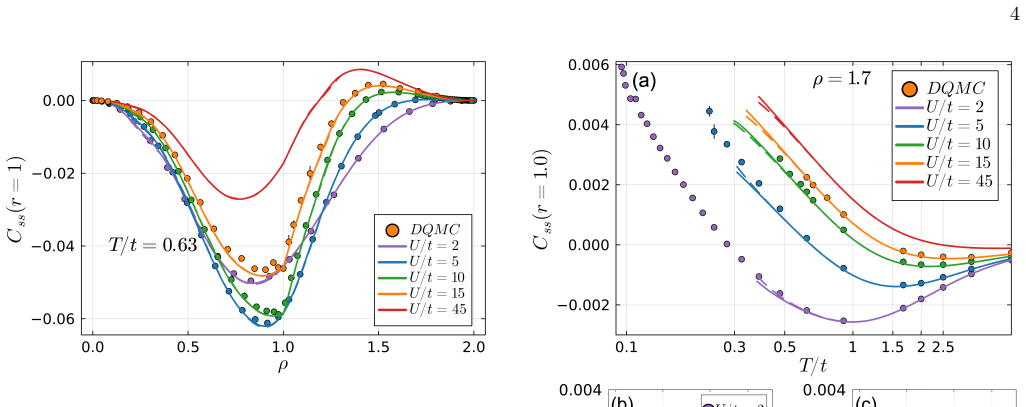
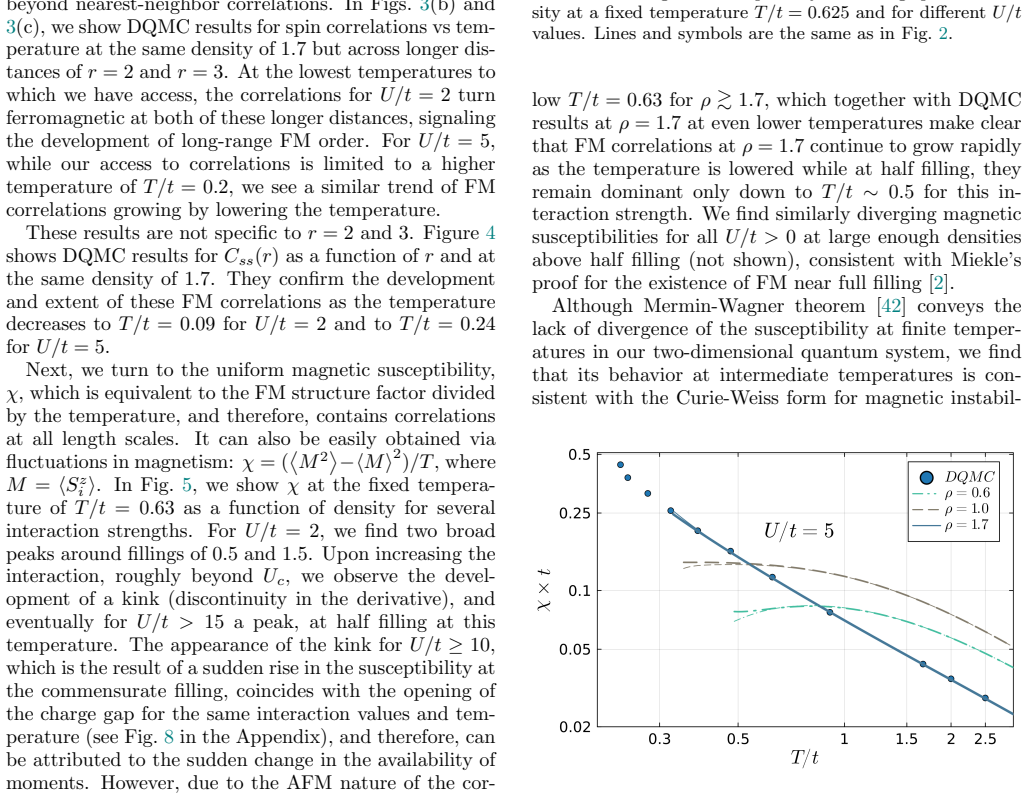
Repulsive interactions enhance ferromagnetic correlations at high electron densities in the kagome Hubbard model and extend the region toward half filling to connect with Nagaoka ferromagnetism.
A machine-rendered reading of the paper's core claim, the machinery that carries it, and where it could break.
Core claim
We find that repulsive interactions enhance ferromagnetic correlations at high electron densities and that increasing the interaction strength extends the region with strong ferromagnetic correlations towards half filling, smoothly connecting it to Nagaoka ferromagnetism near the Mott insulating region. We also use the charge compressibility to obtain an accurate estimate for the critical interaction strength for the metal-insulator transition at half filling.
What carries the argument
Numerical linked-cluster expansion and determinant quantum Monte Carlo applied to the kagome lattice Fermi-Hubbard model to compute finite-temperature spin correlations and charge compressibility as functions of density and interaction strength.
Load-bearing premise
The numerical linked-cluster expansion and determinant quantum Monte Carlo calculations converge sufficiently at the studied temperatures and system sizes to represent the thermodynamic-limit ferromagnetic correlations and compressibility without uncontrolled truncation or sign-problem artifacts.
What would settle it
A simulation or experiment at high electron density that finds ferromagnetic correlations weakening rather than strengthening as interaction strength increases, or that shows no extension of the ferromagnetic region toward half filling, would falsify the central claim.
Figures





read the original abstract
The Kagome lattice Fermi-Hubbard model is one of the most physically rich, and at the same time most challenging, models to study in strongly-correlated physics. Among its special features are geometric frustration and a flat energy band that create conditions favorable to ferromagnetism near the band insulating limit. Here, we utilize two exact finite-temperature methods, the numerical linked-cluster expansion and the determinant quantum Monte Carlo, to study the extent as well as doping and interaction dependence of ferromagnetic correlations and other thermodynamic properties of the model. We find that repulsive interactions enhance ferromagnetic correlations at high electron densities and that increasing the interaction strength, extends the region with strong ferromagnetic correlations towards half filling, smoothly connecting it to Nagaoka ferromagnetism near the Mott insulating region. We also use the charge compressibility to obtain an accurate estimate for the critical interaction strength for the metal-insulator transition at half filling. These results improve our understanding of the magnetic tendencies of the model away from half filling and pave the way for further studies, including with ultracold atoms in optical lattices.
Editorial analysis
A structured set of objections, weighed in public.
Referee Report
Summary. The manuscript examines the Kagome lattice Hubbard model at finite temperatures using the numerical linked-cluster expansion (NLC) and determinant quantum Monte Carlo (DQMC) methods. The authors find that repulsive interactions enhance ferromagnetic correlations at high electron densities, and that increasing the interaction strength extends the region with strong ferromagnetic correlations towards half filling, smoothly connecting it to Nagaoka ferromagnetism near the Mott insulating region. They also estimate the critical interaction strength for the metal-insulator transition at half filling using the charge compressibility.
Significance. If the numerical findings are confirmed to be free from significant finite-size, truncation, and sign-problem artifacts, this study would contribute significantly to understanding magnetic correlations in frustrated Hubbard models. The combination of two independent numerical techniques is a positive aspect, and the results could inform experiments with ultracold atoms. However, the strength of the conclusions hinges on the robustness of the data near half filling.
major comments (3)
- The central claim that increasing U extends the strong ferromagnetic region towards half filling and smoothly connects to Nagaoka ferromagnetism rests on the assumption that both NLC and DQMC faithfully capture thermodynamic-limit correlations. The manuscript should provide explicit checks, such as the average sign in DQMC as a function of n, U, and T (particularly for n close to 1), to confirm that sign-problem artifacts do not invalidate the reported susceptibilities.
- For the NLC results, convergence with respect to the maximum cluster size must be demonstrated for the ferromagnetic correlations near half filling, as finite-order truncations may miss long-wavelength fluctuations that become important at lower temperatures or higher U.
- The overlap between NLC and DQMC should be shown quantitatively (e.g., in a figure comparing ferromagnetic susceptibility vs. doping for fixed U values) to support the claim that the two methods agree and that the extension toward half filling is not an artifact of either technique.
minor comments (2)
- Clarify in the main text how the two methods are combined, including the specific temperature and doping ranges where each is applied and where they cross-validate.
- Ensure all figures include error bars, clear legends for different U and n values, and labels indicating the method used for each data set.
Simulated Author's Rebuttal
We thank the referee for their careful reading of our manuscript and for the constructive major comments. We have revised the manuscript to incorporate explicit checks on the DQMC sign problem, NLC convergence with cluster size, and a quantitative comparison between the two methods. These additions directly address the concerns about robustness near half filling and strengthen the support for our central claims.
read point-by-point responses
-
Referee: The central claim that increasing U extends the strong ferromagnetic region towards half filling and smoothly connects to Nagaoka ferromagnetism rests on the assumption that both NLC and DQMC faithfully capture thermodynamic-limit correlations. The manuscript should provide explicit checks, such as the average sign in DQMC as a function of n, U, and T (particularly for n close to 1), to confirm that sign-problem artifacts do not invalidate the reported susceptibilities.
Authors: We agree that explicit verification of the sign problem is necessary to substantiate the DQMC results near half filling. In the revised manuscript we have added a new supplementary figure (Fig. S1) plotting the average sign versus filling n for U = 4, 6, 8 and several temperatures down to T = 0.2. In the doping window n > 0.8 where we report enhanced ferromagnetic susceptibilities the average sign remains above 0.15, allowing reliable statistics with our Monte Carlo lengths. Closer to n = 1 the sign decreases, but we have restricted all quantitative claims to the region where the sign is still adequate; this addition confirms that sign-problem artifacts do not invalidate the reported trends. revision: yes
-
Referee: For the NLC results, convergence with respect to the maximum cluster size must be demonstrated for the ferromagnetic correlations near half filling, as finite-order truncations may miss long-wavelength fluctuations that become important at lower temperatures or higher U.
Authors: We thank the referee for highlighting the need for explicit NLC convergence tests near half filling. We have added an appendix (Appendix A) and an inset to Fig. 2 that show the ferromagnetic susceptibility for maximum cluster sizes 8, 10, and 12 at n = 0.95, U = 6, and T = 0.3. The susceptibility changes by less than 8 % between orders 10 and 12 and stabilizes for the temperatures and interaction strengths used in the main text. We note that at still lower T longer clusters would eventually be required, but within the parameter range of our conclusions the data are converged to the level stated. revision: yes
-
Referee: The overlap between NLC and DQMC should be shown quantitatively (e.g., in a figure comparing ferromagnetic susceptibility vs. doping for fixed U values) to support the claim that the two methods agree and that the extension toward half filling is not an artifact of either technique.
Authors: We appreciate the suggestion for a direct side-by-side comparison. The revised manuscript now contains a new figure (Fig. 3) that plots the ferromagnetic susceptibility versus doping for both NLC and DQMC at fixed U = 4, 6, 8 and T = 0.5. In the overlapping doping interval 0.75 < n < 0.9 the two independent methods agree within statistical error bars, providing quantitative support that the extension of strong ferromagnetic correlations toward half filling is not an artifact of either technique. revision: yes
Circularity Check
No circularity: results are direct numerical outputs from standard methods on the Hubbard Hamiltonian
full rationale
The paper computes ferromagnetic correlations and compressibility directly via NLC and DQMC applied to the standard Kagome Hubbard model. No parameters are fitted to data and then relabeled as predictions; no quantities are defined in terms of the results they are claimed to produce; no load-bearing claims reduce to self-citations or ansatzes imported from prior author work. The central statements (repulsive U enhancing FM correlations at high density, extension toward half-filling, and MIT estimate from compressibility) are outputs of the simulations, not tautological restatements of inputs. The work is therefore self-contained against external benchmarks.
Axiom & Free-Parameter Ledger
free parameters (2)
- On-site repulsion U
- Electron density n
axioms (2)
- domain assumption The Kagome lattice Hubbard model Hamiltonian is an accurate effective description of the system under study.
- domain assumption Numerical linked-cluster expansion and determinant quantum Monte Carlo provide unbiased access to finite-temperature observables in the thermodynamic limit when converged.
Reference graph
Works this paper leans on
-
[1]
sharper as the temperature decreases
The double occupancy also shows a crossing of curves at different temperatures around the same interaction strength. sharper as the temperature decreases. The double oc- cupancy also shows a crossing of curves from different temperatures aroundU/t= 6. Using exact NLCE results for the compressibility at intermediate temperatures, we are able to obtain an a...
-
[2]
J. Wang, Z. Jia, Z. Fan, Q. Duan, and T. Ma, Mag- netic fluctuations near the Van Hove singularity in the Kagome-lattice Hubbard model at finite doping, Phys. Rev. B113, 085128 (2026)
2026
-
[3]
Mielke, Exact ground states for the Hubbard model on the Kagome lattice, Journal of Physics A: Mathematical and General25, 4335 (1992)
A. Mielke, Exact ground states for the Hubbard model on the Kagome lattice, Journal of Physics A: Mathematical and General25, 4335 (1992)
1992
-
[4]
Tasaki, Ferromagnetism in the Hubbard models with degenerate single-electron ground states, Phys
H. Tasaki, Ferromagnetism in the Hubbard models with degenerate single-electron ground states, Phys. Rev. Lett. 69, 1608 (1992)
1992
-
[5]
Pollmann, P
F. Pollmann, P. Fulde, and K. Shtengel, Kinetic ferro- magnetism on a Kagome lattice, Phys. Rev. Lett.100, 136404 (2008)
2008
-
[6]
Nishimoto, M
S. Nishimoto, M. Nakamura, A. O’Brien, and P. Fulde, Metal-insulator transition of fermions on a Kagome lat- tice at 1/3 filling, Phys. Rev. Lett.104, 196401 (2010)
2010
-
[7]
Ferhat and A
K. Ferhat and A. Ralko, Phase diagram of the 1 3-filled extended Hubbard model on the Kagome lattice, Phys. Rev. B89, 155141 (2014)
2014
-
[8]
Pollmann, K
F. Pollmann, K. Roychowdhury, C. Hotta, and K. Penc, Interplay of charge and spin fluctuations of strongly in- teracting electrons on the Kagome lattice, Phys. Rev. B 90, 035118 (2014)
2014
-
[9]
B. H. Bernhard, B. Canals, and C. Lacroix, The Hub- bard model on the Kagome lattice, Journal of Physics: Condensed Matter19, 145258 (2007)
2007
-
[10]
Ohashi, N
T. Ohashi, N. Kawakami, and H. Tsunetsugu, Mott tran- sition in Kagom´ e lattice Hubbard model, Phys. Rev. Lett. 97, 066401 (2006)
2006
-
[11]
Kuratani, A
S. Kuratani, A. Koga, and N. Kawakami, Mott transition of correlated electrons on the Kagom´ e lattice, Journal of Physics: Condensed Matter19, 145252 (2007)
2007
-
[12]
Yamada, K
A. Yamada, K. Seki, R. Eder, and Y. Ohta, Mott transi- tion and ferrimagnetism in the Hubbard model on the anisotropic Kagome lattice, Phys. Rev. B83, 195127 (2011)
2011
-
[13]
Higa and K
R. Higa and K. Asano, Bond formation effects on the metal-insulator transition in the half-filled Kagome Hub- bard model, Phys. Rev. B93, 245123 (2016)
2016
-
[14]
Kaufmann, K
J. Kaufmann, K. Steiner, R. T. Scalettar, K. Held, and O. Janson, How correlations change the magnetic struc- ture factor of the Kagome Hubbard model, Phys. Rev. B 104, 165127 (2021)
2021
-
[15]
Sun and Z
R.-Y. Sun and Z. Zhu, Metal-insulator transition and in- termediate phases in the Kagome lattice Hubbard model, Phys. Rev. B104, L121118 (2021)
2021
-
[16]
A. R. Medeiros-Silva, N. C. Costa, and T. Paiva, Ther- modynamic, magnetic, and transport properties of the repulsive Hubbard model on the Kagome lattice, Phys. Rev. B107, 035134 (2023)
2023
-
[17]
Bulut, W
N. Bulut, W. Koshibae, and S. Maekawa, Magnetic corre- lations in the Hubbard model on triangular and Kagom´ e lattices, Phys. Rev. Lett.95, 037001 (2005)
2005
-
[18]
C. Wen, X. Zhu, Z. Xiao, N. Hao, R. Mondaini, H. Guo, and S. Feng, Superconducting pairing symmetry in the Kagome-lattice Hubbard model, Phys. Rev. B105, 075118 (2022)
2022
-
[19]
E. Y. Loh, J. E. Gubernatis, R. T. Scalettar, S. R. White, D. J. Scalapino, and R. L. Sugar, Sign problem in the nu- merical simulation of many-electron systems, Phys. Rev. B41, 9301 (1990)
1990
-
[20]
Henelius and A
P. Henelius and A. W. Sandvik, Sign problem in Monte Carlo simulations of frustrated quantum spin systems, Phys. Rev. B62, 1102 (2000)
2000
-
[21]
V. I. Iglovikov, E. Khatami, and R. T. Scalettar, Geom- etry dependence of the sign problem in quantum Monte Carlo simulations, Phys. Rev. B92, 045110 (2015)
2015
- [22]
-
[23]
M. L. Prichard, B. M. Spar, I. Morera, E. Demler, Z. Z. Yan, and W. S. Bakr, Directly imaging spin polarons in a kinetically frustrated Hubbard system, Nature629, 323 (2024)
2024
-
[24]
Nagaoka, Ground state of correlated electrons in a narrow almost half-filled s band, Solid State Communi- cations3, 409 (1965)
Y. Nagaoka, Ground state of correlated electrons in a narrow almost half-filled s band, Solid State Communi- cations3, 409 (1965)
1965
-
[25]
J. O. Haerter and B. S. Shastry, Kinetic antiferromag- 9 netism in the triangular lattice, Phys. Rev. Lett.95, 087202 (2005)
2005
-
[26]
G.-B. Jo, J. Guzman, C. K. Thomas, P. Hosur, A. Vish- wanath, and D. M. Stamper-Kurn, Ultracold atoms in a tunable optical Kagome lattice, Phys. Rev. Lett.108, 045305 (2012)
2012
-
[27]
Leung, M
T.-H. Leung, M. N. Schwarz, S.-W. Chang, C. D. Brown, G. Unnikrishnan, and D. Stamper-Kurn, Interaction- enhanced group velocity of bosons in the flat band of an optical Kagome lattice, Phys. Rev. Lett.125, 133001 (2020)
2020
-
[28]
T. H. Barter, T.-H. Leung, M. Okano, M. Block, N. Y. Yao, and D. M. Stamper-Kurn, Spatial coherence of a strongly interacting bose gas in the trimerized Kagome lattice, Phys. Rev. A101, 011601 (2020)
2020
-
[29]
H. Tasaki, From Nagaoka’s ferromagnetism to flat-band ferromagnetism and beyond: An introduction to ferro- magnetism in the Hubbard model, Progress of Theoreti- cal Physics99, 489 (1998)
1998
-
[30]
Rigol, T
M. Rigol, T. Bryant, and R. R. P. Singh, Numerical linked-cluster approach to quantum lattice models, Phys. Rev. Lett.97, 187202 (2006)
2006
-
[31]
B. Tang, E. Khatami, and M. Rigol, A short introduc- tion to numerical linked-cluster expansions, Computer Physics Communications184, 557 (2013)
2013
-
[32]
Domb and G
C. Domb and G. M. S.,Phase Transitions and Critical Phenomena, Vol. 3 (Academic Press, London, 1974)
1974
-
[33]
Oitmaa, C
J. Oitmaa, C. Hamer, and W. Zhang,Series Expansion Methods for Strongly Interacting Lattice Models(Cam- bridge University Press, Cambridge, England, 2006)
2006
-
[34]
A flexible implementation of the numerical linked-cluster expansions
Pranav Seetharaman, Francisco Correia, and Ehsan Khatami, “A flexible implementation of the numerical linked-cluster expansions” (unpublished)
-
[35]
H. W. Press, B. P. Flannery, S. A. Teukolsky, and W. T. Vetterling,Numerical Recipes in Fortran(Cambridge University Press, Cambridge, England, 1999) Chap. 5.1
1999
-
[36]
Rigol, T
M. Rigol, T. Bryant, and R. R. P. Singh, Numerical linked-cluster algorithms. i. spin systems on square, tri- angular, and Kagom´ e lattices, Phys. Rev. E75, 061118 (2007)
2007
-
[37]
B. Tang, T. Paiva, E. Khatami, and Rigol, Finite- temperature properties of strongly correlated fermions in the honeycomb lattice, Phys. Rev. B88, 125127 (2013)
2013
-
[38]
Khatami, R
E. Khatami, R. T. Scalettar, and R. R. P. Singh, Finite- temperature superconducting correlations of the Hub- bard model, Phys. Rev. B(R)91, 241107 (2015)
2015
-
[39]
Cohen-Stead, S
B. Cohen-Stead, S. M. Costa, J. Neuhaus, A. T. Ly, Y. Zhang, R. Scalettar, K. Barros, and S. Johnston, Smo- QyDQMC.jl: A flexible implementation of determinant quantum Monte Carlo for Hubbard and electron-phonon interactions, SciPost Phys. Codebases , 29 (2024)
2024
-
[40]
Miles, B
C. Miles, B. Cohen-Stead, O. Bradley, S. Johnston, R. Scalettar, and K. Barros, Dynamical tuning of the chemical potential to achieve a target particle number in grand canonical Monte Carlo simulations, Phys. Rev. E 105, 045311 (2022)
2022
-
[41]
M. Xu, L. H. Kendrick, A. Kale, Y. Gang, G. Ji, R. T. Scalettar, M. Lebrat, and M. Greiner, Frustration- and doping-induced magnetism in a Fermi–Hubbard simula- tor, Nature620, 971 (2023)
2023
-
[42]
Lebrat, M
M. Lebrat, M. Xu, L. H. Kendrick, A. Kale, Y. Gang, P. Seetharaman, I. Morera, E. Khatami, E. Demler, and M. Greiner, Observation of Nagaoka polarons in a Fermi– Hubbard quantum simulator, Nature629, 317 (2024)
2024
-
[43]
N. D. Mermin and H. Wagner, Absence of ferromag- netism or antiferromagnetism in one- or two-dimensional isotropic Heisenbergmodels, Phys. Rev. Lett.17, 1133 (1966)
1966
-
[44]
Y. Tang, L. Li, T. Li, Y. Xu, S. Liu, K. Barmak, K. Watanabe, T. Taniguchi, A. H. MacDonald, J. Shan, and K. F. Mak, Simulation of Hubbard model physics in wse2/ws2 moir´ e superlattices, Nature579, 353 (2020)
2020
-
[45]
K. Lee, P. Sharma, O. Vafek, and H. J. Changlani, Tri- angular lattice Hubbard model physics at intermediate temperatures, Phys. Rev. B107, 235105 (2023)
2023
-
[46]
Morera, M
I. Morera, M. Kan´ asz-Nagy, T. Smolenski, L. Ciorciaro, A. m. c. Imamo˘ glu, and E. Demler, High-temperature kinetic magnetism in triangular lattices, Phys. Rev. Res. 5, L022048 (2023)
2023
-
[47]
Immanuel Bloch (private communication)
-
[48]
Ferrimagnetism of ultracold fermions in a multi-band Hubbard system
M. Lebrat, A. Kale, L. H. Kendrick, M. Xu, Y. Gang, A. Nikolaenko, P. M. Bonetti, S. Sachdev, and M. Greiner, Ferrimagnetism of ultracold fermions in a multi-band Hubbard system (2025), arXiv:2404.17555 [cond-mat.quant-gas]
work page internal anchor Pith review arXiv 2025
- [49]
-
[50]
L. O. Lima, A. R. Medeiros-Silva, R. R. dos San- tos, T. Paiva, and N. C. Costa, Magnetism and metal- insulator transitions in the anisotropic Kagome lattice, Phys. Rev. B108, 235163 (2023)
2023
-
[51]
Lange, A
H. Lange, A. Van de Walle, A. Abedinnia, and A. Bohrdt, From architectures to applications: a review of neural quantum states, Quantum Science and Technology9, 040501 (2024)
2024
-
[52]
J. R. Moreno, G. Carleo, A. Georges, and J. Stokes, Fermionic wave functions from neural-network con- strained hidden states, Proceedings of the National Academy of Sciences119, e2122059119 (2022)
2022
-
[53]
Ibarra-Garc´ ıa-Padilla, H
E. Ibarra-Garc´ ıa-Padilla, H. Lange, R. G. Melko, R. T. Scalettar, J. Carrasquilla, A. Bohrdt, and E. Khatami, Autoregressive neural quantum states of Fermi Hubbard models, Phys. Rev. Res.7, 013122 (2025)
2025
- [54]
- [55]
discussion (0)
Sign in with ORCID, Apple, or X to comment. Anyone can read and Pith papers without signing in.