Weighted Emulators with Local Heaviest Edges Stretch for Undirected Graphs
Pith reviewed 2026-05-07 10:54 UTC · model grok-4.3
The pith
A new family of emulators for weighted undirected graphs achieves stretch bounded by the two heaviest edges on shortest paths with Õ(n^{1+1/k}) edges for any k.
A machine-rendered reading of the paper's core claim, the machinery that carries it, and where it could break.
Core claim
We introduce a generalized family of (2⋅⌊k/2⌋−1, 2⋅⌈k/2⌉⋅W1 + max{0,2⋅(⌈k/2⌉−2)}⋅W2)-emulators with Õ(n^{1+1/k}) edges, for any k∈ℕ, where Wi is the i-th heaviest edge on a shortest path between two vertices. When k is even these are (k−1, k⋅W1 + (k−4)⋅W2)-emulators and when k is odd these are (k−2, (k+1)⋅W1 + (k−3)⋅W2)-emulators. The framework expands known constructions for weighted graphs and yields an improved stretch over the additive +Õ(δ^{1−1/k})-emulator of Thorup and Zwick for all vertex pairs separated by distance δ ≤ O(3^{k²}).
What carries the argument
The local heaviest-edges stretch, an additive stretch term built from the first and second heaviest edges W1 and W2 on any shortest path, realized by a sampling and clustering procedure that retains Õ(n^{1+1/k}) edges while preserving the property.
If this is right
- When k is even the emulators achieve stretch (k−1, k⋅W1 + (k−4)⋅W2).
- When k is odd the emulators achieve stretch (k−2, (k+1)⋅W1 + (k−3)⋅W2).
- The emulators have size Õ(n^{1+1/k}) for every natural number k.
- For vertex pairs at distance δ ≤ O(3^{k²}) the construction improves the additive stretch of Thorup-Zwick emulators.
- The new family generalizes the +2W1-spanner of size Õ(n^{3/2}) and the +4W1-emulator of size Õ(n^{4/3}).
Where Pith is reading between the lines
- The local heaviest-edge formulation may allow tuning k according to the typical distance scale of an application rather than fixing a global multiplicative factor.
- Combining the sampling procedure with existing multiplicative spanners could produce hybrid emulators whose stretch adapts to both local heavy edges and global structure.
- The improvement in the small-distance unweighted regime suggests that similar local-weight ideas could be tested on concrete network instances to measure realized stretch beyond worst-case analysis.
Load-bearing premise
The input graph is undirected with positive real edge weights and a suitable sampling or clustering procedure exists that selects retained edges while preserving the local heaviest-edge stretch property.
What would settle it
A concrete weighted graph on n vertices for fixed k where every subgraph with Õ(n^{1+1/k}) edges violates the stated (multiplicative, additive-in-W1-W2) stretch bound for at least one pair of vertices.
Figures




read the original abstract
We introduce a generalized family of $\left( 2\cdot \left\lfloor \frac{k}{2} \right\rfloor-1, 2\cdot \left\lceil \frac{k}{2} \right\rceil \cdot W_{1} +\max\left\{0,2\cdot\left(\left\lceil\frac{k}{2}\right\rceil-2\right)\right\}\cdot W_{2} \right)$-emulators with $\tilde O \left(n^{1+\frac{1}{k}}\right)$ edges, for any $k\in\mathbb{N}$, where $W_{i}$ is the $i$th heaviest edge on a shortest path between two vertices. Our construction generalizes the $+2W_{1}$-spanner of size $\tilde O\left(n^{\frac{3}{2}}\right)$ and the $+4W_{1}$-emulator of size $\tilde O \left(n^{\frac{4}{3}}\right)$, both by Elkin, Gitlitz and Neiman [DISC'21 and DICO'23]. When $k$ is even, these are $\left(k-1,k\cdot W_{1} + \left(k-4\right)\cdot W_{2}\right)$-emulators and when $k$ is odd, these are $\left(k-2,\left(k+1\right)\cdot W_{1} + \left(k-3\right) \cdot W_{2}\right)$-emulators. Our framework not only expands known constructions for weighted graphs but also yields an improved stretch over state of the art emulators and spanners for unweighted graphs within a specific distance regime. In particular, for all vertex pairs separated by a distance of $\delta \leq O\left(3^{k^{2}}\right)$, our construction improves upon the seminal additive $+\tilde O\left(\delta^{1-\frac{1}{k}}\right)$-emulator of size $\tilde O\left(n^{1+\frac{1}{2^{k+1}-1}}\right)$ by Thorup and Zwick [SODA'06].
Editorial analysis
A structured set of objections, weighed in public.
Referee Report
Summary. The paper introduces a parameterized family of weighted emulators for undirected graphs with positive real edge weights. For any natural number k, it constructs (2⌊k/2⌋−1, 2⌈k/2⌉⋅W1 + max{0,2(⌈k/2⌉−2)}⋅W2)-emulators of size Õ(n^{1+1/k}), where Wi denotes the i-th heaviest edge on a shortest path. The construction generalizes the +2W1 spanner (k=2) and +4W1 emulator (k=3) of Elkin et al., and for even/odd k yields the simplified forms (k−1, k⋅W1+(k−4)⋅W2) and (k−2, (k+1)⋅W1+(k−3)⋅W2). It also claims an improvement over Thorup-Zwick additive emulators for unweighted graphs when distances are at most O(3^{k²}).
Significance. If the stretch and size bounds hold, the result supplies a flexible combinatorial framework for emulators whose additive stretch is expressed directly in terms of the two heaviest edges on shortest paths. This extends known techniques from weighted spanners/emulators and yields a concrete improvement over the Thorup-Zwick construction inside a bounded-distance regime for unweighted graphs. The explicit dependence on local heaviest-edge weights may be useful for downstream algorithms that already exploit edge-weight ordering.
major comments (2)
- [§4] §4 (Construction and Analysis): the inductive/recursive clustering procedure for arbitrary k is described at a high level, but the argument that inter-cluster connections and sampling probabilities preserve the exact claimed coefficients on W1 and W2 (without extra additive factors) is not fully expanded. The base cases k=2 and k=3 are referenced to prior work, yet the step that bounds the number of clusters crossed and the heaviest-edge ordering for k>3 requires a concrete lemma or calculation.
- [Theorem 1] Theorem 1 (main size-and-stretch statement): the Õ(n^{1+1/k}) edge bound is asserted after choosing sampling probability p and cluster radius r, but the explicit dependence of the hidden constants on k (arising from the product of per-level sampling rates) is not derived, making it impossible to verify that the bound matches the known Õ(n^{3/2}) and Õ(n^{4/3}) results for k=2,3.
minor comments (2)
- [§2] The notation W1, W2 is introduced in the abstract and used throughout, yet the precise definition (whether ties are broken arbitrarily or by index along the path) is stated only informally; a short paragraph in §2 would remove ambiguity.
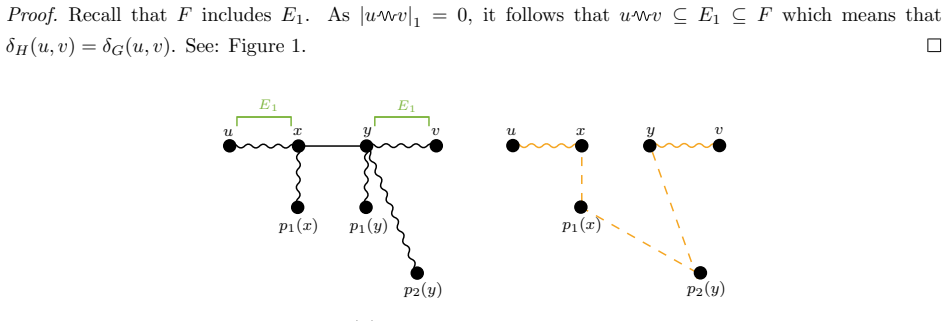
- [Figure 1] Figure 1 (illustrative example) labels the retained edges but does not annotate the two heaviest edges on the depicted shortest path, making it harder to verify the claimed stretch visually.
Simulated Author's Rebuttal
We thank the referee for the thorough review and constructive feedback on our manuscript. We address each major comment below, indicating the revisions we will incorporate to strengthen the presentation and verifiability of the results.
read point-by-point responses
-
Referee: [§4] §4 (Construction and Analysis): the inductive/recursive clustering procedure for arbitrary k is described at a high level, but the argument that inter-cluster connections and sampling probabilities preserve the exact claimed coefficients on W1 and W2 (without extra additive factors) is not fully expanded. The base cases k=2 and k=3 are referenced to prior work, yet the step that bounds the number of clusters crossed and the heaviest-edge ordering for k>3 requires a concrete lemma or calculation.
Authors: We agree that the inductive step for general k would benefit from a more explicit argument. In the revised manuscript we will add a dedicated lemma (Lemma 4.3) that tracks the number of clusters crossed by a shortest path and verifies that the sampling probabilities and inter-cluster edge selections preserve exactly the claimed multiplicative and additive coefficients on W1 and W2, without extraneous additive terms. The proof will proceed by induction on k, with the base cases k=2 and k=3 citing the referenced prior work and the inductive step providing the concrete calculation for the heaviest-edge ordering when k>3. revision: yes
-
Referee: [Theorem 1] Theorem 1 (main size-and-stretch statement): the Õ(n^{1+1/k}) edge bound is asserted after choosing sampling probability p and cluster radius r, but the explicit dependence of the hidden constants on k (arising from the product of per-level sampling rates) is not derived, making it impossible to verify that the bound matches the known Õ(n^{3/2}) and Õ(n^{4/3}) results for k=2,3.
Authors: We acknowledge that the dependence of the Õ notation on k is not expanded in the current draft. In the revision we will insert an explicit calculation (immediately following the choice of p and r in the proof of Theorem 1) that unfolds the product of the per-level sampling rates and shows that the resulting size is O(n^{1+1/k} · f(k)) where f(k) is a function of k only. Specializing to k=2 and k=3 recovers the known Õ(n^{3/2}) and Õ(n^{4/3}) bounds up to the standard polylogarithmic factors absorbed by the Õ notation. revision: yes
Circularity Check
No circularity: explicit combinatorial construction with independent stretch analysis
full rationale
The paper presents an explicit sampling/clustering construction for the claimed (2⌊k/2⌋−1, 2⌈k/2⌉⋅W1 + max{0,2(⌈k/2⌉−2)}⋅W2)-emulators of size Õ(n^{1+1/k}). Stretch bounds are derived from the procedure's edge-retention properties and local heaviest-edge ordering on shortest paths, without any fitted parameters, self-definitional reductions, or load-bearing self-citations. Prior base cases (k=2,3) are cited to independent external work; the general-k extension follows from the same combinatorial rules without collapsing to the input by construction.
Axiom & Free-Parameter Ledger
free parameters (1)
- k
axioms (1)
- domain assumption Input graph is undirected with positive real-valued edge weights.
Reference graph
Works this paper leans on
-
[1]
The 4/3 Additive Spanner Exponent Is Tight
Amir Abboud and Greg Bodwin. “The 4/3 Additive Spanner Exponent Is Tight”. In:J. ACM64.4 (Sept. 2017). issn: 0004-5411.doi:10.1145/3088511.url:https://doi.org/10.1145/3088511
work page doi:10.1145/3088511.url:https://doi.org/10.1145/3088511 2017
-
[2]
A Hierarchy of Lower Bounds for Sublinear Additive Spanners
Amir Abboud, Greg Bodwin, and Seth Pettie. “A Hierarchy of Lower Bounds for Sublinear Additive Spanners”. In:SIAM Journal on Computing47.6 (2018), pp. 2203–2236.doi:10 . 1137 / 16M1105815. eprint:https : //doi.org/10.1137/16M1105815.url:https://doi.org/10.1137/16M1105815
work page doi:10.1137/16m1105815.url:https://doi.org/10.1137/16m1105815 2018
-
[3]
On Additive Spanners in Weighted Graphs with Local Error
Reyan Ahmed, Greg Bodwin, Keaton Hamm, Stephen Kobourov, and Richard Spence. “On Additive Spanners in Weighted Graphs with Local Error”. In:Graph-Theoretic Concepts in Computer Science. Ed. by Lukasz Kowalik, Micha l Pilipczuk, and Pawe l Rza˙ zewski. Cham: Springer International Publishing, 2021, pp. 361–373. isbn: 978-3-030-86838-3
2021
-
[4]
Reyan Ahmed, Greg Bodwin, Faryad Darabi Sahneh, Stephen Kobourov, and Richard Spence. “Weighted Additive Spanners”. In:arXiv(2021). arXiv:2002.07152 [cs.DM].url:https://arxiv.org/abs/2002.07152
-
[5]
Fast Estimation of Diameter and Shortest Paths (Without Matrix Multiplication)
Donald Aingworth, Chandra Chekuri, Piotr Indyk, and Rajeev Motwani. “Fast Estimation of Diameter and Shortest Paths (Without Matrix Multiplication)”. In:SIAM Journal on Computing28.4 (1999), pp. 1167–1181. doi:10.1137/S0097539796303421
-
[6]
Fast Construction of 4-Additive Spanners
Bandar Al-Dhalaan. “Fast Construction of 4-Additive Spanners”. In:arXivabs/2106.07152 (2021). arXiv: 2106.07152.url:https://arxiv.org/abs/2106.07152
-
[7]
On sparse spanners of weighted graphs
Ingo Althofer, Gautam Das, David Dobkin, Deborah Joseph, and Jose Soares. “On sparse spanners of weighted graphs”. In:Discrete Comput. Geom.9.1 (Dec. 1993), pp. 81–100.issn: 0179-5376
1993
-
[8]
Faster Algorithms for All-pairs Approximate Shortest Paths in Undirected Graphs
Surender Baswana and Telikepalli Kavitha. “Faster Algorithms for All-pairs Approximate Shortest Paths in Undirected Graphs”. In:SIAM Journal on Computing39.7 (2010), pp. 2865–2896.doi:10.1137/080737174. url:https://doi.org/10.1137/080737174
-
[9]
Faster Algorithms for Approximate Distance Oracles and All-Pairs Small Stretch Paths
Surender Baswana and Telikepalli Kavitha. “Faster Algorithms for Approximate Distance Oracles and All-Pairs Small Stretch Paths”. In:2006 47th Annual IEEE Symposium on Foundations of Computer Science (FOCS’06). Oct. 2006, pp. 591–602.doi:10.1109/FOCS.2006.29
-
[10]
Additive spanners and (α,β)- spanners
Surender Baswana, Telikepalli Kavitha, Kurt Mehlhorn, and Seth Pettie. “Additive spanners and (α,β)- spanners”. In:ACM Trans. Algorithms7.1 (Dec. 2010).issn: 1549-6325.doi:10.1145/1868237.1868242.url: https://doi.org/10.1145/1868237.1868242
-
[11]
A simple and linear time randomized algorithm for computing sparse spanners in weighted graphs
Surender Baswana and Sandeep Sen. “A simple and linear time randomized algorithm for computing sparse spanners in weighted graphs”. In:Random Structures & Algorithms30.4 (2007), pp. 532–563.doi:https : //doi.org/10.1002/rsa.20130. eprint:https://onlinelibrary.wiley.com/doi/pdf/10.1002/rsa.20130. url:https://onlinelibrary.wiley.com/doi/abs/10.1002/rsa.20130
-
[12]
New (α, β) Spanners and Hopsets
Uri Ben-Levy and Merav Parter. “New (α, β) Spanners and Hopsets”. In:Proceedings of the 2020 ACM-SIAM Symposium on Discrete Algorithms (SODA), pp. 1695–1714.doi:10 . 1137 / 1 . 9781611975994 . 104.url: https://epubs.siam.org/doi/abs/10.1137/1.9781611975994.104
-
[13]
Shiri Chechik. “New Additive Spanners”. In:Proceedings of the 2013 Annual ACM-SIAM Symposium on Discrete Algorithms (SODA), pp. 498–512.doi:10.1137/1.9781611973105.36.url:https://epubs.siam. org/doi/abs/10.1137/1.9781611973105.36. 41
work page doi:10.1137/1.9781611973105.36.url:https://epubs.siam 2013
-
[14]
Edith Cohen and Uri Zwick. “All-Pairs Small-Stretch Paths”. In:Journal of Algorithms38.2 (1997), pp. 335– 353.issn: 0196-6774.doi:http://doi.org/10.1006/jagm.2000.1117.url:http://dl.acm.org/doi/pdf/10. 5555/314161.314190
work page doi:10.1006/jagm.2000.1117.url:http://dl.acm.org/doi/pdf/10 1997
-
[15]
All-Pairs Almost Shortest Paths
Dorit Dor, Shay Halperin, and Uri Zwick. “All-Pairs Almost Shortest Paths”. In:SIAM Journal on Com- puting29.5 (2000), pp. 1740–1759.doi:10 . 1137 / S0097539797327908.url:https : / / doi . org / 10 . 1137 / S0097539797327908
2000
-
[16]
Fast 2-Approximate All-Pairs Shortest Paths
Michal Dory, Sebastian Forster, Yael Kirkpatrick, Yasamin Nazari, Virginia Vassilevska Williams, and Tijn De Vos. “Fast 2-Approximate All-Pairs Shortest Paths”. In:arXiv(2023).doi:10.1137/1.9781611977912.169. arXiv:2307.09258 [cs.DS].url:https://arxiv.org/abs/2307.09258
-
[17]
Almost Shortest Paths with Near-Additive Error in Weighted Graphs
Michael Elkin, Yuval Gitlitz, and Ofer Neiman. “Almost Shortest Paths with Near-Additive Error in Weighted Graphs”. In:18th Scandinavian Symposium and Workshops on Algorithm Theory (SWAT 2022). Ed. by Artur Czumaj and Qin Xin. Vol. 227. Leibniz International Proceedings in Informatics (LIPIcs). Dagstuhl, Germany: Schloss Dagstuhl – Leibniz-Zentrum f¨ ur I...
-
[18]
Improved Weighted Additive Spanners
Michael Elkin, Yuval Gitlitz, and Ofer Neiman. “Improved Weighted Additive Spanners”. In:35th International Symposium on Distributed Computing (DISC 2021). Vol. 209. Leibniz International Proceedings in Informatics (LIPIcs). Dagstuhl, Germany: Schloss Dagstuhl – Leibniz-Zentrum f¨ ur Informatik, 2021, 21:1–21:15.isbn: 978-3-95977-210-5.doi:10 . 4230 / LIP...
-
[19]
(1 +ε·β)-spanner constructions for general graphs
Michael Elkin and David Peleg. “(1 +ε·β)-spanner constructions for general graphs”. In:Proceedings of the Thirty-Third Annual ACM Symposium on Theory of Computing. STOC ’01. Hersonissos, Greece: Association for Computing Machinery, 2001, pp. 173–182.isbn: 1581133499.doi:10.1145/380752.380797.url:https: //doi.org/10.1145/380752.380797
-
[20]
Extremal problems in graph theory
Paul Erd˝ os. “Extremal problems in graph theory”. In:Proceedings of the Symposium on Theory of Graphs and Its Applications. Smolenice, Czechoslovakia, 1963, pp. 29–36
1963
-
[21]
Lower Bounds on Sparse Spanners, Emulators, and Diameter-Reducing Shortcuts
Shang-En Huang and Seth Pettie. “Lower Bounds on Sparse Spanners, Emulators, and Diameter-Reducing Shortcuts”. In:SIAM Journal on Discrete Mathematics35.3 (2021), pp. 2129–2144.doi:10.1137/19M1306154. eprint:https://doi.org/10.1137/19M1306154.url:https://doi.org/10.1137/19M1306154
-
[22]
Thorup–Zwick emulators are universally optimal hopsets
Shang-En Huang and Seth Pettie. “Thorup–Zwick emulators are universally optimal hopsets”. In:Information Processing Letters142 (2019), pp. 9–13.issn: 0020-0190.doi:https://doi.org/10.1016/j.ipl.2018.10.001. url:https://www.sciencedirect.com/science/article/pii/S0020019018301868
-
[23]
Shimon Kogan and Merav Parter. “New Additive Emulators”. In:50th International Colloquium on Automata, Languages, and Programming (ICALP 2023). Ed. by Kousha Etessami, Uriel Feige, and Gabriele Puppis. Vol. 261. Leibniz International Proceedings in Informatics (LIPIcs). Dagstuhl, Germany: Schloss Dagstuhl – Leibniz-Zentrum f¨ ur Informatik, 2023, 85:1–85:...
-
[24]
New weighted additive spanners
An La and Hung Le. “New weighted additive spanners”. In:arXiv(2024). arXiv:2408.14638 [cs.DS].url: https://arxiv.org/abs/2408.14638. 42
-
[25]
Liam Roditty and Ariel Sapir. “Additive, Near-Additive, and Multiplicative Approximations for APSP in Weighted Undirected Graphs: Trade-Offs and Algorithms”. In:45th IARCS Annual Conference on Foundations of Software Technology and Theoretical Computer Science (FSTTCS 2025). Ed. by C. Aiswarya, Ruta Mehta, and Subhajit Roy. Vol. 360. Leibniz International...
-
[26]
Faster Approximate All Pairs Shortest Paths
Barna Saha and Christopher Ye. “Faster Approximate All Pairs Shortest Paths”. In:Proceedings of the 2024 Annual ACM-SIAM Symposium on Discrete Algorithms (SODA). siam, 2023, pp. 4758–4827.doi:10.1137/ 1.9781611977912.170. eprint:https://epubs.siam.org/doi/pdf/10.1137/1.9781611977912.170.url: https://epubs.siam.org/doi/abs/10.1137/1.9781611977912.170
-
[27]
Approximate distance oracles
Mikkel Thorup and Uri Zwick. “Approximate distance oracles”. In:Journal of the ACM52 (2005), pp. 1–24. url:https://www.cs.jhu.edu/ ~baruch/teaching/600.427/Papers/oracle-STOC-try.pdf
2005
-
[28]
Mikkel Thorup and Uri Zwick. “Compact routing schemes”. In: SPAA ’01. Crete Island, Greece: Association for Computing Machinery, 2001, pp. 1–10.isbn: 1581134096.doi:10 . 1145 / 378580 . 378581.url:https : //doi.org/10.1145/378580.378581
-
[29]
Spanners and emulators with sublinear distance errors
Mikkel Thorup and Uri Zwick. “Spanners and emulators with sublinear distance errors”. In:Proceedings of the Seventeenth Annual ACM-SIAM Symposium on Discrete Algorithm. SODA ’06. Miami, Florida: Society for Industrial and Applied Mathematics, 2006, pp. 802–809.isbn: 0898716055
2006
-
[30]
Greedy Completion for Weighted (α, β)-Spanners
Elad Tzalik. “Greedy Completion for Weighted (α, β)-Spanners”. In:arXivabs/2603.17047 (2026). eprint: 2603.17047(cs.DS).url:https://arxiv.org/abs/2603.17047
-
[31]
Additive spanners in nearly quadratic time
David P. Woodruff. “Additive spanners in nearly quadratic time”. In:Proceedings of the 37th International Colloquium Conference on Automata, Languages and Programming. ICALP’10. Bordeaux, France: Springer- Verlag, 2010, pp. 463–474.isbn: 3642141641
2010
-
[32]
Lower Bounds for Additive Spanners, Emulators, and More
David P. Woodruff. “Lower Bounds for Additive Spanners, Emulators, and More”. In:2006 47th Annual IEEE Symposium on Foundations of Computer Science (FOCS’06). 2006, pp. 389–398.doi:10.1109/FOCS.2006.45. A Runtime Efficient Construction In this section, we present Algorithm 4, which is a runtime efficient algorithm that essentially constructs the same 2· k...
-
[33]
We assume without loss of generality thatp 1(w)∈ball(x, S 1, S2)
Case (c1):p 1(x)∈ball(w, S 1, S2) orp 1(w)∈ball(x, S 1, S2). We assume without loss of generality thatp 1(w)∈ball(x, S 1, S2). By Claim A.4 it follows that d[p1(w), x] =δ G(p1(w), x). The rest follows as inCase (c 1)from Lemma 6.5
-
[34]
Letibe the minimal such index
Case (c2):p 1(x)/∈ball(w, S 1, S2),p 1(w)/∈ball(x, S 1, S2) and there exists an 2≤i≤k−4 such thatp i(x)∈ball(p 1(w), Si , Si+2) orp i(w)∈ball(p 1(x), Si , Si+2). Letibe the minimal such index. By Claim A.5 it follows thatd[p i(x), p1(w)] =δ G(pi(x), p1(w)). The rest follows as inCase (c 2)from Lemma 6.5
-
[35]
In this case we introduce a slight modification to our case analysis
Case (c3):p 1(x)/∈ball(w, S 1, S2),p 1(w)/∈ball(x, S 1, S2) and for any 2≤i≤k−4 it holds thatp i(x)/∈ball(p1(w), Si , Si+2) andp i(w)/∈ball(p 1(x), Si , Si+2). In this case we introduce a slight modification to our case analysis. By Claim A.6 eitheru v⊆E k−1, in which case eitherd[p k−2(x), p1(w)] =δ G(pk−2(x), p1(w)) and we continue as inCase (c 3)from L...
discussion (0)
Sign in with ORCID, Apple, or X to comment. Anyone can read and Pith papers without signing in.