Recognition: unknown
Quantum scattering of droplets by wells and barriers in one-dimensional Bose-Bose mixtures
Pith reviewed 2026-05-07 11:24 UTC · model grok-4.3
The pith
Quantum droplets in one-dimensional Bose mixtures show a sharp switch from total reflection to transmission through attractive wells at a critical incident velocity.
A machine-rendered reading of the paper's core claim, the machinery that carries it, and where it could break.
Core claim
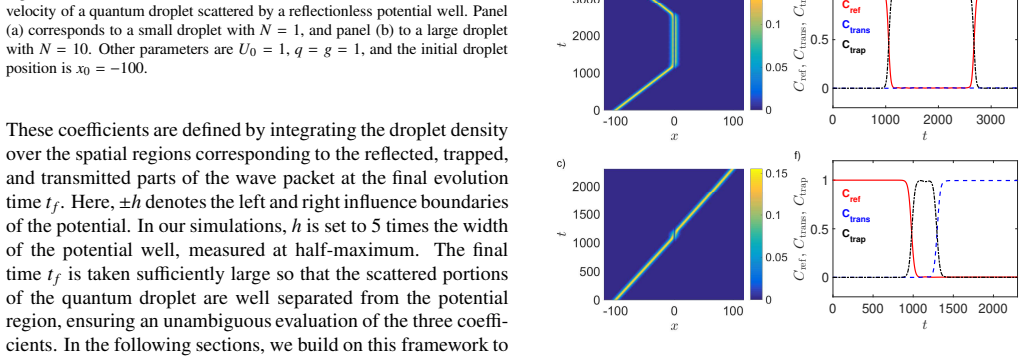
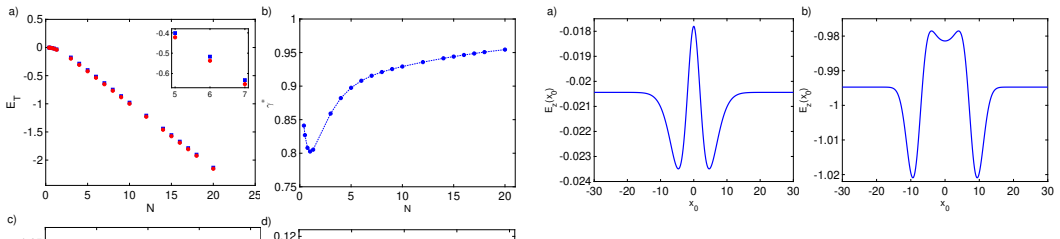
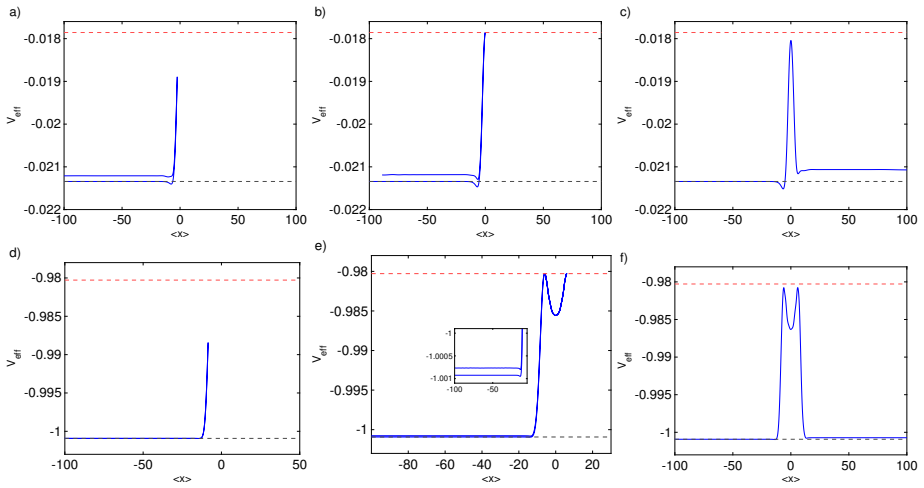
For attractive Pöschl-Teller wells, quasi-one-dimensional quantum droplets exhibit a sharp transition between complete reflection and complete transmission at a critical incident velocity. Small soliton-like droplets develop a spatially symmetric trapped mode at criticality, while large flat-top droplets develop a spatially asymmetric trapped state. The critical velocity depends non-monotonically on atom number, rising in the small-droplet compressible regime, falling in the large-droplet incompressible regime, and turning at the crossover. Reflectionless wells produce a pi phase shift that alters droplet-droplet collisions, and the persistence of confined modes after such collisions depends
What carries the argument
The Pöschl-Teller potential wells and barriers acting on the mean-field wave functions of the two-component Bose gas that supports quantum droplet solutions.
If this is right
- A reflectionless well imparts a pi phase shift that strongly modifies subsequent droplet-droplet collisions relative to free space.
- The survival of a trapped mode after a collision between a pre-trapped droplet and an incident droplet depends on their relative phase.
- Repulsive barriers produce regimes of complete reflection, partial return, or full transmission that depend on incident velocity, barrier height, and particle number.
- All analytic predictions for these scattering outcomes are confirmed by direct numerical integration of the governing equations.
Where Pith is reading between the lines
- The non-monotonic critical velocity could be used to design velocity-selective filters or switches for droplet transport in guided atomtronic systems.
- The emergence of asymmetric trapped states for large droplets implies that internal density structure begins to couple to the scattering dynamics once the droplet exceeds the soliton-like size.
- Phase-dependent persistence of confined modes after collisions suggests a route to phase-controlled droplet interferometry using static wells.
Load-bearing premise
The quasi-one-dimensional mean-field description of the Bose-Bose mixture remains accurate and the chosen Pöschl-Teller potentials faithfully represent experimental potentials without important higher-dimensional or beyond-mean-field corrections.
What would settle it
An experiment that measures transmission probability versus incident velocity for droplets of varying atom number and finds either a smooth rather than abrupt change or a monotonic rather than non-monotonic dependence of the critical velocity on atom number.
Figures






read the original abstract
We investigate, both analytically and numerically, the scattering of quasi-one-dimensional quantum droplets from P\"oschl-Teller potential wells and barriers. For attractive wells, we find a sharp transition between complete reflection and transmission at a critical incident velocity for both small and large flat-top droplets. The scattering interactions differ: small, soliton-like droplets form a spatially symmetric trapped mode at the critical velocity, showing their compressibility and coherence characteristics, while large droplets develop a spatially asymmetric trapped state, revealing incompressibility and internal structure. The critical velocity depends non-monotonically on atom number: it rises in the small, compressible-droplet regime, falls in the incompressible, flat-top regime, and turns at the crossover point. We also show that the reflectionless well generates a $\pi$-phase shift, strongly altering droplet-droplet collisions relative to free space. The persistence of a confined mode after collisions between trapped and incident droplets depends sensitively on their relative phase. For the repulsive barrier, we identify regimes of complete reflection, partial return, and full transmission, depending on incident velocity, barrier height, and particle number. Our predictions match direct numerical simulations in all cases.
Editorial analysis
A structured set of objections, weighed in public.
Referee Report
Summary. The paper investigates analytically and numerically the scattering of quasi-1D quantum droplets in Bose-Bose mixtures from Pöschl-Teller wells and barriers within the extended Gross-Pitaevskii framework. For attractive wells it reports a sharp reflection-to-transmission transition at a critical incident velocity, with small compressible droplets forming spatially symmetric trapped modes and large incompressible flat-top droplets forming asymmetric trapped states; the critical velocity depends non-monotonically on atom number. Reflectionless wells induce a π-phase shift that alters droplet-droplet collisions, while barrier scattering exhibits complete reflection, partial return, or full transmission regimes depending on velocity, height, and particle number. All analytical predictions are stated to match direct numerical simulations.
Significance. If the results hold, the work advances understanding of quantum-droplet dynamics in inhomogeneous potentials by linking compressibility and internal structure to distinct scattering outcomes and phase effects. The direct numerical verification of the analytical predictions (including the non-monotonic critical-velocity curve and phase-dependent collision persistence) is a clear strength, providing falsifiable benchmarks for the quasi-1D model. These findings are relevant to ongoing experiments with engineered potentials in one-dimensional ultracold gases.
minor comments (3)
- The numerical methods section should specify grid resolution, time-stepping scheme, and convergence/error estimates so that the claimed agreement between analytics and simulations can be independently reproduced.
- Figure captions would benefit from explicit listing of the atom numbers, velocities, and potential depths used in each panel to facilitate direct comparison with the analytic expressions.
- A brief statement in the introduction or model section on the range of validity of the quasi-1D extended GPE (e.g., with respect to transverse confinement strength) would help readers assess the applicability of the reported regimes.
Simulated Author's Rebuttal
We thank the referee for the careful reading of our manuscript, the positive evaluation of its significance, and the recommendation for minor revision. The summary accurately captures the key findings on velocity-dependent scattering transitions, trapped modes in compressible versus incompressible droplets, non-monotonic critical velocity dependence, phase-shift effects, and barrier regimes, all verified against numerics.
Circularity Check
No significant circularity
full rationale
The paper's central results on scattering transitions, trapped modes, and velocity dependence are obtained by direct analytical and numerical solution of the standard quasi-1D extended Gross-Pitaevskii equations for the Bose-Bose mixture. No parameter is fitted to a subset of data and then relabeled as a prediction; no load-bearing step reduces to a self-citation or self-defined ansatz; and all reported behaviors are cross-checked against independent numerical integration of the same governing equations. The derivation chain therefore remains self-contained against external benchmarks.
Axiom & Free-Parameter Ledger
axioms (2)
- domain assumption Quasi-one-dimensional reduction of the three-dimensional Bose-Bose mixture dynamics
- domain assumption Mean-field Gross-Pitaevskii-type equations govern the droplet scattering
Reference graph
Works this paper leans on
-
[1]
Friedrich, A
H. Friedrich, A. Jurisch, Quantum reflection times for at - tractive potential tails, Phys. Rev. Lett. 92, 103202 (2004). 15
2004
-
[2]
Druzhinina, M
V . Druzhinina, M. DeKieviet, Experimental observation of Quantum reflection far from threshold, Phys. Rev. Lett. 91, 193202 (2003)
2003
-
[3]
R. Côté, B. Segev, Quantum reflection engineering: The bichromatic evanescent-wave mirror, Phys. Rev. A 67, 041604(R) (2003)
2003
-
[4]
Shimizu, Specular Reflection of very slow metastable neon atoms from a solid surface, Phys
F. Shimizu, Specular Reflection of very slow metastable neon atoms from a solid surface, Phys. Rev. Lett. 86, 987 (2001)
2001
-
[5]
T. A. Pasquini, Y . Shin, C. Sanner, M. Saba, A. Schi- rotzek, D. E. Pritchard, W . Ketterle, Quantum reflection from a solid surface at normal incidence, Phys. Rev. Lett. 93, 223201 (2004)
2004
-
[6]
Amico, M
L. Amico, M. Boshier, G. Birkl, A. Minguzzi et al., Roadmap on Atomtronics: State of the art and perspec- tive, A VS Quantum Sci.3, 039201 (2021)
2021
-
[7]
Gertjerenken, T
B. Gertjerenken, T. P . Wiles, C. Weiss, Progress to- wards quantum-enhanced interferometry with harmoni- cally trapped quantum matter-wave bright solitons, Phys. Rev. A 94, 053638 (2016)
2016
-
[8]
A. D. Martin, J. Ruostekoski, Quantum dynamics of atomic bright solitons under splitting and recollision, an d implications for interferometry, New J. Phys. 14, 043040 (2012)
2012
-
[9]
R. H. Goodman, P . J. Holmes, M. I. Weinstein, Strong NLS soliton-defect interactions, Physica D 192, 215 (2004)
2004
-
[10]
C. Lee, J. Brand, Enhanced quantum reflection of matter- wave solitons, EuroPhys. Lett. 73, 321 (2006)
2006
-
[11]
X. D. Cao, B. A. Malomed, Soliton-defect collisions in t he nonlinear Schrödinger equation, Phys. Rev. Lett. A 206, 177 (1995)
1995
-
[12]
Forinash, M
K. Forinash, M. Peyrard, B. Malomed, Interaction of dis - crete breathers with impurity modes, Phys.Rev. E 49, 3400 (1994)
1994
-
[13]
A. L. Marchant, T. P . Billam, T. P . Wiles, M. M. H. Y u, S. A. Gardiner, S. L. Cornish, Controlled formation and reflection of a bright solitary matter-wave, Nat. Commun. 4, 1865 (2013)
2013
-
[14]
Sakaguchi, M
H. Sakaguchi, M. Tamura, Scattering and trapping of non - linear Schrödinger solitons in external potentials, J. Phy s. Soc. Jpn. 73, 503 (2004)
2004
-
[15]
Al Sakkaf, U
L. Al Sakkaf, U. Al Khawaja, Reflectionless potentials and resonant scattering of flat-top and thin-top solitons, Phys. Rev. E 107, 014202 (2023)
2023
-
[16]
L. Zeng, J. Zeng, Gaussian-like and flat-top solitons of atoms with spatially modulated repulsive interactions, JOSA B 36, 2278 (2019)
2019
-
[17]
B. A. Umarov, N. A. B. Aklan, M. R. Rosly, T. H. Has- san, Flat top solitons on linear gaussian potential, J. Phys .: Conf. Ser. 890 (1), 012071 (2017)
2017
-
[18]
P . O. Fedichev, Y u. Kagan, G. V . Shlyapnikov, J. T. M. Walraven, Influence of nearly resonant light on the scat- tering length in low-temperature atomic gases, Phys. Rev. Lett. 77, 2913 (1996)
1996
-
[19]
Y amazaki, S
R. Y amazaki, S. Taie, S. Sugawa, Y . Takahashi, Submi- cron spatial modulation of an interatomic interaction in a Bose-Einstein condensate, Phys. Rev. Lett. 105, 050405 (2010)
2010
-
[20]
Theocharis, P
G. Theocharis, P . Schmelcher, P . G. Kevrekidis, D. J. Frantzeskakis, Dynamical trapping and transmission of matter-wave solitons in a collisionally inhomogeneous en- vironment, Phys. Rev. A 74, 053614 (2006)
2006
-
[21]
Garnier, F
J. Garnier, F. Kh. Abdullaev, Transmission of matter-w ave solitons through nonlinear traps and barriers, Phys. Rev. A 74, 013604 (2006)
2006
-
[22]
F. Kh. Abdullaev, A. Gammal, L. Tomio, Dynamics of bright matter-wave solitons in a Bose-Einstein conden- sate with inhomogeneous scattering length, J. Phys. B: At. Mol. Opt. Phys. 37 (3), 635 (2004)
2004
-
[23]
Al Khawaja, Stability and dynamics of two-soliton molecules, Phys
U. Al Khawaja, Stability and dynamics of two-soliton molecules, Phys. Rev. E 81, 056603 (2010)
2010
-
[24]
O. V . Marchukov, B. A. Malomed, V . A. Y urovsky, M. Olshanii, V . Dunjko, R. G. Hulet, Splitting of nonlinear- Schrödinger equation breathers by linear and nonlinear lo- calized potentials, Phys. Rev. A 99, 063623 (2019)
2019
-
[25]
Cuevas, P
J. Cuevas, P . G. Kevrekidis, B. A. Malomed, P . Dyke, R. G. Hulet, Interactions of solitons with a Gaussian barrier: splitting and recombination in quasi-one-dimensional and three-dimensional settings, New J. Phys. 15, 063006 (2013)
2013
-
[26]
D. S. Petrov, Quantum mechanical stabilization of a col - lapsing Bose-Bose mixture, Phys. Rev. Lett. 115, 155302 (2015)
2015
-
[27]
D. S. Petrov, G. E. Astrakharchik, Ultradilute low- dimensional liquids, Phys. Rev. Lett. 117, 100401 (2016)
2016
-
[28]
T. D. Lee, K. Huang, C. N. Y ang, Eigenvalues and eigen- functions of a Bose system of hard spheres and its low- temperature properties, Phys. Rev. 106, 1135 (1957)
1957
-
[29]
C. R. Cabrera, L. Tanzi, J. Sanz, B. Naylor, P . Thomas, P .Cheiney, L. Tarruell, Quantum liquid droplets in a mixture of Bose-Einstein condensates, Science 359, 301 (2018)
2018
-
[30]
Semeghini, G
G. Semeghini, G. Ferioli, L. Masi, C. Mazzinghi, L. Wol- swijk, F. Minardi, M. Modugno, G. Modugno, M. Ingus- cio, M. Fattori, Self-bound quantum droplets of atomic mixtures in free space, Phys. Rev. Lett. 120, 235301 (2018). 16
2018
-
[31]
Ferrier-Barbut, H
I. Ferrier-Barbut, H. Kadau, M. Schmitt, M. Wenzel, T. Pfau, Observation of quantum droplets in a strongly dipo- lar Bose gas, Phys. Rev. Lett. 116, 215301 (2016)
2016
-
[32]
X. Hu, Z. Li, Y . Guo, Y . Chen, X. Luo, Scattering of one- dimensional quantum droplets by a reflectionless potential well, Phys. Rev. A 108, 053306 (2023)
2023
-
[33]
Debnath, A
A. Debnath, A. Khan, B. Malomed, Interaction of one- dimensional quantum droplets with potential wells and barriers, Commun. Nonlinear Sci. Numer. Simul. 126, 107457 (2023)
2023
-
[34]
F. Kh. Abdullaev, R. M. Galimzyanov, Bosonic impurity in a one-dimensional quantum droplet in the Bose-Bose mixture, J. Phys. B: At. Mol. Opt. Phys. 53 , 165301 (2020)
2020
-
[35]
Bighin, A
G. Bighin, A. Burchianti, F. Minardi, T. Macrì, Im- purity in a heteronuclear two-component Bose mixture, Phys.Rev. A 106, 023301 (2022)
2022
-
[36]
Sinha, S
S. Sinha, S. Biswas, L. Santos, S. Sinha, Impurities in quasi-one-dimensional droplets of binary Bose mixtures, Phys. Rev. A 108, 023311 (2023)
2023
-
[37]
Bristy, G
F. Bristy, G. A. Bougas, G. C. Katsimiga, S. I. Mistakidi s, Localization and splitting of a quantum droplet with a po- tential defect, Chaos, Solitons, and Fractals 201, 117383 (2025)
2025
-
[38]
P . Zin, M. Pylak, T. Wasak, K. Jachymski, Z. Idziaszek, Quantum droplets in a dipolar Bose gas at a dimensional crossover, J. Phys. B: At. Mol. Opt. Phys. 54, 165302 (2021)
2021
-
[39]
Debnath, A
A. Debnath, A. Khan, Investigation of quantum droplets : an analytical approach, Ann. der Phys. 533, 2000549 (2021)
2021
-
[40]
Sh. R. Otajonov, E. N. Tsoy, F. Kh. Abdullaev, Station- ary and dynamical properties of one-dimensional quantum droplets, Phys. Lett. A 383, 125980 (2019)
2019
-
[41]
Sh. R. Otajonov, B. A. Umarov, F. Kh. Abdullaev, Dynam- ics of quasi-one-dimensional quantum droplets in Bose- Bose mixtures, Chaos, Solitons, and Fractals 186, 115212 (2024)
2024
-
[42]
Sh. R. Otajonov, B. A. Umarov, F. Kh. Abdullaev, Modu- lational instability and discrete quantum droplets in a deep quasi-one-dimensional optical lattice, Phys. Rev. E 111, 054206 (2025)
2025
-
[43]
Al Khawaja, Critical soliton speed for quantum reflec - tion by a reflectionless potential well, Phys
U. Al Khawaja, Critical soliton speed for quantum reflec - tion by a reflectionless potential well, Phys. Rev. E 103, 062202 (2021)
2021
-
[44]
Sh. R. Otajonov, E. N. Tsoy, F. Kh. Abdullaev, V ariational approximation for two-dimensional quantum droplets, Phys. Rev. E 102, 062217 (2020)
2020
-
[45]
Sh. R. Otajonov, Quantum droplets in three-dimensiona l Bose-Einstein condensates, J. Phys. B: At. Mol. Opt. Phys 55, 085001 (2022)
2022
-
[46]
Kh. M. Elhadj, L. Al Sakkaf, A. Boudjemâa, U. Al Khawaja, Quantum droplet molecules in Bose-Bose mix- tures, Phys. Lett. A 494, 129274 (2024)
2024
-
[47]
A. L. Marchant, T. P . Billam, M. M. H. Y u, A. Rakonjac, J. L. Helm, J. Polo, C. Weiss, S. A. Gardiner, S. L. Cornish, Quantum reflection of bright solitary matter waves from a narrow attractive potential, Phys. Rev. A 93, 021604(R) (2016). 17
2016
discussion (0)
Sign in with ORCID, Apple, or X to comment. Anyone can read and Pith papers without signing in.