Recognition: unknown
Designing Solutions to Geophysical Inverse Problems by Changing Variables
Pith reviewed 2026-05-07 08:57 UTC · model grok-4.3
The pith
Geophysical inverse solutions can be designed simply by changing how parameters are represented.
A machine-rendered reading of the paper's core claim, the machinery that carries it, and where it could break.
Core claim
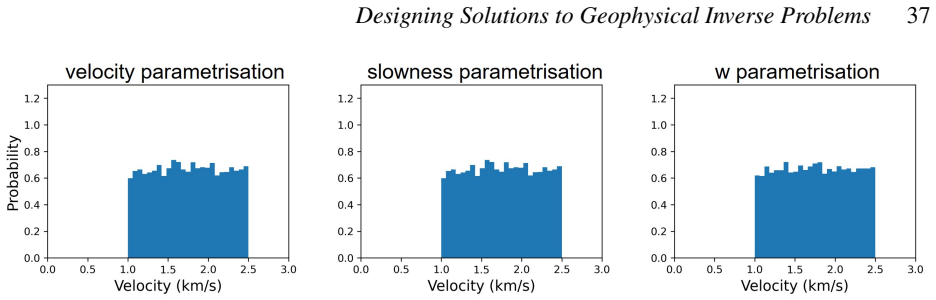
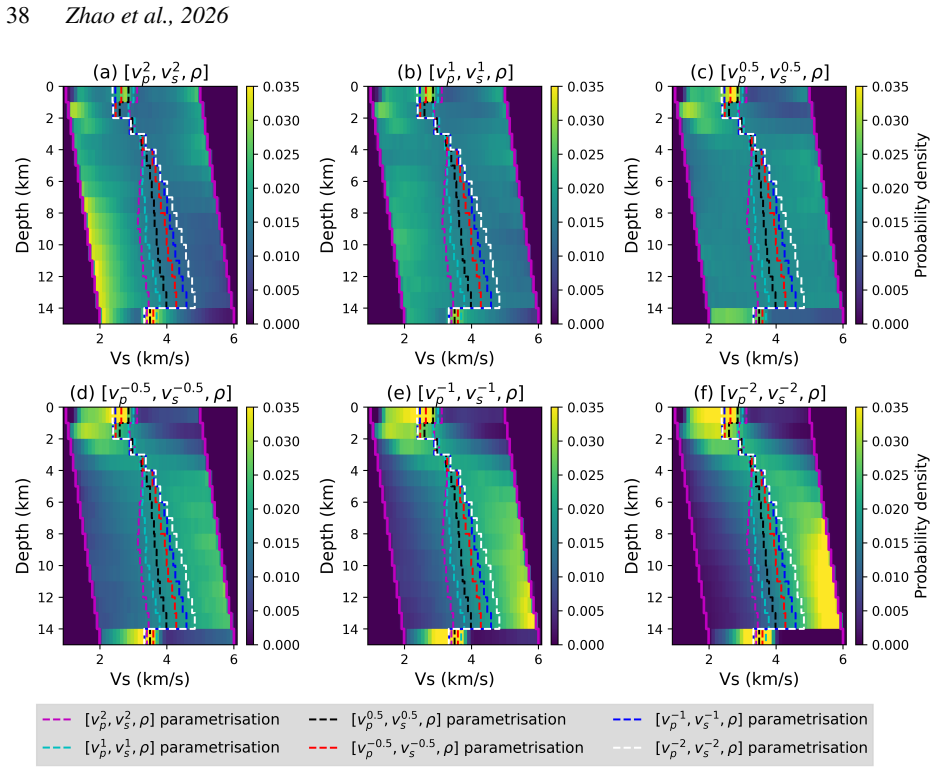
Different parametrisations that encode exactly the same information yield mathematically inconsistent conditional probability densities. When these densities are used in Bayesian inference for geophysical inverse problems with real and synthetic data, the resulting posterior solutions differ dramatically. Because deterministic inversion is mathematically equivalent to computing the maximum a posteriori solution, the same inconsistency appears in deterministic results as well. Solutions can therefore be designed simply by changing the parametrisation.
What carries the argument
The BK-inconsistency: the mathematical inconsistency between conditional probability densities obtained from equivalent but differently parametrised descriptions of the same information.
If this is right
- Bayesian posterior solutions for geophysical problems differ dramatically depending on the chosen parametrisation.
- Deterministic inversion results become inconsistent across parametrisations because they match maximum a posteriori solutions.
- Solutions to inverse problems can be designed or steered by selecting appropriate parameter representations.
- A rethinking of Bayesian inference and deterministic inversion may be required for physical problems.
Where Pith is reading between the lines
- Uncertainty estimates used for risk-based decisions may depend on the arbitrary choice of variables rather than being unique to the data.
- Consistency checks across multiple equivalent parametrisations could become a standard validation step in geophysical workflows.
- The effect may extend to inverse problems outside geophysics whenever Bayesian or MAP-based methods are applied to continuous parameters.
Load-bearing premise
That different parametrisations truly encode exactly the same information and that observed differences arise solely from the BK-inconsistency rather than implementation details or data-specific choices.
What would settle it
Apply two equivalent parametrisations to the same geophysical data set and prior information, then check whether the resulting posterior probability densities and deterministic inversion solutions are identical.
Figures

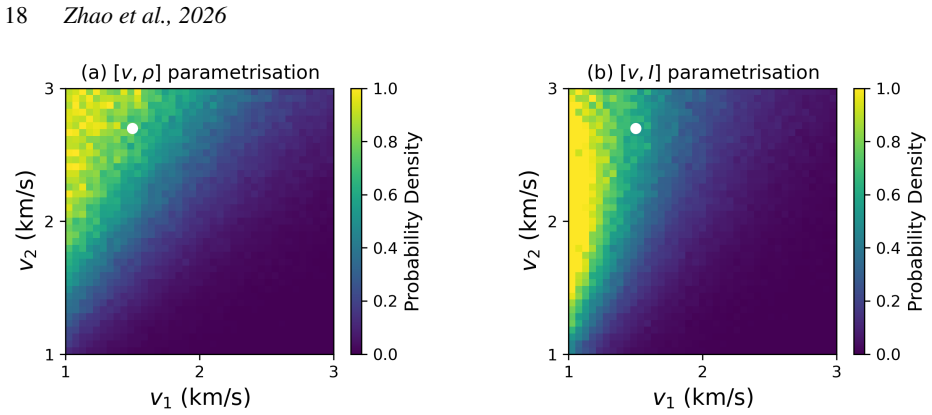
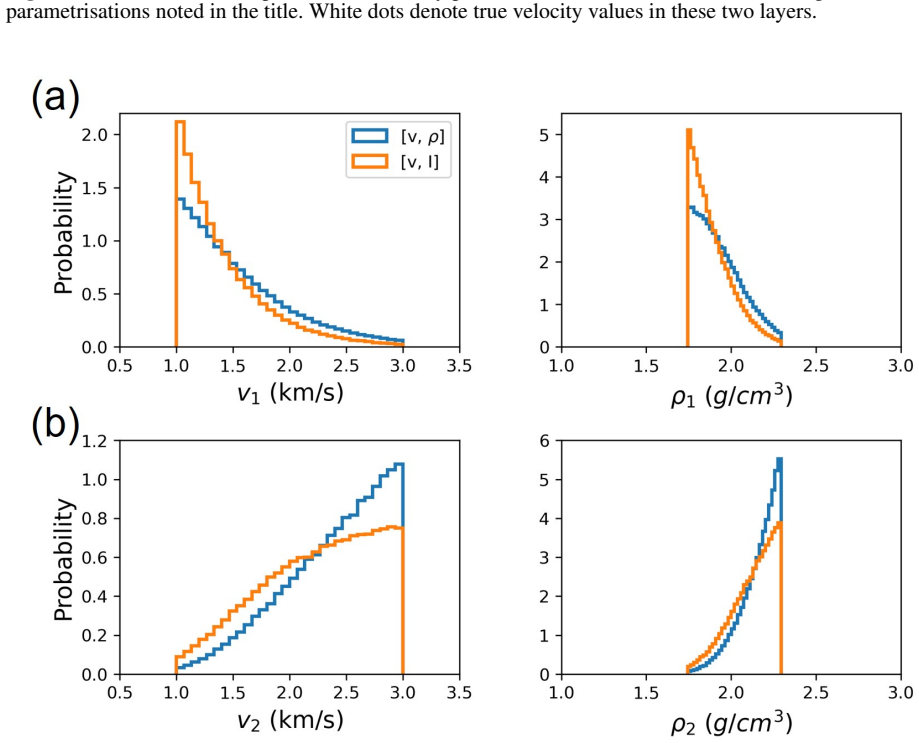
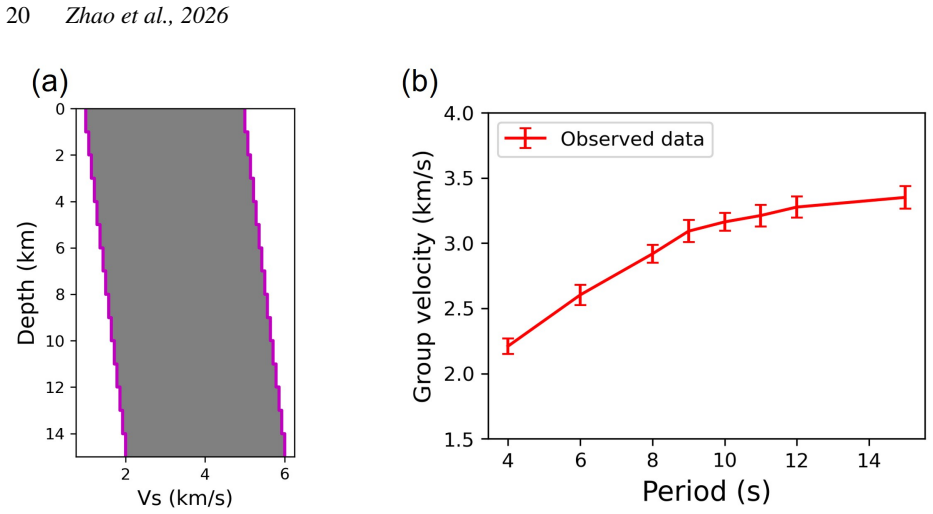
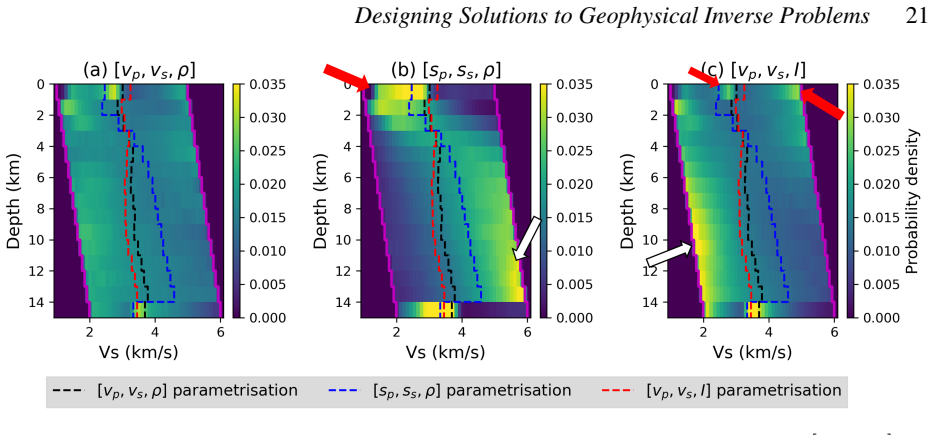



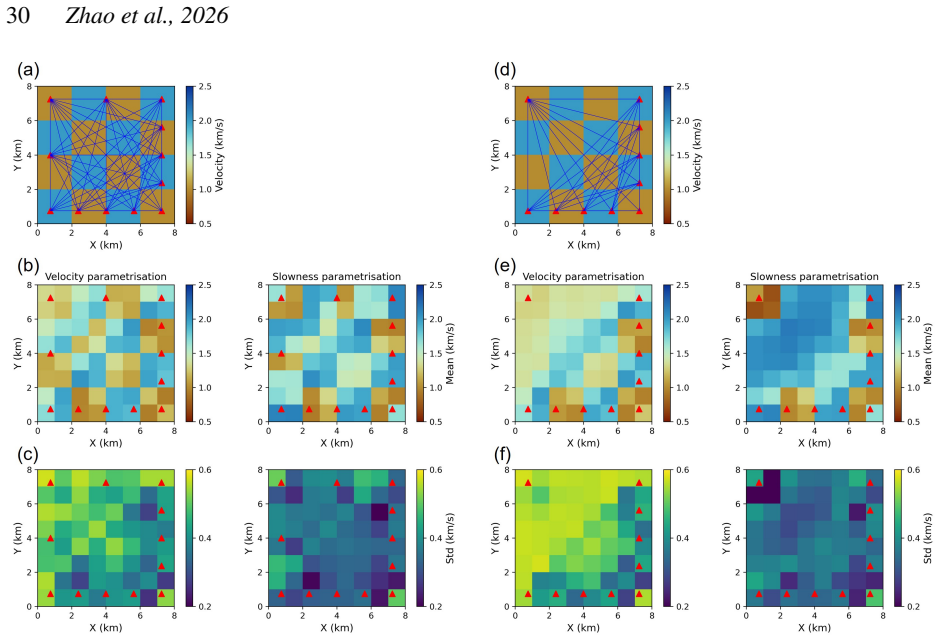
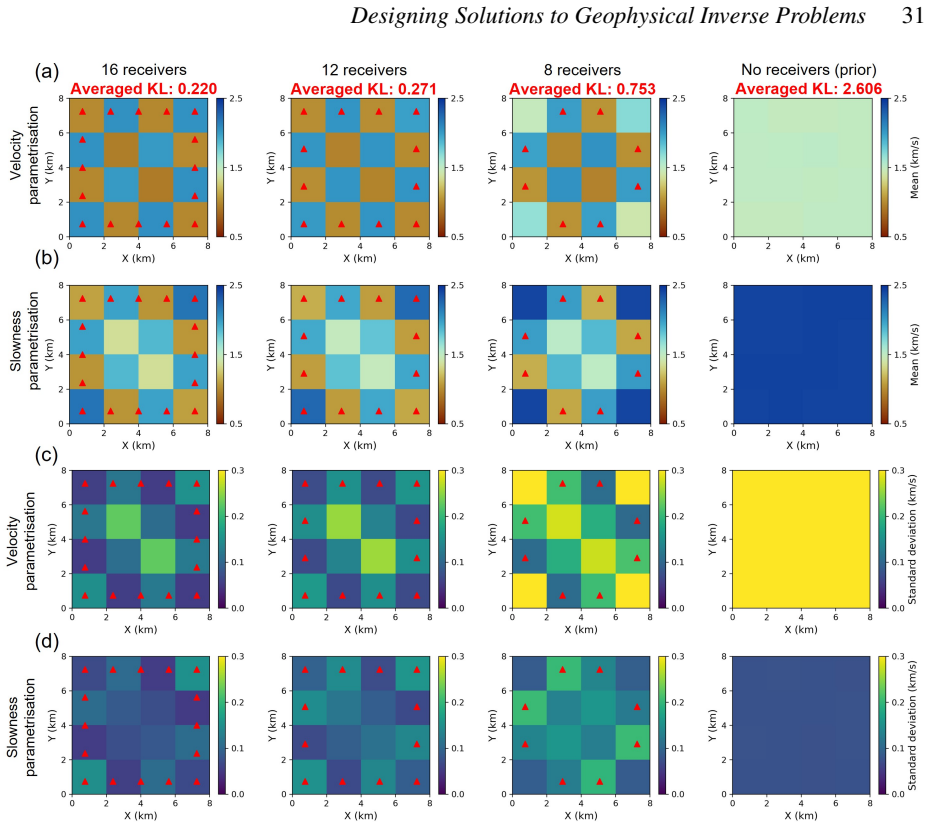
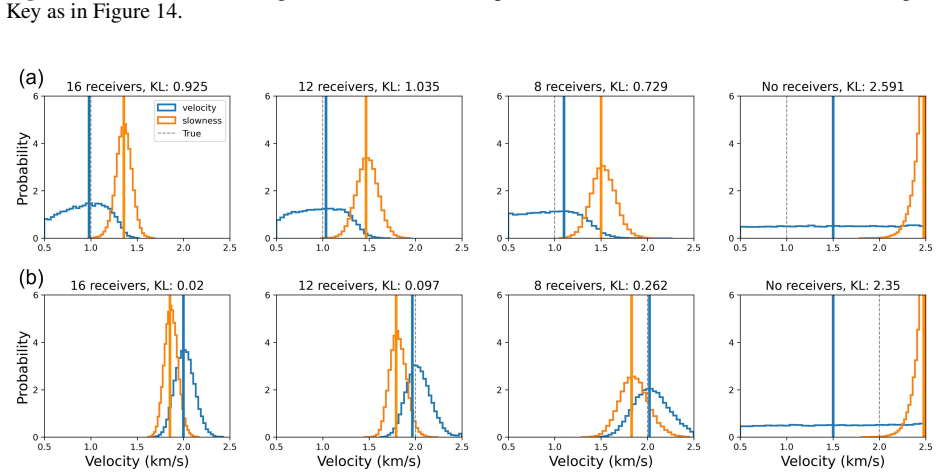
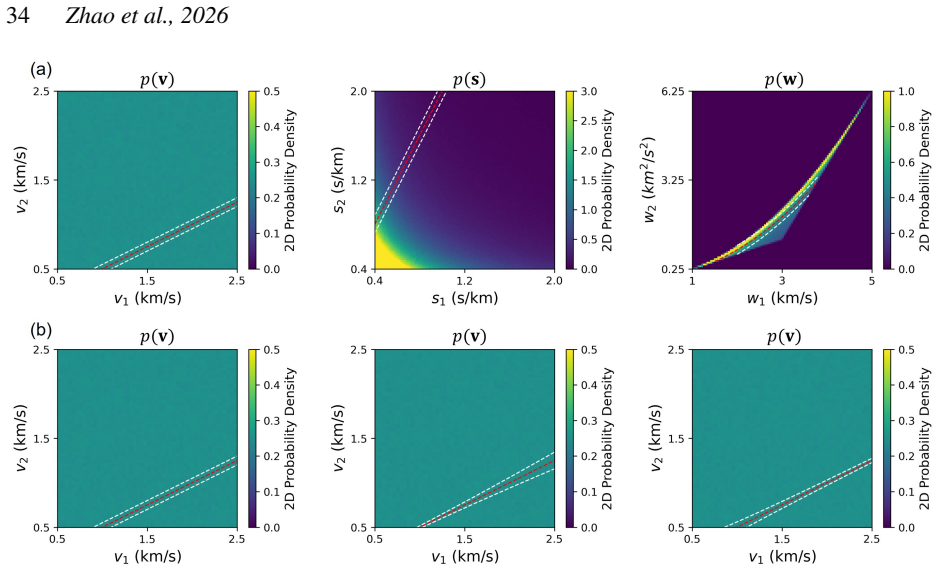

read the original abstract
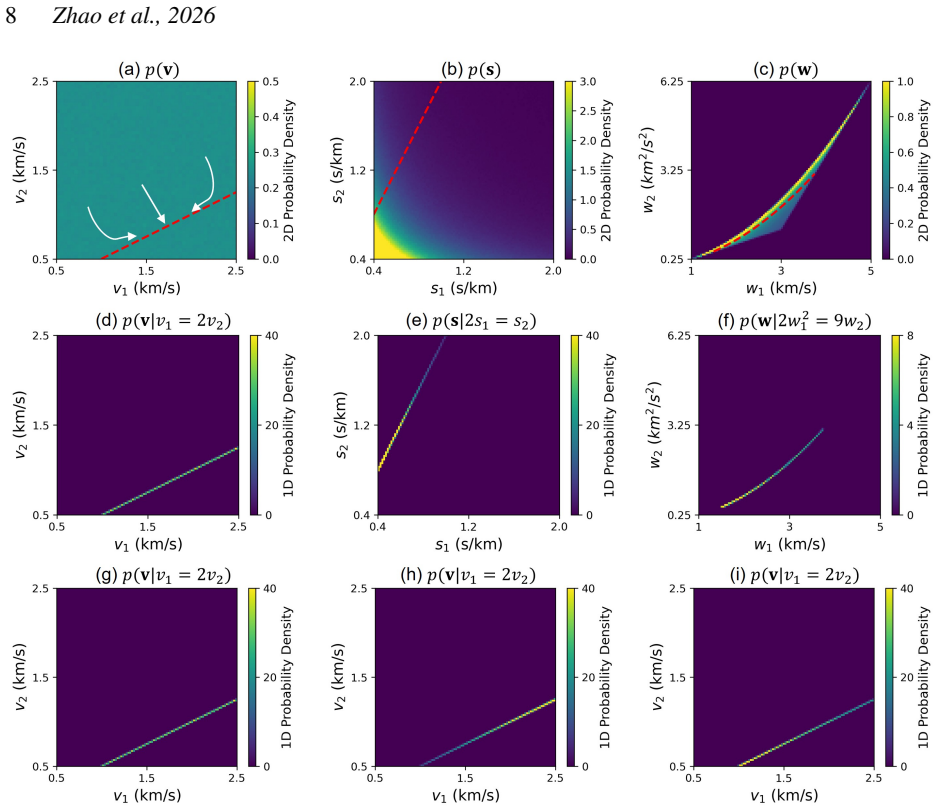
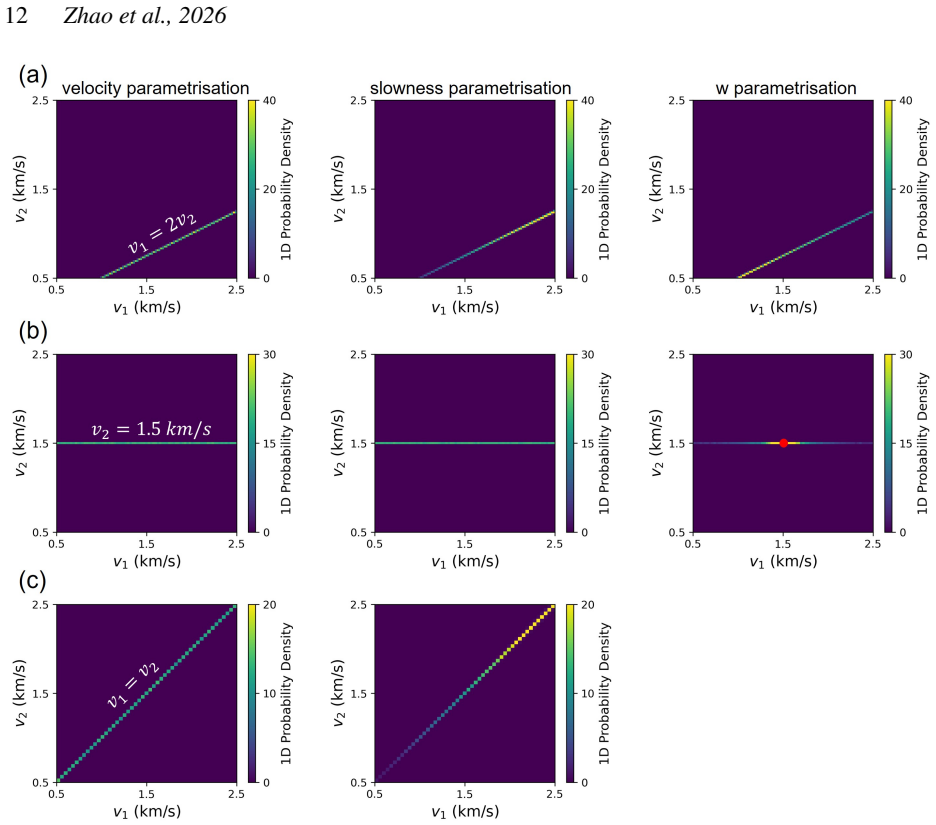
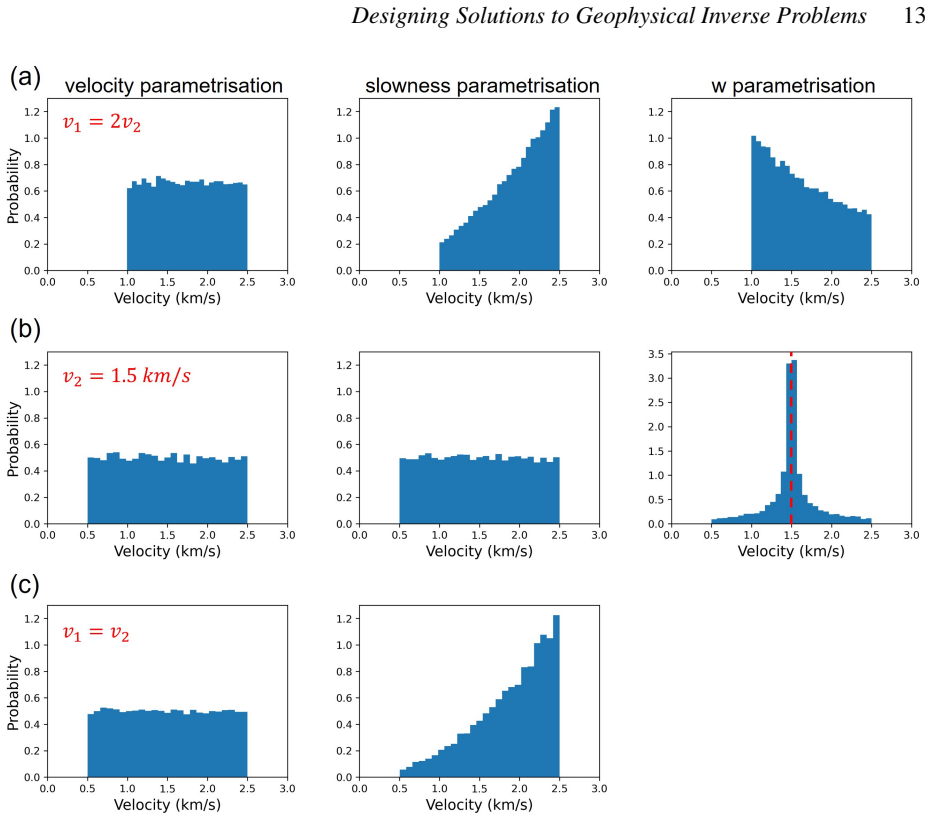
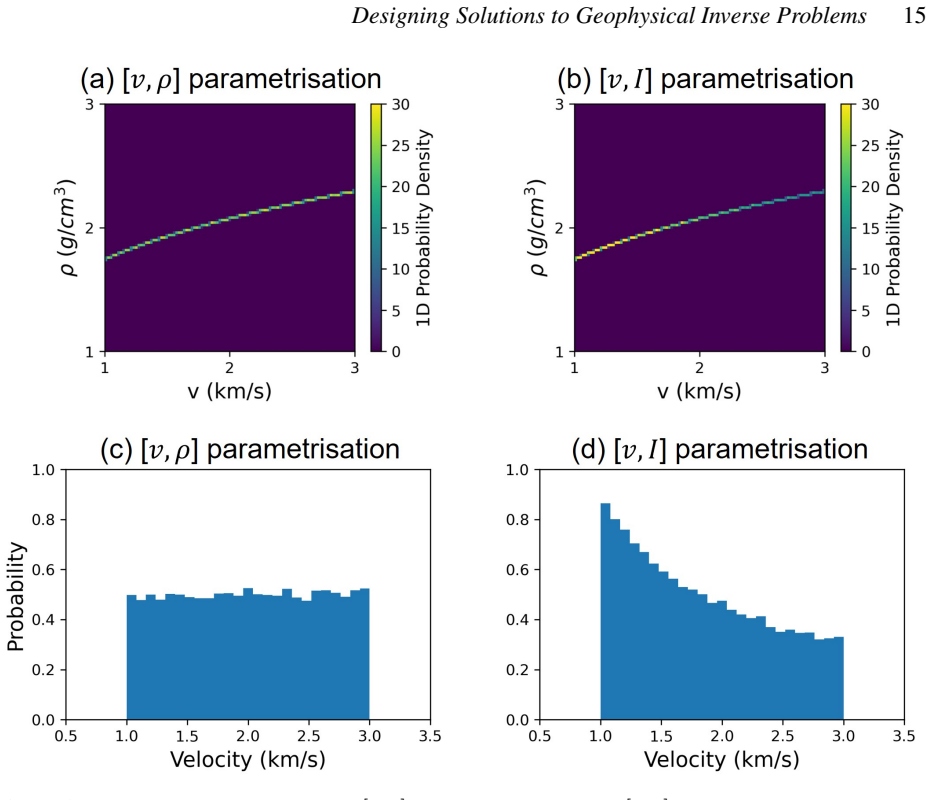
Geoscientists often solve inverse problems to estimate values of parameters of interest given relevant data sets. Bayesian inference solves these problems by combining probability distributions that describe uncertainties in both observations and unknown parameters, and we require that the solution provides unbiased uncertainty estimates in order to inform risk-based decisions. It has been known for over a century that employing different, but equivalent parametrisations of the same information can yield conditional probabilities that are mathematically inconsistent, a property referred to as the BK-inconsistency. Recently this inconsistency was shown to invalidate the solutions to physical problems found using several well-established methods of Bayesian inference. In this study, we explore the extent to which this inconsistency affects solutions to common geophysical problems. We demonstrate that changes in parametrisations result in inconsistent conditional probability densities, even though they represent exactly the same information. We show that this can affect Bayesian posterior solutions dramatically across various geoscientific problems using real and synthetic data. Given that deterministic inversion is often equivalent to finding the maximum a posteriori solution to specific Bayesian problems (the mathematical equations to be solved are identical), the BK-inconsistency also results in inconsistent solutions to deterministic inverse problems. Indeed, we show that solutions can potentially be designed, simply by changing the parametrisation. This study highlights that a careful rethinking of Bayesian inference and deterministic inversion may be required in physical problems: the effects that we demonstrate are likely to affect past and present inverse problem solutions in a variety of different fields of application.
Editorial analysis
A structured set of objections, weighed in public.
Referee Report
Summary. The paper claims that the Bertrand-Kolmogorov (BK) inconsistency implies that distinct but equivalent parametrizations of the same geophysical information produce mathematically inconsistent conditional probability densities. It reports empirical demonstrations of dramatic effects on Bayesian posterior solutions across common geoscientific inverse problems (real and synthetic data), notes that deterministic inversion is equivalent to MAP estimation and is therefore also affected, and concludes that solutions can be 'designed' simply by changing the parametrization, necessitating a rethinking of Bayesian and deterministic methods in physical problems.
Significance. If the demonstrations establish that the compared parametrizations induce identical measures on the underlying physical space, the result would be significant: it would show that a known but under-appreciated inconsistency can produce practically large changes in geophysical inversions, offering both a diagnostic and a constructive route to solution design. The empirical scope across multiple problems strengthens the case for re-examination of standard practices.
major comments (2)
- [Abstract; demonstrations (real/synthetic examples)] The central claim requires that the two parametrizations encode exactly the same information, which in continuous settings demands that the prior density in the second parametrization equals the first density multiplied by the absolute Jacobian determinant of the coordinate transformation. The abstract and demonstrations assert equivalence without reference to this transformation; if the priors are instead chosen independently or ad-hoc in each coordinate system, the reported posterior differences are explained by mismatched measures rather than by BK-inconsistency.
- [Demonstrations section] To isolate the BK-inconsistency as the load-bearing mechanism, the paper must show that the conditional densities differ even after the priors have been properly transformed. Without an explicit Jacobian check or equivalent measure-preserving construction in the examples, the dramatic effects cannot be attributed to the claimed source and may instead reflect implementation details or data-specific prior choices.
minor comments (3)
- [Abstract] The abstract states that the BK-inconsistency has been 'known for over a century'; add a specific citation to the original Bertrand or Kolmogorov statements and to the recent work that showed it invalidates certain Bayesian methods.
- [Introduction / Methods] Notation for conditional densities should be clarified when changing variables; e.g., distinguish p(m|d) from p(m'(d)|d) and indicate whether densities are with respect to Lebesgue measure in each coordinate system.
- [Results] Figures showing posterior densities or MAP solutions for different parametrizations would benefit from side-by-side panels with identical color scales and explicit statement of the prior used in each case.
Simulated Author's Rebuttal
We thank the referee for the careful reading of our manuscript and the constructive comments, which help clarify the conditions under which the reported effects can be attributed to the BK-inconsistency. We respond to each major comment below and will revise the manuscript accordingly to strengthen the presentation.
read point-by-point responses
-
Referee: [Abstract; demonstrations (real/synthetic examples)] The central claim requires that the two parametrizations encode exactly the same information, which in continuous settings demands that the prior density in the second parametrization equals the first density multiplied by the absolute Jacobian determinant of the coordinate transformation. The abstract and demonstrations assert equivalence without reference to this transformation; if the priors are instead chosen independently or ad-hoc in each coordinate system, the reported posterior differences are explained by mismatched measures rather than by BK-inconsistency.
Authors: We agree that equivalence of information in continuous spaces requires the prior in the transformed parametrization to be the original prior multiplied by the absolute Jacobian determinant. The original manuscript asserted equivalence in the abstract and demonstrations without explicit reference to this transformation or Jacobian verification. This leaves open the possibility that observed differences arise from ad-hoc prior choices rather than the BK-inconsistency. In the revised manuscript we will update the abstract to qualify the equivalence claim and add an explicit discussion of the Jacobian in the demonstrations section, including verification that the priors induce identical measures on the underlying physical space where possible. We will also distinguish between the transformed (measure-preserving) case and the common practical case of independent prior assignment in each parametrization, which our original examples largely reflected. revision: yes
-
Referee: [Demonstrations section] To isolate the BK-inconsistency as the load-bearing mechanism, the paper must show that the conditional densities differ even after the priors have been properly transformed. Without an explicit Jacobian check or equivalent measure-preserving construction in the examples, the dramatic effects cannot be attributed to the claimed source and may instead reflect implementation details or data-specific prior choices.
Authors: We will revise the demonstrations to include explicit Jacobian checks and at least one measure-preserving construction to verify that the priors encode identical information. This will allow clearer isolation of the BK-inconsistency. In the original examples the priors were assigned according to standard geophysical practice in the chosen parametrization; the dramatic effects therefore illustrate the practical consequences of the inconsistency. The revision will present the properly transformed case alongside the untransformed case to show when the underlying measures agree and when the reported posteriors (and deterministic MAP solutions) diverge. revision: yes
- Demonstrating that conditional densities differ after the priors have been properly transformed via the Jacobian would contradict the premise that the parametrizations encode identical information; we can only show consistency of the probability measures in that case while highlighting the practical divergence that occurs without the transformation.
Circularity Check
No significant circularity; applies externally known BK-inconsistency to geophysical problems
full rationale
The paper invokes the BK-inconsistency as a property known for over a century and recently demonstrated to invalidate certain Bayesian solutions in physical problems, treating it as an external mathematical fact rather than deriving it from quantities internal to this work. Demonstrations on real and synthetic geophysical data show effects on conditional densities and posteriors when changing parametrisations, with the claim that solutions can be designed via parametrisation change presented as a direct consequence of this external property. No load-bearing steps reduce by construction to the paper's own inputs: there are no self-definitional relations, fitted parameters renamed as predictions, self-citation chains justifying uniqueness, or ansatzes smuggled via citation. The derivation remains self-contained against external benchmarks, with empirical examples providing independent content.
Axiom & Free-Parameter Ledger
axioms (1)
- domain assumption Bayesian inference combines prior and likelihood distributions to obtain a posterior that quantifies uncertainty
Reference graph
Works this paper leans on
- [1]
-
[2]
Berger, J
Numerical applications of a formalism for geophysical inverse problems, Geophysical Journal International, 13(1-3), 247–276. Berger, J. O., 2013.Statistical decision theory and Bayesian analysis, Springer Science & Business Media. Bernardo, J. M. & Rueda, R.,
2013
-
[3]
Bloem, H., Curtis, A., & Tetzlaff, D.,
Transdimensional 2D full-waveform inversion and uncertainty estimation, arXiv preprint arXiv:2201.09334. Bloem, H., Curtis, A., & Tetzlaff, D.,
-
[4]
44 Zhao et al., 2026 Curtis, A.,
GLAD-M35: a joint P and S global tomographic model with uncertainty quantification, Geophysical Journal International, 239(1), 478–502. 44 Zhao et al., 2026 Curtis, A.,
2026
-
[5]
Pooling methods in deep neural networks, a review, arXiv preprint arXiv:2009.07485. Goodfellow, I., Pouget-Abadie, J., Mirza, M., Xu, B., Warde-Farley, D., Ozair, S., Courville, A., & Bengio, Y .,
-
[6]
Hosseini, K., Sigloch, K., Tsekhmistrenko, M., Zaheri, A., Nissen-Meyer, T., & Igel, H.,
Deep decoder: Concise image representations from untrained non- convolutional networks, arXiv preprint arXiv:1810.03982. Hosseini, K., Sigloch, K., Tsekhmistrenko, M., Zaheri, A., Nissen-Meyer, T., & Igel, H.,
-
[7]
Auto-Encoding Variational Bayes
Auto-encoding variational Bayes, arXiv preprint arXiv:1312.6114. Koelemeijer, P., Ritsema, J., Deuss, A., & Van Heijst, H.-J.,
work page internal anchor Pith review arXiv
-
[8]
46 Zhao et al., 2026 Lindseth, R
Diffusioninv: Prior-enhanced bayesian full waveform inversion using diffusion models, arXiv preprint arXiv:2505.03138. 46 Zhao et al., 2026 Lindseth, R. O.,
-
[9]
Malinverno, A.,
BayesBay: a versatile Bayesian inversion framework written in Python, Seismological Research Letters, 96(3), 2052–2064. Malinverno, A.,
2052
-
[10]
Inconsistency and acausality in Bayesian inference for physical prob- lems, arXiv preprint arXiv:2411.13570. Mosegaard, K. & Hansen, T. M.,
-
[11]
& Woodhouse, J
48 Zhao et al., 2026 Trampert, J. & Woodhouse, J. H.,
2026
-
[12]
1-D, 2-D, and 3-D Monte Carlo ambient Designing Solutions to Geophysical Inverse Problems 49 noise tomography using a dense passive seismic array installed on the North Sea seabed, Journal of Geophysical Research: Solid Earth, 125(2), e2019JB018552. Zhao, X. & Curtis, A., 2024a. Physically structured variational inference for Bayesian full waveform invers...
discussion (0)
Sign in with ORCID, Apple, or X to comment. Anyone can read and Pith papers without signing in.