Recognition: unknown
T-cell repertoire response in individuals with post-acute sequelae of COVID-19
Pith reviewed 2026-05-07 14:05 UTC · model grok-4.3
The pith
Over 1,000 T-cell receptor beta sequences distinguish long COVID immune responses from full recovery.
A machine-rendered reading of the paper's core claim, the machinery that carries it, and where it could break.
Core claim
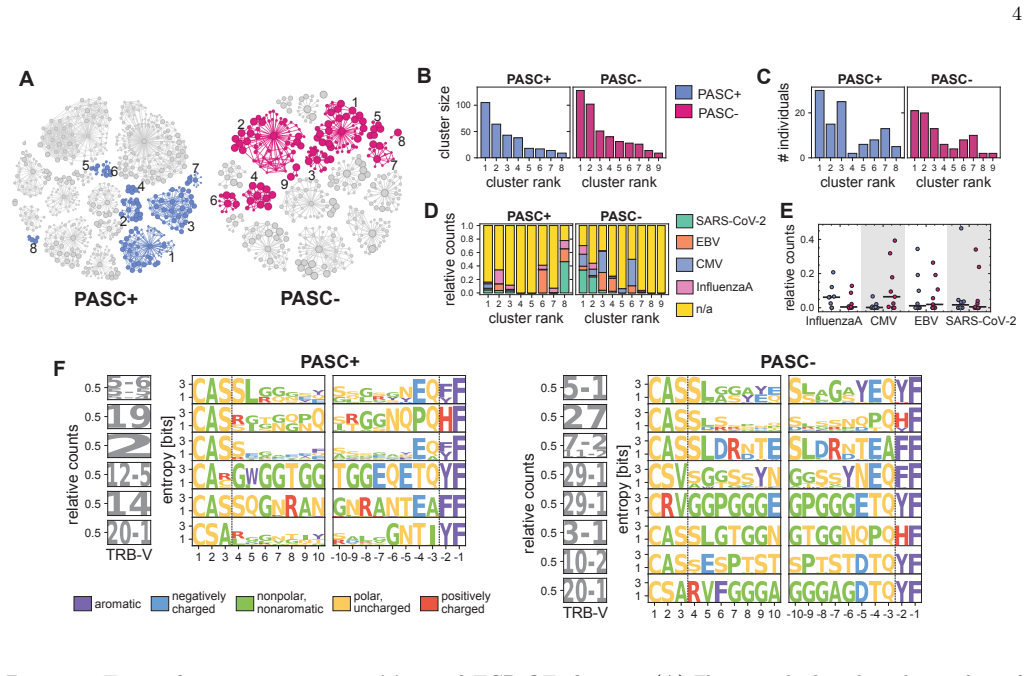
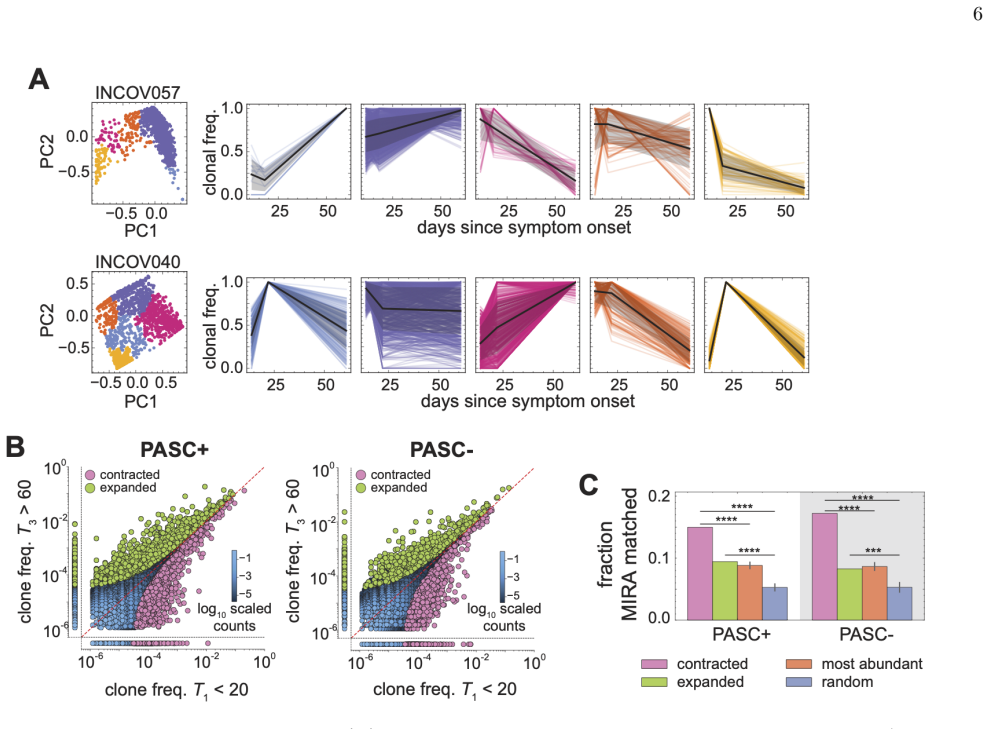
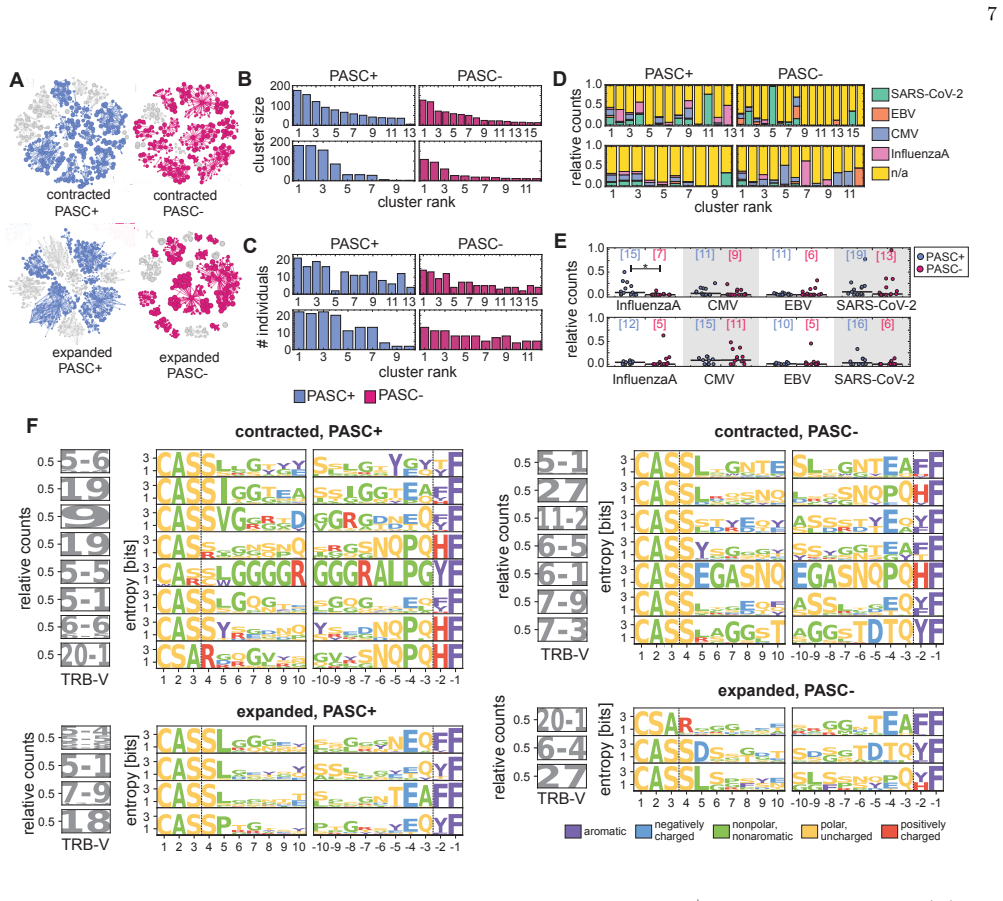
Longitudinal bulk TCRβ repertoire profiling of 120 COVID-19 patients reveals that while global repertoire statistics remain similar, locally enriched sequence motifs and differentially dynamic clones distinguish PASC-positive from PASC-negative immune responses. Clones contracting after the acute phase are enriched for SARS-CoV-2 specificity in both groups, but influenza A-specific TCRs are disproportionately enriched among contracting clones in PASC+ individuals. Rare public TCR clones show higher SARS-CoV-2 specificity and are modestly more common in PASC+ repertoires, yielding over 1,000 candidate TCRβ receptors that discriminate the two groups.
What carries the argument
Statistical modeling of repertoire composition and clonal dynamics applied to bulk TCRβ sequences sampled at multiple time points.
If this is right
- Contracting T-cell clones following the acute phase are enriched for SARS-CoV-2 specificity in both PASC+ and PASC- individuals.
- Influenza A-specific TCRs are disproportionately enriched among contracting clones in PASC+ repertoires, implicating viral co-infection in early severity and possibly in PASC pathogenesis.
- Rare public TCR clones are markedly enriched for SARS-CoV-2 specificity and occur at higher rates in PASC+ individuals.
- The set of over 1,000 candidate TCRβ receptors provides a starting point for identifying disease-relevant T-cell specificities and developing T-cell-based biomarkers for long COVID.
Where Pith is reading between the lines
- The candidate sequences could be validated as diagnostic predictors in separate patient groups collected at different sites.
- Prior influenza exposure might be examined as a risk modifier for developing persistent symptoms after COVID-19.
- Longer-term tracking of the identified clones could test whether they remain active during ongoing symptoms.
- Similar motif and dynamics analysis might be applied to other post-viral conditions to search for shared immune patterns.
Load-bearing premise
The observed statistical differences in TCR motifs and clone dynamics reflect PASC-specific biology rather than confounders such as demographics, sampling timing, or technical variation.
What would settle it
An independent cohort in which the candidate TCR sequences show no significant enrichment or predictive association with PASC status.
Figures


read the original abstract
T-cells are central to SARS-CoV-2 clearance and immunological memory, yet their contribution to the persistence of post-acute sequelae of COVID-19 (PASC) remains poorly understood. The immunological features that distinguish individuals who develop PASC from those who recover fully are unresolved, in part due to the phenotypic heterogeneity of the condition and the likely multiplicity of its underlying mechanisms. Here, we profiled longitudinal bulk TCR$\beta$ repertoires from 120 individuals in the INCOV cohort--71 with PASC and 49 without--sampled at two to three time points spanning the acute and post-acute phases of infection. Using robust statistical modeling of repertoire composition and clonal dynamics, we found that global statistics such as V, J gene usage and CDR3 length do not differ between groups, but that locally enriched sequence motifs and differentially dynamic clones reveal distinct T-cell signatures associated with PASC status. Clones contracting following the peak of the acute response were significantly enriched for SARS-CoV-2 specificity in both groups. Interestingly, Influenza A-specific TCRs were disproportionately enriched among contracting clones in PASC{$^+$} repertoires, implicating viral co-infection as a potential contributor to early disease severity and, possibly, PASC pathogenesis. Rare public TCR clones were markedly enriched for SARS-CoV-2 specificity, with PASC{$^+$} individuals harboring a modestly but significantly higher proportion than PASC{$^-$} individuals. Together, we identified over 1,000 candidate TCR$\beta$ receptors potentially discriminating PASC{$^+$} from PASC{$^-$} immune responses, opening a path toward the identification of disease-relevant T-cell specificities and the development of T-cell-based immunological biomarkers for long COVID.
Editorial analysis
A structured set of objections, weighed in public.
Referee Report
Summary. The paper profiles longitudinal bulk TCRβ repertoires from 120 INCOV cohort participants (71 PASC+ and 49 PASC-) at two to three time points. It reports no differences in global V/J usage or CDR3 length between groups, but identifies locally enriched sequence motifs and differentially dynamic clones that distinguish PASC+ from PASC- responses. Contracting clones are enriched for SARS-CoV-2 specificity in both groups, with Influenza A-specific TCRs disproportionately enriched among contracting clones in PASC+ individuals. Rare public TCR clones show higher SARS-CoV-2 specificity in PASC+ participants, yielding over 1,000 candidate TCRβ receptors as potential discriminators.
Significance. If the reported motif and clonal dynamic distinctions prove robust after confounder adjustment and external validation, the work could advance T-cell-based biomarkers for long COVID and clarify contributions of antiviral responses and possible co-infections to PASC. The longitudinal sampling and focus on clonal contraction/expansion represent strengths relative to cross-sectional repertoire studies.
major comments (2)
- [Abstract and Results (motif and clone dynamics sections)] Abstract and Results on motif/clonal dynamics: The central claim that locally enriched motifs and differentially contracting/expanding clones reflect PASC-specific biology requires explicit control for confounders. The manuscript does not state whether statistical models for motif enrichment or clone dynamics were adjusted or matched for age, sex, ethnicity, exact days post-infection, or batch effects, despite noting indistinguishable global V/J and CDR3 statistics. Without such adjustment, the Influenza A enrichment in PASC+ contracting clones and the >1,000 candidate TCRs could arise from cohort imbalances rather than PASC status.
- [Methods (statistical modeling subsection)] Methods describing statistical modeling: No details are provided on model specification, multiple-testing correction, data exclusion criteria, or cross-validation procedures used to identify the >1,000 candidate TCRβ receptors. These omissions make it impossible to evaluate whether post-hoc thresholds or unaccounted multiplicity inflate the reported enrichments and candidate list.
minor comments (2)
- [Abstract] Abstract: The notation PASC{$^+$} and PASC{$^-$} appears to be an unrendered LaTeX artifact; replace with PASC+ and PASC- for readability.
- [Abstract] Abstract: The phrase 'robust statistical modeling' is used without reference to specific methods or supplementary tables; add a brief methods pointer or table summarizing the modeling approach.
Simulated Author's Rebuttal
We thank the referee for their constructive and detailed review. The comments highlight important aspects of transparency in our statistical analyses, and we have revised the manuscript to address them directly. Below we respond point by point.
read point-by-point responses
-
Referee: [Abstract and Results (motif and clone dynamics sections)] Abstract and Results on motif/clonal dynamics: The central claim that locally enriched motifs and differentially contracting/expanding clones reflect PASC-specific biology requires explicit control for confounders. The manuscript does not state whether statistical models for motif enrichment or clone dynamics were adjusted or matched for age, sex, ethnicity, exact days post-infection, or batch effects, despite noting indistinguishable global V/J and CDR3 statistics. Without such adjustment, the Influenza A enrichment in PASC+ contracting clones and the >1,000 candidate TCRs could arise from cohort imbalances rather than PASC status.
Authors: We agree that explicit documentation of confounder control is necessary to support the interpretation of local motif and clonal dynamic differences. The manuscript already notes the absence of global differences in V/J usage and CDR3 length distributions, which provides initial evidence against major demographic or temporal confounding. In the revised version we have expanded the Methods and Results sections to state that motif enrichment was assessed via logistic regression models that included age, sex, ethnicity, days post-infection, and sequencing batch as covariates, while clonal expansion/contraction dynamics were modeled with linear mixed-effects regressions incorporating the same terms plus a random effect for individual. Propensity-score-matched sensitivity analyses (balancing the listed covariates) were added and confirm that the reported Influenza A enrichment among contracting clones in PASC+ individuals and the overall candidate receptor list remain statistically significant. We have also added a limitations paragraph noting that independent external validation would be valuable but lies outside the scope of the current INCOV longitudinal dataset. revision: yes
-
Referee: [Methods (statistical modeling subsection)] Methods describing statistical modeling: No details are provided on model specification, multiple-testing correction, data exclusion criteria, or cross-validation procedures used to identify the >1,000 candidate TCRβ receptors. These omissions make it impossible to evaluate whether post-hoc thresholds or unaccounted multiplicity inflate the reported enrichments and candidate list.
Authors: We acknowledge that the original Methods subsection on statistical modeling lacked sufficient detail. The revised manuscript now provides a complete description: motif enrichment was performed with MEME followed by Fisher’s exact tests with Benjamini-Hochberg FDR correction (q < 0.05); differential clonal dynamics were tested with edgeR using empirical Bayes moderation and Bonferroni correction across time-point comparisons; candidate receptors were defined as those passing both motif and dynamics thresholds with an additional frequency filter (>0.001). Data exclusion criteria included removal of samples with fewer than 1,000 unique TCRβ sequences and clones with fewer than 10 reads. No formal cross-validation was applied because the analysis was hypothesis-generating within a single cohort; instead, permutation-based significance testing (1,000 permutations) was used to assess the robustness of the >1,000-candidate list. The full model specifications, exact correction procedures, exclusion rules, and permutation results have been added to the main Methods text and a new supplementary methods document. revision: yes
Circularity Check
No significant circularity in observational statistical analysis
full rationale
The paper is an observational cohort study that applies standard statistical modeling to primary TCRβ sequencing data from the INCOV cohort (71 PASC+ vs 49 PASC-). It reports empirical observations: global V/J usage and CDR3 lengths are indistinguishable between groups, while local sequence motifs and clonal dynamics show differences, leading to identification of candidate TCRs. No mathematical derivation chain exists, and no steps reduce by construction to fitted parameters, self-definitions, or self-citation chains. Claims rest on direct data comparisons rather than any of the enumerated circular patterns, rendering the analysis self-contained.
Axiom & Free-Parameter Ledger
free parameters (1)
- motif enrichment and clone dynamics thresholds
axioms (1)
- domain assumption INCOV cohort samples are representative of broader PASC and non-PASC populations
Reference graph
Works this paper leans on
-
[1]
H. E. Davis, L. McCorkell, J. M. Vogel, and E. J. Topol, Long covid: major findings, mechanisms and recommendations, Nature Reviews Microbiology21, 133 (2023)
2023
-
[2]
Greenhalgh, M
T. Greenhalgh, M. Sivan, A. Perlowski, and J. v. Nikolich, Long covid: a clinical update, The Lancet404, 707–724 (2024)
2024
-
[3]
Michelen, L
M. Michelen, L. Manoharan, N. Elkheir, V. Cheng, A. Dagens, C. Hastie, M. O’Hara, J. Suett, D. Dahmash, P. Bugaeva, I. Rigby, D. Munblit, E. Harriss, A. Burls, C. Foote, J. Scott, G. Carson, P. Olliaro, L. Sigfrid, and C. Stavropoulou, Characterising long covid: a living systematic review, BMJ Global Health6, e005427 (2021)
2021
-
[4]
Parotto, M
M. Parotto, M. Gy¨ ongy¨ osi, K. Howe, S. N. Myatra, O. Ranzani, M. Shankar-Hari, and M. S. Herridge, Post-acute sequelae of covid-19: understanding and addressing the burden of multisystem manifestations, The Lancet Respiratory Medicine 11, 739–754 (2023)
2023
-
[5]
D. H. Jiang, D. J. Roy, B. J. Gu, L. C. Hassett, and R. G. McCoy, Postacute sequelae of severe acute respiratory syndrome coronavirus 2 infection, JACC: Basic to Translational Science6, 796–811 (2021)
2021
-
[6]
DeVries, S
A. DeVries, S. Shambhu, S. Sloop, and J. M. Overhage, One-year adverse outcomes among us adults with post–covid-19 condition vs those without covid-19 in a large commercial insurance database, inJAMA Health Forum, Vol. 4 (American Medical Association, 2023) pp. e230010–e230010
2023
-
[7]
D. M. Mancini, D. L. Brunjes, A. Lala, M. G. Trivieri, J. P. Contreras, and B. H. Natelson, Use of cardiopulmonary stress testing for patients with unexplained dyspnea post–coronavirus disease, JACC: Heart Failure9, 927–937 (2021)
2021
-
[8]
Mitigation of off-target toxicity in CRISPR-Cas9 screens for essential non-coding elements
C. Kedor, H. Freitag, L. Meyer-Arndt, K. Wittke, L. G. Hanitsch, T. Zoller, F. Steinbeis, M. Haffke, G. Rudolf, B. Hei- decker, T. Bobbert, J. Spranger, H.-D. Volk, C. Skurk, F. Konietschke, F. Paul, U. Behrends, J. Bellmann-Strobl, and C. Scheibenbogen, A prospective observational study of post-covid-19 chronic fatigue syndrome following the first pan- d...
-
[9]
C. S. Palmer, C. Perdios, M. Abdel-Mohsen, J. Mudd, P. K. Datta, N. J. Maness, G. Lehmicke, N. Golden, L. Hellmers, C. Coyne,et al., Non-human primate model of long-covid identifies immune associates of hyperglycemia, Nature commu- nications15, 6664 (2024)
2024
-
[10]
Tsampasian, M
V. Tsampasian, M. B¨ ack, M. Bernardi, E. Cavarretta, M. Debski, S. Gati, D. Hansen, N. Kr¨ ankel, K. C. Koskinas, J. Niebauer,et al., Cardiovascular disease as part of long covid: a systematic review, European journal of preventive cardiology , zwae070 (2024)
2024
-
[11]
Y. Xie, E. Xu, B. Bowe, and Z. Al-Aly, Long-term cardiovascular outcomes of covid-19, Nature Medicine28, 583–590 (2022)
2022
-
[12]
Al-Aly and C
Z. Al-Aly and C. J. Rosen, Long covid and impaired cognition—more evidence and more work to do (2024)
2024
-
[13]
Pollack, E
B. Pollack, E. von Saltza, L. McCorkell, L. Santos, A. Hultman, A. K. Cohen, and L. Soares, Female reproductive health impacts of long covid and associated illnesses including me/cfs, pots, and connective tissue disorders: a literature review, Frontiers in Rehabilitation Sciences4, 1122673 (2023)
2023
-
[14]
E. Xu, Y. Xie, and Z. Al-Aly, Long-term gastrointestinal outcomes of covid-19, Nature communications14, 983 (2023)
2023
-
[15]
National Academies of Sciences, Engineering, and Medicine; Health and Medicine Division; Board on Global Health; Board on Health Sciences Policy; Committee on Examining the Working Definition for Long COVID,A Long COVID definition: A Chronic, Systemic Disease State with Profound Consequences(National Academies Press (US), Washington (DC), 2024)
2024
-
[16]
L. N. Geng, K. M. Erlandson, M. Hornig, R. Letts, C. Selvaggi, H. Ashktorab, O. Atieh, L. Bartram, H. Brim, S. B. Brosnahan, J. Brown, M. Castro, A. Charney, P. Chen, S. G. Deeks, N. Erdmann, V. J. Flaherman, M. A. Ghamloush, P. Goepfert, J. D. Goldman, J. E. Han, R. Hess, E. Hirshberg, S. E. Hoover, S. D. Katz, J. D. Kelly, J. D. Klein, J. A. Kr- ishnan,...
2024
-
[17]
Swank, Y
Z. Swank, Y. Senussi, Z. Manickas-Hill, X. G. Yu, J. Z. Li, G. Alter, and D. R. Walt, Persistent circulating severe acute respiratory syndrome coronavirus 2 spike is associated with post-acute coronavirus disease 2019 sequelae, Clinical Infectious Diseases76, e487–e490 (2022)
2019
-
[18]
Y. Su, D. Yuan, D. G. Chen, R. H. Ng, K. Wang, J. Choi, S. Li, S. Hong, R. Zhang, J. Xie,et al., Multiple early factors anticipate post-acute covid-19 sequelae, Cell185, 881 (2022)
2022
-
[19]
Zubchenko, I
S. Zubchenko, I. Kril, O. Nadizhko, O. Matsyura, and V. Chopyak, Herpesvirus infections and post-covid-19 manifesta- tions: a pilot observational study, Rheumatology International42, 1523–1530 (2022)
2022
-
[20]
A. C. Wong, A. S. Devason, I. C. Umana, T. O. Cox, L. Dohnalov´ a, L. Litichevskiy, J. Perla, P. Lundgren, Z. Etwebi, L. T. Izzo,et al., Serotonin reduction in post-acute sequelae of viral infection, Cell186, 4851 (2023). 17
2023
-
[21]
Klein, J
J. Klein, J. Wood, J. R. Jaycox, R. M. Dhodapkar, P. Lu, J. R. Gehlhausen, A. Tabachnikova, K. Greene, L. Tabacof, A. A. Malik, V. Silva Monteiro, J. Silva, K. Kamath, M. Zhang, A. Dhal, I. M. Ott, G. Valle, M. Pe˜ na-Hern´ andez, T. Mao, B. Bhattacharjee, T. Takahashi, C. Lucas, E. Song, D. McCarthy, E. Breyman, J. Tosto-Mancuso, Y. Dai, E. Perotti, K. A...
2023
-
[22]
M. J. Peluso, T.-M. Deveau, S. E. Munter, D. Ryder, A. Buck, G. Beck-Engeser, F. Chan, S. Lu, S. A. Goldberg, R. Hoh, V. Tai, L. Torres, N. S. Iyer, M. Deswal, L. H. Ngo, M. Buitrago, A. Rodriguez, J. Y. Chen, B. C. Yee, A. Chenna, J. W. Winslow, C. J. Petropoulos, A. N. Deitchman, J. Hellmuth, M. A. Spinelli, M. S. Durstenfeld, P. Y. Hsue, J. D. Kelly, J...
-
[23]
Mohandas, P
S. Mohandas, P. Jagannathan, T. J. Henrich, Z. A. Sherif, C. Bime, E. Quinlan, M. A. Portman, M. Gennaro, and J. Rehman, Immune mechanisms underlying covid-19 pathology and post-acute sequelae of sars-cov-2 infection (pasc), Elife12, e86014 (2023)
2023
-
[24]
K. Yin, M. J. Peluso, X. Luo, R. Thomas, M.-G. Shin, J. Neidleman, A. Andrew, K. C. Young, T. Ma, R. Hoh,et al., Long covid manifests with t cell dysregulation, inflammation and an uncoordinated adaptive immune response to sars-cov-2, Nature Immunology25, 218 (2024)
2024
-
[25]
M. Cai, Y. Xie, E. J. Topol, and Z. Al-Aly, Three-year outcomes of post-acute sequelae of covid-19, Nature medicine , 1 (2024)
2024
-
[26]
Wuller, N
S. Wuller, N. G. Singer, C. Lewis, E. W. Karlson, G. S. Schulert, J. D. Goldman, J. Hadlock, J. Arnold, K. Hirabayashi, L. E. Stiles, L. C. Kleinman, L. G. Cowell, M. Hornig, M. A. Hall, M. G. Weiner, M. Koropsak, M. F. Lamendola- Essel, R. Kenney, R. A. Moffitt, S. Abedian, S. Esquenazi-Karonika, S. G. Johnson, S. Stroebel, Z. S. Wallace, K. H. Costenbad...
2025
-
[28]
M. J. Peluso and S. G. Deeks, Mechanisms of long COVID and the path toward therapeutics, Cell187, 5500 (2024)
2024
-
[29]
J. C. Marshall, S. Murthy, J. Diaz, N. K. Adhikari, D. C. Angus, Y. M. Arabi, K. Baillie, M. Bauer, S. Berry, B. Blackwood, M. Bonten, F. Bozza, F. Brunkhorst, A. Cheng, M. Clarke, V. Q. Dat, M. de Jong, J. Denholm, L. Derde, J. Dunning, X. Feng, T. Fletcher, N. Foster, R. Fowler, N. Gobat, C. Gomersall, A. Gordon, T. Glueck, M. Harhay, C. Hodgson, P. Hor...
2020
-
[30]
Janeway,Immunobiology: the immune system in health and disease, 9th ed
C. Janeway,Immunobiology: the immune system in health and disease, 9th ed. (Garland Science, 2005)
2005
-
[31]
N. Lam, Y. Lee, and D. L. Farber, A guide to adaptive immune memory, Nature Reviews Immunology , 1 (2024)
2024
-
[32]
J. S. Maltzman, Cd8 t cells are forever, Science Immunology8, eadg8279 (2023)
2023
-
[33]
K¨ unzli and D
M. K¨ unzli and D. Masopust, Cd4+ t cell memory, Nature immunology24, 903 (2023)
2023
-
[34]
Phetsouphanh, B
C. Phetsouphanh, B. Jacka, S. Ballouz, K. J. Jackson, D. B. Wilson, B. Manandhar, V. Klemm, H.-X. Tan, A. Wheatley, A. Aggarwal,et al., Improvement of immune dysregulation in individuals with long covid at 24-months following sars-cov-2 infection, Nature Communications15, 3315 (2024)
2024
-
[35]
Canderan, L
G. Canderan, L. M. Muehling, A. Kadl, S. Ladd, C. Bonham, C. E. Cross, S. M. Lima, X. Yin, J. M. Sturek, J. M. Wilson,et al., Distinct type 1 immune networks underlie the severity of restrictive lung disease after covid-19, Nature immunology (2025)
2025
-
[36]
R. O. Emerson, W. S. DeWitt, M. Vignali, J. Gravley, J. K. Hu, E. J. Osborne, C. Desmarais, M. Klinger, C. S. Carlson, J. A. Hansen,et al., Immunosequencing identifies signatures of cytomegalovirus exposure history and hla-mediated effects on the t cell repertoire, Nature genetics49, 659 (2017)
2017
-
[37]
M. V. Pogorelyy, A. M. Kirk, S. Adhikari, A. A. Minervina, B. Sundararaman, K. Vegesana, D. C. Brice, Z. B. Scott, P. G. Thomas, S. S. Team,et al., Tirtl-seq: Deep, quantitative, and affordable paired tcr repertoire sequencing, bioRxiv (2024)
2024
-
[38]
A. A. Minervina, M. V. Pogorelyy, E. A. Komech, V. K. Karnaukhov, P. Bacher, E. Rosati, A. Franke, D. M. Chudakov, I. Z. Mamedov, Y. B. Lebedev,et al., Primary and secondary anti-viral response captured by the dynamics and phenotype of individual t cell clones, Elife9, e53704 (2020)
2020
-
[39]
A. A. Minervina, E. A. Komech, A. Titov, M. Bensouda Koraichi, E. Rosati, I. Z. Mamedov, A. Franke, G. A. Efimov, D. M. Chudakov, T. Mora,et al., Longitudinal high-throughput tcr repertoire profiling reveals the dynamics of t-cell memory formation after mild covid-19 infection, Elife10, e63502 (2021)
2021
-
[40]
Rawat, M
P. Rawat, M. R. Shapiro, L. D. Peters, M. Widrich, K. Mayer-Blackwell, K. Motwani, M. Pavlovi, G. al Hajj, A. L. Posgai, C. Kanduri,et al., Identification of a type 1 diabetes-associated t cell receptor repertoire signature from the human peripheral blood, medRxiv , 2024 (2024)
2024
-
[41]
M. V. Pogorelyy, A. A. Minervina, D. M. Chudakov, I. Z. Mamedov, Y. B. Lebedev, T. Mora, and A. M. Walczak, Method for identification of condition-associated public antigen receptor sequences, Elife7, e33050 (2018)
2018
-
[42]
M. V. Pogorelyy, A. A. Minervina, M. Shugay, D. M. Chudakov, Y. B. Lebedev, T. Mora, and A. M. Walczak, Detecting t cell receptors involved in immune responses from single repertoire snapshots, PLoS Biology17, e3000314 (2019). 18
2019
-
[43]
Vujkovic, M
A. Vujkovic, M. Ha, T. de Block, L. van Petersen, I. Brosius, C. Theunissen, S. H. Van Ierssel, E. Bartholomeus, W. Adriaensen, G. Vanham,et al., Diagnosing viral infections through t-cell receptor sequencing of activated cd8+ t cells, The Journal of Infectious Diseases229, 507 (2024)
2024
-
[44]
R. M. Gittelman, E. Lavezzo, T. M. Snyder, H. J. Zahid, C. L. Carty, R. Elyanow, S. Dalai, I. Kirsch, L. Baldo, L. Manuto, E. Franchin, C. Del Vecchio, M. Pacenti, C. Boldrin, M. Cattai, F. Saluzzo, A. Padoan, M. Plebani, F. Simeoni, J. Bordini, N. I. Lor` e, D. Lazarevi´ c, D. M. Cirillo, P. Ghia, S. Toppo, J. M. Carlson, H. S. Robins, A. Crisanti, and G...
-
[45]
Santa Cruz, A
A. Santa Cruz, A. Mendes-Frias, M. Azarias-da Silva, S. Andr´ e, A. I. Oliveira, O. Pires, M. Mendes, B. Oliveira, M. Braga, J. R. Lopes,et al., Post-acute sequelae of covid-19 is characterized by diminished peripheral cd8+β7 integrin+ t cells and anti-sars-cov-2 iga response, Nature Communications14, 1772 (2023)
2023
-
[46]
K. M. Littlefield, R. O. Watson, J. M. Schneider, C. P. Neff, E. Yamada, M. Zhang, T. B. Campbell, M. T. Falta, S. E. Jolley, A. P. Fontenot,et al., Sars-cov-2-specific t cells associate with inflammation and reduced lung function in pulmonary post-acute sequalae of sars-cov-2, PLoS pathogens18, e1010359 (2022)
2022
-
[47]
G. P. Williams, E. D. Yu, K. Shapiro, E. Wang, A. Freuchet, A. Frazier, C. S. L. Arlehamn, A. Sette, and R. da Silva An- tunes, Investigating viral and autoimmune t cell responses associated with post-acute sequelae of covid-19, Human Im- munology85, 110770 (2024)
2024
-
[48]
Paniskaki, S
K. Paniskaki, S. Goretzki, M. Anft, M. J. Konik, T. L. Meister, S. Pfaender, K. Lechtenberg, M. Vogl, B. Dogan, S. Dolff, et al., Increased sars-cov-2 reactive low avidity t cells producing inflammatory cytokines in pediatric post-acute covid-19 sequelae (pasc), Pediatric Allergy and Immunology34, e14060 (2023)
2023
-
[49]
Y. Su, D. Chen, D. Yuan, C. Lausted, J. Choi, C. L. Dai, V. Voillet, V. R. Duvvuri, K. Scherler, P. Troisch,et al., Multi-omics resolves a sharp disease-state shift between mild and moderate covid-19, Cell183, 1479 (2020)
2020
-
[50]
Danesh, A
V. Danesh, A. C. Arroliga, J. A. Bourgeois, L. M. Boehm, M. J. McNeal, A. J. Widmer, T. M. McNeal, and S. R. Kesler, Symptom clusters seen in adult covid-19 recovery clinic care seekers, Journal of general internal medicine38, 442 (2023)
2023
-
[51]
J. T. Reese, H. Blau, E. Casiraghi, T. Bergquist, J. J. Loomba, T. J. Callahan, B. Laraway, C. Antonescu, B. Coleman, M. Gargano,et al., Generalisable long covid subtypes: findings from the nih n3c and recover programmes, EBioMedicine 87(2023)
2023
-
[52]
S. W. Hanson, C. Abbafati, J. G. Aerts, Z. Al-Aly, C. Ashbaugh, T. Ballouz, O. Blyuss, P. Bobkova, G. Bonsel, S. Borza- kova,et al., Estimated global proportions of individuals with persistent fatigue, cognitive, and respiratory symptom clusters following symptomatic covid-19 in 2020 and 2021, Jama328, 1604 (2022)
2020
-
[53]
N. Keur, A. W. Flikweert, I. Rica˜ no-Ponce, A. C. M. Kobold, I. A. Rodenhuis-Zybert, K. T. Le, M. van Meurs, M. J. Grootenboers, P. H. van der Voort, P. Heeringa,et al., Delineating sex-specific circulating host response signatures associated with covid-19 severity and mortality, Iscience27(2024)
2024
-
[54]
Sieurin, G
J. Sieurin, G. Brand´ en, C. Magnusson, M.-P. Hergens, and K. Kosidou, A population-based cohort study of sex and risk of severe outcomes in covid-19, European Journal of Epidemiology37, 1159 (2022)
2022
-
[55]
P. Dash, A. J. Fiore-Gartland, T. Hertz, G. C. Wang, S. Sharma, A. Souquette, J. C. Crawford, E. B. Clemens, T. H. Nguyen, K. Kedzierska,et al., Quantifiable predictive features define epitope-specific t cell receptor repertoires, Nature 547, 89 (2017)
2017
-
[56]
X. Hou, G. Wang, W. Fan, X. Chen, C. Mo, Y. Wang, W. Gong, X. Wen, H. Chen, D. He, L. Mo, S. Jiang, M. Ou, H. Guo, and H. Liu, T-cell receptor repertoires as potential diagnostic markers for patients with COVID-19, Int. J. Infect. Dis.113, 308 (2021)
2021
-
[57]
L. Luo, W. Liang, J. Pang, G. Xu, Y. Chen, X. Guo, X. Wang, Y. Zhao, Y. Lai, Y. Liu, B. Li, B. Su, S. Zhang, M. Baniyash, L. Shen, L. Chen, Y. Ling, Y. Wang, Q. Liang, H. Lu, Z. Zhang, and F. Wang, Dynamics of TCR repertoire and T cell function in COVID-19 convalescent individuals, Cell Discov.7, 89 (2021)
2021
-
[58]
M. P. Weekes, A. J. Carmichael, M. R. Wills, K. Mynard, and J. G. Sissons, Human cd28-cd8+ T cells contain greatly expanded functional virus-specific memory CTL clones, J. Immunol.162, 7569 (1999)
1999
-
[59]
B. J. Olson, S. A. Schattgen, P. G. Thomas, P. Bradley, and F. A. Matsen IV, Comparing t cell receptor repertoires using optimal transport, PLOS Computational Biology18, e1010681 (2022)
2022
-
[60]
Shugay, D
M. Shugay, D. V. Bagaev, I. V. Zvyagin, R. M. Vroomans, J. C. Crawford, G. Dolton, E. A. Komech, A. L. Sycheva, A. E. Koneva, E. S. Egorov,et al., Vdjdb: a curated database of t-cell receptor sequences with known antigen specificity, Nucleic acids research46, D419 (2018)
2018
-
[61]
Goncharov, D
M. Goncharov, D. Bagaev, D. Shcherbinin, I. Zvyagin, D. Bolotin, P. G. Thomas, A. A. Minervina, M. V. Pogorelyy, K. Ladell, J. E. McLaren,et al., Vdjdb in the pandemic era: a compendium of t cell receptors specific for sars-cov-2, Nature methods19, 1017 (2022)
2022
-
[62]
J. E. Gold, R. A. Okyay, W. E. Licht, and D. J. Hurley, Investigation of long covid prevalence and its relationship to epstein-barr virus reactivation, Pathogens10, 763 (2021)
2021
-
[63]
Rohrhofer, M
J. Rohrhofer, M. Graninger, L. Lettenmaier, J. Schweighardt, S. A. Gentile, L. Koidl, D. Ret, M. Stingl, E. Puchhammer- St¨ ockl, and E. Untersmayr, Association between epstein-barr-virus reactivation and development of long-covid fatigue, Allergy , 10 (2022)
2022
-
[64]
Cervia-Hasler, S
C. Cervia-Hasler, S. C. Br¨ uningk, T. Hoch, B. Fan, G. Muzio, R. C. Thompson, L. Ceglarek, R. Meledin, P. Westermann, M. Emmenegger,et al., Persistent complement dysregulation with signs of thromboinflammation in active long covid, Science383, eadg7942 (2024)
2024
-
[65]
A. D. Hoeggerl, V. Nunhofer, W. Lauth, N. Badstuber, N. Held, G. Zimmermann, C. Grabmer, L. Weidner, C. Jungbauer, N. Lindlbauer,et al., Epstein-barr virus reactivation is not causative for post-covid-19-syndrome in individuals with 19 asymptomatic or mild sars-cov-2 disease course, BMC Infectious Diseases23, 800 (2023)
2023
-
[66]
M. V. Pogorelyy, E. Rosati, A. A. Minervina, R. C. Mettelman, A. Scheffold, A. Franke, P. Bacher, and P. G. Thomas, Resolving sars-cov-2 cd4+ t cell specificity via reverse epitope discovery, Cell Reports Medicine3(2022)
2022
-
[67]
J. D. Miller, R. G. van der Most, R. S. Akondy, J. T. Glidewell, S. Albott, D. Masopust, K. Murali-Krishna, P. L. Mahar, S. Edupuganti, S. Lalor,et al., Human effector and memory cd8+ t cell responses to smallpox and yellow fever vaccines, Immunity28, 710 (2008)
2008
-
[68]
Thevarajan, T
I. Thevarajan, T. H. Nguyen, M. Koutsakos, J. Druce, L. Caly, C. E. van De Sandt, X. Jia, S. Nicholson, M. Catton, B. Cowie,et al., Breadth of concomitant immune responses prior to patient recovery: a case report of non-severe covid-19, Nature medicine26, 453 (2020)
2020
-
[69]
Bertoletti, A
A. Bertoletti, A. T. Tan, and N. Le Bert, The t-cell response to sars-cov-2: kinetic and quantitative aspects and the case for their protective role, Oxford Open Immunology2, iqab006 (2021)
2021
-
[70]
Y. Wu, L. Kang, Z. Guo, J. Liu, M. Liu, and W. Liang, Incubation period of covid-19 caused by unique sars-cov-2 strains: a systematic review and meta-analysis, JAMA network open5, e2228008 (2022)
2022
-
[71]
Manica, M
M. Manica, M. Litvinova, A. De Bellis, G. Guzzetta, P. Mancuso, M. Vicentini, F. Venturelli, E. Bisaccia, A. I. Bento, P. Poletti,et al., Estimation of the incubation period and generation time of sars-cov-2 alpha and delta variants from contact tracing data, Epidemiology & Infection151, e5 (2023)
2023
-
[72]
M. B. Koraichi, M. P. Touzel, A. Mazzolini, T. Mora, and A. M. Walczak, Noiset: noise learning and expansion detection of t-cell receptors, The Journal of Physical Chemistry A126, 7407 (2022)
2022
-
[73]
Nolan, M
S. Nolan, M. Vignali, M. Klinger, J. N. Dines, I. M. Kaplan, E. Svejnoha, T. Craft, K. Boland, M. W. Pesesky, R. M. Gittelman, T. M. Snyder, C. J. Gooley, S. Semprini, C. Cerchione, F. Nicolini, M. Mazza, O. M. Delmonte, K. Dobbs, G. Carre˜ no-Tarragona, S. Barrio, V. Sambri, G. Martinelli, J. D. Goldman, J. Heath, L. D. Notarangelo, J. Martinez- Lopez, B...
2025
-
[74]
Alosaimi, A
B. Alosaimi, A. Naeem, M. E. Hamed, H. S. Alkadi, T. Alanazi, S. S. Al Rehily, A. Z. Almutairi, and A. Zafar, Influenza co-infection associated with severity and mortality in covid-19 patients, Virol. J.18, 127 (2021)
2021
-
[75]
Achdout, E
H. Achdout, E. B. Vitner, B. Politi, S. Melamed, Y. Yahalom-Ronen, H. Tamir, N. Erez, R. Avraham, S. Weiss, L. Cherry, E. Bar-Haim, E. Makdasi, D. Gur, M. Aftalion, T. Chitlaru, Y. Vagima, N. Paran, and T. Israely, Increased lethality in influenza and sars-cov-2 coinfection is prevented by influenza immunity but not sars-cov-2 immunity, Nat. Commun.12, 58...
2021
-
[76]
Isacchini, A
G. Isacchini, A. M. Walczak, T. Mora, and A. Nourmohammad, Deep generative selection models of t and b cell receptor repertoires with sonnia, Proceedings of the National Academy of Sciences118, e2023141118 (2021)
2021
-
[77]
Marcou, T
Q. Marcou, T. Mora, and A. M. Walczak, High-throughput immune repertoire analysis with igor, Nature communications 9, 561 (2018)
2018
-
[78]
Elhanati, Z
Y. Elhanati, Z. Sethna, C. G. Callan Jr, T. Mora, and A. M. Walczak, Predicting the spectrum of tcr repertoire sharing with a data-driven model of recombination, Immunological reviews284, 167 (2018)
2018
-
[79]
Montague, H
Z. Montague, H. Lv, J. Otwinowski, W. S. DeWitt, G. Isacchini, G. K. Yip, W. W. Ng, O. T.-Y. Tsang, M. Yuan, H. Liu, et al., Dynamics of b cell repertoires and emergence of cross-reactive responses in patients with different severities of covid-19, Cell Reports35(2021)
2021
-
[80]
Ruiz Ortega, N
M. Ruiz Ortega, N. Spisak, T. Mora, and A. M. Walczak, Modeling and predicting the overlap of b-and t-cell receptor repertoires in healthy and sars-cov-2 infected individuals, PLoS Genetics19, e1010652 (2023)
2023
-
[81]
H. E. Davis, L. McCorkell, J. M. Vogel, and E. J. Topol, Long COVID: major findings, mechanisms and recommendations, Nat. Rev. Microbiol.21, 133 (2023)
2023
discussion (0)
Sign in with ORCID, Apple, or X to comment. Anyone can read and Pith papers without signing in.