Recognition: unknown
Efficient mapping of multi-constraint satisfaction problems to Rydberg platforms
Pith reviewed 2026-05-07 13:24 UTC · model grok-4.3
The pith
A compact gadget uses atom geometry and blockade to enforce exactly-one constraints on Rydberg arrays with fixed small detunings.
A machine-rendered reading of the paper's core claim, the machinery that carries it, and where it could break.
Core claim
The central claim is that a hardware-native gadget built from geometrically arranged Rydberg atoms can enforce exactly-one constraints through blockade interactions alone. Because the enforcement relies on geometry rather than tunable penalty strengths, the required detuning stays fixed and independent of problem size. The same geometric tailoring produces embeddings that fit within the planar connectivity of neutral-atom arrays and avoids all-to-all couplings. When applied to concrete problems, the construction delivers the reported reductions in detuning range, atom count, and connectivity overhead while remaining compatible with near-term hardware.
What carries the argument
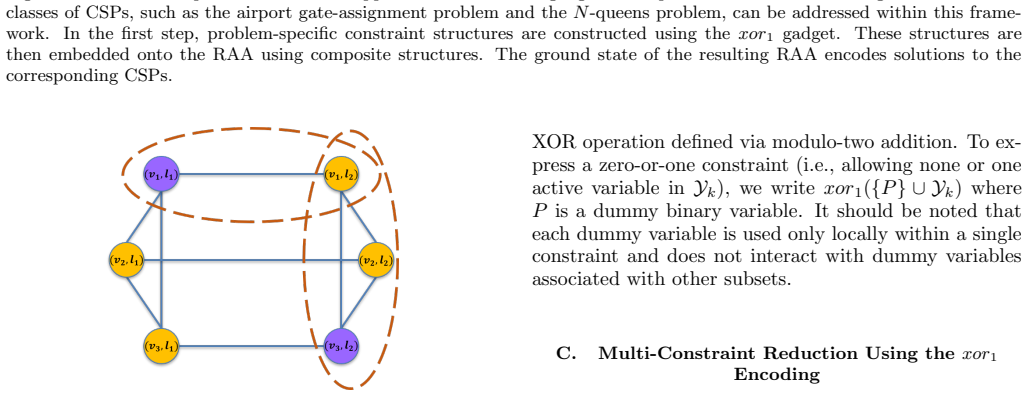
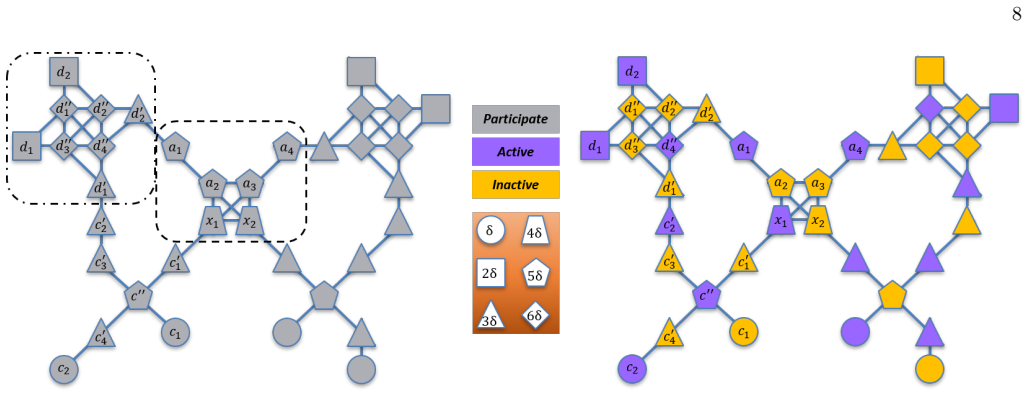
The xor_1 gadget: a fixed local arrangement of atoms whose Rydberg blockade interactions enforce that exactly one variable in a group is true, with detuning set by geometry rather than problem size.
If this is right
- The same gadget construction applies to any combinatorial problem whose constraints are collections of exactly-one requirements.
- Resource demands drop enough to make larger instances feasible on current neutral-atom devices.
- Embeddings remain planar and therefore avoid the hardware cost of long-range couplings.
- No extensive classical preprocessing is required to generate the atom layout.
Where Pith is reading between the lines
- If the blockade enforcement proves reliable, similar geometric gadgets could be designed for other common constraints such as at-most-one or pairwise exclusions.
- The fixed-detuning property might extend the reachable problem size on hardware whose laser systems cannot supply wide detuning ranges.
- The planar-layout emphasis could guide mappings on other quantum platforms that also offer only local interactions.
Load-bearing premise
Geometric placement of atoms can enforce exactly-one constraints exactly through blockade interactions alone without errors, crosstalk, or the need for size-dependent adjustments.
What would settle it
An experiment implementing the gadget for a small N-queens instance that either demands a larger detuning range than the fixed value or fails to produce only the valid solutions because of unintended interactions.
Figures





read the original abstract
We present a hardware-native gadget framework for solving constraint satisfaction problems on Rydberg quantum computing architectures. Our approach introduces a compact $xor_1$ gadget that enforces exactly-one constraints, ubiquitous in combinatorial optimization, directly through geometric embedding and blockade interactions. A key advantage of the $xor_1$ gadget is its fixed, problem-size-independent detuning requirements: enforcing constraints through blockade interactions eliminates the need for large penalty terms, thereby substantially reducing the detuning range compared to Quadratic Unconstrained Binary Optimization (QUBO) formulations and improving experimental feasibility. By tailoring the construction to the geometric connectivity of Rydberg atom arrays, the framework bypasses the all-to-all physical couplings often assumed in logical encodings. This enables embeddings compatible with planar layouts and avoids highly connected arrangements. We develop scalable implementations that reduce atom count and connectivity overhead while avoiding extensive classical preprocessing, making them compatible with near-term neutral-atom hardware. As illustrations, we apply our framework to the gate-assignment and $N$-queens problems, highlighting its practicality, resource efficiency, and hardware compatibility. In these examples, we observe reductions in detuning range of up to $99\%$ and savings in atom count and connectivity overhead of up to $54\%$ compared to the QUBO method. These results establish a route toward implementing large-scale combinatorial optimization on Rydberg platforms beyond the limits of existing encodings.
Editorial analysis
A structured set of objections, weighed in public.
Referee Report
Summary. The paper introduces a hardware-native gadget framework for mapping multi-constraint satisfaction problems onto Rydberg atom arrays. It defines a compact xor_1 gadget that enforces exactly-one constraints directly via geometric placement and ideal Rydberg blockade interactions, yielding problem-size-independent detuning requirements. This is contrasted with standard QUBO encodings that rely on large penalty terms. The framework is applied to the gate-assignment and N-queens problems, with reported resource savings of up to 99% in detuning range and 54% in atom count and connectivity overhead relative to QUBO, while remaining compatible with planar layouts and avoiding extensive classical preprocessing.
Significance. If the central gadget construction holds under realistic Rydberg Hamiltonians, the approach would meaningfully lower the experimental barriers to solving combinatorial optimization problems on near-term neutral-atom hardware by eliminating the need for large, problem-dependent detuning penalties and by exploiting native geometric connectivity. The explicit resource comparisons and hardware-tailored embeddings constitute a concrete advance over generic logical encodings.
major comments (2)
- [Abstract / xor_1 gadget section] Abstract and the xor_1 gadget construction: the central claims of exact constraint enforcement and problem-size-independent detuning rest on the assumption of ideal, infinite-range blockade. No effective-Hamiltonian derivation, error bounds, or fidelity estimates are supplied that account for the soft C6/r^6 van der Waals tail at intermediate distances; any residual crosstalk or leakage would directly erode the stated 99% detuning reduction and 54% resource savings relative to QUBO.
- [Results / illustrations section] Results on gate-assignment and N-queens: the specific percentage improvements (99% detuning range, 54% atom/connectivity savings) are asserted without numerical tables, error bars, explicit QUBO baseline parameters, or methodology for the comparison, preventing independent verification of the magnitude of the gains.
minor comments (1)
- [Methods] Notation for the gadget Hamiltonian and blockade radius should be defined explicitly with units and parameter ranges before the resource comparisons are presented.
Simulated Author's Rebuttal
We thank the referee for the careful reading and constructive comments. We address each major point below and will revise the manuscript accordingly to strengthen the presentation and analysis.
read point-by-point responses
-
Referee: [Abstract / xor_1 gadget section] Abstract and the xor_1 gadget construction: the central claims of exact constraint enforcement and problem-size-independent detuning rest on the assumption of ideal, infinite-range blockade. No effective-Hamiltonian derivation, error bounds, or fidelity estimates are supplied that account for the soft C6/r^6 van der Waals tail at intermediate distances; any residual crosstalk or leakage would directly erode the stated 99% detuning reduction and 54% resource savings relative to QUBO.
Authors: We agree that the exact-enforcement claims and the reported resource savings are derived under the standard perfect-blockade approximation commonly used in Rydberg gadget literature. To address this, the revised manuscript will include a perturbative effective-Hamiltonian derivation that incorporates the finite-range C6/r^6 tail, together with quantitative error bounds and fidelity estimates evaluated at experimentally relevant distances and detunings. These additions will explicitly bound the residual crosstalk and show that the detuning-range reduction remains substantial (well above 90% for typical parameters) while preserving the problem-size independence. The 99% and 54% figures will be clearly labeled as ideal-model values, with the new analysis quantifying degradation under realistic interactions. revision: yes
-
Referee: [Results / illustrations section] Results on gate-assignment and N-queens: the specific percentage improvements (99% detuning range, 54% atom/connectivity savings) are asserted without numerical tables, error bars, explicit QUBO baseline parameters, or methodology for the comparison, preventing independent verification of the magnitude of the gains.
Authors: The percentages are obtained from explicit, deterministic resource counts on the concrete gadget embeddings versus standard QUBO penalty formulations for the same problem instances; the full constructions and parameter choices appear in the results section. In the revision we will add a dedicated comparison table listing atom counts, maximum degree, detuning ranges, and the precise QUBO penalty strengths used for each benchmark (gate assignment and N-queens). Because the quantities are exact combinatorial counts rather than statistical estimates, error bars are not applicable, but we will append a short methods paragraph detailing the counting procedure and the specific problem sizes at which the “up to” maxima are attained. revision: yes
Circularity Check
No significant circularity; derivation rests on explicit gadget construction
full rationale
The paper introduces a new xor_1 gadget whose enforcement of exactly-one constraints is defined directly via geometric placement and ideal blockade interactions in the Rydberg Hamiltonian. No equations or claims reduce by construction to fitted parameters, self-citations, or prior ansatzes from the same authors. The reported detuning-range and atom-count savings are presented as consequences of this construction rather than re-derived quantities. The central claims therefore remain independent of the inputs they are compared against, satisfying the self-contained criterion.
Axiom & Free-Parameter Ledger
axioms (1)
- domain assumption Rydberg atoms exhibit strong, distance-dependent blockade interactions that prevent simultaneous excitation of nearby atoms
invented entities (1)
-
xor_1 gadget
no independent evidence
Reference graph
Works this paper leans on
-
[1]
Marzec, Portfolio optimization: Applications in quan- tum computing (2016)
M. Marzec, Portfolio optimization: Applications in quan- tum computing (2016)
2016
-
[2]
T. G. Crainic, M. Gendreau, and A. Frangioni, eds., Combinatorial Optimization and Applications: A Tribute to Bernard Gendron, International Series in Operations Research & Management Science, Vol. 358 (Springer Na- ture Switzerland, Cham, 2024)
2024
-
[3]
B. d. A. Prata, Engineering Optimization57, 7 (2025)
2025
-
[4]
Crescenzi and V
P. Crescenzi and V. Kann, A compendium of NP opti- mization problems (1995)
1995
-
[5]
Burer and A
S. Burer and A. N. Letchford, Surveys in Operations Re- search and Management Science17, 97 (2012)
2012
-
[6]
C. A. Floudas, I. G. Akrotiriankis, S. Caratzoulas, C. A. Meyer, and J. Kallrath, Computers & Chemical Engi- neering Selected Papers Presented at the 14th European Symposium on Computer Aided Process Engineering,29, 1185 (2004)
2004
- [7]
-
[8]
Abbas, A
A. Abbas, A. Ambainis, B. Augustino, A. B¨ artschi, H. Buhrman, C. Coffrin, G. Cortiana, V. Dunjko, D. J. Egger, B. G. Elmegreen, N. Franco, F. Fratini, B. Fuller, J. Gacon, C. Gonciulea, S. Gribling, S. Gupta, S. Had- field, R. Heese, G. Kircher, T. Kleinert, T. Koch, G. Ko- rpas, S. Lenk, J. Marecek, V. Markov, G. Mazzola, S. Mensa, N. Mohseni, G. Nanni...
2024
-
[9]
Volpe, G
D. Volpe, G. Orlandi, and G. Turvani, Quantum Reports 7, 3 (2025)
2025
-
[10]
Grange, M
C. Grange, M. Poss, and E. Bourreau, Annals of Opera- tions Research343, 847 (2024)
2024
-
[11]
A Quantum Approximate Optimization Algorithm
E. Farhi, J. Goldstone, and S. Gutmann, A quan- tum approximate optimization algorithm (2014), arXiv:1411.4028 [quant-ph]
work page internal anchor Pith review arXiv 2014
- [12]
-
[13]
Cerezo, A
M. Cerezo, A. Arrasmith, R. Babbush, S. C. Benjamin, S. Endo, K. Fujii, J. R. McClean, K. Mitarai, X. Yuan, L. Cincio, and P. J. Coles, Nature Reviews Physics3, 625 (2021)
2021
-
[14]
N. Sachdeva, G. S. Hartnett, S. Maity, S. Marsh, Y. Wang, A. Winick, R. Dougherty, D. Canuto, Y. Q. Chong, M. Hush, P. S. Mundada, C. D. B. Bentley, M. J. Biercuk, and Y. Baum, Quantum optimization using a 127-qubit gate-model ibm quantum computer can out- perform quantum annealers for nontrivial binary opti- mization problems (2024), arXiv:2406.01743 [quant-ph]
-
[15]
F. A. Quinton, P. A. S. Myhr, M. Barani, P. Crespo Del Granado, and H. Zhang, Scientific Reports15, 12733 (2025)
2025
-
[16]
S. K. Sood, M. Singh, and M. Bhatia, The Journal of Supercomputing81, 1064 (2025)
2025
-
[17]
Ebadi, T
S. Ebadi, T. T. Wang, H. Levine, A. Keesling, G. Se- meghini, A. Omran, D. Bluvstein, R. Samajdar, H. Pich- ler, W. W. Ho, S. Choi, S. Sachdev, M. Greiner, V. Vuleti´ c, and M. D. Lukin, Nature595, 227 (2021)
2021
-
[18]
Browaeys and T
A. Browaeys and T. Lahaye, Nature Physics16, 132 (2020)
2020
-
[19]
Scholl, M
P. Scholl, M. Schuler, H. J. Williams, A. A. Eberharter, D. Barredo, K.-N. Schymik, V. Lienhard, L.-P. Henry, T. C. Lang, T. Lahaye, A. M. L¨ auchli, and A. Browaeys, Nature595, 233 (2021)
2021
-
[20]
Euchner and I
S. Euchner and I. Lesanovsky, Phys. Rev. Res.7, L042009 (2025)
2025
-
[21]
de L´ es´ eleuc, V
S. de L´ es´ eleuc, V. Lienhard, P. Scholl, D. Barredo, S. We- ber, N. Lang, H. P. B¨ uchler, T. Lahaye, and A. Browaeys, Science365, 775 (2019)
2019
-
[22]
T. F. Maier, H. P. B¨ uchler, and N. Lang, PRX Quantum 6, 030340 (2025)
2025
-
[24]
Steinert, P
L.-M. Steinert, P. Osterholz, R. Eberhard, L. Festa, N. Lorenz, Z. Chen, A. Trautmann, and C. Gross, Phys. Rev. Lett.130, 243001 (2023)
2023
- [25]
-
[26]
A. Hudomal, A. Daniel, T. S. do Espirito Santo, M. Kornjaˇ ca, T. Macr` ı, J. C. Halimeh, G.-X. Su, A. Balaˇ z, and Z. Papi´ c, Ergodicity breaking meets crit- icality in a gauge-theory quantum simulator (2025), arXiv:2512.23794 [cond-mat.quant-gas]
- [27]
- [28]
- [29]
-
[30]
Quantum Optimization for Maximum Independent Set Using Rydberg Atom Arrays
H. Pichler, S.-T. Wang, L. Zhou, S. Choi, and M. D. Lukin, Quantum optimization for maximum independent set using rydberg atom arrays (2018), arXiv:1808.10816 [quant-ph]
work page Pith review arXiv 2018
-
[31]
Ebadi, A
S. Ebadi, A. Keesling, M. Cain, T. T. Wang, H. Levine, D. Bluvstein, G. Semeghini, A. Omran, J.-G. Liu, R. Samajdar, X.-Z. Luo, B. Nash, X. Gao, B. Barak, E. Farhi, S. Sachdev, N. Gemelke, L. Zhou, S. Choi, H. Pichler, S.-T. Wang, M. Greiner, V. Vuleti´ c, and M. D. Lukin, Science376, 1209 (2022)
2022
-
[32]
Lanthaler, C
M. Lanthaler, C. Dlaska, K. Ender, and W. Lechner, Phys. Rev. Lett.130, 220601 (2023)
2023
-
[33]
Nguyen, J.-G
M.-T. Nguyen, J.-G. Liu, J. Wurtz, M. D. Lukin, S.-T. Wang, and H. Pichler, PRX Quantum4, 010316 (2023)
2023
-
[34]
A. G. de Oliveira, E. Diamond-Hitchcock, D. M. Walker, M. T. Wells-Pestell, G. Pelegr´ ı, C. J. Picken, G. P. A. Malcolm, A. J. Daley, J. Bass, and J. D. Pritchard, PRX Quantum6, 010301 (2025)
2025
-
[35]
Bombieri, Z
L. Bombieri, Z. Zeng, R. Tricarico, R. Lin, S. Notarni- cola, M. Cain, M. D. Lukin, and H. Pichler, PRX Quan- tum6, 020306 (2025). 24
2025
-
[36]
M. J. A. Schuetz, R. S. Andrist, G. Salton, R. Yalovet- zky, R. Raymond, Y. Sun, A. Acharya, S. Chakrabarti, M. Pistoia, and H. G. Katzgraber, Phys. Rev. Res.7, 033107 (2025)
2025
-
[37]
D. Guidobene and G. Cera, Improved dynamics for the maximum common subgraph problem (2024), arXiv:2403.08703 [cs.DM]
-
[38]
Hartmanis, Siam Review24, 90 (1982)
J. Hartmanis, Siam Review24, 90 (1982)
1982
-
[39]
S. K. Barik, A. Thakur, Y. Jindal, S. B. S, and S. Roy, Frontiers in Quantum Science and TechnologyVolume 3 - 2024, 10.3389/frqst.2024.1426216 (2024)
-
[40]
S. R. Cohen and J. D. Thompson, PRX Quantum2, 030322 (2021)
2021
-
[41]
Goswami, R
K. Goswami, R. Mukherjee, H. Ott, and P. Schmelcher, Physical Review Research6(2024)
2024
-
[42]
A Scalable Heuristic for Molecular Docking on Neutral-Atom Quantum Processors
M. Garrigues, V. Onofre, W. Coelho, and S. Acheche, A scalable heuristic for molecular docking on neutral-atom quantum processors (2025), arXiv:2508.18147 [quant-ph]
work page internal anchor Pith review Pith/arXiv arXiv 2025
-
[43]
D’Arcangelo, L.-P
M. D’Arcangelo, L.-P. Henry, L. Henriet, D. Loco, N. Gouraud, S. Angebault, J. Sueiro, J. Forˆ et, P. Mon- march´ e, and J.-P. Piquemal, Phys. Rev. Res.6, 043020 (2024)
2024
-
[44]
Kitai, J
K. Kitai, J. Guo, S. Ju, S. Tanaka, K. Tsuda, J. Shiomi, and R. Tamura, Phys. Rev. Res.2, 013319 (2020)
2020
-
[45]
I. P. Gent, C. A. Jefferson, and P. W. Nightingale, Jour- nal of Artificial Intelligence Research59, 815 (2017)
2017
-
[46]
Torggler, P
V. Torggler, P. Aumann, H. Ritsch, and W. Lechner, Quantum3, 149 (2019)
2019
discussion (0)
Sign in with ORCID, Apple, or X to comment. Anyone can read and Pith papers without signing in.