Recognition: unknown
Doubly robust local projections difference-in-differences
Pith reviewed 2026-05-07 11:41 UTC · model grok-4.3
The pith
A doubly robust local projections difference-in-differences estimator stays consistent for the ATT if either the outcome regression or the treatment probability model is correct.
A machine-rendered reading of the paper's core claim, the machinery that carries it, and where it could break.
Core claim
The paper establishes that the doubly robust local projections difference-in-differences estimator, DRLPDID, preserves the LP-DiD local-stack ATT target and is consistent when either the local untreated-outcome regression or the local treatment-probability model is correctly specified.
What carries the argument
DRLPDID, the estimator that augments local projections DiD with both regression adjustment for untreated outcomes and inverse probability weighting for treatment assignment.
Load-bearing premise
At least one of the two local models for untreated outcomes or treatment probabilities is correctly specified, along with standard staggered DiD assumptions such as no anticipation and appropriate covariate conditioning.
What would settle it
A Monte Carlo design or real-data setting in which both the untreated-outcome regression and the treatment-probability model are misspecified, yet the estimator still recovers the true local ATT without bias.
Figures
read the original abstract
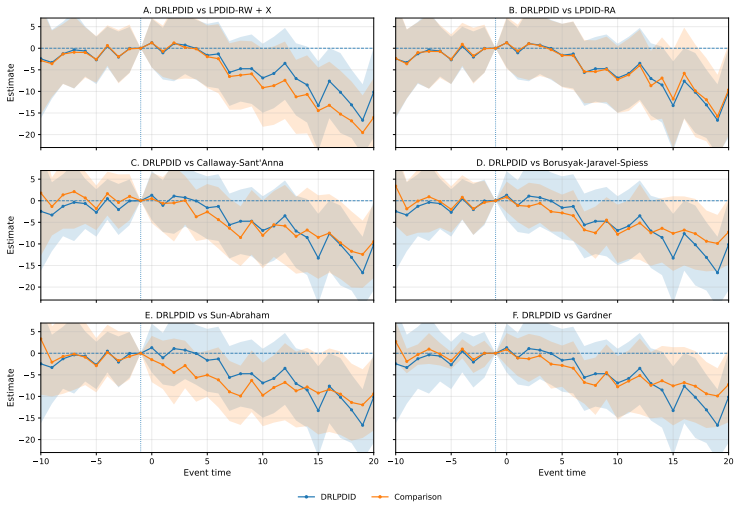
This paper develops a doubly robust extension of local-projections difference-in-differences (LP-DiD) for staggered absorbing treatments. The resulting estimator, DRLPDID, preserves the LP-DiD local-stack ATT target and is consistent when either the local untreated-outcome regression or the local treatment-probability model is correctly specified. It also delivers influence-function-based inference for post-treatment summaries and multiplier-bootstrap bands for dynamic paths. In Monte Carlo designs with covariate-driven selection, DRLPDID matches regression-adjusted LP-DiD under outcome-model alignment and clearly outperforms the IPT-only variant under propensity-score misspecification. In the no-fault-divorce application, DRLPDID tracks robust staggered-adoption estimators and is less negative than unadjusted LP-DiD.
Editorial analysis
A structured set of objections, weighed in public.
Referee Report
Summary. The paper develops a doubly robust extension of local-projections difference-in-differences (LP-DiD) for staggered absorbing treatments. The resulting DRLPDID estimator preserves the original LP-DiD local-stack ATT target and is consistent when either the local untreated-outcome regression or the local treatment-probability model is correctly specified. It supplies influence-function-based inference for post-treatment summaries and multiplier-bootstrap bands for dynamic paths. Monte Carlo designs with covariate-driven selection and an application to no-fault divorce laws are used to illustrate performance relative to regression-adjusted LP-DiD and IPT-only variants.
Significance. If the double-robustness property and target preservation hold, the estimator would provide a practical robustness upgrade for LP-DiD users facing potential misspecification in either the outcome or propensity model under standard staggered DiD assumptions. The Monte Carlo results and application supply concrete evidence of behavior under covariate selection, and the influence-function plus bootstrap inference is a clear implementation strength.
major comments (2)
- [§3] §3 (estimator construction): the explicit form of the DRLPDID influence function and the bias-cancellation argument for double robustness should be derived in full, showing how the regression residual and IPW terms combine to yield consistency under either correct model without additional assumptions beyond those stated for LP-DiD.
- [Application section] Application section: the local untreated-outcome regression and treatment-probability specifications appear chosen after inspecting the data; pre-specification or a sensitivity table varying the covariate sets and functional forms would strengthen the claim that DRLPDID is less negative than unadjusted LP-DiD.
minor comments (2)
- [Introduction] The notation distinguishing the local-stack ATT from the standard ATT could be introduced earlier and used consistently in the abstract and introduction.
- [Monte Carlo] Monte Carlo tables would benefit from reporting the exact functional forms used for the outcome and propensity models in each design to allow direct replication of the misspecification cases.
Simulated Author's Rebuttal
We thank the referee for the careful reading, positive assessment, and constructive suggestions. We address each major comment below and will revise the manuscript accordingly.
read point-by-point responses
-
Referee: [§3] §3 (estimator construction): the explicit form of the DRLPDID influence function and the bias-cancellation argument for double robustness should be derived in full, showing how the regression residual and IPW terms combine to yield consistency under either correct model without additional assumptions beyond those stated for LP-DiD.
Authors: We agree that greater explicitness in the derivation will strengthen the section. In the revised manuscript we will expand §3 to present the full closed-form expression for the DRLPDID influence function. We will also walk through the bias-cancellation argument in detail, showing algebraically how the regression-residual term and the IPW term jointly eliminate first-order bias when either the local untreated-outcome regression or the local treatment-probability model is correctly specified, under no assumptions beyond those already maintained for the original LP-DiD estimator. revision: yes
-
Referee: [Application section] Application section: the local untreated-outcome regression and treatment-probability specifications appear chosen after inspecting the data; pre-specification or a sensitivity table varying the covariate sets and functional forms would strengthen the claim that DRLPDID is less negative than unadjusted LP-DiD.
Authors: We acknowledge that the covariate sets and functional forms used in the application were informed by economic reasoning and preliminary data inspection. To address the concern, the revised application section will include a sensitivity table that reports DRLPDID estimates under alternative covariate specifications (different subsets, with and without interactions, linear versus flexible forms). This table will confirm that the qualitative finding—DRLPDID estimates are less negative than unadjusted LP-DiD—remains stable across these choices. revision: yes
Circularity Check
No significant circularity; derivation is self-contained
full rationale
The paper's central result is the construction of a doubly robust estimator DRLPDID that combines an outcome regression term with an inverse-probability-weighted residual to achieve consistency for the LP-DiD local-stack ATT target whenever at least one of the two nuisance models is correctly specified. This is the standard double-robustness property obtained by algebraic cancellation of bias terms under the maintained staggered DiD assumptions (no anticipation, covariate conditioning). No equation reduces the target ATT or the consistency claim to a fitted quantity by construction, no self-citation supplies a load-bearing uniqueness theorem, and no ansatz is smuggled in. The Monte Carlo and application sections compare the estimator to its components without redefining the target parameter. The derivation therefore stands on independent statistical arguments rather than tautological re-labeling of inputs.
Axiom & Free-Parameter Ledger
axioms (1)
- domain assumption Standard no-anticipation and parallel trends assumptions conditional on covariates for staggered absorbing treatments
Reference graph
Works this paper leans on
-
[1]
Girardi, \`O
Dube, A., D. Girardi, \`O. Jord\`a, A. M. Taylor, 2025. A local projections approach to difference-in-differences. Journal of Applied Econometrics 40, 741--758
2025
-
[2]
diff-diff: Difference-in-differences in Python
diff-diff contributors, 2026. diff-diff: Difference-in-differences in Python. Python package documentation. https://diff-diff.readthedocs.io/
2026
-
[3]
Difference-in-differences with variation in treatment timing
Goodman-Bacon, A., 2021. Difference-in-differences with variation in treatment timing. Journal of Econometrics 225, 254--277
2021
-
[4]
Graham, B. S., C. C. Pinto, D. Egel, 2012. Inverse probability tilting for moment condition models with missing data. Review of Economic Studies 79, 1053--1079
2012
-
[5]
Sant'Anna, P. H. C., J. Zhao, 2020. Doubly robust difference-in-differences estimators. Journal of Econometrics 219, 101--122
2020
-
[6]
Wolfers, 2006
Stevenson, B., J. Wolfers, 2006. Bargaining in the shadow of the law: Divorce laws and family distress. Quarterly Journal of Economics 121, 267--288
2006
-
[7]
Jaravel, J
Borusyak, K., X. Jaravel, J. Spiess, 2024. Revisiting event-study designs: Robust and efficient estimation. Review of Economic Studies 91, 3253--3285
2024
-
[8]
Callaway, B., P. H. C. Sant'Anna, 2021. Difference-in-differences with multiple time periods. Journal of Econometrics 225, 200--230
2021
-
[9]
D'Haultf uille, 2020
de Chaisemartin, C., X. D'Haultf uille, 2020. Two-way fixed effects estimators with heterogeneous treatment effects. American Economic Review 110, 2964--2996
2020
-
[10]
D'Haultf uille, 2023
de Chaisemartin, C., X. D'Haultf uille, 2023. Two-way fixed effects and difference-in-differences with heterogeneous treatment effects: A survey. The Econometrics Journal 26, C1--C30
2023
-
[11]
Two-stage differences in differences
Gardner, J., 2022. Two-stage differences in differences. arXiv preprint arXiv:2207.05943
-
[12]
Discussion of ``An Essay on the Logical Foundations of Survey Sampling, Part I'', by D
H \'a jek, J., 1971. Discussion of ``An Essay on the Logical Foundations of Survey Sampling, Part I'', by D. Basu. In: Godambe, V.P., Sprott, D.A. (Eds.), Foundations of Statistical Inference. Holt, Rinehart and Winston, Toronto, p. 326
1971
-
[13]
Estimation and inference of impulse responses by local projections
Jord \'a , \`O., 2005. Estimation and inference of impulse responses by local projections. American Economic Review 95, 161--182
2005
-
[14]
Sant'Anna, A
Roth, J., M. Sant'Anna, A. Bilinski, J. Poe, 2023. What’s trending in difference-in-differences? A synthesis of the recent econometrics literature. Journal of Econometrics 235, 2218--2244
2023
-
[15]
Abraham, 2021
Sun, L., S. Abraham, 2021. Estimating dynamic treatment effects in event studies with heterogeneous treatment effects. Journal of Econometrics 225, 175--199
2021
discussion (0)
Sign in with ORCID, Apple, or X to comment. Anyone can read and Pith papers without signing in.