Recognition: unknown
Holomorphic disks and tropical Lagrangians
Pith reviewed 2026-05-07 08:49 UTC · model grok-4.3
The pith
Tropical graphs provide a calculus for counting pseudoholomorphic disks bounded by Lagrangians in almost toric manifolds.
A machine-rendered reading of the paper's core claim, the machinery that carries it, and where it could break.
Core claim
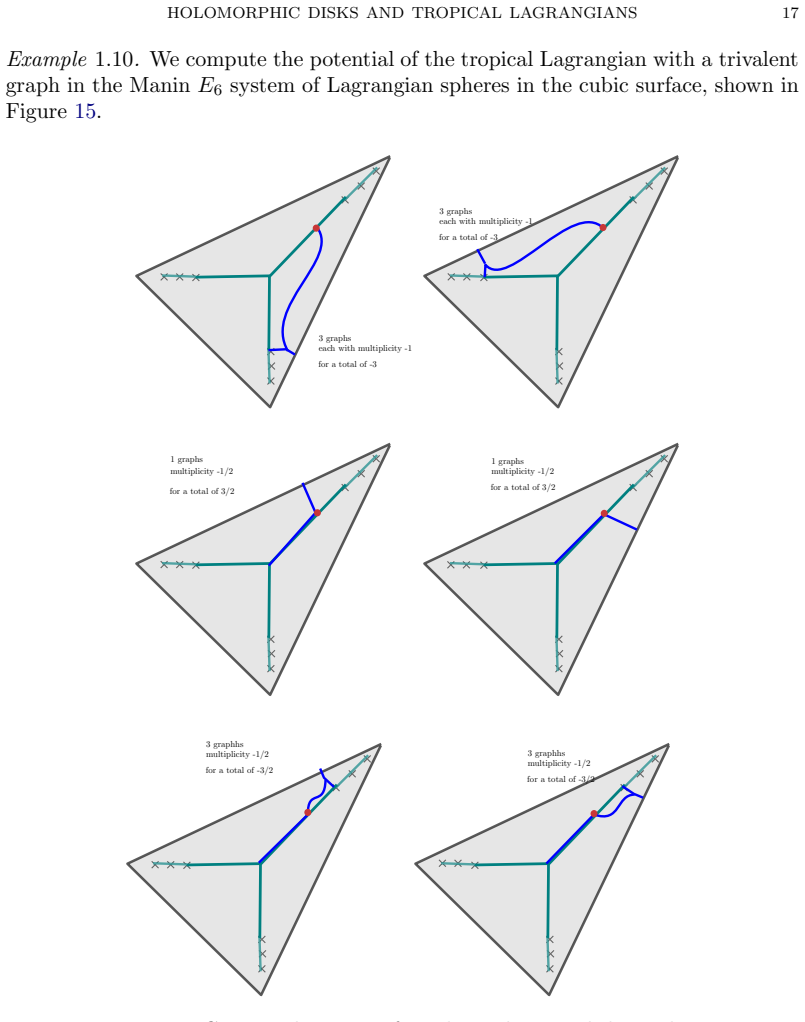
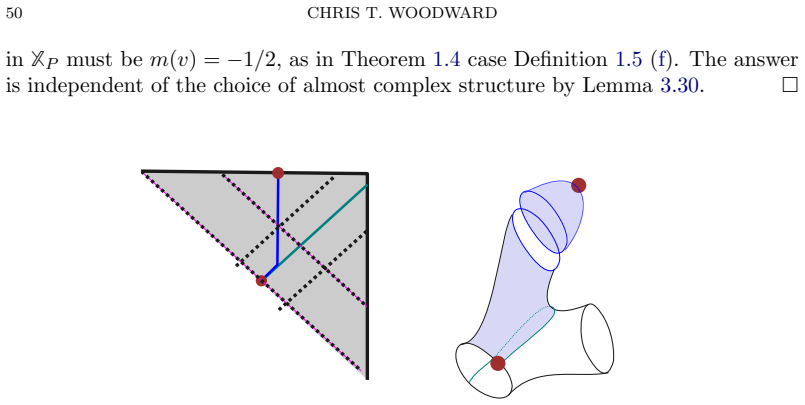
We develop a calculus for counting pseudoholomorphic disks with boundary in tropical Lagrangians contained in almost toric manifolds, given as a sum over tropical graphs that interact with the tropical graph of the Lagrangian. The main contribution is the calculation of several multiplicities of vertices corresponding to disks, such as the holomorphic pant and various univalent vertices occurring at trivalent vertices of the graph of the Lagrangian, using a Lagrangian isotopy from the Lagrangian pair of pants in the del Pezzo of degree seven to the inverse image of a diagonal. We show that every integer eigenvalue of non-maximal modulus for quantum multiplication by the first Chern class is
What carries the argument
The sum over tropical graphs interacting with the Lagrangian's tropical graph, with computed multiplicities for disk vertices including the holomorphic pant.
If this is right
- The calculus generalizes Mikhalkin-Nishinou-Siebert sphere counts and prior disk counts on moment fibers.
- Explicit vertex multiplicities enable computation of disk invariants in almost toric four-manifolds.
- All integer non-maximal eigenvalues of quantum multiplication by the first Chern class are realized by holomorphic spheres from the construction.
- The technique extends in principle to higher dimensions and non-monotonic cases.
Where Pith is reading between the lines
- This combinatorial approach could enable algorithmic calculations of quantum invariants for specific almost toric examples.
- The isotopy between the Lagrangian pants and the diagonal inverse image might extend to other Lagrangian submanifolds for simplifying counts.
- Connections to tropical geometry suggest potential links with mirror symmetry computations in these manifolds.
Load-bearing premise
The counting results rely on dimension four and monotonicity assumptions for the Lagrangians, although the underlying technique is asserted to work more generally.
What would settle it
A mismatch between the tropical graph sum prediction and an independent computation of the number of holomorphic disks bounding a tropical Lagrangian in a specific almost toric four-manifold, such as a del Pezzo surface.
Figures
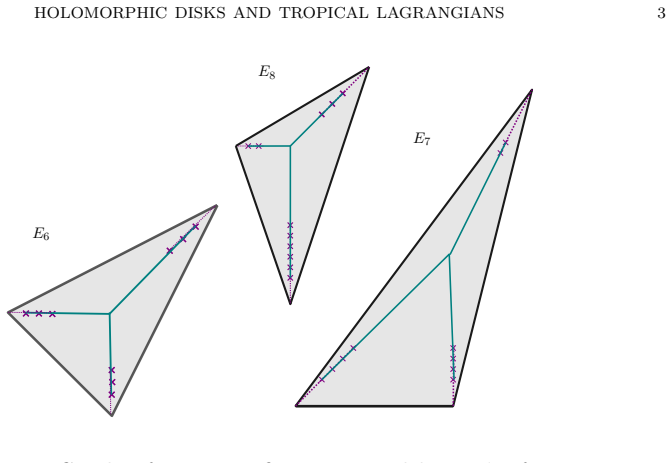


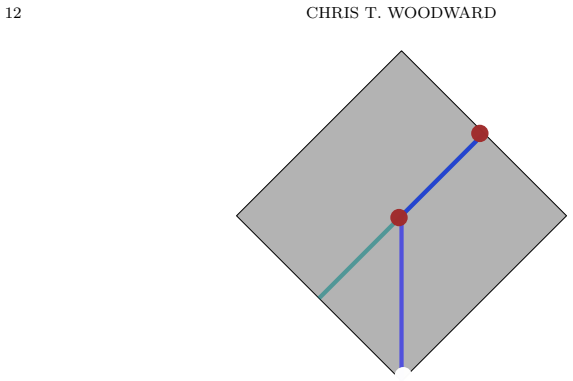
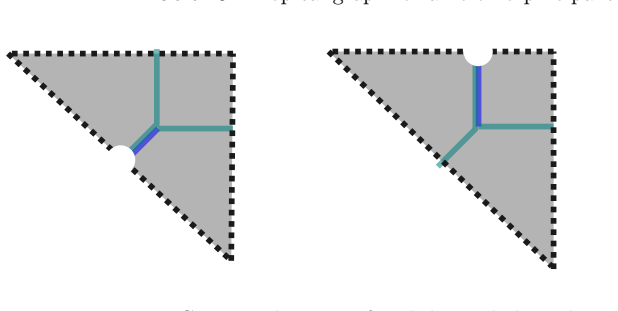


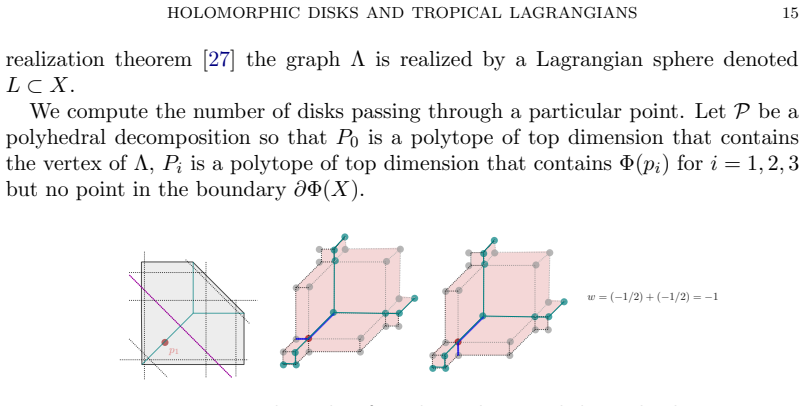




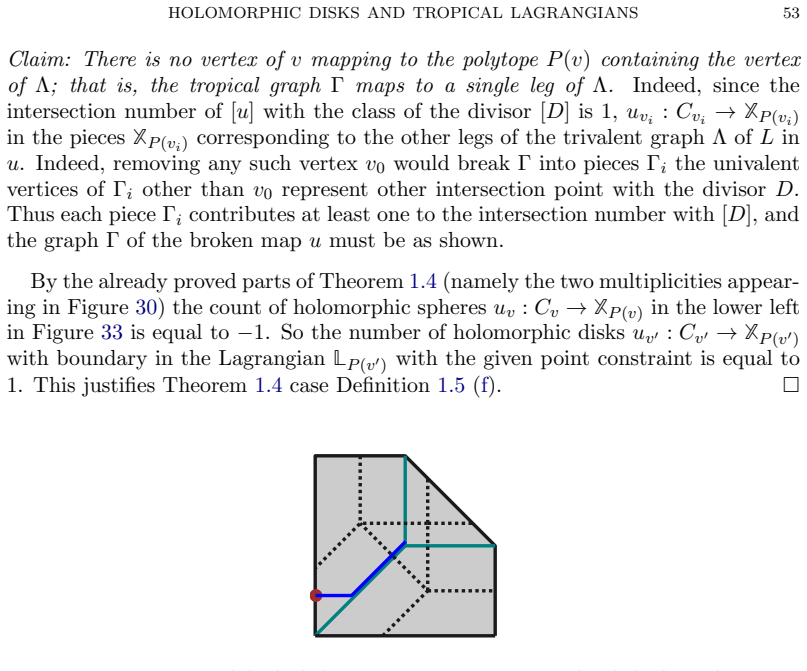
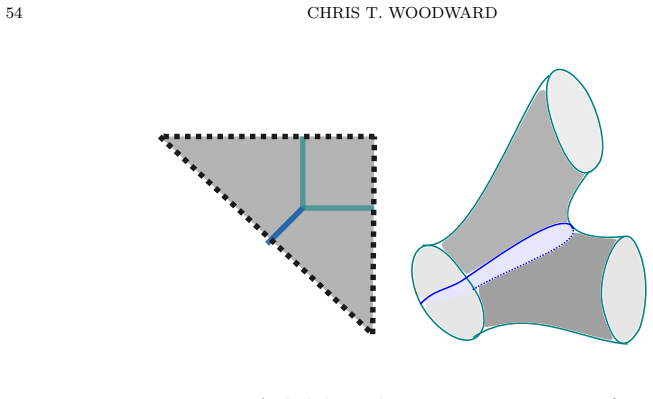
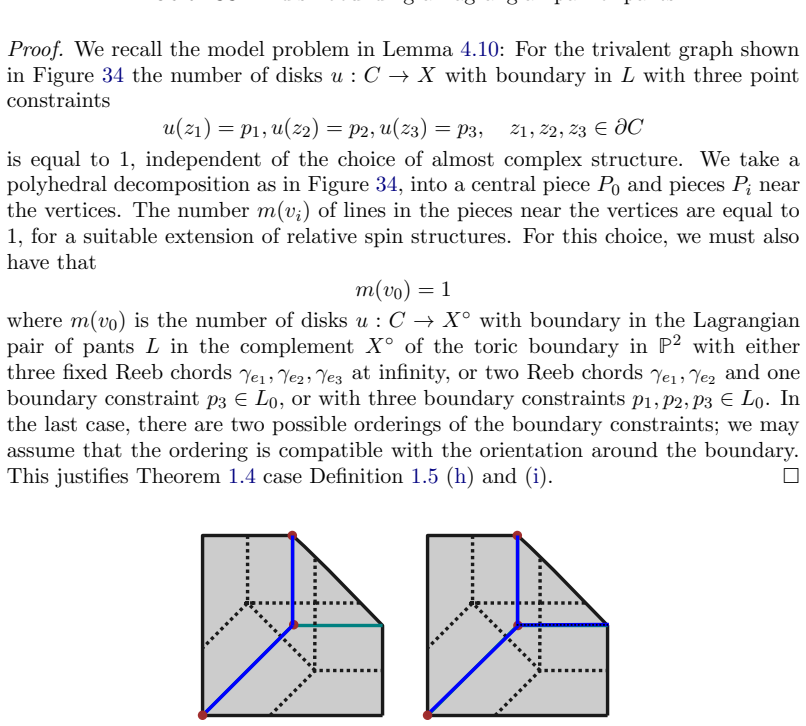
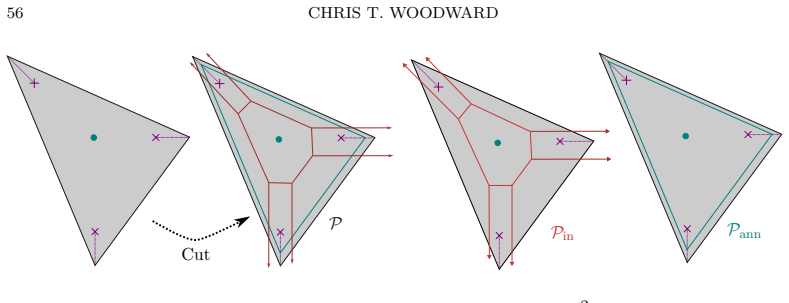


read the original abstract
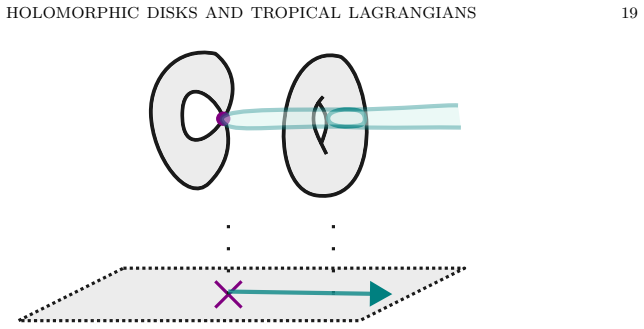
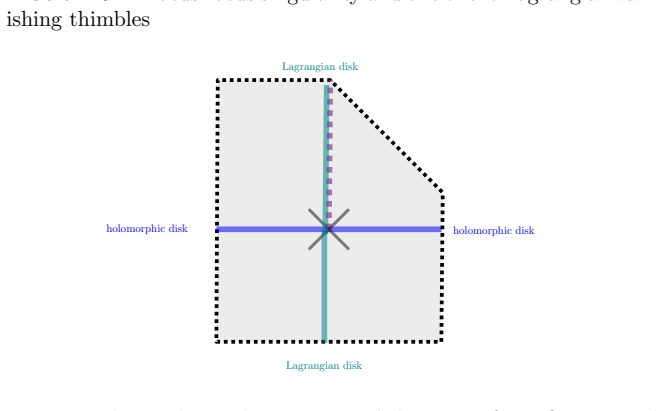
We develop a calculus for counting pseudoholomorphic disks with boundary in tropical Lagrangians contained in almost toric manifolds, using our previous work with Venugopalan. The results are mostly in dimension four under monotonicity assumptions although in principle the same technique works in any dimension and without monotonicity. The calculus is given as a sum over tropical graphs that interact with the tropical graph of the Lagrangian, generalizing results of Mikhalkin and Nishinou-Siebert for holomorphic spheres in toric varieties, and our previous result with Venugopalan which dealt with disks bounding almost toric moment fibers. The main contribution of this paper is the calculation of several multiplicities of vertices corresponding to disks, such as the holomorphic pant (half of the holomorphic pair of pants) and various univalent vertices occuring at trivalent vertices of the graph of the Lagrangian; a key tool is a Lagrangian isotopy from the Lagrangian pair of pants in the del Pezzo of degree seven to the inverse image of a diagonal, which is a special case of a results of Hind and Evans. We show that every integer eigenvalue of non-maximal modulus for quantum multiplication by the first Chern class is realized by such a sphere.
Editorial analysis
A structured set of objections, weighed in public.
Referee Report
Summary. The manuscript develops a tropical calculus for counting pseudoholomorphic disks with boundary on tropical Lagrangians in almost toric manifolds, expressed as a sum over tropical graphs interacting with the Lagrangian graph. This generalizes Mikhalkin/Nishinou-Siebert sphere counts and the authors' prior work with Venugopalan on disks bounding almost toric moment fibers. The central technical contribution is the explicit computation of vertex multiplicities (including the holomorphic pant and univalent vertices at trivalent Lagrangian points) via a Lagrangian isotopy in the degree-7 del Pezzo surface from the pair-of-pants to the inverse image of a diagonal, invoking a special case of Hind-Evans results. The main theorem asserts that every integer eigenvalue of non-maximal modulus for quantum multiplication by the first Chern class is realized by a sphere obtained from this counting procedure. The results are presented primarily in dimension four under monotonicity assumptions.
Significance. If the multiplicity calculations hold, the work supplies an explicit geometric mechanism for realizing eigenvalues of quantum multiplication by c1 via holomorphic spheres, extending tropical methods to Lagrangian settings in almost toric geometry. The isotopy-based computation of specific vertex multiplicities (holomorphic pant and univalent vertices) is a concrete strength that could facilitate further applications to quantum cohomology invariants.
major comments (2)
- [the section on Lagrangian isotopy and vertex multiplicity calculation] The transfer of disk multiplicities through the Lagrangian isotopy in the degree-7 del Pezzo (invoked to compute the holomorphic pant and univalent vertex contributions) requires explicit verification that the isotopy induces a bijection on the relevant pseudoholomorphic disks and that the almost-toric almost-complex structures introduce no extraneous contributions not captured by the tropical graphs. Without this, the multiplicity values feeding the sum-over-tropical-graphs formula are not guaranteed to be correct, undermining the eigenvalue realization claim.
- [the statement of the main theorem and the preceding multiplicity computations] The headline statement that every integer eigenvalue of non-maximal modulus is realized by such a sphere rests on the computed multiplicities entering the generalized Mikhalkin/Nishinou-Siebert formula; the manuscript must confirm that the tropical graph enumeration exhausts all contributions under the monotonicity and dimension-four hypotheses, with no missing or overcounted terms from the almost toric structure.
minor comments (2)
- The abstract and introduction could more clearly distinguish the new multiplicity calculations from the results that follow directly from prior work with Venugopalan.
- Notation for the tropical graphs and their interaction with the Lagrangian graph would benefit from an additional illustrative figure or explicit low-degree example.
Simulated Author's Rebuttal
We thank the referee for their careful reading of the manuscript and for identifying points where additional clarification would strengthen the presentation. We address each major comment below and have revised the manuscript to incorporate explicit verifications of the isotopy and the completeness of the tropical enumeration under the stated hypotheses.
read point-by-point responses
-
Referee: [the section on Lagrangian isotopy and vertex multiplicity calculation] The transfer of disk multiplicities through the Lagrangian isotopy in the degree-7 del Pezzo (invoked to compute the holomorphic pant and univalent vertex contributions) requires explicit verification that the isotopy induces a bijection on the relevant pseudoholomorphic disks and that the almost-toric almost-complex structures introduce no extraneous contributions not captured by the tropical graphs. Without this, the multiplicity values feeding the sum-over-tropical-graphs formula are not guaranteed to be correct, undermining the eigenvalue realization claim.
Authors: We agree that the transfer of multiplicities via the isotopy requires a more explicit argument. In the revised manuscript we have added a dedicated paragraph in the relevant section that invokes the precise statement from Hind-Evans (the special case for the inverse image of a diagonal) to establish a bijection between the moduli spaces of pseudoholomorphic disks before and after the isotopy. Because the isotopy is through almost-toric Lagrangians and the almost-complex structure is chosen to be compatible with the toric fibration throughout the family, the maximum principle precludes disks that escape the almost-toric neighborhood; hence no extraneous contributions arise outside the tropical graphs. The vertex multiplicities for the holomorphic pant and the univalent vertices are therefore correctly transferred and may be used in the sum-over-graphs formula. revision: yes
-
Referee: [the statement of the main theorem and the preceding multiplicity computations] The headline statement that every integer eigenvalue of non-maximal modulus is realized by such a sphere rests on the computed multiplicities entering the generalized Mikhalkin/Nishinou-Siebert formula; the manuscript must confirm that the tropical graph enumeration exhausts all contributions under the monotonicity and dimension-four hypotheses, with no missing or overcounted terms from the almost toric structure.
Authors: We accept the need to make the exhaustion argument fully explicit. Under the monotonicity and dimension-four hypotheses the Maslov index is strictly positive for non-constant disks, and the almost-toric almost-complex structure forces every pseudoholomorphic disk (or sphere) to tropicalize to a graph in the base whose vertices lie on the Lagrangian graph. The revised proof of the main theorem now contains a short lemma showing that the tropicalization map is surjective onto the set of graphs appearing in the sum and that each such graph arises from a unique stable map in the Gromov compactification; multiplicities match by the vertex computations already performed. Consequently there are neither missing nor overcounted terms, and the eigenvalue realization follows directly from the generalized Mikhalkin/Nishinou-Siebert count. revision: yes
Circularity Check
Minor self-citation to prior tropical counting framework; central multiplicity calculations and eigenvalue realizations remain independent
specific steps
-
self citation load bearing
[Abstract]
"We develop a calculus for counting pseudoholomorphic disks with boundary in tropical Lagrangians contained in almost toric manifolds, using our previous work with Venugopalan. ... The calculus is given as a sum over tropical graphs that interact with the tropical graph of the Lagrangian, generalizing results of Mikhalkin and Nishinou-Siebert for holomorphic spheres in toric varieties, and our previous result with Venugopalan which dealt with disks bounding almost toric moment fibers."
The general counting formula and its application to eigenvalue realization are adopted from the author's prior self-cited work; while new multiplicities are computed separately, the framework itself is self-referential at the level of the sum-over-graphs method used to produce the spheres realizing the eigenvalues.
full rationale
The derivation generalizes a sum-over-tropical-graphs formula from Mikhalkin/Nishinou-Siebert and the author's prior work with Venugopalan to count disks bounding tropical Lagrangians. The load-bearing new step is the explicit computation of holomorphic pant and univalent vertex multiplicities via a Lagrangian isotopy in the degree-7 del Pezzo to the inverse image of a diagonal (special case of Hind-Evans). These multiplicities are fed into the formula to realize the integer eigenvalues of quantum multiplication by c1. The self-citation supports only the general counting method and is not load-bearing for the specific geometric computations or the final eigenvalue statement, which rest on independent isotopy-based input rather than reducing to fitted parameters or prior outputs by construction.
Axiom & Free-Parameter Ledger
axioms (1)
- domain assumption monotonicity assumptions
Reference graph
Works this paper leans on
-
[1]
Lagrangian cobordism
Paul Biran and Octav Cornea. Lagrangian cobordism. I.J. Amer. Math. Soc., 26(2):295–340, 2013
2013
-
[2]
Woodward
Kenneth Blakey, Soham Chanda, Yuhan Sun, and Chris T. Woodward. Augmentation varieties and disk potentials i, 2024
2024
-
[3]
The local Gromov-Witten theory of curves.J
Jim Bryan and Rahul Pandharipande. The local Gromov-Witten theory of curves.J. Amer. Math. Soc., 21(1):101–136, 2008. With an appendix by Bryan, C. Faber, A. Okounkov and Pandharipande. 64 CHRIS T. WOODWARD
2008
-
[4]
Floer cohomology and higher mutations, 2023
Soham Chanda. Floer cohomology and higher mutations, 2023. arXiv:2301.08311
-
[5]
Floer cohomology and disc instantons of Lagrangian torus fibers in Fano toric manifolds.Asian J
Cheol-Hyun Cho and Yong-Geun Oh. Floer cohomology and disc instantons of Lagrangian torus fibers in Fano toric manifolds.Asian J. Math., 10(4):773–814, 2006
2006
-
[6]
Cieliebak, T
K. Cieliebak, T. Ekholm, and J. Latschev. Compactness for holomorphic curves with switching Lagrangian boundary conditions.J. Symplectic Geom., 8(3):267–298, 2010
2010
-
[7]
Coriasco, E
S. Coriasco, E. Schrohe, and J. Seiler. Realizations of differential operators on conic manifolds with boundary.Ann. Global Anal. Geom., 31(3):223–285, 2007
2007
-
[8]
J. J. Duistermaat. On global action-angle coordinates.Comm. Pure Appl. Math., 33(6):687– 706, 1980
1980
-
[9]
J. D. Evans. Lagrangian spheres in del Pezzo surfaces.J. Topol., 3(1):181–227, 2010
2010
-
[10]
Part I, volume 46 ofAMS/IP Studies in Advanced Mathe- matics
Kenji Fukaya, Yong-Geun Oh, Hiroshi Ohta, and Kaoru Ono.Lagrangian intersection Floer theory: anomaly and obstruction. Part I, volume 46 ofAMS/IP Studies in Advanced Mathe- matics. American Mathematical Society, Providence, RI; International Press, Somerville, MA, 2009
2009
-
[11]
Part II, volume 46 ofAMS/IP Studies in Advanced Mathe- matics
Kenji Fukaya, Yong-Geun Oh, Hiroshi Ohta, and Kaoru Ono.Lagrangian intersection Floer theory: anomaly and obstruction. Part II, volume 46 ofAMS/IP Studies in Advanced Mathe- matics. American Mathematical Society, Providence, RI; International Press, Somerville, MA, 2009
2009
-
[12]
Observations on disks with tropical Lagrangian boundary
Jeff Hicks. Observations on disks with tropical Lagrangian boundary. In2019–20 MATRIX annals, volume 4 ofMATRIX Book Ser., pages 603–607. Springer, Cham, [2021]©2021
2021
-
[13]
Realizability in tropical geometry and unobstructedness ofLagrangian submanifolds,
Jeff Hicks. Realizability in tropical geometry and unobstructedness ofLagrangian submanifolds,
-
[14]
Tropical Lagrangians in toric del-Pezzo surfaces.Selecta Math
Jeffrey Hicks. Tropical Lagrangians in toric del-Pezzo surfaces.Selecta Math. (N.S.), 27(1):Pa- per No. 3, 50, 2021
2021
-
[15]
PhD thesis, University of California, Berkeley, 2023
Jeffrey Stephen Hicks.TropicalLagrangians and Homological Mirror Symmetry. PhD thesis, University of California, Berkeley, 2023
2023
-
[16]
R. Hind. Lagrangian spheres inS 2 ×S 2.Geom. Funct. Anal., 14(2):303–318, 2004
2004
-
[17]
N. J. Hitchin, A. Karlhede, U. Lindstr¨ om, and M. Roˇ cek. Hyper-K¨ ahler metrics and super- symmetry.Comm. Math. Phys., 108(4):535–589, 1987
1987
-
[18]
Gamma conjecture I for del Pezzo surfaces.Adv
Jianxun Hu, Huazhong Ke, Changzheng Li, and Tuo Yang. Gamma conjecture I for del Pezzo surfaces.Adv. Math., 386:Paper No. 107797, 40, 2021
2021
-
[19]
Smith, and Alessio Corti.Rational and nearly rational varieties, vol- ume 92 ofCambridge Studies in Advanced Mathematics
J´ anos Koll´ ar, Karen E. Smith, and Alessio Corti.Rational and nearly rational varieties, vol- ume 92 ofCambridge Studies in Advanced Mathematics. Cambridge University Press, Cam- bridge, 2004
2004
-
[20]
Almost toric symplectic four-manifolds.J
Naichung Conan Leung and Margaret Symington. Almost toric symplectic four-manifolds.J. Symplectic Geom., 8(2):143–187, 2010
2010
-
[21]
Yu. I. Manin.Cubic forms, volume 4 ofNorth-Holland Mathematical Library. North-Holland Publishing Co., Amsterdam, second edition, 1986. Algebra, geometry, arithmetic, Translated from the Russian by M. Hazewinkel
1986
-
[22]
Lagrangian pairs of pants.International Mathematics Research Notices, 2021(15):11306–11356, jul 2019
Diego Matessi. Lagrangian pairs of pants.International Mathematics Research Notices, 2021(15):11306–11356, jul 2019
2021
-
[23]
Lagrangian submanifolds from tropical hypersurfaces.Internat
Diego Matessi. Lagrangian submanifolds from tropical hypersurfaces.Internat. J. Math., 32(7):Paper No. 2150046, 63, 2021
2021
-
[24]
Remarks on the uniqueness of symplectic blowing up
Dusa McDuff. Remarks on the uniqueness of symplectic blowing up. InSymplectic geometry, volume 192 ofLondon Math. Soc. Lecture Note Ser., pages 157–167. Cambridge Univ. Press, Cambridge, 1993
1993
-
[25]
Enumerative tropical algebraic geometry inR 2.J
Grigory Mikhalkin. Enumerative tropical algebraic geometry inR 2.J. Amer. Math. Soc., 18(2):313–377, 2005
2005
-
[26]
Quantum indices and refined enumeration of real plane curves.Acta Math., 219(1):135–180, 2017
Grigory Mikhalkin. Quantum indices and refined enumeration of real plane curves.Acta Math., 219(1):135–180, 2017
2017
-
[27]
Examples of tropical-to-Lagrangian correspondence.Eur
Grigory Mikhalkin. Examples of tropical-to-Lagrangian correspondence.Eur. J. Math., 5(3):1033–1066, 2019. HOLOMORPHIC DISKS AND TROPICAL LAGRANGIANS 65
2019
-
[28]
Milnor.Morse theory
J. Milnor.Morse theory. Annals of Mathematics Studies, No. 51. Princeton University Press, Princeton, NJ, 1963. Based on lecture notes by M. Spivak and R. Wells
1963
-
[29]
Toric degenerations of toric varieties and tropical curves
Takeo Nishinou and Bernd Siebert. Toric degenerations of toric varieties and tropical curves. Duke Math. J., 135(1):1–51, 2006
2006
-
[30]
Floer cohomology of Lagrangian intersections and pseudo-holomorphic disks
Yong-Geun Oh. Floer cohomology of Lagrangian intersections and pseudo-holomorphic disks. I.Comm. Pure Appl. Math., 46(7):949–993, 1993
1993
-
[31]
Floer homology of Lagrangians in clean intersection.https://arxiv.org/ abs/1606.05327
Felix Schm¨ aschke. Floer homology of Lagrangians in clean intersection.https://arxiv.org/ abs/1606.05327
-
[32]
On the Fukaya category of a Fano hypersurface in projective space.Publ
Nick Sheridan. On the Fukaya category of a Fano hypersurface in projective space.Publ. Math. Inst. Hautes ´Etudes Sci., 124:165–317, 2016
2016
-
[33]
Mirror symmetry isT-duality.Nuclear Phys
Andrew Strominger, Shing-Tung Yau, and Eric Zaslow. Mirror symmetry isT-duality.Nuclear Phys. B, 479(1-2):243–259, 1996
1996
-
[34]
Tropical disk potentials for almost toric mani- folds
Sushmita Venugopalan and Chris Woodward. Tropical disk potentials for almost toric mani- folds. In preparation
-
[35]
Tropical Fukaya algebras.arXiv: 2004.14314, 2020
Sushmita Venugopalan and Chris Woodward. Tropical Fukaya algebras.https://arxiv.org/ abs/2004.14314. To appear inMonographs of the European Mathematical Society
-
[36]
Sushmita Venugopalan, Chris T. Woodward, and Guangbo Xu. Fukaya categories of blowups, to appear in theJournal of the Institute of Mathematics of Jussieu. 2006.12264
-
[37]
Infinitely many monotone Lagrangian tori in del Pezzo surfaces.arXiv: 1602.03356, 2016
Renato Vianna. Infinitely many monotone Lagrangian tori in del pezzo surfaces, 2016. 1602.03356
-
[38]
Orientations for pseudoholomorphic quilts.https: //arxiv.org/abs/1503.07803, 2015
Katrin Wehrheim and Chris Woodward. Orientations for pseudoholomorphic quilts.https: //arxiv.org/abs/1503.07803, 2015
-
[39]
Woodward
Katrin Wehrheim and Chris T. Woodward. Pseudoholomorphic quilts.J. Symplectic Geom., 13(4):849–904, 2015
2015
-
[40]
Manin configurations of tropical Lagrangians in del Pezzo surfaces
Chris Woodward. Manin configurations of tropical Lagrangians in del Pezzo surfaces. In prepa- ration
discussion (0)
Sign in with ORCID, Apple, or X to comment. Anyone can read and Pith papers without signing in.