Recognition: unknown
Oscillators from non-semisimple walled Brauer algebras
Pith reviewed 2026-05-07 10:22 UTC · model grok-4.3
The pith
Non-semisimple walled Brauer algebras have dimension corrections governed by the partition function of an infinite tower of simple harmonic oscillators.
A machine-rendered reading of the paper's core claim, the machinery that carries it, and where it could break.
Core claim
We introduce restricted Bratteli diagrams, obtained by modifying the standard Bratteli diagrams for B_N(m,n). This construction provides a systematic way to use representation-theoretic data from the stable regime to compute the dimension modifications arising in the non-semisimple regime. In the regime N=m+n-l, with l small compared to m,n, we show that the restricted diagrams exhibit a stability property and enable an efficient counting of the paths responsible for these dimension corrections. Remarkably, the resulting generating functions are governed by the partition function of an infinite tower of simple harmonic oscillators.
What carries the argument
Restricted Bratteli diagrams obtained by modifying standard diagrams to capture kernel-induced dimension changes and to stabilize for small l.
If this is right
- Representation dimensions in the non-semisimple regime can be obtained from stable-regime data through systematic path modifications.
- Generating functions for the corrections take the explicit form of the partition function of an infinite tower of simple harmonic oscillators.
- Orthogonal bases for matrix invariants in gauge theory can be constructed more efficiently using the corrected dimensions.
- Applications in quantum information theory gain a practical counting method for mixed tensor representations.
Where Pith is reading between the lines
- The emergence of oscillator partition functions hints at recursive or symmetry-based structures that may extend the counting method beyond small l.
- Similar restricted-diagram techniques could be tested on other families of non-semisimple algebras appearing in Schur-Weyl dualities.
- Small explicit calculations for concrete m and n would provide immediate numerical checks and possible generalizations to larger deviations.
Load-bearing premise
The restricted Bratteli diagrams fully capture all dimension modifications arising from the non-semisimple kernel without missing further corrections or stability violations beyond the stated regime of small l.
What would settle it
Direct computation of representation dimensions for specific small m, n, and l using the algebra's defining action on tensor space, followed by comparison to the oscillator partition function predictions.
Figures




read the original abstract
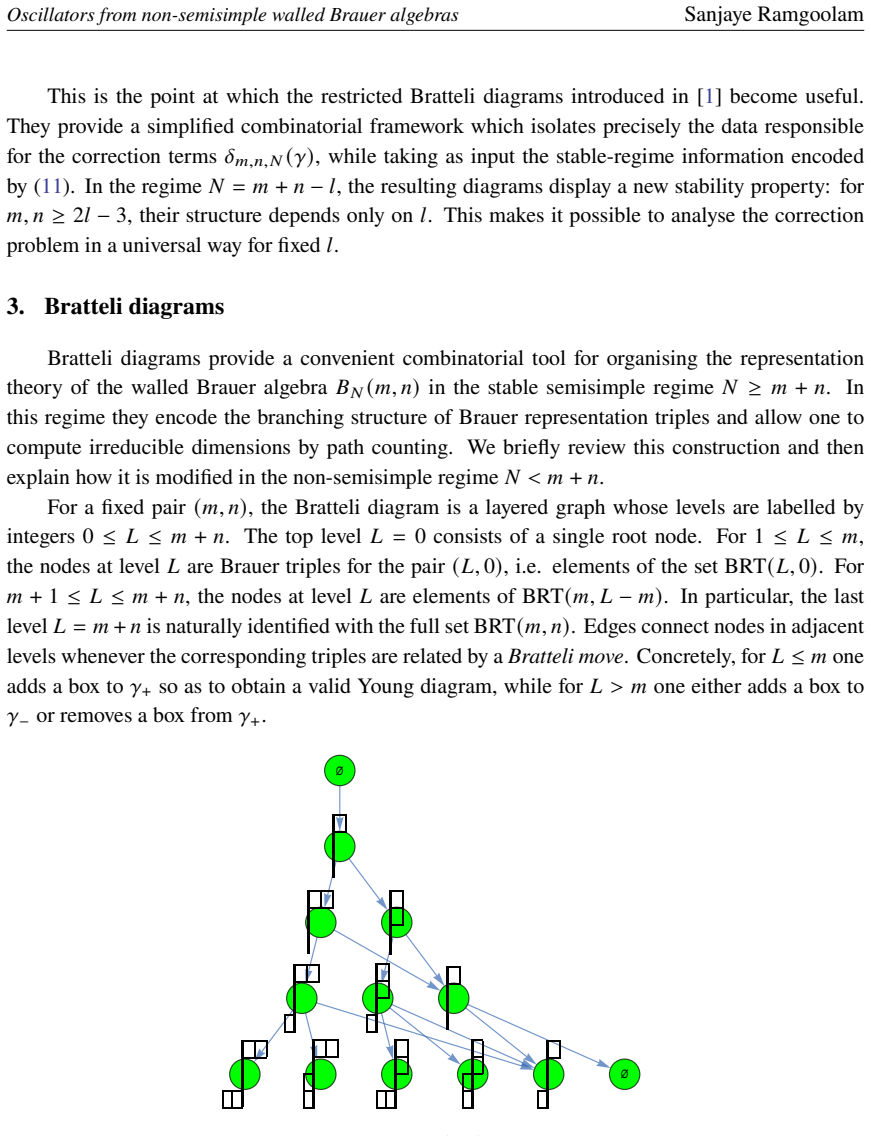
The walled Brauer algebras $B_N(m,n)$ govern Schur--Weyl duality for unitary groups $U(N)$ acting on mixed tensor spaces $V_N^{\otimes m}\otimes \overline{V}_N^{\otimes n}$ and play an important role in applications ranging from AdS/CFT to quantum information theory. In the stable regime $N\ge m+n$ the algebra is semisimple and its representation theory is well understood. For $N<m+n$, however, $B_N(m,n)$ becomes non-semisimple. The representation of the algebra on tensor space has a non-trivial kernel and the corresponding quotient algebra is semisimple, with representation dimensions differing from those in the stable regime. We introduce \emph{restricted Bratteli diagrams}, obtained by modifying the standard Bratteli diagrams for $B_N(m,n)$. This construction provides a systematic way to use representation-theoretic data from the stable regime to compute the dimension modifications arising in the non-semisimple regime. In the regime $N=m+n-l$, with $l$ small compared to $m,n$, we show that the restricted diagrams exhibit a stability property and enable an efficient counting of the paths responsible for these dimension corrections. Remarkably, the resulting generating functions are governed by the partition function of an infinite tower of simple harmonic oscillators. We briefly discuss implications for the construction of orthogonal bases of matrix invariants in gauge theory and related applications in quantum information theory.
Editorial analysis
A structured set of objections, weighed in public.
Referee Report
Summary. The manuscript introduces restricted Bratteli diagrams obtained by modifying the standard Bratteli diagrams for the walled Brauer algebra B_N(m,n). In the regime N = m + n - l with l small relative to m and n, these diagrams are shown to be stable and to permit efficient path counting that computes the dimension shifts induced by the non-trivial kernel of the algebra action on mixed tensor space. The resulting generating functions are claimed to be exactly those of an infinite tower of simple harmonic oscillators, with brief remarks on applications to orthogonal bases of matrix invariants.
Significance. If the restricted diagrams fully reproduce the representation-theoretic dimensions of the semisimple quotient, the construction supplies a systematic combinatorial bridge from the well-understood stable regime to the non-semisimple regime. The emergence of an exact oscillator partition function from path enumeration would be a striking and potentially useful result for computations in AdS/CFT and quantum information theory.
major comments (2)
- [Construction of restricted Bratteli diagrams and stability statement] The central claim that path counting on the restricted diagrams yields precisely the oscillator generating function rests on the assertion that the restriction rule encodes all linear dependencies coming from the radical. The manuscript should supply an explicit small-(m,n,l) example (e.g., m=n=2, l=1) in which the dimensions obtained from the restricted diagrams are compared with the known dimensions of the quotient algebra, confirming that no further corrections are missed.
- [Stability property and path-counting section] The stability property is stated for l small compared with m and n, yet the scope of this stability (i.e., for which values of l the diagrams remain complete) is not delimited by a precise inequality or theorem. Without such a bound, it is unclear whether the oscillator result holds only for l=0 or extends to the full regime advertised in the abstract.
minor comments (2)
- [Abstract and generating-function paragraph] The abstract refers to “an infinite tower of simple harmonic oscillators” without displaying the explicit product form of the generating function; including the closed-form expression (e.g., ∏_k (1−x^k)^(−c_k)) would make the result immediately verifiable.
- Notation for the restricted diagrams (e.g., how the restriction operation is denoted on edges or vertices) should be introduced once and used consistently throughout the path-counting arguments.
Simulated Author's Rebuttal
We thank the referee for the careful reading of the manuscript and the constructive comments. We address each major point below and outline the revisions we will make to strengthen the presentation.
read point-by-point responses
-
Referee: [Construction of restricted Bratteli diagrams and stability statement] The central claim that path counting on the restricted diagrams yields precisely the oscillator generating function rests on the assertion that the restriction rule encodes all linear dependencies coming from the radical. The manuscript should supply an explicit small-(m,n,l) example (e.g., m=n=2, l=1) in which the dimensions obtained from the restricted diagrams are compared with the known dimensions of the quotient algebra, confirming that no further corrections are missed.
Authors: We agree that an explicit low-dimensional verification would make the central claim more transparent and would help confirm that the restricted diagrams fully capture the dimension shifts induced by the radical. In the revised version we will add a new subsection containing the complete calculation for the case m = n = 2, l = 1. We will list the standard Bratteli diagram, apply the restriction rule, enumerate the surviving paths, and tabulate the resulting dimensions side-by-side with the independently known dimensions of the semisimple quotient algebra B_N(2,2)/rad. This comparison will explicitly show that no additional corrections are required beyond those encoded by the restricted diagram. revision: yes
-
Referee: [Stability property and path-counting section] The stability property is stated for l small compared with m and n, yet the scope of this stability (i.e., for which values of l the diagrams remain complete) is not delimited by a precise inequality or theorem. Without such a bound, it is unclear whether the oscillator result holds only for l=0 or extends to the full regime advertised in the abstract.
Authors: We acknowledge that the current statement of stability is qualitative. In the revised manuscript we will insert a precise theorem that delimits the range of l. The theorem will state that, for any fixed l, the restricted Bratteli diagrams become stable once m and n both exceed a finite threshold depending only on l (specifically, m, n > 2l suffices). The proof will rely on the known branching rules for the walled Brauer algebra and on the fact that the radical acts trivially on paths that avoid certain forbidden subdiagrams once the tensor ranks are large enough. With this bound in place, the oscillator generating-function result is shown to hold throughout the regime N = m + n - l with l fixed and m, n sufficiently large, which is the regime advertised in the abstract. revision: yes
Circularity Check
No significant circularity; path counting in restricted Bratteli diagrams yields oscillator generating functions independently
full rationale
The paper defines restricted Bratteli diagrams as a modification of standard ones using stable-regime representation data, then counts paths in the non-semisimple regime N = m + n - l (l small) to obtain dimension corrections. This counting produces generating functions that match the infinite-tower oscillator partition function as a derived combinatorial result. No equation reduces the output to a fitted parameter, self-referential definition, or load-bearing self-citation chain; the stability property and path enumeration are independent steps. The derivation is self-contained against external representation-theoretic benchmarks.
Axiom & Free-Parameter Ledger
axioms (2)
- standard math In the stable regime N ≥ m + n the walled Brauer algebra is semisimple with well-understood representation theory and Bratteli diagrams.
- domain assumption For N < m + n the algebra has a non-trivial kernel and the quotient is semisimple with modified representation dimensions.
invented entities (1)
-
restricted Bratteli diagrams
no independent evidence
Reference graph
Works this paper leans on
-
[1]
Simpleharmonicoscillatorsfromnon-semisimplewalled Brauer algebras,
S.RamgoolamandM.Studziński,“Simpleharmonicoscillatorsfromnon-semisimplewalled Brauer algebras,” arXiv:2509.04234 [hep-th]
-
[2]
W. Fulton and J. Harris,Representation Theory: A First Course, Graduate Texts in Mathe- matics, Vol. 129, Springer-Verlag, New York (1991). doi:10.1007/978-1-4612-0979-9
-
[3]
Perspectives on invariant theory: Schur duality, multiplicity-free actions and be- yond,
R. Howe, “Perspectives on invariant theory: Schur duality, multiplicity-free actions and be- yond,” inTheSchurLectures(1992)(TelAviv), IsraelMathematicalConferenceProceedings, Vol. 8, Bar-Ilan University, Ramat Gan, pp. 1–182 (1995)
1992
-
[4]
Tensor product representations of general linear groups and their connections with Brauer algebras,
G. Benkart, M. Chakrabarti, T. Halverson, R. Leduc, C. Y. Lee, and J. Stroomer, “Tensor product representations of general linear groups and their connections with Brauer algebras,” Journal of Algebra166(3), 529–567 (1994)
1994
-
[5]
Operator invariants of tangles, and𝑅-matrices,
V. G. Turaev, “Operator invariants of tangles, and𝑅-matrices,”Mathematics of the USSR- Izvestiya35(2), 411 (1990)
1990
-
[6]
On the decomposition of tensor products of the representations of the classical groups: Bymeansoftheuniversalcharacters,
K. Koike, “On the decomposition of tensor products of the representations of the classical groups: Bymeansoftheuniversalcharacters,”AdvancesinMathematics74(1),57–86(1989)
1989
-
[7]
Acellfiltrationofmixedtensorspace,
F.StollandM.Werth,“Acellfiltrationofmixedtensorspace,”Math.Z.282(2016)769–798
2016
-
[8]
Branes, anti-branes and Brauer algebras in gauge-gravity duality,
Y. Kimura and S. Ramgoolam, “Branes, anti-branes and Brauer algebras in gauge-gravity duality,” JHEP11(2007) 078. 14 Oscillators from non-semisimple walled Brauer algebrasSanjaye Ramgoolam
2007
-
[9]
Exact multi-matrix correlators,
R. Bhattacharyya, S. Collins and R. de Mello Koch, “Exact multi-matrix correlators,” JHEP 03(2008) 044
2008
-
[10]
Exact multi-restricted Schur poly- nomial correlators,
R. Bhattacharyya, R. de Mello Koch and M. Stephanou, “Exact multi-restricted Schur poly- nomial correlators,” JHEP06(2008) 101
2008
-
[11]
Diagonal multi-matrix correlators and BPS operators inN=4SYM,
T. W. Brown, P. J. Heslop and S. Ramgoolam, “Diagonal multi-matrix correlators and BPS operators inN=4SYM,” JHEP02(2008) 030
2008
-
[12]
Diagonal free field matrix correlators, global symmetries and giant gravitons,
T. W. Brown, P. J. Heslop and S. Ramgoolam, “Diagonal free field matrix correlators, global symmetries and giant gravitons,” JHEP04(2009) 089
2009
-
[13]
Enhanced symmetries of gauge theory and resolving the spectrum of local operators,
Y. Kimura and S. Ramgoolam, “Enhanced symmetries of gauge theory and resolving the spectrum of local operators,” Phys. Rev. D78(2008), 126003 [arXiv:0807.3696 [hep-th]]
-
[14]
Non-holomorphic multi-matrix gauge invariant operators based on Brauer alge- bra,
Y. Kimura, “Non-holomorphic multi-matrix gauge invariant operators based on Brauer alge- bra,” JHEP12(2009), 044 [arXiv:0910.2170 [hep-th]]
-
[15]
Quarter BPS classified by Brauer algebra,
Y. Kimura, “Quarter BPS classified by Brauer algebra,” JHEP05(2010) 103
2010
-
[16]
Young diagrams, Brauer algebras, and bubbling geometries,
Y. Kimura and H. Lin, “Young diagrams, Brauer algebras, and bubbling geometries,” JHEP 01(2013) 096
2013
-
[17]
Permutationcentralizeralgebrasandmulti-matrixinvariants,
P.MattioliandS.Ramgoolam,“Permutationcentralizeralgebrasandmulti-matrixinvariants,” Phys. Rev. D93(2016) 065040
2016
-
[18]
Irreducible matrix representa- tions for the walled Brauer algebra,
M. Studziński, T. Młynik, M. Mozrzymas and M. Horodecki, “Irreducible matrix representa- tions for the walled Brauer algebra,” arXiv:2502.16062 [quant-ph]
-
[19]
New developments in the numerical conformal bootstrap,
D. Grinko, A. Burchardt and M. Ozols, “Gelfand–Tsetlin basis for partially transposed per- mutations, with applications to quantum information,” arXiv:2311.15844 [quant-ph]
-
[20]
The mixed Schur transform: efficient quantum circuit and applications,
Q. T. Nguyen, “The mixed Schur transform: efficient quantum circuit and applications,” arXiv:2310.01613 [quant-ph]
-
[21]
Efficient quantum circuits for port-based teleporta- tion,
D. Grinko, A. Burchardt and M. Ozols, “Efficient quantum circuits for port-based teleporta- tion,” arXiv:2404.11742 [quant-ph]
-
[22]
Efficient quantum algorithm for port-based teleporta- tion,
J. Fei, S. Timmerman and P. Hayden, “Efficient quantum algorithm for port-based teleporta- tion,” arXiv:2311.16056 [quant-ph]
-
[23]
Efficient algorithms for all port-based teleportation protocols,
A. Wills, M.-H. Hsieh and S. Strelchuk, “Efficient algorithms for all port-based teleportation protocols,” PRX Quantum5(2024) 030354
2024
-
[24]
MixedSchur–Weyldualityinquantuminformation,
D.Grinko,“MixedSchur–Weyldualityinquantuminformation,”PhDthesis,Universiteitvan Amsterdam (2025)
2025
-
[25]
Port-based teleportation in arbitrary dimension,
M. Studziński, S. Strelchuk, M. Mozrzymas and M. Horodecki, “Port-based teleportation in arbitrary dimension,” Sci. Rep.7(2017) 10871. 15 Oscillators from non-semisimple walled Brauer algebrasSanjaye Ramgoolam
2017
-
[26]
Optimal multi-port-based teleportation schemes,
M. Mozrzymas, M. Studziński and P. Kopszak, “Optimal multi-port-based teleportation schemes,” Quantum5(2021) 477
2021
-
[27]
A simplified formalism of the algebra of partially transposed permutation operators with applications,
M. Mozrzymas, M. Studziński and M. Horodecki, “A simplified formalism of the algebra of partially transposed permutation operators with applications,” J. Phys. A: Math. Theor.51 (2018) 125202
2018
-
[28]
Deterministic transformations between unitary operations: exponential advantage with adaptive quantum circuits and the power of indefinite causality,
M. T. Quintino and D. Ebler, “Deterministic transformations between unitary operations: exponential advantage with adaptive quantum circuits and the power of indefinite causality,” Quantum6(2022) 679
2022
-
[29]
A memory and gate efficient algorithm for unitary mixed Schur sampling,
E. Cerveró-Martín, L. Mančinska and E. Theil, “A memory and gate efficient algorithm for unitary mixed Schur sampling,” arXiv:2408.00152 [quant-ph]
-
[30]
Linear programming with unitary-equivariant constraints,
D. Grinko and M. Ozols, “Linear programming with unitary-equivariant constraints,” Com- mun. Math. Phys.405(2024) 278
2024
-
[31]
Separability properties of tripartite states with𝑈⊗𝑈⊗𝑈 symmetry,
T. Eggeling and R. F. Werner, “Separability properties of tripartite states with𝑈⊗𝑈⊗𝑈 symmetry,”Phys. Rev. A63, 042111 (2001)
2001
-
[32]
Commuting actions—a tale of two groups
G. Benkart, “Commuting actions—a tale of two groups.” In:Lie Algebras and Their Repre- sentations,Contemporary Mathematics194(1996)
1996
-
[33]
D. V. Bulgakova,Some Aspects of Representation Theory of Walled Brauer Algebras, Thesis, Aix Marseille Université (2020)
2020
-
[34]
OntheblocksofthewalledBraueralgebra,
A.Cox,M.DeVisscher,S.Doty,andP.Martin,“OntheblocksofthewalledBraueralgebra,” Journal of Algebra320(1), 169–212 (2008)
2008
-
[35]
Accessed: 2025-07-28
OEIS Foundation Inc.,The On-Line Encyclopedia of Integer Sequences, Sequence A000714, https://oeis.org/A000714 (2025). Accessed: 2025-07-28
2025
-
[36]
ConformalfieldtheorytechniquesinlargeNYang-Millstheory,
M.R.Douglas,“ConformalfieldtheorytechniquesinlargeNYang-Millstheory,”[arXiv:hep- th/9311130 [hep-th]]
-
[37]
BubblingAdSspaceand1/2BPSgeometries,
H.Lin,O.LuninandJ.M.Maldacena,“BubblingAdSspaceand1/2BPSgeometries,”JHEP 10(2004), 025 [arXiv:hep-th/0409174 [hep-th]]. 16
discussion (0)
Sign in with ORCID, Apple, or X to comment. Anyone can read and Pith papers without signing in.