Recognition: unknown
Compressible Navier--Stokes Flow in Schr\"odinger-Type Variables
Pith reviewed 2026-05-07 10:14 UTC · model grok-4.3
The pith
Isothermal compressible Navier-Stokes equations admit an exact Cole-Hopf reformulation in Schrödinger-type amplitude variables.
A machine-rendered reading of the paper's core claim, the machinery that carries it, and where it could break.
Core claim
We derive an exact Eulerian Cole-Hopf-type reformulation of isothermal compressible Navier-Stokes flow in Schrödinger-type amplitude variables. To our knowledge, this gives the first exact Cole-Hopf-type Schrödinger-variable reformulation of compressible NS flow. In two dimensions, a Helmholtz decomposition separates the velocity into compressive and vortical potentials, whose logarithmic transforms yield two scalar imaginary-time Schrödinger-type equations with nonlinear self-consistent potentials. The mixed density-compressive amplitude Ψ_α=ρ^α Θ^{1-2α} (α≠0,1/2) satisfies a nonlinear Schrödinger-type equation with a vector-potential-coupled Laplacian. The transformed system is exactly the
What carries the argument
The mixed amplitude Ψ_α = ρ^α Θ^{1-2α} (α ≠ 0, 1/2) obtained from the Cole-Hopf logarithmic transformation of the compressive velocity potential, which converts the nonlinear dissipative Navier-Stokes system into imaginary-time Schrödinger equations with self-consistent potentials.
If this is right
- The equations expose operator structures that may be useful for reduced flow descriptions.
- The mapping may support quantum algorithms for operator evolution in fluid problems.
- Quantum partial differential equation solvers could be applied to the resulting imaginary-time system.
- In three dimensions the density-carrying equation retains the vector-potential-coupled structure while the solenoidal sector admits a compressible analogue of Ohkitani's formulation.
Where Pith is reading between the lines
- The imaginary-time character of the equations suggests a direct link to diffusion-based numerical schemes that could be explored for compressible flow without quantum hardware.
- Similar Cole-Hopf constructions might be sought for non-isothermal or reacting flows to test whether the exact equivalence generalizes beyond the isothermal restriction.
- The nonlocal projections could be discretized in ways that preserve the Schrödinger form, potentially allowing spectral methods developed for quantum mechanics to be reused for fluids.
Load-bearing premise
The specific Cole-Hopf logarithmic transformation together with the choice of mixed amplitude preserves exact equivalence to the isothermal compressible Navier-Stokes equations without introducing hidden approximations.
What would settle it
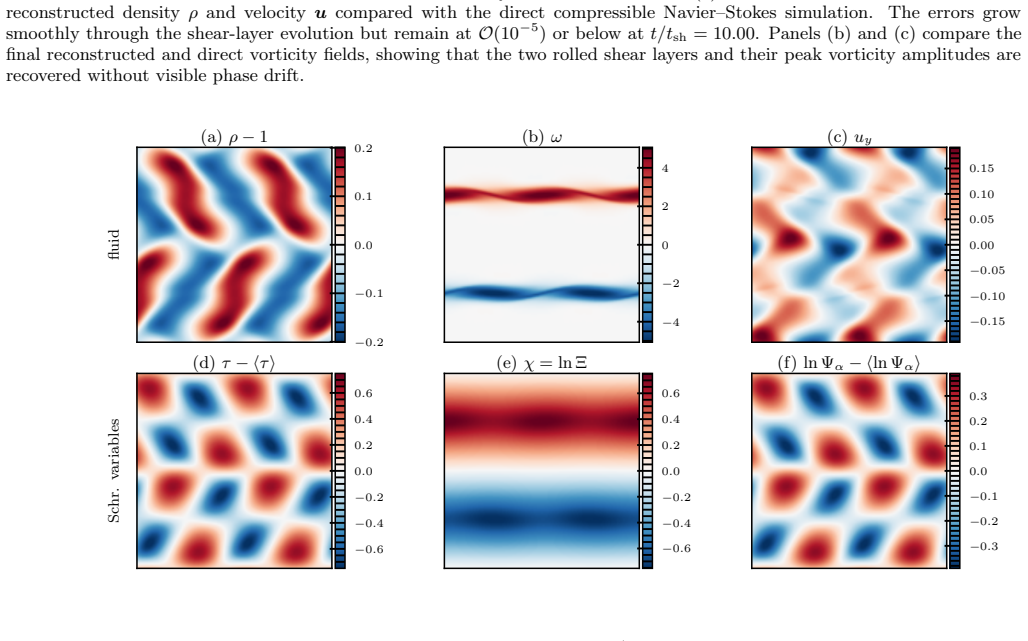
A direct numerical comparison in the two-dimensional Kelvin-Helmholtz shear-layer test case where the density and velocity fields produced by the transformed Schrödinger-type equations deviate from those obtained by solving the original compressible Navier-Stokes system.
Figures


read the original abstract
Fluid equations are nonlinear, dissipative, and non-Hamiltonian, which makes their relation to Schr\"odinger evolution and quantum algorithms nontrivial. We derive an exact Eulerian Cole-Hopf-type reformulation of isothermal compressible Navier-Stokes (NS) flow in Schr\"odinger-type amplitude variables. To our knowledge, this gives the first exact Cole-Hopf-type Schr\"odinger-variable reformulation of compressible NS flow. In two dimensions, a Helmholtz decomposition separates the velocity into compressive and vortical potentials, whose logarithmic transforms yield two scalar imaginary-time Schr\"odinger-type equations with nonlinear self-consistent potentials. We show that the mixed density-compressive amplitude $\Psi_\alpha=\rho^\alpha\Theta^{1-2\alpha}$, where $\rho$ is the density, $\Theta$ is the compressive amplitude, and $\alpha\neq 0,\,1/2$, satisfies a nonlinear Schr\"odinger-type equation with a vector-potential-coupled Laplacian. The transformed system is exactly equivalent to compressible NS and is nonlocal only through Helmholtz and Poisson projections. In three dimensions, the density-carrying equation retains the same vector-potential-coupled structure, while the solenoidal sector admits a compressible analogue of Ohkitani's incompressible NS Cole-Hopf formulation. Unlike unitary hydrodynamic Schr\"odinger-flow representations, the present equations are imaginary-time heat or drift-diffusion equations with self-consistent potentials, but they remain an exact change of variables for compressible NS. A two-dimensional Kelvin-Helmholtz unstable shear-layer calculation verifies the transformed equations against a direct compressible NS simulation. The formulation exposes operator structures that may be useful for reduced flow descriptions, quantum algorithms for operator evolution, and quantum partial differential equation solvers.
Editorial analysis
A structured set of objections, weighed in public.
Referee Report
Summary. The manuscript derives an exact Eulerian Cole-Hopf-type reformulation of isothermal compressible Navier-Stokes flow in Schrödinger-type amplitude variables. In 2D, a Helmholtz decomposition yields compressive and vortical potentials whose logarithmic transforms produce two scalar imaginary-time Schrödinger-type equations with nonlinear self-consistent potentials. A mixed density-compressive amplitude Ψ_α = ρ^α Θ^{1-2α} (α ≠ 0, 1/2) is shown to satisfy a nonlinear Schrödinger-type equation with vector-potential-coupled Laplacian. The transformed system is asserted to be exactly equivalent to compressible NS, nonlocal only via Helmholtz and Poisson projections. A 3D extension is sketched, and a 2D Kelvin-Helmholtz shear-layer simulation is used to verify the equations against direct NS computation.
Significance. If the exact equivalence is rigorously established, the reformulation would be significant for exposing operator structures amenable to quantum algorithms, quantum PDE solvers, and reduced-order modeling of dissipative flows. The imaginary-time Schrödinger structure for a classically non-Hamiltonian system is novel, and the parameter-free change of variables (no fitted constants) strengthens the claim relative to approximate hydrodynamic Schrödinger representations.
major comments (2)
- Abstract and main derivation: the central claim that the transformed system is 'exactly equivalent to compressible NS' requires explicit term-by-term inversion showing that substitution of Ψ_α, the logarithmic potentials, and isothermal closure recovers the continuity equation, momentum equation, and viscous dissipation identically with no residual constraints. This algebraic cancellation is asserted but not exhibited, which is load-bearing for the equivalence result.
- The handling of nonlinear self-consistent potentials in the Schrödinger-type equations (mentioned in the abstract) must be shown to introduce no hidden approximations when the vector-potential-coupled Laplacian and projections are inverted; without this, the 'exact change of variables' assertion cannot be verified.
minor comments (2)
- Clarify the precise definition and range of the parameter α in the mixed amplitude Ψ_α at first introduction, including why α = 0 and α = 1/2 are excluded.
- The 2D verification simulation is useful but would benefit from quantitative error norms (e.g., L2 differences between original and transformed fields) rather than qualitative agreement alone.
Simulated Author's Rebuttal
We thank the referee for the careful and constructive review. The comments highlight important points for clarifying the exact equivalence, and we will revise the manuscript to address them explicitly while preserving the core claims.
read point-by-point responses
-
Referee: Abstract and main derivation: the central claim that the transformed system is 'exactly equivalent to compressible NS' requires explicit term-by-term inversion showing that substitution of Ψ_α, the logarithmic potentials, and isothermal closure recovers the continuity equation, momentum equation, and viscous dissipation identically with no residual constraints. This algebraic cancellation is asserted but not exhibited, which is load-bearing for the equivalence result.
Authors: We agree that an explicit term-by-term back-substitution would make the equivalence more transparent and verifiable. The manuscript derives the Schrödinger-type equations from the NS system via invertible steps (Helmholtz decomposition of velocity, logarithmic transforms of density and potentials, and the linear combination defining Ψ_α for α ≠ 0, 1/2). Each transformation is algebraically reversible under the isothermal closure and suitable boundary conditions, with no residuals introduced. To strengthen the presentation, we will add a new subsection that performs the full inverse substitution: expressing the original continuity, momentum, and viscous terms in terms of the amplitudes and potentials, and demonstrating identical recovery of the NS equations. This will include explicit cancellation for the dissipation term. revision: yes
-
Referee: The handling of nonlinear self-consistent potentials in the Schrödinger-type equations (mentioned in the abstract) must be shown to introduce no hidden approximations when the vector-potential-coupled Laplacian and projections are inverted; without this, the 'exact change of variables' assertion cannot be verified.
Authors: The nonlinear self-consistent potentials are defined exactly as logarithms of the amplitudes and enter the equations without approximation. The vector-potential-coupled Laplacian is inverted exactly by the Helmholtz decomposition, which recovers the original velocity components (compressive and solenoidal) without residuals or approximations; the projections are nonlocal but exact operators. In the 2D case, this holds identically, and the 3D extension follows analogously. No hidden approximations arise because the potentials are self-consistent by construction. We will revise the manuscript to include an explicit inversion step for the coupled Laplacian and projections, showing that the original fields are recovered precisely and that the nonlinear terms cancel consistently with the NS viscous and convective structures. revision: yes
Circularity Check
No significant circularity: direct change-of-variables reformulation with asserted algebraic equivalence
full rationale
The paper derives a Cole-Hopf-type reformulation by introducing the mixed amplitude Ψ_α = ρ^α Θ^{1-2α} (α ≠ 0, 1/2) and logarithmic transforms of compressive/vortical potentials, then states that the resulting imaginary-time Schrödinger-type equations with vector-potential-coupled Laplacians and Helmholtz/Poisson projections are exactly equivalent to isothermal compressible NS. This is a standard change-of-variables argument whose validity rests on term-by-term algebraic cancellation (not on fitting, self-definition, or self-citation chains). No parameters are tuned to data, no output is used to define the input, and external citations (e.g., Ohkitani) are not load-bearing for the equivalence claim. The 2D numerical verification against direct NS simulation further confirms the transformation is treated as an identity map rather than a predictive fit. The derivation is therefore self-contained.
Axiom & Free-Parameter Ledger
axioms (2)
- standard math Helmholtz decomposition separates the velocity field into compressive and solenoidal potentials in two dimensions
- domain assumption The flow is isothermal
invented entities (1)
-
Mixed density-compressive amplitude Ψ_α = ρ^α Θ^{1-2α} (α ≠ 0, 1/2)
no independent evidence
Reference graph
Works this paper leans on
-
[1]
a scalar compressive amplitudeΘsatisfying the heat or imaginary-time Schrödinger-type equation (51),
-
[2]
a scalar vortical amplitudeΞsatisfying the corre- sponding equation (52),
-
[3]
a scalar density-carrying amplitudeΨ α satisfy- ing the vector-potential-coupled Schrödinger-type equation (53), with effective vector potentialA α given by (50). The density sector does not close as a pure density ampli- tude; instead, the mixed amplitudeΨα =ρ αΘ1−2α, with α̸= 0, 1 2, cancels the compressive Laplacian terms and closesinthevector-potentia...
-
[4]
Therefore this localscalargradient transform does not close to a second-order Schrödinger-type equation unless the gradient dependence is absent
Local transforms involving gradients First consider a scalar transform that depends locally on the fields and their first spatial derivatives, Q=F s, τ, χ,∇s,∇τ,∇χ .(D1) The key differentiated variables obey (∂t +u·∇)∇s= 2µ c∇∆τ−(∇u) ⊤∇s,(D2) ∂t∇τ=µ c∇∆τ+∇ µc|∇τ| 2 +V Θ ,(D3) ∂t∇χ=ν∇∆χ− 1 2µs ∇ΨF .(D4) Hence any nontrivial dependence on∇s,∇τ, or∇χin- trod...
-
[5]
(D6) The transformed equation acquires the nonlocal commu- tator[u·∇, K], which vanishes only in very special flows
Fixed spatial nonlocal transforms LetKbe a time-independent spatial operator, for ex- ample∆ −1,∇∆ −1, or(−∆) −1/2, and define QK ≡KR g, R g =F(ρ).(D5) Using (C5), we find ∂tQK +u·∇Q K = [u·∇, K]R g + 2µcK g′(s)∆τ R g . (D6) The transformed equation acquires the nonlocal commu- tator[u·∇, K], which vanishes only in very special flows. Thus a fixed nonloca...
-
[6]
Auxiliary-field and doubled-amplitude formulations Finally, we can write an exact doubled Schrödinger- type formulation. For anyα̸= 1 2, we define the partner amplitudes Ψα =ρ αΘ1−2α,Ψ 1−α =ρ 1−αΘ2α−1.(D7) Their product recovers the density exactly: ρ= Ψ αΨ1−α.(D8) Moreover, each partner satisfies an equation of the form (48), with parameters D1−α =−D α,A...
-
[7]
K. Ohkitani, Dynamical equations for the vector poten- tial and the velocity potential in incompressible irrota- tional euler flows: A refined bernoulli theorem, Physical Review E92, 033010 (2015)
2015
-
[8]
J. M. Burgers, A mathematical model illustrating the theory of turbulence, inAdvances in Applied Mechanics, Vol. 1, edited by R. von Mises and T. von Karman (Aca- demic Press, New York, 1948) pp. 171–199
1948
-
[9]
Hopf, The partial differential equationu t +uu x = µuxx, Communications on Pure and Applied Mathemat- ics3, 201 (1950)
E. Hopf, The partial differential equationu t +uu x = µuxx, Communications on Pure and Applied Mathemat- ics3, 201 (1950)
1950
-
[10]
J.D.Cole,Onaquasi-linearparabolicequationoccurring in aerodynamics, Quarterly of Applied Mathematics9, 225 (1951)
1951
-
[11]
Ohkitani, A miscellany of basic issues on incompress- ible fluid equations, Nonlinearity21, T255 (2008)
K. Ohkitani, A miscellany of basic issues on incompress- ible fluid equations, Nonlinearity21, T255 (2008)
2008
-
[12]
Ohkitani, Analogue of the cole–hopf transform for the incompressible navier–stokes equations and its applica- tion, Journal of Turbulence18, 465 (2017)
K. Ohkitani, Analogue of the cole–hopf transform for the incompressible navier–stokes equations and its applica- tion, Journal of Turbulence18, 465 (2017)
2017
-
[13]
Vanon and K
R. Vanon and K. Ohkitani, Applications of a cole–hopf transform to the 3d navier–stokes equations, Journal of Turbulence19, 322 (2018)
2018
- [14]
-
[15]
R. Bandyopadhyay, J. R. Beattie, and A. Bhattachar- jee, Density Fluctuation-Mach Number Scaling in Com- pressible, High Plasma Beta Turbulence: In Situ Space Observations and High-Reynolds Number Simulations, The Astrophysical Journal Letters982, L45 (2025), arXiv:2502.08883 [astro-ph.SR]
-
[16]
Gaitan, Finding flows of a Navier–Stokes fluid through quantum computing, npj Quantum Information6, 61 (2020)
F. Gaitan, Finding flows of a Navier–Stokes fluid through quantum computing, npj Quantum Information6, 61 (2020)
2020
-
[17]
J.-P. Liu, H. Ø. Kolden, H. K. Krovi, N. F. Loureiro, K. Trivisa, and A. M. Childs, Efficient quantum al- gorithm for dissipative nonlinear differential equations, Proceedings of the National Academy of Sciences118, e2026805118 (2021)
2021
-
[18]
F. Oz, R. K. S. S. Vuppala, K. Kara, and F. Gaitan, Solv- ing Burgers’ equation with quantum computing, Quan- tum Information Processing21, 30 (2022)
2022
-
[19]
Pfeffer, F
P. Pfeffer, F. Heyder, and J. Schumacher, Hybrid quantum-classicalreservoircomputingofthermalconvec- tion flow, Physical Review Research4, 033176 (2022)
2022
- [20]
-
[21]
P. Mocz and A. Szasz, Towards cosmological simula- tions of dark matter on quantum computers, arXiv e-prints , arXiv:2101.05821 (2021), arXiv:2101.05821 [astro-ph.CO]
-
[22]
Madelung, Quantentheorie in hydrodynamischer form, Zeitschrift für Physik40, 322 (1927)
E. Madelung, Quantentheorie in hydrodynamischer form, Zeitschrift für Physik40, 322 (1927)
1927
-
[23]
Zylberman, G
J. Zylberman, G. Di Molfetta, M. Brachet, N. F. Loureiro, and F. Debbasch, Quantum simulations of hy- drodynamics via the madelung transformation, Physical Review A106, 032408 (2022)
2022
- [24]
-
[25]
Meng and Y
Z. Meng and Y. Yang, Quantum computing of fluid dy- namics using the hydrodynamic Schrödinger equation, Physical Review Research5, 033182 (2023)
2023
- [26]
-
[27]
M. Goldack, Y. Atia, O. Alberton, and K. Jansen, Com- puting statistical properties of velocity fields on current quantum hardware, arXiv e-prints , arXiv:2601.10166 (2026), arXiv:2601.10166 [quant-ph]
-
[28]
Linden, A
N. Linden, A. Montanaro, and C. Shao, Quantum vs. classical algorithms for solving the heat equation, Com- munications in Mathematical Physics395, 601 (2022)
2022
-
[29]
Avron, I
J. Avron, I. Herbst, and B. Simon, Schrödinger opera- tors with magnetic fields. i. general interactions, Duke Mathematical Journal45, 847 (1978)
1978
-
[30]
Leray, Sur le mouvement d’un liquide visqueux emplis- sant l’espace, Acta Mathematica63, 193 (1934)
J. Leray, Sur le mouvement d’un liquide visqueux emplis- sant l’espace, Acta Mathematica63, 193 (1934)
1934
-
[31]
K. J. Burns, G. M. Vasil, J. S. Oishi, D. Lecoanet, and B. P. Brown, Dedalus: A flexible framework for numer- ical simulations with spectral methods, Physical Review Research2, 023068 (2020)
2020
-
[32]
Feireisl,Dynamics of Viscous Compressible Fluids (Oxford University Press, Oxford, 2004)
E. Feireisl,Dynamics of Viscous Compressible Fluids (Oxford University Press, Oxford, 2004)
2004
-
[33]
Holmes, J
P. Holmes, J. L. Lumley, G. Berkooz, and C. W. Row- ley,Turbulence, Coherent Structures, Dynamical Systems and Symmetry, 2nd ed. (Cambridge University Press, Cambridge, 2012)
2012
-
[34]
Benner, S
P. Benner, S. Gugercin, and K. Willcox, A survey of projection-based model reduction methods for paramet- ric dynamical systems, SIAM Review57, 483 (2015)
2015
-
[35]
Taira, S
K. Taira, S. L. Brunton, S. T. M. Dawson, C. W. Rowley, T. Colonius, B. J. McKeon, O. T. Schmidt, S. Gordeyev, V. Theofilis, and L. S. Ukeiley, Modal analysis of fluid flows: An overview, AIAA Journal55, 4013 (2017)
2017
-
[36]
Succi, W
S. Succi, W. Itani, K. Sreenivasan, and R. Steijl, Quan- tumcomputingforfluids: Wheredowestand?,EPL144, 10001 (2023)
2023
-
[37]
B. Wang, Z. Meng, Y. Zhao, and Y. Yang, Quantum lattice Boltzmann method for simulating nonlinear fluid dynamics, npj Quantum Information11, 196 (2025)
2025
-
[38]
Tennie, S
F. Tennie, S. Laizet, S. Lloyd, and L. Magri, Quantum computing for nonlinear differential equations and tur- bulence, Nature Reviews Physics7, 220 (2025). 17
2025
-
[39]
J. R. Beattie, M. Sokolova, K. Negandhi, and B. Rip- perda, dedalus-CH: Minimal dedalus code for compress- ible cole–hopf validation (2026), accessed 27 April 2026
2026
-
[40]
OpenAI, Introducing codex (2025), accessed 25 April 2026
2025
discussion (0)
Sign in with ORCID, Apple, or X to comment. Anyone can read and Pith papers without signing in.