Recognition: unknown
Astrocytes: Arnol'd Tongues Generalization in Dynamical Systems' Parameter Plane
Pith reviewed 2026-05-07 09:36 UTC · model grok-4.3
The pith
Astrocytes are star-shaped structures in dynamical systems' parameter planes that mark regions of regular behavior and generalize Arnold tongues.
A machine-rendered reading of the paper's core claim, the machinery that carries it, and where it could break.
Core claim
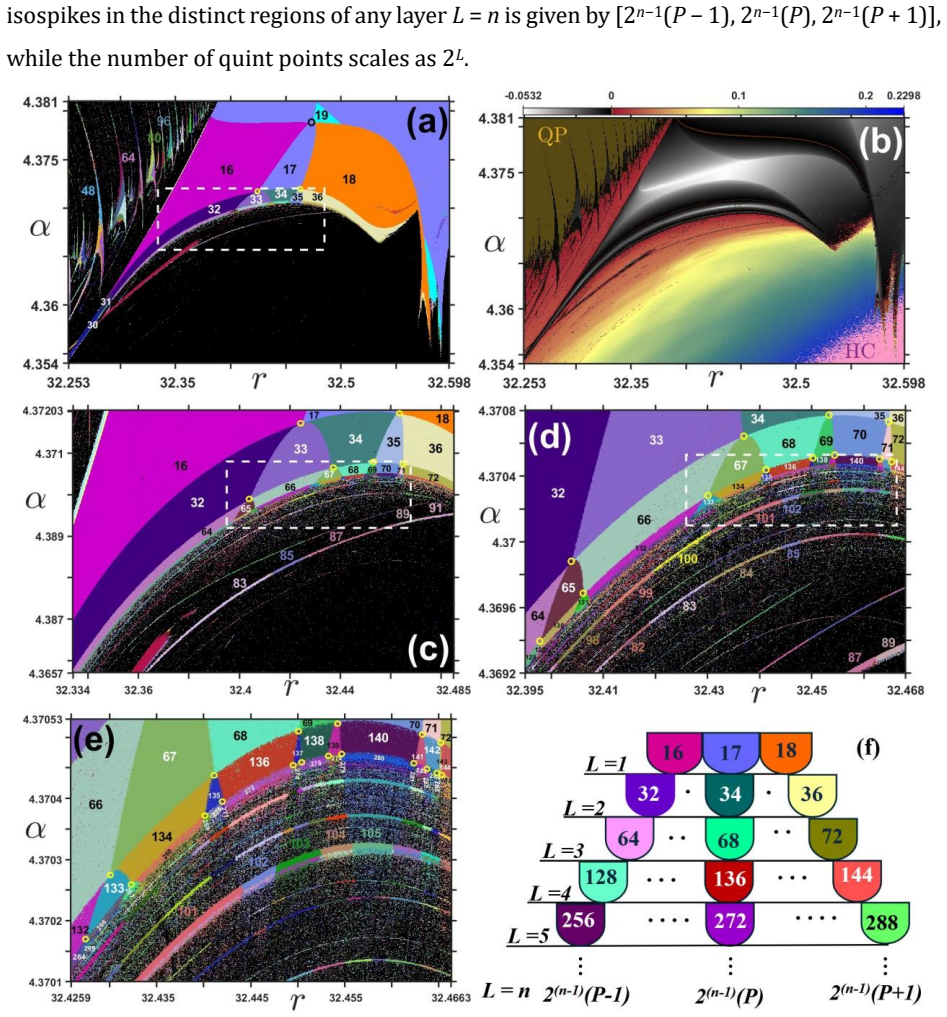
We discovered generalized structures, named astrocytes due to their shape, that constitute a defined region characterizing regular behavior within the parameter plane of dynamical systems. Morphologically, they are characterized by a branch and a soma with several vertices and sometimes with multiple periodicities. A bunch of infinite astrocytes emerge through their branches from a region, in general, of low periodicity. Astrocytes are embedded in a quasiperiodic-chaotic scenario. The soma complexity determines a kind of hierarchy of the astrocytes; moreover, bunches of subsequent structures from the astrocyte have been emphasized, revealing a self-similarity property.
What carries the argument
The astrocyte, a star-shaped region in the parameter plane with a multi-vertex soma and emanating branches, organizes regular multi-periodic behavior and its transitions to chaos.
If this is right
- Soma vertex count establishes a hierarchy among astrocytes.
- Self-similarity produces bunches of subsequent astrocytes from each branch.
- Multiperiodicity inside the soma generates harlequin patterns and tri-, quad-, and quint-critical points.
- A doubling cascade of quint-points along concave soma borders creates ordered sequences of higher periodicity en route to chaos.
Where Pith is reading between the lines
- If astrocytes appear consistently across unrelated oscillators, they may provide a practical way to locate stable operating windows without exhaustive bifurcation scans.
- The multi-critical points suggest astrocytes capture higher-order resonance overlaps that classical Arnold tongue diagrams treat only pairwise.
- Analytic approximations for astrocyte boundaries could be derived from the underlying map or flow, turning the observed structures into predictive tools.
Load-bearing premise
The visually identified star-shaped regions represent a fundamental generalization of Arnold tongues rather than interpretive overlays on standard bifurcation structures.
What would settle it
Numerical continuation or experimental scans in the Zeeman laser that show the star-shaped boundaries coincide exactly with conventional resonance tongues and period-doubling cascades, without new multi-critical organization, would falsify the generalization claim.
Figures


read the original abstract
We discovered generalized structures, named astrocytes due to their shape, that constitute a defined region characterizing regular behavior within the parameter plane (PP) of dynamical systems (DSs). Morphologically, they are characterized by a branch and a soma with several vertices (arms) and sometimes with multiple periodicities. A bunch of infinite astrocytes emerge through their branches from a region, in general, of low periodicity. Astrocytes are embedded in a quasiperiodic-chaotic scenario. The soma complexity (number of vertices) determines a kind of hierarchy of the astrocytes; moreover, bunches of subsequent structures from the astrocyte have been emphasized, revealing a self-similarity property. We conducted a detailed analysis in a Zeeman laser model, but we also observed astrocytes in many other DSs. The multiperiodicity exhibited by the astrocytes in their soma gives rise to harlequin dress-like patterns and tri-, quad-, and quint-critical points, which indicate the coexistence of different higher-order periodicities. In the concave borders of the soma, a doubling cascade of quint-points emerges as a bifurcation in the PP, defining regions of ordered sequences of higher periodicity in the route to chaos.
Editorial analysis
A structured set of objections, weighed in public.
Referee Report
Summary. The manuscript claims to have identified novel star-shaped structures, termed 'astrocytes,' in the parameter planes of dynamical systems that generalize Arnold tongues. These structures are characterized morphologically by branches emerging from low-periodicity regions, multi-vertex somas with multi-periodicities, self-similarity, and the emergence of tri-, quad-, and quint-critical points leading to harlequin-like patterns and doubling cascades; the claims rest on numerical periodicity and Lyapunov diagrams from the Zeeman laser model and other systems, with astrocytes embedded in quasiperiodic-chaotic scenarios.
Significance. If the astrocytes can be shown to be distinct from known resonance structures with quantifiable properties, the work could contribute to understanding the hierarchical organization of regular behavior in high-dimensional parameter spaces of nonlinear oscillators. The numerical observation across multiple systems is a positive aspect, but the lack of analytical anchors limits the potential impact to an observational note rather than a foundational generalization.
major comments (3)
- [Abstract] Abstract: The central claim that astrocytes constitute a 'defined region characterizing regular behavior' and a generalization of Arnold tongues is not supported by any formal definition, boundary equations, or derivation from the underlying vector field; the identification appears to rest solely on visual morphology in numerical scans without criteria to distinguish from standard Arnold tongues or codimension-2 bifurcations.
- [Zeeman laser model analysis] Zeeman laser model analysis: No specific model equations, parameter values, or quantitative diagnostics (e.g., scaling exponents along branches, Lyapunov spectra at soma boundaries, or topological invariants) are supplied to verify the multi-periodicity or self-similarity claims, leaving the hierarchy and bunching properties without measurable support.
- [Discussion of multi-critical points and cascades] Discussion of multi-critical points and cascades: The description of quint-critical points and doubling cascades in concave soma borders as defining 'regions of ordered sequences' lacks comparison to existing bifurcation theory in quasiperiodic systems or any computation of the associated normal forms, undermining the assertion of a new route to chaos.
minor comments (2)
- [Abstract] The informal phrasing 'harlequin dress-like patterns' and 'bunch of infinite astrocytes' should be replaced with precise descriptions of the periodicity distributions and branching topology.
- The manuscript would benefit from explicit statements of the numerical methods used for the periodicity/Lyapunov diagrams, including grid resolution and integration tolerances, to allow reproducibility.
Simulated Author's Rebuttal
We thank the referee for the constructive and detailed comments on our manuscript. We address each major comment point by point below, clarifying the numerical basis of our observations while indicating specific revisions to strengthen the presentation.
read point-by-point responses
-
Referee: [Abstract] Abstract: The central claim that astrocytes constitute a 'defined region characterizing regular behavior' and a generalization of Arnold tongues is not supported by any formal definition, boundary equations, or derivation from the underlying vector field; the identification appears to rest solely on visual morphology in numerical scans without criteria to distinguish from standard Arnold tongues or codimension-2 bifurcations.
Authors: Astrocytes are defined in the manuscript through consistent morphological criteria observed in numerical periodicity and Lyapunov diagrams: star-shaped structures featuring branches emerging from low-periodicity regions and somas with multiple vertices that exhibit multi-periodicity, self-similarity, and embedding within quasiperiodic-chaotic scenarios. This morphological characterization distinguishes them from standard Arnold tongues, which typically lack multi-vertex somas and the observed hierarchy of bunches. We acknowledge the absence of boundary equations or vector-field derivations, as the work is observational and numerical across multiple systems. In revision we will add an explicit morphological definition with distinguishing criteria in the abstract and introduction, along with a direct comparison to Arnold tongues and codimension-2 points. revision: partial
-
Referee: [Zeeman laser model analysis] Zeeman laser model analysis: No specific model equations, parameter values, or quantitative diagnostics (e.g., scaling exponents along branches, Lyapunov spectra at soma boundaries, or topological invariants) are supplied to verify the multi-periodicity or self-similarity claims, leaving the hierarchy and bunching properties without measurable support.
Authors: The Zeeman laser model equations and the parameter values employed for the scans are presented in the methods section of the full manuscript. The periodicity and Lyapunov diagrams already demonstrate the multi-periodicity at somas and the self-similar bunching along branches. To provide measurable support, we will add quantitative diagnostics in the revision, including scaling exponents measured along representative branches, Lyapunov spectra evaluated at soma boundaries, and a quantitative assessment of self-similarity via pattern repetition metrics. These additions will directly substantiate the hierarchy and bunching properties. revision: yes
-
Referee: [Discussion of multi-critical points and cascades] Discussion of multi-critical points and cascades: The description of quint-critical points and doubling cascades in concave soma borders as defining 'regions of ordered sequences' lacks comparison to existing bifurcation theory in quasiperiodic systems or any computation of the associated normal forms, undermining the assertion of a new route to chaos.
Authors: The tri-, quad-, and quint-critical points are identified numerically as loci of coexisting higher-order periodicities that produce the harlequin patterns and the doubling cascades along concave soma borders. These structures organize ordered sequences of periodicities within the quasiperiodic-chaotic background. We will revise the discussion to include explicit comparisons with established bifurcation structures in quasiperiodic systems (e.g., Arnold tongue hierarchies and codimension-2 points) and cite relevant literature. Normal-form computations are not included in the present numerical study; we note this as a natural direction for future analytical work rather than a claim of a fully new route to chaos. revision: partial
Circularity Check
Numerical visualization of star-shaped regions in parameter planes shows no circular derivation
full rationale
The paper's central claim rests on direct numerical scans of periodicity and Lyapunov diagrams in the Zeeman laser and other maps, visually identifying star-shaped regions termed astrocytes. No analytical derivation, boundary equations, or parameter fitting is presented that could reduce to self-definition or fitted inputs. Self-citations, if present, are not load-bearing for the morphological observations, which remain independent empirical findings without reduction to prior results by construction.
Axiom & Free-Parameter Ledger
axioms (1)
- standard math Bifurcation theory and periodic structures in parameter planes of dynamical systems
invented entities (1)
-
Astrocytes
no independent evidence
Reference graph
Works this paper leans on
-
[1]
arcs,” “shrimps,
(see Fig. S1 [58] obtained in terms of isospikes and the two largest Lyapunov exponents (LLEs)); we note some interesting details (see framed region that is zoomed in Figs. 1(a) and (b)). In principle one should expect them to con tain mainly quasiperiodicity; surprisingly enough, we determined a bunch of structures with different shapes and exhibiting pe...
2020
-
[2]
Poincare , Ácta Math
H. Poincare , Ácta Math. 13, 1 (1890)
-
[3]
M. W . Parker , Stud. Hist. Philos. Sci. Part B: Stud. Hist. Philos. Mod. Phys. 29, 575 (1998). [
1998
-
[4]
Áubin and Á
D. Áubin and Á. Dahan Dalmedico, Hist. Math. 29, 273 (2002)
2002
-
[5]
Letellier , R
C. Letellier , R. Ábraham, D. L. Shepelyansky, O. E. Ro ssler , P . Holmes, R. Lozi, L. Glass, A. Pikovsky, L. F . Olsen, I. Tsuda, C. Grebogi, U. Parlitz, R. Gilmore, L. M. Pecora, and T . L. Carroll, Chaos 31, 053110 (2021)
2021
-
[6]
Á. Á. Ándronov, C.R. Ácad. Sc. Paris Math. 189, 559 (1929)
1929
-
[7]
G. D. Birkhoff, Dynamical systems, Vol. 9 (Ámerican Mathematical Soc., Providence, 1927)
1927
-
[8]
Hilborn, Chaos and nonlinear dynamics: an introduction for scientists and engineers (Oxford University Press, Demand, 2000)
R. Hilborn, Chaos and nonlinear dynamics: an introduction for scientists and engineers (Oxford University Press, Demand, 2000)
2000
-
[9]
J. C. Sprott, Chaos and time-series analysis (Oxford University Press, New York, 2003)
2003
-
[10]
Duneau and Á
M. Duneau and Á. Katz, Phys. Rev. Lett. 54, 2688 (1985)
1985
-
[11]
V . E. Korepin, J. Sov. Math. 41, 956 (1988)
1988
-
[12]
Stavans, F
J. Stavans, F . Heslot, and Á. Libchaber , Phys. Rev. Lett. 55, 596 (1985)
1985
-
[13]
Mainieri, T
R. Mainieri, T . S. Sullivan, and R. E. Ecke, Phys. Rev. Lett. 63, 2357 (1989)
1989
-
[14]
Weixing, W
D. Weixing, W . Huang, X. Wang, and C. X. Yu, Phys. Rev. Lett. 70, 170 (1993)
1993
-
[15]
J.-B. Gao, N. S. V . Rao, J. Hu, and J. Ái, Phys. Rev. Lett. 94, 198702 (2005)
2005
-
[16]
Hauck and F
T . Hauck and F . W . Schneider , J. Phys. Chem. 97, 391 (1993)
1993
-
[17]
Olsen, T
L. Olsen, T . Bronnikova, and W . Schaffer , Phys. Chem. Chem. Phys. 4, 1292 (2002)
2002
-
[18]
Redondo, E
J. Redondo, E. Rolda n, and G. J. de Valca rcel, Phys. Lett. Á 210, 301 (1996)
1996
-
[19]
Ramos, E
O. Ramos, E. Áltshuler , and K. J. Ma løy, Phys. Rev. Lett. 96, 098501 (2006). 14
2006
-
[20]
C. Rosa, M. J. Correia, and P . C. Rech, Chaos Solitons Fractals 40, 2041 (2009)
2041
-
[21]
Wang and H
F . Wang and H. Cao, Commun. Nonlinear Sci. Numer . Simul. 56, 481 (2018)
2018
-
[22]
G. M. Ramí rez-Á vila, S. S. Muni, and T . Kapitaniak, Chaos 34, 083134 (2024)
2024
-
[23]
Árnol’d, Izv
V . Árnol’d, Izv. Ákad. Nauk SSSR Ser . Mat. 25, 21 (1961)
1961
-
[24]
J. Á. C. Gallas, Phys. Rev. Lett. 70, 2714 (1993)
1993
-
[25]
J. Á. C. Gallas, Physica Á 202, 196 (1994)
1994
-
[26]
Gaspard, R
P . Gaspard, R. Kapral, and G. Nicolis, J. Stat. Phys. 35, 697 (1984)
1984
-
[27]
Bonatto and J
C. Bonatto and J. Á. C. Gallas, Phys. Rev. Lett. 101, 054101 (2008)
2008
-
[28]
Barrio, F
R. Barrio, F . Blesa, S. Serrano, and Á. Shilnikov, Phys. Rev. E 84, 035201 (2011), pRE
2011
-
[29]
R. E. Francke, T . Po schel, and J. Á. C. Gallas, Physical Review E 87, 042907 (2013)
2013
-
[30]
M. R. Gallas, M. R. Gallas, and J. Á. C. Gallas, Eur . Phys. J.-Spec. Top. 223, 2131 (2014)
2014
-
[31]
G. M. Ramí rez-Á vila, I. M. Ja nosi, and J. Á. C. Gallas, Europhys. Lett. 126, 20001 (2019)
2019
-
[32]
G. M. Ramí rez-Á vila and T . Carletti, Chaos 35, 033144 (2025)
2025
-
[33]
R. O. Medrano-T and R. Rocha, Int. J. Bifurcation Chaos 24, 1430025 (2014)
2014
-
[34]
C. Á. T . Cha vez and S. Curilef, Chaos 30, 023130 (2020)
2020
-
[35]
G. M. Ramí rez-Á vila, J. Kurths, and J. Á. C. Gallas, Chaos 31, 101102 (2021)
2021
-
[36]
B. R. R. Boaretto, P . R. Protachevicz, M. Hansen, R. O. Medrano-T , E. E. N. Macau, and C. Grebogi Phys. Rev. E 111, L052203 (2025)
2025
-
[37]
J. G. Freire and J. Á. C. Gallas, Phys. Chem. Chem. Phys. 13, 12191 (2011)
2011
-
[38]
Junges, T
L. Junges, T . Po schel, and J. Á. C. Gallas, Eur . Phys. J. D 67, 149 (2013)
2013
-
[39]
J. Á. C. Gallas, Eur . Phys. J. Spec. Top. 228, 2081 (2019)
2081
-
[40]
S. Gu, P . Zhou, P . Mu, G. Guo, X. Liu, and N. Li, Opt. Express 31, 31853 (2023)
2023
-
[41]
M. R. Gallas and J. Á. C. Gallas, Chaos 25, 064603 (2015)
2015
-
[42]
L. F . Olsen, Chaos 33, 023102 (2023)
2023
-
[43]
G. M. Ramí rez-Á vila, T . Kapitaniak, and D. Gonze, Chaos 34, 073154 (2024)
2024
-
[44]
J. G. Freire, M. R. Gallas, and J. Á. C. Gallas, Chaos 28, 053118 (2018)
2018
-
[45]
G. M. Ramí rez-Á vila, J. Kurths, D. Gonze, and G. Dupont, Chaos Solitons Fractals 173, 113743 (2023)
2023
-
[46]
J. Á. C. Gallas, Eur . Phys. J. Plus 136, 1048 (2021). 15
2021
-
[47]
C. K. Volos and J. Á. C. Gallas, Eur . Phys. J. Plus 137, 154 (2022)
2022
-
[48]
J. Á. C. Gallas, Phys. Chem. Chem. Phys. 23, 25720 (2021)
2021
-
[49]
J. Á. C. Gallas, J. Phys.-Condens. Mat. 34, 144002 (2022)
2022
-
[50]
Z. Liu, X. Rao, J. Gao, and S. Ding, Chaos Solitons Fractals 177, 114254 (2023)
2023
-
[51]
S. Gu, P . Zhou, and N. Li, Opt. Lett. 48, 2845 (2023)
2023
-
[52]
Manchein, B
C. Manchein, B. Fusinato, H. S. Chagas, and H. Á. Álbuquerque, Chaos 33, 063147 (2023)
2023
-
[53]
Á. L. de Oliveira, G. B. Corrˆea, H. Á. Álbuquerque, K. M. Farias, and P . C. Rech, Phys. Lett. A 562, 131023 (2025)
2025
-
[54]
G. P . Puccioni, M. V . Tratnik, J. E. Sipe, and G. L. Oppo, Opt. Lett. 12, 242 (1987)
1987
-
[55]
Redondo, G
J. Redondo, G. J. de Valca rcel, and E. Rolda n, Phys. Rev. E 56, 6589 (1997)
1997
-
[56]
S. L. Kingston, Á. Mishra, M. Balcerzak, T . Kapitaniak, and S. K. Dana, Phys. Rev. E 104, 034215 (2021)
2021
-
[57]
S. L. Kingston, S. Kumarasamy, M. Balcerzak, and T . Kapitaniak, Opt. Express 31, 22817 (2023)
2023
-
[58]
S. L. Kingston, T . Kapitaniak, and S. K. Dana, Chaos 32, 081106 (2022)
2022
-
[59]
See Supplemental Material
-
[60]
M. V . Sofroniew and H. V . Vinters, Ácta Neuropatho. 119, 7 (2010)
2010
-
[61]
Á. Wolf, J. B. Swift, H. L. Swinney, and J. Á. Vastano, Physica D 16, 285 (1985)
1985
-
[62]
Pikovsky and Á
Á. Pikovsky and Á. Politi, Lyapunov exponents: a tool to explore complex dynamics (Cambridge University Press, 2016)
2016
-
[63]
Skokos, The Lyapunov characteristic exponents and their computation, in Dynamics of Small Solar System Bodies and Exoplanets, edited by J
C. Skokos, The Lyapunov characteristic exponents and their computation, in Dynamics of Small Solar System Bodies and Exoplanets, edited by J. J. Souchay and R. Dvorak (Springer Berlin Heidelberg, Berlin, Heidelberg, 2010) pp. 63–135
2010
-
[64]
N. P . Maffione, C. M. Giordano, and P . M. Cincotta, Int. J. Nonlin. Mech. 46, 23 (2011)
2011
-
[65]
P . M. Cincotta and C. M. Giordano, Theory and applications of the mean exponential growth factor of nearby orbits (megno) method, in Chaos Detection and Predictability , edited by C. Skokos, G. Á. Gottwald, and J. Laskar (Springer Berlin Heidelberg, Berlin, Heidelberg, 2016) pp. 93–128
2016
-
[66]
Benettin, L
G. Benettin, L. Galgani, Á. Giorgilli, and J.-M. Strelcyn, Meccanica 15, 9 (1980). 16
1980
-
[67]
Bonatto and J
C. Bonatto and J. Á. C. Gallas, Phys. Rev. E 75, 055204 (2007)
2007
-
[68]
Áugusto Cardoso Pereira, E
F . Áugusto Cardoso Pereira, E. Colli, and J. Carlos Sartorelli, Chaos 22, 013135 (2012)
2012
-
[69]
Astrocytes: Arnol’d Tongues Generalization in Dynamical Systems’ Parameter Plane
J. Á. C. Gallas, Phys. Rev. E 48, R4156 (1993). 1 Supplemental Material for “Astrocytes: Arnol’d Tongues Generalization in Dynamical Systems’ Parameter Plane” Gonzalo Marcelo Ramí rez-Á vila,1,2,3 S. Leo Kingston,4 Marek Balcerzak,2 Je ro me Daquin,5 Timoteo Carletti,1 and Tomasz Kapitaniak2 1Namur Institute for Complex Systems (naXys), Université de Namu...
1993
-
[70]
S10(b), we have a zoomed view of the main astrocyte showing several vertices and multiple periodicities in its soma
In Fig. S10(b), we have a zoomed view of the main astrocyte showing several vertices and multiple periodicities in its soma. FIG. S10: (a) Parameter plane γs ×γp of the variable n in terms of the number of isospikes, where it is noted the bunch of emergent astrocytes from a region in which the dynamical behavior is characterized by oscillations with three...
discussion (0)
Sign in with ORCID, Apple, or X to comment. Anyone can read and Pith papers without signing in.