Recognition: unknown
Beyond Project-Based Learning: Conference-Style Writing as Authentic Assessment in Interdisciplinary Quantum Engineering Education
Pith reviewed 2026-05-07 10:33 UTC · model grok-4.3
The pith
Conference-style writing extends project-based learning by serving as authentic assessment in quantum engineering courses
A machine-rendered reading of the paper's core claim, the machinery that carries it, and where it could break.
Core claim
In the pilot course, students perceived that completing a conference-style paper as the capstone of their project-based learning assignment strengthened their conceptual understanding, scientific communication abilities, and readiness for research, making the paper a meaningful addition to standard PBL activities.
What carries the argument
The conference-style paper requirement, which requires students to formalize project results into a professional manuscript format as authentic disciplinary assessment.
If this is right
- The overall project improves student engagement, confidence, and technical skill development.
- The writing requirement develops scientific communication and research readiness.
- The approach works especially well as an extension for graduate students in quantum engineering.
- Retaining the requirement with improved scaffolding will support better student experiences in future course runs.
Where Pith is reading between the lines
- Similar conference-style writing could be tested as a capstone in other STEM project-based courses outside quantum topics.
- Incorporating workshops on manuscript preparation might address the demanding nature of the task reported by students.
- Longitudinal tracking of graduates could show whether the skills transfer to actual research or industry roles.
Load-bearing premise
Self-reported survey responses from a single pilot course without control groups or objective measures of learning accurately reflect genuine gains in conceptual understanding, communication skills, and research readiness.
What would settle it
A controlled comparison of students who complete the conference paper versus those who do not, using pre/post conceptual tests and blind evaluation of writing samples, would show no measurable skill differences if the claimed benefits do not hold.
Figures
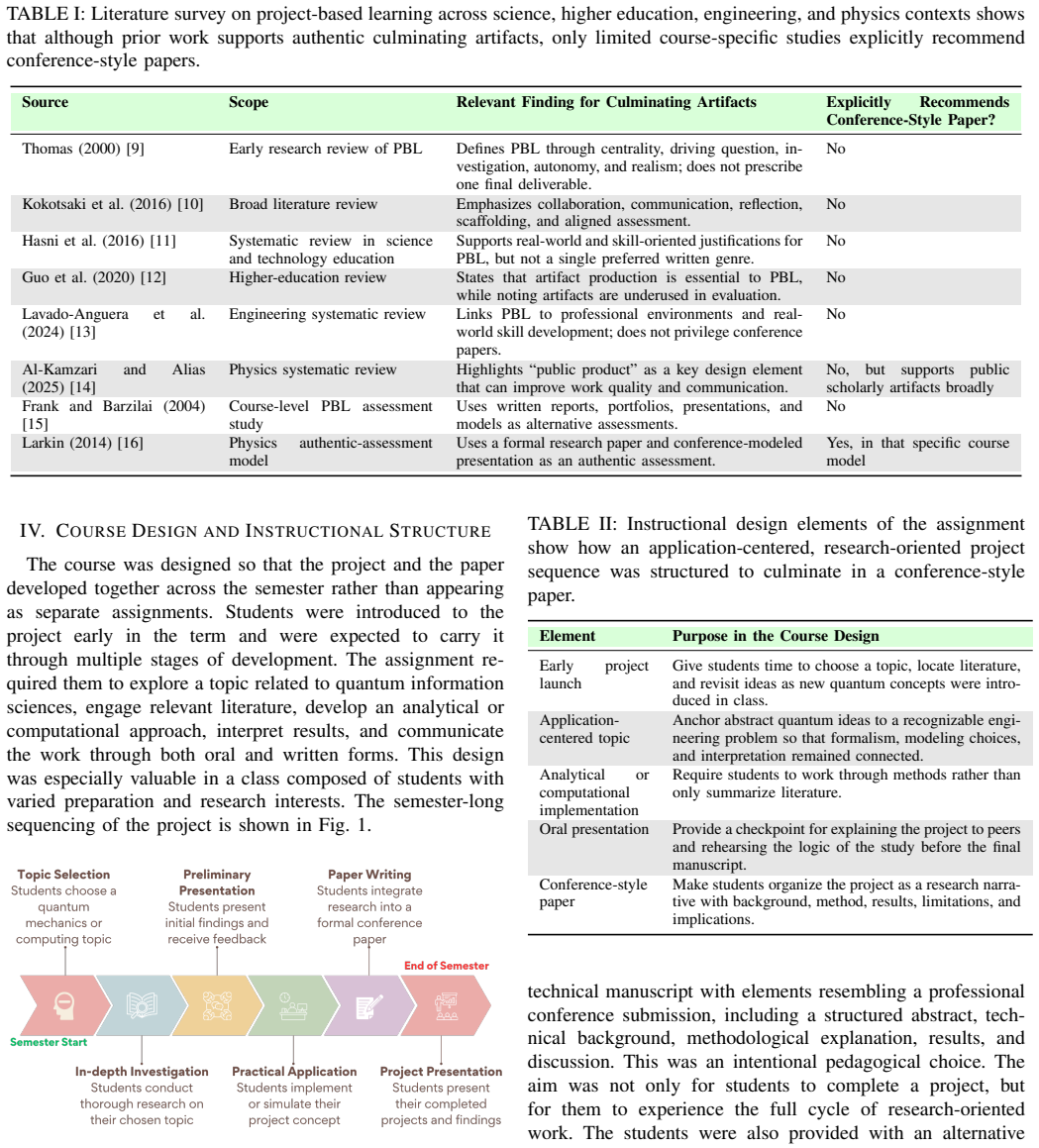

read the original abstract
Project-based learning is recognized as an effective approach for improving engagement and applied understanding in STEM education. In quantum engineering courses, however, the question is no longer only whether students benefit from projects but how those projects should culminate if the goal is authentic disciplinary preparation. This paper examines the educational role of a conference-style paper requirement embedded within a project-based learning implementation for an introductory quantum mechanics course for engineers. We use post-course survey responses from students in a pilot run of the course. We evaluate perceived effects on conceptual understanding, scientific communication, research readiness, and attitudes toward the writing requirement itself. The results suggest that students viewed the project as beneficial for engagement, confidence, and technical skill development, while the conference-style paper emerged as a demanding but meaningful component of the experience. We argue that once PBL has been established in quantum mechanics education, conference-style writing can serve as an extension of that model, especially for graduate students. The findings support retaining the conference-paper requirement with improved scaffolding.
Editorial analysis
A structured set of objections, weighed in public.
Referee Report
Summary. The manuscript describes the implementation of a conference-style paper requirement within a project-based learning (PBL) framework for an introductory quantum mechanics course for engineers. Using post-course survey responses from a single pilot run, it evaluates student perceptions of effects on conceptual understanding, scientific communication, research readiness, engagement, and attitudes toward the writing component. The authors conclude that the conference-style paper is a demanding but meaningful extension of PBL, particularly for graduate students, and argue for retaining the requirement with improved scaffolding.
Significance. If substantiated, the work could contribute a practical model for authentic disciplinary assessment in quantum engineering education, bridging PBL with professional scientific practices like conference paper writing. It addresses a timely question in physics education research about scaling PBL beyond basic projects. However, the current evidence is limited to descriptive self-reports from one pilot, which reduces its significance as a basis for curricular recommendations.
major comments (3)
- [Pilot course evaluation and results] The evaluation relies exclusively on post-course survey responses from the pilot run, but the manuscript provides no information on sample size, survey question wording, response rate, validation of the instrument, or any statistical analysis. This information is required to assess whether the reported perceptions of benefit constitute reliable evidence for the central claims about conceptual understanding and research readiness.
- [Results and discussion] Claims that the approach improves conceptual understanding, scientific communication, and research readiness are supported only by self-reported perceptions, with no pre/post objective measures (e.g., concept inventories), control conditions, or independent assessments of learning outcomes referenced. This leaves open the possibility that positive responses reflect novelty or social desirability rather than genuine disciplinary gains, directly undermining the argument for retaining the requirement.
- [Conclusions] The conclusion that conference-style writing serves as an effective extension of PBL 'especially for graduate students' is not grounded in differentiated data; the pilot results do not separate or compare outcomes by student level, making the specific recommendation for graduate contexts unsupported.
minor comments (2)
- [Abstract] The abstract and introduction would benefit from a brief statement of the study's limitations to appropriately frame the pilot nature of the work.
- [Introduction] Additional citations to prior work on PBL implementations in quantum mechanics and validated instruments for assessing scientific communication skills would help situate the contribution within the broader physics education research literature.
Simulated Author's Rebuttal
We thank the referee for the constructive comments, which highlight important limitations in the presentation of our pilot study. We address each major comment below and outline revisions that will better contextualize the scope and evidence of the work.
read point-by-point responses
-
Referee: [Pilot course evaluation and results] The evaluation relies exclusively on post-course survey responses from the pilot run, but the manuscript provides no information on sample size, survey question wording, response rate, validation of the instrument, or any statistical analysis. This information is required to assess whether the reported perceptions of benefit constitute reliable evidence for the central claims about conceptual understanding and research readiness.
Authors: We agree that these details are essential for readers to evaluate the survey results. In the revised manuscript we will report the sample size, response rate, and exact survey question wording (placed in an appendix). We will also state explicitly that the instrument was not formally validated and that only descriptive summaries were used, with no inferential statistics performed. These additions will allow a clearer assessment of the reliability of the perceptual data. revision: yes
-
Referee: [Results and discussion] Claims that the approach improves conceptual understanding, scientific communication, and research readiness are supported only by self-reported perceptions, with no pre/post objective measures (e.g., concept inventories), control conditions, or independent assessments of learning outcomes referenced. This leaves open the possibility that positive responses reflect novelty or social desirability rather than genuine disciplinary gains, directly undermining the argument for retaining the requirement.
Authors: We acknowledge that self-reported perceptions cannot demonstrate objective disciplinary gains and that the absence of pre/post measures or controls is a genuine limitation of this single-pilot design. We will revise the results and discussion sections to frame all findings strictly as student perceptions of engagement, confidence, and the writing experience. Language implying direct improvements in conceptual understanding or research readiness will be removed or qualified, while retaining the value of perceptual data for evaluating authentic assessment formats. revision: partial
-
Referee: [Conclusions] The conclusion that conference-style writing serves as an effective extension of PBL 'especially for graduate students' is not grounded in differentiated data; the pilot results do not separate or compare outcomes by student level, making the specific recommendation for graduate contexts unsupported.
Authors: The specific phrasing regarding graduate students was based on informal instructor observations rather than segmented survey responses. Because the pilot survey did not collect or analyze data by student level, we will revise the conclusions to remove this unsubstantiated claim and instead present the overall student feedback as the basis for retaining the requirement, noting differentiated outcomes as a topic for future study. revision: yes
- We cannot supply pre/post objective measures, concept inventories, or control-group comparisons because the study was conducted as a single post-course pilot survey without those elements.
- We cannot provide formal validation data for the survey instrument, as none was performed in this initial pilot evaluation.
Circularity Check
No circularity: purely descriptive pilot report with no derivations or self-referential reductions
full rationale
The paper reports post-course survey perceptions from a single pilot implementation of a quantum engineering course. It contains no equations, no fitted parameters, no mathematical derivations, and no load-bearing self-citations. The central claims are presented as direct summaries of student responses rather than predictions or results derived from prior author work. Because the manuscript performs no reduction of outputs to inputs by construction and makes no uniqueness or ansatz claims, the derivation chain is empty and the analysis is self-contained.
Axiom & Free-Parameter Ledger
Reference graph
Works this paper leans on
-
[1]
Investigating and improving student understanding of the basics of quantum computing,
P. Hu, Y . Li, and C. Singh, “Investigating and improving student understanding of the basics of quantum computing,”Physical Review Physics Education Research, vol. 20, no. 2, p. 020108, 2024
2024
-
[2]
Motivating project-based learning: Sustaining the doing, supporting the learning,
P. C. Blumenfeld, E. Soloway, R. W. Marx, J. S. Krajcik, M. Guzdial, and A. Palincsar, “Motivating project-based learning: Sustaining the doing, supporting the learning,”Educational psychologist, vol. 26, no. 3-4, pp. 369–398, 1991
1991
-
[3]
Dewey,The Philosophy of John Dewey
J. Dewey,The Philosophy of John Dewey. H. Holt, 1928
1928
-
[4]
Project– based learning in engineering higher education: two decades of teaching competences in real environments,
I. de Los Rios, A. Cazorla, J. M. D ´ıaz-Puente, and J. L. Yag¨ue, “Project– based learning in engineering higher education: two decades of teaching competences in real environments,”Procedia-Social and Behavioral Sciences, vol. 2, no. 2, pp. 1368–1378, 2010
2010
-
[5]
A study of the impact of project-based learning on student learning effects: A meta-analysis study,
L. Zhang and Y . Ma, “A study of the impact of project-based learning on student learning effects: A meta-analysis study,”Frontiers in psychology, vol. 14, p. 1202728, 2023
2023
-
[6]
The case for authentic assessment,
G. Wiggins, “The case for authentic assessment,”Practical assessment, research, and evaluation, vol. 2, no. 1, 1990
1990
-
[7]
Landscape of quantum information science and engineering education: From physics foundations to interdisciplinary frontiers,
A. Pi ˜na, S. El-Adawy, M. Verostek, B. T. Boyle, M. Cacheiro, M. Lawler, N. Pradeep, E. Watts, C. G. West, H. Lewandowskiet al., “Landscape of quantum information science and engineering education: From physics foundations to interdisciplinary frontiers,”Physical Review Physics Education Research, vol. 21, no. 2, p. 020131, 2025
2025
-
[8]
Project-based learning in introductory quantum computing courses: A case study on quantum algorithms for medical imaging,
N. B. Gautam, K. E. Schubert, and E. P. Blair, “Project-based learning in introductory quantum computing courses: A case study on quantum algorithms for medical imaging,” in2025 IEEE International Conference on Quantum Computing and Engineering (QCE), vol. 3. IEEE, 2025, pp. 39–50
2025
-
[9]
A review of research on project-based learning,
J. W. Thomas, “A review of research on project-based learning,” 2000
2000
-
[10]
Project-based learning: A review of the literature,
D. Kokotsaki, V . Menzies, and A. Wiggins, “Project-based learning: A review of the literature,”Improving schools, vol. 19, no. 3, pp. 267–277, 2016
2016
-
[11]
Trends in research on project-based science and technology teaching and learning at k–12 levels: a systematic review,
A. Hasni, F. Bousadra, V . Bellet ˆete, A. Benabdallah, M.-C. Nicole, and N. Dumais, “Trends in research on project-based science and technology teaching and learning at k–12 levels: a systematic review,”Studies in Science education, vol. 52, no. 2, pp. 199–231, 2016
2016
-
[12]
A review of project- based learning in higher education: Student outcomes and measures,
P. Guo, N. Saab, L. S. Post, and W. Admiraal, “A review of project- based learning in higher education: Student outcomes and measures,” International journal of educational research, vol. 102, p. 101586, 2020
2020
-
[13]
Project-based learning (pbl) as an experiential pedagogical method- ology in engineering education: A review of the literature,
S. Lavado-Anguera, P.-J. Velasco-Quintana, and M.-J. Terr ´on-L´opez, “Project-based learning (pbl) as an experiential pedagogical method- ology in engineering education: A review of the literature,”Education Sciences, vol. 14, no. 6, p. 617, 2024
2024
-
[14]
A systematic literature review of project- based learning in secondary school physics: theoretical foundations, design principles, and implementation strategies,
F. Al-Kamzari and N. Alias, “A systematic literature review of project- based learning in secondary school physics: theoretical foundations, design principles, and implementation strategies,”Humanities and Social Sciences Communications, vol. 12, no. 1, pp. 1–18, 2025
2025
-
[15]
Integrating alternative assessment in a project-based learning course for pre-service science and technology teachers,
M. Frank and A. Barzilai, “Integrating alternative assessment in a project-based learning course for pre-service science and technology teachers,”Assessment & Evaluation in Higher Education, vol. 29, no. 1, pp. 41–61, 2004
2004
-
[16]
The student conference: A model of authentic assessment,
T. Larkin, “The student conference: A model of authentic assessment,” 2014
2014
-
[17]
The midpoint on a five-point likert-type scale,
R. L. Armstrong, “The midpoint on a five-point likert-type scale,” Perceptual and motor skills, vol. 64, no. 2, pp. 359–362, 1987. APPENDIXA SURVEYINSTRUMENT ANDFULLRESULTS This appendix preserves the full survey instrument and the complete set of descriptive results used in this study. The survey export contained 13 rows, of which 10 contained substantiv...
1987
-
[18]
I was familiar with quantum mechanics and/or quantum computing concepts before this course
-
[19]
I had previous experience with project-based assign- ments before this course
-
[20]
Project Design and Clarity
I was comfortable using computational tools (e.g., Python, MATLAB, Qiskit) prior to this project. Project Design and Clarity
-
[21]
The project instructions were clear and easy to follow
-
[22]
The learning objectives of the project were clearly explained
-
[23]
The expectations for project deliverables (report, presen- tation, code, etc.) were clearly defined
-
[24]
Engagement and Motivation
The introduction of the project early in the semester was appropriate. Engagement and Motivation
-
[25]
The project increased my motivation to learn quantum mechanics
-
[26]
I felt more engaged in this project than in traditional homework assignments
-
[27]
Understanding of Quantum Mechanics Content
I would like more project-based tasks in future physics or quantum mechanics courses. Understanding of Quantum Mechanics Content
-
[28]
The project helped me connect the mathematical formal- ism of quantum mechanics with physical meaning
-
[29]
The project strengthened my problem-solving skills in quantum mechanics
-
[30]
Skill Development
After completing the project, I feel more confident discussing quantum mechanics concepts. Skill Development
-
[31]
The project improved my scientific communication skills (written and/or oral)
-
[32]
The project improved my computational or coding skills
-
[33]
The project improved my ability to read scientific or technical literature
-
[34]
The project strengthened my ability to design or plan investigation steps
-
[35]
The project improved my ability to interpret numerical or simulation results
-
[36]
The project helped me learn to structure a longer scien- tific report
-
[37]
Difficulty and Workload
The project increased my readiness for future research or independent study. Difficulty and Workload
-
[38]
The overall difficulty of the project was appropriate for this course level
-
[39]
The project required more effort than regular course assignments
-
[40]
Instructor Support and Resources
I felt sufficiently prepared by lectures and course mate- rials to complete the project. Instructor Support and Resources
-
[41]
The instructor provided enough guidance throughout the project
-
[42]
Feedback from the instructor or teaching assistants was timely and helpful
-
[43]
Conference Paper Requirement
I often felt lost during the project and needed more guidance. Conference Paper Requirement
-
[44]
For this level of course, a conference paper may not be necessary, and a simpler report would be more appropriate
-
[45]
Writing a conference-style paper helped me better un- derstand how scientific research is communicated
-
[46]
The requirement to write a conference paper increased my motivation to do a high-quality project
-
[47]
Open-Ended Questions
I would recommend keeping the conference paper re- quirement for future versions of the course. Open-Ended Questions
-
[48]
Is there anything you would want to see added to the project requirements in future Quantum Mechanics / Quantum Computing course?
-
[49]
Is there anything you would want to see removed from the project requirements in future Quantum Mechanics / Quantum Computing course?
-
[50]
Do you have any comments related to the project?
-
[51]
AI was helpful in improving my understanding of the course concepts
-
[52]
I often felt lost during the project and needed more guidance
Please describe any creative and ethical ways you used AI for this project or recommend how AI could be used effectively for similar projects. Also, please identify any AI tools or platforms you found particularly helpful or valuable. B. Closed-Ended Results Note:For brevity in the table headings, SD = Strongly Disagree, D = Disagree, N = Neutral, A = Agr...
-
[53]
Items Students Wanted Added:
-
[54]
2.40 5 1 0 3 1 I had previous experience with project-based assignments before this course
While I do think the conference paper assignment was appropriate for graduate students, it might be better to have a clearer and more simplistic assignment for undergraduate students, as they often have not learned about the topics being discussed in enough depth to TABLE VII: Background, Project Design, and Engagement Results Item Mean SD D N A SA I was ...
-
[55]
Something that would be helpful, and also provide insight to the status of people’s projects, would be a type of midpoint checkup, to help highlight if people are doing well or need some assistance
-
[56]
Progress checkpoints throughout the semester
-
[57]
I found others research presentations as a function of their reseach or strenghts very interesting
Possibly more discussion on applications of quantum mechanics in other areas of engineering. I found others research presentations as a function of their reseach or strenghts very interesting
-
[58]
Items Students Wanted Removed:
-
[59]
I think the analysis of other classmates’ project isn’t very necessary, and it’s very hard to take notes to the level required for the analysis assignment while the student is talking/presenting anyways
-
[60]
Picking an appropriate conference with a submission deadline that also aligns with the this class end date is not always easy to find
Having to actually submit the conference paper might be a bit of a challenge. Picking an appropriate conference with a submission deadline that also aligns with the this class end date is not always easy to find
-
[61]
15 seems a bit much, given that most of it will be explained in a presentation that lasts roughly 10 minutes on the short end
Maybe a shorter technical paper, like 10 pages. 15 seems a bit much, given that most of it will be explained in a presentation that lasts roughly 10 minutes on the short end
-
[62]
Additional Project Comments:
-
[63]
More guidance on how quantum mechanics relates to other courses could be helpful
The project was a good addition for the course and I liked it. More guidance on how quantum mechanics relates to other courses could be helpful
-
[64]
Com- prehension was minimal at best
Given the breadth of topics related to the quantum space, I cannot say the class prepared me well for the project topics or concepts within the academic references. Com- prehension was minimal at best
-
[65]
AI-Related Responses:
-
[66]
It helped me add meaningful comments and help me formulate my code in a way that is readable and accurate
I used Microsoft Copilot to help me edit and proofread my python code for the project. It helped me add meaningful comments and help me formulate my code in a way that is readable and accurate. I did not use AI in any way to help write any form of the paper
-
[67]
I mostly just used AI (ChatGPT) for spelling/grammar checks and to ensure that the sources I used were cred- ible/accepted by professionals in the relevant field(s)
-
[68]
It’s really helpful to get an idea of where to start and to structure your findings into a presentation
-
[69]
it can also help to explore ideas that we would not think of otherwise
ChatGPT could be used to summarize a technical paper in order to determine the relevance to the project. it can also help to explore ideas that we would not think of otherwise. However, one thing to keep in mind is not to use AI for writing the report as it is unethical and AI is also wrong half the time
-
[70]
I asked ChatGPT to explain concepts to me like I was 12 years old, so it used analogies which helped
I used it to help me understand the concepts better. I asked ChatGPT to explain concepts to me like I was 12 years old, so it used analogies which helped
-
[72]
All technical content was reviewed and verified independently
I used AI to help clarify complex concepts, organize the presentation, and improve clarity and flow. All technical content was reviewed and verified independently. Chat- GPT was especially helpful as a learning and explanation aid, and I see AI as a supportive tool rather than a replacement for original work
-
[73]
Explaining some complex concepts in different ways, and sometimes with fewer details, so it would be more digestible
-
[74]
It was helpful with brainstorming and simulation generation
Gemini was used for assistance with my project. It was helpful with brainstorming and simulation generation. It was also a good reference for clarity points on such a complex field of study
-
[75]
It was also helpful for explaining the differences between how concepts and equations are presented in academic literature versus the course content
AI was very helpful as a search engine for LaTeX formatting and syntax since the documentation for most LaTeX packages was sub-optimal. It was also helpful for explaining the differences between how concepts and equations are presented in academic literature versus the course content
-
[76]
AI is helpful in describing equations and deriving their foundations in a very simple and concise way that I found useful to my understanding
discussion (0)
Sign in with ORCID, Apple, or X to comment. Anyone can read and Pith papers without signing in.