uGMRT and MeerKAT observation of RXCJ0232-4420: a quiet cluster with a giant radio halo
Pith reviewed 2026-07-01 08:23 UTC · model grok-4.3
The pith
A cool-core cluster hosts a giant radio halo spanning more than 1 Mpc, showing such emission can occur with only minor dynamical disturbances.
A machine-rendered reading of the paper's core claim, the machinery that carries it, and where it could break.
Core claim
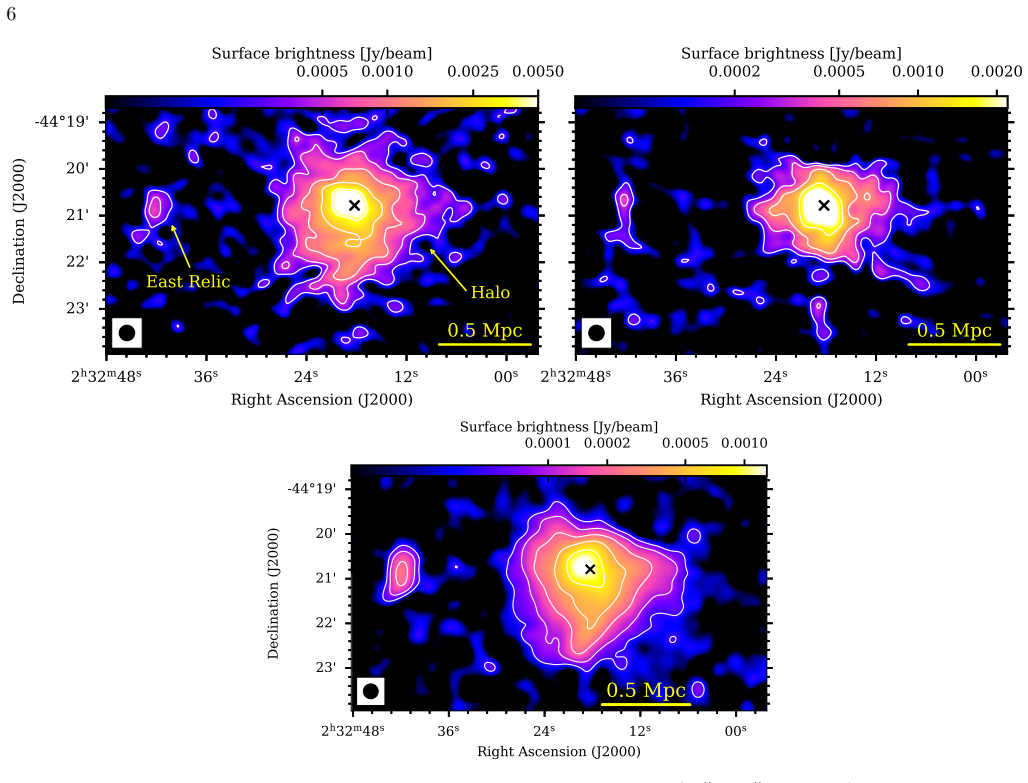
The central radio emission in RXCJ0232-4420 extends beyond ~1 Mpc at all observed frequencies and is confirmed as a giant radio halo in a cool-core cluster. The integrated spectral index of the halo is -1.17 ± 0.17 with a mostly uniform resolved map between -1.0 and -1.3. The surface brightness follows a single exponential law with constant e-folding radius, and point-to-point radio-X-ray analysis yields a sublinear slope of ~0.80 with no frequency evolution. A candidate relic of ~300 kpc is also detected. The results show that such Mpc-scale emission can arise in dynamically intermediate systems where merger-driven turbulence from minor disturbances sustains particle re-acceleration without
What carries the argument
The giant radio halo in a cool-core cluster, identified via multi-frequency spectral mapping and radio-X-ray correlation that remains uniform and sublinear.
If this is right
- Mpc-scale radio halos can form in systems that retain a cool core.
- Merger-driven turbulence from minor disturbances is sufficient to sustain cluster-wide re-acceleration.
- The distinction between giant halos and mini-halos becomes less sharp at low frequencies.
- The radio halo remains morphologically aligned with the thermal gas and shows no frequency-dependent radial changes.
Where Pith is reading between the lines
- Low-frequency surveys may uncover additional giant halos in apparently relaxed cool-core clusters.
- The uniform spectral index suggests the re-acceleration mechanism operates similarly across the halo volume rather than being centrally peaked.
- The candidate eastern relic may trace a weak shock that coexists with the turbulent halo.
Load-bearing premise
The cluster is assumed to be dynamically intermediate with only minor disturbances on the basis of the cool core coexisting with the giant halo.
What would settle it
X-ray or spectroscopic measurements that reveal a major merger with high velocity dispersion or strong shocks inconsistent with minor disturbances.
Figures




read the original abstract
Giant radio halos are the Mpc-scale extended sources associated with the merging clusters, while the mini-halos are preferentially associated with cool-core clusters. Both trace the ICM plasma physical process, and recent low-frequency observations increasingly blur the distinction between the two classes. We present the first multi-frequency spectral analysis of the galaxy cluster RXCJ0232--4420, hosting a cool core, using uGMRT (400 and 650 MHz) and MeerKAT (1283 MHz) observations. The central radio emission extends beyond $\sim 1$ Mpc at all frequencies, confirming it as a giant radio halo. One candidate relic (in the east) has also been detected, with an extent of $\sim 300$ kpc. The integrated spectral indices of halo and candidate east relic are $\alpha = -1.17 \pm 0.17$, and $\alpha = -0.85 \pm 0.17$, respectively. The resolved spectral map of the halo is mostly uniform ($-1.0$ to $-1.3$) and does not show any radial steepening. The radio surface brightness profile is well modelled by a single exponential law, with the e-folding radius constant across frequencies. The radio halo emission is morphologically well correlated with the thermal emission. Point-to-point radio-X-ray correlation analysis gives a sublinear relationship (slope $\sim 0.80$), with no frequency evolution. The presence of Mpc-scale emission in the cool-core cluster shows that such emission can arise in dynamically intermediate systems. Our results demonstrate that merger-driven turbulence, even from minor disturbances, can sustain cluster-wide particle re-acceleration without destroying the cool core.
Editorial analysis
A structured set of objections, weighed in public.
Referee Report
Summary. The manuscript reports uGMRT (400 and 650 MHz) and MeerKAT (1283 MHz) observations of RXCJ0232-4420, confirming Mpc-scale radio emission as a giant halo in a cool-core cluster. It gives integrated spectral indices α = -1.17 ± 0.17 for the halo and α = -0.85 ± 0.17 for a candidate eastern relic, a uniform spectral map (-1.0 to -1.3), an exponential surface-brightness profile with frequency-independent e-folding radius, and a sublinear radio-X-ray point-to-point correlation (slope ~0.80) with no frequency evolution. The authors conclude that such emission arises in dynamically intermediate systems where minor merger turbulence sustains cluster-wide re-acceleration without destroying the cool core.
Significance. If the dynamical classification is independently verified, the result supplies a well-measured example of a giant halo in a cool-core system, with concrete spectral indices, profile parameters, and correlation slopes that can be compared to re-acceleration models. It adds to the observational basis for blurring the giant-halo/mini-halo distinction and for turbulence operating in systems that retain cool cores.
major comments (1)
- [Abstract] Abstract: the classification of RXCJ0232-4420 as dynamically intermediate with only minor disturbances is inferred solely from the coexistence of a cool core and the giant halo itself. No independent dynamical diagnostics (X-ray morphology metrics, substructure measures, or velocity data) are cited, rendering the attribution of the halo to 'minor merger-driven turbulence' circular and load-bearing for the central interpretive claim.
Simulated Author's Rebuttal
We thank the referee for the constructive feedback. The major comment identifies a valid concern with the abstract's phrasing on dynamical classification, which we address below.
read point-by-point responses
-
Referee: [Abstract] Abstract: the classification of RXCJ0232-4420 as dynamically intermediate with only minor disturbances is inferred solely from the coexistence of a cool core and the giant halo itself. No independent dynamical diagnostics (X-ray morphology metrics, substructure measures, or velocity data) are cited, rendering the attribution of the halo to 'minor merger-driven turbulence' circular and load-bearing for the central interpretive claim.
Authors: We agree that the abstract as written infers the 'dynamically intermediate' state primarily from the coexistence of the cool core (identified via X-ray data) and the Mpc-scale halo (identified via radio data), without citing additional independent metrics such as X-ray morphology parameters or velocity dispersions. This creates the appearance of circularity for the turbulence interpretation. The cool-core classification itself rests on X-ray observations that are independent of the new radio results. In the revised manuscript we will modify the abstract and relevant discussion sections to state that the detection demonstrates Mpc-scale emission can persist in a cool-core cluster, consistent with turbulence-driven re-acceleration operating even when dynamical disturbance is limited, while explicitly noting the absence of additional substructure diagnostics in the present work and avoiding any claim that minor-merger turbulence is definitively established. revision: yes
Circularity Check
No circularity; purely observational measurements with interpretive conclusion
full rationale
The provided abstract contains only direct observational results: integrated spectral indices, resolved spectral maps, surface brightness profiles fitted to an exponential law, and point-to-point radio-X-ray correlations. No equations, parameter fits to subsets, or derivations are present. The statement classifying the cluster as dynamically intermediate follows from the observed coexistence of cool core and Mpc-scale halo but is an interpretive inference, not a reduction of any claimed prediction or result to its own inputs by construction. No self-citations, ansatzes, or uniqueness theorems appear. The analysis is self-contained against the new data.
Axiom & Free-Parameter Ledger
free parameters (2)
- integrated spectral index of halo =
-1.17
- point-to-point radio-X-ray correlation slope =
0.80
discussion (0)
Sign in with ORCID, Apple, or X to comment. Anyone can read and Pith papers without signing in.