Recognition: unknown
ConformaDecompose: Explaining Uncertainty via Calibration Localization
Pith reviewed 2026-05-07 09:05 UTC · model grok-4.3
The pith
Localizing the calibration set around a test instance decomposes conformal prediction uncertainty into reducible and irreducible components.
A machine-rendered reading of the paper's core claim, the machinery that carries it, and where it could break.
Core claim
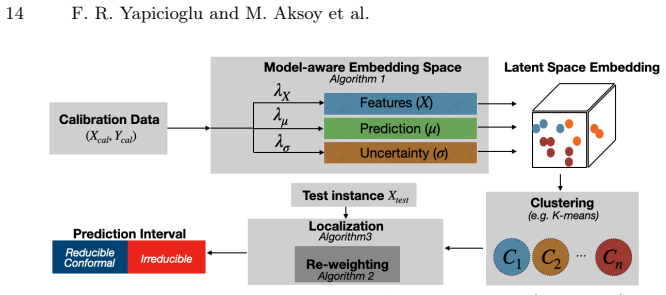
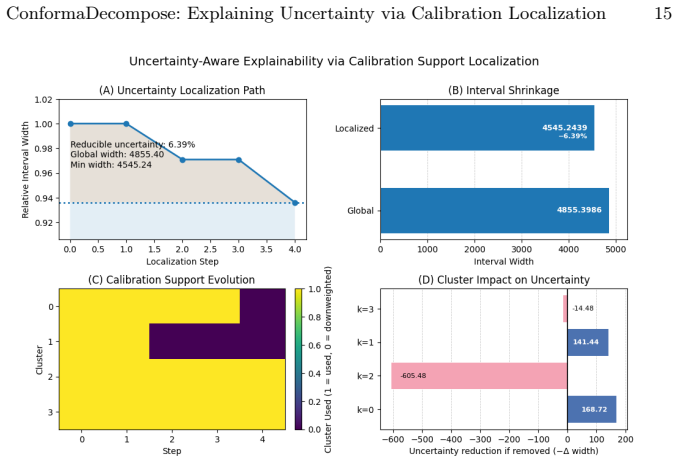
ConformaDecompose analyses the reducibility of calibration-induced epistemic conformal uncertainty via progressive calibration localisation for regression tasks. It explains how conformal intervals contract and stabilise as calibration support is localised around a test instance. Across benchmarks and real-world data, absolute reducible uncertainty aligns with epistemic proxies, while its relative contribution varies by task, revealing regimes hidden by interval width. The approach is diagnostic rather than causal and does not estimate true aleatoric or epistemic uncertainty.
What carries the argument
Progressive calibration localisation, the process of shrinking the calibration set to instances nearest the test point and measuring contraction in the conformal quantile threshold to quantify reducible epistemic uncertainty.
If this is right
- The absolute amount of reducible uncertainty extracted by localisation aligns with independent epistemic uncertainty measures on both synthetic and real regression tasks.
- The proportion of reducible uncertainty relative to total interval width differs systematically by task, exposing uncertainty regimes invisible from interval width alone.
- The decomposition supplies instance-level interpretability while preserving the original predictor and its distribution-free coverage guarantee.
- Insights apply equally to standard benchmark datasets and to domain-specific real-world regression problems.
Where Pith is reading between the lines
- Users could apply the localisation procedure to decide whether acquiring additional data similar to a given test point would meaningfully reduce prediction interval width.
- The same localisation idea might be adapted to classification settings or to other conformal variants that rely on a calibration quantile.
- Pairing this diagnostic with feature-attribution methods could separate calibration mismatch from other sources of epistemic uncertainty in deployed models.
Load-bearing premise
That progressively restricting the calibration set to points near the test instance isolates calibration-induced epistemic uncertainty without introducing selection bias from the similarity metric.
What would settle it
If the reducible uncertainty extracted by localisation shows no consistent correlation with external epistemic proxies such as model ensemble variance or sensitivity on held-out data across multiple datasets, the claimed alignment would not hold.
Figures

read the original abstract
Conformal Prediction provides distribution-free prediction intervals with guaranteed coverage, but its reliance on a single global calibration threshold obscures the sources of uncertainty at the instance level. In particular, it conflates irreducible noise with uncertainty induced by heterogeneous training data (aleatoric), model limitations, or calibration mismatch (epistemic), offering little insight into why an interval is wide or whether it could be reduced. We introduce an uncertainty-aware explainability framework that analyses the reducibility of calibration-induced epistemic conformal uncertainty via progressive calibration localisation for regression tasks. The approach is diagnostic rather than causal: it does not estimate true aleatoric or epistemic uncertainty, but explains how conformal intervals contract and stabilise as calibration support is localised around a test instance. Across benchmarks and real-world data, absolute reducible uncertainty aligns with epistemic proxies, while its relative contribution varies by task, revealing regimes hidden by interval width. This instance-level view complements conformal uncertainty, enhancing interpretability without altering the predictor or coverage.
Editorial analysis
A structured set of objections, weighed in public.
Referee Report
Summary. The paper introduces ConformaDecompose, a diagnostic framework for conformal prediction in regression that decomposes reducible calibration-induced epistemic uncertainty through progressive localization of the calibration set around a test instance. It claims that the absolute reducible uncertainty aligns with external epistemic proxies (e.g., ensemble variance) across benchmarks and real-world data, while the relative contribution varies by task and reveals uncertainty regimes not visible from interval width alone. The method preserves coverage guarantees and is explicitly positioned as explanatory rather than an estimator of true aleatoric or epistemic uncertainty.
Significance. If the reported alignment is robust, the framework offers a practical, instance-level diagnostic that complements standard conformal intervals by clarifying when and why they can be tightened via localized calibration support. This could improve interpretability in applications where understanding uncertainty sources matters, without requiring changes to the underlying predictor or loss of distribution-free properties. The careful non-causal framing is a strength.
major comments (2)
- [Method section on localization procedure] Method section on localization procedure: the claim that progressive localization isolates calibration-induced epistemic uncertainty (and thereby produces alignment with epistemic proxies) is load-bearing for the central result, yet no analysis or controls are provided to demonstrate that the (unstated or underspecified) similarity metric is independent of local data density, model disagreement, or the epistemic proxies themselves; this leaves open the possibility that observed contraction and alignment are artifacts of neighborhood selection rather than a diagnostic of reducibility.
- [Experimental results] Experimental results (benchmarks and real-world data): the alignment between absolute reducible uncertainty and epistemic proxies is asserted across tasks, but the manuscript supplies insufficient detail on the exact correlation metrics, statistical significance tests, number of localization steps, and controls for selection bias; without these, it is not possible to evaluate whether the data support the claim that relative contribution varies by task in a manner hidden by interval width.
minor comments (2)
- [Abstract and introduction] The abstract and introduction could more explicitly reference the specific sections or equations defining the localization radius schedule and the reducible-uncertainty formula to improve readability.
- [Figures] Figure captions and axis labels should clarify whether plotted quantities are normalized or absolute to avoid ambiguity when comparing across tasks.
Simulated Author's Rebuttal
We thank the referee for the constructive and detailed feedback on our manuscript. The comments identify areas where additional rigor and transparency can strengthen the presentation of ConformaDecompose. We address each major comment below and indicate the revisions we will make in the next version of the paper.
read point-by-point responses
-
Referee: Method section on localization procedure: the claim that progressive localization isolates calibration-induced epistemic uncertainty (and thereby produces alignment with epistemic proxies) is load-bearing for the central result, yet no analysis or controls are provided to demonstrate that the (unstated or underspecified) similarity metric is independent of local data density, model disagreement, or the epistemic proxies themselves; this leaves open the possibility that observed contraction and alignment are artifacts of neighborhood selection rather than a diagnostic of reducibility.
Authors: The similarity metric is the Euclidean distance in the normalized feature space, as stated in Section 3.2. We agree that explicit controls are needed to rule out artifacts. In the revised manuscript we will add an ablation subsection that (i) compares progressive localization against random calibration subsets of identical cardinality (controlling for effective sample size and local density) and (ii) reports the correlation between the similarity scores and the external epistemic proxies. These controls will be presented alongside the original results to demonstrate that the observed contraction and alignment are not explained by neighborhood selection alone. revision: yes
-
Referee: Experimental results (benchmarks and real-world data): the alignment between absolute reducible uncertainty and epistemic proxies is asserted across tasks, but the manuscript supplies insufficient detail on the exact correlation metrics, statistical significance tests, number of localization steps, and controls for selection bias; without these, it is not possible to evaluate whether the data support the claim that relative contribution varies by task in a manner hidden by interval width.
Authors: We will expand the experimental section and appendix to report: Pearson and Spearman correlation coefficients for each dataset and task, p-values obtained from permutation tests (10,000 permutations), the number of localization steps (fixed at 10, with convergence diagnostics shown), and an explicit selection-bias control that matches random subsets to the same local density as the localized sets. These additions will allow direct evaluation of the claim that relative reducible uncertainty varies by task independently of interval width. revision: yes
Circularity Check
No circularity: diagnostic localization remains independent of fitted inputs
full rationale
The paper frames ConformaDecompose as a post-hoc diagnostic that observes interval contraction under progressive calibration localization and reports empirical alignment with external epistemic proxies across benchmarks. No derivation step equates the reducible uncertainty measure to a parameter fitted from the same data, nor does any central claim rest on a self-citation chain or uniqueness theorem imported from prior author work. The method explicitly disclaims causal estimation of true aleatoric/epistemic uncertainty and presents the alignment as an observed pattern rather than a mathematical necessity, keeping the analysis self-contained against external benchmarks.
Axiom & Free-Parameter Ledger
Reference graph
Works this paper leans on
-
[1]
Springer, 2005
Vladimir Vovk, Alexander Gammerman, and Glenn Shafer.Algorithmic learning in a random world. Springer, 2005
2005
-
[2]
Conformal prediction: A gentle introduction.Foundations and Trends in Machine Learning, 16(4):494–591, 2023
Anastasios N Angelopoulos and Stephen Bates. Conformal prediction: A gentle introduction.Foundations and Trends in Machine Learning, 16(4):494–591, 2023
2023
-
[3]
What uncertainties do we need in bayesian deep learning for computer vision?Advances in neural information processing systems, 30, 2017
Alex Kendall and Yarin Gal. What uncertainties do we need in bayesian deep learning for computer vision?Advances in neural information processing systems, 30, 2017
2017
-
[4]
Simple and scalable predictive uncertainty estimation using deep ensembles.Advances in neu- ral information processing systems, 30, 2017
Balaji Lakshminarayanan, Alexander Pritzel, and Charles Blundell. Simple and scalable predictive uncertainty estimation using deep ensembles.Advances in neu- ral information processing systems, 30, 2017
2017
-
[5]
Aleatoric and epistemic uncertainty in machine learning: An introduction to concepts and methods.Machine learning, 110(3):457–506, 2021
Eyke Hüllermeier and Willem Waegeman. Aleatoric and epistemic uncertainty in machine learning: An introduction to concepts and methods.Machine learning, 110(3):457–506, 2021
2021
-
[6]
Conformalized credal set predictors.Advances in Neural Information Processing Systems,37:116987–117014, 2024
Alireza Javanmardi, David Stutz, and Eyke Hüllermeier. Conformalized credal set predictors.Advances in Neural Information Processing Systems,37:116987–117014, 2024
2024
-
[7]
Normalized non- conformity measures for regression conformal prediction
Harris Papadopoulos, Alex Gammerman, and Volodya Vovk. Normalized non- conformity measures for regression conformal prediction. InProceedings of the IASTED International Conference on Artificial Intelligence and Applications (AIA 2008), pages 64–69, 2008
2008
-
[8]
Conformalized quantile regression.Advances in neural information processing systems, 32, 2019
Yaniv Romano, Evan Patterson, and Emmanuel Candes. Conformalized quantile regression.Advances in neural information processing systems, 32, 2019
2019
-
[9]
Integrating uncer- tainty awareness into conformalized quantile regression
Raphael Rossellini, Rina Foygel Barber, and Rebecca Willett. Integrating uncer- tainty awareness into conformalized quantile regression. InInternational Confer- ence on Artificial Intelligence and Statistics, pages 1540–1548. PMLR, 2024
2024
-
[10]
Helena Löfström, Tuwe Löfström, Anders Hjort, and Fatima Rabia Yapicioglu. Concerning uncertainty–a systematic survey of uncertainty-aware xai.arXiv preprint arXiv:2603.26838, 2026. 24 F. R. Yapicioglu and M. Aksoy et al
-
[11]
Conformasegment: A conformal prediction-based, uncertainty-aware, and model-agnostic explainability framework for time-series forecasting
Fatima Rabia Yapicioglu, Meltem Aksoy, Tuwe Löfström, Fabio Vitali, and Alberto Rigenti. Conformasegment: A conformal prediction-based, uncertainty-aware, and model-agnostic explainability framework for time-series forecasting. InWorld Con- ference on Explainable Artificial Intelligence, pages 218–242. Springer, 2025
2025
-
[12]
Explainability through uncertainty: Trustworthy decision-making with neural networks.European Journal of Operational Research, 317(2):330–340, 2024
Arthur Thuy and Dries F Benoit. Explainability through uncertainty: Trustworthy decision-making with neural networks.European Journal of Operational Research, 317(2):330–340, 2024
2024
-
[13]
Calibrated explanations for regression.Machine Learning, 114(4):1–34, 2025
Tuwe Löfström, Helena Löfström, Ulf Johansson, Cecilia Sönströd, and Rudy Matela. Calibrated explanations for regression.Machine Learning, 114(4):1–34, 2025
2025
-
[14]
Mondrian conformal pre- dictive distributions
Henrik Boström, Ulf Johansson, and Tuwe Löfström. Mondrian conformal pre- dictive distributions. InConformal and Probabilistic Prediction and Applications, pages 24–38. PMLR, 2021
2021
-
[15]
Uncertainty propagation in xai: A comparison of analytical and empirical estimators
Teodor Chiaburu, Felix Bießmann, and Frank Haußer. Uncertainty propagation in xai: A comparison of analytical and empirical estimators. InWorld Conference on Explainable Artificial Intelligence, pages 390–411. Springer, 2025
2025
-
[16]
Uncertainty quantification for gradient- based explanations in neural networks
Mihir Mulye and Matias Valdenegro-Toro. Uncertainty quantification for gradient- based explanations in neural networks. InProceedings of the Computer Vision and Pattern Recognition Conference, pages 1752–1760, 2025
2025
-
[17]
Aleatoric and epistemic uncertainty in conformal prediction
Yusuf Sale, Alireza Javanmardi, and Eyke Hüllermeier. Aleatoric and epistemic uncertainty in conformal prediction. 2025
2025
-
[18]
A comparison of some conformal quantile regression methods.Stat, 9(1):e261, 2020
Matteo Sesia and Emmanuel J Candès. A comparison of some conformal quantile regression methods.Stat, 9(1):e261, 2020
2020
-
[19]
Some methods of classification and analysis of multivariate observations
James B McQueen. Some methods of classification and analysis of multivariate observations. InProc. of 5th Berkeley Symposium on Math. Stat. and Prob., pages 281–297, 1967
1967
-
[20]
Used cars dataset (craigslist cars & trucks data), 2020
Austin Reese. Used cars dataset (craigslist cars & trucks data), 2020. Accessed: 2026-02-01
2020
-
[21]
The proof and measurement of association between two things
Charles Spearman. The proof and measurement of association between two things. The American journal of psychology, 100(3/4):441–471, 1987
1987
-
[22]
Combined cycle power plant.https://archive
Pinar Tüfekci and Hasan Kaya. Combined cycle power plant.https://archive. ics.uci.edu/ml/datasets/Combined+Cycle+Power+Plant, 2014. UCI Machine Learning Repository
2014
-
[23]
Parkinsons telemonitoring.https://archive
Athanasios Tsanas and Max Little. Parkinsons telemonitoring.https://archive. ics.uci.edu/ml/datasets/Parkinsons+Telemonitoring, 2009. UCI Machine Learning Repository
2009
-
[24]
Brooks, David S
Thomas F. Brooks, David S. Pope, and Michael A. Marcolini. Airfoil self-noise. https://archive.ics.uci.edu/ml/datasets/Airfoil+Self-Noise, 1989. UCI Machine Learning Repository
1989
-
[25]
Warwick Nash, Tracy Sellers, Simon Talbot, Andrew Cawthorn, and Wes Ford. Abalone. UCI Machine Learning Repository, 1994. DOI: https://doi.org/10.24432/C55C7W
-
[26]
Scikit-learn: Machine learning in python.Journal of Machine Learning Research, 12:2825–2830, 2011
Fabian Pedregosa, Gaël Varoquaux, Alexandre Gramfort, Vincent Michel, Bertrand Thirion, Olivier Grisel, Mathieu Blondel, Peter Prettenhofer, Ron Weiss, Vincent Dubourg, et al. Scikit-learn: Machine learning in python.Journal of Machine Learning Research, 12:2825–2830, 2011
2011
-
[27]
Random forests.Machine Learning, 45(1):5–32, 2001
Leo Breiman. Random forests.Machine Learning, 45(1):5–32, 2001
2001
-
[28]
Ridge regression: Biased estimation for nonorthogonal problems.Technometrics, 12(1):55–67, 1970
Arthur E Hoerl and Robert W Kennard. Ridge regression: Biased estimation for nonorthogonal problems.Technometrics, 12(1):55–67, 1970
1970
-
[29]
Karl Pearson. Vii. note on regression and inheritance in the case of two parents. proceedings of the royal society of London, 58(347-352):240–242, 1895. ConformaDecompose: Explaining Uncertainty via Calibration Localization 25
-
[30]
PınarTüfekci. Predictionoffullloadelectricalpoweroutputofabaseloadoperated combined cycle power plant using machine learning methods.International Journal of Electrical Power & Energy Systems, 60:126–140, 2014
2014
-
[31]
Little, Patrick E
Max A. Little, Patrick E. McSharry, Stephen J. Roberts, Declan A. E. Costello, and Irene M. Moroz. Suitability of dysphonia measurements for telemonitoring of parkinson’s disease.IEEE Transactions on Biomedical Engineering, 56(4):1015– 1022, 2009
2009
-
[32]
Airfoil self-noise and prediction
Thomas F Brooks, D Stuart Pope, and Michael A Marcolini. Airfoil self-noise and prediction. Technical report, 1989
1989
discussion (0)
Sign in with ORCID, Apple, or X to comment. Anyone can read and Pith papers without signing in.