Recognition: unknown
Molecular Outflows in the Nucleus of the Nearby Compton-thick AGN NGC 3079
Pith reviewed 2026-05-07 07:59 UTC · model grok-4.3
The pith
The nuclear molecular outflow in NGC 3079 carries 15 times the momentum of the AGN radiation pressure.
A machine-rendered reading of the paper's core claim, the machinery that carries it, and where it could break.
Core claim
In addition to the rotating molecular disk, NGC 3079 contains a spatially unresolved nuclear molecular outflow traced by blueshifted CO(2-1) emission offset 0.17 arcsec from the continuum peak. The outflow has a mass rate of 8.82 solar masses per year, kinetic power of 3.8 times 10^41 erg/s, and momentum rate of 2.05 times 10^34 dyne. This momentum rate exceeds the AGN radiation momentum by a factor of approximately 15, favoring an energy-driven rather than radiation-driven mechanism. The kinetic power further supports a jet-powered origin that accounts for the evolutionary behavior of the VLBA-detected parsec-scale radio source.
What carries the argument
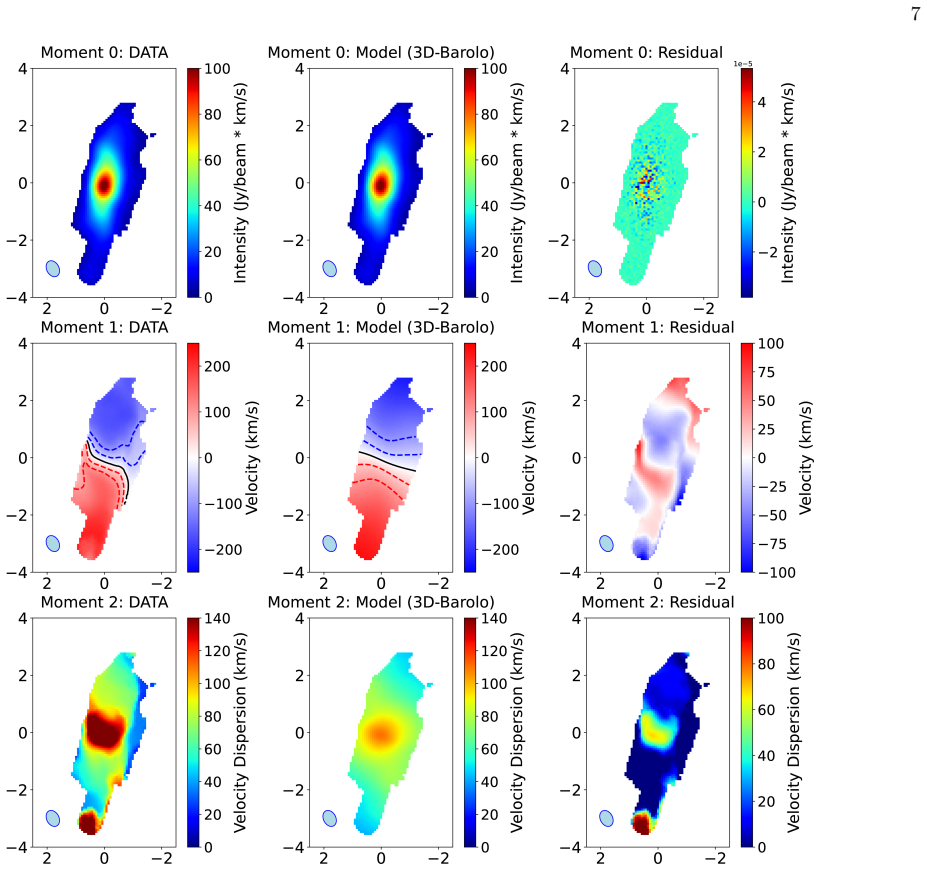
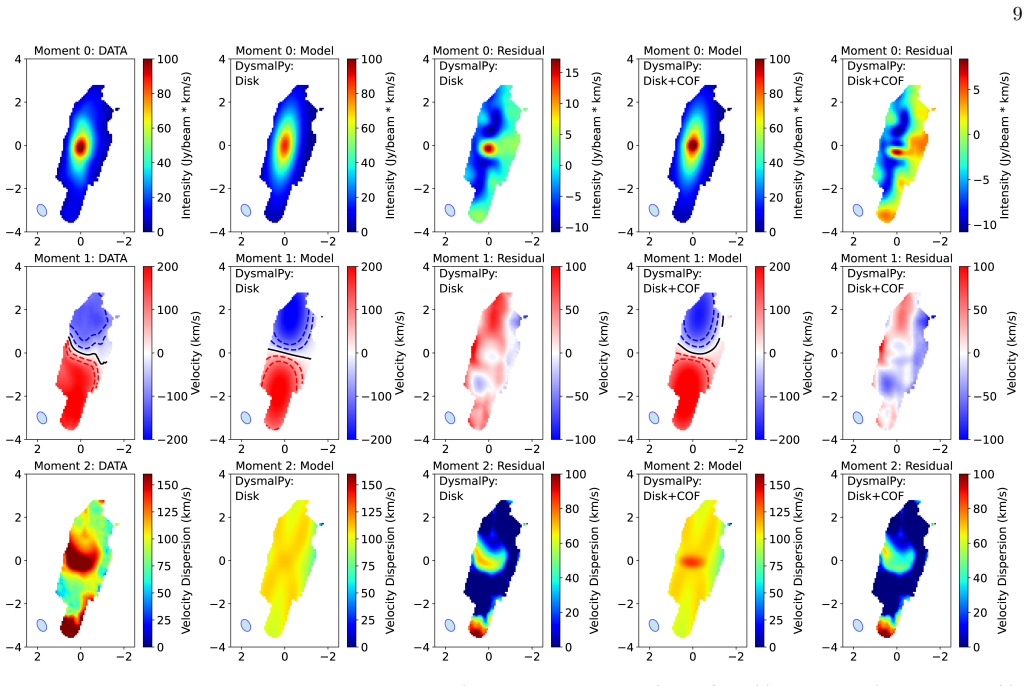
The spatially offset, high-velocity blueshifted CO(2-1) component interpreted as a nuclear molecular outflow after subtraction of a rotating-disk model generated by 3D-Barolo and DysmalPy.
If this is right
- The outflow is energy-driven, not momentum-driven by AGN radiation pressure.
- A radio jet supplies the power needed to drive the molecular wind.
- The same jet explains the observed slowdown and brightening of the parsec-scale radio source.
- Jet-driven feedback can operate efficiently even in Compton-thick nuclei.
Where Pith is reading between the lines
- Comparable nuclear molecular outflows may be detectable in other nearby Compton-thick Seyferts once similar resolution and modeling are applied.
- The energy deposited by the outflow could locally suppress star formation on tens-of-parsec scales around the nucleus.
- Multi-epoch radio and millimeter monitoring could test whether the jet continues to inject energy into the molecular gas over time.
Load-bearing premise
The high-velocity blueshifted CO emission represents a genuine nuclear molecular outflow rather than disk turbulence, inflow, or a modeling artifact, with the mass and rate calculations relying on assumed outflow geometry, size, and CO-to-H2 conversion factor.
What would settle it
Higher-resolution observations that resolve the 14-pc offset component and show its velocity field is consistent with bound disk motion or inflow instead of radial outflow would falsify the nuclear outflow interpretation.
Figures





read the original abstract
We present Northern Extended Millimeter Array (NOEMA) observations of the CO (2-1) molecular gas kinematics in the nearby Compton-thick Seyfert 2 galaxy NGC 3079, with an angular resolution of 0.5" ($\sim$40 pc). To interpret the observed CO (2-1) kinematics, we model the rotating disk using two software tools, 3D-Barolo and DysmalPy, to generate mock 3D data cubes. Both models indicate, in addition to the rotating disk, the presence of a spatially unresolved nuclear component characterized by high velocity dispersion. Analysis of the visibility data reveals that the blue-shifted, high-velocity component is spatially offset from the continuum peak by 0.17" ($\sim$ 14 pc) and exhibits line-of-sight velocities of $v$ - $v_{sys}$ = -350 to -450 km s$^{-1}$, which we interpret as a nuclear molecular outflow. We calculate a molecular gas mass outflow rate of 8.82 $M_\odot$ yr$^{-1}$, with a kinetic power ($\dot{E}_{\text{out}}$) of 3.8 $\times$ 10$^{41}$ erg s$^{-1}$ and a momentum rate ($\dot{p}_{\text{out}}$) of 2.05 $\times$ 10$^{34}$ Dyne. The momentum rate exceeds the AGN radiation momentum rate by a factor of $\sim$15, suggesting an energy-driven outflow. Furthermore, we argue that the derived kinetic power of the nuclear molecular outflow favors a jet-powered scenario that explains the slowdown and brightening of the parsec-scale radio source observed with the Very Long Baseline Array.
Editorial analysis
A structured set of objections, weighed in public.
Referee Report
Summary. The paper reports NOEMA CO(2-1) observations of NGC 3079 at ~0.5 arcsec (~40 pc) resolution. Kinematic modeling with two independent codes (3D-Barolo and DysmalPy) decomposes the data into a rotating molecular disk plus an unresolved nuclear high-dispersion component. Visibility analysis identifies a blueshifted high-velocity feature offset 0.17 arcsec (~14 pc) from the continuum peak with line-of-sight velocities -350 to -450 km/s, interpreted as a nuclear molecular outflow. The authors derive an outflow rate of 8.82 M_⊙ yr^{-1}, kinetic power 3.8×10^{41} erg s^{-1}, and momentum rate 2.05×10^{34} dyne. This momentum rate exceeds L_AGN/c by a factor of ~15, interpreted as evidence for an energy-driven outflow; the kinetic power is argued to favor a jet-powered scenario consistent with VLBA observations of the parsec-scale radio source.
Significance. If the outflow classification holds, the result provides a well-resolved example of a nuclear molecular outflow in a Compton-thick AGN with a momentum boost of order 15, supporting energy-driven feedback models over purely momentum-driven ones. The agreement between two distinct kinematic codes and the direct use of visibility data to measure the spatial offset and velocity range are methodological strengths that increase confidence in the kinematic decomposition. The suggested connection between the molecular outflow energetics and the slowdown/brightening of the VLBA radio jet offers a potential observational link between small-scale jet activity and molecular gas dynamics. The calculations apply standard outflow-rate formulas to measured velocities, offsets, and fluxes, which is a positive aspect.
major comments (3)
- [Kinematic modeling and visibility analysis] The classification of the blueshifted high-velocity component as a nuclear outflow (rather than disk turbulence, bar-driven inflow, or model artifact) is load-bearing for the momentum excess of ~15 and the energy-driven/jet-powered conclusions. The visibility analysis shows a 0.17 arcsec offset at 0.5 arcsec resolution (sub-beam); the paper should include explicit tests (e.g., residual maps or simulated visibilities) demonstrating that no pure rotating-disk model reproduces this feature.
- [Outflow rate calculations] The mass outflow rate (8.82 M_⊙ yr^{-1}), kinetic power, and momentum rate depend on the adopted CO-to-H2 conversion factor, outflow radius (taken as the 0.17 arcsec offset), and geometry for deprojection. These parameters must be stated explicitly with justification and a sensitivity analysis showing the range of momentum boost factors that result from plausible variations (e.g., α_CO = 0.8–4.3).
- [Discussion of jet-powered scenario] The argument that the derived kinetic power favors a jet-powered scenario over radiation-driven alternatives requires a quantitative comparison (e.g., estimated jet power, energy injection timescale, or momentum flux) to the VLBA parsec-scale radio source properties; the current qualitative link is insufficient to support the claim.
minor comments (3)
- [Abstract] The abstract should report uncertainties on the derived rates, the exact CO conversion factor adopted, and the key model parameters from 3D-Barolo and DysmalPy.
- [Figures] Figure captions and text should explicitly state the synthesized beam size when discussing the 0.17 arcsec offset and clarify how the offset is measured in the visibility domain.
- [Modeling section] Add a short table listing the best-fit parameters from both kinematic codes for reproducibility.
Simulated Author's Rebuttal
We thank the referee for the thorough and constructive review of our manuscript. The comments have helped us strengthen the kinematic validation, clarify parameter choices, and add quantitative comparisons to the VLBA data. We address each major comment point-by-point below and have incorporated the requested additions into the revised version.
read point-by-point responses
-
Referee: [Kinematic modeling and visibility analysis] The classification of the blueshifted high-velocity component as a nuclear outflow (rather than disk turbulence, bar-driven inflow, or model artifact) is load-bearing for the momentum excess of ~15 and the energy-driven/jet-powered conclusions. The visibility analysis shows a 0.17 arcsec offset at 0.5 arcsec resolution (sub-beam); the paper should include explicit tests (e.g., residual maps or simulated visibilities) demonstrating that no pure rotating-disk model reproduces this feature.
Authors: We agree that explicit validation against a pure rotating-disk model is essential. In the revised manuscript we have added residual maps after subtracting the best-fit 3D-Barolo rotating-disk model from the observed data cube; the blueshifted high-velocity feature at -350 to -450 km s^{-1} remains clearly visible at the reported 0.17 arcsec offset. We also generated simulated visibilities from a pure rotating-disk model (using the fitted parameters and the exact uv-coverage of the observations) and imaged them identically to the real data. The simulated cube does not reproduce the observed high-velocity blueshifted component, confirming that the feature is not an artifact of the disk model or fitting procedure. These tests are now presented in a new subsection of Section 3 and in an additional figure. revision: yes
-
Referee: [Outflow rate calculations] The mass outflow rate (8.82 M_⊙ yr^{-1}), kinetic power, and momentum rate depend on the adopted CO-to-H2 conversion factor, outflow radius (taken as the 0.17 arcsec offset), and geometry for deprojection. These parameters must be stated explicitly with justification and a sensitivity analysis showing the range of momentum boost factors that result from plausible variations (e.g., α_CO = 0.8–4.3).
Authors: We have revised the text to state the adopted parameters explicitly in Section 4: α_CO = 0.8 M_⊙ (K km s^{-1} pc²)^{-1} (justified by values commonly used for nuclear regions in Compton-thick AGNs and ULIRGs), outflow radius = 14 pc (directly from the measured visibility offset), and deprojection assuming a biconical geometry perpendicular to the disk with inclination taken from the kinematic modeling (~70°). We added a sensitivity analysis varying α_CO from 0.8 to 4.3. This scales the mass outflow rate from 8.82 to 47.5 M_⊙ yr^{-1}, the kinetic power from 3.8×10^{41} to 2.0×10^{42} erg s^{-1}, and the momentum boost factor (ṗ_out / (L_AGN/c)) from ~15 down to ~3.2. Even at the highest α_CO the boost remains >1, supporting an energy-driven outflow. A new table summarizes the full range of values and the discussion has been updated accordingly. revision: yes
-
Referee: [Discussion of jet-powered scenario] The argument that the derived kinetic power favors a jet-powered scenario over radiation-driven alternatives requires a quantitative comparison (e.g., estimated jet power, energy injection timescale, or momentum flux) to the VLBA parsec-scale radio source properties; the current qualitative link is insufficient to support the claim.
Authors: We acknowledge that the original discussion was largely qualitative. In the revised manuscript we have added quantitative comparisons in Section 5. Using the VLBA 5 GHz flux density of the parsec-scale radio jet, we apply the standard radio-to-jet-power scaling P_jet ≈ 5×10^{43} (L_5GHz / 10^{40} erg s^{-1})^{0.7} erg s^{-1}, obtaining P_jet ~ 5×10^{41} erg s^{-1}, which is comparable to the molecular outflow kinetic power of 3.8×10^{41} erg s^{-1}. The outflow dynamical timescale (r/v ≈ 14 pc / 400 km s^{-1} ≈ 3.4×10^4 yr) is also consistent with the timescale over which the VLBA radio source shows deceleration and brightening. These numbers provide a direct energetic and temporal link between the molecular outflow and the jet activity, strengthening the jet-powered interpretation. revision: yes
Circularity Check
No significant circularity; derivation is self-contained from observations
full rationale
The paper's chain proceeds from NOEMA visibility data and kinematic modeling with external tools (3D-Barolo, DysmalPy) to identify an offset blueshifted component, then applies standard formulas for outflow rate, kinetic power, and momentum rate using measured velocities, spatial offset, and conventional CO-to-H2 factors plus assumed geometry. The factor-of-15 excess over L_AGN/c and jet-powered interpretation follow directly as numerical comparisons without any equation reducing the reported values back to a fitted parameter or self-citation by construction. No self-definitional loops, fitted-input predictions, or load-bearing self-citations appear in the derivation; external benchmarks and standard assumptions keep the central claims independent of the inputs.
Axiom & Free-Parameter Ledger
free parameters (2)
- CO-to-H2 conversion factor
- Outflow radius and geometry
axioms (2)
- domain assumption The blueshifted high-velocity gas is an outflow rather than disk turbulence or inflow
- domain assumption Standard thin-disk plus Gaussian outflow geometry for rate calculations
Reference graph
Works this paper leans on
-
[1]
, " * write output.state after.block = add.period write newline
ENTRY address archivePrefix author booktitle chapter doi edition editor eprint howpublished institution journal key month number organization pages publisher school series title misctitle type volume year version url label extra.label sort.label short.list INTEGERS output.state before.all mid.sentence after.sentence after.block FUNCTION init.state.consts ...
-
[2]
write newline
" write newline "" before.all 'output.state := FUNCTION format.url url empty "" new.block "" url * "" * if FUNCTION format.eprint eprint empty "" archivePrefix empty "" archivePrefix "arXiv" = new.block " " eprint * " " * new.block " " eprint * " " * if if if FUNCTION format.doi doi empty "" " " doi * " " * if FUNCTION format.pid doi empty eprint empty ur...
-
[3]
adobe:ns:meta/
thebibliography [1] 20pt to REFERENCES 6pt =0pt \@twocolumntrue 12pt -12pt 10pt plus 3pt =0pt =0pt =1pt plus 1pt =0pt =0pt -12pt =13pt plus 1pt =20pt =13pt plus 1pt \@M =10000 =-1.0em =0pt =0pt 0pt =0pt =1.0em @enumiv\@empty 10000 10000 `\.\@m \@noitemerr \@latex@warning Empty `thebibliography' environment \@ifnextchar \@reference \@latexerr Missing key o...
2017
-
[15]
2021, title CARTA: Cube Analysis and Rendering Tool for Astronomy ,
Comrie , A., Wang , K.-S., Hsu , S.-C., et al. 2021, title CARTA: Cube Analysis and Rendering Tool for Astronomy ,
2021
-
[35]
2000, in Astronomical Society of the Pacific Conference Series, Vol
Guilloteau , S., & Lucas , R. 2000, in Astronomical Society of the Pacific Conference Series, Vol. 217, Imaging at Radio through Submillimeter Wavelengths, ed. J. G. Mangum & S. J. E. Radford , 299
2000
-
[41]
Israel , F. P., van der Werf , P. P., Hawarden , T. G., & Aspin , C. 1998, title The obscured circumnuclear region of NGC 3079 , arXiv e-prints, astro, 10.48550/arXiv.astro-ph/9806247
work page internal anchor Pith review doi:10.48550/arxiv.astro-ph/9806247 1998
-
[69]
A., & Mead, R
Nelder, J. A., & Mead, R. 1965, title A Simplex Method for Function Minimization., Comput. J., 7, 308. http://dblp.uni-trier.de/db/journals/cj/cj7.html#NelderM65
1965
-
[96]
doi:10.1051/0004-6361/202451906
Akylas, A., Georgantopoulos, I., Gandhi, P., et al.\ 2024, , 692, A250. doi:10.1051/0004-6361/202451906
-
[97]
doi:10.1051/0004-6361/201935431
Alonso-Herrero, A., Garc \' a-Burillo, S., Pereira-Santaella, M., et al.\ 2019, , 628, A65. doi:10.1051/0004-6361/201935431
-
[98]
doi:10.1051/0004-6361/202037642
Alonso-Herrero, A., Pereira-Santaella, M., Rigopoulou, D., et al.\ 2020, , 639, A43. doi:10.1051/0004-6361/202037642
-
[99]
doi:10.1051/0004-6361/202346074
Alonso Herrero, A., Garc \' a-Burillo, S., Pereira-Santaella, M., et al.\ 2023, , 675, A88. doi:10.1051/0004-6361/202346074
-
[100]
M., Gandhi, P., et al.\ 2025, , 540, 4, 3827
Annuar, A., Alexander, D. M., Gandhi, P., et al.\ 2025, , 540, 4, 3827. doi:10.1093/mnras/staf956
-
[101]
Astropy Collaboration, Price-Whelan, A. M., Lim, P. L., et al.\ 2022, , 935, 2, 167. doi:10.3847/1538-4357/ac7c74
-
[102]
and Wolfire, Mark and Leroy, Adam K
Bolatto, A. D., Wolfire, M., & Leroy, A. K.\ 2013, , 51, 1, 207. doi:10.1146/annurev-astro-082812-140944
work page Pith review doi:10.1146/annurev-astro-082812-140944 2013
-
[103]
Bolatto, A. D., Leroy, A. K., Levy, R. C., et al.\ 2021, , 923, 1, 83. doi:10.3847/1538-4357/ac2c08
-
[104]
Bower, R. G., Benson, A. J., Malbon, R., et al.\ 2006, , 370, 2, 645. doi:10.1111/j.1365-2966.2006.10519.x
-
[105]
Burtscher, L., Meisenheimer, K., Tristram, K. R. W., et al.\ 2013, , 558, A149. doi:10.1051/0004-6361/201321890
-
[106]
Cecil, G., Bland-Hawthorn, J., Veilleux, S., et al.\ 2001, , 555, 1, 338. doi:10.1086/321481
-
[107]
2014, A&A, 562, A21, doi: 10.1051/0004-6361/201322464
Cicone, C., Maiolino, R., Sturm, E., et al.\ 2014, , 562, A21. doi:10.1051/0004-6361/201322464
-
[108]
Cresci, G., Hicks, E. K. S., Genzel, R., et al.\ 2009, , 697, 1, 115. doi:10.1088/0004-637X/697/1/115
-
[109]
Croton, D. J., Springel, V., White, S. D. M., et al.\ 2006, , 365, 1, 11. doi:10.1111/j.1365-2966.2005.09675.x
-
[110]
ascl:2103.031
Comrie, A., Wang, K.-S., Hsu, S.-C., et al.\ 2021, Astrophysics Source Code Library. ascl:2103.031
2021
-
[111]
Davies, R. I., Tacconi, L. J., & Genzel, R.\ 2004, , 602, 1, 148. doi:10.1086/380995
-
[112]
Davies, R., F \"o rster Schreiber, N. M., Cresci, G., et al.\ 2011, , 741, 2, 69. doi:10.1088/0004-637X/741/2/69
-
[113]
Davies, R. I., Maciejewski, W., Hicks, E. K. S., et al.\ 2014, , 792, 2, 101. doi:10.1088/0004-637X/792/2/101
-
[114]
Davies, R. I., Burtscher, L., Rosario, D., et al.\ 2015, , 806, 1, 127. doi:10.1088/0004-637X/806/1/127
-
[115]
Di Teodoro, E. M. & Fraternali, F.\ 2015, , 451, 3, 3021. doi:10.1093/mnras/stv1213
-
[116]
Observational Evidence of AGN Feedback
Fabian, A. C.\ 2012, , 50, 455. doi:10.1146/annurev-astro-081811-125521
work page Pith review doi:10.1146/annurev-astro-081811-125521 2012
-
[117]
2012, MNRAS, 423, 600, doi: 10.1111/j.1365-2966.2012.20901.x
Faucher-Gigu \`e re, C.-A. & Quataert, E.\ 2012, , 425, 1, 605. doi:10.1111/j.1365-2966.2012.21512.x
-
[118]
Fernandez, L. C., Secrest, N. J., Johnson, M. C., et al.\ 2023, , 958, 1, 61. doi:10.3847/1538-4357/acfeda
-
[119]
Feruglio, C., Maiolino, R., Piconcelli, E., et al.\ 2010, , 518, L155. doi:10.1051/0004-6361/201015164
-
[120]
Fiore, F., Feruglio, C., Shankar, F., et al.\ 2017, , 601, A143. doi:10.1051/0004-6361/201629478
-
[121]
Fischer, T. C., Secrest, N. J., Johnson, M. C., et al.\ 2021, , 906, 2, 88. doi:10.3847/1538-4357/abca3c
-
[122]
Fluetsch, A., Maiolino, R., Carniani, S., et al.\ 2019, , 483, 4, 4586. doi:10.1093/mnras/sty3449
-
[123]
F., Elitzur, M., Maiolino, R., et al.\ 2016, , 829, 1, L7
Gallimore, J. F., Elitzur, M., Maiolino, R., et al.\ 2016, , 829, 1, L7. doi:10.3847/2041-8205/829/1/L7
-
[124]
doi:10.1051/0004-6361/201423843
Garc \' a-Burillo, S., Combes, F., Usero, A., et al.\ 2014, , 567, A125. doi:10.1051/0004-6361/201423843
-
[125]
doi:10.1051/0004-6361/201936606
Garc \' a-Burillo, S., Combes, F., Ramos Almeida, C., et al.\ 2019, , 632, A61. doi:10.1051/0004-6361/201936606
-
[126]
W., Jaffe, W., et al.\ 2022, , 602, 7897, 403
G \'a mez Rosas, V., Isbell, J. W., Jaffe, W., et al.\ 2022, , 602, 7897, 403. doi:10.1038/s41586-021-04311-7
-
[127]
GRAVITY Collaboration, Dexter, J., Shangguan, J., et al.\ 2020, , 635, A92. doi:10.1051/0004-6361/201936767
-
[128]
GRAVITY Collaboration, Amorim, A., Bourdarot, G., et al.\ 2024, , 690, A76. doi:10.1051/0004-6361/202450746
-
[129]
Gruppioni, C., Berta, S., Spinoglio, L., et al.\ 2016, , 458, 4, 4297. doi:10.1093/mnras/stw577
-
[130]
& Lucas, R.\ 2000, Imaging at Radio through Submillimeter Wavelengths, 217, 299
Guilloteau, S. & Lucas, R.\ 2000, Imaging at Radio through Submillimeter Wavelengths, 217, 299
2000
-
[131]
Hagiwara, Y., Kl \"o ckner, H.-R., & Baan, W.\ 2004, , 353, 4, 1055. doi:10.1111/j.1365-2966.2004.08092.x
-
[132]
Heckman, T. M. & Best, P. N.\ 2014, , 52, 589. doi:10.1146/annurev-astro-081913-035722
work page internal anchor Pith review doi:10.1146/annurev-astro-081913-035722 2014
-
[133]
Ho, L. C. & Peng, C. Y.\ 2001, , 555, 2, 650. doi:10.1086/321524
-
[134]
Impellizzeri, C. M. V., Gallimore, J. F., Baum, S. A., et al.\ 2019, , 884, 2, L28. doi:10.3847/2041-8213/ab3c64
-
[135]
Irwin, J. A. & Seaquist, E. R.\ 1988, , 335, 658. doi:10.1086/166956
-
[136]
P., van der Werf, P
Israel, F. P., van der Werf, P. P., Hawarden, T. G., et al.\ 1998, , 336, 433
1998
-
[137]
D., Jahnke, K., et al.\ 2020, , 898, 1, 61
Izumi, T., Silverman, J. D., Jahnke, K., et al.\ 2020, , 898, 1, 61. doi:10.3847/1538-4357/ab99a8
-
[138]
Keenan, R. P., Marrone, D. P., & Keating, G. K.\ 2025, , 979, 2, 228. doi:10.3847/1538-4357/ada361
-
[139]
Kellermann, K. I., Sramek, R., Schmidt, M., et al.\ 1989, , 98, 1195. doi:10.1086/115207
-
[140]
Kianfar, K., Andreani, P., Fern \'a ndez-Ontiveros, J. A., et al.\ 2024, , 691, A118. doi:10.1051/0004-6361/202451185
-
[141]
R., Zubovas, K., & Power, C.\ 2011, , 415, 1, L6
King, A. R., Zubovas, K., & Power, C.\ 2011, , 415, 1, L6. doi:10.1111/j.1745-3933.2011.01067.x
-
[142]
King, A. & Pounds, K.\ 2015, , 53, 115. doi:10.1146/annurev-astro-082214-122316
-
[143]
Koda, J., Sofue, Y., Kohno, K., et al.\ 2002, , 573, 1, 105. doi:10.1086/340561
-
[144]
Kondratko, P. T., Greenhill, L. J., & Moran, J. M.\ 2005, , 618, 2, 618. doi:10.1086/426101
-
[145]
LaMassa, S. M., Yaqoob, T., Boorman, P. G., et al.\ 2019, , 887, 2, 173. doi:10.3847/1538-4357/ab552c
-
[146]
Lang, P., F \"o rster Schreiber, N. M., Genzel, R., et al.\ 2017, , 840, 2, 92. doi:10.3847/1538-4357/aa6d82
-
[147]
Lee, L. L., F \"o rster Schreiber, N. M., Price, S. H., et al.\ 2025, , 978, 1, 14. doi:10.3847/1538-4357/ad90b5
-
[148]
Leitherer, C., Schaerer, D., Goldader, J. D., et al.\ 1999, , 123, 1, 3. doi:10.1086/313233
-
[149]
K., Walter, F., Martini, P., et al
Leroy, A. K., Walter, F., Martini, P., et al.\ 2015, , 814, 2, 83. doi:10.1088/0004-637X/814/2/83
-
[150]
Li, J.-T., Sun, W., Ji, L., et al.\ 2024, , 966, 2, 239. doi:10.3847/1538-4357/ad3af2
-
[151]
I., Burtscher, L., et al.\ 2016, , 458, 2, 1375
Lin, M.-Y., Davies, R. I., Burtscher, L., et al.\ 2016, , 458, 2, 1375. doi:10.1093/mnras/stw401
-
[152]
2022, A&A, 659, A123, doi: 10.1051/0004-6361/201936803
Lutz, D., Sturm, E., Janssen, A., et al.\ 2020, , 633, A134. doi:10.1051/0004-6361/201936803
-
[153]
Macaulay, E., Nichol, R. C., Bacon, D., et al.\ 2019, , 486, 2, 2184. doi:10.1093/mnras/stz978
-
[154]
Maiolino, R., Gallerani, S., Neri, R., et al.\ 2012, , 425, 1, L66. doi:10.1111/j.1745-3933.2012.01303.x
-
[155]
doi:10.1038/s41550-025-02518-6
Marconcini, C., Marconi, A., Cresci, G., et al.\ 2025, Nature Astronomy, 9, 907. doi:10.1038/s41550-025-02518-6
-
[156]
Martini, P., Regan, M. W., Mulchaey, J. S., et al.\ 2003, , 589, 2, 774. doi:10.1086/374685
-
[157]
2007, MNRAS, 378, 910, doi: 10.1111/j.1365-2966.2007.11817.x
Middelberg, E., Agudo, I., Roy, A. L., et al.\ 2007, , 377, 2, 731. doi:10.1111/j.1365-2966.2007.11639.x
-
[158]
Morganti, R., Oosterloo, T., Oonk, J. B. R., et al.\ 2015, , 580, A1. doi:10.1051/0004-6361/201525860
-
[159]
V., Sutherland, R., & Wagner, A
Mukherjee, D., Bicknell, G. V., Sutherland, R., et al.\ 2016, , 461, 1, 967. doi:10.1093/mnras/stw1368
-
[160]
Mukherjee, D., Bicknell, G. V., Wagner, A. Y., et al.\ 2018, , 479, 4, 5544. doi:10.1093/mnras/sty1776
-
[161]
I., Genzel, R., et al.\ 2009, , 691, 1, 749
M \"u ller S \'a nchez, F., Davies, R. I., Genzel, R., et al.\ 2009, , 691, 1, 749. doi:10.1088/0004-637X/691/1/749
-
[162]
Murray, N., Quataert, E., & Thompson, T. A.\ 2005, , 618, 2, 569. doi:10.1086/426067
-
[163]
Nagashima, Y., Saito, T., Ikarashi, S., et al.\ 2024, , 974, 2, 243. doi:10.3847/1538-4357/ad6312
-
[164]
2012, MNRAS, 423, 600, doi: 10.1111/j.1365-2966.2012.20901.x
Narayanan, D., Krumholz, M. R., Ostriker, E. C., et al.\ 2012, , 421, 4, 3127. doi:10.1111/j.1365-2966.2012.20536.x
-
[165]
Available: https://doi.org/10.1093/comjnl/7.4.308
Nelder, J. A., & Mead, R.\ 1965, Comput. J., 7, 4, 308. doi:10.1093/comjnl/7.4.308
-
[166]
Netzer, H.\ 2015, , 53, 365. doi:10.1146/annurev-astro-082214-122302
-
[167]
Oh, K., Koss, M., Markwardt, C. B., et al.\ 2018, , 235, 1, 4. doi:10.3847/1538-4365/aaa7fd
-
[168]
Price, S. H., Shimizu, T. T., Genzel, R., et al.\ 2021, , 922, 2, 143. doi:10.3847/1538-4357/ac22ad
discussion (0)
Sign in with ORCID, Apple, or X to comment. Anyone can read and Pith papers without signing in.