Recognition: unknown
Dispersive Properties of Plasma Diffraction Gratings: Towards Plasma-Based Laser Pulse Compression
Pith reviewed 2026-05-07 09:58 UTC · model grok-4.3
The pith
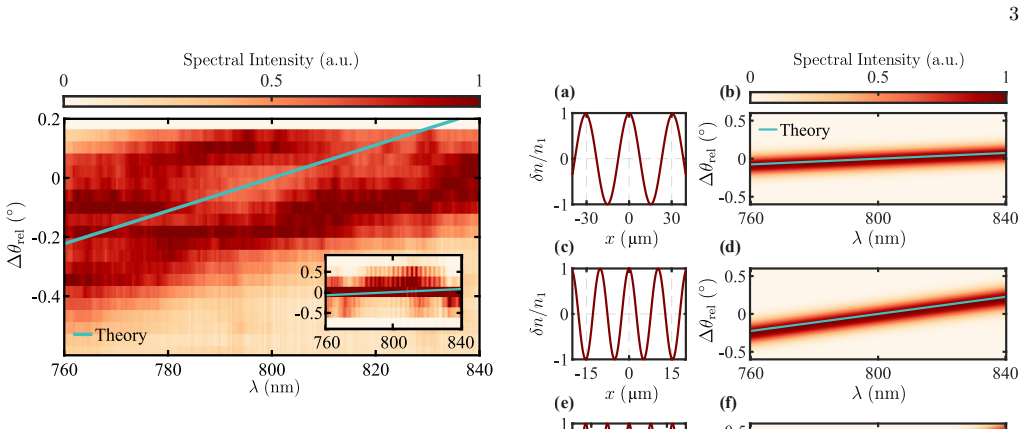
Measurements show plasma transmission gratings disperse light as optical theory predicts, with 0.005 degrees per nanometer for 10.2-micron periods.
A machine-rendered reading of the paper's core claim, the machinery that carries it, and where it could break.
Core claim
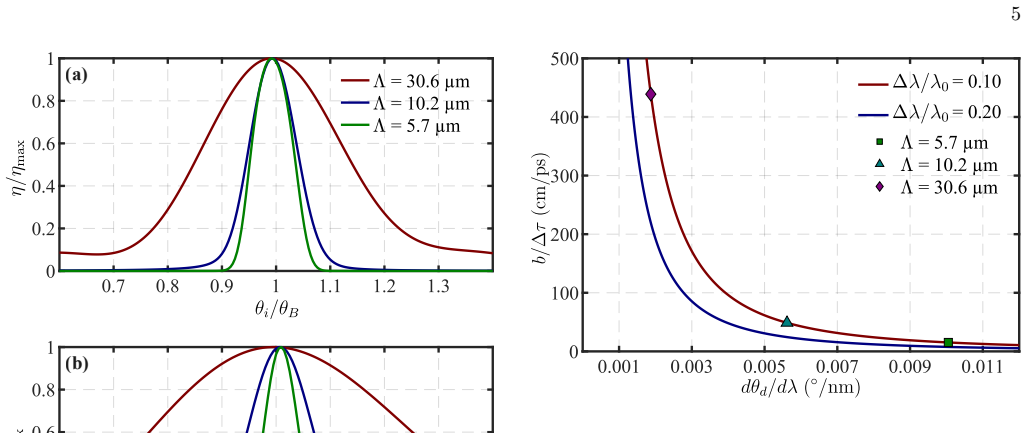
The authors establish that the dispersive and diffractive properties of ionization-based plasma transmission gratings follow optical grating theory and simulations to high accuracy. Gratings of 10.2-micron period exhibit an angular dispersion of approximately 0.005 degrees per nanometer together with consistent angular bandwidth and diffraction angles. These results confirm usable optical quality at laboratory scale and directly support the design of plasma-grating compressors capable of handling the intensities needed for petawatt-to-exawatt peak powers.
What carries the argument
Ionization-induced plasma transmission gratings whose angular dispersion follows the standard grating equation and whose measured bandwidth permits femtosecond pulse compression.
If this is right
- Plasma gratings could replace solid gratings inside chirped-pulse amplifiers at intensities that would destroy conventional optics.
- Compressor layouts using the measured 0.005 deg/nm dispersion become practical for stretching and recompressing femtosecond pulses.
- Peak laser power can be scaled into the exawatt range while keeping the overall system footprint smaller than current petawatt facilities.
- The close match to theory supplies predictive formulas for choosing grating period and incidence angle in future designs.
Where Pith is reading between the lines
- If meter-scale plasma gratings can be formed with the same uniformity, entire compressor stages could fit inside a room rather than a large hall.
- Pairing these gratings with plasma amplifiers would create an all-plasma laser chain free of solid-optic damage limits.
- The dispersion value is compatible with the chirp rates already used in existing petawatt lasers, so existing front-end designs could be adapted directly.
Load-bearing premise
The dispersion, bandwidth, and uniformity measured on small plasma gratings will persist when the structures are scaled to the aperture sizes and intensities required for high-power compressors.
What would settle it
A direct measurement showing that angular dispersion deviates from theory by more than a few percent once the grating aperture exceeds a few centimeters or the intensity exceeds 10^12 W per square centimeter would falsify the proposed compression application.
Figures



read the original abstract
The standard architecture for a high-peak-power femtosecond laser is chirped pulse amplification using diffraction gratings for compression; the damage threshold of the compression gratings limits current lasers to multi-petawatt peak power. Plasma gratings have orders-of-magnitude higher damage tolerance than conventional optics, so plasma gratings with sufficiently high optical quality could allow the construction of ultra-high-power femtosecond lasers. Here, we present experimental measurements of the angular dispersion, angular bandwidth, and diffraction angles of ionization-based plasma transmission gratings and show that both the dispersive and the diffractive properties of these gratings are in close agreement with optical theory and simulations. Gratings with a period of 10.2 microns are found to have an angular dispersion of approximately 0.005 degrees/nm. The dispersion and bandwidth of these gratings suggest plausible designs for a plasma-grating-based compressor and indicate a pathway to compact lasers with petawatt to exawatt peak power.
Editorial analysis
A structured set of objections, weighed in public.
Referee Report
Summary. The manuscript reports experimental measurements of the angular dispersion (~0.005 deg/nm), angular bandwidth, and diffraction angles for small-scale (10.2 μm period) ionization-based plasma transmission gratings. These properties are stated to be in close agreement with optical theory and simulations. The authors conclude that the dispersion and bandwidth support plausible designs for plasma-grating compressors, indicating a pathway to compact petawatt-to-exawatt peak-power lasers via the gratings' high damage threshold.
Significance. If the experimental agreement holds under scaling, the work would demonstrate a viable route to bypass the damage-threshold limit of conventional CPA gratings, enabling higher peak powers in a compact form. The direct comparison of measured dispersion to independent theory is a clear strength when properly quantified.
major comments (2)
- [Abstract] Abstract: the claim of 'close agreement with optical theory and simulations' is presented without quantitative support (error bars, number of trials, data-exclusion criteria, or goodness-of-fit metrics). This is load-bearing for the central experimental result and must be supplied with specific comparison data or plots.
- [Discussion/Conclusion] Implications/Discussion: the pathway to petawatt-exawatt compressors rests on the untested assumption that the measured dispersive properties and optical quality will persist at aperture scales of tens of cm, uniformities required for high-power use, and intensities >>10^12 W/cm². No scaling analysis, hydrodynamic simulation, or uniformity study is provided, rendering the broader claim dependent on an extrapolation whose failure modes (plasma non-uniformities, instabilities) are not addressed.
minor comments (2)
- [Abstract] Abstract: '10.2 microns' should be written consistently as 10.2 μm (SI) throughout the manuscript.
- [Abstract] The abstract supplies a single dispersion value but does not state the measurement wavelength range or the exact grating geometry used; these details are needed for reproducibility even in a short report.
Simulated Author's Rebuttal
We thank the referee for the constructive feedback, which highlights the need for stronger quantitative backing of our experimental claims and clearer scoping of the implications. We respond to each major comment below and will revise the manuscript accordingly.
read point-by-point responses
-
Referee: [Abstract] Abstract: the claim of 'close agreement with optical theory and simulations' is presented without quantitative support (error bars, number of trials, data-exclusion criteria, or goodness-of-fit metrics). This is load-bearing for the central experimental result and must be supplied with specific comparison data or plots.
Authors: We agree that the abstract requires quantitative support for the 'close agreement' statement. In the revised manuscript we will report error bars on the dispersion (standard deviation from repeated measurements), the number of trials (typically 8-12 per condition), data-exclusion criteria (shots showing visible plasma instabilities or beam clipping), and a chi-squared goodness-of-fit metric for the comparison between measured and theoretical dispersion curves. We will also add a figure (or supplementary panel) overlaying the measured angular dispersion versus wavelength with the theoretical prediction and uncertainty bands. These additions directly address the load-bearing claim without changing the reported values or conclusions. revision: yes
-
Referee: [Discussion/Conclusion] Implications/Discussion: the pathway to petawatt-exawatt compressors rests on the untested assumption that the measured dispersive properties and optical quality will persist at aperture scales of tens of cm, uniformities required for high-power use, and intensities >>10^12 W/cm². No scaling analysis, hydrodynamic simulation, or uniformity study is provided, rendering the broader claim dependent on an extrapolation whose failure modes (plasma non-uniformities, instabilities) are not addressed.
Authors: The referee is correct that our work is a small-scale (10.2 μm period) proof-of-principle demonstration and contains no large-aperture scaling analysis or hydrodynamic simulations. We will revise the discussion and conclusion to (1) explicitly label the petawatt-exawatt pathway as a design indication based on the measured small-scale properties rather than a validated claim, (2) add a paragraph outlining key scaling assumptions and potential failure modes (plasma non-uniformity, hydrodynamic instabilities, and intensity-dependent effects) with references to existing plasma-optics literature, and (3) state that dedicated uniformity and scaling studies are required future work. This tempers the language while preserving the motivation that the measured dispersion and bandwidth support initial compressor designs. We cannot supply new large-scale data in this revision. revision: partial
Circularity Check
No circularity: results from direct experiment validated against independent theory
full rationale
The paper's core content consists of experimental measurements of angular dispersion (~0.005 deg/nm for 10.2 μm period gratings) and diffraction properties, directly compared to standard optical grating theory and simulations. No equations or claims reduce a 'prediction' to a fitted input by construction, no self-citations are invoked as load-bearing uniqueness theorems, and no ansatz is smuggled in. The pathway to petawatt-exawatt compressors is presented as a plausible design suggestion extrapolated from the measured values rather than a derived result that collapses to the inputs. The derivation chain is therefore self-contained and non-circular.
Axiom & Free-Parameter Ledger
axioms (1)
- domain assumption Standard optical diffraction theory applies to ionization-based plasma transmission gratings
Reference graph
Works this paper leans on
-
[1]
Strickland and G
D. Strickland and G. Mourou, Compression of amplified chirped optical pulses, Opt. Comm.55, 447 (1985)
1985
-
[2]
Lureau, O
F. Lureau, O. Chalus, G. Matras, S. Laux, C. Radier, O. Casagrande, C. Derycke, S. Ricaud, G. Rey, T. Mor- bieu, A. Pellegrina, L. Boudjemaa, C. Simon-Boisson, A. Baleanu, R. Banici, A. Gradinariu, C. Caldararu, P. Ghenuche, A. Naziru, G. Kolliopoulos, L. Neagu, B. D. Boisdeffre, D. Ursescu, and I. Dancus, 10 petawatt lasers for extreme light applications...
2020
-
[3]
Jourdain, U
N. Jourdain, U. Chaulagain, M. Havl´ ık, D. Kramer, D. Kumar, I. Majerov´ a, V. T. Tikhonchuk, G. Korn, and S. Weber, The L4n laser beamline of the P3-installation: Towards high-repetition rate high-energy density physics at ELI-Beamlines, Matter Rad. Extremes6, 015401 (2020)
2020
-
[4]
Zakharov, Collisionless laboratory astrophysics with lasers, IEEE Trans
Y. Zakharov, Collisionless laboratory astrophysics with lasers, IEEE Trans. Plasma Sci.31, 1243 (2003)
2003
-
[5]
Fiuza, R
F. Fiuza, R. Fonseca, J. Tonge, W. Mori, and L. Silva, Weibel-instability-mediated collisionless shocks in the laboratory with ultraintense lasers, Phys. Rev. Lett.108, 235004 (2012)
2012
-
[6]
H. Chen, F. Fiuza, A. Link, A. Hazi, M. Hill, D. Hoarty, S. James, S. Kerr, D. D. Meyerhofer, J. Myatt, J. Park, Y. Sentoku, and G. J. Williams, Scaling the yield of laser- driven electron-positron jets to laboratory astrophysical applications, Phys. Rev. Lett.114, 215001 (2015)
2015
-
[7]
Takabe and Y
H. Takabe and Y. Kuramitsu, Recent progress of labora- tory astrophysics with intense lasers, High Power Laser Sci. Eng.9, e49 (2021)
2021
-
[8]
water-window
P. Gibbon, Harmonic generation by femtosecond laser- solid interaction: A coherent “water-window” light source?, Phys. Rev. Lett.76, 50 (1996)
1996
-
[9]
Dromey, S
B. Dromey, S. Cousens, S. Rykovanov, M. Yeung, D. Jung, D. C. Gautier, T. Dzelzainis, D. Kiefer, S. Palaniyppan, R. Shah, J. Schreiber, J. C. Fernandez, C. L. S. Lewis, M. Zepf, and B. M. Hegelich, Coherent synchrotron emission in transmission from ultrathin rel- 7 ativistic laser plasmas, New J. Phys.15, 015025 (2013)
2013
-
[10]
Brambrink, S
E. Brambrink, S. Baton, M. Koenig, R. Yurchak, N. Bidaut, B. Albertazzi, J. Cross, G. Gregori, A. Rigby, E. Falize, A. Pelka, F. Kroll, S. Pikuz, Y. Sakawa, N. Ozaki, C. Kuranz, M. Manuel, C. Li, P. Tzeferacos, and D. Lamb, Short-pulse laser-driven x-ray radiography, High Pow. Laser Sci. Eng.4, e30 (2016)
2016
-
[11]
M. R. Edwards and J. M. Mikhailova, The x-ray emission effectiveness of plasma mirrors: Reexamining power-law scaling for relativistic high-order harmonic generation, Sci. Rep.10, 5154 (2020)
2020
-
[12]
Tajima and J
T. Tajima and J. M. Dawson, Laser electron accelerator, Phys. Rev. Lett.43, 267 (1979)
1979
-
[13]
Geddes, C
C. Geddes, C. Toth, J. Van Tilborg, E. Esarey, C. Schroeder, D. Bruhwiler, C. Nieter, J. Cary, and W. Leemans, High-quality electron beams from a laser wakefield accelerator using plasma-channel guiding, Na- ture431, 538 (2004)
2004
-
[14]
Esarey, C
E. Esarey, C. Schroeder, and W. Leemans, Physics of laser-driven plasma-based electron accelerators, Rev. Mod. Phys.81, 1229 (2009)
2009
-
[15]
W. P. Leemans, B. Nagler, A. J. Gonsalves, C. Toth, K. Nakamura, C. G. Geddes, E. Esarey, C. Schroeder, and S. Hooker, GeV electron beams from a centimetre- scale accelerator, Nat. Phys.2, 696 (2006)
2006
-
[16]
Albert and A
F. Albert and A. G. Thomas, Applications of laser wake- field accelerator-based light sources, Plasma Phys. Con- trol. F.58, 103001 (2016)
2016
-
[17]
Z. Gong, S. Cao, J. P. Palastro, and M. R. Edwards, Laser wakefield acceleration of ions with a transverse fly- ing focus, Phys. Rev. Lett.133, 265002 (2024)
2024
-
[18]
Di Piazza, C
A. Di Piazza, C. M¨ uller, K. Hatsagortsyan, and C. Kei- tel, Extremely high-intensity laser interactions with fun- damental quantum systems, Rev. Mod. Phys.84, 1177 (2012)
2012
-
[19]
Weber, S
S. Weber, S. Bechet, S. Borneis, L. Brabec, M. Buˇ cka, E. Chacon-Golcher, M. Ciappina, M. DeMarco, A. Fa- jstavr, K. Falk, E.-R. Garcia, J. Grosz, Y.-J. Gu, J.-C. Hernandez, M. Holec, P. Janeˇ cka, M. Jantaˇ c, M. Jirka, H. Kadlecova, D. Khikhlukha, O. Klimo, G. Korn, D. Kramer, D. Kumar, T. Lastoviˇ cka, P. Lutoslawski, L. Morejon, V. Olˇ sovcov´ a, M. ...
2017
-
[20]
S. Meuren, P. H. Bucksbaum, N. J. Fisch, F. Fi´ uza, S. Glenzer, M. J. Hogan, K. Qu, D. A. Reis, G. White, and V. Yakimenko, On seminal HEDP research opportunities enabled by colocating multi- petawatt laser with high-density electron beams, arXiv preprint arXiv:2002.10051 (2020)
-
[21]
Mirzaie, C
M. Mirzaie, C. I. Hojbota, D. Y. Kim, V. B. Pathak, T. G. Pak, C. M. Kim, H. W. Lee, J. W. Yoon, S. K. Lee, Y. J. Rhee,et al., All-optical nonlinear Compton scattering performed with a multi-petawatt laser, Nat. Photon.18, 1212 (2024)
2024
-
[22]
Poole, S
P. Poole, S. Trendafilov, G. Shvets, D. Smith, and E. Chowdhury, Femtosecond laser damage threshold of pulse compression gratings for petawatt scale laser sys- tems, Opt. Express21, 26341 (2013)
2013
-
[23]
Ristau, M
D. Ristau, M. Jup´ e, and K. Starke, Laser damage thresh- olds of optical coatings, Thin Solid Films518, 1607 (2009)
2009
-
[24]
Thaury, F
C. Thaury, F. Qu´ er´ e, J.-P. Geindre, A. Levy, T. Ceccotti, P. Monot, M. Bougeard, F. R´ eau, P. d’Oliveira, P. Aude- bert, R. Marjoribanks, and Ph. Martin, Plasma mirrors for ultrahigh-intensity optics, Nat. Phys.3, 424 (2007)
2007
-
[25]
Dromey, S
B. Dromey, S. Kar, M. Zepf, and P. Foster, The plasma mirror-a subpicosecond optical switch for ultra- high power lasers, Rev. Sci. Instr.75, 645 (2004)
2004
-
[26]
Scott, V
G. Scott, V. Bagnoud, C. Brabetz, R. Clarke, J. Green, R. Heathcote, H. Powell, B. Zielbauer, T. Arber, P. McKenna, and D. Neely, Optimization of plasma mir- ror reflectivity and optical quality using double laser pulses, New J. Phys.17, 033027 (2015)
2015
-
[27]
H. C. Kapteyn, M. M. Murnane, A. Szoke, and R. W. Fal- cone, Prepulse energy suppression for high-energy ultra- short pulses using self-induced plasma shuttering, Opt. Lett.16, 490 (1991)
1991
-
[28]
Backus, H
S. Backus, H. C. Kapteyn, M. M. Murnane, D. M. Gold, H. Nathel, and W. White, Prepulse suppression for high- energy ultrashort pulses using self-induced plasma shut- tering from a fluid target, Opt. Lett.18, 134 (1993)
1993
-
[29]
J. M. Mikhailova, A. Buck, A. Borot, K. Schmid, C. Sears, G. D. Tsakiris, F. Krausz, and L. Veisz, Ultra-high-contrast few-cycle pulses for multipetawatt- class laser technology, Opt. Lett.36, 3145 (2011)
2011
-
[30]
R¨ odel, M
C. R¨ odel, M. Heyer, M. Behmke, M. K¨ ubel, O. J¨ ackel, W. Ziegler, D. Ehrt, M. Kaluza, and G. Paulus, High repetition rate plasma mirror for temporal contrast en- hancement of terawatt femtosecond laser pulses by three orders of magnitude, Appl. Phys. B103, 295 (2011)
2011
-
[31]
M. R. Edwards, N. M. Fasano, T. Bennett, A. Griffith, N. Turley, B. M. O’Brien, and J. M. Mikhailova, A multi- terawatt two-color beam for high-power field-controlled nonlinear optics, Opt. Lett.45, 6542 (2020)
2020
-
[32]
I. Kim, I. Choi, S. Lee, K. Janulewicz, J. Sung, T. Yu, H. Kim, H. Yun, T. Jeong, and J. Lee, Spatio-temporal characterization of double plasma mirror for ultrahigh contrast and stable laser pulse, Appl. Phys. B104, 81 (2011)
2011
-
[33]
L´ evy, T
A. L´ evy, T. Ceccotti, P. D’Oliveira, F. R´ eau, M. Perdrix, F. Qu´ er´ e, P. Monot, M. Bougeard, H. Lagadec, P. Mar- tin, J.-P. Geindre, and P. Audebert, Double plasma mir- ror for ultrahigh temporal contrast ultraintense laser pulses, Opt. Lett.32, 310 (2007)
2007
-
[34]
Inoue, K
S. Inoue, K. Maeda, S. Tokita, K. Mori, K. Teramoto, M. Hashida, and S. Sakabe, Single plasma mirror pro- viding 104 contrast enhancement and 70% reflectivity for intense femtosecond lasers, Appl. Opt.55, 5647 (2016)
2016
-
[35]
Yu. M. Mikhailova, V. T. Platonenko, and S. Rykovanov, Generation of an attosecond x-ray pulse in a thin film irradiated by an ultrashort ultrarelativistic laser pulse, JETP Lett.81, 571 (2005)
2005
-
[36]
J. M. Mikhailova, M. V. Fedorov, N. Karpowicz, P. Gib- bon, V. T. Platonenko, A. M. Zheltikov, and F. Krausz, Isolated attosecond pulses from laser-driven synchrotron radiation, Phys. Rev. Lett.109, 245005 (2012)
2012
-
[37]
Heissler, A
P. Heissler, A. Barna, J. M. Mikhailova, G. Ma, K. Khrennikov, S. Karsch, L. Veisz, I. F¨ oldes, and G. D. Tsakiris, Multi-µJ harmonic emission energy from laser- driven plasma, Appl. Phys. B118, 195 (2015)
2015
-
[38]
Dromey, M
B. Dromey, M. Zepf, A. Gopal, K. Lancaster, M. Wei, K. Krushelnick, M. Tatarakis, N. Vakakis, S. Mous- taizis, R. Kodama, M. Tampo, C. Stoeckl, R. Clarke, H. Habara, D. Neely, S. Karsch, and P. Norreys, High 8 harmonic generation in the relativistic limit, Nat. Phys. 2, 456 (2006)
2006
-
[39]
Heissler, R
P. Heissler, R. H¨ orlein, J. M. Mikhailova, L. Waldecker, P. Tzallas, A. Buck, K. Schmid, C. M. S. Sears, F. Krausz, L. Veisz, M. Zepf, and G. D. Tsakiris, Few- cycle driven relativistically oscillating plasma mirrors: a source of intense isolated attosecond pulses, Phys. Rev. Lett.108, 235003 (2012)
2012
-
[40]
Michel, L
P. Michel, L. Divol, E. A. Williams, S. Weber, C. A. Thomas, D. A. Callahan, S. W. Haan, J. D. Salmonson, S. Dixit, D. E. Hinkel, M. J. Edwards, B. J. MacGowan, J. D. Lindl, S. H. Glenzer, and L. J. Suter, Tuning the im- plosion symmetry of ICF targets via controlled crossed- beam energy transfer, Phys. Rev. Lett.102, 025004 (2009)
2009
-
[41]
S. H. Glenzer, B. J. MacGowan, P. Michel, N. B. Meezan, L. J. Suter, S. N. Dixit, J. L. Kline, G. A. Kyrala, D. K. Bradley, D. A. Callahan, E. L. Dewald, L. Divol, E. Dzenitis, M. J. Edwards, A. V. Hamza, C. A. Hay- nam, D. E. Hinkel, D. H. Kalantar, J. D. Kilkenny, O. L. Landen, J. D. Lindl, S. LePape, J. D. Moody, A. Nikroo, T. Parham, M. B. Schneider, ...
2010
-
[42]
J. D. Moody, P. Michel, L. Divol, R. L. Berger, E. Bond, D. K. Bradley, D. A. Callahan, E. L. Dewald, S. Dixit, M. J. Edwards, S. Glenn, A. Hamza, C. Haynam, D. E. Hinkel, N. Izumi, O. Jones, J. D. Kilkenny, R. K. Kirk- wood, J. L. Kline, W. L. Kruer, G. A. Kyrala, O. L. Landen, S. LePape, J. D. Lindl, B. J. MacGowan, N. B. Meezan, A. Nikroo, M. D. Rosen,...
2012
-
[43]
Sheng, K
H. Sheng, K. Kim, V. Kumarappan, B. Layer, and H. Milchberg, Plasma waveguides efficiently generated by bessel beams in elongated cluster gas jets, Phys. Rev. E 72, 036411 (2005)
2005
-
[44]
Lemos, L
N. Lemos, L. Cardoso, J. Geada, G. Figueira, F. Albert, and J. Dias, Guiding of laser pulses in plasma waveguides created by linearly-polarized femtosecond laser pulses, Sci. Rep.8, 1 (2018)
2018
-
[45]
B. Miao, L. Feder, J. E. Shrock, A. Goffin, and H. M. Milchberg, Optical guiding in meter-scale plasma waveg- uides, Phys. Rev. Lett.125, 074801 (2020)
2020
-
[46]
Oubrerie, A
K. Oubrerie, A. Leblanc, O. Kononenko, R. Lahaye, I. A. Andriyash, J. Gautier, J.-P. Goddet, L. Martelli, A. Tafzi, K. Ta Phuoc, S. Smartsev, and C. Thaury, Controlled acceleration of GeV electron beams in an all- optical plasma waveguide, Light Sci. Appl.11, 1 (2022)
2022
-
[47]
Shrock, B
J. Shrock, B. Miao, L. Feder, and H. Milchberg, Meter- scale plasma waveguides for multi-gev laser wakefield ac- celeration, Phys. Plasmas29(2022)
2022
-
[48]
V. M. Malkin, G. Shvets, and N. J. Fisch, Fast compres- sion of laser beams to highly overcritical powers, Phys. Rev. Lett.82, 4448 (1999)
1999
-
[49]
Andreev, C
A. Andreev, C. Riconda, V. Tikhonchuk, and S. Weber, Short light pulse amplification and compression by stim- ulated Brillouin scattering in plasmas in the strong cou- pling regime, Phys. Plasmas13, 053110 (2006)
2006
-
[50]
Lancia, J.-R
L. Lancia, J.-R. Marques, M. Nakatsutsumi, C. Riconda, S. Weber, S. H¨ uller, A. Manˇ ci´ c, P. Antici, V. Tikhonchuk, A. H´ eron, P. Audebert, and J. Fuchs, Experimental ev- idence of short light pulse amplification using strong- coupling stimulated Brillouin scattering in the pump de- pletion regime, Phys. Rev. Lett.104, 025001 (2010)
2010
-
[51]
Vieux, A
G. Vieux, A. Lyachev, X. Yang, B. Ersfeld, J. Farmer, E. Brunetti, R. Issac, G. Raj, G. Welsh, S. Wiggins, and D. A. Jaroszynski, Chirped pulse Raman amplification in plasma, New J. Phys.13, 063042 (2011)
2011
-
[52]
Marqu` es, L
J.-R. Marqu` es, L. Lancia, T. Gangolf, M. Blecher, S. Bola˜ nos, J. Fuchs, O. Willi, F. Amiranoff, R. Berger, M. Chiaramello, S. Weber, and C. Riconda, Joule-level high-efficiency energy transfer to subpicosecond laser pulses by a plasma-based amplifier, Phys. Rev. X9, 021008 (2019)
2019
-
[53]
Sheng, J
Z.-M. Sheng, J. Zhang, and D. Umstadter, Plasma den- sity gratings induced by intersecting laser pulses in un- derdense plasmas, Appl. Phys. B77, 673 (2003)
2003
-
[54]
Suntsov, D
S. Suntsov, D. Abdollahpour, D. Papazoglou, and S. Tzortzakis, Femtosecond laser induced plasma diffrac- tion gratings in air as photonic devices for high intensity laser applications, Appl. Phys. Lett.94, 251104 (2009)
2009
-
[55]
Lehmann and K
G. Lehmann and K. H. Spatschek, Transient plasma pho- tonic crystals for high-power lasers, Phys. Rev. Lett.116, 225002 (2016)
2016
-
[56]
M. R. Edwards and P. Michel, Plasma transmission grat- ings for compression of high-intensity laser pulses, Phys. Rev. Appl.18(2022)
2022
-
[57]
C. Ren, B. J. Duda, R. G. Hemker, W. B. Mori, T. Kat- souleas, T. M. Antonsen, and P. Mora, Compressing and focusing a short laser pulse by a thin plasma lens, Phys. Rev. E63, 026411 (2001)
2001
-
[58]
J. P. Palastro, D. Gordon, B. Hafizi, L. A. Johnson, J. Pe˜ nano, R. F. Hubbard, M. Helle, and D. Kaganovich, Plasma lenses for ultrashort multi-petawatt laser pulses, Phys. Plasmas22, 123101 (2015)
2015
-
[59]
Lehmann and K
G. Lehmann and K. Spatschek, Plasma volume holo- grams for focusing and mode conversion of ultraintense laser pulses, Phys. Rev. E100, 033205 (2019)
2019
-
[60]
M. R. Edwards, V. R. Munirov, A. Singh, N. Fasano, E. Kur, N. Lemos, J. M. Mikhailova, J. S. Wurtele, and P. Michel, Holographic plasma lenses, Phys. Rev. Lett. 128, 065003 (2022)
2022
-
[61]
Turnbull, P
D. Turnbull, P. Michel, T. Chapman, E. Tubman, B. Pol- lock, C. Chen, C. Goyon, J. Ross, L. Divol, N. Woolsey, and J. D. Moody, High power dynamic polarization control using plasma photonics, Phys. Rev. Lett.116, 205001 (2016)
2016
-
[62]
Turnbull, C
D. Turnbull, C. Goyon, G. Kemp, B. Pollock, D. Mariscal, L. Divol, J. Ross, S. Patankar, J. Moody, and P. Michel, Refractive index seen by a probe beam interacting with a laser-plasma system, Phys. Rev. Lett. 118, 015001 (2017)
2017
-
[63]
Michel, E
P. Michel, E. Kur, M. Lazarow, T. Chapman, L. Divol, and J. Wurtele, Polarization-dependent theory of two- wave mixing in nonlinear media, and application to dy- namical polarization control, Phys. Rev. X10(2020)
2020
-
[64]
Lehmann and K
G. Lehmann and K. H. Spatschek, Plasma-grating-based laser pulse compressor, Phys. Rev. E110, 015209 (2024)
2024
-
[65]
Treacy, Optical pulse compression with diffraction gratings, IEEE J
E. Treacy, Optical pulse compression with diffraction gratings, IEEE J. Quantum Electron.5, 454 (1969)
1969
-
[66]
X. Yang, J. Wu, Y. Tong, L. Ding, Z. Xu, and H. Zeng, Femtosecond laser pulse energy transfer induced by 9 plasma grating due to filament interaction in air, Appl. Phys. Lett.97, 071108 (2010)
2010
-
[67]
Y. Liu, M. Durand, S. Chen, A. Houard, B. Prade, B. Forestier, and A. Mysyrowicz, Energy exchange be- tween femtosecond laser filaments in air, Phys. Rev. Lett. 105, 10.1103/PhysRevLett.105.055003 (2010)
-
[68]
L. Shi, W. Li, Y. Wang, X. Lu, and H. Zeng, Genera- tion of high-density electrons based on plasma grating induced Bragg diffraction in air, Phys. Rev. Lett.107, 095004 (2011)
2011
-
[69]
Durand, Y
M. Durand, Y. Liu, B. Forestier, A. Houard, and A. Mysyrowicz, Experimental observation of a traveling plasma grating formed by two crossing filaments in gases, Appl. Phys. Lett.98, 121110 (2011)
2011
-
[70]
J. Liu, W. Li, H. Pan, and H. Zeng, Two-dimensional plasma grating by non-collinear femtosecond filament in- teraction in air, Appl. Phys. Lett.99, 151105 (2011)
2011
-
[71]
Durand, A
M. Durand, A. Jarnac, Y. Liu, B. Prade, A. Houard, V. Tikhonchuk, and A. Mysyrowicz, Dynamics of plasma gratings in atomic and molecular gases, Phys. Rev. E86 (2012)
2012
-
[72]
M. R. Edwards, S. Waczynski, E. Rockafellow, L. Manzo, A. Zingale, P. Michel, and H. M. Milchberg, Control of intense light with avalanche-ionization plasma gratings, Optica10, 1587 (2023)
2023
-
[73]
M. R. Edwards, N. M. Fasano, A. M. Giakas, M. M. Wang, J. Griff-McMahon, A. Morozov, V. M. Perez- Ramirez, N. Lemos, P. Michel, and J. M. Mikhailova, Greater than five-order-of-magnitude post-compression temporal contrast improvement with an ionization plasma grating, Phys. Rev. Lett.133(2024)
2024
-
[74]
M. M. Wang, V. M. Perez-Ramirez, N. M. Fasano, K. Ou, S. Cao, V. Dewan, A. M. Giakas, A. Morozov, P. Michel, M. R. Edwards, and J. M. Mikhailova, Experimental scal- ing of diffraction efficiency in laser-induced plasma grat- ings, arXiv preprint arXiv:2603.17164 (2026)
work page internal anchor Pith review Pith/arXiv arXiv 2026
-
[75]
M. G. Moharam and L. Young, Criterion for Bragg and Raman-Nath diffraction regimes, Appl. Opt.17, 1757 (1978)
1978
-
[76]
Yeh,Introduction to Photorefractive Nonlinear Optics, Wiley Series in Pure and Applied Optics (Wiley, 1993)
P. Yeh,Introduction to Photorefractive Nonlinear Optics, Wiley Series in Pure and Applied Optics (Wiley, 1993)
1993
-
[77]
Wu, Z.-M
H.-C. Wu, Z.-M. Sheng, Q.-J. Zhang, Y. Cang, and J. Zhang, Manipulating ultrashort intense laser pulses by plasma Bragg gratings, Phys. Plasmas12, 113103 (2005)
2005
-
[78]
Lee, C.-H
K.-H. Lee, C.-H. Pai, M.-W. Lin, L.-C. Ha, J.-Y. Lin, J. Wang, and S.-Y. Chen, Degenerate four-wave mixing mediated by ponderomotive-force-driven plasma grat- ings, Phys. Rev. E75, 036403 (2007)
2007
-
[79]
H. Peng, C. Riconda, M. Grech, J.-Q. Su, and S. Weber, Nonlinear dynamics of laser-generated ion-plasma grat- ings: A unified description, Phys. Rev. E100, 061201 (2019)
2019
-
[80]
Michine and H
Y. Michine and H. Yoneda, Ultra high damage threshold optics for high power lasers, Commun. Phys.3, 1 (2020)
2020
discussion (0)
Sign in with ORCID, Apple, or X to comment. Anyone can read and Pith papers without signing in.