Recognition: unknown
Empirical Material Sampling and Linearisation -- A Simple and Efficient Strain-Space Model Order Reduction Approach for Computational Homogenisation in Large-Deformation Hyperelasticity
Pith reviewed 2026-05-07 08:37 UTC · model grok-4.3
The pith
By sampling material responses at expected strains once per load step and linearising the rest with POD modes, a new method turns hyperelastic RVE problems into linear systems solved without Newton iterations.
A machine-rendered reading of the paper's core claim, the machinery that carries it, and where it could break.
Core claim
The central claim is that EMSL produces an affine reduced problem in each load increment by sampling the material law once per cluster at its empirically estimated expected strain and linearising the response using the material tangent and POD strain modes, enabling direct integration without Newton iterations in the online phase.
What carries the argument
The central mechanism is the linearised stress estimate obtained from the reference material tangent and POD-derived strain modes after single-point sampling at empirically expected strains per material cluster.
If this is right
- The reduced problem per load step is linear, so the online phase requires only a single linear solve and no material routine evaluations or Newton iterations.
- All domain integrals can be replaced by precomputed linear combinations of offline quantities, eliminating repeated quadrature during the simulation.
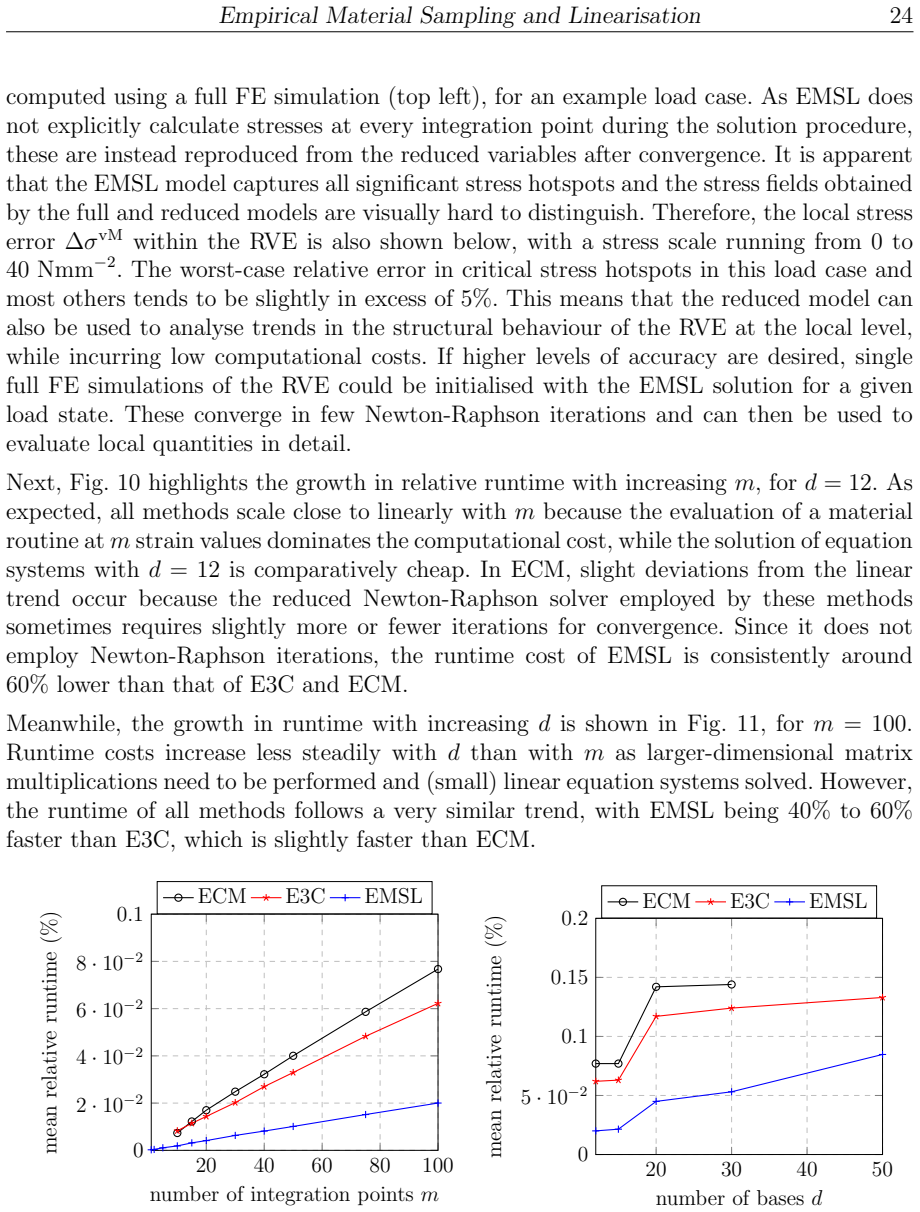
- On the tested porous RVE, EMSL achieves a better accuracy-runtime Pareto front than the E3C method and two other popular strain-space cubature schemes.
- The approach inherits an incremental variational structure from earlier strain-space MOR work, which helps preserve consistency between stress and tangent.
Where Pith is reading between the lines
- The same sampling-plus-linearisation pattern could be tested on other nonlinear constitutive laws, such as elastoplasticity or viscoelasticity, provided the deviation from the cluster mean stays moderate.
- Because the online cost is now independent of the number of material evaluations, the method opens a route to embedding RVEs inside topology optimization loops or real-time control without prohibitive expense.
- A natural extension would be to adapt the cluster definition or the expected-strain estimator dynamically during the simulation rather than fixing them from an initial POD basis.
- Hybrid schemes that switch between EMSL and full material evaluation in regions of high strain variation could further tighten the error bound without losing the overall speed gain.
Load-bearing premise
Sampling reference strains only once per load increment at empirically estimated expected values produces a linearisation whose error remains small enough across the entire material cluster even under large deformations where local strains can deviate substantially from the cluster mean.
What would settle it
A concrete counterexample would be a porous hyperelastic RVE under non-monotonic loading in which local strains within one or more clusters deviate far from the estimated mean, causing the linearised macroscopic stress response to diverge from the full-order solution by more than a chosen tolerance.
Figures



read the original abstract
In this article, we propose a simple and efficient hyperreduced strain-space model order reduction (MOR) approach for hyperelastic representative volume elements (RVEs), called Empirical Material Sampling and Linearisation (EMSL). The approach is conceptually motivated by the Empirically Corrected Cluster Cubature (E3C) of Wulfinghoff and Hauck [36], but also draws on ideas from previous work on incremental variational structure-preserving strain-space model order reduction techniques to achieve rapid evaluations in the online phase. As in E3C, we group the material domain into regions of similar behaviour, and query the material routine at one reference strain value per region. However, we sample these strains only once per load increment, at empirically estimated expected strain values. We use the reference material tangent and strain modes obtained via the Proper Orthogonal Decomposition (POD) to compute a linearised estimate of the stress response in the remainder of the material cluster. In contrast to E3C, which approximately integrates the exact material law, EMSL could therefore be said to exactly integrate an approximation of the material behaviour. The resulting reduced problem is affine in each load step, allowing for integration over the entire computational domain via operations which can readily be preprocessed in the offline phase. Since a linear equation system is obtained in each load increment, no Newton iterations are required in the online phase. For benchmark comparisons, we pose a variant of two popular reduced cubature schemes in strain space and recall the E3C algorithm proposed by Wulfinghoff et al. On an example hyperelastic RVE problem with a porous geometry, we show that EMSL Pareto-dominates competing strain-space approaches in terms of the tradeoff between accuracy and runtime.
Editorial analysis
A structured set of objections, weighed in public.
Referee Report
Summary. The paper proposes Empirical Material Sampling and Linearisation (EMSL), a strain-space model order reduction technique for hyperelastic RVEs in computational homogenization. Material points are clustered by similar behavior; per load increment, the exact material response and tangent are evaluated at one empirically estimated expected strain per cluster. POD modes are then used to linearly approximate the stress response over the remainder of each cluster, yielding an affine online problem that requires no Newton iterations. On a single porous hyperelastic RVE benchmark, EMSL is reported to Pareto-dominate two variants of reduced cubature schemes and the E3C method in the accuracy-runtime tradeoff.
Significance. If the linearisation error can be shown to remain controlled under large-deformation conditions with high intra-cluster strain variance, EMSL would supply a lightweight, iteration-free online phase that could accelerate multiscale simulations. The method re-uses standard POD and tangent information already present in the literature and avoids additional nonlinear solves per increment, which is a practical advantage. However, the current evidence consists of a single empirical comparison without quantitative error norms, convergence data, or error bounds, so the significance remains conditional on further validation.
major comments (3)
- [Numerical results / benchmark comparison] Numerical results section: the Pareto-dominance claim is asserted without any reported quantitative error measures (e.g., relative L2 error in macroscopic stress or local strain fields), without specifying how the expected strain per cluster is estimated from the current load increment, and without error bars or repeated-run statistics. These omissions make it impossible to assess whether the observed runtime gain is achieved at an acceptable accuracy level.
- [EMSL formulation / linearisation step] Method description and § on linearisation: the central approximation replaces the exact nonlinear material law inside each cluster by a first-order Taylor expansion around a single per-increment expected strain. No a-priori residual estimate, sensitivity analysis with respect to intra-cluster strain variance, or numerical study of deviation from the cluster mean (especially near pores under large deformation) is supplied. This directly affects the validity of the affine online problem and the claimed accuracy-runtime tradeoff.
- [Benchmark comparisons] Comparison protocol: the manuscript introduces “a variant of two popular reduced cubature schemes” and recalls E3C, yet provides insufficient detail on the precise implementation, hyper-reduction parameters, number of POD modes, and runtime measurement methodology used for the competing methods. Without these, the fairness of the Pareto-dominance statement cannot be verified.
minor comments (2)
- [Abstract] The abstract states that EMSL “exactly integrates an approximation of the material behaviour,” but the precise meaning of this statement (integration over the cluster versus point-wise linearisation) is not clarified until later; a short clarifying sentence would help readers.
- [Method overview] Notation for the expected strain estimator and the POD projection operators is introduced without an explicit equation reference in the early sections; adding equation numbers at first use would improve readability.
Simulated Author's Rebuttal
We thank the referee for the constructive and detailed review. The comments correctly identify areas where additional quantitative data, clarification of the approximation, and implementation details would strengthen the manuscript. We address each major comment below and will incorporate revisions to improve clarity and verifiability while preserving the empirical nature of the proposed EMSL approach.
read point-by-point responses
-
Referee: Numerical results section: the Pareto-dominance claim is asserted without any reported quantitative error measures (e.g., relative L2 error in macroscopic stress or local strain fields), without specifying how the expected strain per cluster is estimated from the current load increment, and without error bars or repeated-run statistics. These omissions make it impossible to assess whether the observed runtime gain is achieved at an acceptable accuracy level.
Authors: We agree that tabulated quantitative error norms would enhance the presentation. The Pareto-dominance is currently shown via comparative plots of error versus runtime in the numerical results section, but explicit relative L2 errors for macroscopic stress and local strain fields were not listed in a table. We will add such a table in the revised manuscript, reporting errors for representative load increments and different numbers of clusters/modes. The expected strain per cluster is estimated once per increment as the volume-weighted average of the POD-reconstructed strain field from the previous increment (detailed in Section 3.3); we will expand this with a pseudocode listing and explicit formulas. Because the method is deterministic for fixed meshes and load paths, repeated-run statistics are not applicable, but we will add a brief discussion of sensitivity to clustering parameters and initial strain guesses. These changes will allow direct assessment of the accuracy-runtime tradeoff. revision: yes
-
Referee: Method description and § on linearisation: the central approximation replaces the exact nonlinear material law inside each cluster by a first-order Taylor expansion around a single per-increment expected strain. No a-priori residual estimate, sensitivity analysis with respect to intra-cluster strain variance, or numerical study of deviation from the cluster mean (especially near pores under large deformation) is supplied. This directly affects the validity of the affine online problem and the claimed accuracy-runtime tradeoff.
Authors: The referee accurately notes that EMSL employs a first-order Taylor expansion of the stress around the reference strain per cluster, leading to an affine online system. The manuscript presents the derivation in Section 3.4 but does not include a dedicated error analysis. We will add a new subsection to the numerical results that performs a post-hoc numerical study of the linearisation error: for the porous RVE benchmark, we will compute and plot the pointwise deviation between the exact stress and the linearised estimate as a function of intra-cluster strain variance, with particular attention to regions near pores under large deformation. This will be obtained by comparing against full-order solutions at selected increments. While a general a-priori residual estimate is difficult for nonlinear hyperelasticity without additional assumptions, the added numerical evidence will quantify when the approximation remains accurate for the clustering employed. We believe this supports the validity of the affine online phase for the reported benchmarks. revision: yes
-
Referee: Comparison protocol: the manuscript introduces “a variant of two popular reduced cubature schemes” and recalls E3C, yet provides insufficient detail on the precise implementation, hyper-reduction parameters, number of POD modes, and runtime measurement methodology used for the competing methods. Without these, the fairness of the Pareto-dominance statement cannot be verified.
Authors: We acknowledge that more implementation specifics are required for reproducibility and to substantiate the comparison. In the revised manuscript we will expand the benchmark section with a dedicated table that lists, for each competing method: the exact variant of reduced cubature implemented (including any strain-space adaptations), the hyper-reduction parameters (number of cubature points or clusters), the number of POD modes retained, and the runtime measurement protocol (hardware, timing of online phase only, and exclusion of offline costs). We will also clarify how the E3C reference implementation was reproduced. These additions will enable independent verification of the Pareto-dominance claim on the porous hyperelastic RVE. revision: yes
- Providing a rigorous a-priori (theoretical) residual estimate or error bound for the linearisation error that holds for arbitrary large-deformation hyperelasticity and high intra-cluster strain variance, as the EMSL approach is fundamentally empirical and relies on numerical validation rather than analytical bounds.
Circularity Check
Minor self-citation to prior MOR techniques; central performance claim empirically validated on external benchmark
full rationale
The paper proposes EMSL by combining standard POD for strain modes, material tangents evaluated at empirically chosen reference strains per cluster, and clustering ideas drawn from the cited E3C method of Wulfinghoff and Hauck. The resulting affine online problem (no Newton iterations) follows directly from the explicit linearisation modeling choice rather than any first-principles derivation. The Pareto-dominance claim rests on numerical runtime-accuracy comparisons against competing cubature schemes on a specific porous RVE example, supplying independent empirical evidence. Any references to the authors' prior incremental variational strain-space MOR work are supplementary and not invoked to prove uniqueness or to close a self-referential loop; the method is presented as an approximation whose error behavior is assessed externally rather than by construction.
Axiom & Free-Parameter Ledger
free parameters (2)
- number of material clusters
- number of POD modes
axioms (2)
- domain assumption Local strain variation within each cluster is small enough for a first-order Taylor expansion around the reference strain to remain accurate throughout the load increment.
- ad hoc to paper An empirically estimated expected strain per cluster can be obtained reliably from the current load increment without additional nonlinear solves.
Reference graph
Works this paper leans on
-
[1]
Steven S An, Theodore Kim, and Doug L James. Optimizing cubature for efficient integration of subspace deformations.ACM transactions on graphics (TOG), 27(5): 1–10, 2008. doi: 10.1145/1409060.1409118
-
[2]
Maxime Barrault, Yvon Maday, Ngoc Cuong Nguyen, and Anthony T. Patera. An ‘empirical interpolation’ method: application to efficient reduced-basis discretization of partial differential equations.Comptes Rendus Mathematique, 339(9):667–672,
-
[3]
ISSN 1631-073X. doi: 10.1016/j.crma.2004.08.006
-
[4]
Mohamed Amine Benaimeche, Julien Yvonnet, Benoit Bary, and Qi-Chang He. A k-means clustering machine learning-based multiscale method for anelastic heteroge- neous structures with internal variables.International Journal for Numerical Meth- ods in Engineering, 123(9):2012–2041, May 2022. ISSN 0029-5981, 1097-0207. doi: 10.1002/nme.6925
-
[5]
Thomas Daniel, Fabien Casenave, Nissrine Akkari, and David Ryckelynck. Model order reduction assisted by deep neural networks (ROM-net).Advanced Modeling and Simulation in Engineering Sciences, 7(1):16, December 2020. ISSN 2213-7467. doi: 10.1186/s40323-020-00153-6
-
[6]
Thomas Daniel, Fabien Casenave, Nissrine Akkari, Ali Ketata, and David Ryck- elynck. Physics-informed cluster analysis and a priori efficiency criterion for the construction of local reduced-order bases.Journal of Computational Physics, 458: 111120, June 2022. ISSN 00219991. doi: 10.1016/j.jcp.2022.111120
-
[7]
Algorithm 832: Umfpack v4
Timothy A Davis. Algorithm 832: Umfpack v4. 3—an unsymmetric-pattern mul- tifrontal method.ACM Transactions on Mathematical Software (TOMS), 30(2): 196–199, 2004. Empirical Material Sampling and Linearisation28
2004
-
[8]
Charbel Farhat, Philip Avery, Todd Chapman, and Julien Cortial. Dimensional re- duction of nonlinear finite element dynamic models with finite rotations and energy- based mesh sampling and weighting for computational efficiency.International Jour- nal for Numerical Methods in Engineering, 98(9):625–662, June 2014. ISSN 0029- 5981, 1097-0207. doi: 10.1002/nme.4668
-
[9]
Erik Faust and Lisa Scheunemann. A hyperreduced manifold learning approach to nonlinear model order reduction for the homogenisation of hyperelastic rves.arXiv preprint arXiv:2508.21527, 2025
-
[10]
Erik Faust and Lisa Scheunemann. Nonlinear model order reduction on polyno- mial manifolds for computational homogenisation problems.Proceedings in Applied Mathematics and Mechanics, 26(2):e70096, 2026. doi: 10.1002/pamm.70096
-
[11]
Felix Fritzen and Matthias Leuschner. Reduced basis hybrid computational homog- enization based on a mixed incremental formulation.Computer Methods in Ap- plied Mechanics and Engineering, 260:143–154, June 2013. ISSN 00457825. doi: 10.1016/j.cma.2013.03.007
-
[12]
Christophe Geuzaine and Jean-Fran¸ cois Remacle. Gmsh: A 3-D finite element mesh generator with built-in pre- and post-processing facilities.International Journal for Numerical Methods in Engineering, 79(11):1309–1331, 2009. ISSN 1097-0207. doi: 10.1002/nme.2579
-
[13]
JA Hern´ andez. A multiscale method for periodic structures using domain decompo- sition and ecm-hyperreduction.Computer Methods in Applied Mechanics and Engi- neering, 368:113192, 2020. doi: 10.1016/j.cma.2020.113192
-
[14]
J.A. Hern´ andez, M.A. Caicedo, and A. Ferrer. Dimensional hyper-reduction of nonlinear finite element models via empirical cubature.Computer Methods in Ap- plied Mechanics and Engineering, 313:687–722, January 2017. ISSN 00457825. doi: 10.1016/j.cma.2016.10.022
-
[15]
JA Hern´ andez, JR Bravo, and S Ares de Parga. Cecm: A continuous empirical cu- bature method with application to the dimensional hyperreduction of parameterized finite element models.Computer Methods in Applied Mechanics and Engineering, 418:116552, 2024. doi: 10.1016/j.cma.2023.116552
-
[16]
Gerhard A. Holzapfel. Nonlinear Solid Mechanics: A Continuum Approach for En- gineering Science.Meccanica, 37(4):489–490, July 2002. ISSN 1572-9648. doi: 10.1023/A:1020843529530
-
[17]
Axel Klawonn, Stephan K¨ ohler, Martin Lanser, and Oliver Rheinbach. Compu- tational homogenization with million-way parallelism using domain decomposition methods.Computational Mechanics, 65(1):1–22, January 2020. ISSN 0178-7675, 1432-0924. doi: 10.1007/s00466-019-01749-5
-
[18]
On the computation of the exact overall consistent tangent moduli for non- linear finite strain homogenization problems using six finite perturbations
Julian Kochmann, Tim Brepols, Stephan Wulfinghoff, Bob Svendsen, and Stefanie Reese. On the computation of the exact overall consistent tangent moduli for non- linear finite strain homogenization problems using six finite perturbations. InPro- ceedings of the 6th European Conference on Computational Mechanics (ECCM6) and Erik Faust & Lisa Scheunemann29 7t...
1938
-
[19]
Oliver Kunc and Felix Fritzen. Finite Strain Homogenization Using a Reduced Basis and Efficient Sampling.Mathematical and Computational Applications, 24(2):56, May 2019. ISSN 2297-8747. doi: 10.3390/mca24020056
-
[20]
Nils Lange, Geralf H¨ utter, and Bjoern Kiefer. A monolithic hyper ROM FE2 method with clustered training at finite deformations.Computer Methods in Ap- plied Mechanics and Engineering, 418:116522, January 2024. ISSN 00457825. doi: 10.1016/j.cma.2023.116522
-
[21]
Zeliang Liu, M.A. Bessa, and Wing Kam Liu. Self-consistent clustering analysis: An efficient multi-scale scheme for inelastic heterogeneous materials.Computer Methods in Applied Mechanics and Engineering, 306:319–341, July 2016. ISSN 00457825. doi: 10.1016/j.cma.2016.04.004
-
[22]
J.C. Michel and P. Suquet. Nonuniform transformation field analysis.International Journal of Solids and Structures, 40(25):6937–6955, December 2003. ISSN 00207683. doi: 10.1016/S0020-7683(03)00346-9
-
[23]
Jean-Claude Michel and Pierre Suquet. A model-reduction approach in micromechan- ics of materials preserving the variational structure of constitutive relations.Journal of the Mechanics and Physics of Solids, 90:254–285, May 2016. ISSN 00225096. doi: 10.1016/j.jmps.2016.02.005
-
[24]
Aslan Nasirov and Caglar Oskay. Surrogate-enhanced higher order eigenstrain-based reduced order homogenization for polycrystal plasticity.Computer Methods in Ap- plied Mechanics and Engineering, 452:118772, 2026. doi: 10.1016/j.cma.2026.118772
-
[25]
Karl Pearson. LIII.On lines and planes of closest fit to systems of points in space.The London, Edinburgh, and Dublin Philosophical Magazine and Jour- nal of Science, 2(11):559–572, November 1901. ISSN 1941-5982, 1941-5990. doi: 10.1080/14786440109462720
-
[26]
Benjamin Peherstorfer. Breaking the Kolmogorov Barrier with Nonlinear Model Reduction.Notices of the American Mathematical Society, 69(05):1, May 2022. ISSN 0002-9920, 1088-9477. doi: 10.1090/noti2475
-
[27]
Marcelo Raschi, Oriol Lloberas-Valls, Alfredo Huespe, and Javier Oliver. High per- formance reduction technique for multiscale finite element modeling (HPR-FE2): Towards industrial multiscale FE software.Computer Methods in Applied Mechanics and Engineering, 375:113580, March 2021. ISSN 00457825. doi: 10.1016/j.cma.2020. 113580
-
[28]
Hongshi Ruan, Xiaozhe Ju, Junjun Chen, Lihua Liang, and Yangjian Xu. A clustering-enhanced potential-based reduced order homogenization framework for nonlinear heterogeneous materials.European Journal of Mechanics - A/Solids, 103: 105190, 2024. ISSN 0997-7538. doi: 10.1016/j.euromechsol.2023.105190. Empirical Material Sampling and Linearisation30
-
[29]
Aspects of Computational Homoge- nization at Finite Deformations: A Unifying Review From Reuss’ to Voigt’s Bound
Saba Saeb, Paul Steinmann, and Ali Javili. Aspects of Computational Homoge- nization at Finite Deformations: A Unifying Review From Reuss’ to Voigt’s Bound. Applied Mechanics Reviews, 68(5):050801, September 2016. ISSN 0003-6900, 2379-
2016
-
[30]
doi: 10.1115/1.4034024
-
[31]
Mechanics of Materials159, 103918 (2021) https://doi.org/10.1016/j.mechmat
L. Scheunemann, D. Balzani, D. Brands, and J. Schr¨ oder. Design of 3D statistically similar Representative Volume Elements based on Minkowski functionals.Mechanics of Materials, 90:185–201, November 2015. ISSN 01676636. doi: 10.1016/j.mechmat. 2015.03.005
-
[32]
Lisa Scheunemann and Erik Faust. A manifold learning approach to nonlinear model order reduction of quasi-static problems in solid mechanics: proof of concept and parameter study.Computational Mechanics, pages 983–1023, 2025. doi: 10.1007/ s00466-025-02696-0
2025
-
[33]
Habilitation, Universit¨ at Stuffgart, 2000
J¨ org Schr¨ oder.Homogenisierungsmethoden Der Nichtlinearen Kontinuumsmechanik Unter Beachtung von Stabilit¨ atsproblemen. Habilitation, Universit¨ at Stuffgart, 2000
2000
-
[34]
A Numerical Two-Scale Homogenization Scheme: The FE2-Method
J¨ org Schr¨ oder. A Numerical Two-Scale Homogenization Scheme: The FE2-Method. InPlasticity and beyond: Microstructures, Crystal-Plasticity and Phase Transitions, number Vol. 550 in Courses and Lectures, pages 1–64. Springer, Wien, 2014. ISBN 978-3-7091-1624-1
2014
-
[35]
Springer-Verlag, 2001
Peter Wriggers.Nichtlineare Finite-Element-Methoden. Springer-Verlag, 2001. ISBN 978-3-642-56865-7
2001
-
[36]
Stephan Wulfinghoff. Homogenization in hyperelasticity using empirically corrected cluster cubature (e3c) hyper-reduction.Computer Methods in Applied Mechanics and Engineering, 444:118137, 2025. ISSN 0045-7825. doi: 10.1016/j.cma.2025.118137
-
[37]
Stephan Wulfinghoff. Empirically corrected cluster cubature (e3c).Computer Meth- ods in Applied Mechanics and Engineering, 437:117779, 2025. doi: 10.1016/j.cma. 2025.117779
-
[38]
Stephan Wulfinghoff and Jan Hauck. E3c hyper-reduction for computational homog- enization in nonlinear mechanics.Computational Mechanics, 76(6):1563–1572, 2025. doi: 10.1007/s00466-025-02662-w
-
[39]
E3C for Computational Homogenization in Nonlinear Mechanics, January 2025
Stephan Wulfinghoff and Jan Hauck. E3C for Computational Homogenization in Nonlinear Mechanics, January 2025
2025
-
[40]
Stephan Wulfinghoff, Fabiola Cavaliere, and Stefanie Reese. Model order reduction of nonlinear homogenization problems using a Hashin–Shtrikman type finite element method.Computer Methods in Applied Mechanics and Engineering, 330:149–179, March 2018. ISSN 00457825. doi: 10.1016/j.cma.2017.10.019
-
[41]
Cheng Yu, Orion L. Kafka, and Wing Kam Liu. Self-consistent clustering analysis for multiscale modeling at finite strains.Computer Methods in Applied Mechanics and Engineering, 349:339–359, 2019. ISSN 0045-7825. doi: 10.1016/j.cma.2019.02.027. Erik Faust & Lisa Scheunemann31 A Algorithmic tangent To derive the algorithmic macroscopic tangent modulus, we r...
discussion (0)
Sign in with ORCID, Apple, or X to comment. Anyone can read and Pith papers without signing in.