Recognition: unknown
Dynamical delocalization in disordered 2D Chern insulators
Pith reviewed 2026-05-07 09:38 UTC · model grok-4.3
The pith
Topological jumps in the Chern character ensure dynamical delocalization at certain energies in disordered 2D Chern insulators
A machine-rendered reading of the paper's core claim, the machinery that carries it, and where it could break.
Core claim
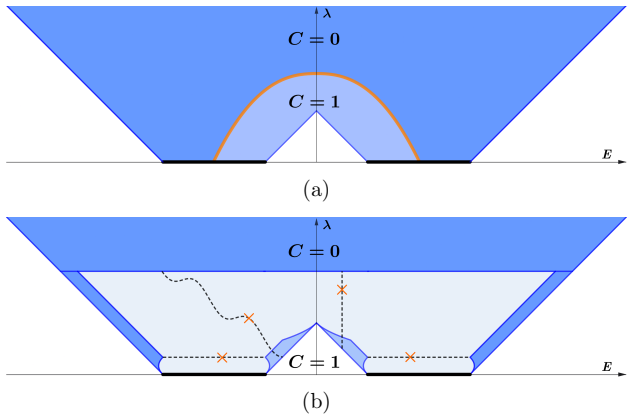
We show the existence of energies exhibiting dynamical delocalization in discrete 2D Chern insulators perturbed by a random potential in a general setting. Our proof exploits two main features of the model: jumps in the integer value of the Chern character and continuity of averaged spectral projections in both energy and disorder parameters. This allows us to show robustness of the topological index in the presence of disorder, which, combined with existing methods to prove dynamical localization, allows us to provide detailed information on the phase diagram of the model. The novelty of our approach is that we are able to show dynamical delocalization in the disorder parameter, and notonly
What carries the argument
Jumps in the integer Chern character combined with continuity of averaged spectral projections in energy and disorder parameters, which together establish robustness of the topological index against disorder
If this is right
- The topological index remains stable under addition of random potentials
- Dynamical delocalization occurs at specific energies despite the presence of disorder
- The phase diagram contains Anderson metal-insulator transitions that survive the closing of spectral gaps
- Delocalization can be established by fixing energy and varying disorder strength
Where Pith is reading between the lines
- The same combination of index jumps and continuous projections could be checked in higher-dimensional topological insulators or in models with different symmetries
- Finite-size numerical diagonalization of concrete Chern insulator lattices with tunable disorder would locate the predicted delocalized energies
- The result suggests that topological protection of transport may survive in real materials with impurities even when bulk gaps disappear
Load-bearing premise
Averaged spectral projections vary continuously with both energy and disorder strength while the Chern character jumps by integers
What would settle it
A concrete lattice computation or simulation in which the time-averaged mean-square displacement remains bounded at every energy and every disorder strength, including across points where the Chern number changes
Figures


read the original abstract
We show the existence of energies exhibiting dynamical delocalization in discrete 2D Chern insulators perturbed by a random potential in a general setting. Our proof exploits two main features of the model: jumps in the integer value of the Chern character and continuity of averaged spectral projections in both energy and disorder parameters. This allows us to show robustness of the topological index in the presence of disorder, which, combined with existing methods to prove dynamical localization, allows us to provide detailed information on the phase diagram of the model. The novelty of our approach is that we are able to show dynamical delocalization in the disorder parameter, and not only in the energy parameter, which allows to prove Anderson metal-insulator transition even when spectral gaps close due to the strength of disorder.
Editorial analysis
A structured set of objections, weighed in public.
Referee Report
Summary. The manuscript proves the existence of energies with dynamical delocalization in discrete 2D Chern insulators subject to random potential perturbations in a general setting. The argument combines jumps in the integer Chern character with continuity of averaged spectral projections in both energy and disorder parameters to establish robustness of the topological index under disorder; this is then paired with existing dynamical localization techniques to map the phase diagram, including Anderson metal-insulator transitions even when spectral gaps close with increasing disorder strength. The novelty lies in obtaining delocalization directly in the disorder parameter rather than only in energy.
Significance. If the continuity of averaged projections holds rigorously, the result supplies a general, parameter-free route to dynamical delocalization in topological insulators that remains valid when disorder closes gaps. It strengthens the link between topological indices and localization/delocalization transitions without ad-hoc assumptions or fitted parameters, and yields concrete, falsifiable information on the phase diagram of disordered Chern insulators.
minor comments (3)
- [§2] The model Hamiltonian and the precise definition of the unperturbed Chern insulator (lattice, hopping terms, and flux) should be stated explicitly in §2 to make the setting self-contained for readers unfamiliar with the discrete model.
- [§3] In the continuity argument for averaged spectral projections (likely §3 or §4), add a brief remark on the norm or trace-class estimates used when the gap closes, even if the details are standard; this would clarify the range of disorder strengths for which the argument applies.
- The references to prior localization results (e.g., the specific theorems on dynamical localization invoked in the phase-diagram analysis) should be cited with equation or theorem numbers for precision.
Simulated Author's Rebuttal
We thank the referee for the positive report, accurate summary of our results, and recommendation for minor revision. The assessment correctly highlights the novelty of proving dynamical delocalization in the disorder parameter and the resulting ability to establish Anderson transitions even when spectral gaps close. No specific major comments were raised in the report.
Circularity Check
Minor self-citation of localization methods; central derivation remains independent
full rationale
The derivation proceeds from jumps in the integer Chern character combined with continuity of averaged spectral projections (in both energy and disorder) to establish robustness of the topological index, then pairs this with existing localization techniques to locate dynamical delocalization. No equation or claim reduces by construction to a fitted parameter, self-definition, or unverified self-citation chain; the continuity statement and localization results are treated as independent inputs whose technical development lies outside the present argument. This matches the expected pattern of a non-circular paper that invokes standard topological and localization tools.
Axiom & Free-Parameter Ledger
axioms (2)
- domain assumption Jumps in the integer value of the Chern character
- domain assumption Continuity of averaged spectral projections in energy and disorder parameters
Reference graph
Works this paper leans on
-
[1]
: Localization at weak disorder: Some elementary bounds
Aizenman, M. : Localization at weak disorder: Some elementary bounds. Rev. Math. Phys. 6 , 1163-1182 (1994)
1994
-
[2]
: Moment analysis for localization in random Schr\" o dinger operators
Aizenman, M.; Elgart, A.; Naboko, S.; Schenker, J.; Stolz G. : Moment analysis for localization in random Schr\" o dinger operators. Invent. math. 163 , 343–413 (2006)
2006
-
[3]
: Localization bounds for an electron gas, J
Aizenman, M.; Graf, G.M. : Localization bounds for an electron gas, J. Phys. A: Math. Gen. 31 , 6783–6806 (1998)
1998
-
[4]
: Localization at large disorder and at extreme energies: An elementary derivation
Aizenman, A.; Molchanov, S.A. : Localization at large disorder and at extreme energies: An elementary derivation. Commun. Math. Phys. 157, 245–278 (1993)
1993
-
[5]
: Finite-volume fractional-moment criteria for Anderson localization
Aizenman, M.; Schenker, J.H.; Friedrich, R.M.; Hundertmark, D. : Finite-volume fractional-moment criteria for Anderson localization. Commun. Math. Phys. 224, No.1, 219-253 (2001)
2001
-
[6]
: Random Operators: Disorder Effects on Quantum Spectra and Dynamics
Aizenman, M.; Warzel, S. : Random Operators: Disorder Effects on Quantum Spectra and Dynamics. Graduate Studies in Mathematics, AMS (2016)
2016
-
[7]
: Absence of diffusion in certain random lattices
Anderson, P.W. : Absence of diffusion in certain random lattices. Phys. Rev. 109 , 1492-1505 (1958)
1958
-
[8]
: Charge deficiency, charge transport and comparison of dimensions
Avron, J.E.; Seiler, R.; Simon, B. : Charge deficiency, charge transport and comparison of dimensions. Commun. Math. Phys. 159, 399-422 (1994)
1994
-
[9]
: Density of states and delocalization for discrete magnetic random Schr\" o dinger operators
Becker, S.; Han, R. : Density of states and delocalization for discrete magnetic random Schr\" o dinger operators. Int. Math. Res. Not. 17 , 13447–13504 (2022)
2022
-
[10]
: Magic angle (in)stability and mobility edges in disordered Chern insulators
Becker, S.; Oltman, I.; Vogel, M. : Magic angle (in)stability and mobility edges in disordered Chern insulators. J. Phys. A: Math. Theor. 58 , 365302 (2025)
2025
-
[11]
: Ordinary quantum Hall effect and non-commutative cohomology
Bellissard, J. : Ordinary quantum Hall effect and non-commutative cohomology. In: Localization in disordered systems . Weller, W., Zieche, P. (eds.), Teubner-Texte Phys. 16 , Teubner, Leipzig, pp. 61-74 (1986)
1986
-
[12]
: The noncommutative geometry of the quantum Hall effect
Bellissard, J.; van Elst, A.; Schulz-Baldes, H. : The noncommutative geometry of the quantum Hall effect. J. Math. Phys. 35, 5373-5451 (1994)
1994
-
[13]
: Topological Insulators and Topological Superconductors, Princeton University Press (2013)
Bernevig, B.A.; Hughes, T.L. : Topological Insulators and Topological Superconductors, Princeton University Press (2013)
2013
-
[14]
: Linear response theory for magnetic Schr\" o dinger operators in disordered media
Bouclet, J.; Germinet, F.; Klein, A.; Schenker, J. : Linear response theory for magnetic Schr\" o dinger operators in disordered media. J. Func. Anal. 226 , 301–372 (2005)
2005
-
[15]
o dinger Operators, Springer series in statistics: Probability and its applications, Birkh\
Carmona, R.; Lacroix, J. : Spectral Theory of Random Schr\" o dinger Operators, Springer series in statistics: Probability and its applications, Birkh\" a user Boston (1990)
1990
-
[16]
: Edge and impurity effects on quantization of Hall currents
Combes, J.M.; Germinet, F. : Edge and impurity effects on quantization of Hall currents. Commun. Math. Phys. 256 , 159–180 (2005)
2005
-
[17]
Combes, J.M.; Hislop, P.D.; Klopp. F. : H\" o lder continuity of the integrated density of states for some random operators at all energies. Int. Math. Res. Not. 2003 , 179-209 (2003)
2003
-
[18]
: Spectral Theory and Differential Operators
Davies, E.B. : Spectral Theory and Differential Operators. Cambridge University Press (1995)
1995
-
[19]
: Localization and Chern numbers for weakly disordered BdG operators
De Nittis G.; Drabkin M.; Schulz-Baldes H. : Localization and Chern numbers for weakly disordered BdG operators. Markov Processes. Relat. Fields 21 , 463-482 (2015)
2015
-
[20]
: Remark on the continuity of the density of states of ergodic finite difference operators
Delyon, D.; Souillard, B. : Remark on the continuity of the density of states of ergodic finite difference operators. Commun. Math. Phys. 94 , 289-291 (1984)
1984
-
[21]
: Lifshitz tails and localization in the three-dimensional Anderson model
Elgart, A. : Lifshitz tails and localization in the three-dimensional Anderson model. Duke Math. J. 146 (2), 331-360 (2009)
2009
-
[22]
: Equality of the bulk and edge Hall conductances in a mobility gap
Elgart, A.; Graf, G.; Schenker, J. : Equality of the bulk and edge Hall conductances in a mobility gap. Commun. Math. Phys. 259 , 185–221 (2005)
2005
-
[23]
: Anderson localization for a class of models with a sign-indefinite single-site potential via fractional moment method
Elgart, A.; Tautenhahn, M.; Veselić, I. : Anderson localization for a class of models with a sign-indefinite single-site potential via fractional moment method. Ann. Henri Poincaré 12 , 1571–1599 (2011)
2011
-
[24]
: Localization phenomenon in gaps of the spectrum of random lattice operators
Figotin, A.; Klein, A. : Localization phenomenon in gaps of the spectrum of random lattice operators. J. Stat. Phys. 75 , 997–1021 (1994)
1994
-
[25]
: Localization of classical waves I: Acoustic waves
Figotin, A.; Klein, A. : Localization of classical waves I: Acoustic waves. Commun.Math. Phys. 180 , 439–482 (1996)
1996
-
[26]
: Absence of diffusion with Anderson tight binding model for large disorder or low energy
Fr\" o hlich, J.; Spencer, T. : Absence of diffusion with Anderson tight binding model for large disorder or low energy. Commun. Math. Phys. 88 , 151–184 (1983)
1983
-
[27]
: Bootstrap multiscale analysis and localization in random media
Germinet, F.; Klein, A. : Bootstrap multiscale analysis and localization in random media. Commun. Math. Phys. 222 , 415–448 (2001)
2001
-
[28]
: A characterization of the Anderson metal-insulator transport transition
Germinet, F.; Klein, A. : A characterization of the Anderson metal-insulator transport transition. Duke Math. J. 124 , 309–351 (2004)
2004
-
[29]
: New characterizations of the region of complete localization for random Schr\" o dinger operators
Germinet, F.; Klein, A. : New characterizations of the region of complete localization for random Schr\" o dinger operators. J. Stat. Phys. 122 , 73-94 (2005)
2005
-
[30]
: Dynamical delocalization in random Landau Hamiltonians
Germinet, F.; Klein, A.; Schenker, J. : Dynamical delocalization in random Landau Hamiltonians. Ann. Math. 166, 215–244 (2007)
2007
-
[31]
: Quantization of the Hall conductance and delocalization in ergodic Landau Hamiltonians
Germinet, F.; Klein, A.; Schenker, J. : Quantization of the Hall conductance and delocalization in ergodic Landau Hamiltonians. Rev. Math. Phys. 21 , 1045-1080 (2009)
2009
-
[32]
: Aspects of the integer quantum Hall effect
Graf, G.M. : Aspects of the integer quantum Hall effect. Proceedings of symposia in pure mathematics, spectral theory, and mathematical physics: a Festschrift in honor of Barry Simon’s 60th birthday , 429-442, Proc. Sympos. Pure Math. 76 , Part 1, Amer. Math. Soc. (2007)
2007
-
[33]
parity anomaly
Haldane, F.D.M. : Model for a quantum Hall effect without Landau levels: condensed-matter realization of the “parity anomaly”. Phys. Rev. Lett. 61 , 2017 (1988)
2017
-
[34]
: Colloquium: Topological insulators
Hasan, M.Z.; Kane, C.L. : Colloquium: Topological insulators. Rev. Mod Phys. 82, 3045 (2010)
2010
-
[35]
: Continuity with respect to disorder of the integrated density of states
Hislop, P.; Klopp, F.; Schenker, J. : Continuity with respect to disorder of the integrated density of states. Illinois J. Math. 49 , 893-904 (2005)
2005
-
[36]
: Perturbation Theory for Linear Operators, 2nd edition
Kato, T. : Perturbation Theory for Linear Operators, 2nd edition. Springer, Berlin (1995)
1995
-
[37]
: Edge current channels and Chern numbers in the integer quantum Hall effect
Kellendonk, J.; Richter, T.; Schulz-Baldes, H. : Edge current channels and Chern numbers in the integer quantum Hall effect. Rev. Math. Phys. 14 , 87–119 (2002)
2002
-
[38]
: Boundary maps for C*-crossed products with an application to the quantum Hall effect
Kellendonk, J.; Schulz-Baldes, H. : Boundary maps for C*-crossed products with an application to the quantum Hall effect. Commun. Math. Phys. 249 , 611-637 (2004)
2004
-
[39]
o dinger operators. In: Random Schr\
Kirsch, W. : An invitation to random Schr\" o dinger operators. In: Random Schr\" o dinger operator , Disertori, M., Kirsch, W., Klein, A., Klopp, F., Rivasseau V. (eds.), Panoramas et Synthèses 25 , Soc. Math. France, Paris, pp. 1–119 (2008)
2008
-
[40]
: Periodic table for topological insulators and superconductors
Kitaev, A. : Periodic table for topological insulators and superconductors. AIP Conf. Proc. 1134 , 22-30 (2009)
2009
-
[41]
: Continuity of integrated density of states — independent randomness
Krishna, M. : Continuity of integrated density of states — independent randomness. Proc. Math. Sci. 117 , 401–410 (2007)
2007
-
[42]
: The Haldane model and its localization dichotomy
Marcelli, G.; Monaco, D.; Moscolari, M.; Panati, G. : The Haldane model and its localization dichotomy. Rend. Mat. Appl. 39 , 307–327 (2018)
2018
-
[43]
Localization of generalized Wannier bases implies Chern triviality in non-periodic insulators
Marcelli, G., Moscolari, M., Panati, G. : Localization of generalized Wannier bases implies Chern triviality in non-periodic insulators. Ann. Henri Poincaré 24 , 895– 930 (2023). Revised version of: Localization implies Chern triviality in non-periodic insulators, arXiv:2012.14407 (2020)
work page internal anchor Pith review arXiv 2023
-
[44]
: Low energy bands do not contribute to quantum Hall effect
Nakamura, S., Bellissard, J. : Low energy bands do not contribute to quantum Hall effect. Commun. Math. Phys. 131 (2), 283 – 305 (1990)
1990
-
[45]
: Triviality of Bloch and Bloch-Dirac bundles
Panati, G. : Triviality of Bloch and Bloch-Dirac bundles. Ann. Henri Poincar\'e 8 , 995--1011 (2007)
2007
-
[46]
: Topology and transport in Chern insulators: a note on consistency problems
Panati, G.; Rossi, V. : Topology and transport in Chern insulators: a note on consistency problems. In preparation
-
[47]
: Spectral properties of disordered systems in one-body approximation
Pastur, L. : Spectral properties of disordered systems in one-body approximation. Commun. Math. Phys. 75 , 179-196 (1980)
1980
-
[48]
: Spectra of Random and Almost-Periodic Operators
Pastur, L.; Figotin, A. : Spectra of Random and Almost-Periodic Operators. Springer, Berlin (1992)
1992
-
[49]
: Bulk and Boundary Invariants for Complex Topological Insulators: From K -Theory to Physics
Prodan, E.; Schulz-Baldes H. : Bulk and Boundary Invariants for Complex Topological Insulators: From K -Theory to Physics. Mathematical Physics Studies, Springer, Berlin (2016)
2016
-
[50]
: Topological insulators and superconductors
Qi, X.L.; Zhang, S.C. : Topological insulators and superconductors. Rev. Mod. Phys. 83, 1057 (2011)
2011
-
[51]
: Homotopy arguments for quantized Hall conductivity
Richter, T.; Schulz-Baldes, H. : Homotopy arguments for quantized Hall conductivity. J. Math. Phys. 42 , 3439-3444 (2001)
2001
-
[52]
: H\" o lder equicontinuity of the integrated density of states at weak disorder
Schenker, J. : H\" o lder equicontinuity of the integrated density of states at weak disorder. Lett. Math. Phys. 70 , 195–209 (2004)
2004
-
[53]
: Equality of bulk and edge Hall conductances for continuous magnetic random Schrödinger operators
Taarabt, A. : Equality of bulk and edge Hall conductances for continuous magnetic random Schrödinger operators. Preprint arXiv:1403.7767 (2014)
-
[54]
: Localization and quantum Hall effect in a two-dimensional periodic potential
Tan, Y. : Localization and quantum Hall effect in a two-dimensional periodic potential. J. Phys. Condens. Matter 6 , 7941–7954 (1994)
1994
-
[55]
: Quantized Hall conductance in a two-dimensional periodic potential
Thouless, D.J.; Kohmoto, M.; Nightingale, M.P.; de Nijs, M. : Quantized Hall conductance in a two-dimensional periodic potential. Phys. Rev. Lett. 49 , 405–408 (1982)
1982
-
[56]
: Localization and universality of Poisson statistics for the multidimensional Anderson model at weak disorder
Wang, W-M. : Localization and universality of Poisson statistics for the multidimensional Anderson model at weak disorder. Invent. Math. 146 365–398 (2001)
2001
-
[57]
: Unit cell consistency of maximally localized Wannier functions
Yang, X.; He, Z.; Zheng, X. : Unit cell consistency of maximally localized Wannier functions. Electron. Struct. 2 , (2020)
2020
discussion (0)
Sign in with ORCID, Apple, or X to comment. Anyone can read and Pith papers without signing in.